Trying to manage inventory can feel like walking a tightrope. On one side, you have capital tied up in stock that is not moving. On the other, you have unhappy customers because of stockouts. The key is to stop seeing this as a balancing act and start viewing it as a competitive advantage. The best inventory management practices are all about seeing what you have, predicting what you will need, and making the flow of goods as smooth as possible to cut costs and boost your bottom line.
Building Your Foundation for Efficient Operations
If you’re a manager or a buyer, you know that great inventory management is more than just having a tidy warehouse. It’s the bedrock of a resilient, profitable operation. This is not about abstract theories; it is about concrete strategies that turn your inventory from a costly liability into a powerful asset.
This guide will break down the exact strategies that top-performing companies rely on every day. We will explore how smart forecasting, the right storage solutions, and intelligent technology all click together. The goal is not just to put out fires, it’s to build a system that fuels your growth.

Core Pillars of Modern Inventory Management
Before diving deep, let’s get a handle on the foundational practices and the real-world impact they have. Think of a strong inventory system as being built on a few key pillars that have to work together.
Here is a quick look at the core ideas that hold everything up and how they directly help your business.
Core Pillars of Modern Inventory Management
| Practice | Primary Goal | Key Business Benefit |
|---|---|---|
| Accurate Tracking | Know what you have, where it is, and its value at all times. | Prevents stockouts, reduces carrying costs, and improves order fulfillment. |
| Demand Forecasting | Predict future sales to align inventory with customer needs. | Minimizes overstocking, improves cash flow, and increases customer satisfaction. |
| Warehouse Optimization | Design layouts and storage to reduce handling and maximize space. | Speeds up picking/packing, lowers labor costs, and increases throughput. |
| Supplier Management | Build reliable vendor relationships for timely replenishment. | Ensures consistent stock availability and provides leverage for better terms. |
| Regular Audits | Use methods like cycle counting to keep data accurate. | Catches discrepancies early, reduces theft, and improves financial reporting. |
Mastering these areas creates a solid framework that makes everything else in your operation run smoother.
It is surprising, but one study found that 43% of small businesses either do not track inventory at all or still use a manual process. Just implementing these basic best practices gives you a massive leg up, slashing costly errors and making your entire operation more efficient.
Here at Material Handling USA, we see it every day. A well-designed inventory system, backed by the right equipment, is a game-changer. Our team offers free layouts and designs with no obligation, helping you see exactly how a system tailored to your specific needs can transform your space. We’re known for our competitive pricing and the fastest shipping in the industry.
Ready to build a more efficient operation? Request a Quote today to get started.
How to Set Goals and Measure Success with KPIs
You cannot improve what you do not measure. That simple truth is the bedrock of any solid inventory management strategy. It is tempting to aim for vague goals like “better efficiency,” but real progress comes from setting clear Key Performance Indicators (KPIs). Think of them as your operational compass, guiding every decision you make.
When you track the right metrics, you turn a flood of raw data into sharp, actionable insights. These insights are what help you improve cash flow, keep customers happy, and ultimately boost your bottom line. Let’s dig into the essential KPIs every manager and buyer should have on their radar.
Inventory Turnover Rate
This is a core metric that tells a powerful story: How many times did you sell and replace your entire inventory over a specific period? A higher number usually points to strong sales and lean management. On the flip side, a low number might signal sluggish sales or that you are sitting on too much stock.
The calculation is straightforward:
Cost of Goods Sold (COGS) / Average Inventory = Inventory Turnover Rate
Imagine your annual COGS is $500,000 and your average inventory is valued at $100,000. Your turnover rate would be 5, meaning you sold through your complete inventory five times that year. A word of caution, though: a very high turnover is not always good if it means you are constantly running out of stock. The goal is to find that sweet spot that maximizes sales without frustrating customers.
Inventory Accuracy
This KPI measures the gap between what your system says you have and what’s physically sitting on your shelves. It is a measure of trust in your own data. Inaccuracies are costly, leading to everything from botched orders and surprise stockouts to paying carrying costs on “ghost” inventory. The target is always as close to 100% as you can get.
You can measure your accuracy with this formula:
(Number of Accurate Items / Total Number of Items Counted) x 100 = Inventory Accuracy Rate
One of the best ways to keep this number high is through regular cycle counting. Instead of shutting everything down for a massive, disruptive annual count, you audit small sections of your warehouse continuously. This proactive approach catches discrepancies before they can snowball into bigger problems.
A well-organized warehouse is the backbone of high inventory accuracy. When every item has a designated, logical place, cycle counts become faster and errors drop significantly. A smart layout makes accuracy an achievable, daily standard.
Days Sales of Inventory (DSI)
Also known as Days of Inventory, DSI tells you the average number of days it takes to convert your inventory into cash. A lower DSI is almost always better because it means your capital is not tied up in unsold goods for long stretches.
Here is how you calculate it:
(Average Inventory / Cost of Goods Sold) x 365 = Days Sales of Inventory
For example, with $50,000 in average inventory and a COGS of $300,000, your DSI is about 61 days. This number is absolutely crucial for managing cash flow and making smarter purchasing decisions. Knowing your DSI helps you align your warehouse layout with how fast your products actually move, a key concept we dive into in our guide on WMS integrated warehouse design.
Tracking these three KPIs gives you a powerful, at-a-glance snapshot of your inventory’s health. They empower you to shift from reactive problem-solving to a proactive, data-driven strategy.
Ready to optimize your operations based on what the data is telling you? Our team provides free quotes and expert advice. Call (800) 326-4403 to speak with a specialist today.
Choosing the Right Inventory Control Method
How you move products through your warehouse is not just an accounting detail, it is a core strategy that hits your cash flow, product quality, and ultimately, your bottom line. Getting it right comes down to one thing: the nature of your products.
The goal is to set a clear, unbreakable rule for which items get picked and shipped first. This decision shapes everything from financial reporting to the physical layout of your warehouse racking. Let’s break down the three main ways to do it.
First In, First Out (FIFO)
FIFO is exactly what it sounds like and the most common method for a reason. First In, First Out means the first products to arrive are the first ones to leave. Think of it like a grocery store checkout line, first one in is the first one out. Simple.
This is the go-to strategy for most businesses, especially those handling goods with a long but not infinite shelf life, like electronics or clothing. It ensures a healthy rotation of stock, keeping older items from gathering dust, getting damaged, or becoming obsolete. To make FIFO work, your warehouse needs to be set up for it with systems like pallet flow racks that let you load from the back and pick from the front.
This decision tree helps visualize how your product type directly points to the optimal inventory method.
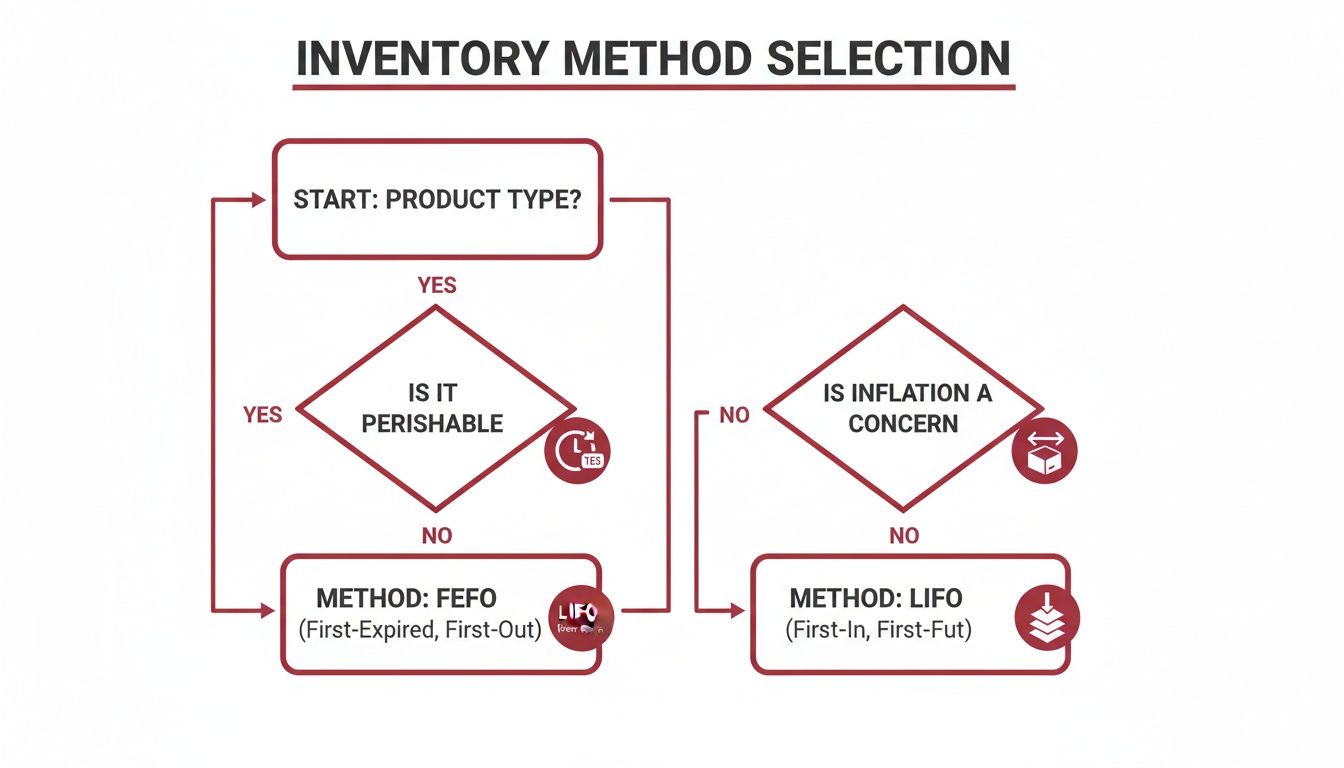
For most general goods, FIFO is the default. But if you’re dealing with anything that can spoil, FEFO becomes a must.
Last In, First Out (LIFO)
Flipping FIFO on its head, the Last In, First Out method assumes the newest items you received are the first ones you sell. This is pretty rare for managing physical inventory because it can leave old stock sitting for ages. Imagine a stack of bricks, you would naturally take from the top, leaving the bottom ones untouched indefinitely.
So why does LIFO even exist? It is almost purely an accounting move, especially when costs are rising (inflation). By selling the newest, most expensive inventory first, your cost of goods sold (COGS) goes up. This lowers your reported profit, which can lead to a smaller tax bill. It is critical to know that LIFO is a financial strategy, and while it’s allowed under U.S. GAAP, it is banned by International Financial Reporting Standards (IFRS).
First Expired, First Out (FEFO)
For anyone in the food, pharmaceutical, or lab reagent business, First Expired, First Out is not just a good idea, it is the only way. This method prioritizes selling items with the earliest expiration date, no matter when they showed up at your receiving dock.
FEFO is your best defense against spoilage and waste. It protects customers and ensures product quality by making sure nothing expired ever makes it out the door. A solid FEFO system requires you to meticulously track expiration dates from the moment inventory arrives and maintain a highly organized storage layout where you can easily see and access lots as they approach their use-by date.
A well-run FEFO strategy is absolutely essential for cutting your losses from expired stock. In regulated industries, it is also a cornerstone of compliance, protecting your customers and your company’s reputation.
Comparing Inventory Control Methods
Choosing the right method requires a clear understanding of your products and business goals. This side-by-side analysis will help you select the best strategy for your business.
| Method | Best Suited For | Key Advantages | Potential Drawbacks |
|---|---|---|---|
| FIFO | General merchandise, electronics, non-perishable goods. | Ensures product rotation, minimizes obsolescence, logical workflow. | Can result in higher reported profits (and taxes) during inflation. |
| LIFO | Non-perishable goods with stable shelf life (e.g., sand, coal). | Provides tax benefits during periods of rising costs. | Can leave old inventory sitting for long periods; not allowed by IFRS. |
| FEFO | Food, beverages, pharmaceuticals, chemicals, anything with an expiry date. | Drastically reduces waste from spoilage, ensures product safety. | Requires strict date tracking and highly organized storage. |
Ultimately, the inventory control method you choose has to match the reality of your operations. If you need help designing a warehouse layout that supports FIFO or FEFO principles, our experts are here to help. We offer free layouts and designs with no obligation. Contact Us to build a system that protects your products and your profits.
Mastering Your Warehouse Layout and Storage
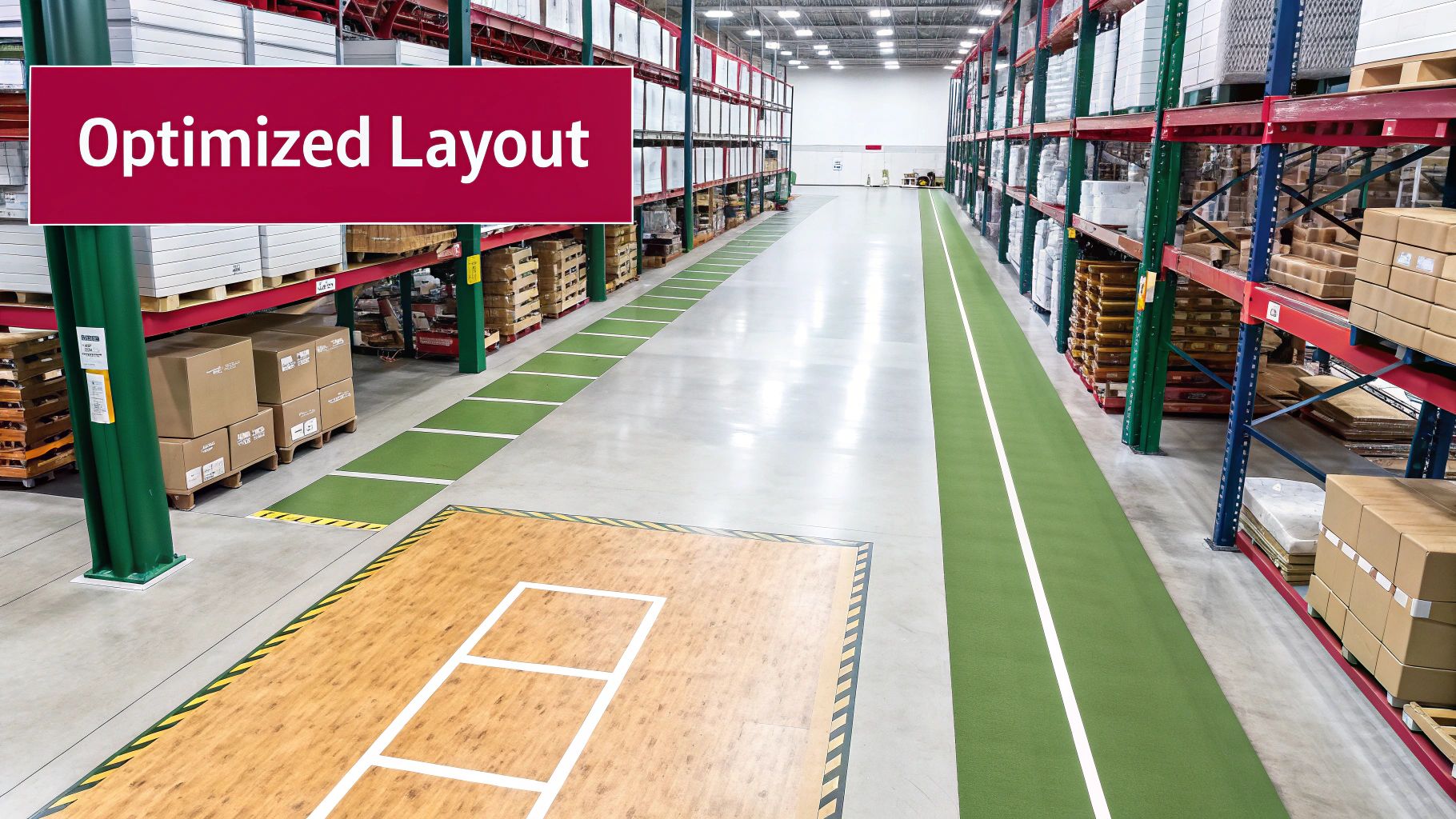
Even the most buttoned-up inventory management practices will fall flat if your physical space is fighting against you. An optimized warehouse layout is not just about being tidy; it is the very foundation of an efficient operation. It directly impacts picking speed, order accuracy, and employee safety.
Think about it: the way you organize your space dictates how effectively you can actually use methods like FIFO or FEFO. This is where theory hits the concrete floor, transforming a chaotic storeroom into a high-functioning hub. It is where you either win big on cost savings or lose money with every wasted step.
Core Principles of Warehouse Design
Great warehouse design boils down to a few core principles. Whether you are running a massive distribution center or a secure evidence room, getting these right is the first step toward unlocking serious efficiency.
- Maximize Vertical Space: Your building’s footprint is fixed, but its height is often your greatest untapped resource. Using tall pallet racking or multi-tier shelving systems can easily double or even triple your storage capacity without the massive expense of new construction.
- Establish Logical Work Zones: Group related activities together. A smart layout creates distinct zones for receiving, putaway, picking, packing, and shipping. This simple move cuts down on unnecessary employee movement and drastically reduces the chance of costly mix-ups.
- Create Clear Pathways: Aisles need to be wide enough for people and equipment to move safely and efficiently. Clear, well-marked pathways prevent bottlenecks, reduce accident risks, and speed up the entire fulfillment process. For facilities looking to max out flow and energy efficiency, it is worth exploring the benefits of high-speed doors for warehouses to separate zones without slowing people down.
Choosing the Right Storage Solutions
The right storage equipment is a game-changer. The goal is simple: match the racking or shelving to the size, weight, and turnover rate of your inventory. A one-size-fits-all approach just does not work here.
Common Storage Types and Their Uses
| Storage Solution | Best For | Key Benefit |
|---|---|---|
| Selective Pallet Racking | Warehouses with a wide variety of SKUs on pallets. | Offers direct access to every pallet, making it highly versatile for FIFO systems. |
| Cantilever Racks | Storing long, bulky items like lumber, pipe, or furniture. | Open-front design provides easy access without vertical obstructions. |
| Mobile Aisle Shelving | Secure storage, labs, or offices with limited space. | Compacts storage by eliminating fixed aisles, maximizing floor space. |
| Metro Wire Shelving | Labs, healthcare, and cleanroom environments. | Promotes air circulation and is easy to clean, supporting sterile conditions. |
Picking the right system prevents product damage and makes inventory access faster and safer for your entire team.
A study by Georgia Tech found that employee travel can account for up to 50% of the total time spent on picking orders in a warehouse. A thoughtfully designed layout directly attacks this inefficiency, slashing travel time and boosting labor productivity.
Partnering with Experts for a Flawless Layout
Designing an efficient warehouse is a complex job with long-term consequences. A small mistake in aisle width or rack placement can create daily frustrations and hidden costs for years to come. This is where professional expertise is not just helpful, it is invaluable.
We specialize in turning your operational needs into a functional, efficient physical space. Our team offers free, no-obligation layouts and designs, giving you a clear visual plan before you commit to anything. We dig into your specific workflow, inventory characteristics, and growth projections to create a plan that works today and scales for tomorrow.
A great layout is not an expense; it is a critical piece of your overall inventory management strategy. To see how we can help you create a smarter, more productive space, check out our comprehensive warehouse design services.
Do not let a poor layout undermine all your hard work. Request a Quote today and let us show you what is possible with a professionally designed plan.
Leveraging Technology for Unbeatable Accuracy
Relying on manual spreadsheets to manage your inventory today is like trying to navigate a busy highway with a paper map. Sure, it might have worked in the past, but it is painfully slow, riddled with errors, and leaves you miles behind the competition. Making the switch to dedicated technology is one of the most critical inventory management best practices you can adopt for survival and growth.
This is not just about getting new gadgets; it is about fundamentally rewiring how your operation runs. Tools like a Warehouse Management System (WMS), barcode scanners, and RFID tags are the engines that drive almost every other best practice we have covered. They deliver the real-time data and automation needed for everything from sharp forecasting to flawless cycle counting.

The Power Trio of Warehouse Technology
Forget the technical jargon for a moment and think about the results. Picture a WMS guiding a worker to the exact bin for a specific item, slashing order fulfillment time in half. That is how modern businesses gain their edge.
- Warehouse Management System (WMS): This is the brain of your entire operation. A solid WMS gives you a real-time, bird’s-eye view of everything happening in your facility. It automates tedious tasks, intelligently directs your team for picking and putaway, and syncs with your other business systems to create a single source of truth.
- Barcode Scanners: These simple devices are the backbone of accuracy. Scanning items as they are received, moved, picked, and shipped completely removes the human error that plagues manual data entry. It is the easiest way to ensure your inventory records are always current and trustworthy.
- RFID (Radio-Frequency Identification): Think of RFID as barcodes on steroids. These tags can be read from a distance and all at once, meaning you can count an entire pallet of goods in seconds without needing a direct line of sight. This technology massively accelerates receiving and cycle counting.
Automation for Next-Level Efficiency
Beyond simple tracking, technology unlocks the door to powerful automation. When you pair these systems with a smart warehouse design, you can completely transform your throughput and accuracy.
Integrating technology is not an expense; it is a critical investment in operational excellence. A WMS can reduce picking errors by up to 99%, which directly translates to happier customers and a much healthier bottom line.
For facilities ready to make a serious leap forward, automated solutions are the answer. We specialize in designing and implementing Automated Storage and Retrieval Systems (ASRS), helping businesses hit unmatched levels of speed and storage density. These systems use robotics to store and retrieve items automatically, running 24/7 with near-perfect accuracy.
Whether you’re starting with basic barcode scanners or planning a fully automated facility, the goal remains the same: use technology to make your processes faster, more accurate, and more efficient.
Reshoring Manufacturing in America
Reshoring often sounds like a simple decision. Move production back to the US, reduce risk, and gain control. In practice, the biggest constraints are rarely at final assembly. They show up deeper in the supply chain, where component suppliers, specialized tooling, and skilled labor determine what is actually feasible.
Reshoring is not a switch you flip. Without the component-level ecosystem, even well-funded reshoring plans can stall on tooling, materials, and the institutional know-how required to run complex operations efficiently.
If you are evaluating domestic production, it helps to start with a clear-eyed audit. Map your dependencies beyond tier-one suppliers, identify which component capabilities exist domestically, and set timelines that account for training, tooling capacity, and supplier development. This article on reshoring manufacturing in America is a helpful breakdown of the real constraints supply chain leaders are navigating.
Rather than treating reshoring as all-or-nothing, many organizations end up with a hybrid approach: reshore what is strategically valuable and operationally realistic while maintaining offshore partnerships where the domestic supply base is still rebuilding.
Your Action Plan for Better Inventory Management
Knowing the theory is one thing, but putting it into practice is where the real work begins. Let’s break down how to actually get this done. We will walk through a clear, phased roadmap that turns overwhelming concepts into manageable, actionable steps.
Think of this as your implementation checklist. Following these phases methodically will transform your inventory operations, slash waste, and build a much more resilient foundation for your business.
Phase 1: Audit Your Current State
Before you can map out where you are going, you need an honest look at where you are right now. This first phase is all about gathering data and setting a baseline. No guesswork allowed.
- Document Existing Workflows: Get it all down on paper (or a whiteboard). Map every single step your inventory takes, from the moment it hits the receiving dock to when it ships out. Who touches it? What tools do they use? This process alone will shine a bright light on bottlenecks and areas ripe for improvement.
- Calculate Baseline KPIs: Dust off those formulas we talked about earlier and calculate your current Inventory Turnover Rate, Inventory Accuracy, and Days Sales of Inventory (DSI). These are not just numbers; they are your starting line. Everything you do from here on out should be about moving these metrics in the right direction.
- Gather Team Feedback: Your frontline crew—the people in the warehouse every day—know the real story. Talk to them. Quick interviews or simple surveys can uncover the biggest pain points you’d never see from an office, like hard-to-find items, clunky software, or illogical putaway routes.
Phase 2: Optimize Your Physical Environment
With a clear picture of your operations, it is time to tackle the physical space. A disorganized environment will sabotage even the most advanced software and processes. You cannot put a high-performance engine in a car with flat tires.
Start by applying the 5S methodology. This is not just about tidying up; it is a lean principle that builds a rock-solid foundation for efficiency.
- Sort: Get rid of everything you do not need. Old inventory, broken tools, unnecessary clutter—if it does not serve a purpose, it is in the way.
- Set in Order: Arrange the essential items logically. Everything should have a designated home, making it easy to find and return.
- Shine: Clean the entire workspace. A clean environment is a safer, more productive, and frankly, a more pleasant place to work.
- Standardize: Create simple, clear rules to maintain the first three S’s. Think visual cues, checklists, and defined procedures.
- Sustain: This is the hard part. Build a culture where these standards become second nature, not a one-time project.
Next, take a hard look at your storage solutions. Are you still using the same racking you had five years ago, even though your product mix has completely changed? Are your fastest-moving products buried in the back corner? This is where our expertise can make a huge impact. We provide free layouts and designs with no obligation, helping you visualize a floor plan that is built for speed and scalability.
Optimizing your warehouse layout is a direct investment in productivity. Simply moving your most popular products closer to the packing stations can slash employee travel time, cutting labor costs and dramatically speeding up order fulfillment.
Ready to see what a smarter layout could do for your space? Request a Quote and we’ll get you a free design consultation.
Phase 3: Implement Technology and Training
Once your physical space is in order, you can bring in technology to automate the mundane and supercharge your accuracy.
- Select the Right Tools: Do not try to boil the ocean. Start with the basics, like barcode scanners, to kill manual data entry errors at the source. As you grow, a full-fledged Warehouse Management System (WMS) can give you real-time command and control over your entire operation.
- Develop Standard Operating Procedures (SOPs): Write it down. Create clear, step-by-step instructions for every key task—receiving, cycle counting, picking, and packing. Good SOPs are the bedrock of consistency, ensuring everyone follows the new, better way of doing things.
- Train Your Team: A tool is only as good as the person using it. Provide hands-on training for any new hardware or software. More importantly, explain the “why” behind it all. When your team understands how these changes make their jobs easier and the company stronger, you will get buy-in instead of resistance.
Making these changes is not an overnight fix. It takes commitment, but the payoff—a more profitable, competitive, and less chaotic operation—is well worth the effort.
Frequently Asked Questions
When you are overhauling your inventory management, a few key questions always pop up. Here are some straightforward answers based on what we see in the field every day.
How often should we be doing cycle counts?
There is no single magic number here—it really comes down to the value and velocity of your items. Your high-value, fast-moving products (the “A” items in an ABC analysis) need the most attention. We often see clients counting these weekly, and in some high-turnover environments, even daily. For your slower-moving “B” and “C” items, you can relax the schedule a bit to monthly or quarterly. The most important thing is consistency. A disciplined, regular cycle counting program is infinitely more effective than a frantic annual physical count.
What is the single biggest mistake in warehouse layout planning?
Hands down, the biggest misstep we see is failing to plan for future growth. It is easy to design a layout that is perfect for your current needs, but that perfection can turn into a cramped, inefficient mess in just a year or two. Always plan your layout with your three-to-five-year growth projections in mind. This is where getting an expert second opinion really pays off. Services like our free layout and design consultations help you build a scalable solution from day one.
Is a Warehouse Management System (WMS) really worth it for a small business?
Absolutely. The idea that a WMS is only for massive operations is a thing of the past. Today’s WMS solutions are more affordable and scalable than ever. For a small business, they deliver an almost immediate return by drastically reducing picking errors, boosting inventory accuracy, and providing real-time data a spreadsheet could never provide. That data leads directly to happier customers and smarter purchasing decisions.
Conclusion: Take Control of Your Inventory Today
Implementing these inventory management best practices is the most direct path to a more efficient, profitable, and scalable operation. From tracking the right KPIs and choosing the correct control method to optimizing your physical layout and leveraging technology, each step builds on the last. By transforming your inventory from a liability into a strategic asset, you gain a powerful competitive advantage.
At Material Handling USA, we don’t just sell equipment; we provide the storage solutions and expert guidance needed to put these best practices into action. We offer quality products, competitive pricing, and the fastest shipping in the industry.
Request a Quote for a free, no-obligation design consultation and see for yourself how a smarter layout can transform your entire operation, or Call (800) 326-4403 to speak with a specialist now.
Who This Is For
Our inventory management best practices solutions are ideal for:
- Warehouse managers
- Facility planners
- Property managers
- Government coordinators
- Manufacturing managers
- Distribution operators