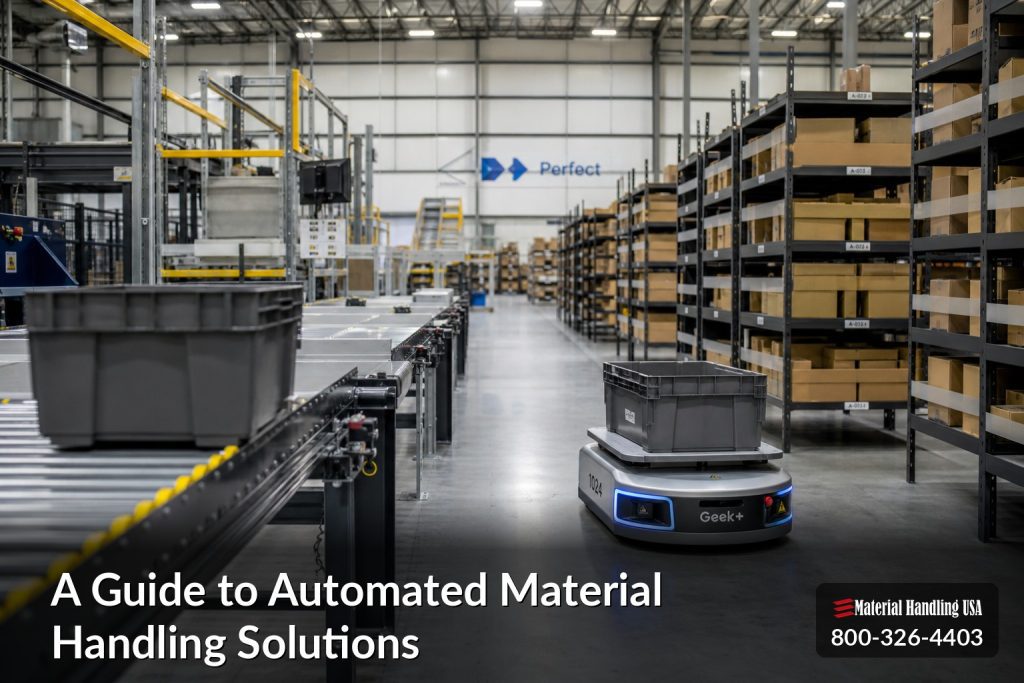
Automated material handling solutions are systems of robotics, software, and intelligent equipment designed to move, store, and manage materials throughout a facility with minimal human intervention. Think of them as the backbone of a modern warehouse, replacing slow manual processes to deliver significant gains in efficiency, accuracy, and safety.
How Automated Solutions Transform Warehouse Operations
If you’ve ever stood on a cluttered warehouse floor, you know the feeling. It’s easy to get overwhelmed by operational bottlenecks, persistent picking errors, and nagging safety concerns. A manual operation can feel like a city street grid during rush hour: full of unpredictable stops, human mistakes, and delays that cost real money. Those inefficiencies hit your bottom line hard, from inflated labor costs to unhappy customers.
Now, picture an automated facility. It runs more like a perfectly synchronized subway system. Automated material handling solutions get goods where they need to go efficiently, reliably, and on a predictable schedule. By weaving together robotics, conveyors, and intelligent software, these systems cut to the core of modern logistics challenges. This isn’t just about adding a few robots; it’s about fundamentally re-engineering your workflow for peak performance.
Driving Tangible Business Outcomes
Ultimately, the only reason to invest in automation is to achieve measurable results. When you make a smart investment in the right technology, you’ll see significant improvements across your entire operation. To get a better handle on the bigger picture, it’s helpful to understand a comprehensive guide to industrial controls automation, as it provides great context for how these intricate systems work behind the scenes.
Here are the key benefits you can expect:
- Increased Throughput: An automated system doesn’t get tired. It can operate 24/7, moving more product through your facility in less time and allowing you to scale up to meet demand without a massive hiring push.
- Enhanced Accuracy: Automation virtually eliminates picking and sorting errors. That means fewer costly returns, less wasted inventory, and happier customers, all of which protect your brand’s reputation.
- Improved Workplace Safety: By taking over repetitive, physically demanding, and often dangerous tasks, automation keeps your team out of harm’s way. This directly translates to fewer workplace injuries and lower associated costs.
- Optimized Space Utilization: High-density systems like AS/RS are masters of vertical space. It’s not uncommon to double or even triple your storage capacity without expanding your building’s footprint. You can learn more about this in our guide to AS/RS for smart warehouse automation.
By focusing on solving your specific operational challenges, you can unlock significant competitive advantages. Automation is a critical tool for future growth and operational excellence, not just a way to replace manual labor.
Adopting automated material handling solutions is about future-proofing your business. It positions you to handle market demands with greater speed, precision, and resilience.
A Look Inside the Automation Toolbox
To choose the right solution for your facility, you first need to understand the tools available. Let’s explore the key components of automated material handling solutions and what they do. Think of it like a mechanic’s shop: every tool has a specific job, and success comes from knowing which one to use for the task at hand.
We’ll walk through the main systems that form the backbone of any modern automated facility. From ultra-dense storage units to smart mobile robots, each technology brings unique capabilities. The goal is to match the right technology to your biggest challenge, whether that’s a space crunch or the need to accelerate order picking.
Automated Storage and Retrieval Systems (AS/RS)
Imagine reclaiming up to 90% of the floor space your static shelving currently occupies. That’s the power of an Automated Storage and Retrieval System (AS/RS). These systems leverage vertical height to densify your inventory storage, making them a game-changer for facilities where every square foot counts.
An AS/RS consists of tall racks paired with robotic cranes or shuttles that travel between them. These machines autonomously store and retrieve totes, boxes, or pallets with incredible speed and accuracy. It’s the perfect technology for buffering inventory, sequencing parts for a manufacturing line, or handling high-volume order fulfillment. If your facility is bursting at the seams, an AS/RS might be the answer that prevents a costly expansion project.
Conveyor and Sortation Systems
If AS/RS is the library where items are stored, then conveyors and sortation systems are the superhighways that connect everything. These systems are the workhorses of material transport, moving thousands of items per hour along fixed paths. They are the essential link between different operational areas, from the receiving dock to packing and shipping.
Modern conveyors are much more than simple belts. They’re equipped with intelligent sortation technology, like pop-up wheels or cross-belt sorters, that automatically direct packages to their precise destinations. This makes them indispensable for e-commerce hubs that need to sort a massive number of individual orders quickly and accurately. To get the most out of this tech, it’s vital to improve operational efficiency across your entire workflow.
Autonomous Mobile Robots (AMRs) and AGVs
While conveyors follow a fixed path, Autonomous Mobile Robots (AMRs) and Automated Guided Vehicles (AGVs) bring flexibility to the floor. Think of them as intelligent couriers that navigate your facility independently. AGVs typically follow a set path, like magnetic tape on the floor, while AMRs use advanced sensors and AI to navigate dynamically, even sidestepping unexpected obstacles.
These robots are perfect for shuttling pallets, carts, and bins from one workstation to another, eliminating the need for manual transport with a forklift or pallet jack. This not only boosts efficiency but also significantly enhances workplace safety.
The best part about AMRs and AGVs is their scalability. You can start with just a few robots and add more as your business grows, making them a smart, flexible investment.
Robotic Picking Systems
The final major piece of the automation puzzle is robotic picking. These systems use advanced vision cameras and robotic arms to handle the repetitive task of picking individual items from bins and placing them into order containers. This technology excels in “goods-to-person” setups, where an AS/RS or AMR brings inventory directly to a picking station.
By automating this tedious job, you can achieve picking speeds and accuracy levels that are difficult for humans to sustain. It also reduces your reliance on labor for less desirable tasks and keeps your fulfillment engine running 24/7.
Comparing Key Automation Technologies
To help you see how these different systems fit into the bigger picture, here’s a quick breakdown of what each one does best.
| Technology | Primary Function | Best For | Key Benefit |
|---|---|---|---|
| AS/RS | High-density automated storage and buffering of goods. | Maximizing vertical storage space; high-volume inventory. | Massive space savings; fast retrieval. |
| Conveyor & Sortation | Transporting and sorting large volumes of items along fixed paths. | E-commerce fulfillment; distribution centers with consistent flow. | High throughput; reliable and continuous operation. |
| AGVs / AMRs | Flexible movement of pallets, bins, or carts without fixed infrastructure. | Dynamic environments; moving goods between workstations. | Scalability and flexibility; improved safety over forklifts. |
| Robotic Picking | Automating the picking and placing of individual items into orders. | Piece-picking operations; high-accuracy order fulfillment. | Increased pick rates and accuracy; reduced labor dependency. |
Each of these technologies solves a different part of the material handling challenge. The most powerful automated material handling solutions often blend several of these systems to create a smooth, uninterrupted flow of goods from arrival to shipment.
Calculating the Real ROI of Warehouse Automation
Forget the impressive tech for a moment. What does automation actually do for your bottom line? It’s one thing to talk about features, but what really matters to managers and buyers are tangible business results. We need to cut through the jargon and focus on the direct financial impact of putting automated material handling solutions to work in your facility.
Think of a well-designed automation system not as an expense, but as a strategic financial move that pays for itself over time. The real key is understanding how every efficiency gain, from faster picking to fewer accidents, translates into measurable dollars and cents.
Supercharge Your Fulfillment Speed
In today’s market, speed is the name of the game. Customers expect their orders faster than ever, and even small delays can cost you sales and loyalty. Manual processes, limited by human speed and stamina, are almost always the biggest bottleneck holding you back.
Automated systems like conveyors and robotic picking cells don’t get tired. They operate at a consistent, high velocity around the clock. This leap in fulfillment speed means you can process significantly more orders without adding staff. Faster turnarounds lead directly to happier customers and give you a serious competitive edge.
Drive Accuracy to Near Perfection
Picking errors are silent profit killers. Every wrong item pulled triggers a domino effect of costs: return shipping, the labor to receive and restock the item, and sometimes the complete loss of the product. Even worse, it chips away at the trust you’ve built with your customer.
This is where automation shines. Automated systems can achieve near-perfect accuracy, often topping 99.9%. By using things like barcode scanners, vision systems, and precise robotics, these solutions practically eliminate human error from picking and sorting. When you slash the costs tied to mis-picks, returns, and customer service headaches, you see an immediate and direct boost to your profitability.
Key Drivers of Automation ROI
When you’re building the business case for automation, these are the four pillars to focus on:
- Labor Cost Reduction: Free up your team from repetitive tasks to handle more valuable work. This helps you control payroll costs, even as your business grows.
- Error Reduction Savings: Add up the total cost of a single picking error—returns, restocking, lost product, customer service time. That’s how much you save with every error automation prevents.
- Throughput Revenue Gain: Figure out the value of processing more orders every single day without having to increase your operational costs.
- Space Optimization Savings: Put a number on the value of the floor space you get back. Or, even better, calculate the cost of a facility expansion you can now avoid entirely.
Enhance Worker Safety and Cut Related Costs
Workplace injuries are a massive liability. They lead to workers’ compensation claims, lost productivity, and the risk of fines from regulators. Many warehouse jobs involve the exact kind of strenuous, repetitive motions or heavy lifting that cause the most common injuries. The Occupational Safety and Health Administration (OSHA) points to ergonomic hazards as a primary concern in material handling for a reason.
Automation takes your people out of harm’s way. Robots can handle the back-breaking lifting, and conveyor systems eliminate the need for workers to push heavy carts across a massive facility. This doesn’t just create a safer place to work; it directly reduces injury-related costs and boosts employee morale.
Maximize Your Existing Footprint
Real estate is one of your biggest operational expenses. Before you even think about signing a lease on a new building or starting a costly expansion, look up. Automated material handling solutions like a high-density AS/RS can fundamentally change your storage capacity within the building you already have.
By making smart use of vertical space, you can store far more inventory in the exact same square footage. This kind of optimization can delay, or even completely eliminate, the need for an expensive move or new construction project. Our team offers free layouts and designs with no obligation to show you exactly how much space you can reclaim. Request a Quote today to see what a new plan could look like for your facility.
How Automation Solves Real-World Problems in Different Industries
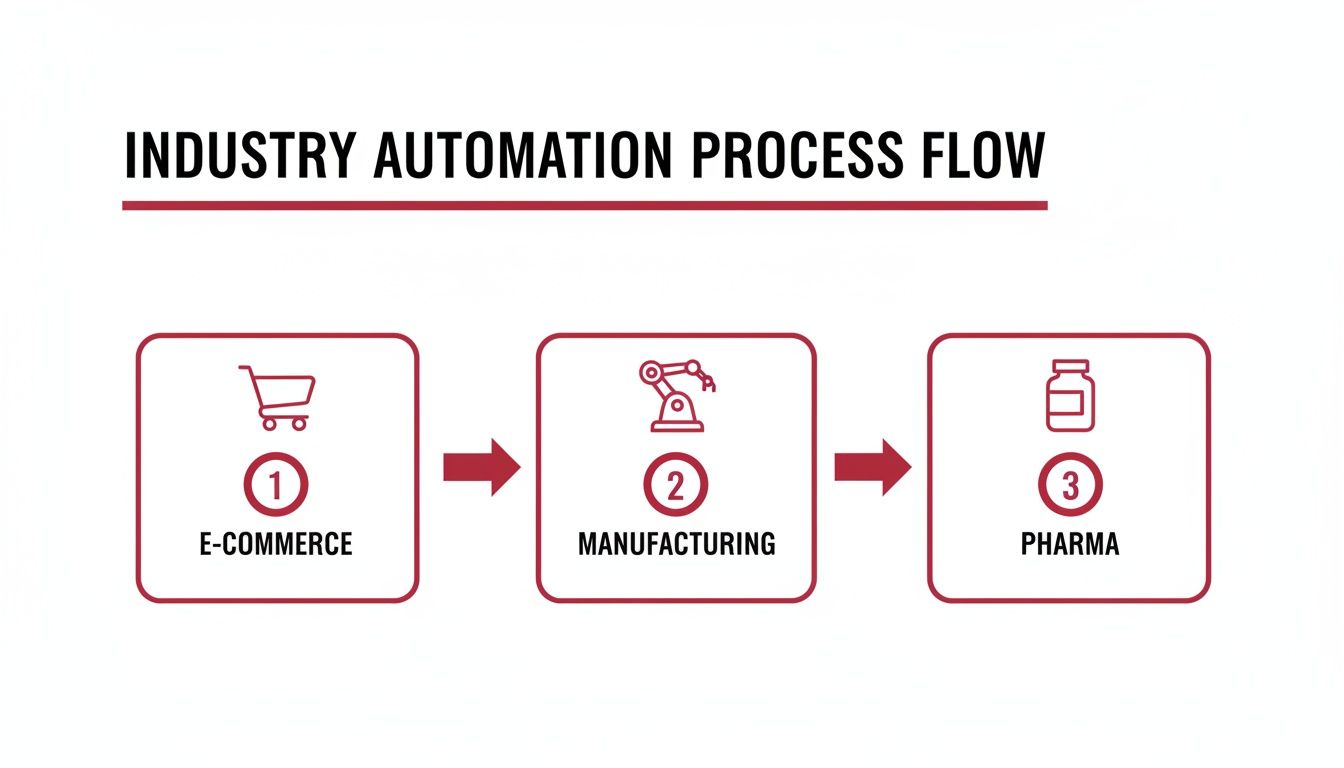
Automation isn’t a one-size-fits-all product; it’s a toolkit full of solutions designed to tackle very specific, often frustrating, industry challenges. The real magic happens when automated material handling solutions are applied to unique operational pain points, whether in a chaotic, high-speed distribution center or a meticulously controlled manufacturing plant.
By looking at how these systems work in the real world, you can start to see how this technology could solve problems that might look a lot like your own. Each industry, from e-commerce with its razor-thin margins to pharmaceuticals with its ironclad regulations, has its own pressures. The trick is to match the right automation to the right workflow, turning a nagging headache into a powerful competitive advantage.
E-commerce and Distribution Centers
In the world of e-commerce and distribution, it all comes down to speed and accuracy. The daily battle involves managing a relentless flood of individual orders, each with different items, that have to be picked, packed, and shipped out the door on an impossibly tight schedule. This is where high-speed sortation systems become the heart of the operation.
Think of it: thousands of packages are zipping down a line, each one scanned and instantly diverted to the correct shipping lane without a human ever touching it. This is all made possible by sophisticated warehouse conveyor solutions, which act as the arteries of a modern fulfillment center. When you pair them with an AS/RS that automatically feeds products to picking stations, these facilities can hit throughput levels that are simply out of reach for manual operations.
Manufacturing and Assembly Lines
For manufacturers, the name of the game is uninterrupted production. Any little hiccup that stops parts from reaching the assembly line can bring the entire operation to a screeching halt, costing thousands of dollars every single minute. The core challenge is getting the right components to the right station at the exact right time, a concept known as “just-in-time” delivery.
This is a job tailor-made for AGVs and AMRs. These smart, mobile robots are like tireless couriers, zipping around the facility to transport bins of parts from the warehouse directly to the workstations that need them. This completely cuts out the need for someone to push a cart across the factory floor, slashes the risk of production delays, and lets skilled workers stay focused on assembly. The result is a much leaner, more predictable, and more efficient production cycle.
Specialized and Regulated Applications
Automation also plays an indispensable role in highly regulated fields like pharmaceuticals and food and beverage. In these industries, protecting product integrity and maintaining a perfect chain of custody isn’t just a good idea; it’s the law. The challenge is moving sensitive materials with absolute precision while meticulously tracking every single step.
This is where automated systems provide a level of control and traceability that manual processes can’t touch. An AS/RS can store temperature-sensitive medicines in a perfectly controlled environment, while robotic arms handle sterile items without any risk of human contamination. Every movement is logged by the Warehouse Control System (WCS), creating a flawless digital audit trail for compliance and quality control. This precision minimizes the risk of spoilage or loss, protecting both public safety and the company’s bottom line.
From processing millions of online orders to guaranteeing the safety of medical supplies, automated material handling solutions are proving their worth across the board. By targeting a specific operational pain point with the right system, businesses are building stronger, more resilient, and more profitable operations. Contact Us for a free consultation to see how automation can be fitted to your industry’s unique demands.
Building Your Automation Implementation Roadmap
Making the jump to automation can feel like a massive undertaking, but breaking it down with a clear plan makes all the difference. Think of this as your practical roadmap, guiding you from the first spark of an idea all the way to a successful rollout of your automated material handling solutions. A smart, structured approach is the best way to make sure you address every critical step in the right order, maximizing your return and keeping disruptions to a minimum.
The whole process kicks off not with buying shiny new equipment, but with a hard, honest look at your current operations. If you don’t have a crystal-clear picture of what’s actually broken, you can’t possibly fix it. This foundational analysis sets the stage for every decision that follows, ensuring your investment is aimed precisely where it will deliver the biggest punch.
Start with a Thorough Operational Assessment
The absolute first step is a deep-dive assessment of how things are running right now. The goal is to pinpoint the true bottlenecks, not just the symptoms you see on the surface. Where are the real slowdowns? What specific tasks are causing the most errors? Where are the safety risks hiding? Answering these questions means gathering and digging into your operational data.
This is exactly where our free, no-obligation design and layout services come in. Our experts can help you visualize your entire workflow and identify the key pressure points where automation will deliver the greatest impact. Getting this collaborative first step right is essential for building a successful project from the ground up.
Plan for Seamless Systems Integration
Your new automation hardware can’t just operate in a silo. It has to talk seamlessly with the software you already use, like your Warehouse Management System (WMS) or Enterprise Resource Planning (ERP) platform. This integration is what turns a collection of machines into a truly connected, intelligent facility where data flows freely to direct the movement of goods.
A lack of planning for software integration is one of the most common reasons automation projects stumble. Before you fall in love with any specific technology, you have to confirm it can interface with your current systems. This ensures your automated equipment gets the right instructions and provides accurate feedback, creating a single source of truth for your entire operation.
Build the Financial Case and Plan for Costs
Once you have a clear handle on your needs and potential solutions, it’s time to build the financial justification. This goes way beyond the initial price tag. You need to calculate the Total Cost of Ownership (TCO), which includes everything from installation and software integration to employee training and ongoing maintenance.
On the other side of the ledger, you’ll weigh the projected Return on Investment (ROI). Put real numbers to the expected savings from reduced labor costs, fewer expensive errors, and increased throughput. This business case is the crucial document you’ll need to get budget approval and get all your key stakeholders on board. To help with this, our team provides free quotes to give you concrete numbers for this critical planning phase.
Logistics, Training, and Long-Term Success
Finally, you need to tackle the practical logistics of the rollout. This includes creating a detailed installation timeline designed to cause as little disruption as possible to your day-to-day operations. Just as important is developing a solid training program for your employees. Your team needs to feel confident and understand how to work alongside the new systems safely and effectively.
Long-term success also hinges on having a solid maintenance plan. Like any sophisticated equipment, automated material handling solutions need regular upkeep to perform at their peak. Planning for preventive maintenance from day one will ensure your investment continues to deliver value for years and years to come.
Automation Project Planning Checklist
- Assess current workflow bottlenecks and collect hard operational data.
- Define clear project goals (e.g., increase throughput by 25%, reduce pick errors by 90%).
- Consult with experts for a professional facility layout and system design.
- Evaluate different technology options (AS/RS, conveyors, AMRs).
- Analyze software integration requirements with your current WMS/ERP.
- Calculate projected ROI and total cost of ownership to build the business case.
- Develop a phased implementation and training plan for your team.
- Ensure compliance with all safety regulations and industry standards.
- Plan for long-term maintenance and support to protect your investment.
By following this roadmap, you can approach your automation project with confidence. The journey begins with a conversation. Call (800) 326-4403 to discuss your operational challenges and get started with a free, no-obligation layout and quote.
Your Automation Questions, Answered
Let’s tackle some of the most common questions managers have when they start exploring automated material handling. Our goal is to provide clear, straightforward answers to help you determine the best path forward for your business.
How Much Do Automated Material Handling Solutions Cost?
The honest answer is: it varies significantly. The final cost depends on the specific technology, the scale of your operation, and the complexity of the project. A simple conveyor system might be a modest investment, while a full-scale AS/RS installation represents a major capital expense.
The best way to approach it is by focusing on the Return on Investment (ROI), not just the initial price. That’s why we provide free, no-obligation quotes. This gives you a clear picture of the actual costs and, more importantly, the potential financial returns for your specific facility, allowing you to build a solid business case based on real numbers.
Can Automation Be Integrated With My Current Warehouse Software?
Absolutely. Modern automated systems are designed for integration. The vast majority of solutions can connect with existing Warehouse Management Systems (WMS) and Enterprise Resource Planning (ERP) software, ensuring that data flows seamlessly where it needs to.
During our free consultation, our team will review your current software stack. We address this early to ensure a smooth integration plan is part of the project from day one, helping you avoid common technical headaches down the road.
How Long Does It Take To Implement An Automation Project?
Timelines depend heavily on the project’s scope. Simpler implementations, like adding a few AMRs or a straightforward conveyor line, can be up and running relatively quickly, often in a matter of weeks.
Larger, more complex systems like an AS/RS require more thorough planning, installation, and testing, which can take several months. At Material Handling USA, we are known for having the fastest shipping and delivery in the industry. As part of our free layout and design proposal, we provide a detailed project timeline so you have clear expectations for every stage of the process.
Partner with the Experts for Your Automation Journey
Taking the leap into automation is a strategic decision to build a smarter, faster, and more resilient operation. The journey starts not with a purchase order, but with a solid plan developed with an experienced partner. By focusing on your specific operational bottlenecks, you can unlock a significant competitive advantage.
At Material Handling USA, we combine competitive pricing and quality materials with some of the industry’s fastest shipping to get you results, fast. We believe a successful project begins when your data defines the layout, a core principle detailed in our guide to WMS-integrated warehouse design.
The best way to see the potential is with our free, no-obligation layout and design service. We’ll show you exactly how automation can transform your space and your bottom line.
Ready to build a more efficient future?
Contact Us or call our specialists at (800) 326-4403 to schedule your free consultation today.
Who This Is For
Our automated material handling solutions solutions are ideal for:
- Warehouse managers
- Facility planners
- Property managers
- Government coordinators
- Manufacturing managers
- Distribution operators
Frequently Asked Questions
Does Material Handling USA offer free quotes?
Yes. Material Handling USA provides free, no-obligation quotes for all warehouse storage and material handling projects. Contact us online or call 801-328-8788.
Do you handle delivery and installation?
Yes. Material Handling USA provides professional delivery and installation for pallet rack, shelving, mezzanines, security cages, and all warehouse equipment. Our team manages the project from layout to final walkthrough.
Related Solutions
Need Help Choosing the Right Solution?
Material Handling USA provides free warehouse design consultations, competitive pricing, and expert project management from layout to installation.
Get a Free Quote or call 801-328-8788
Get a Free Quote on Automated Material Handling Solutions
Our team will design a solution for your space and budget. Most quotes returned same day.