Imagine having a powerful lifting partner you can move anywhere in your facility, one that doesn’t require tearing into your building’s structure. That’s the simple, powerful idea behind an electric gantry crane. It’s a strategic piece of equipment for boosting efficiency in warehouses, manufacturing plants, and workshops, blending serious lifting power with go-anywhere flexibility.
Your Guide to Electric Gantry Crane Solutions
Think of an electric gantry crane as a portable powerhouse. Unlike an overhead bridge crane that’s permanently bolted into your building’s support columns, a gantry crane stands on its own two legs, often on heavy-duty casters. This self-supporting design is its superpower, allowing it to roll freely across the floor, bringing heavy-lift capabilities to any workstation or loading bay on demand.
This mobility is what really sets it apart. A forklift is great for zipping pallets around horizontally, but it struggles with vertical height and precise placement. An electric gantry crane, on the other hand, is built for exactly that—expertly lifting and placing heavy, bulky, or odd-shaped items like engines, dies, and massive components with pinpoint accuracy.
This kind of adaptability is essential in modern operations. It’s no surprise the global gantry crane market, valued around $1,823.93 million in 2025, is expected to climb to $2,808.57 million by 2032. That’s a strong compound annual growth rate of 6.4%, driven by the same pressures you’re likely facing: the need for more efficient workflows everywhere from manufacturing floors to e-commerce hubs. You can explore the market projections and trends in more detail on metastatinsight.com.
Why an Electric Gantry Crane is a Smart Investment
Choosing the right material handling equipment has a direct impact on your bottom line. An electric gantry crane brings some key advantages to the table that deliver real, measurable returns. For a broader look at lifting solutions, you can also check out our guide on the different types of cranes and their uses.
Here are the main benefits you can expect:
- Increased Productivity: When you can put lifting power exactly where the work is happening, you eliminate delays. No more waiting for a shared overhead crane or tying up a forklift. This directly cuts downtime and keeps production or maintenance cycles moving.
- Enhanced Worker Safety: Manually lifting heavy loads is one of the biggest causes of workplace injuries. A gantry crane takes that physical strain off your team, creating a much safer environment and reducing the risk of accidents and workers’ comp claims.
- Maximized Floor Space: Because they aren’t permanent installations, these cranes don’t lock up your floor plan. You get to keep your space open and flexible, ready to be reconfigured as your operational needs evolve.
- Cost-Effective Solution: The installation cost is worlds away from what it takes to put in an overhead bridge crane, which often requires major structural work. An electric gantry is a much more budget-friendly path to acquiring serious lifting capacity.
Once you grasp these core benefits, it’s easier to see how this one piece of equipment can solve a host of challenges inside your facility.
Choosing the Right Electric Gantry Crane Type
Let’s be clear: not all electric gantry cranes are created equal. Picking the right one for your facility is the most important first step, and it all comes down to your real-world needs. The layout of your workspace, the kind of materials you’re lifting, and the daily rhythm of your operations will point you to the perfect fit.
Get this decision right, and the crane becomes a seamless part of your production. Get it wrong, and you’re stuck with an expensive bottleneck. The decision tree below is a great starting point, helping you visualize where a gantry crane fits into the bigger picture of lifting solutions.
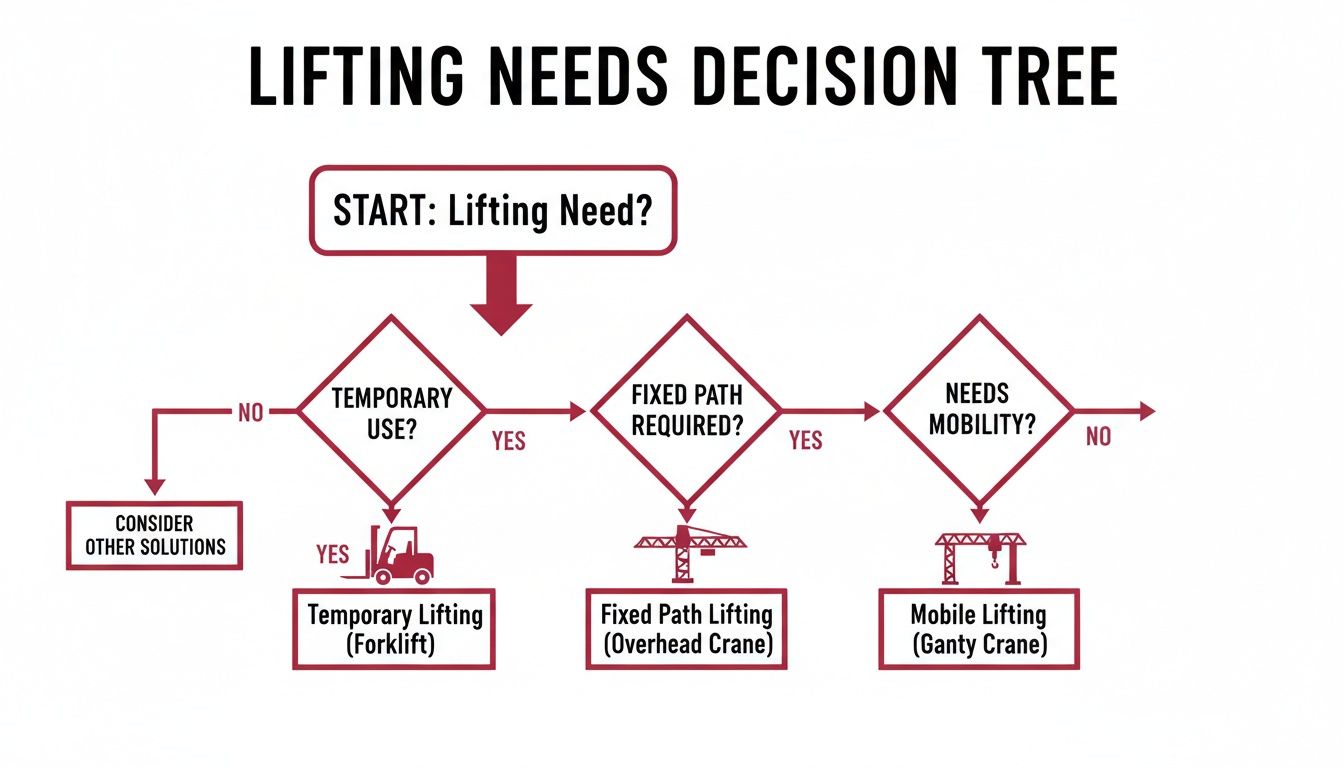
As you can see, when your job demands a powerful lift combined with the freedom to move anywhere without being locked into a fixed path, an electric gantry crane is almost always the answer. Let’s dig into the main types.
Portable And Adjustable Gantry Cranes
Think of these as the versatile, jack-of-all-trades workhorses. Usually built from lightweight steel or aluminum, they’re designed to be rolled around the facility by just one or two people. Their biggest selling point is pure adaptability; you can adjust the height and span on the fly to squeeze into tight corners or clear overhead pipes and ducts.
These cranes are a perfect match for places like:
- Maintenance Shops: Easily hoist engines, transmissions, or heavy machine parts for repairs.
- Small Workshops: Move heavy dies, molds, or raw materials from one station to the next without a permanent overhead crane.
- HVAC and Mechanical Work: Perfect for positioning hefty units on rooftops or inside buildings during an install.
The real beauty of a portable gantry is that it isn’t chained to one spot. It brings the lifting power to wherever the work is, preventing those classic slowdowns where multiple teams are stuck waiting for their turn on a single, fixed crane.
Rail Mounted Gantry Cranes
Now, if your workflow is all about repetition—moving the same heavy things along the same path, day in and day out—then a rail mounted gantry crane is your champion. These are serious, heavy-duty systems that glide on rails installed directly on the ground. This setup gives them incredible stability and the muscle to handle massive loads, often pushing well over 100 tons.
Their movement is predictable and precise, which is exactly what you need in a high-volume environment. You’ll see them loading and unloading shipping containers at ports, shifting giant steel coils in manufacturing plants, or handling precast concrete slabs at construction sites. The fixed path guarantees a smooth, reliable flow of materials, shift after shift.
Rubber Tired Gantry Cranes
For maximum freedom in big, open spaces, nothing comes close to a rubber tired gantry crane (RTG). These are the giants of the gantry world, moving on massive, heavy-duty rubber tires instead of rails. This frees them to travel and stack materials with incredible flexibility across huge areas like container terminals or sprawling industrial storage yards.
While their mobility is unmatched, they are specialized machines that require a lot of open space and highly skilled operators to run. RTGs are the go-to solution when you need to reposition immense lifting capacity over a vast area without committing to the infrastructure of laying down miles of track.
Comparing Electric Gantry Crane Configurations
| Crane Type | Mobility | Typical Capacity | Best For | Considerations |
|---|---|---|---|---|
| Portable/Adjustable | High (Manual/Motorized) | 1-10 tons | Maintenance, workshops, varied tasks in multiple locations. | Lower capacity, requires manual positioning. |
| Rail Mounted | Fixed Path (Motorized) | 20-100+ tons | Repetitive, high-volume tasks along a predictable route. | Requires permanent rail installation, less flexible. |
| Rubber Tired (RTG) | High (Motorized) | 40-100+ tons | Large yards, container terminals, maximum flexibility. | Requires large open space and skilled operators. |
Ultimately, the goal is to match the crane to the job. Whether you need the quick-change artistry of a portable unit or the brute strength of a rail-mounted system, the right choice will pay dividends in efficiency and safety for years. To see how these fit into a broader strategy, feel free to explore our full range of lifting and material transport equipment.
Understanding Key Crane Specifications
Trying to make sense of a technical spec sheet for an electric gantry crane can feel like reading a foreign language. To make the right call for your facility, you have to know what all those numbers actually mean for your day-to-day work. Let’s break down the most important metrics into plain English, so you can buy with confidence.
Don’t just think of these specifications as numbers on a page; see them as the blueprint for your lifting solution. Getting them right from the start ensures the crane fits your building, handles your materials safely, and actually helps—not hinders—your team’s workflow. Let’s decode the key specs you’ll come across.

Core Dimensional and Capacity Metrics
First up are the foundational specs—the ones that define the crane’s physical footprint and its raw power. These three metrics are non-negotiable and have to line up perfectly with your workspace and what you need to lift.
- Load Capacity: This is the absolute maximum weight the crane is certified to lift safely. It’s critical to figure out the weight of your heaviest typical load and then build in a safety margin of about 20% to 25%. This buffer isn’t just for safety; it accounts for dynamic forces during the lift and ensures you aren’t constantly redlining your equipment.
- Span: This is simply the horizontal distance between the crane’s two legs. The span defines the side-to-side working area for your hoist and trolley, so it has to be wide enough to clear the largest items you plan to lift and move.
- Height Under Beam (HUB): This measurement is the vertical clearance from the floor to the underside of the main lifting beam. Your HUB dictates the maximum lifting height, so it needs to be tall enough to clear your equipment and materials while still fitting under any overhead obstacles like pipes, ductwork, or low-hanging roof trusses.
Expert Tip: Measuring your facility is just the first step. You also have to think about workflow. Our team offers free layouts and designs to help you visualize how a crane’s span and HUB will integrate into your actual operational space, guaranteeing a perfect fit with no obligation. Request a Quote to get started.
Understanding Hoist Performance
The hoist is the heart of your gantry crane; it’s the component doing all the heavy lifting. Its specs tell you exactly how it will perform under load and whether it can handle the intensity of your operation.
Hoist Type: Chain vs. Wire Rope
Your choice between a chain hoist and a wire rope hoist really comes down to the application.
| Hoist Type | Best For | Key Advantages |
|---|---|---|
| Chain Hoist | Lower capacities, maintenance tasks, workshops | More durable, cost-effective, handles true vertical lifts without drift. |
| Wire Rope Hoist | Higher capacities, faster speeds, high-frequency lifts | Smoother and faster operation, better for longer lift heights. |
Performance and Durability Metrics
Beyond the type of hoist, you need to look at its performance ratings. This is where you match the machine to the mission.
- Lift Speed: Measured in feet per minute (FPM), this spec tells you how quickly the hoist can raise or lower a load. In high-volume settings, faster speeds improve cycle times. But for delicate or precision work, slower speeds offer much better control.
- Duty Cycle Classification: This is one of the most important—and most overlooked—specs. It classifies how frequently and intensely a crane can be used. A crane built for occasional maintenance (Class A or B) will burn out fast if you stick it in a continuous production line that really needs a Class D or E rating. Matching the duty cycle to your operational tempo is essential for a long service life.
Making sense of these specifications is the key to choosing a gantry crane that doesn’t just lift heavy things, but one that actively improves your facility’s productivity and safety. Planning for these details early prevents costly delays down the road. Because our quality materials are in high demand, securing your design consultation sooner ensures a smoother path to installation. Contact Us or call (800) 326-4403 to discuss your project with an expert.
Navigating Safety and OSHA Compliance
A productive facility is a safe facility. Period. When you bring an electric gantry crane into your operation, you’re not just adding a piece of heavy machinery; you’re integrating a system designed from the ground up to protect your people. The best modern cranes are packed with safety mechanisms that work in concert to prevent accidents before they happen, keeping your workflow smooth and predictable.
Getting a handle on these features is the first step toward building a rock-solid safety culture and staying compliant. It’s a combination of smart engineering and smart practices that keeps everyone safe and your business running without a hitch.
Essential Built-In Safety Mechanisms
High-quality electric gantry cranes aren’t just strong; they’re smart. They come equipped with several non-negotiable safety features. Think of these less as “add-ons” and more as fundamental components essential for a safe work environment and for meeting regulatory standards.
Here are the key systems you need to look for:
- Overload Protection: This is your crane’s built-in bodyguard. The system automatically stops the hoist from even attempting to lift a load that’s over its rated capacity. It’s a critical defense against structural failure and dropped loads.
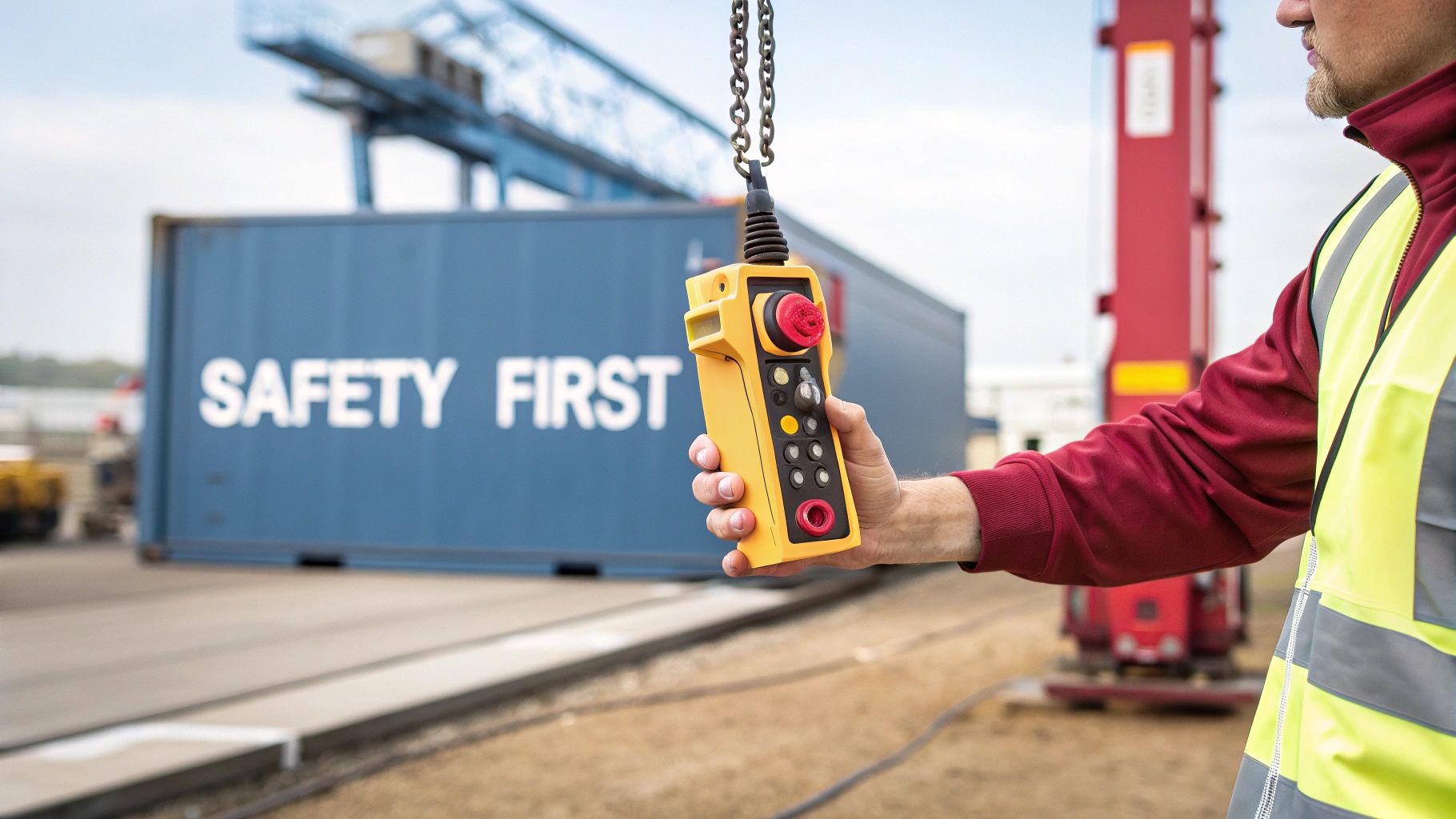
- Emergency Stop Buttons: You can’t miss them. These large, red buttons are placed in easy-to-reach spots, allowing anyone on the floor to kill all power to the crane instantly. That ability to react in a split second can be the difference between a close call and a catastrophe.
- Travel Limit Switches: These switches act as invisible guardrails. They automatically halt the crane’s trolley or bridge before it can travel past a pre-set safe point on the beam. This prevents collisions with end stops or other machinery, protecting the crane, the load, and your facility.
Connecting Features to OSHA Regulations
These engineered controls aren’t just good ideas; they’re central to meeting OSHA 1910.179, the federal standard that dictates how overhead and gantry cranes must operate. Compliance isn’t just about dodging fines. It’s about having a documented, systematic approach to safety that protects your most valuable asset: your team.
Today’s gantry cranes are run by complex embedded systems. A solid understanding of the security in embedded systems is vital to head off operational risks and ensure your safety protocols are never compromised.
A core principle of OSHA is that safety must be engineered into the equipment and the process, not just hoped for. Investing in a crane with certified, modern safety features gives you peace of mind and a strong foundation for your entire safety program.
There’s a reason more advanced cranes are being adopted across North America. Features like collision avoidance and geofencing are becoming standard because they work, dramatically cutting incident rates by aligning with stricter OSHA interpretations. This is especially true for specialized work, like managing evidence storage for law enforcement or handling sensitive lab materials.
The Human Element: Operator Training and Inspections
Of course, even the most advanced crane is only as safe as the person at the controls. OSHA is crystal clear on this: only trained and authorized personnel are allowed to operate a gantry crane. Proper certification ensures operators know the machine’s limits, use correct lifting techniques, and are prepared to handle any emergency.
The other side of this coin is routine inspection. A simple pre-shift visual check by the operator can spot a small issue before it becomes a major hazard. This daily habit needs to be backed up by periodic, in-depth inspections from a qualified technician to guarantee the crane’s long-term reliability.
Maximizing Your Long-Term ROI
An electric gantry crane isn’t just another piece of equipment; it’s a serious investment in your facility’s future. While the initial price tag is always a factor, the real story unfolds when you look at the total cost of ownership and the return you’ll get over the crane’s entire working life. A smart decision isn’t just about what it costs today, but about what it earns you tomorrow.
Thinking beyond the sticker price means considering how this machine will perform for you year after year. We’re talking about maintenance, operational efficiency, and the direct impact on your bottom line. Looked at this way, the crane stops being an expense and becomes a strategic asset that can pay for itself many times over.
Calculating the Total Cost of Ownership
To really get a handle on the crane’s value, you need to calculate its Total Cost of Ownership (TCO). This isn’t just the upfront price; it’s the full picture, combining the initial purchase with all the ongoing expenses.
Key pieces of the TCO puzzle include:
- Initial Purchase Price: The base cost for the crane, hoist, and any special attachments you need.
- Installation and Commissioning: The cost to get the system set up, tested, and ready for work.
- Operational Costs: This is mostly electricity. Thankfully, modern electric models are incredibly efficient, so this number stays low.
- Maintenance and Repair Costs: The budget for routine inspections, preventive care, and any fixes needed down the road.
- Operator Training: The investment in getting your team certified to run the equipment safely and effectively.
This holistic view is crucial for comparing your options. A crane that looks cheaper at first might rack up higher maintenance bills or burn more energy, making it the more expensive choice in the long run.
Building a Business Case with ROI
The return on investment is where the crane truly proves its worth. ROI is all about measuring the financial gains the crane brings to your business, weighed against its total cost. The benefits are both direct and indirect, and together they build a powerful case for the investment.
Direct Financial Gains:
- Reduced Labor Costs: A gantry crane lets a single operator safely move loads that would otherwise tie up a whole team, freeing up your people for more valuable tasks.
- Increased Throughput: By making material handling faster, the crane cuts down cycle times. That means you can process more work in the same amount of time, which directly boosts your output.
Indirect Financial Gains:
- Improved Workplace Safety: Taking manual lifting out of the equation dramatically cuts the risk of expensive workplace injuries and the claims that come with them.
- Fewer Product Damages: Smooth, controlled lifting means you’re far less likely to drop or damage valuable materials or finished products.
When you add it all up, the financial argument is compelling. Many of our clients find their electric gantry crane pays for itself much faster than they ever expected, turning an operational cost into a driver of real efficiency and profit.
The Impact of Modern Technology on ROI
Today’s technology is making electric gantry cranes an even smarter investment. Innovations like the NZE Transtainer, which runs on lithium-ion batteries and gensets for almost zero emissions, are actively slashing operational costs. This shift toward energy efficiency is perfectly in line with lean design principles.
The market for this tech is projected to hit $1.9 billion by 2035, growing at over 5% CAGR—a clear signal that the industry is moving toward more sustainable and cost-effective solutions. You can learn more about the rubber-tired gantry crane market on gminsights.com.
Investing now puts you ahead of the curve, letting you reap these efficiency benefits sooner. Our team can help you map out the long-term ROI for your specific operation with a free, no-obligation quote. Because quality equipment is in high demand, planning ahead is the best way to avoid potential installation backlogs. Give us a call at (800) 326-4403 or Contact Us to lock in your consultation.
Let’s Build Your Lifting Solution Together
Choosing the right electric gantry crane is a big decision—one that directly affects your operation’s safety, efficiency, and bottom line. You’ve now got the roadmap and the key knowledge to break down your needs and make a smart choice. The next step is turning that knowledge into the right piece of equipment on your floor.
At Material Handling USA, we’re not just another equipment supplier. We see ourselves as your partner in building smarter, more effective ways to handle materials. We stand behind our promise of quality materials and products, ensuring every crane we deliver is built for the long haul. That commitment also means competitive pricing and the fastest shipping in the industry, so you get incredible value without frustrating delays.
A Partnership Built on Expertise
To make sure you get a perfect fit for your specific space and job, we offer free layouts and designs with no obligation. Bringing our team into the conversation early is one of the best moves you can make. We’ll help you dial in the right specs, sidestep common buying mistakes, and design a system that slots seamlessly into your workflow.
This hands-on approach helps our clients dodge the costly project delays that can arise from poor planning. With demand for quality lifting solutions as strong as ever, getting your design consultation locked in sooner rather than later puts you on the fast track to installation and a quicker return on your investment. Let our experience work for you, from the first sketch to the final install. We also have a wide selection of Vestil cranes if you’re exploring specific brands for your lifting needs.
Partnering with an experienced provider isn’t just about buying a piece of equipment. It’s about investing in a streamlined process that minimizes risk and maximizes long-term operational value.
Take the next step toward a safer, more productive facility. Our team is ready to jump on a complimentary consultation to walk through your requirements and build a solution that’s all yours.
Request a Quote today for a free design and layout, or call us at (800) 326-4403 to speak directly with a material handling specialist.
Frequently Asked Questions
When you’re looking at an investment as significant as an electric gantry crane, you’re bound to have questions. It’s a major decision. To help you move forward with confidence, we’ve put together some straightforward answers to the questions we hear most often from buyers and facility managers.
What Is the Difference Between a Gantry Crane and an Overhead Bridge Crane?
This is easily the number one question we get, and the difference is simple but fundamental. Think of an overhead bridge crane as a permanent fixture. It’s built into your facility, with its main beam (the bridge) running along runways that are bolted directly to your building’s support columns. It’s part of the structure.
An electric gantry crane, on the other hand, is a completely self-supporting system. It stands on its own two legs, which are often fitted with casters so you can roll it around. It doesn’t rely on your building for support at all, making it a much more flexible and less invasive option, especially if you’re in a leased building or need to work outdoors in a yard.
How Do I Determine the Right Load Capacity?
Getting the load capacity right is absolutely critical for safety and keeping your operation running smoothly. First step: figure out the absolute heaviest thing you’ll need to lift on a consistent basis.
Once you have that number, don’t just stop there. You need to build in a safety margin of at least 20% to 25%. This buffer is non-negotiable. It accounts for the dynamic forces that happen during a lift, protects against long-term wear, and makes sure your crane is never redlining, which will dramatically extend its service life.
Can Electric Gantry Cranes Be Used Outdoors?
Absolutely, but they need to be built for it. Many electric gantry crane models are designed specifically for outdoor work, but they come with some key upgrades. Any crane destined for the outdoors needs proper weatherproofing to shield its electrical components, motors, and controls from the elements—rain, snow, you name it.
They also typically get a tougher paint job or specialized coatings, like an epoxy finish, to fight off rust and corrosion. Just make sure to tell us the crane will be used outside when you request a free quote. That way, we can include all these vital protections in the design from the get-go.
What Power Supply Does an Electric Gantry Crane Require?
The power needed really depends on the crane’s muscle. Most industrial-grade electric gantry cranes run on three-phase power, usually 230/460 volt. It’s crucial to have a qualified electrician take a look at your facility’s electrical setup to confirm it can handle the crane’s power draw.
Getting your power supply sorted out ahead of time is one of the most important steps for a smooth installation. With our free layout and design service, we can help you pinpoint the exact power requirements for your specific model and avoid any last-minute surprises or delays.
At Material Handling USA, our experts are ready to help you find the perfect electric gantry crane solution for your operation. To get started with a free, no-obligation design and quote, contact us or give us a call at (800) 326-4403 to speak with a specialist.