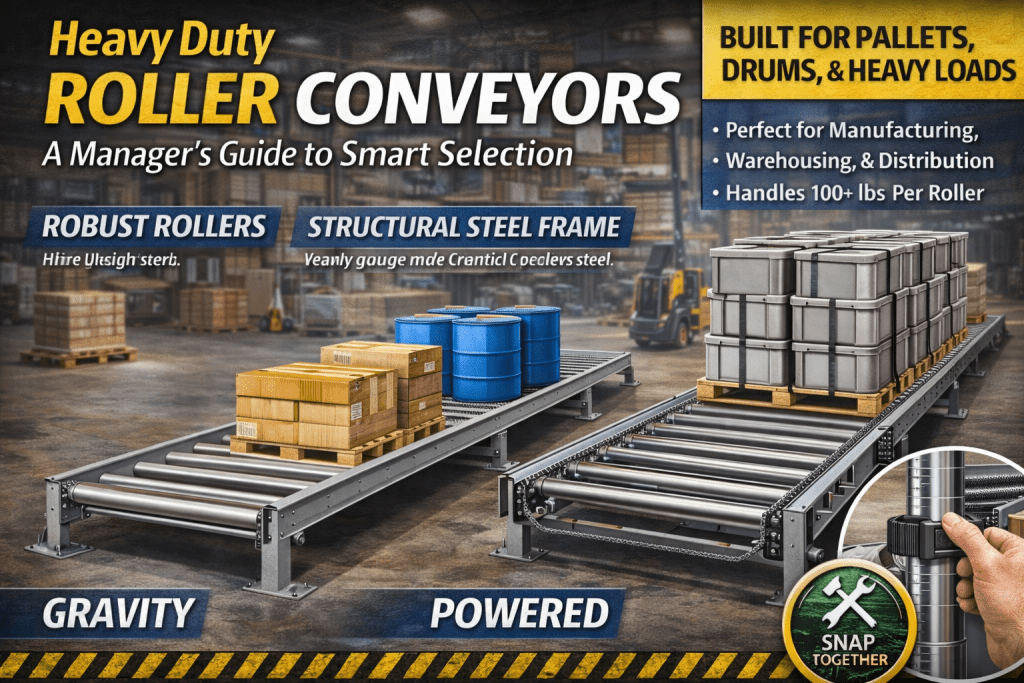
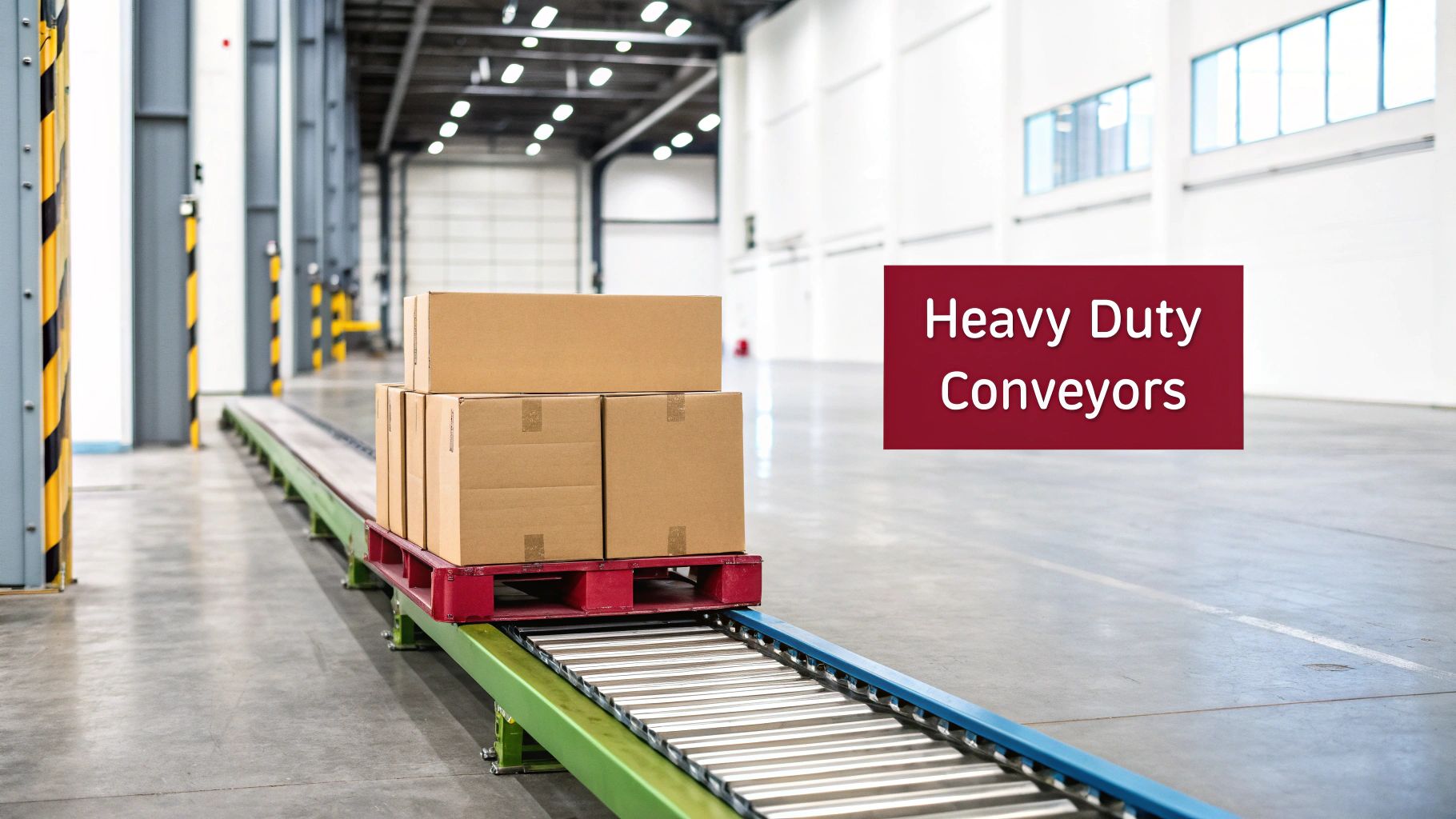
When your operation deals with serious weight like pallets, drums, or massive totes, standard equipment just won’t cut it. Heavy duty roller conveyors are the undisputed workhorses of modern industry, engineered to move substantial loads with rock-solid reliability. Unlike their lighter-duty cousins, these systems are built with brawny frames, oversized rollers, and powerful drives to thrive under the intense pressure of manufacturing, warehousing, and distribution.
The Foundation of Efficient Material Handling
In any facility managing heavy goods, the mission is simple: get items from point A to point B safely, efficiently, and without a hitch. This is exactly where heavy duty roller conveyors shine. They aren’t just another piece of equipment; they are the circulatory system for your entire operation. They ensure a constant, dependable flow of materials from the moment they hit your receiving docks, through storage, and right out to the shipping bays.
These systems are purpose-built to take a beating in tough industrial environments. They’re designed to handle products that are too heavy, bulky, or awkward for a person or a standard conveyor to manage. By automating this movement, you can dramatically boost throughput, slash the risk of workplace injuries, and free up your team for more valuable, hands-on tasks.
Core Components That Define Strength
The incredible resilience of these conveyors comes down to three key components working together:
- Robust Rollers: These rollers are typically made from thick-gauge steel, designed to shoulder significant weight without bending or breaking. The diameter and wall thickness are specified to perfectly match the demands of your products.
- Structural Steel Frames: The frame is the conveyor’s backbone. Heavy duty systems rely on heavy-gauge formed or structural steel channels, giving them the rigidity to support thousands of pounds across long spans without sagging.
- Powerful Drive Mechanisms: For powered systems, the drive is everything. Options like chain-driven live rollers (CDLR) provide positive, non-slip power, perfect for moving oily parts or hefty pallets that would make other systems falter.
A Growing Market for Industrial Strength
The critical role these systems play is clearly reflected in market trends. The global conveyor roller market has already hit USD 115.9 million, with North America dominating the field with a 40% share (USD 46.36 million). This number underscores just how much the region’s supply chain relies on high-performance material handling.
These conveyors are engineered to handle loads often exceeding 100 pounds per roller, making them essential for distribution centers moving palletized goods and manufacturing plants handling parts weighing up to 2,000 pounds. As businesses everywhere continue to automate for greater efficiency, the demand for truly reliable, heavy-duty solutions is only getting stronger. You can discover more about these market insights on Cognitive Market Research.
For any facility manager or purchasing agent, getting these basics right is the first step. The ideal system is never one-size-fits-all; it depends entirely on your unique application, from product weight to facility layout. Exploring the different types of material handling conveyors is crucial, but expert guidance is what ensures your investment delivers from day one. Our free layouts and designs with no obligation help you engineer a solution that fits your operation perfectly.
Gravity vs. Powered: Making the Right Choice
Once you’ve decided a heavy duty roller conveyor is the right tool, the next step is figuring out which kind is the best fit for your operation. This isn’t about finding the single “best” conveyor, it’s about matching the right system to the unique challenges you face on your floor every day. The conversation starts by splitting them into two main camps: Gravity and Powered.
Gravity Roller Conveyors for Simple, Cost-Effective Flow
Think of a Gravity Roller Conveyor as a purpose-built, industrial slide for your products. It’s elegantly simple, using the natural force of gravity to move items along a downward slope. This makes it an incredibly cost-effective and low-maintenance solution because there are no motors or moving parts to worry about.
These systems are the workhorses of packing stations, assembly lines, and shipping and receiving docks for loading and unloading trucks. If you just need to get something from Point A to a slightly lower Point B, or have a level section where operators can easily push items along, a gravity system is a smart, economical choice.
Powered Roller Conveyors for Controlled Movement
But what happens when gravity isn’t on your side, or when you need absolute control over how and when your products move? That’s where Powered Roller Conveyors come in. These are the escalators of the warehouse, actively moving items horizontally, up an incline, or at a very specific, consistent speed. They’re the backbone of any automated system or long-distance transport line where manual pushing just isn’t feasible.
Powered systems get their muscle from a drive mechanism, and for heavy duty applications, two types dominate the field.
Chain Driven Live Roller (CDLR) Conveyors
When you need pure, brute-force reliability, you need a Chain Driven Live Roller (CDLR) conveyor. These are the titans of the industry. In a CDLR system, each roller is physically connected to the next with a loop of chain, creating a positive, powerful drive that guarantees every single roller turns at the same speed. There’s no slippage, period.
This direct-drive design makes CDLR the go-to choice for the toughest, messiest, and heaviest jobs out there. Think about:
- Handling Oily or Grimy Parts: A chain drive couldn’t care less about surface contaminants that would make a belt slip and fail.
- Moving Seriously Heavy Loads: We’re talking fully loaded pallets, engine blocks, massive steel drums, or heavy castings.
- Awkward or Uneven Items: The positive drive forces items with uneven bottoms like wire baskets or containers with feet to move without stalling.
CDLR systems are built for one thing: rugged, non-stop movement of substantial weight where there is absolutely no room for error.
Belt Driven Live Roller (BDLR) Conveyors
If CDLR is all about brute force, Belt Driven Live Roller (BDLR) conveyors bring a bit more finesse to the table. Instead of chains, a BDLR system uses a flat belt running underneath the rollers. Pressure is applied to the belt, which in turn spins the rollers above it. This indirect drive is the key to a critical feature called accumulation.
Accumulation is simply the ability to stop products on the conveyor without shutting down the entire line. It’s essential for creating buffers between workstations or feeding items into machines like palletizers and stretch wrappers at a steady pace. The belt can slip harmlessly under the stopped rollers, preventing product pile-ups and protecting the drive system from strain. This makes BDLR an excellent choice for handling cartons, totes, and other uniform items that need smoother transport and the ability to queue up.
Expert Insight: Understanding the core differences here is everything. The choice you make directly impacts your throughput, the safety of your products, and your long-term operational costs.
Comparing Heavy Duty Conveyor Systems
Use this side-by-side comparison to help select the right heavy duty roller conveyor for your operational needs and environment.
| Conveyor Type | Power Source | Ideal Application | Primary Advantage | Key Considerations |
|---|---|---|---|---|
| Gravity Roller Conveyor | Gravity / Manual Push | Loading/unloading, assembly lines, downhill transport | Low cost, zero energy consumption, simple maintenance | Requires a decline or manual force; no speed control |
| Chain Driven Live Roller (CDLR) | Motor and Chain | Pallets, oily parts, drums, uneven loads | Positive, non-slip drive for maximum torque | Not suitable for accumulation; higher initial cost |
| Belt Driven Live Roller (BDLR) | Motor and Belt | Totes, cartons, accumulation zones, buffer lines | Allows for gentle handling and zero pressure accumulation | Less suitable for oily environments or very heavy loads |
Choosing the right heavy duty roller conveyor is a critical investment in your facility’s future. Our team has spent years analyzing workflows to recommend the most effective and efficient solutions. For a detailed assessment and a free, no-obligation layout, Request a Quote or give our experts a call directly at (800) 326-4403.
Understanding Critical Technical Specifications
Choosing the right type of heavy duty roller conveyor is the first step, but making it perform boils down to the technical details. The difference between a smooth, reliable workflow and one riddled with jams and costly downtime is all in the specs. Getting these details right from the start is the best way to guarantee a solid return on your investment.
For facility managers and engineers, knowing what these specs mean is everything. Terms like load capacity, roller centers, and frame gauge aren’t just industry jargon; they are the literal building blocks of a system designed to last. Let’s break down what really matters.
Decoding Load Capacity
The first spec everyone looks at is load capacity, but it’s often misunderstood. It’s not just one big number. It’s actually a combination of two key metrics that work together.
- Capacity Per Roller: This is the maximum weight a single roller can support without bending or failing. It’s a direct result of the roller’s material, its diameter, and the quality of its bearings.
- Capacity Per Foot: This tells you the total weight a one-foot section of the conveyor frame can handle before it starts to bow or suffer structural stress. This is all about the frame’s material, thickness, and overall design.
Think of it like a bridge. Each roller is a support pillar, and the frame is the road itself. You need both to be strong enough for the traffic you plan to run over it. If you miscalculate either one, you’re setting yourself up for a major failure down the road.
Before we dive deeper into those specs, it helps to visualize where they fit in the bigger picture.

This diagram shows the first big decision: gravity or powered. Once you’ve made that choice, you can get into the nitty-gritty specs for that system.
Roller Diameter, Gauge, and Spacing
Once your load capacity is sorted, the focus shifts to the rollers themselves. Three specs are absolutely critical for ensuring your products move smoothly and safely.
Roller Diameter and Gauge
The roller’s diameter impacts its strength and how smoothly your products ride on it. As you’d expect, bigger rollers can handle heavier loads and bridge larger gaps more effectively. The gauge refers to the thickness of the roller’s steel wall, a lower gauge number means a thicker, stronger wall that can take more punishment.
Roller Centers and the Three-Roller Rule
Roller centers are just the distance from the center of one roller to the center of the next. This spacing is vital for product stability. The gold standard here is the “three-roller rule,” which says you need at least three rollers under your product at all times to keep it from tipping or getting jammed.
For example, if you’re moving a 40-inch-long pallet, your roller centers should be no more than 12 inches apart. That setup guarantees at least three rollers are always supporting the pallet’s length, preventing it from rocking or catching on the gaps.
Frame Construction and Its Impact
The frame is the backbone of your conveyor system. Its design directly affects the system’s overall strength, rigidity, and how long it will last. The two most common options are formed channel and structural channel steel.
Formed Channel Frames: These are made from flat steel that’s bent into a “C” shape. They offer a great balance of strength and cost, making them perfect for most standard heavy duty jobs.
Structural Channel Frames: These are built with a thicker web and flanges, giving them superior strength and resistance to twisting under extreme loads. If you’re dealing with exceptionally heavy pallets or need to span long, unsupported distances, structural channel is the safer, more reliable pick.
Nailing down the right specs can feel like a lot, but our team is here to help you sort through these critical choices. With project timelines getting tighter every year, getting the design right from the get-go is more important than ever. Give us a call at (800) 326-4403 for a no-obligation consultation to talk through your specific needs.
Choosing the Right Conveyor for Your Application
Connecting the technical specs to what’s actually happening on your floor is the most important step in picking a new conveyor system. This isn’t just about numbers on a spec sheet; it’s about asking the right questions to find the perfect heavy duty roller conveyor for the products you handle, day in and day out.
Making a smart decision upfront is the single best way to avoid expensive retrofits, frustrating bottlenecks, and killer downtime. A system that’s perfectly matched to your needs from day one will maximize your ROI and get your workflow humming immediately. The key is to really dig into your application before you buy.
Matching the Conveyor to the Product
It’s simple: the product dictates the conveyor. Every item has its own handling quirks. A system built for perfectly uniform pallets is going to choke on heavy drums or odd-shaped totes. So, the first step is to get crystal clear on exactly what you need to move.
Take a look at your products:
- Uniform Pallets: If you’re mainly moving standard pallets with flat, solid bottoms, a Chain Driven Live Roller (CDLR) system is almost always the answer. Its positive drive gives you consistent, no-slip movement you can rely on.
- Industrial Totes and Cartons: For lighter, uniform loads like plastic totes or cardboard boxes, a Belt Driven Live Roller (BDLR) conveyor is a great choice. It offers gentle handling and, critically, lets you accumulate products without them crashing into each other.
- Heavy Drums and Barrels: The concentrated weight and round shape of drums demand seriously robust rollers with precise spacing to stop them from wandering or tipping. You’ll need a heavy duty CDLR system for this job.
- Irregularly Shaped Items: Anything with an uneven bottom, think wire baskets or containers with feet, needs the positive grip of a CDLR conveyor to keep it from getting stuck between rollers.
Key Questions for Your Self-Assessment
Once you’ve identified your main product types, it’s time to drill down into the nitty-gritty of your operation. Answering these questions will point you straight to the right technical specs and system design. Think of this as translating your daily headaches into solid conveyor requirements.
| Assessment Category | Key Questions to Answer | Impact on Conveyor Selection |
|---|---|---|
| Load Characteristics | What’s the heaviest and lightest thing you’ll move? What are their exact dimensions (L x W x H)? | Determines required roller capacity, roller centers, frame strength, and motor horsepower. |
| Throughput Requirements | How many products per minute or hour do you need to handle? Do you need a constant speed or variable? | Dictates the necessary conveyor speed (feet per minute) and which drive system makes sense. |
| Facility Environment | Will the conveyor be in a freezer, a washdown area, or an oily environment? | Influences your choice of materials (like galvanized or stainless steel) and drive type (CDLR for oily conditions). |
| System Integration | Does this conveyor need to talk to other equipment like palletizers, stretch wrappers, or pallet racking? | Affects the layout design, control systems, and whether you need transfers, turntables, or lifts. |
Free, No-Obligation Layouts to Ensure a Perfect Fit
Let’s be honest, navigating these choices can get complicated, especially when you’re dealing with tight floor space or need to move products up or down. For applications that require products to change elevation or navigate complex paths, specialized solutions may be necessary to maintain flow. You can learn more about how spiral conveyors solve these vertical transport challenges.
Expert Insight: Answering these questions is the first step, but seeing how the system will look and function in your space is what builds confidence.
Our team specializes in turning your operational needs into an efficient, real-world design. We provide free, no-obligation layout and design services to make sure your chosen heavy duty roller conveyor fits perfectly into your current workflow. By getting our team involved in the planning sooner rather than later, you can lock in better timelines and sidestep the potential delays that are all too common in this industry.
Ready to find the perfect fit for your application? Request a Quote today, and let our experts design a system that truly works for you.
Optimizing Your Layout and Installation Plan
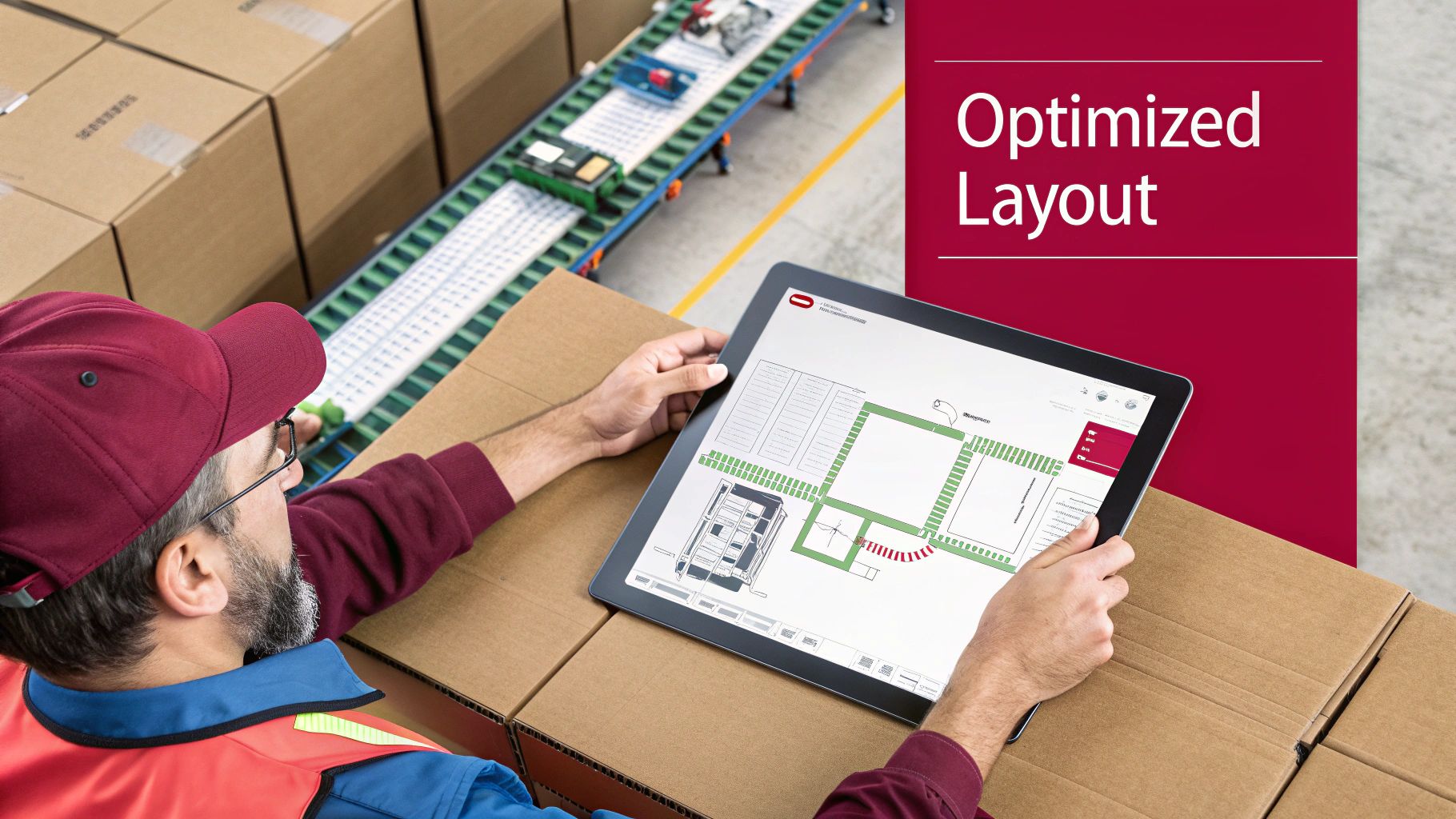
A powerful heavy duty roller conveyor is only as effective as the layout it operates within. Smart system design is what separates a truly productive workflow from a chaotic one, ensuring your products move efficiently and safely, without the bottlenecks that quietly drain your profits.
This isn’t just about dropping a conveyor onto your floor. It’s about thinking through the entire product journey, from the moment goods hit your inbound docks to the second they’re loaded for shipping. This strategic planning is the key to unlocking the full potential of your investment.
Core Principles of Efficient System Design
A successful layout is really built on a few common-sense principles. First, you have to nail the flow. Your conveyor system needs to create a clear, logical path for materials, cutting down travel distance and getting rid of any cross-traffic that leads to collisions or slowdowns. Always think about how your inbound and outbound lines will hold up during peak hours, that’s where the chokepoints show up.
Next, you need to handle elevation changes. If you’re moving products between different levels, planning effective inclines and declines is non-negotiable. The angle has to be just right to stop items from sliding out of control on a gravity conveyor or losing their grip on a powered one. Getting this part of the design right is crucial for both product safety and consistent operation.
Finally, don’t forget about support and stability. The type of supports your system uses must be a perfect match for your floor type and the loads you’re running. An uneven or poorly supported conveyor will kill your bearings and drive components, leading to the kind of unexpected downtime nobody wants.
Integrating Conveyors with Your Facility
Your conveyor doesn’t operate in a vacuum. To create a truly cohesive material handling ecosystem, it must connect seamlessly with other critical equipment and zones in your facility.
- Pallet Racking Interfaces: A classic application is creating an efficient path from bulk storage to picking or packing stations. The conveyor layout has to align perfectly with your racking aisles to make this handoff smooth for forklifts or personnel.
- Dock Door Transitions: For loading and unloading, the conveyor should extend right up to the dock doors. This often involves using flexible or telescoping sections to handle different truck sizes without a hitch.
- Transfers and Turntables: When products need to change direction or jump between parallel lines, you’ll need transfers or turntables. Planning these junctions correctly is absolutely vital for maintaining throughput and preventing jams.
Expert Insight: A well-integrated system feels like a natural extension of your facility. The goal is to make the movement of heavy goods feel effortless, which requires careful planning of every transition point and interaction with other equipment.
Secure Your Installation Timeline with Expert Design
Trying to navigate all these layout complexities on your own can be a huge challenge, especially when you’re also juggling daily operations. This is where leaning on an expert gives you a clear advantage. We’ve seen it time and again: delays in project planning create a domino effect, pushing back installation dates and postponing the operational gains you were counting on.
By working with our team, you can get way ahead of these problems. We provide free layouts and designs with no obligation, letting you visualize and fine-tune your footprint long before a single piece of equipment shows up. This proactive approach helps lock in better installation timelines so your business can start seeing productivity gains much sooner.
Don’t let poor planning create future headaches. Let our experts design a layout that maximizes efficiency and fits your space perfectly. Contact Us or call (800) 326-4403 to start your free design consultation today.
Maintaining Your System for Safety and Longevity
Your heavy duty roller conveyor is a serious investment. Protecting it is just as critical as the initial purchase. A well-maintained system doesn’t just run better; it keeps your team safe and adds years to the equipment’s life. Think of it this way: proactive maintenance is your best defense against surprise downtime and budget-busting repairs.
It all starts with a simple, repeatable inspection schedule. You’d be amazed how quickly a small issue, like a worn bearing or a loose chain, can snowball into a major system failure if you let it go. A straightforward checklist is the easiest way to make sure nothing gets missed during those routine walk-throughs.
Preventative Maintenance Checklist
A solid preventative maintenance plan should be built around your specific system, whether it’s a simple gravity line or a complex powered setup. The core principles, however, are always the same.
For All Conveyor Types:
- Roller Inspection: Give each roller a look. Are there any dents or obvious signs of wear? Give them a spin, they should move freely and sit squarely in the frame.
- Frame and Support Integrity: Scan the frame for any bending, cracks, or other damage. Check that all support legs are stable and bolted down tight to the floor.
- Debris Removal: Regularly clear out any dust, dirt, plastic wrap, or other junk that could jam up the rollers and create a hazard. For the really tough grime that builds up on heavy equipment, incorporating specialized industrial pressure washing methods can be a game-changer for deep cleaning.
For Powered Conveyors:
- Bearing Lubrication: Stick to the manufacturer’s guidelines for lubricating all bearings. This simple step prevents the friction and heat that cause premature failure.
- Drive Chain Tension: On CDLR systems, check the drive chain’s tension. If it’s too loose, it can slip. Too tight, and you’ll put unnecessary strain on the motor and bearings.
- Motor and Gearbox Check: Listen for any weird noises coming from the motor or gearbox. Keep an eye out for oil leaks, as they often point to internal problems.
Troubleshooting Common Conveyor Issues
Even with the best maintenance plan, things happen. Knowing how to quickly spot and solve common problems can be the difference between a minor hiccup and a major shutdown.
| Common Issue | Potential Cause | Quick Solution |
|---|---|---|
| Packages Drifting or Skewing | Rollers are not level or the frame is misaligned. | Grab a level and check the rollers and frame sections. Adjust the support legs until the conveyor path is perfectly straight and level. |
| Conveyor Won’t Start | Motor overload, a tripped e-stop, or an electrical fault. | First, check if an emergency stop button has been pushed. Next, try resetting the motor’s thermal overload. If it’s still dead, it’s time to call an electrician. |
| Unusual Grinding or Squealing | Worn bearings, bad chain tension, or debris caught in moving parts. | Power down and lock out the system immediately. Inspect the bearings and chain tension. Clean any foreign material out of the drive mechanism. |
Upholding Safety and Compliance
A safe operation is a productive one. Making sure your conveyor system meets all safety standards protects your people and your business. The Occupational Safety and Health Administration (OSHA) is crystal clear about its guidelines for machine guarding to keep workers away from moving parts.
Expert Insight: Proper guarding is not optional; it is a fundamental requirement for creating a safe work environment. All pinch points, chains, and gears must be adequately shielded to prevent accidental contact.
We are dedicated to helping you build systems that are both highly efficient and fundamentally safe. That includes providing effective conveyor guarding solutions that fit perfectly with your layout. When you pair a robust maintenance schedule with the right safety protocols, you create an environment where your team can work with confidence and your equipment performs reliably day in and day out. Protecting your investment and your people is the smartest business decision you can make.
Frequently Asked Questions
When you’re making a big investment in your facility’s workflow, you’re bound to have questions. Here are the most common ones we get from facility managers and decision-makers, with straight answers to help you move forward with confidence.
How Much Weight Can These Conveyors Actually Handle?
This is where the term “heavy duty” really comes into play. These systems are engineered for serious loads, typically starting at 100 pounds per roller. For applications like pallet handling, the capacity can easily scale up to several thousand pounds per conveyor section.
The final number really depends on the specifics, the roller material and diameter, how far apart they’re spaced, and the frame design all play a part. The best way to know for sure is to let our experts run the calculations for your exact application during a free design consultation.
Should I Go with a Gravity or a Powered Conveyor?
The right choice comes down to one thing: your workflow.
Gravity conveyors are the simple, cost-effective workhorses. They’re perfect if you’re moving products down a slight slope or have a manual push-line where operators are controlling the flow. On the other hand, powered conveyors are non-negotiable if you need to move loads uphill, cover long flat distances, or need precise control over speed and accumulation. We can help you weigh the pros and cons to make sure you’re not over- or under-investing.
Can These Conveyors Tie into My Pallet Racking?
Absolutely. In fact, that’s one of their biggest strengths. Seamlessly integrating roller conveyors with your existing pallet racking is how you create incredibly efficient pick modules and high-velocity loading or unloading zones.
Getting this right requires careful planning to maximize the workflow between storage and movement. Our free layout and design services are all about creating these kinds of cohesive systems that make your entire operation more productive. Call us at (800) 326-4403 to talk about how it could work in your space.
What’s a Realistic Lead Time for a New Conveyor System?
We’ve built our reputation on having the fastest shipping and delivery in the business. While a fully custom-designed system will naturally have a longer lead time, we keep a huge inventory of standard components ready for immediate shipment.
Our best advice? Start the conversation with our team as early as possible. Planning ahead helps you secure better timelines and sidestep the supply chain headaches that are still causing delays across the industry.
Partner with the Experts for Your Heavy Duty Conveyor Needs
At Material Handling USA, we don’t just sell parts; we provide the expertise to build a heavy duty roller conveyor system that becomes a true asset for your business. With competitive pricing and the industry’s fastest delivery, we are committed to delivering a solution that provides real, lasting value. From the first sketch to the final installation, our team is here to ensure your project is a success.
Ready to see what a better workflow looks like? Request a Quote for a free, no-obligation layout and design from our experts.