
When your warehouse runs out of space, you have two main options: build outward or build upward. Expanding your building footprint is the traditional approach. Installing an industrial mezzanine is the faster, more cost-effective alternative that most facility managers overlook.
This article compares the two approaches across cost, timeline, disruption, flexibility, and ROI so you can make the right decision for your facility.
The Space Problem Every Warehouse Faces
Growing businesses hit a wall — sometimes literally. Inventory increases, new product lines arrive, and suddenly the warehouse that worked fine three years ago is packed to the gills. The knee-jerk reaction is to look for a bigger building or add on to the one you have. But building expansion is expensive, slow, and disruptive.
Meanwhile, most warehouses have 15 to 25 feet of unused vertical space above their operations. That wasted airspace is the opportunity a mezzanine captures.
What Is an Industrial Mezzanine?
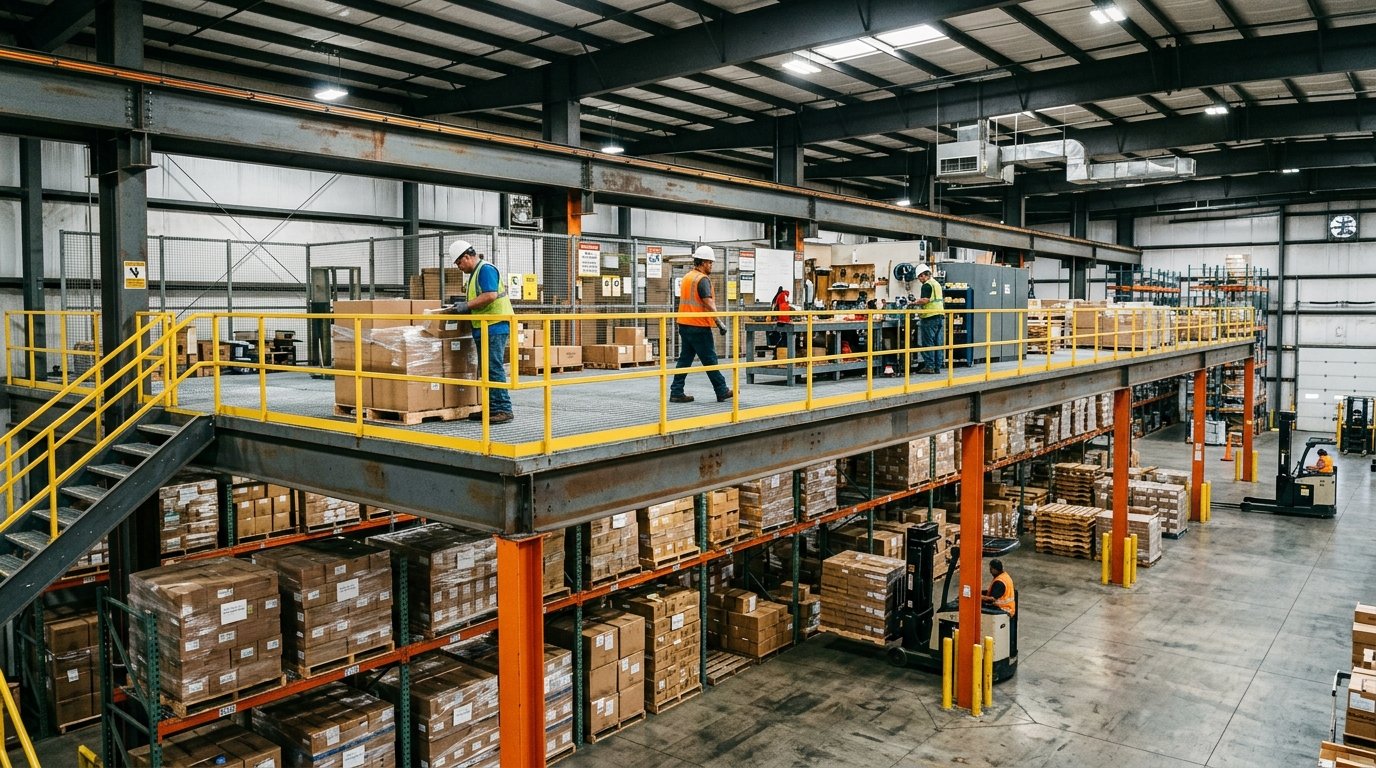
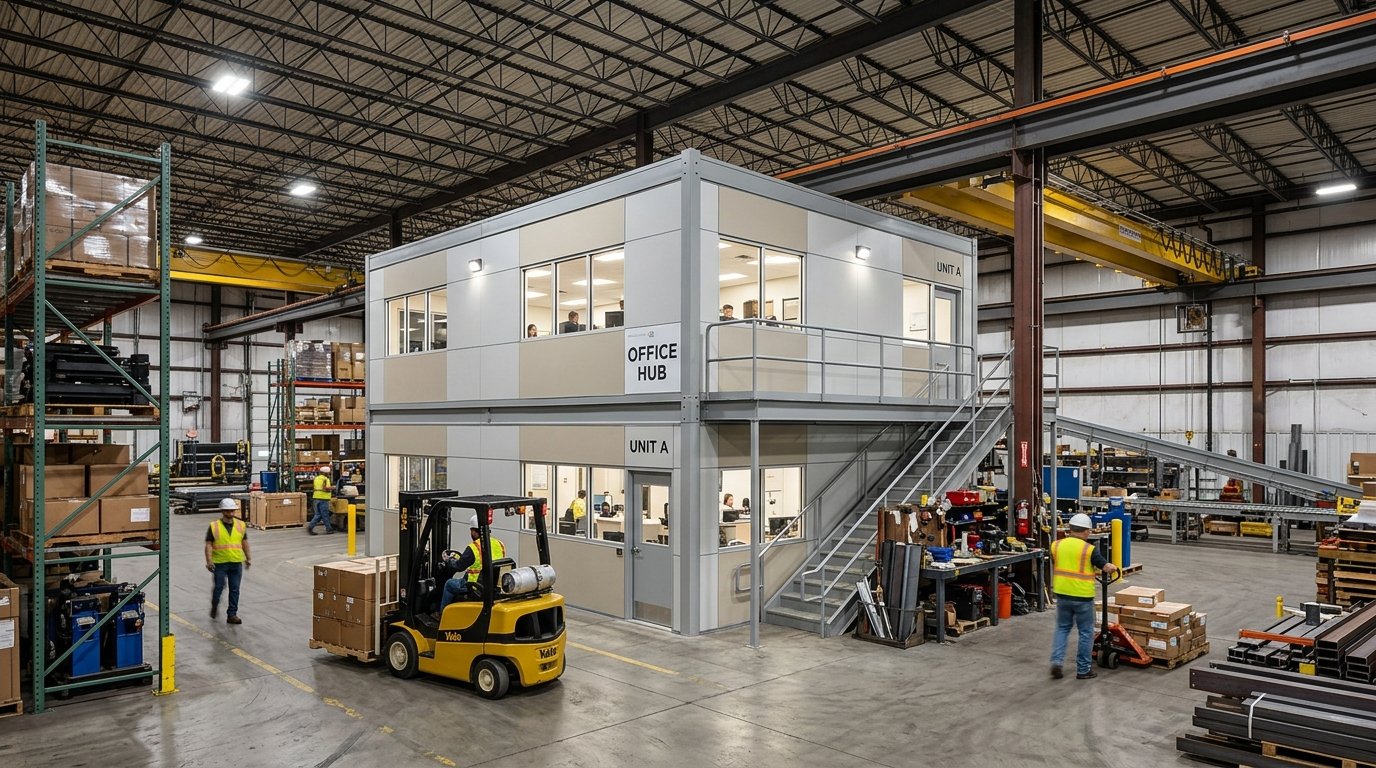
An industrial mezzanine is a freestanding elevated steel platform installed inside an existing building. It creates a second (or third) level of usable floor space without altering the building envelope. Mezzanines include structural steel columns, beams, decking, stairs, handrails, and safety gates.
Common uses include:
- Additional storage for pallets, cartons, or equipment on the upper level
- Elevated offices or break rooms overlooking the warehouse floor
- Pick and pack stations separated from bulk storage
- Production or assembly areas on a dedicated level
- Overflow space during seasonal demand peaks
Cost Comparison
This is where the mezzanine advantage is clearest.
| Cost Factor | Building Expansion | Industrial Mezzanine |
|---|---|---|
| Construction cost per sq ft | $50 to $200+ | $15 to $50 |
| Permits and engineering | Full building permits, architect, structural engineer | Engineering stamps, simpler permit process |
| Foundation work | New footings, slab, grading | Bolts to existing floor (usually no new foundation) |
| HVAC / mechanical | Extended to new space | Typically uses existing building systems |
| Roofing and exterior | New roof, walls, insulation | None — inside existing building |
| Property tax impact | Increased building value raises taxes | Classified as equipment in many jurisdictions, lower tax impact |
| Total project cost (5,000 sq ft example) | $250,000 to $1,000,000+ | $75,000 to $250,000 |
A mezzanine typically costs 25 to 50 percent of what a building expansion costs for the same square footage. And because mezzanines are classified as equipment rather than real property in many jurisdictions, the tax implications are often more favorable.
Timeline Comparison
Time is money, especially when you need space yesterday.
| Phase | Building Expansion | Industrial Mezzanine |
|---|---|---|
| Design and engineering | 2 to 6 months | 2 to 4 weeks |
| Permitting | 1 to 4 months | 1 to 4 weeks |
| Construction / installation | 3 to 12 months | 1 to 4 weeks |
| Total project time | 6 to 22 months | 4 to 12 weeks |
A mezzanine project that delivers 5,000 square feet of new space can go from initial design to completed installation in as little as one month. A building expansion of the same size is a six-month project at minimum.
Operational Disruption
Building Expansion
A building expansion means construction crews, heavy equipment, noise, dust, and closed-off areas for months. Your existing operations may need to be rerouted or temporarily relocated. Shipping and receiving may be impacted if the expansion affects dock areas.
Mezzanine Installation
Mezzanine installation happens inside the building with minimal disruption. The structural components are fabricated off-site and assembled on location. Most installations can work around ongoing operations, and the area directly below the mezzanine is the only space that needs to be temporarily cleared.
Flexibility and Future-Proofing
Here is where mezzanines have a hidden advantage: they are not permanent.
- A mezzanine can be disassembled and relocated if you move to a new facility
- It can be expanded by adding bays to the existing structure
- It can be reconfigured for different uses — storage today, office space next year
- If your lease ends, you can take the mezzanine with you
A building expansion is a permanent change to the property. If your needs change or you outgrow the facility entirely, that investment stays behind.
When a Building Expansion Makes More Sense
Mezzanines are not the right answer for every situation. A building expansion may be the better choice when:
- Your ceiling height is too low for a functional mezzanine (under 14 feet)
- You need more ground-floor space for heavy equipment, dock access, or vehicle traffic
- The additional space needs its own environmental controls (cold storage, clean room)
- You own the building and plan to stay for 20+ years, making the long-term ROI of expansion worthwhile
- Local zoning or fire codes limit mezzanine installations
When a Mezzanine Is the Clear Winner
- You have 16 feet or more of clear ceiling height
- You need the space in weeks, not months
- Your budget is limited or you prefer a lower capital expenditure
- You lease the building and want to take the asset with you
- The new space is for storage, offices, or light operations (not heavy manufacturing or dock access)
- You want to minimize operational disruption during the project
Mezzanine Design Considerations
If you decide a mezzanine is the right path, here are the key design factors:
- Load capacity — what will the mezzanine hold? Storage loads, office furniture, equipment, and foot traffic all have different requirements
- Decking type — options include bar grating, concrete-filled steel deck, plywood, and resin deck, each with different load ratings and costs
- Access — stairs, ladders, and material lifts or gates for moving product to the upper level
- Handrails and safety — OSHA-compliant guardrails, kick plates, and self-closing gates are required
- Fire protection — sprinkler placement may need to be adjusted for the new level
- Lighting — the mezzanine deck will block overhead lights, so supplemental lighting is often needed below
Material Handling USA provides complete design services including engineering drawings, load calculations, and permit-ready specifications for industrial mezzanines.
Frequently Asked Questions
Do mezzanines require a building permit?
In most jurisdictions, yes. Mezzanines are regulated by local building codes, which typically limit mezzanine area to one-third of the floor area below. Material Handling USA provides engineered stamped drawings to support the permit process.
How much weight can an industrial mezzanine hold?
Load capacity is engineered to your specific needs. Common ratings range from 125 PSF (pounds per square foot) for office use to 250 PSF or more for heavy storage. Pallet loads, equipment, and fork truck access can all be designed into the structure.
Can I put an office on a mezzanine?
Yes. Modular office buildings can be placed on mezzanine platforms to create elevated workspaces. This is a common configuration that combines the space-doubling benefit of a mezzanine with the enclosed environment of a modular office.
Is a mezzanine considered real property or personal property?
This varies by jurisdiction and how the mezzanine is attached. Freestanding mezzanines that bolt to the floor without permanent foundation modifications are often classified as personal property or equipment, which can reduce property tax implications. Consult your tax advisor for specifics.
How long does a mezzanine last?
Industrial steel mezzanines are designed for decades of service. With proper maintenance (primarily paint touch-up and bolt tightening), a well-built mezzanine can last 30 years or more.
Need more warehouse space? Contact Material Handling USA for a free mezzanine consultation. We will assess your space, calculate load requirements, and provide a design that maximizes your available vertical space.