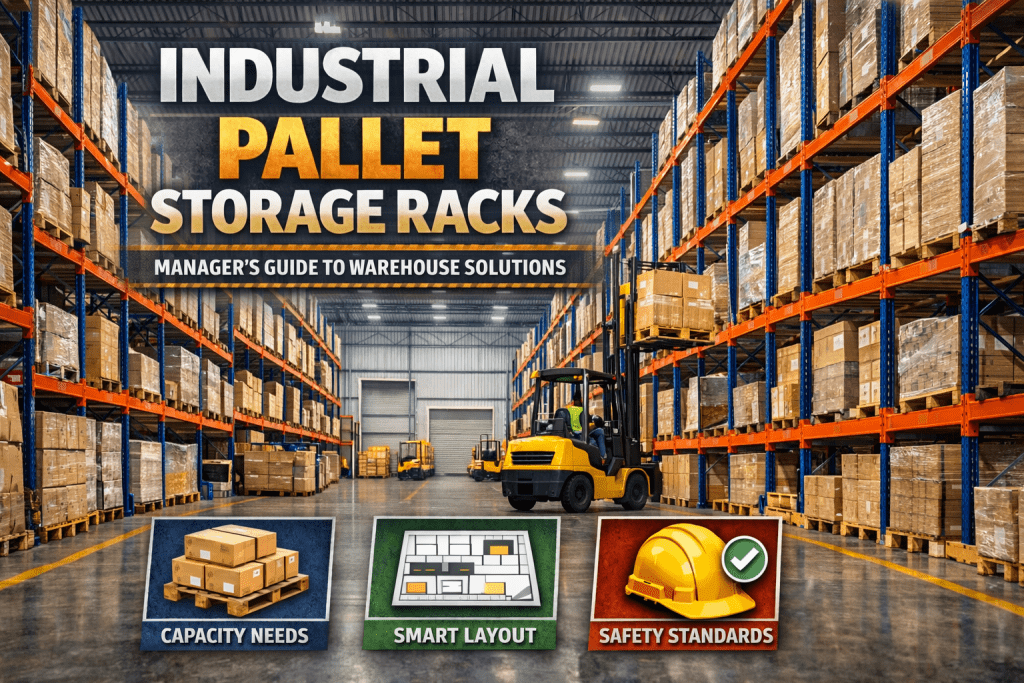
Choosing the right industrial pallet storage racks is not about finding a one size fits all solution. It boils down to a single, critical principle: the best system is the one that fits your inventory, your workflow, and your physical space perfectly. As a manager or buyer, making this strategic decision is crucial. This guide is your starting point, designed to get you past generic advice and focus on what truly matters for your operation.
Choosing the Right Pallet Racking for Your Warehouse
Think of your racking as more than just steel shelving; it is the backbone of your entire operation. A smart choice can slash pick times, seriously boost safety, and squeeze maximum value out of every square foot of your warehouse. The key is to analyze your products, processes, and people to find that perfect operational harmony.
Key Factors for Your Decision
Before you even start looking at specific types of industrial pallet storage racks, you need to get a handle on your own operational DNA. Answering these questions first will immediately narrow the field and point you toward the most efficient setup for your business.
- Inventory Characteristics: Are you dealing with uniform pallets of the same product, or is your warehouse a mix of different SKUs? Can your pallets be stacked safely on top of each other? The nature of your goods is always the number one driver of your storage strategy.
- Product Velocity: How fast does your inventory move? High demand items that fly off the shelf need a completely different level of accessibility than slow moving or seasonal goods that might sit for months.
- Warehouse Space: Take a hard look at your building. What is your ceiling height? Where are the support columns? What is the actual footprint you have to work with? The goal is to build up, maximizing vertical cube and density without creating traffic jams.
- Material Handling Equipment: The forklifts you already have, or the ones you plan to buy, will dictate crucial details like aisle width. Your racking and your forklifts must be compatible partners.
A well chosen pallet rack system does more than just hold inventory; it actively improves workflow, reduces operational costs, and creates a safer environment for your team.
Getting this initial analysis right is the foundation of any successful warehouse design. For a much deeper dive into the specifics, check out our comprehensive guide to selecting pallet rack for your warehouse.
From here, we will explore the most effective racking systems out there and give you actionable insights to make an informed investment. And remember, this decision is backed by Material Handling USA’s expertise. We provide free layouts and the industry’s fastest shipping to get your project off the ground without delay.
Contact Us today for a free, no obligation quote and layout design.
Picking the Right Tool for the Job: Common Pallet Racking Systems
Choosing the right type of industrial pallet storage racks is not about finding the single “best” system. It is about finding the best system for your warehouse, your products, and your unique operational challenges. Think of each racking style as a specialized tool designed to solve a specific problem, whether that is maximizing every square inch of space, speeding up access, or managing a precise inventory flow.
Let’s move beyond dry definitions and look at how these systems actually work in the real world. The goal is to match the right tool to the right job, finding a solution that clicks perfectly with your product types, inventory turnover, and the physical layout of your facility.
H3: Selective Pallet Racking: The All-Rounder
Selective racking is the most common and versatile setup you will find in warehouses, and for good reason. Imagine a library where every single book is instantly accessible from the aisle; that is the core idea here. Every pallet position can be reached directly, offering 100% selectivity.
This makes it the perfect choice for operations with a high number of different SKUs but relatively low pallet quantities for each one. If you are running a busy e commerce fulfillment center or a retail distribution hub where you need to constantly pick varied items for orders, selective racking is your best option.
- Pros: Low initial investment, immediate access to every single pallet, and it is adaptable to just about any product type you can throw at it.
- Cons: It is a space hog. The need for so many aisles means it offers the lowest storage density of all the systems.
H3: Drive-In and Drive-Thru Racking: The Density Champion
Now, picture a massive cold storage facility holding thousands of pallets of the same brand of frozen peas. In that scenario, grabbing any single pallet at a moment’s notice is not the priority. What is the priority is cramming as much product as possible into that expensive, refrigerated space. This is where Drive In racking becomes the hero.
Forklifts literally drive into the racking structure to place or retrieve pallets stored on rails. This design eliminates most of the aisles, creating incredible storage density. It operates on a Last In, First Out (LIFO) basis, since the last pallet you put in is the first one you have to take out. A Drive Thru system is similar but allows access from both ends, which enables a First In, First Out (FIFO) workflow.
This flowchart helps visualize how inventory, space, and workflow all point you toward the right racking decision.
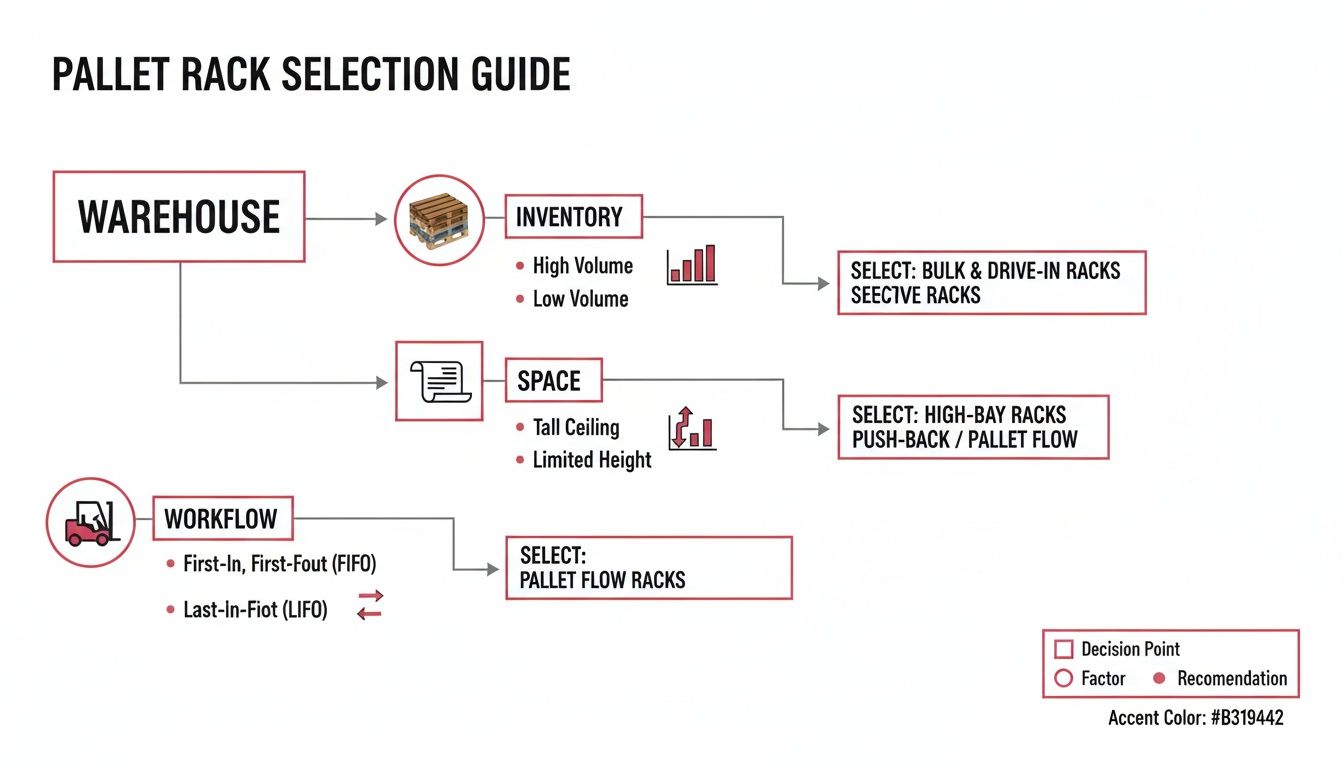
As the chart shows, if you are dealing with high volume, low SKU inventory, the math naturally points toward high density solutions like Drive In racking to make the most of your building’s footprint.
H3: Push-Back Racking: The Smart Compromise
Push Back racking strikes a clever balance between the raw density of Drive In and the easy access of Selective racking. Here, pallets are stored on a series of nested carts that sit on inclined rails. When you load a new pallet, it gently pushes the one behind it one position deeper into the system.
This LIFO system lets you store pallets several deep while still giving you access to a different SKU at the face of each lane. It is a fantastic choice for operations that need more density than selective racking can offer but cannot commit to the single product lanes of a Drive In system. By storing 2 to 6 pallets deep per lane, these systems can boost density by up to 60% over standard selective racks.
H3: Pallet Flow Racking: For FIFO Operations
If your products are perishable or have expiration dates, a FIFO inventory system is non negotiable. Pallet Flow racking (also called Gravity Flow) is engineered specifically for this. Pallets are loaded onto one side of the rack and smoothly glide down on inclined rollers or wheels to the other side for picking.
This creates a perfect first in, first out rotation, ensuring older stock is always used first. It is the go to system for the food and beverage industry, pharmaceuticals, and any business where product freshness is critical.
H3: Cantilever Racking: For Awkward Loads
Finally, what do you do with items that just will not fit neatly on a standard pallet? We are talking about things like lumber, steel pipes, furniture, or long rolls of carpet. Cantilever racking is the purpose built solution for these long, bulky, and irregularly shaped items.
This system uses a central column with arms extending outward to support the load. By getting rid of the front vertical uprights that would normally get in the way, it makes loading and unloading these awkward items a breeze.
For an even deeper look at all these options and more, you can explore our full range of pallet rack and pallet rack systems.
At a Glance Comparison of Pallet Racking Systems
Feeling overwhelmed by the options? This table offers a quick side by side look at the most popular pallet racking systems, making it easier to see which one best aligns with your day to day operational needs.
| Racking Type | Storage Density | Inventory Access | Ideal Use Case | Relative Cost |
|---|---|---|---|---|
| Selective | Low | 100% Selectivity (FIFO) | High SKU count, low volume per SKU | $ |
| Drive-In | Very High | Low Selectivity (LIFO) | Low SKU count, high volume per SKU | $$ |
| Push-Back | High | Medium Selectivity (LIFO) | Medium SKU count, needing more density | $$$ |
| Pallet Flow | High | High Selectivity (FIFO) | Perishable goods, date-sensitive products | $$$$ |
| Cantilever | Varies | 100% Selectivity (FIFO) | Long, bulky, or irregular items | $$$ |
Each system solves a different puzzle. The key is knowing which puzzle you are trying to solve. Is it maximizing space, ensuring product rotation, or providing instant access to a wide variety of goods? Once you know that, the right choice becomes much clearer.
Calculating Your Load Capacity and System Footprint
Before you even think about choosing a type of industrial pallet rack, you need to do the math. Getting your load and space calculations right is not just a step in the process; it is the single most important foundation for designing a safe, efficient, and cost effective system.
Think of it like building a bridge: you have to know the exact strength of every support and the total weight it is expected to hold. Getting these numbers right from the start prevents dangerous overloading and ensures you buy a system that actually meets your needs without wasting money on capacity you will never use. This is non negotiable.

Gathering Your Core Pallet Data
First things first, you need to know exactly what you are storing. Do not guess. Pull real data from your inventory and receiving logs to get these figures locked down. A small miscalculation here can snowball into major safety and budget problems down the line.
Use this simple checklist to gather your core numbers:
- Average and Maximum Pallet Weight: What is the typical weight of a loaded pallet? More importantly, what is the absolute heaviest pallet you will ever store? Always design for your maximum possible load.
- Pallet Dimensions (W x D x H): Grab a tape measure. Get the precise width, depth, and height of your standard loaded pallets. These numbers will directly dictate your beam length, frame depth, and the vertical space between shelves.
- Pallets Per Bay: How many pallets are you planning to put on each beam level? The most common setup is two pallets per beam, but your operation might be different.
- Number of Shelf Levels: How many levels of storage will each bay have? Do not forget to count the floor level. This is a critical piece of the puzzle for calculating the total load on your upright frames.
Understanding Beam and Upright Capacity
Once you have your pallet data, you can start to look at the two components that do all the heavy lifting: the beams and the uprights. They work together, but they have their own separate capacity ratings you have to respect.
Beam Capacity is the maximum weight a pair of horizontal beams can safely support. This rating is almost always given per pair and assumes the load is spread out evenly. So, if a beam pair is rated for 5,000 lbs. and you plan to store two pallets, each pallet cannot weigh more than 2,500 lbs.
Upright Capacity, on the other hand, is the total weight a single upright frame can handle. You figure this out by adding up the weight of all the beam levels that rest on that frame. And here is a key detail: the vertical distance between your beams dramatically affects the upright’s capacity. The wider the gap, the lower the capacity. Our team can help with these more complex calculations.
For a deeper dive into the engineering specifics, check out our guide to pallet rack specifications.
Measuring Your Warehouse Footprint
With your load requirements figured out, it is time to look at your physical space. This is more than just knowing your total square footage; you need a detailed map of the usable area to create a layout that actually works.
Make sure you account for every obstacle and feature:
- Building Columns: Note the precise location and dimensions of every support column.
- Doorways: This includes every personnel door, roll up door, and emergency exit.
- Utilities: Mark where all your sprinkler systems, electrical panels, and HVAC units are.
- Staging Areas: Block out clear zones for loading, unloading, and order picking.
Getting these calculations right is the foundation of a safe and productive warehouse. A mistake in your initial numbers can lead to an inefficient layout, premature system failure, or a dangerous collapse.
Feeling overwhelmed by the numbers? Let our experts handle it. We offer free, no obligation layout and design services to make sure every calculation is perfect.
Contact Us or call (800) 326-4403 to get your free design consultation today.
Once you have figured out your capacity needs, it is time to map out a layout that actually works on the floor. This is where the rubber meets the road, where your industrial pallet racks and forklifts come together. Get it right, and your whole operation speeds up. Get it wrong, and you have just created a bottleneck that slows everything down. A smart layout is what unlocks the real value of your racking investment.
The starting point for any great layout is one critical decision: aisle width. This single measurement dictates your storage density, what kind of equipment you can use, and how efficiently your team can move. It is the classic trade off between packing in as many pallets as possible and the cost of the forklifts needed to do it.
Aisle Width: The Space Versus Equipment Tradeoff
Choosing the right aisle width means taking a hard look at your goals. Do you need to cram in every last pallet position, or is having flexible, lower cost equipment the bigger priority?
- Wide Aisles (12+ feet): These are the standard for a reason. They give standard counterbalance forklifts plenty of room to operate safely and quickly. If you already own this type of equipment or prefer its versatility and lower upfront cost, this is a solid choice. The obvious downside is that these wide lanes eat up a lot of valuable floor space.
- Narrow Aisles (8 to 10 feet): Shave a few feet off each aisle, and suddenly you can often squeeze in another full row of racking. This does require specialized equipment like reach trucks, which are designed for a tighter turning radius. The payoff is a real jump in storage density without a massive leap in equipment costs.
- Very Narrow Aisles (VNA) (6 feet or less): This is the ultimate play for maximum density. VNA layouts can boost your storage capacity by a massive 40% to 50% compared to a standard wide aisle setup. The catch? You need highly specialized (and expensive) equipment like turret trucks that run on wire or rail guidance systems. The investment is significant, but for huge operations sitting on pricey real estate, the ROI is undeniable.
The optimal aisle width is not some magic number; it is a strategic choice you make based on your unique balance of space, budget, and throughput goals.
Principles of an Efficient Layout
Beyond just aisle width, a truly efficient layout just makes sense. The goal is to cut down on travel time, eliminate traffic jams, and make the journey from receiving to shipping as smooth as possible. A great layout treats your warehouse less like a static storage box and more like a dynamic, living system.
Smart Design Checklist
- Create a Logical Product Flow: The best layouts follow a simple U shaped or straight line path. Goods come in at one end (receiving), move to storage, then to picking/packing, and finally out through shipping on the other end. This one way traffic flow stops forklifts and people from backtracking and running into each other.
- Prioritize High Velocity SKUs: Your most popular, fastest moving products need to be in the most accessible spots, usually right up front near the shipping docks. This simple practice, often called “slotting,” can slash forklift travel time and make order fulfillment dramatically faster.
- Plan for People and Equipment: Your layout is not just for racks. You have to carve out adequate space for staging areas, battery charging stations for your lifts, designated walkways for personnel, and essential safety gear like fire extinguishers and eye wash stations.
- Consider Future Growth: Always design with some flexibility. Can you easily add another row of racking or reconfigure a zone if your product mix shifts? Thinking in a modular way from the start will save you massive headaches and money down the road.
Nailing the perfect layout is a complex puzzle. Why not let our experts handle it for you?
Our team provides free, no obligation layout and design services to optimize every one of these variables for your operation. Request a Quote or give us a call today at (800) 326-4403 to get started.
Meeting Safety Standards and OSHA Requirements
A safe warehouse is not just about avoiding fines; it is about building a productive and profitable operation from the ground up. Think of your industrial pallet storage racks not as an expense, but as a critical investment in protecting your people, your products, and your bottom line. Meeting the standards set by organizations like the Occupational Safety and Health Administration (OSHA) is the baseline, not the finish line.
When your racking is properly engineered and maintained, it becomes your first line of defense against accidents, product damage, and the kind of downtime that kills profitability. The real goal is to move beyond just checking boxes and create a culture of proactive safety, where every single team member knows their role in keeping the entire storage system sound.
Translating OSHA Guidelines into Action
OSHA gives us the framework for warehouse safety, but it is up to you to turn those guidelines into practical, everyday actions. Compliance is not about memorizing regulations; it is about putting consistent, common sense processes in place that protect your facility and your team.
Here are the key areas to focus on:
- Professional Installation: Your racking system has to be installed exactly as the manufacturer specified. This is non negotiable. It ensures every component is plumb, level, and anchored correctly to handle its full rated load capacity without compromise.
- Clear Load Capacity Plaques: Forklift operators should not have to guess. Every single rack bay needs a clearly visible plaque stating the maximum load allowed for the beams and the entire bay. This simple step prevents dangerous overloading.
- Regular Inspection Protocols: You have to make inspections a routine. This means daily visual checks by operators as they work and a formal, documented inspection by a qualified person at least once a year.
The image below from OSHA’s website drives home the point that safe storage is about more than just the racks themselves.
It is a reminder that securing loads properly and keeping work areas clear and unobstructed are just as crucial for preventing accidents.
Identifying and Addressing Common Hazards
Let’s be realistic: forklift impacts are going to happen in a busy warehouse. That is why regular inspections are so essential. One of the most powerful safety measures you can implement is training your team to spot damage and report it the moment it happens. Damage that looks minor can slash a rack component’s load capacity.
Here is a simple checklist you can use for routine safety walks:
| Hazard to Check For | What to Look For | Action Required |
|---|---|---|
| Damaged Uprights | Dents, twists, or cuts in the vertical columns, especially near the floor. | Unload the affected bay immediately and report it for professional assessment. |
| Deflected Beams | Beams that are visibly sagging or bowed under a load. | Unload immediately. The beam is overloaded or has been previously damaged. |
| Missing Safety Clips | The small clips or bolts that lock beams into the uprights are gone. | Do not load the beam. Replace the missing hardware right away. |
| Damaged Anchors | Floor anchors that are loose, sheared, or missing from the baseplates. | Restrict access to the area and schedule a repair without delay. |
A rack system is only as strong as its weakest link. A single damaged upright, a missing safety pin, or an overloaded beam can compromise the stability of an entire row.
Understanding Seismic Requirements
If your facility is in a seismically active area, standard pallet racking just will not cut it. These zones require specially engineered industrial pallet storage racks designed to handle the ground motion of an earthquake. This usually means larger footplates, much stronger anchoring systems, and specific bracing patterns to keep the whole structure stable when things start shaking.
Investing in quality materials and a professional installation is the best insurance policy you can buy for your warehouse. Contact Us or call us at (800) 326-4403 to talk about your specific safety needs and get a free quote for a compliant and secure racking system.
Your Partner in Pallet Rack Installation and Maintenance
Getting your carefully designed warehouse layout off the paper and onto the floor is the final, crucial step. Professional installation of your industrial pallet storage racks is not just a good idea; it is absolutely essential for safety and long term performance. A certified team makes sure every single component is assembled exactly to the manufacturer’s specs, guaranteeing the system is plumb, level, and ready to safely handle its fully rated load from day one.
Once your system is up and running, the job shifts to long term care and proactive maintenance. This is not just about fixing what is broken; it is about preventing problems before they start. A well maintained rack system protects your investment, your inventory, and most importantly, your people.
Creating a Proactive Maintenance Plan
The foundation of a durable racking system is a culture of awareness and regular upkeep. Your forklift operators are your first line of defense. They are interacting with the racking more than anyone, so they need to be trained to immediately report any impacts, no matter how minor they seem. Even a small dent can seriously reduce a component’s load capacity.
Beyond that daily vigilance, a formal inspection schedule is critical. This is what ensures potential hazards are caught and addressed before they can escalate into a catastrophic failure.
A proactive maintenance strategy does more than just extend the life of your racking; it is a fundamental part of a safe and efficient warehouse operation.
Knowing When to Repair or Replace
Understanding the difference between a minor ding and critical structural damage is key. A small scrape on a beam might be fixable with an approved repair kit. But more significant damage, like a dented upright column or a twisted beam, almost always means you need to replace the entire component. Never attempt to weld or straighten a damaged structural part. Doing so compromises the steel’s integrity and is a major safety risk.
As a full service provider, Material Handling USA is with you for the entire lifecycle of your industrial pallet storage racks. We are your partner from the initial design all the way through long term maintenance. With our commitment to quality products and the fastest shipping and delivery in the industry, you can get the replacement parts you need quickly to keep any operational disruptions to a minimum.
If you have a damaged rack or need to schedule a professional inspection, do not wait. Contact Us immediately for expert advice or call (800) 326-4403 to ensure your system remains safe and productive.
Your Top Pallet Racking Questions Answered
When you are looking at a major warehouse investment like pallet racking, questions are going to come up. It is just part of the process. Here are the answers to some of the most common ones we hear from facility managers just like you.
What is the Real Difference Between Roll Formed and Structural Steel Racking?
Think of it like this: roll formed steel is the versatile workhorse for most warehouses. It is made by bending sheets of steel into shape, which makes it lighter, less expensive, and perfect for standard retail, e commerce, and general distribution centers. It gets the job done reliably and cost effectively.
Structural steel, on the other hand, is the heavy duty specialist. It is forged from hot rolled C channel steel, making it much thicker and tougher. You bring in structural racks for the really demanding jobs, like bustling freezer and cooler environments, high traffic distribution hubs, or anywhere there is a greater risk of forklift impact. It is built for brute strength and maximum durability.
How Do I Know If My Concrete Floor Can Handle the Weight?
This is a big one, and you definitely do not want to guess. The first step is to dig up your building’s original blueprints. They should list the concrete slab’s thickness and its compressive strength, usually measured in PSI.
But for any serious industrial racking system, you really need a professional assessment. An expert can calculate the exact point loads from each upright frame and ensure they will not crack, punch through, or damage your floor over time. It is a critical step for safety and protecting your building’s integrity.
How Often Should We Be Inspecting Our Pallet Racks?
A smart approach is twofold. First, your own warehouse crew should be doing quick, informal visual checks all the time, daily or at least weekly. They are on the floor and will be the first to spot a bent beam or a missing safety clip.
On top of that, you absolutely need a formal, fully documented inspection by a qualified professional at least once a year. If your facility has a ton of forklift traffic or you are constantly moving pallets, you should probably bump that up to twice a year. Consistent inspections are non negotiable for keeping everyone safe.
Can I Mix and Match Beams and Uprights from Different Brands?
We get this question a lot, especially when a facility is trying to save a few bucks or replace a damaged part quickly. The answer is always a hard no.
A pallet rack system is engineered from the ground up to work as a single, integrated unit. The way a beam connects to an upright, the specific grade of steel used, and the load ratings are all designed to work together perfectly. Mixing components from different manufacturers creates a dangerously unstable setup, instantly voids any warranties, and likely violates safety codes. It is just not worth the risk.
At Material Handling USA, our job is to give you the expert guidance and proven products you need to build a storage system that is not just efficient, but fundamentally safe and reliable. From our competitive pricing and free warehouse layouts to the fastest shipping in the industry, we are here to support you at every single stage of your project.
Ready to optimize your warehouse with a high quality racking system? Request a Quote or give our specialists a call at (800) 326-4403 today.