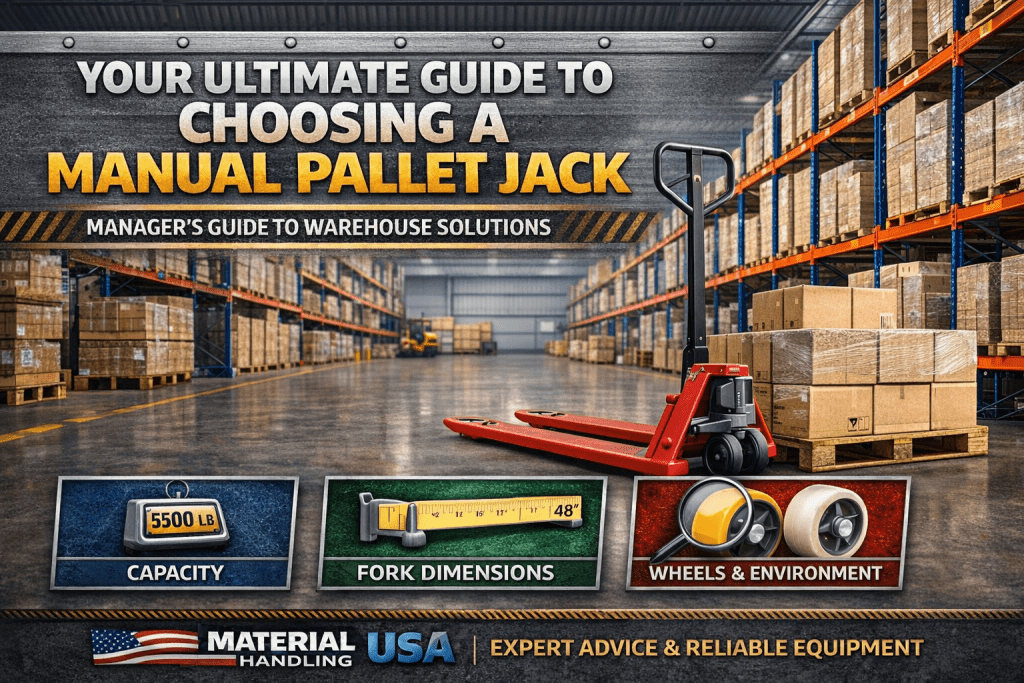
A manual pallet jack is a brilliantly simple tool designed to do one thing perfectly: lift and move palletized loads across short distances. It’s the undisputed MVP in warehouses, bustling retail stockrooms, and on hectic loading docks for its sheer simplicity, low cost, and incredible versatility. For countless businesses, it is not just a piece of equipment, it is foundational.
Why the Manual Pallet Jack Is Still a Warehouse Staple
In an age of automation, the humble manual pallet jack is still the undisputed workhorse of the warehouse floor. Its staying power is not just about the low price tag; it is about pure, tactical efficiency. This tool empowers any team member to move loads up to 5,500 pounds (or even more) without waiting for a certified forklift operator.
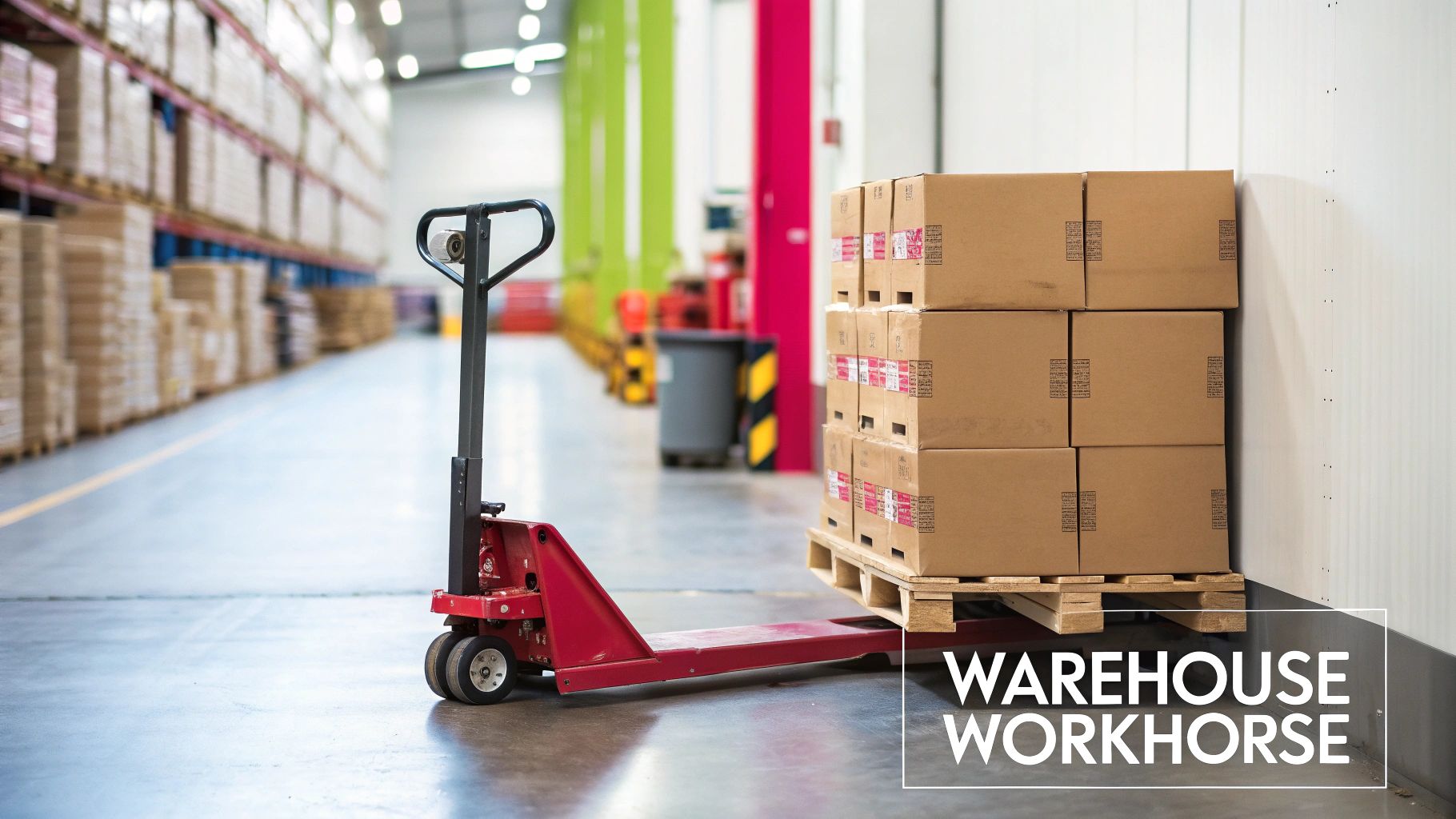
That immediate accessibility is a massive win for productivity. Picture unloading a delivery truck or shuffling inventory down a narrow aisle. A manual pallet jack gives you the agility to make quick, precise moves that keep the entire workflow humming, cutting down on bottlenecks and seriously boosting your operational speed.
A Cornerstone of Modern Logistics
Do not mistake its simplicity for being outdated. The manual pallet jack is a key player in modern, lean warehouse design, fitting perfectly into high touch, low distance tasks. This smart approach allows you to save your more expensive, powered equipment for long hauls and high volume zones, creating a far more balanced and cost effective material handling ecosystem.
The numbers back this up. The global market for pallet jacks is on track to hit USD 1.6 billion by 2035, with manual models still expected to make up the vast majority of units in service. It’s clear that facility planners continue to depend on manual jacks, using them in tandem with advanced systems like selective racking and mezzanines to squeeze every ounce of efficiency from their square footage. You can get more details from the pallet jacks market forecast on futuremarketinsights.com.
The Material Handling USA Advantage
Picking the right tool is only half the battle; you also need the right partner. At Material Handling USA, we supply tough, high quality manual pallet jacks built to take a beating in demanding environments. We stand by our commitment to delivering:
- Competitive Pricing: Get the absolute best value for your investment without ever cutting corners on quality.
- Fastest Shipping: We pride ourselves on having the fastest delivery in the industry, so you can minimize downtime and get back to work.
- Expert Support: Our team offers free, no obligation layout designs and quotes to make sure you get the perfect solution tailored to your facility.
Ready to outfit your team with a pallet jack you can count on? Shop Now or Request a Quote to get started today.
Understanding the Anatomy of a Manual Pallet Jack
To make a confident purchase, you need to know what makes a manual pallet jack tick. Think of it like looking under the hood of a car. Knowing the key parts helps you appreciate quality construction and spot potential red flags. A well built pallet jack is not just a tool; it is a long term asset for your daily operations.
Each component plays a critical role in how the jack performs, from lifting heavy loads to navigating tight corners. Let’s break down the essential anatomy so you can identify a durable, efficient machine that will serve your team well for years.
The Handle and Control Lever
The handle, often called the tiller, is your command center. It is not just for steering; it also houses the control lever and acts as the pump handle for the hydraulic system. A quality handle should feel good in your hands, with an ergonomic grip designed to reduce operator fatigue during long shifts.
That small control lever on the handle is deceptively simple. It typically has three positions:
- Lower: Safely and smoothly lowers the forks.
- Neutral: This is your “freewheel” mode. It disengages the lifting mechanism, allowing you to pull the jack without resistance.
- Lift: Engages the hydraulic pump, so every time you pump the handle, you’re raising the forks.
A crisp, reliable control mechanism is a hallmark of a well engineered pallet jack.
Hydraulic Pump and Lift Mechanism
The hydraulic pump is the heart of the pallet jack, the muscle that does all the heavy lifting. It’s a sealed unit containing hydraulic fluid. When you pump the handle in the “lift” position, you force that fluid into a cylinder, which raises the forks and your pallet load.
A robust hydraulic system is non negotiable. Look for jacks with high quality seals to prevent leaks and ensure consistent lifting power day in and day out. The pump housing itself also needs to be tough, as it has to withstand thousands of lift cycles over its lifespan. For more information on different types of material handling equipment, explore our full range of lifting and material transport equipment.
Forks and Chassis
The forks are what slide under the pallet to engage the load. For maximum durability and safety, they absolutely must be constructed from reinforced, heavy gauge steel. This is what prevents them from bending or warping under heavy loads, a common failure point on cheaper, lower quality models.
The forks are part of the main chassis, or frame, of the pallet jack. A solid, welded steel frame ensures the entire unit maintains its structural integrity while moving loads that can weigh over two tons.
Key Takeaway: The real strength of a manual pallet jack lies in its frame and forks. Always prioritize models with one piece, reinforced steel forks to guarantee longevity and prevent costly equipment failure.
Steer and Load Wheels
Finally, the wheels dictate how the pallet jack moves and handles on your specific floor surface. There are two sets of wheels you need to know about:
- Steer Wheels: These are the larger wheels right under the handle that control the direction you’re going.
- Load Wheels: These are the smaller, tougher wheels at the front end of each fork. They bear the brunt of the load’s weight.
The material these wheels are made from has a massive impact on performance. Choosing the right material for your environment is absolutely critical for efficiency and protecting your floors.
Choosing the Right Pallet Jack Wheel Material
This table compares common load and steer wheel materials to help you select the best option based on your facility’s flooring, noise requirements, and load types.
| Wheel Material | Best For | Pros | Cons |
|---|---|---|---|
| Polyurethane | Smooth concrete, tile, linoleum | Quiet operation, non marking, good grip | Can wear faster on rough surfaces |
| Nylon | Rough concrete, asphalt, cold storage | Highly durable, low rolling resistance | Can be noisy, may damage delicate floors |
| Steel | Heavy duty industrial settings | Extremely durable, highest load capacity | Very loud, can damage most floor types |
Ultimately, choosing the right wheel material prevents a daily struggle and keeps things moving smoothly.
Understanding these core components transforms you from a casual buyer into an informed expert. At Material Handling USA, we prioritize quality materials in every part of our manual pallet jacks, from the ergonomic handle to the durable nylon wheels, ensuring you get a reliable tool built to last. Ready to find the perfect fit for your facility? Request a Quote today.
How to Select the Right Manual Pallet Jack
Choosing the wrong manual pallet jack is like buying shoes that do not fit. Sure, you can tough it out for a bit, but it will not be long before you are dealing with inefficiency, discomfort, and maybe even a few safety hazards. This guide will walk you through making a smart choice, so your new jack becomes a genuine asset, not a daily frustration.
Picking the right model all comes down to asking the right questions about how you work. At Material Handling USA, we do not just sell equipment; we help you find the perfect solution for your space. That’s why we offer free layout and design consultations to match the right tool to your unique environment for peak performance and safety.
Start with Load Capacity and Weight
First things first: load capacity. This is the absolute maximum weight a pallet jack is built to handle safely. Pushing this limit is a recipe for disaster. It can lead to equipment failure, damaged inventory, and serious injuries.
Always play it safe. Choose a pallet jack with a capacity that’s comfortably above the heaviest loads you move on a regular basis. Most standard jacks can handle around 5,500 pounds, which works for many operations. But if you are moving dense materials or consistently oversized loads, you will need to step up to a heavy duty model.
Match Fork Dimensions to Your Pallets
Next up are the fork dimensions, specifically, the length and the overall width. The goal here is simple: match the jack to the pallets you use every day. Forks that are too short or too long create an unstable load, making it a nightmare to maneuver.
Standard pallet jacks are designed for the most common pallet size: 48 inches long by 40 inches wide. Here are the measurements you need to double check:
- Fork Length: The standard is 48 inches. You can also find shorter 36 inch forks for navigating tight spaces like retail stockrooms, or extra long forks up to 96 inches for handling multiple pallets or bulky items.
- Overall Fork Width: This is the distance from the outside edge of one fork to the outside of the other. 27 inches is the standard and fits most pallets. For smaller pallets or narrow entry points, a 20.5 inch width is a popular alternative.
Pro Tip: Before you buy anything, grab a tape measure and check the pallets you use most. Getting the fork dimensions right from the start is one of the easiest ways to boost your team’s efficiency and safety.
Consider Lift Height and Environment
The lift height on a standard manual pallet jack is consistent, usually topping out around 7.5 to 8 inches. This is plenty for clearing most floor bumps or loading onto docks, but some specialized jobs might call for different specs.
While automation gets all the headlines, manual pallet jacks are still the workhorses in most small to mid sized facilities. The global market for pallet handling equipment hit a massive USD 47.7 billion in 2024, and pallet jacks accounted for 35.8% of that. They are indispensable in dense picking areas, stockrooms, and secure zones where travel paths are short and aisles are tight. You can explore the full research on the pallet jack market from Fortune Business Insights to see just how critical these tools are to a facility’s ROI.
The right wheels are also crucial for your environment. This chart breaks down the best choice for your floor type.
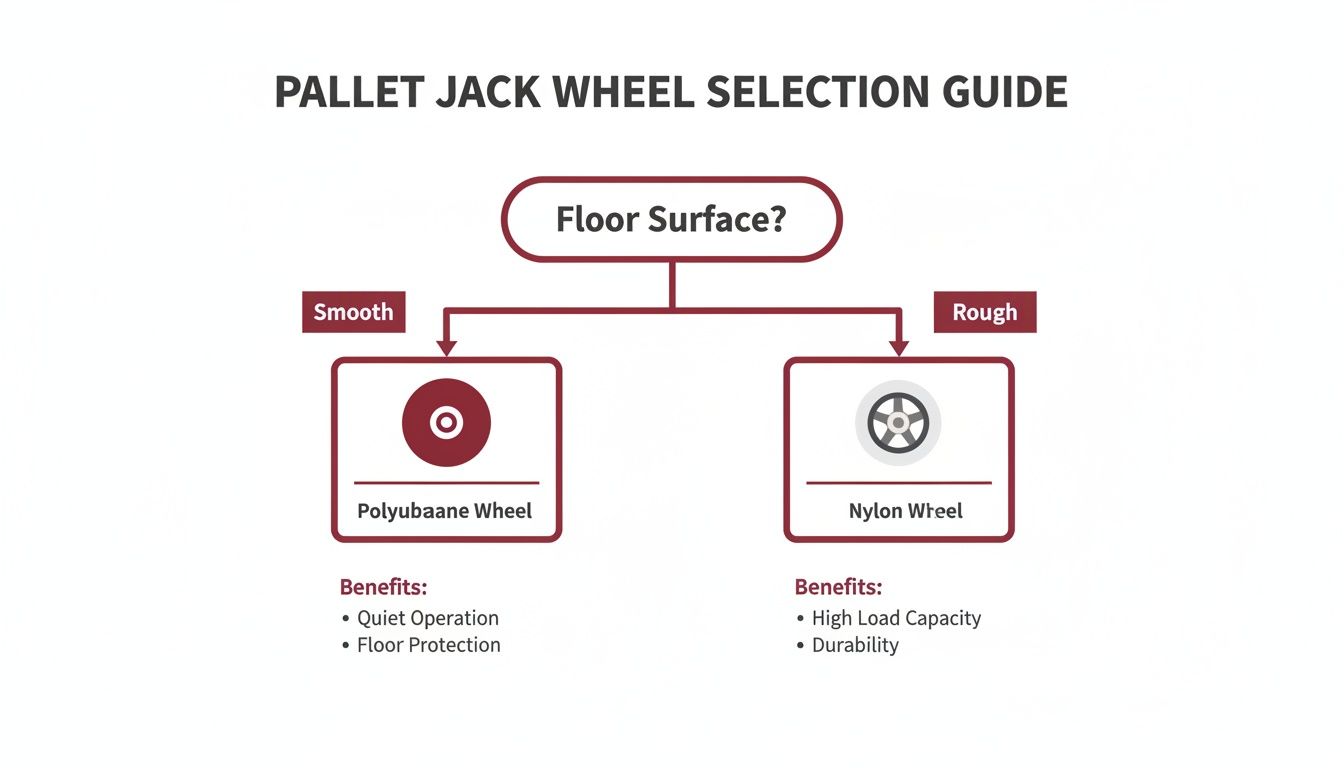
As you can see, polyurethane wheels are your best bet for smooth surfaces, while nylon is the clear winner for rough or uneven floors.
Your Pallet Jack Selection Checklist
Run through this quick checklist before you make a final decision. It will make sure you have covered all the important bases.
- What’s the heaviest load you typically move? (This sets your required load capacity.)
- What are the dimensions of your most used pallets? (This determines your ideal fork length and width.)
- What kind of flooring does your facility have? (This tells you whether to go with polyurethane vs. nylon wheels.)
- How narrow are your aisles or doorways? (This will help you decide between standard or narrow fork widths.)
- Do you work in a special environment, like a freezer or clean room? (You may need a specialized model, like a zinc coated or stainless steel jack.)
Answering these questions will point you straight to the perfect pallet jack for your operation. For a look at some high quality options, feel free to browse our collection of Vestil Pallet Jacks.
If you need a hand analyzing your workflow or designing a more efficient layout, our team is here to help. We provide free quotes and expert advice to ensure you get a solution that truly works for you. Call (800) 326-4403 to talk to a specialist today.
Your standard manual pallet jack is a warehouse workhorse, but let’s be honest, some jobs are just plain weird. When you are dealing with sterile environments, rugged outdoor terrain, or oddly shaped pallets, the basics just will not do.
Choosing the right tool for these unique challenges is not just about getting the job done. It is about safety, compliance, and keeping your operation running smoothly. Because we have seen it all, we know one size definitely does not fit all. That’s why we offer a range of specialized jacks designed to solve very specific problems.
Low Profile Jacks for Non Standard Skids
Ever run into a pallet or skid that’s too low for a standard jack’s forks? It is a classic headache, especially if you handle imported goods, custom crates, or unique manufacturing parts. This is exactly where a low profile manual pallet jack saves the day.
These jacks are built with forks that sit much closer to the ground, often as low as 1.75 inches, a big drop from the typical 3 inches. That small difference is huge in practice. It lets you slide under low clearance skids effortlessly, preventing product damage and stopping dangerous attempts to pry loads up by hand. You will find them indispensable in print shops, custom fabrication facilities, and anywhere else unique container types are the norm.
Corrosion Resistant Jacks for Sterile Environments
In industries like food processing, pharmaceuticals, or labs, cleanliness is everything. A standard painted steel pallet jack is a liability waiting to happen; once it chips or rusts, it becomes a breeding ground for contaminants and a major compliance risk. This is non negotiable territory for corrosion resistant jacks.
You have got two main options here:
- Galvanized or Zinc Coated Jacks: These models are dipped in a protective layer of zinc, giving them solid protection against moisture and the chemicals used in washdowns. They are a smart, cost effective choice for damp areas like coolers or commercial kitchens.
- Stainless Steel Jacks: When you need the absolute highest level of sanitation, nothing else will do. The entire frame, pump, and handle of a stainless steel jack are made from corrosion proof steel. You can sterilize it completely, ensuring it meets the toughest FDA and USDA standards.
Industry Insight: For any facility following a Hazard Analysis and Critical Control Points (HACCP) plan, using a galvanized or stainless steel pallet jack is not just a good idea, it is often a critical control point for preventing cross contamination and keeping products safe.
All Terrain Jacks for Rough Surfaces
Warehouse floors are great, but the real world is messy. What happens when you need to haul a pallet across a gravel lot, a muddy construction site, or an uneven patch of grass? A standard jack’s tiny wheels would grind to an immediate halt. That is a job for the all terrain manual pallet jack.
Think of it as the 4×4 of the pallet jack world. It’s equipped with big, air filled pneumatic tires that soak up bumps and roll right over rough ground. The frame is also usually wider and beefier for extra stability on unstable surfaces. These jacks are absolute must haves for garden nurseries, landscaping suppliers, construction sites, and any business that moves loads between the warehouse and the great outdoors.
If your operation faces any of these unique hurdles, a standard jack just is not going to cut it. Investing in the right specialized model means your team can work safely and efficiently, no matter what you throw at them.
Not sure which specialized jack fits your unique application? Our experts live and breathe this stuff. We are here to help you figure it out with free, no obligation quotes. Contact Us or Call (800) 326-4403 to talk with a material handling specialist today.
Mastering Safe Operation and Maintenance
A manual pallet jack is a fantastic tool, but its real value comes from safe handling and consistent upkeep. Buying quality equipment is step one. Step two is teaching your team how to use it right and take care of it properly. This mindset does not just protect your most valuable asset, your people, but it also guarantees your pallet jack will be a reliable workhorse for years to come.
Think of it this way: prioritizing safety is not just about dodging accidents. It’s about building a confident, efficient, and productive environment. When you weave simple safety checks and maintenance habits into your daily routine, that piece of equipment becomes the backbone of a smooth, secure workflow.
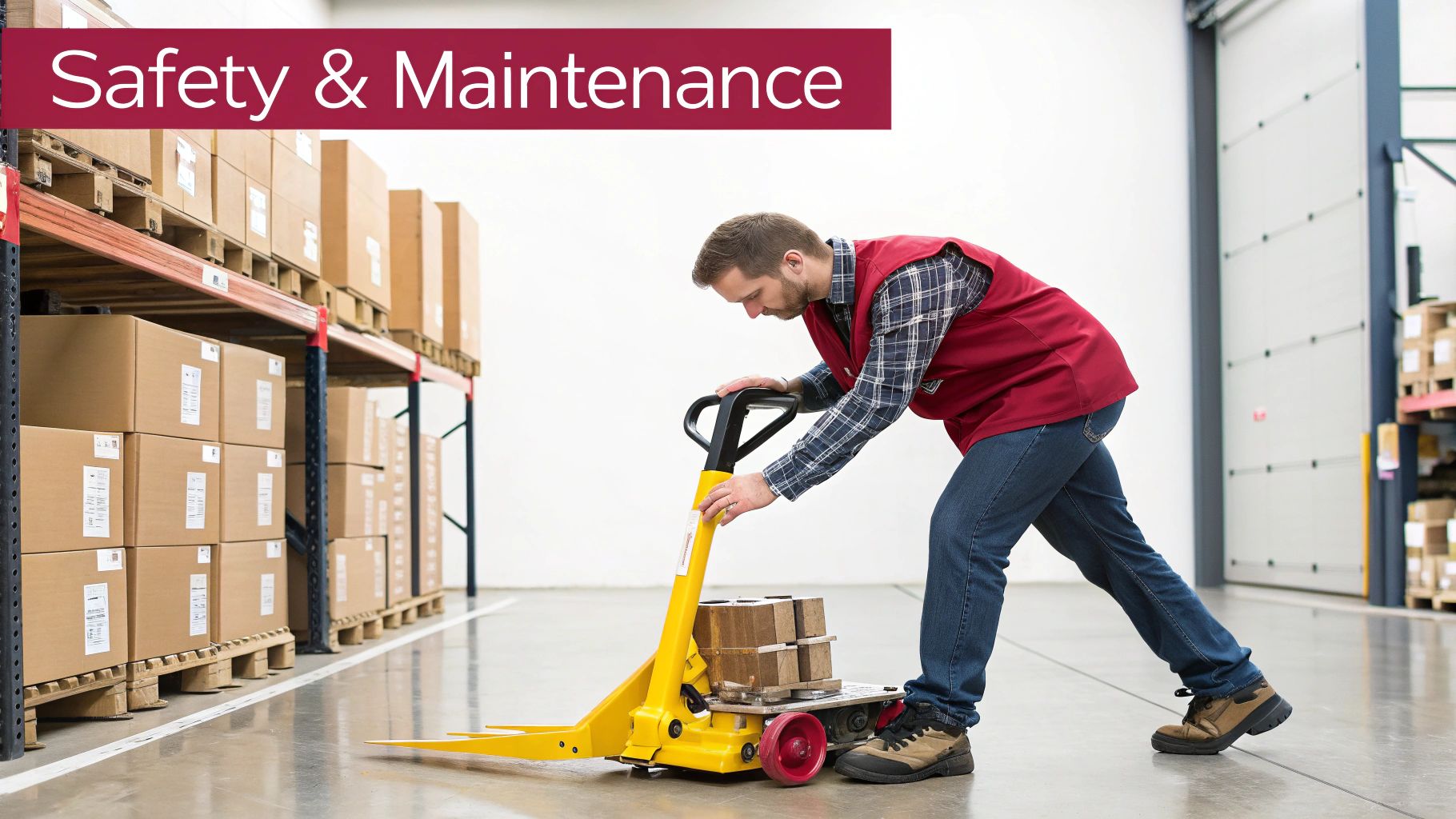
Essential Safety Best Practices
A manual pallet jack might look simple, but misusing it can lead to serious trouble. OSHA data shows that even non powered equipment can cause significant workplace injuries, from broken bones to amputations. That’s why setting clear, non negotiable rules for operation is an absolute must.
The easiest habit to build? A quick visual inspection before every single use. It is a simple step that catches small problems before they spiral into big hazards. From there, sticking to proper load handling techniques is the key to keeping accidents and injuries at bay.
Crucial Reminder: A manual pallet jack has one job. It is not a scooter. It is not a toy. Horseplay, like riding on the jack, is incredibly dangerous and can lead to severe or even fatal injuries.
Pre Operation Safety Checklist
Before you even think about moving a load, run through this quick checklist. It takes less than a minute but can make a massive difference in preventing equipment failure and accidents.
- Inspect the Forks: Look for any cracks, bends, or warping that could weaken the jack.
- Check the Wheels: Make sure both steer and load wheels are clear of debris and spin freely.
- Test the Hydraulic Pump: Give the handle a few pumps. Does it lift smoothly? Do you see any fluid leaks?
- Verify the Controls: Test the three position lever (Lift, Neutral, Lower) to make sure it engages correctly.
- Scan Your Path: Before you move, take a second to clear your route of obstacles, spills, or other debris.
Proactive Maintenance for Longevity
A well maintained pallet jack is a reliable one. A simple, proactive maintenance schedule can dramatically extend the life of your equipment, slash downtime, and save you a fortune on costly repairs or replacements. Best of all, these tasks are straightforward and require minimal tools.
Focus on lubricating key pivot points, checking the hydraulic fluid, and keeping the wheels clean. You can learn more about how to improve warehouse safety and productivity in our detailed guide, which covers everything from equipment care to operational best practices.
Your Simple Maintenance Schedule
Use this table as a starting point for your routine maintenance plan. You may need to adjust the frequency based on how heavily you use your jacks and the environment they operate in.
| Maintenance Task | Frequency | Description |
|---|---|---|
| Clean Wheels | Daily/Weekly | Remove any dirt, plastic wrap, or debris tangled around the wheel axles. This ensures smooth rolling. |
| Lubricate Fittings | Monthly | Apply grease to all pivot points and bearings, including the wheel axles and handle base. |
| Check Hydraulic Fluid | Quarterly | With the forks fully lowered, check the hydraulic fluid level. Top it off if necessary with the correct fluid type. |
| Inspect for Damage | Quarterly | Perform a thorough inspection of the entire frame, handle, and lifting mechanism for cracks or signs of wear. |
For extra guidance on workplace safety standards, we always recommend consulting official OSHA resources to support your facility’s training programs.
You have got the knowledge, and now you know what to look for in a manual pallet jack. But choosing the right piece of equipment is only half the battle. The final step is finding a partner who gets that the right tool is not just a purchase, it is a strategic asset that keeps your operation moving.
At Material Handling USA, our entire mission is to make sure you get the best tool for the job, backed by people who know what they are talking about. We combine competitive pricing and the industry’s fastest shipping with an absolute commitment to quality. Every pallet jack we sell is built from high grade materials meant to take a beating, day in and day out.
We’re More Than Just a Supplier
Look, anyone can sell you a piece of equipment. We want to be the team you call to optimize your entire facility. That’s why our in house experts provide free, no obligation layout designs and practical advice that solves your real world operational headaches. We are here to help you work smarter and safer, period.
Even with all the buzz around powered equipment, the humble manual pallet jack is still the undisputed workhorse of modern logistics. In 2024 alone, manual models brought in around USD 17.4 billion in revenue. That’s nearly half of all pallet truck sales worldwide, a staggering number that proves their critical role in any efficient workflow. You can dig deeper into these pallet truck market trends on gminsights.com.
This is exactly why we are so focused on providing top tier manual options. Whether you need a standard jack shipped out today or a specialized model for a tricky application, we have you covered. Our goal is simple: equip your team for maximum productivity.
Let’s Build a Solution Together
Choosing the right partner is every bit as important as choosing the right product. With our quality equipment, lightning fast delivery, and free design services, Material Handling USA is your one stop shop for everything that keeps your facility running.
Ready to get moving?
- Shop Now to see our online catalog and place an order.
- Request a Quote for custom equipment or if you are buying in bulk.
- Call (800) 326-4403 to talk shop with one of our experts.
Got Questions About Manual Pallet Jacks? We’ve Got Answers.
Even with all the details, you might still be mulling over a few things. That’s completely normal, especially when you are investing in equipment that keeps your operation moving. To help you feel confident in your choice, we have put together some of the most common questions we hear from managers and buyers just like you.
Think of this as a quick reference guide to clear up any final uncertainties for you and your team.
What Is the Average Lifespan of a Manual Pallet Jack?
How long a manual pallet jack lasts really comes down to three things: build quality, how hard you run it, and whether you show it any love with maintenance. A well built, properly maintained jack in a typical warehouse environment can easily give you 5 to 7 years of solid service, sometimes even longer.
On the flip side, a cheap model that’s constantly overloaded and never sees a drop of lubricant might give up the ghost in a year or two when a key part gives out. The lesson here? Investing in a durable jack and sticking to a basic maintenance schedule is the surest way to get the best return on your investment.
Can I Use a Manual Pallet Jack on an Incline?
You can, but it demands your full attention and strict adherence to safety rules. Pushing a heavy load up a ramp is a serious workout and can lead to injuries, while trying to control that same load on the way down can be downright dangerous if you are not careful.
If you have to navigate a ramp, these safety rules are non negotiable:
- Going Up: Always push the load, keeping it uphill from your body.
- Going Down: Walk backward, pulling the jack behind you. The load should always be downhill from you. This way, if you slip or lose your grip, you are out of the pallet’s path.
- Never Turn Sideways: Go straight up or straight down the incline. Turning sideways is a recipe for tipping the whole thing over.
If your facility has steep grades or your team is constantly going up and down ramps, an electric model with built in braking is a much safer and more efficient way to go.
Safety First: Do not underestimate the risks. OSHA data shows that even simple, non powered equipment like pallet jacks can be involved in serious injuries, including fractures and fatalities. Proper training, especially for tricky situations like inclines, is an absolute must.
What’s the Real Difference Between a Standard and Heavy Duty Model?
They might look alike at a glance, but the real difference between a standard and a heavy duty manual pallet jack is what’s on the inside, the guts of the machine.
A standard manual pallet jack is the workhorse of most warehouses, typically built to handle around 5,500 pounds. It’s made from durable steel but is engineered for the most common pallet weights and daily tasks.
A heavy duty model, however, is a different beast entirely, built for more punishing work.
- Bigger Load Capacity: These are engineered to handle 6,500 pounds or more.
- Reinforced Everything: The frame, the forks, and the hydraulic pump are all beefed up with thicker gauge steel and stronger welds. They are designed to take extreme stress without bending, flexing, or failing.
Choosing a heavy duty model is essential if you are regularly moving dense, unforgiving materials like stone slabs, metal coils, or engine blocks. Trying to use a standard jack for that kind of work will cause premature wear and create a serious safety hazard.
At Material Handling USA, we do not just sell equipment; we provide the expertise to make sure you get the right tool for the job. Whether you have a few more questions or you are ready to outfit your facility, our team is here to help.
Contact Us or Call (800) 326-4403 for a free, no obligation quote and expert advice.