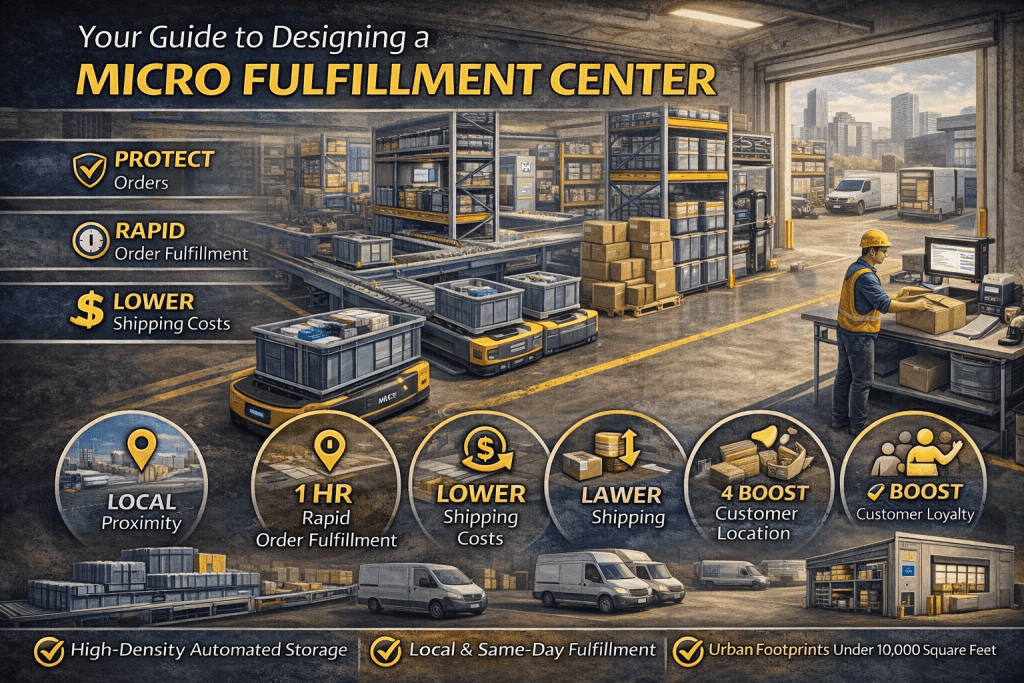
A micro fulfillment center is a small scale, highly automated warehouse strategically placed in dense urban areas. You might find one in the backroom of a retail store or a compact city warehouse. The main goal is to get inventory as close as possible to the end customer, making lightning fast, last mile delivery and in store pickups a reality.
What Exactly Is a Micro Fulfillment Center?
Picture taking a massive, sprawling distribution warehouse and shrinking it down into a powerful, compact hub. One that can fit in the back of a grocery store or a small urban building. That’s the core idea behind a micro fulfillment center (MFC). These facilities are engineered from the ground up to solve the biggest challenge in modern e commerce: delivering orders quickly and affordably at a local level.
Unlike traditional warehouses that are often located miles outside of city centers and cover hundreds of thousands of square feet, an MFC is typically under 10,000 square feet. It’s not built for long term storage; it’s a high octane engine designed for one thing: processing orders at incredible speed.
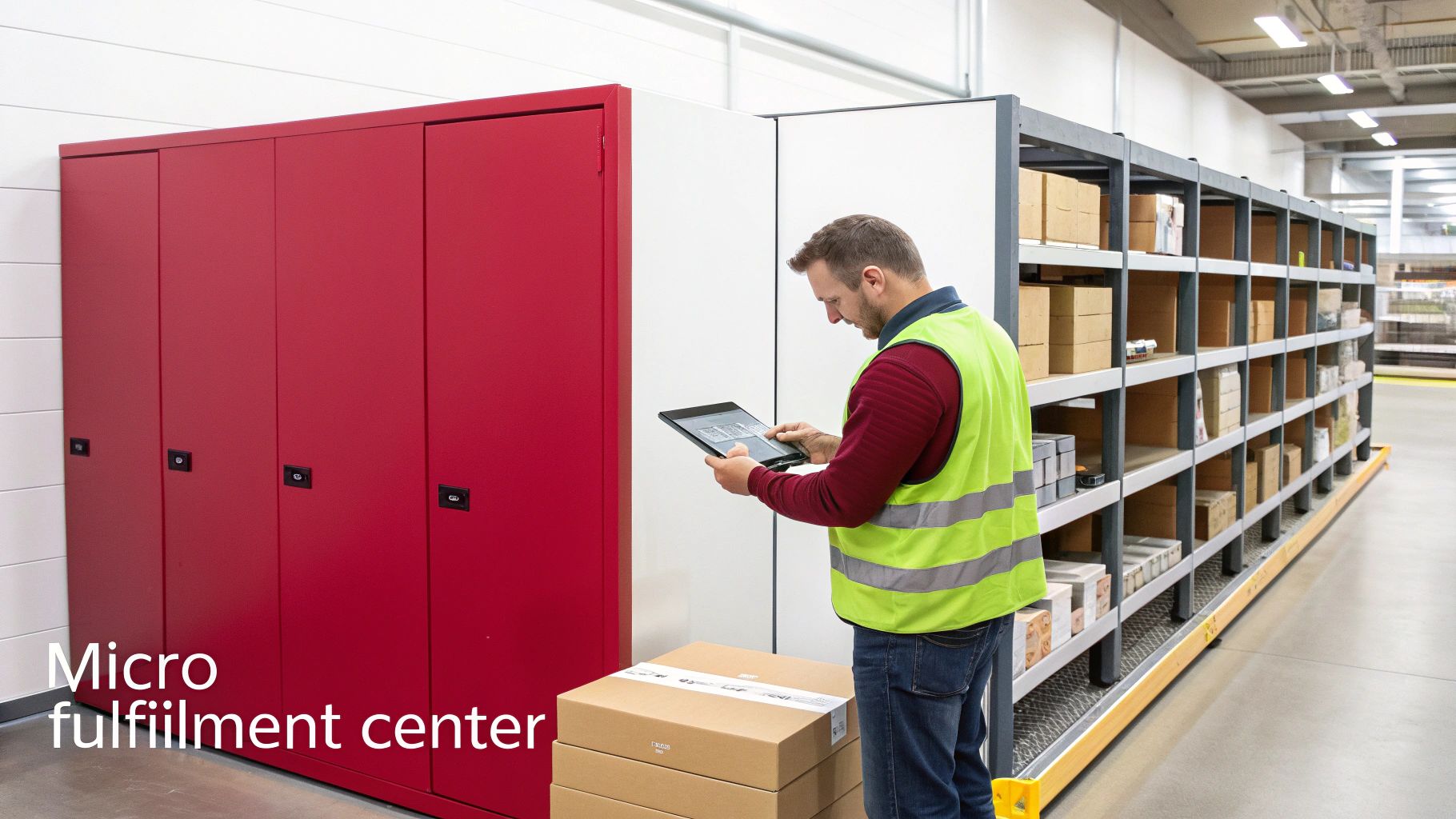
Key Characteristics of an MFC
The real advantage of a micro fulfillment center comes from its unique operational model. Instead of shipping an order from a distant mega warehouse, businesses can process it just a few miles from the customer’s front door.
This proximity is the secret that unlocks some serious advantages:
- Drastically Reduced Delivery Times: When you shorten the final leg of the delivery journey, you can realistically offer same day or even one hour delivery windows.
- Lower Shipping Costs: Fewer shipping zones to cross and shorter distances to travel mean big savings on last mile transportation, which is often the most expensive part of the supply chain.
- An Unbeatable Customer Experience: In a world of instant gratification, meeting and beating customer expectations for speed and convenience builds serious loyalty and a powerful competitive edge.
Traditional Warehouse vs. Micro Fulfillment Center
To really understand why the MFC model is such a game changer, it helps to see how it stacks up against conventional fulfillment operations. The right setup always depends on a company’s goals, but for any business laser focused on speed and accuracy, an MFC has a clear advantage.
Let’s put the two head to head:
| Feature | Traditional Fulfillment Center | Micro Fulfillment Center (MFC) |
|---|---|---|
| Size | 100,000+ sq. ft. | Typically under 10,000 sq. ft. |
| Location | Rural or suburban industrial parks | Dense urban and suburban areas |
| Inventory | Months of stock, broad SKU range | Days of stock, high demand SKUs |
| Primary Goal | Bulk storage and regional distribution | Last mile delivery and speed |
| Automation | Varies; can be manual or automated | Almost always highly automated |
This strategic shift isn’t happening in a vacuum; it’s a direct response to how we all shop now. The expectation for “now” delivery is no longer a luxury, it’s the standard. A micro fulfillment center is the engine that makes this new standard possible for businesses of any size.
The Strategic Benefits of Adopting an MFC
Bringing a micro fulfillment center (MFC) into your supply chain isn’t just a minor operational tweak, it’s a strategic move that delivers serious business results. For any manager with an eye on the bottom line, the benefits are compelling and direct. They touch everything from shipping costs to the kind of customer loyalty that builds brands. By placing inventory right in the heart of urban centers, businesses are unlocking powerful competitive advantages.
The most immediate win? A dramatic drop in last mile delivery costs. When you move products closer to your customers, you shrink the most expensive and frustrating part of the entire delivery journey. This proximity directly translates to faster shipping times, which is no longer a perk but a core expectation for today’s shoppers.
Faster Shipping and Greater Customer Loyalty
In the age of instant gratification, offering one hour delivery or a seamless buy online, pickup in store (BOPIS) experience is what separates you from the competition. An MFC makes this a reality. When a customer knows they can get their order the same day, your brand becomes the automatic, go to choice, building a powerful sense of loyalty that keeps them coming back again and again.
This need for speed is precisely what’s driving MFC adoption. The market is clear: shrinking delivery windows and soaring e grocery demand in dense urban areas are the major catalysts. For example, as same day online grocery penetration was projected to hit 21% by 2025, retailers scrambled to keep up. Many turned to MFCs and high density robotics, which can slash pick and pack cycles down to under 10 minutes.
This shift has enabled those ambitious one hour delivery promises and fueled a massive 30.1% compound annual growth rate for “dark store” micro formats built specifically for these megacities. You can dive deeper into these trends in the full micro fulfillment market report.
Unlocking Operational Precision and Efficiency
Beyond pure speed, the precision of an MFC leads to fantastic order accuracy and much simpler inventory management. The highly controlled, and often automated, environment inside a micro fulfillment center drastically reduces the chances of human error. That means fewer costly mistakes, like sending out the wrong shipment.
This operational excellence delivers several key advantages:
- Near Perfect Order Accuracy: Automation and optimized workflows mean customers get exactly what they ordered. This cuts down on the high costs of returns and keeps your customer service team from getting bogged down with complaints.
- Improved Inventory Management: With a smaller, focused inventory of just your high demand SKUs, tracking and managing stock becomes much simpler. The result is less waste and fewer frustrating stockouts.
- Maximized Real Estate Usage: One of the smartest benefits is the ability to deploy an MFC within your existing real estate, think a retail stockroom or a small urban warehouse. This clever use of space avoids the need for huge, upfront capital investments in brand new facilities.
By focusing on these strategic areas, an MFC doesn’t just make your fulfillment faster; it makes your whole operation smarter and more profitable. If you’re wondering how an MFC could fit into your current space, our team offers free layouts and designs with no obligation.
By transforming an underutilized stockroom into a high efficiency fulfillment hub, you can turn a cost center into a powerful revenue generator, boosting both in store and online sales from a single location.
Ready to see how these benefits could apply to your business? Request a Quote to get a detailed analysis from our design experts. We specialize in creating efficient layouts that squeeze every bit of value out of your space and operational flow, all at a competitive price.
How to Plan Your Micro Fulfillment Center Layout
A successful micro fulfillment center isn’t just about the equipment you put inside it; it’s built on an intelligent, efficient design. The right layout is your roadmap, guiding products from receiving to dispatch with maximum speed and minimal friction. Planning this flow from the ground up is the single most important step you can take to unlock the full potential of your MFC investment.
The process starts with a deep dive into your operational data. You need to really understand your order volume, which items fly off the shelves (SKU velocity), and what a typical customer order looks like. This information is what dictates how you strategically carve out space for each critical zone: receiving, high density storage, packing, and shipping. A data driven approach nips bottlenecks in the bud, ensuring a smooth and continuous workflow from day one.
This infographic breaks down how a well planned process directly impacts your bottom line, connecting operational improvements all the way to customer satisfaction.
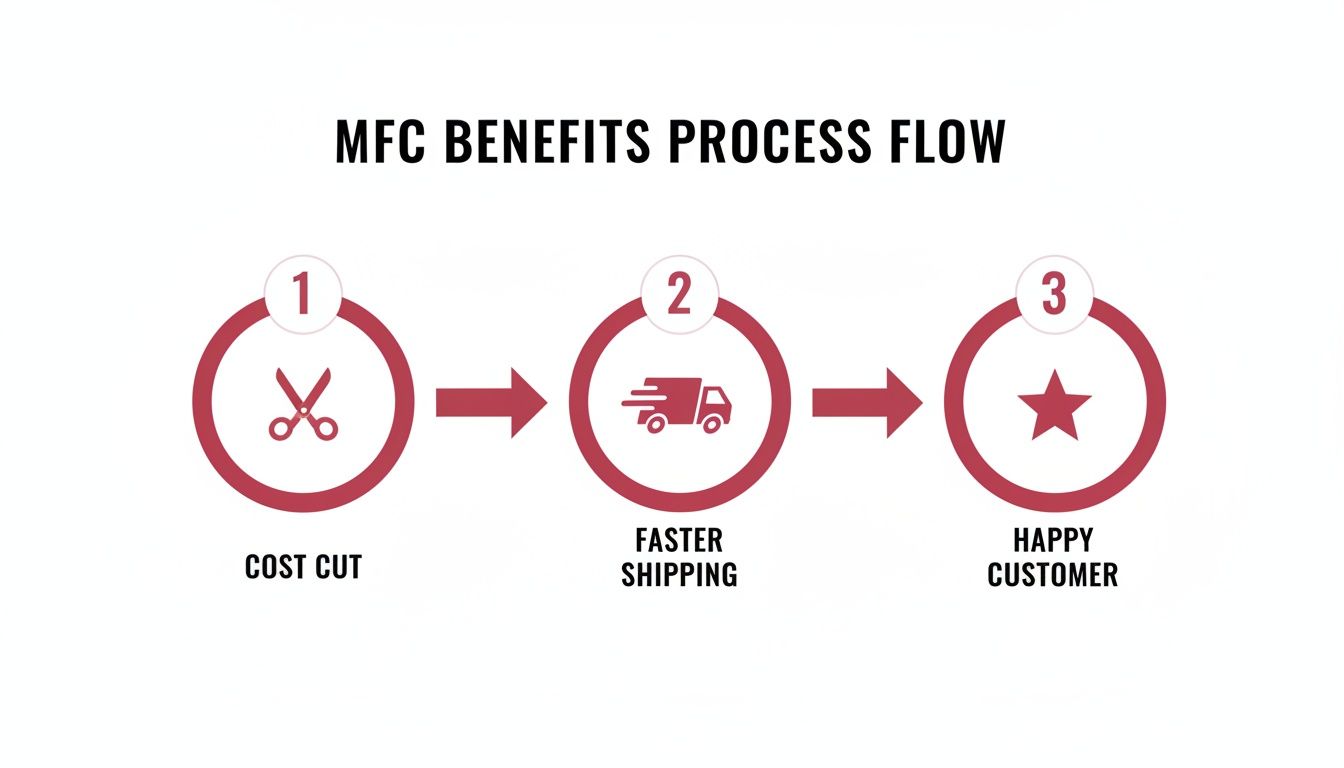
As you can see, optimizing the layout to cut operational costs is the first domino to fall. That efficiency is what enables faster shipping, which ultimately creates a more satisfied and loyal customer base.
Maximizing Every Square Foot
The core principle behind any MFC layout is maximizing every single square foot of available space. Unlike massive traditional warehouses, MFCs thrive on density and efficiency within a compact footprint, often under 10,000 square feet. This requires a total shift in thinking, away from horizontal sprawl and toward vertical opportunity.
Going vertical isn’t just a good idea; it’s non negotiable. Solutions like industrial mezzanines can effectively double your usable floor space without the staggering cost of new construction. They create an entire second level for more storage, packing stations, or even administrative offices. This keeps the ground floor clear for high traffic activities like receiving and shipping, making it one of the most effective ways to boost capacity in an existing building.
Designing the Optimal Workflow
A logical workflow is the beating heart of an efficient MFC. The goal is simple: minimize travel time for both your team and your products. Your layout should create a seamless, one way path that prevents cross traffic and wasted motion.
Think of it like a U shaped flow:
- Receiving Zone: Products enter at one end of the “U.” This area needs enough room for unloading, inspecting, and logging new inventory.
- Storage Zone: From receiving, items move directly into a high density storage area. This is where you’ll strategically place your fastest moving SKUs for the quickest access.
- Picking & Packing Zone: As orders come in, items are picked and brought to dedicated packing stations located right next to the storage area to slash travel time.
- Dispatching Zone: Completed orders move to the dispatching area at the other end of the “U,” ready for carrier pickup or local delivery drivers.
This straightforward progression ensures that each step flows directly into the next, eliminating the backtracking and confusion that can bring an operation to its knees.
A Data Driven Layout Checklist
Crafting a plan that actually works requires a close look at multiple factors. Getting it right from the start saves a tremendous amount of time and money down the road, and this is where expert guidance becomes invaluable. Our team specializes in comprehensive warehouse design and layout services, turning your raw operational data into a high performance floor plan.
To help you get started, we’ve put together this checklist to guide your planning discussions. It covers the critical considerations you’ll need to address to ensure your MFC is designed for peak performance from the moment it goes live.
MFC Layout Planning Checklist
Use this checklist to ensure you cover all critical considerations when designing your micro fulfillment center.
| Planning Phase | Key Considerations | Potential MH USA Solution |
|---|---|---|
| Data Analysis | What’s my daily order volume? Which SKUs are my top sellers? What are the physical dimensions of my products? | Free consultation to analyze your data and identify key layout drivers. |
| Space Planning | How can I maximize vertical space? What’s the most logical product flow? How much space is needed for each zone? | Free, no obligation layouts and 3D designs to help you visualize the final space. |
| Storage Strategy | What mix of shelving and racking is best for my SKU profile? Should I consider mobile aisle or high density systems? | A wide range of industrial shelving, pallet racking, and mobile systems tailored to your inventory. |
| Workflow Design | Where should packing stations be located? How can I minimize pick path travel time for my team? | Ergonomic packing stations and conveyor systems to automate movement and reduce strain. |
A well designed layout is far more than just a floor plan; it’s a strategic asset that directly impacts your labor costs, order accuracy, and fulfillment speed. Investing in professional design ensures your MFC is optimized from day one, setting you up for success instead of headaches.
Equipping Your MFC for Peak Performance
A smart layout is the blueprint, but the right equipment is what brings your micro fulfillment center to life. The hardware you choose becomes the backbone of your entire operation, directly controlling your throughput, order accuracy, and long term ROI. If you invest in quality, durable products from the start, you’re setting your MFC up to handle the intense demands of high volume fulfillment from day one.
Let’s walk through the essential gear needed to outfit a high functioning MFC, breaking it down by operational zone. Each piece plays a critical part in building a smooth and productive workflow.
Core Storage Solutions
The whole point of an MFC is to pack as much storage as possible into a small footprint. Your storage solutions have to be flexible enough for a wide range of SKUs while using every single inch available, especially vertical space.
- Industrial Wire Shelving: This is the undisputed workhorse of most MFCs. Its open design is great for airflow, makes it easy to see inventory, and is a breeze to clean. It’s perfect for hand picking smaller, lighter items and can be configured in endless ways to fit your specific products.
- Pallet Racking: For bulk goods or anything arriving on pallets, selective pallet racking gives you strong, accessible storage. It’s the foundation for organizing backstock before it gets broken down into individual picks.
- High Density Mobile Shelving: When floor space is the biggest constraint, mobile aisle systems are a total game changer. These systems put shelving on mobile carriages that compact together, getting rid of static aisles. This one move can nearly double your storage capacity in the exact same footprint.
For standard shelving and racking, you can find competitively priced options ready for the industry’s fastest shipping. Shop Now to see our in stock inventory. For a specialized high density system, Request a Quote for a free, custom design.
Efficient Material Movement
Once your inventory is stored, you need to get it moving quickly and safely through the fulfillment process. The less time your team spends walking, the lower your labor costs and the faster your cycle times. A fluid workflow absolutely depends on having the right equipment to move goods from storage to packing and out the door.
Automated systems are a powerful way to create this flow. For example, strategically placed conveyor systems can act like the circulatory system of your MFC, automatically moving totes and packages between zones. This frees up your team to focus on what matters, picking and packing, instead of just walking back and forth. You can explore a variety of conveyor solutions that can be tailored to your specific layout.
Don’t forget the basics, either. Ergonomic carts and dollies are still essential for safely moving heavier items or batches of orders without putting a strain on your staff.
Packing and Shipping Stations
The packing station is where the final, make or break steps happen. An organized, well equipped station is non negotiable for keeping up accuracy and speed when the pressure is on. A poorly designed station will quickly become a major bottleneck, grinding your whole operation to a halt.
An ideal packing station includes:
- Ergonomic Workbenches: Benches with adjustable heights reduce physical strain, which keeps your team comfortable and productive.
- Integrated Supplies: Keep scales, printers, scanners, and all your packing materials (boxes, tape, void fill) within arm’s reach to eliminate wasted motion.
- Adequate Lighting: Good lighting is crucial for making sure labels are read correctly and orders are packed perfectly every time.
A well designed packing station can improve an individual worker’s throughput by over 25%. Investing in quality benches and organized supplies pays for itself quickly through sheer efficiency and fewer mistakes.
Security for High Value Inventory
Not all inventory is created equal. If your MFC handles expensive items like electronics, pharmaceuticals, or luxury goods, locking that stock down has to be a top priority. Inventory shrinkage is a silent profit killer.
Security cages, built from heavy duty woven or welded wire mesh, provide a tough, visible barrier. They create a secure, access controlled area right inside your facility without blocking airflow or visibility. This allows you to protect your most valuable assets while keeping an open feel in the rest of the space. These modular cages can be configured to any size or shape, offering a flexible fix for protecting your most important products.
Ready to secure your high value inventory? Contact Us for a free consultation and layout design to see how a security cage can fit into your MFC.
Integrating Automation and Software
If the physical equipment is the backbone of a micro fulfillment center, then automation and software are its brain and nervous system. This is the tech that coordinates every single movement, turning the promise of hyper fast, accurate order processing into a reality. A modern MFC simply can’t function without an intelligent software core pulling all the strings.
The level of automation in an MFC can vary quite a bit, ranging from simple upgrades to fully robotic systems. On one end, you have technology assisted manual processes where your team uses barcode scanners and tablets to follow optimized pick paths. Just this step alone can massively boost accuracy and speed compared to old school paper based methods.
On the far end of the spectrum are sophisticated goods to person (GTP) robotic systems. Instead of workers walking up and down aisles to find products, these automated systems grab the specific storage totes or shelves and bring them directly to a stationary staff member for picking. This all but eliminates wasted travel time, a huge factor that can eat up over 50% of a picker’s shift in a traditional warehouse.
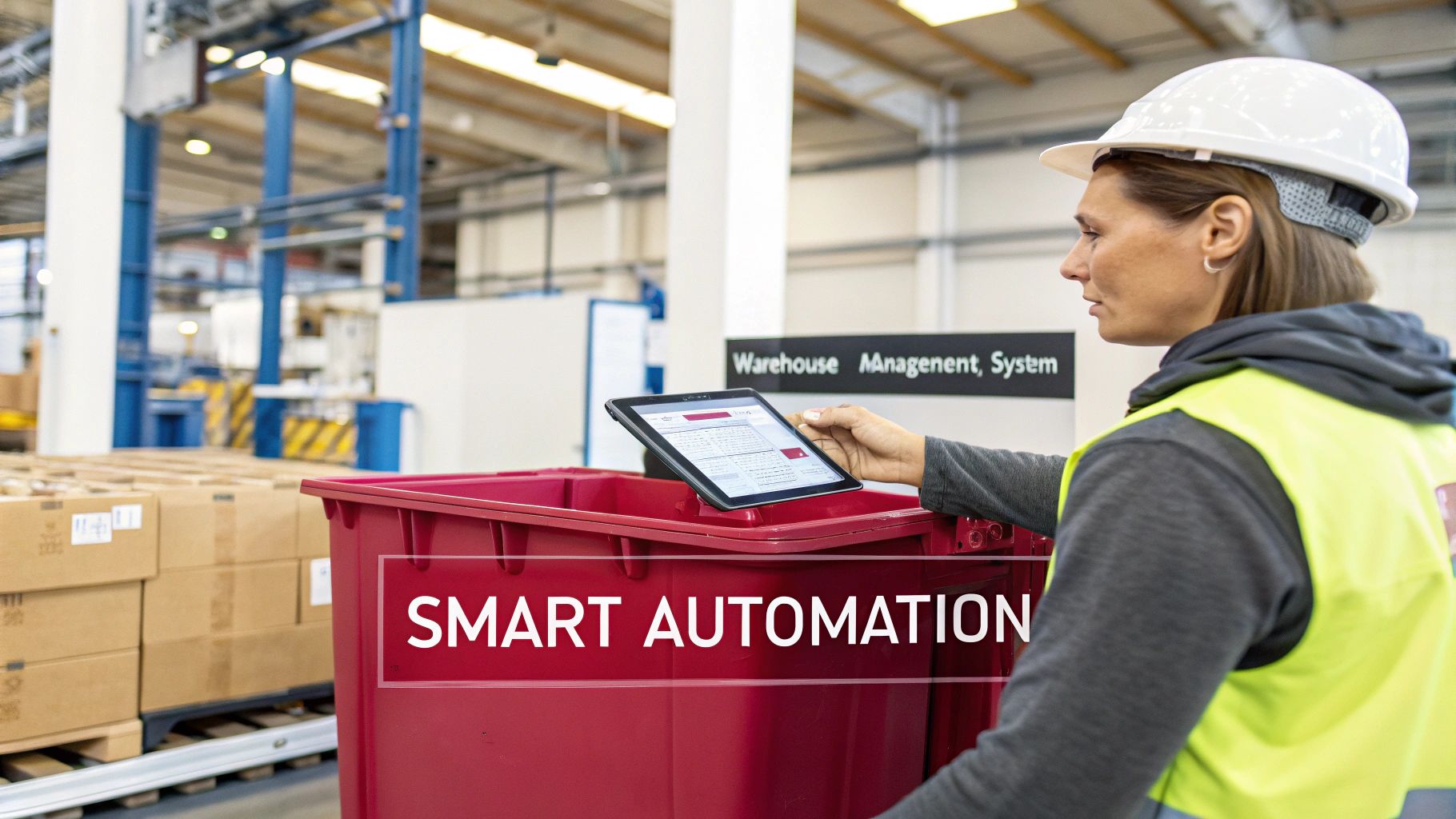
The Central Role of Management Software
The command center for all this activity is a Warehouse Management System (WMS) or a Warehouse Execution System (WES). Think of these software platforms as indispensable, managing every task from the moment inventory hits your dock until an order is shipped out the door.
A solid WMS or WES handles the critical functions that make or break an MFC’s success:
- Inventory Management: Gives you real time visibility into stock levels, preventing you from overselling and automatically triggering replenishment alerts.
- Order Processing: Pulls in orders from e commerce platforms and intelligently groups them for the most efficient picking route.
- Task Orchestration: Directs both human workers and automated systems, optimizing workflows to cut down on congestion and maximize throughput.
Without this software, even the most advanced robotics and equipment would just be an uncoordinated, inefficient mess. It’s what ensures every component works together as one cohesive unit.
Planning for Seamless Technology Integration
A common mistake is treating the physical layout and the technology stack as two separate projects. From our experience, the most successful MFC designs are created with technology integration in mind from day one. The physical placement of racking, conveyors, and workstations absolutely must support the digital workflow your software dictates.
At Material Handling USA, our focus is practical. We provide free layouts and designs that are built for seamless integration from the ground up. We consider the nitty gritty details, like network connectivity, power requirements for automated systems, and the strategic placement of workstations to ensure your physical buildout perfectly complements your tech.
For the seamless operation of automated systems, a robust and intelligent network backbone is essential. This is often achieved through the use of a Managed Ethernet Switch, which ensures reliable communication between all your hardware and software components.
When designing your MFC, always plan your infrastructure for what’s next. Select scalable software and make sure your layout can accommodate more automation down the road. This kind of foresight ensures your initial investment continues to deliver value as your business grows.
Selecting the Right Automation and Software
Choosing the right technology can feel overwhelming, but it really boils down to matching the solution to your specific operational needs and budget. Not every MFC needs a fleet of robots. A well implemented WMS paired with an optimized manual picking process can deliver incredible efficiency gains on its own.
Here is a simplified look at the common automation levels:
| Automation Level | Key Technology | Best For |
|---|---|---|
| Tech Assisted Manual | WMS, Barcode Scanners, Tablets | Lower volume operations, budget conscious startups, or facilities with diverse, hard to automate SKUs. |
| Zone Based Systems | Conveyors, Pick to Light Systems | Mid volume operations where specific zones can be dedicated to high velocity items to speed up picking. |
| Goods to Person (GTP) | Autonomous Mobile Robots (AMRs), AS/RS | High volume operations demanding maximum throughput and accuracy in a very compact footprint. |
The key is to start with a solid software foundation (WMS/WES) that can grow with you. You can begin with a tech assisted manual process and then add more complex automation layers as your order volume justifies the investment.
Ready to explore how to design a physical layout that’s optimized for technology? Contact Us today for a free, no obligation design consultation. Our experts can help you plan a space that’s ready for the future.
Conclusion: Start Your MFC Project with a Strategic Partner
Taking the plunge on a micro fulfillment center is a significant strategic move, and it’s not one you should have to make alone. We’ve walked through what an MFC is, the serious competitive edge it can create, and the fundamentals of designing a high performance operation. Now, let’s turn that knowledge into a real world plan.
At Material Handling USA, we’re not just selling equipment off a shelf. We’re your strategic partner in building a logistics operation that’s faster, smarter, and more efficient. Our entire business is built on a simple promise: deliver high quality products at competitive prices, backed by the fastest shipping in the industry.
From Concept to Completion
The most critical step in any successful project is the initial design. A well planned layout is the foundation for everything that follows, which is why we offer free, no obligation layout and design services. Our expert team works directly with you to understand your specific operational challenges and transform them into a detailed, high performance floor plan. We help you get it right from day one.
Getting proactive is essential, especially in a market that’s exploding. The shift toward urban logistics is happening fast. One analysis projects the global micro fulfillment market will skyrocket from US$6.61 billion in 2025 to an incredible US$53.25 billion by 2032. That’s a compound annual growth rate (CAGR) of about 34.7%, driven largely by store integrated solutions. You can dig into the specifics by exploring the full micro fulfillment market analysis.
Your Next Steps to Success
Whether you’re ready to order standard equipment today or need a deep dive consultation for a complex, custom project, our team is here to back you up. We provide the tools and the expertise to build the perfect solution for your business, ensuring you can nail customer demands for speed and accuracy.
Turning your fulfillment challenges into a competitive advantage starts with a conversation. Let our team provide a free, expert design that shows you exactly what’s possible for your space and your budget.
Ready to take the first step? Let’s build a solution that drives your business forward.
- For standard equipment with our industry leading shipping speeds, you can Shop Now.
- For a custom plan, reach out to our design experts to Request a Quote.
- Have questions? Our team is ready to help. Call (800) 326-4403 or Contact Us online today.
Frequently Asked Questions
When you start digging into micro fulfillment, a few key questions always pop up. Getting straight answers is the first step in figuring out if this strategy is right for you. Let’s tackle the most common ones we hear from managers and business owners.
How Big Is a Typical MFC?
The “micro” in micro fulfillment center is the key. Forget those sprawling, million square foot distribution centers out in the suburbs. An MFC is almost always under 10,000 square feet.
This compact footprint is its superpower. It’s what lets you tuck a high tech fulfillment operation into the backroom of an existing store or a small urban warehouse, right where your customers are.
What Industries Benefit Most from MFCs?
While just about any e commerce operation can get a boost from an MFC, a few industries are leading the charge because their customers demand lightning fast service.
- Grocery: The pressure for one hour delivery of fresh produce and pantry staples makes MFCs a perfect fit.
- General Retail: This is the engine behind successful “buy online, pickup in store” (BOPIS) programs and same day local delivery.
- Pharmaceuticals: For getting prescriptions and medical supplies delivered quickly and securely, there’s no better solution.
Can an MFC Be Added to an Existing Store?
Absolutely. In fact, that’s one of the smartest and most popular ways to do it.
Think about that underused stockroom or back of house space. By converting it, you’re not just adding a fulfillment hub; you’re turning a cost center into a powerful asset that can serve both your online and in store shoppers from one pool of inventory.
What Does It Cost to Fulfill an Order?
The initial setup cost for automation and equipment will vary, but the number you really want to watch is your operational cost per order. With an efficient MFC, you can expect the cost to fulfill a single order to land somewhere between $3 and $5.
This is often dramatically lower than fulfilling from a huge, distant warehouse. Why? Because you’re slashing those expensive last mile delivery costs, which are typically the biggest drain on your logistics budget.
Ready to see how these concepts could look in your own facility? The expert team at Material Handling USA offers free, no obligation layouts and designs to help you visualize the perfect MFC for your space. Contact Us or give us a call at (800) 326-4403 to start the conversation.