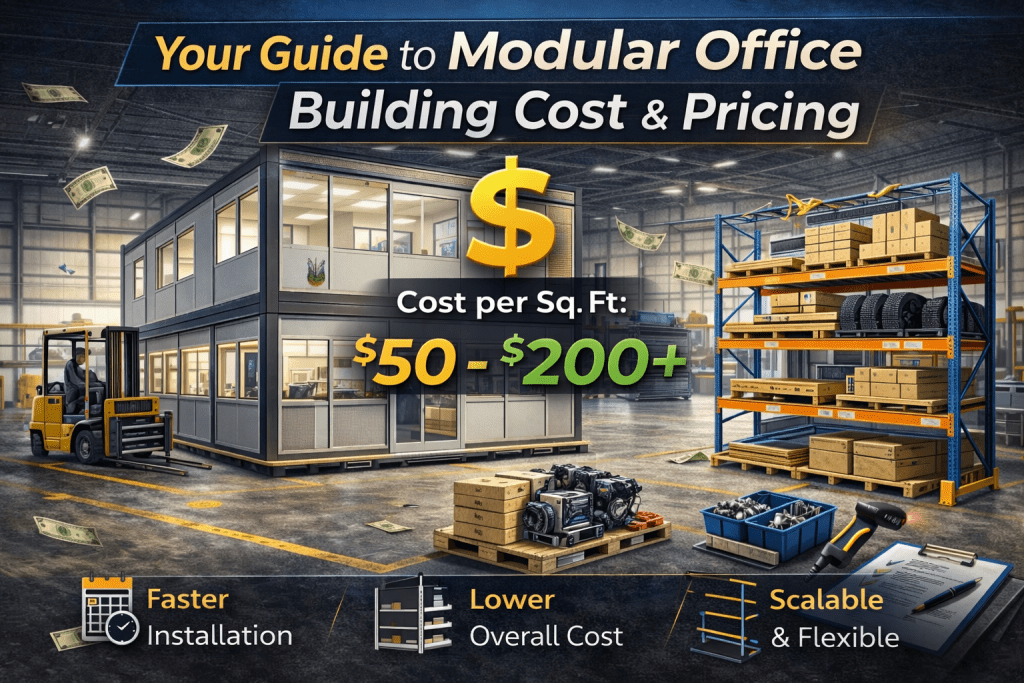
When expanding your facility, the first question is always about the bottom line. For modular office buildings, you’re typically looking at a range of $50 to over $200 per square foot. The final number depends on the size, features, and level of customization required.
This price point makes modular a highly competitive alternative to traditional construction, offering a much faster way to get your operational space up and running.
Understanding Modular Office Building Cost in Today’s Market
Planning an expansion means getting a firm grip on the financials, and this is where modular construction shines. It offers something traditional building methods struggle with: cost predictability. Because the components are fabricated in a controlled, off-site environment, you sidestep a ton of variables.
Think about it: no weather delays, less material waste, and more efficient labor. All of that adds up to a lower, more reliable budget. It’s no wonder so many facility managers are making the switch. For a deeper dive on this trend, check out why modular building sales are on the rise.
This chart breaks down the core value proposition of going modular: speed, cost, and quality.
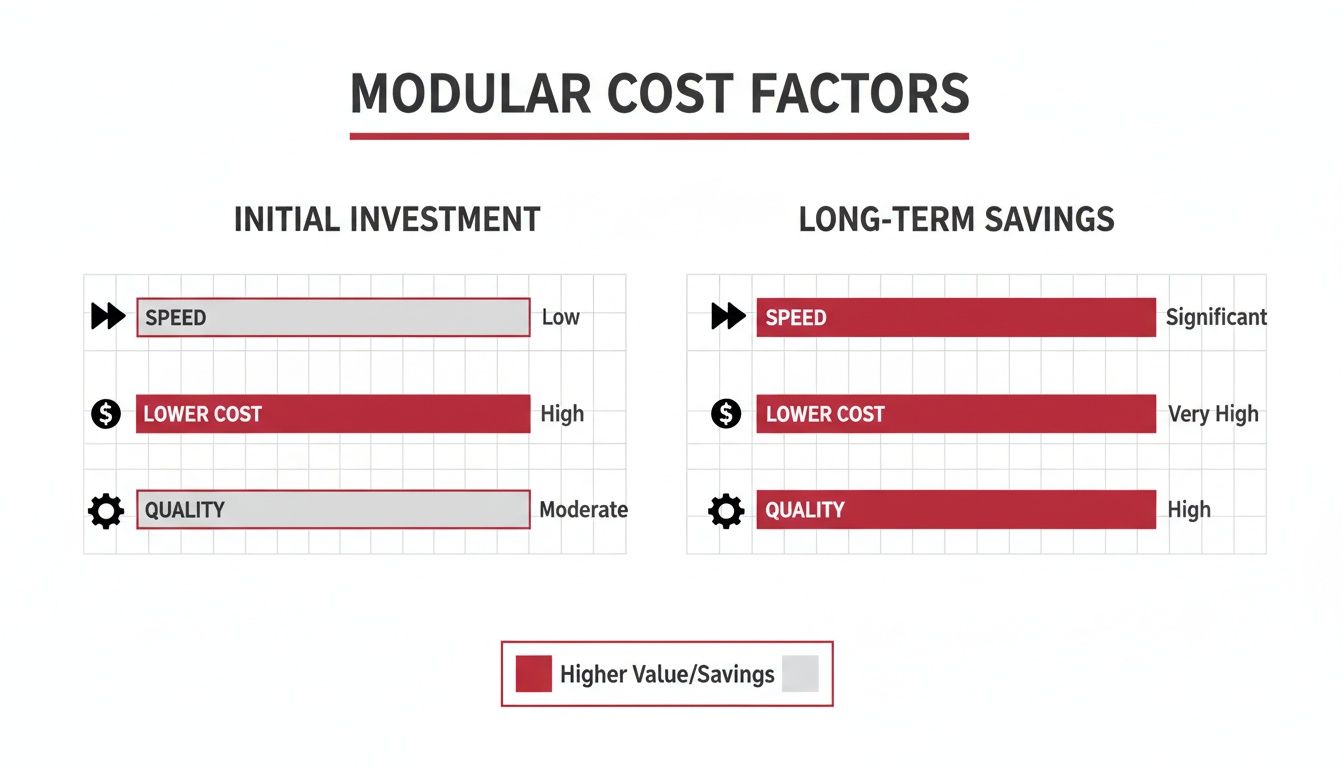
As you can see, these aren’t just separate benefits. They work together to deliver a much better return on your investment compared to a conventional construction project.
Breaking Down the Cost Structure
So, what does this look like in real numbers? On average, modular offices come in about 20% less than their traditional stick-built counterparts. That makes them a smart move for warehouse managers who need to expand without a massive capital investment.
Industry reports show that overall design and construction costs can drop by 20% to 40%. Even better, timelines can be slashed by 40% or more thanks to the efficiencies of off-site prefabrication.
The ability to get a fully functional office up and running in a fraction of the time isn’t just a convenience, it’s a direct path to a faster ROI. Your business starts benefiting from the new space almost immediately.
To truly understand modular office building costs, it helps to know the different components and systems involved. For a great overview, check out this helpful A Guide to Modular Office Wall Systems.
Here at Material Handling USA, we believe in total transparency from day one. That’s why we offer free layouts and designs, so you can see exactly what your space will look like and understand the costs upfront, no strings attached.
The Key Factors That Drive Your Final Project Cost
Once you’ve settled on a rough square footage, the real cost of your modular office starts to take shape through a series of specific, controllable choices. Think of it like buying a new truck: the base model has a starting price, but the final cost depends on whether you add four-wheel drive, premium interior finishes, or a heavy-duty towing package. The same principle applies here, where every decision contributes to the building’s performance and long-term value.
Making these decisions thoughtfully during the planning phase is the single best way to control your budget. It’s far more cost-effective to plan for specialized electrical outlets or reinforced flooring from the get-go than to try and retrofit them later. This proactive approach ensures your new office is dialed in to your exact operational needs from day one.
Structural and Foundational Choices
The core structure of your modular office is the first major cost driver. This isn’t just about the frame and walls; it includes any specialized additions that make the building work harder for your facility.
- Framing Materials: The choice between steel and wood framing directly impacts both cost and durability. Steel brings superior strength and longevity, making it the go-to for tough industrial environments. Wood, on the other hand, can be a more budget-friendly option for standard office use.
- Wall Panel Finishes: Standard vinyl-covered gypsum is a common and economical choice for most interiors. But if your office is in a high-traffic or demanding area, upgrading to tougher materials like steel, aluminum, or fiberglass-reinforced plastic (FRP) will add to the cost but deliver much better resistance to daily wear and tear.
- Load-Bearing Roofs: Adding a modular office with storage roof is a strategic investment. While it increases the upfront cost, it effectively transforms unused vertical space into valuable storage, helping you maximize your facility’s footprint without a costly expansion.
These foundational decisions really set the stage for your building’s long-term performance. You can dive deeper into the material options and see what makes the most sense for your application by reviewing our complete modular building specifications.
Did you know that planning your electrical and data port needs upfront can save thousands in retrofitting costs later? Our free design consultations help you map out every detail for a future-proof workspace.
Customization and Interior Features
With the structural shell defined, the interior features and customizations are what bring the space to life. These are the elements that directly influence the comfort, functionality, and efficiency of the work environment, and their costs can vary significantly depending on what you need.
For instance, a simple administrative office might get by with a basic electrical package. But a control room or a space housing heavy machinery will need a much more robust setup—higher amperage, dedicated circuits, and specialized outlets—all of which will factor into the final budget.
Here’s a quick look at how common customizations can influence the final modular office building cost:
| Feature Category | Standard Option (Lower Cost) | Premium Option (Higher Cost) |
|---|---|---|
| HVAC System | Wall-mounted PTAC unit | Centralized HVAC system with ductwork |
| Windows & Doors | Standard single-pane windows | Double-pane, insulated, or sound-dampening windows |
| Flooring | Commercial-grade carpet or VCT | Anti-static flooring or heavy-duty industrial tile |
| Electrical | Basic outlets and lighting | Upgraded electrical panels, data ports, 220V outlets |
Purpose-built designs, like dedicated modular shipping and receiving offices, often blend these features to create a highly efficient workflow. By working with our design team, you can strike the right balance between these choices to meet your operational needs without breaking the bank.
Demand for customized modular spaces is high, so getting a design consultation locked in soon can help you align your project timeline and avoid potential scheduling backlogs. Request a Quote or give us a call at 800-326-4403 to start your free design process today.
Budgeting for Site Prep and Permitting
When you’re pricing out a modular office, the cost of the building itself is just one piece of the puzzle. To get a real-world budget, you have to factor in what we call “soft costs,” everything involved in preparing your site and getting the right permits.
These steps are absolutely critical. They ensure your new office is safe, compliant, and ready to go from day one, preventing nasty surprises and delays down the road. While modular construction dramatically cuts down on the chaos of a traditional build-out, it doesn’t eliminate the need for a solid foundation and the right paperwork.
Essential Site Preparation Costs
Before your new office walls even show up, the spot you’ve picked out inside your facility needs to be ready. This groundwork is all about guaranteeing the building’s structural integrity and making sure everything works as it should. For a deeper dive into the general principles, check out this expert guide to site preparation excavation.
For an in-plant office, here’s what you’re typically looking at:
- Foundation and Flooring: Most of the time, we’re installing directly onto your existing concrete slab. The main job here is making sure that slab is perfectly level, clean, and free of any cracks or damage. If it’s not, you might need some minor grinding or leveling work, which adds a small cost but is crucial for a stable installation.
- Utility Connections: Your office isn’t much use without power, data, or maybe even plumbing. You’ll need to budget for an electrician to run conduit from your facility’s main panel to the new office. Costs here depend on how far the run is and how complex your electrical needs are.
- ADA Compliance: This isn’t optional, it’s the law. Making your new space accessible might involve adding ramps, ensuring doorways are wide enough, and checking for proper clearance, all according to the Americans with Disabilities Act (ADA) standards.
Navigating the Permitting Process
Even though your modular building is constructed off-site, it still has to play by the local rules. That means getting the thumbs-up from your local building department through permits and inspections. The process can feel like a headache, but with a bit of planning, it’s just another box to check.
Having a detailed, professional building plan is the single most important factor in accelerating permit approvals. Our team at Material Handling USA provides complimentary, code-compliant designs that give local authorities the clear documentation they need, helping to speed up the review process.
Permitting costs usually break down into two main areas:
- Permit Fees: This is the money you pay directly to your city or county for them to review your plans and send an inspector out. The fee can vary wildly depending on your location and the project’s size.
- Professional Services: For more complex projects, like two-story offices or structures with specific engineering needs, you might be required to submit stamped architectural or engineering drawings.
Working with an experienced provider gives you a huge leg up here. We know exactly what kind of documentation is needed and provide detailed plans that make the whole submission process smoother. Finalizing your project plans early is always a smart move, it gives you plenty of time to navigate the permitting phase and locks in your spot on the production schedule.
Ready to get a clear picture of your total project cost? Contact Us for a free, no-obligation layout and quote, or call our team directly at 800-326-4403 to discuss your needs.
Comparing Modular Costs to Traditional Construction
So, how does the cost of a modular office building really stack up against a traditional, stick-built project? When you look past the initial price tag, the true value of going modular becomes crystal clear. It’s not just about the cost of lumber and labor; it’s about timelines, operational headaches, and having a space that can adapt to your business down the road.
The biggest difference is how they’re built. Modular offices are constructed off-site in a controlled factory setting. This simple fact eliminates all the classic construction site problems that blow budgets and timelines. No weather delays. Drastically less material waste. Far more rigorous quality control. For a busy warehouse or production plant, that means a predictable project with almost zero interference in your day-to-day operations.
Financial and Timeline Advantages
The numbers don’t lie. For facilities managers in manufacturing and e-commerce, modular offices consistently deliver 20-40% cost reductions and are built up to 40% faster than old-school methods. This efficiency is why the market for these spaces is booming, expected to jump from $1.4 billion to $2.0 billion by 2029. You can get more details on modular cost savings and market trends.
Where do these savings come from? A few key places:
- Reduced Labor Costs: Factory assembly is simply more efficient, which means fewer boots on the ground at your facility.
- Less Material Waste: Precision manufacturing minimizes the scrap pile, a surprisingly big cost in conventional builds.
- Shorter Timelines: A faster build means your new office is up and running sooner, which gets you a return on your investment that much quicker.
To really see the difference, a side-by-side comparison makes it obvious.
Modular vs. Traditional Construction: A Head-to-Head Comparison
Let’s break down the key factors that impact your budget, timeline, and sanity when choosing between a prefabricated modular office and a conventional stick-built project.
| Factor | Modular Office Building | Traditional Construction |
|---|---|---|
| Construction Timeline | Weeks to a few months | Several months to over a year |
| On-Site Disruption | Minimal; mostly quiet assembly | High; constant noise, dust, and traffic |
| Material Waste | Significantly reduced (1-3%) | Higher (10-15% is common) |
| Weather Delays | Not a factor for fabrication | A major cause of schedule overruns |
| Budget Predictability | High; fixed costs established early | Lower; prone to unexpected costs |
| Quality Control | Consistent factory standards | Varies based on contractors and conditions |
As the table shows, modular construction gives you a level of predictability that traditional methods just can’t match.
Operational Continuity and Long-Term Value
For any busy facility, the biggest hidden cost of traditional construction is the disruption. The constant noise, dust, and parade of contractors can slow down production and even create safety hazards. A modular installation, on the other hand, is a clean, quiet, and incredibly fast assembly process. All the messy work is done before a single component arrives on your property.
Protecting your operational continuity is a benefit that won’t show up on an initial quote, but it has a massive impact on your bottom line.
Even better, modular buildings offer flexibility you just can’t get from a permanent structure. As your business evolves, your office can be reconfigured, moved, or expanded with far less cost and downtime.
Choosing a modular solution is a strategic financial decision. It saves money upfront, protects your ongoing operations, and provides an adaptable asset for the future.
The demand for efficient, cost-effective space is only growing, which means planning ahead is key. Getting a design specialist involved early in your process helps lock in your spot in the production schedule and keeps your project moving without a hitch.
Ready to see how a modular building can fit your budget and timeline? Our team provides free layouts and designs with no obligation. Contact Us or call 800-326-4403 to start the conversation.
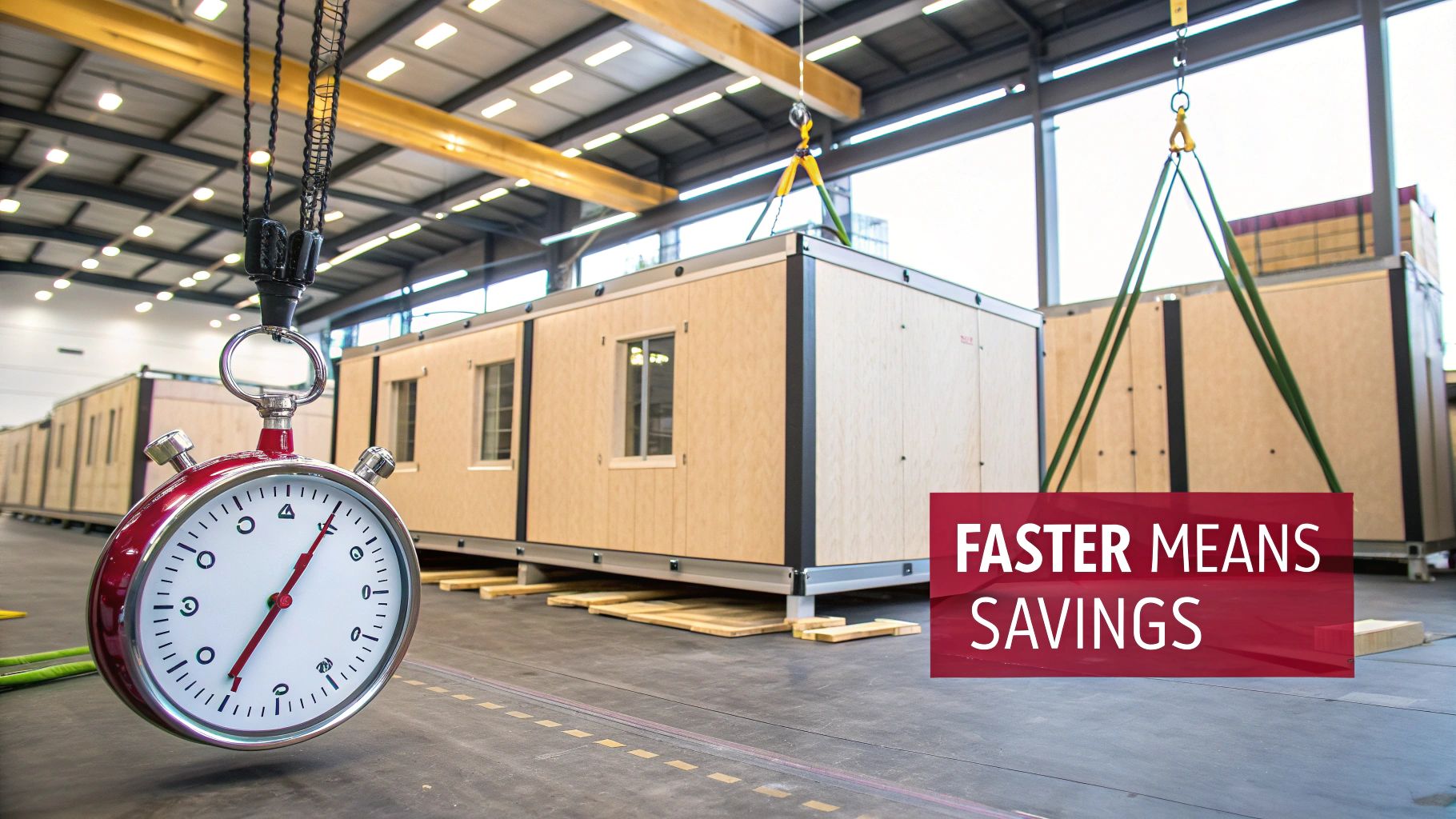
How a Faster Timeline Translates to Real Savings
In business, the old saying “time is money” has never been more true. This is where modular construction really shines, creating a direct line between an accelerated project timeline and your bottom line. A modular office is up and running far sooner than a traditional stick-built one, which means your team gets to use the space faster and start generating value.
That speed doesn’t come at the cost of quality. It’s the direct result of a smarter, more efficient process. With up to 90% of the fabrication happening off-site in a controlled factory, typical construction headaches like bad weather delays are completely off the table. This is what we call parallel processing: we build your office modules in the factory at the same time your site is being prepared. It’s this simple advantage that collapses the project timeline.
From Consultation to Completion: A Predictable Journey
A typical modular project follows a clear, straightforward path that keeps surprises (and surprise costs) to a minimum. This predictability is a huge financial win, since timeline overruns are one of the biggest reasons conventional construction projects go over budget. Our long-standing partnership with trusted suppliers like Panel Built ensures we deliver high-quality buildings efficiently, every single time.
Here’s a quick look at what that journey looks like:
- Initial Consultation & Free Design: We start by listening to your needs and then create a complimentary, no-obligation layout.
- Quote Approval & Order Placement: Once you’re happy with the design and quote, we officially kick things off.
- Off-Site Fabrication: Your building’s components are precision-engineered in a factory setting, safe from the elements.
- Site Preparation: While your office is being built, your on-site location is simultaneously prepared for its arrival.
- Delivery & Installation: The finished modules are delivered and assembled on-site with minimal disruption.
- Final Walkthrough & Handover: We walk through the space with you to make sure everything is perfect before handing over the keys.
This highly efficient model is a major reason North America now commands 35% of the global modular construction market, an industry valued at a massive $114.2 billion. Businesses are catching on to the benefits, slashing project timelines by as much as 40% and cutting total expenses by 20-40%. You can explore more about these industry trends and their impact on U.S. warehouse expansions.
This rapid adoption means that planning your project now is key. It helps you secure a favorable spot in the production schedule, avoid seasonal backlogs, and keep your expansion right on track.
The Financial Impact of Gained Time
The savings from a faster timeline are about more than just reduced labor or financing costs. It’s about opportunity cost. Every week your team has to wait for a new office is a week of lost productivity or a delayed expansion.
A modular building puts that asset to work for you sooner, whether it’s a new shipping office to boost throughput or an administrative hub to support a growing team.
Ultimately, the faster, code compliant construction of commercial modular buildings translates directly to a quicker return on your investment. The high demand for this building method really underscores the importance of planning ahead. By starting the design process early, you can ensure your project stays on schedule and your business starts reaping the benefits of its new space as soon as possible.
Ready to start planning? Request a Quote or give our experts a call at 800-326-4403 for a free design consultation.
Planning Your Budget and Maximizing ROI
Okay, let’s get down to the numbers. Turning the idea of a modular office into a solid financial plan is where the real work begins. This is how you move forward with confidence, understanding that a modular building isn’t just another line item expense, it’s a strategic asset for your entire facility.
Thinking this way helps you see past the initial price tag and appreciate the lasting value that a well-planned modular space brings to the table.
Sample Budget Scenarios
To give you a real-world feel for the investment, let’s walk through a few common setups. Of course, a precise quote needs a detailed layout, but these examples provide a solid baseline for the modular office building cost you can expect.
- Compact Shipping & Receiving Office (10′ x 12′): Think of a small but critical hub for your logistics. A basic electrical package, a window for visibility, and a door are all you need. This setup is a workflow game-changer at a very accessible price point.
- Mid-Size Supervisor’s Office (15′ x 20′): Perfect for a manager who needs space for a desk, a small meeting table, and some filing cabinets. Common upgrades here include more windows to keep an eye on the warehouse floor and extra data ports for connectivity.
- Large Administrative Hub (20′ x 40′): This is where you can house a small team with multiple workstations and even a separate meeting area. You’ll often see these configured with a more robust HVAC system and beefed-up electrical to handle more people and equipment.
These scenarios show just how scalable modular solutions are. You can match your investment directly to what your operation actually needs, without overspending.
Long-Term Return on Investment
The real financial win with a modular office goes way beyond the initial purchase. Its long-term ROI is driven by a few key factors that traditional construction just can’t touch.
Your building’s ability to adapt is one of its most valuable features. A modular office can be moved, reconfigured, or expanded as your business grows, protecting your initial investment and avoiding the need for costly new construction down the line.
Here are the long-term benefits you should be thinking about:
- Durability and Low Maintenance: Because they’re built with high-quality materials in a controlled factory setting, our modular buildings are designed to withstand tough industrial environments with minimal upkeep.
- Energy Efficiency: Modern modular offices are built tight and have superior insulation. That translates directly to lower heating and cooling bills for the entire life of the building.
- Flexibility and Relocatability: This is the big one. The unique ability to move or reconfigure your office gives you an operational agility that’s tough to put a price on, but it’s immensely valuable when plans change.
The next step is to nail down a precise figure for your specific project. With high demand for efficient building solutions, starting the planning process sooner rather than later helps lock in better timelines. Our team is ready to provide a free, no-obligation design and quote tailored to your exact needs. Let us show you just how affordable and efficient your new office space can be.
Ready to get a precise cost for your project? Stop guessing and start planning. Request a Quote or call our team at 800-326-4403 for a free, no-obligation layout and quote.
Common Questions About Modular Office Costs
When you’re getting close to a final decision, a few practical questions always come up. Here are the straight answers to the most common things we get asked about modular office buildings, covering everything from lifespan to the on-site experience.
How Long Do Modular Office Buildings Last?
You can expect a permanent modular office to last for decades. When built with high-quality materials like steel framing and durable wall panels, a properly maintained building has a lifespan of 30 to 50 years, sometimes even longer.
Think of them less like temporary trailers and more like conventionally-built structures. They’re engineered to meet or even exceed the same local building codes as traditional construction, guaranteeing they can stand up to the rigors of a demanding industrial environment for the long haul.
Can I Finance the Purchase of a Modular Building?
Yes, absolutely. Financing a modular building is very similar to financing traditional real estate or any other significant piece of capital equipment. Many businesses use equipment financing or standard commercial loans to make the investment manageable and preserve cash flow.
Better yet, since modular buildings are classified as tangible assets, they can often be depreciated for some significant tax advantages. We always recommend a quick chat with your financial advisor to figure out the best financing strategy for your company’s specific situation.
The ability to finance and depreciate your modular office makes it a financially sound capital investment. It’s an asset that contributes to your operations from day one while offering favorable accounting treatment.
How Disruptive Is the On-Site Installation Process?
This is one of the best parts, it’s significantly less disruptive than any traditional construction project. Because up to 90% of the building is fabricated off-site in a controlled factory environment, the work at your facility is mostly quiet, efficient assembly. No armies of contractors, no months of noise and dust.
The final installation phase is surprisingly fast, typically taking just a few days to a couple of weeks, depending on the project’s size. This approach keeps the noise, debris, and general chaos to an absolute minimum, letting your team stay focused and productive.
Are Modular Offices Customizable?
Definitely. The idea of a cookie-cutter box is a thing of the past. Modern modular offices from top-tier providers like Panel Built offer a huge range of customization options. You aren’t stuck with a standard layout; you can spec out everything from the floor plan and finishes to the exact window and door placements.
Need specialized electrical or data hookups for your specific equipment? That’s all fully customizable, too. At Material Handling USA, our complimentary design service means you work directly with our specialists to create a space that perfectly fits your workflow and company aesthetic. With demand for custom spaces on the rise, getting the design process started soon is the best way to get your project in the queue.
Conclusion: Your Next Step Toward a Smarter Workspace
Understanding the modular office building cost is about more than just a price per square foot. It’s about recognizing the total value of speed, predictability, and long-term flexibility. Modular construction delivers a faster return on investment by getting your space operational sooner with less disruption and lower overall costs compared to traditional methods.
With demand for high-quality, efficient building solutions increasing, planning your project early ensures better timelines and avoids potential delays. The team at Material Handling USA offers competitive pricing and the fastest delivery in the industry, backed by free, no-obligation layouts to get you started.
Contact Us or call our team at 800-326-4403 to discover how fast and affordable your new office can be.