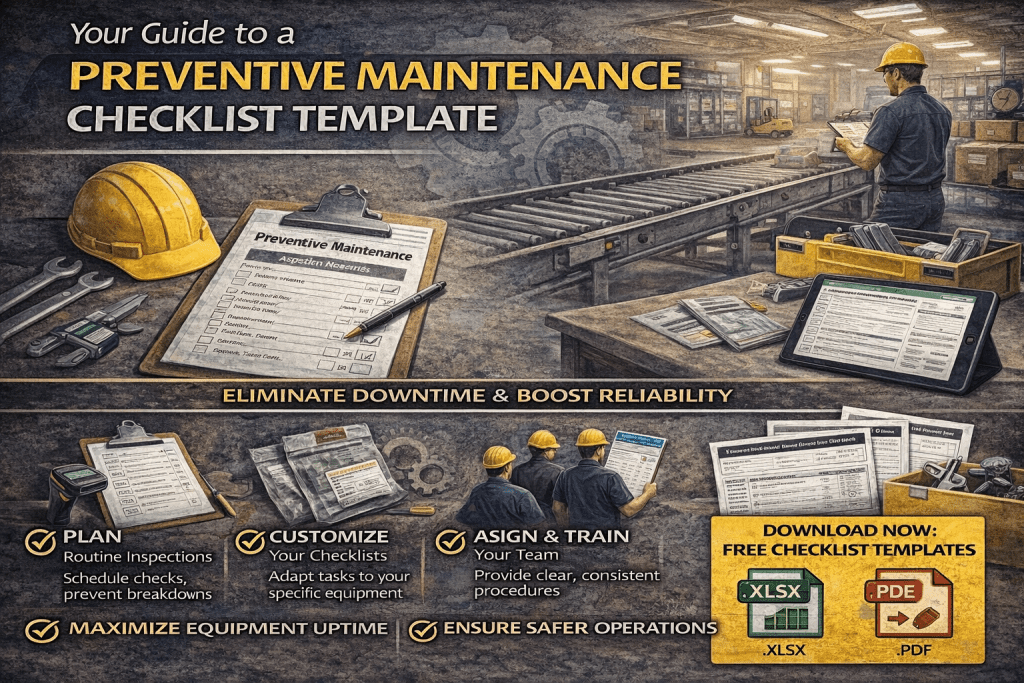
Unexpected equipment failure is a manager’s worst nightmare. It disrupts operations, leading to expensive downtime and derailed production schedules. The best solution isn’t becoming faster at repairs; it’s preventing failures before they happen. That’s where a solid preventive maintenance (PM) program, built around a well-designed preventive maintenance checklist template, becomes your most valuable tool.
Building Your Foundation For Operational Uptime
Shifting from a reactive, “fix it when it breaks” culture to a proactive one provides a significant competitive advantage. This approach is about achieving tangible results: smoother operations, longer equipment life, and a safer, more productive workplace. Every minute of unplanned downtime directly impacts your bottom line, causing scheduling chaos and frustrating customers.
A structured PM program changes the entire dynamic. Instead of a critical conveyor belt failing during peak hours, you can identify and replace a worn part during a planned service window with minimal impact. This level of control is the core of preventive maintenance, and it all starts with an effective checklist. This document is the key to unlocking major efficiencies and moving from chaos to control.

Why a Checklist Is Your Most Important Tool
A well-crafted preventive maintenance checklist is much more than a simple to do list. It is a strategic document that standardizes procedures, ensures consistent task performance across all technicians, and creates a clear record of all maintenance activities. It transforms abstract maintenance goals into concrete, repeatable actions that any trained technician can follow precisely.
The data confirms this approach. PM checklists are a cornerstone of industrial operations, with 88% of manufacturing companies using them to avoid unexpected breakdowns. The financial benefits are significant, with companies using preventive maintenance spending 12% to 18% less than those operating in a reactive cycle. In fact, over 70% of maintenance specialists rely on these checklists to reduce downtime.
A strong preventive maintenance program doesn’t just save money on repairs; it protects your most valuable asset—your operational uptime.
Core Components of an Effective PM Checklist
An effective checklist must be clear, comprehensive, and easy for your team to use. It needs to capture all essential information to guide the technician and properly document the completed work.
Here’s a breakdown of the essential components every preventive maintenance checklist template should include.
| Component | Description & Purpose | Example |
|---|---|---|
| Asset Identification | Clearly identifies the equipment to be serviced, including its name, ID number, and location. This prevents confusion and ensures the right asset receives attention. | Forklift #FL-007, Dock 3 |
| Task Details | A list of specific actions the technician must perform. Each task should be clear and actionable, using precise language. | Check hydraulic fluid levels; inspect tire pressure; test horn and backup alarm. |
| Frequency | Specifies how often the checklist should be completed (e.g., daily, weekly, monthly, or based on usage like every 200 hours). | Weekly |
| Pass/Fail/NA | A simple system for the technician to mark the status of each checkpoint. “N/A” is crucial for tasks that don’t apply in a specific inspection. | Pass |
| Technician Notes | A space for the technician to add important observations, such as noting minor wear that doesn’t yet require repair but needs monitoring. | “Slight fraying on lift chain; recommend monitoring.” |
| Sign-Off | Fields for the technician’s name, the date of completion, and a supervisor’s signature. This creates accountability and a formal record. | Tech: J. Smith, Date: 10/26/2023 |
This basic structure ensures every inspection is thorough and properly documented, forming the backbone of your entire PM strategy.
To better understand the overall strategy, it helps to explore the distinctions between predictive and preventive maintenance. Establishing this foundation is a crucial first step toward a more reliable and profitable operation.
Grab a Proven PM Checklist for Your Industry
Theory is important, but practical tools that deliver results in the real world are what you truly need. That’s why we have developed three fully customizable preventive maintenance checklist templates, based on the daily challenges our customers face.
These are not generic documents. They are field tested starting points, ready for you to download, customize, and implement in your facility immediately. We have designed them to be clear and comprehensive, suitable for technicians using either a clipboard or a tablet. A busy manufacturing plant has different PM needs than a large distribution center, so we created specialized versions.
Review the previews below to see how they are structured, and then download the formats that best suit your team’s workflow.
General Warehouse Equipment Checklist
This is the ideal starting point for any distribution center, fulfillment hub, or storage facility. It focuses on the core equipment that keeps your products moving and safely stored. From daily walk arounds to more detailed monthly inspections, this checklist provides comprehensive coverage.
We’ve included checks for:
- Pallet Racking and Shelving: Look for bent uprights, damaged beams, missing safety clips, and proper load balance. Simple checks here prevent catastrophic failures.
- Conveyor Systems: Check belt tension, roller function, motor noise, and—most importantly—emergency stop functionality.
- Dock Doors and Levelers: Verify smooth operation, check seals for energy loss, and inspect hydraulic or mechanical parts for leaks or wear.
- Material Carts and Hand Trucks: Inspect wheels, handles, and structural integrity. A broken cart can bring a picking line to a halt.
Following this checklist helps ensure your warehouse infrastructure remains safe and reliable, preventing failures that halt operations and put your team at risk.
Manufacturing Machinery Checklist
For facilities with complex production lines, this checklist addresses the specific details of machinery and automated systems. It is designed to handle the wear and tear common in high cycle manufacturing environments.
This template helps you keep a close eye on:
- CNC Machines and Lathes: Lubrication levels, spindle condition, coolant systems, and safety interlocks.
- Assembly Line Equipment: Check robotics, pneumatic systems, sensor alignment, and part feeders.
- Welding and Fabrication Tools: Inspect power sources, gas lines, and fume extraction systems to keep things running safely.
- Presses and Stamping Machines: Verify hydraulic pressure, die condition, and critical safety guards.
Using this checklist will significantly reduce unplanned production stoppages and extend the life of your most critical assets.
Facility and Safety Systems Checklist
Your responsibilities extend beyond production equipment. The overall health of your building and its safety systems is equally important. This checklist covers facility wide systems that protect your people, products, and property, serving as your primary tool for compliance and risk management.
Key focus areas include:
- HVAC Systems: Simple but crucial tasks like regular filter changes, listening for unusual noises, and verifying thermostat accuracy.
- Fire Suppression Systems: Visually inspect sprinkler heads, check fire extinguisher charge levels, and make sure access points are always clear.
- Emergency Lighting and Exits: Test backup batteries and ensure all exit pathways are completely unobstructed. No exceptions.
- Loading Dock Areas: Inspect safety barriers, make sure wheel chocks are available and in good condition, and test warning lights.
Pro Tip: Integrating these checks into your routine is a significant first step. To explore further and find more ways to optimize your facility, our MRO Assessment Guide is the perfect resource for identifying hidden improvement opportunities.
The process is straightforward. If your inspections reveal that equipment is nearing the end of its service life, we can provide a quality replacement. We are known for the fastest shipping in the industry, competitive pricing, and a team ready to assist you.
If your PM assessments reveal a need for equipment upgrades or a full facility redesign, we are here to assist. We offer free layouts and designs with no obligation to purchase. Contact Us to speak with a specialist or Call (800) 326-4403 for immediate assistance.
How to Customize Your Template For Peak Performance
A generic preventive maintenance checklist is a good starting point, but it’s only the beginning. True operational excellence is achieved by tailoring the template to perfectly match the specific needs of your facility. This is what distinguishes a good PM program from a great one.
A customized checklist transforms from a simple to do list into a strategic tool. It actively drives performance and prevents the specific failures your operation is most vulnerable to. This is how maintenance evolves from a cost center into a core advantage that protects your uptime and profitability.
Start with Manufacturer Recommendations
The best place to begin is with the Original Equipment Manufacturer (OEM) guidelines. The engineers who designed your equipment know its vulnerabilities better than anyone. Do not ignore their recommendations.
Review the owner’s manual for each critical asset. Extract all recommended service intervals and specific tasks. For example, a forklift manufacturer might specify checking hydraulic fluid levels every 50 operating hours and inspecting lift chains for wear every 250 hours. Adding these precise, manufacturer backed items to your preventive maintenance checklist template is essential. It ensures warranty compliance and addresses known vulnerabilities from the start.
Incorporate Your Own Failure Data
Your maintenance history is a valuable resource. Your equipment failure logs reveal what actually goes wrong in your facility, not just what the manual predicts. Analyzing this data allows you to identify recurring problems and add checks to prevent them.
If your records show a particular conveyor motor overheats every summer, add a monthly task to clean its cooling fins just before the hot season. This data driven approach makes your checklist uniquely powerful. You are directing your technicians’ attention to the very issues that have historically cost you the most in downtime and repair expenses.
The process of adapting a template involves specialization. You are taking a foundational document and refining it for the unique demands of each part of your operation.
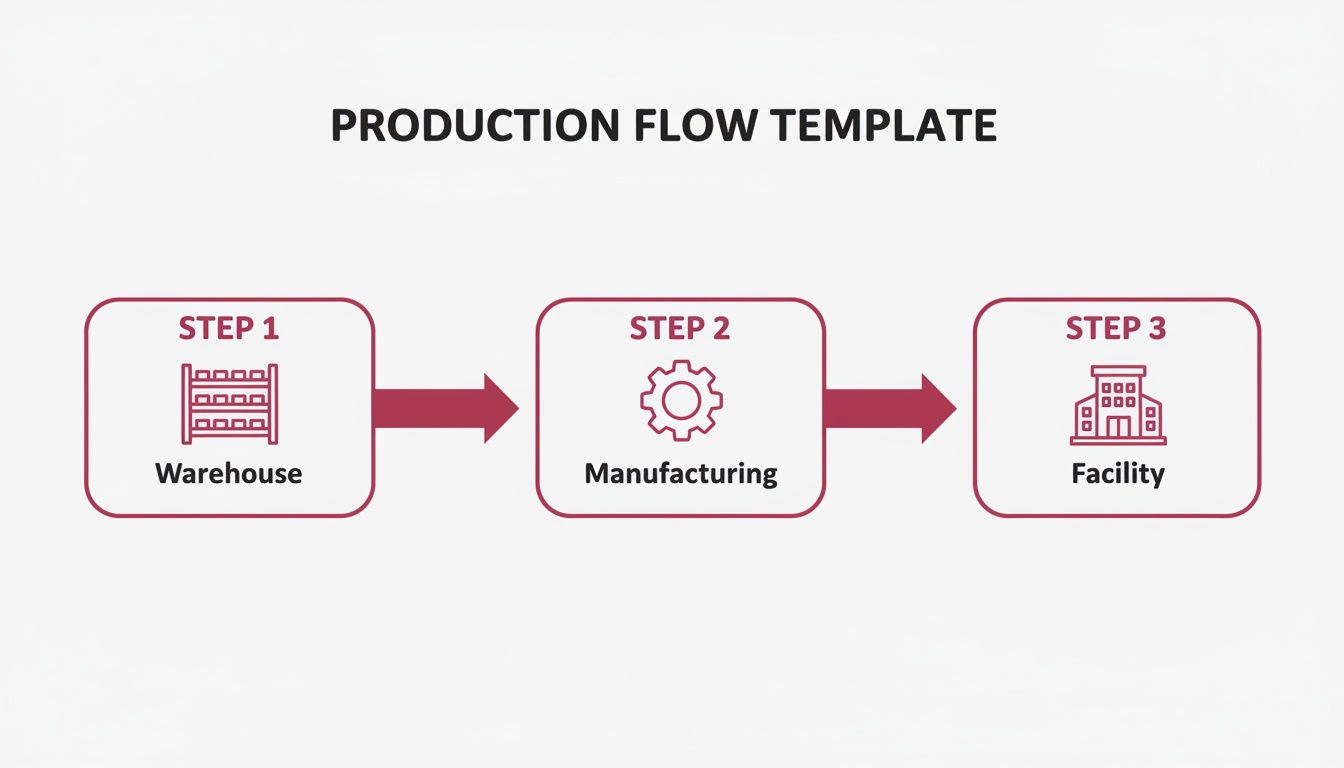
As shown, a single template can be adapted to address warehouse logistics, the precision needs of manufacturing, and the safety compliance of the entire facility. Each area requires its own focus.
Consult Your Frontline Experts
No one knows your machinery better than the technicians who work with it daily. They can detect a subtle change in a motor’s sound before it fails or notice a slight vibration that indicates trouble. Involving them is not just beneficial for morale; it is essential for creating a checklist that is effective in the real world.
Meet with your maintenance crew to review the draft. Ask them what is missing, what is impractical, and what problems they have observed that are not on the list. They might suggest adding a check for a specific bolt that frequently loosens or a sensor that often gets clogged. This firsthand insight is invaluable.
Prioritize and Set Frequencies
Not all maintenance tasks are equally important. To optimize your team’s time, you must classify each checklist item by priority and assign a practical frequency. This ensures that the most critical work is completed without overwhelming your staff with low impact checks.
A simple, effective system includes the following categories:
- Critical (Weekly/Daily): Tasks that, if missed, could cause catastrophic failure, safety incidents, or major production stoppages. Examples include checking emergency stops, inspecting safety guards, and verifying fire suppression systems.
- Important (Monthly): Work that prevents long term decline and expensive repairs. This includes tasks like lubrication, filter changes, and calibration checks.
- Routine (Quarterly/Annually): General inspections and cleaning that enhance equipment longevity and overall facility health.
The results of this structured approach are substantial. Planned maintenance can increase Overall Equipment Effectiveness (OEE) to between 50% and 75%, a significant improvement from the sub 50% rate seen with purely reactive maintenance. It is not surprising that 80% of maintenance personnel favor preventive strategies. Globally, 99% of organizations have pursued maintenance transformations over the last five years, with smart checklists forming the reliable foundation of these efforts. You can find more insights about these maintenance statistics and their impact.
If this customization process reveals larger gaps in your facility’s layout or equipment, our team can help. Contact Us for a free, no-obligation consultation to optimize your space and maintenance plan.
Integrating Checklists Into Your Daily Workflow
An excellent preventive maintenance checklist is ineffective if it remains unused in a binder. The real value is realized when it is deeply integrated into your team’s daily routine, becoming second nature. This is where your strategy meets execution, transforming a simple document into a powerful tool for operational stability.
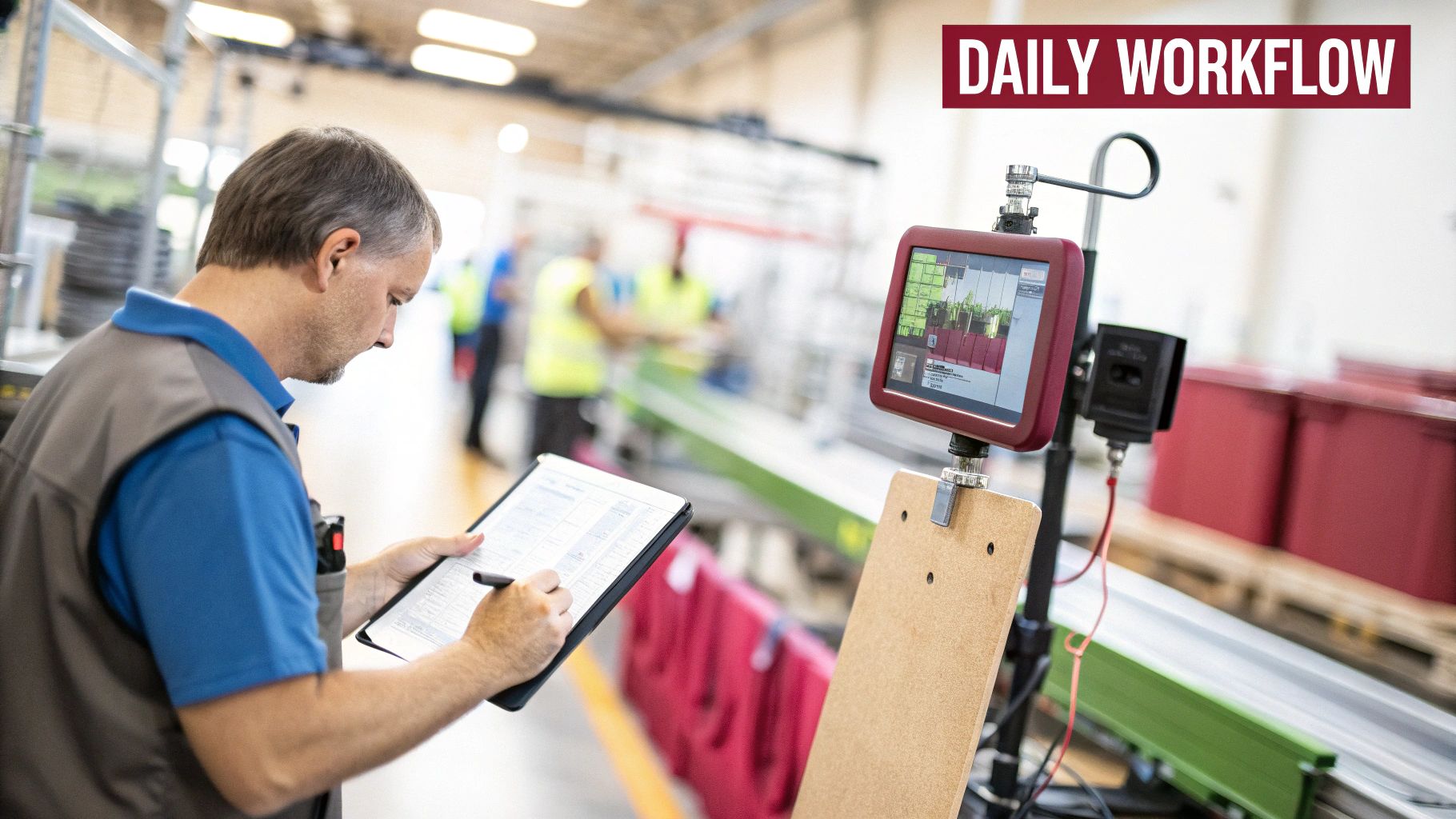
First, you must choose the right format for your environment. There is no single best answer; what works for one facility may not work for another. For tough, greasy environments, the simplicity of a durable, laminated checklist on a clipboard is hard to beat. They are always visible, never require a battery, and are easy for technicians to use.
However, in a fast paced, data intensive warehouse, paper can become a bottleneck. Digital solutions on a tablet or smartphone are particularly effective in these settings. Using a Computerized Maintenance Management System (CMMS) or a dedicated app offers numerous possibilities, including real time updates, attaching photos of issues, and instant data collection. This digital trail is invaluable for identifying trends and demonstrating compliance later.
Training and Assigning Responsibilities
Once you have selected a format, your team needs clear guidance. Effective training involves more than just handing someone a list and telling them to complete it. You must explain the why behind each item. Explain that checking a small hydraulic leak on a forklift today prevents a catastrophic failure during a critical shipment next week. When people understand the importance of their work, they take it more seriously.
Clear ownership is equally critical. If everyone is responsible, then no one is. Vague assignments can lead to missed tasks.
- Assign specific checklists to specific people or roles. For example, the morning shift lead is always responsible for the pre operation forklift checks.
- Designate a supervisor to review completed checklists. This simple step creates accountability and ensures the documentation is complete and accurate.
- Establish a clear process for reporting issues. If a technician marks an item as “Fail,” what is the next step? Who is notified? How is a work order generated?
A well defined workflow eliminates ambiguity and empowers your team to act decisively.
Creating a Feedback Loop for Improvement
Your checklist should not be static. It needs to be a living document, and the best ideas for improvement will come from the people using it every day. You should establish a formal way to capture their knowledge and continuously refine the process.
Consider holding brief, monthly meetings with your maintenance crew to discuss the checklists. Ask them directly: What is working? What is confusing? What are we missing? This is not just about improving the checklist; it builds a sense of ownership and engagement. Your team will be more invested in a process they helped create.
Proper documentation isn’t just paperwork; it’s a crucial shield that protects your business from liability, validates warranty claims, and ensures a safe working environment for your people.
Scheduling and Compliance Documentation
Smart scheduling is about minimizing disruption. The goal is to integrate PM tasks into the workflow so seamlessly that they have little impact on production. Identify natural lulls in your operational tempo, such as shift changes, lunch breaks, or downtime between large production runs. Scheduling non critical tasks during these periods keeps your assets productive when you need them most.
Finally, remember that documentation is your ultimate line of defense. Every completed checklist is a legal record that demonstrates your due diligence in maintaining a safe, compliant facility. These records are essential for:
- OSHA Audits: Detailed maintenance logs provide proof of your commitment to workplace safety regulations.
- Warranty Claims: Manufacturers often require proof of regular maintenance to honor a warranty. Your checklists serve as undeniable evidence.
- Safety Inspections: Clean, consistent records immediately show inspectors that you have a proactive safety culture. For more on official standards, the OSHA website is an excellent resource.
Integrating digital tools can make this part of the job much easier. For example, Enasys Asset Tracking Software can help you manage your entire equipment inventory and link it directly to maintenance schedules. This creates a powerful, centralized system for tracking asset health and your compliance history.
Measuring The Success of Your PM Program
How do you prove that your new preventive maintenance program is effective? A general feeling that operations are running more smoothly is not enough. To demonstrate real value and maintain support from management, you need to measure what matters. This means converting the data from your completed preventive maintenance checklist template into tangible numbers that show a clear return on investment.
This data driven approach shifts the perception of maintenance from a cost center to a strategic advantage. When you can present charts in a budget meeting that show a steady decrease in emergency repair costs, you are communicating in a language everyone understands. Let’s examine the key performance indicators (KPIs) that will help you achieve this.
Tracking the right metrics transforms your maintenance tasks into a measurable, impactful strategy. Use the following KPIs to measure the effectiveness of your PM program and demonstrate its value to stakeholders.
Key Preventive Maintenance KPIs to Track
| KPI | What It Measures | How to Improve It |
|---|---|---|
| Mean Time Between Failures (MTBF) | The average time a piece of equipment operates before it breaks down. A higher MTBF is better, indicating greater reliability. | Follow PM schedules rigorously, use high-quality replacement parts, and address minor issues before they escalate. |
| Mean Time To Repair (MTTR) | The average time it takes to repair a failed piece of equipment, from breakdown to operational status. A lower MTTR is better. | Ensure technicians are well-trained, have the right tools, and that spare parts are readily available. |
| Overall Equipment Effectiveness (OEE) | A comprehensive metric that measures productivity by combining availability, performance, and quality. A higher OEE is better. | Reduce downtime through effective PM, optimize cycle times, and minimize defects or rework caused by faulty equipment. |
These are the industry-standard metrics for a reason—they give you a clear, unbiased look at equipment reliability and maintenance efficiency.
Calculating Your Core Metrics
Knowing the KPIs is one thing, but calculating them provides real, actionable insight. The good news is that your completed checklists are the source of all the raw data you need.
Mean Time Between Failures (MTBF)
This is your reliability score. It tells you, on average, how long you can expect an asset to run without any trouble.
Calculation: (Total Operational Uptime) / (Number of Breakdowns)
For example, if a conveyor system runs for 500 hours in a month and has two unexpected failures, its MTBF is 250 hours. Your goal is to see this number consistently increase as your PM program becomes established.
Mean Time To Repair (MTTR)
When a breakdown occurs, this metric shows how quickly your team restores operations. It is a direct reflection of your maintenance team’s efficiency.
Calculation: (Total Downtime from Failures) / (Number of Breakdowns)
Using the same example, if those two conveyor breakdowns caused a total of four hours of downtime, your MTTR is two hours. A lower number here means you are minimizing the financial and operational impact of each failure.
Overall Equipment Effectiveness (OEE)
OEE is the gold standard for measuring manufacturing productivity. It provides a complete picture by evaluating how well a machine performs when it is running, how often it is available to run, and how many quality products it produces.
Calculation: Availability x Performance x Quality
An OEE score of 100% represents a perfect scenario: making only good parts, as fast as possible, with zero stop time. While 100% is nearly impossible to achieve, a world-class OEE is typically considered 85% or higher. Small improvements in any of the three factors will boost your overall score.
Turning Data into Actionable Insights
Your checklists do more than just provide data for these KPI calculations; they are a rich source of trend data. After collecting a few months of completed checklists, start looking for patterns.
- Recurring Issues: Is the same bearing on Forklift #3 failing every quarter? This indicates a deeper issue that a simple replacement is not addressing. It may be time to investigate the root cause or upgrade to a more durable component.
- Performance by Asset: Do certain machine models require more frequent repairs than others? This insight is invaluable when making future purchasing decisions.
- Technician Feedback: Are your technicians consistently noting the same minor issue across multiple assets? Their on the ground observations can highlight a systemic problem that needs to be addressed in your next checklist revision.
By analyzing this data, you can continuously refine your strategy. Of course, improving your baseline KPIs starts with having reliable, high quality equipment. You can learn more about how equipment choice impacts overall efficiency through strategic warehouse optimization.
If your data indicates that aging or unreliable equipment is the primary obstacle, it might be time for an upgrade. Request a Quote from us for durable, high quality replacements that will improve your metrics from day one.
It’s Time to Own Your Maintenance Workflow
Transitioning to a proactive maintenance culture is one of the most strategic investments you can make for your operation. We have discussed how to start with a solid preventive maintenance checklist template, how to implement it effectively, and why measuring your results is essential for demonstrating its value.
A strong PM program is not an expense; it is a strategic initiative that protects your critical assets and ensures operational continuity. The goal is to move from reacting to emergencies to controlling your workflow with confidence. This journey begins with simple, actionable steps that quickly lead to significant gains in uptime, safety, and profitability.
As your partner in building a more resilient operation, MH-USA provides the quality materials and equipment you need to succeed. We support everything we sell with competitive pricing and the fastest shipping speeds in the industry.
If you need equipment upgrades to support your new PM program, take the next step today.
Request a Quote for a free, no-obligation estimate. For expert advice on optimizing your facility, Contact Us or Call (800) 326-4403 to speak with one of our specialists.
Frequently Asked Questions
Do you have questions about implementing a preventive maintenance program? You are not alone. Here are some of the most common questions managers ask when getting started. Understanding these fundamentals can be the difference between a smooth rollout and a frustrating one.
How Often Should We Perform Preventive Maintenance?
The ideal frequency depends on the specific piece of equipment. Your most important resource should always be the manufacturer’s official guidelines; following them is crucial for safe operation and maintaining your warranty.
Beyond that, consider usage and criticality. A primary conveyor system that runs continuously might need daily or weekly checks. In contrast, durable infrastructure like pallet racking might only require monthly or quarterly inspections.
Let your own data guide you. If you find that a specific part is failing before its scheduled check, it is a clear indication that you need to increase the inspection frequency.
What Is The Difference Between Preventive And Predictive Maintenance?
This is a very important distinction. Consider it this way:
- Preventive maintenance (PM) is time-based. It involves scheduled tasks at fixed intervals. A classic example is changing the oil in a forklift every 200 hours of use, regardless of the oil’s condition. It is a foundational strategy that prevents common failures.
- Predictive maintenance (PdM) is condition-based. It uses sensors, data, and analytics to predict exactly when a failure might occur, allowing you to schedule maintenance just in time.
For most operations, PM is the cost effective starting point. PdM is a more advanced and expensive approach best reserved for your most critical, high value assets where unplanned failure would be catastrophic.
How Can I Get My Team To Adopt A New PM Program?
Team buy in is essential. You can have the best checklist in the world, but if your team does not support it, it will fail. The key is to show them the benefits for them, such as a safer job with fewer chaotic, stressful emergency repairs.
The most effective strategy is to involve your experienced technicians in creating the checklists from the beginning. Their hands on knowledge is invaluable, and it gives them a real sense of ownership over the program.
Support this with clear training, ensure they have the right tools for every task, and celebrate successes. When you can demonstrate a full month with zero unplanned downtime, it proves to everyone that their hard work is paying off. If you are looking for more ideas on handling common inquiries, reviewing a dedicated page for general FAQs can be a helpful exercise.
Should I Use a Digital App Instead of a Paper Checklist?
A paper checklist on a clipboard is an excellent starting point. It is simple and effective. However, when you are ready to scale your program, going digital is a game changer.
Digital checklists, typically managed through a CMMS, offer significant advantages. You get automated scheduling and reminders, which means no more missed inspections. Technicians can attach photos of potential issues directly to a report, and all data is collected instantly for tracking your KPIs. This moves you from simply doing maintenance to actively managing it with real data.
At Material Handling USA, we provide the durable, high-quality equipment that forms the foundation of a successful preventive maintenance program. Our competitive pricing and the fastest shipping in the industry ensure you get the reliable assets you need to maximize uptime and operational efficiency.
Ready to upgrade your equipment and simplify your maintenance workflow?