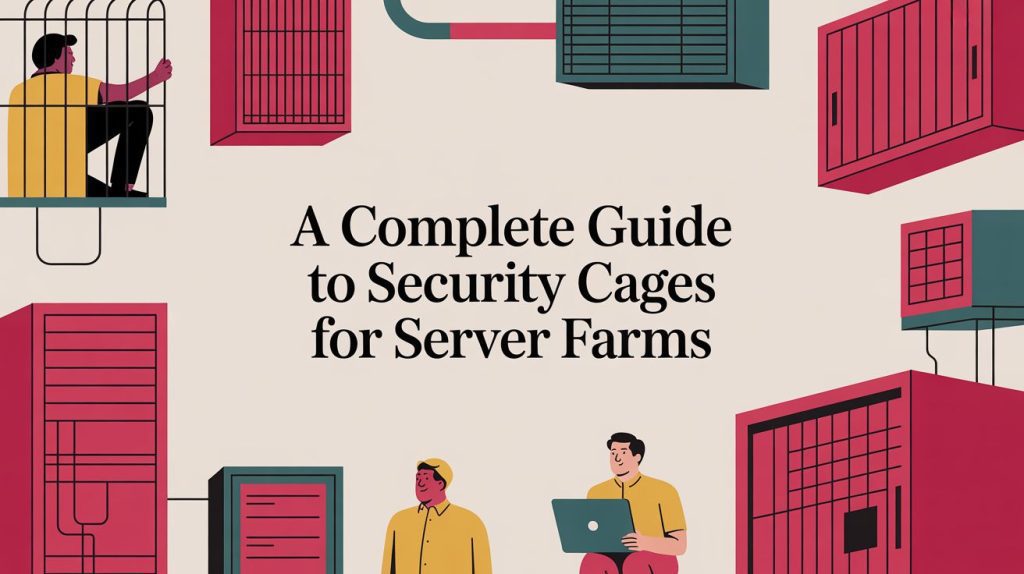
Security cages for server farms are wire mesh enclosures that physically block access to server racks and other IT equipment inside a data center. Think of them as a secure, contained room within a room. These modular partitions create a formidable barrier, turning a shared server room into a private, protected zone. They are a fundamental tool for guarding your most critical infrastructure against theft, tampering, and unauthorized access.
Why Physical Security for Server Farms Is a Top Priority

All the firewalls and encryption in the world become useless if an unauthorized person can simply walk up and touch your hardware. For facility managers and IT directors, this makes physical security the bedrock of any comprehensive protection plan. The dangers of a physical breach extend far beyond just data theft.
A single unauthorized entry can lead to disaster:
- Equipment Sabotage: Intentional damage to servers, network switches, or power supplies can trigger catastrophic operational disruptions.
- Costly Downtime: A physical breach can bring business to a screeching halt, with downtime costs hitting thousands of dollars per minute for many companies.
- Data Theft: Physical access allows an intruder to connect devices directly to your network or, even worse, walk out the door with your storage drives.
- Reputational Damage: A security incident can shatter client trust and ruin your brand's reputation, an especially critical risk in colocation and cloud service environments.
The Growing Need for Physical Hardening
Understanding the broader landscape of data center security is crucial for grasping why physical protection, like server cages, has become so important. The global data center cage security market is projected to grow from an estimated USD 7.2 billion in 2026 to USD 13.7 billion by 2033. This explosion is fueled by rising concerns over physical breaches in critical IT infrastructure.
This rapid market growth signals a clear industry shift: operators are no longer taking chances with physical access. Proactive investment in physical security is now seen as a baseline requirement, not a luxury.
This trend is particularly strong in North America, where hyperscale operators and colocation facilities must meet strict regulatory standards. For warehouse operations managers and IT professionals, this means the demand for custom and modular security cages is climbing fast. Moving forward with your project planning sooner rather than later ensures you can secure better installation timelines and avoid potential supply chain delays.
At Material Handling USA, we provide a rapidly deployable and cost-effective solution with our security cages for server farms. Our team offers free layouts and designs with no obligation, helping you plan a solution that safeguards your most valuable assets before a costly incident occurs.
To start planning your facility's protection, Request a Quote or call our experts today at (800) 326-4403.
Understanding the Anatomy of a Server Security Cage
What separates a basic wire partition from a serious server farm security system? It is not just about putting up a fence. It is about building a complete defense where every single component—from the posts to the mesh to the bolts—works together to create a formidable barrier.
To make the right choice for your facility, you have to look past the surface and understand what makes these cages work. The quality of the individual parts is what determines whether you have a simple divider or a true security enclosure. The details matter.
Core Components of a Security Cage
Every server cage, no matter how complex, is built from three fundamental parts. The strength of the entire structure is only as good as its weakest link.
- Posts: Think of these as the skeleton. These vertical steel supports are anchored directly to the floor, providing the structural backbone that holds the entire cage together.
- Panels: These are the wire mesh sections that create the walls of the cage. The type of mesh, its thickness, and the grid pattern are what define the cage's security level, airflow, and visibility for surveillance.
- Hardware: This covers every nut, bolt, and bracket. Using high quality, tamper resistant hardware is non negotiable; it is what stops someone from simply disassembling the cage from the outside.
These elements are designed to work together as a modular system, which is a huge advantage. You can learn more about how these pieces create a powerful security solution in our guide to wire mesh modular cages. Because our systems are pre engineered, they install fast, getting your assets secured with minimal disruption to your operations.
Woven vs. Welded Wire: The Critical Difference
Choosing between woven and welded wire mesh is one of the most important decisions you will make. They might look similar from a distance, but how they are made creates significant differences in performance, affecting everything from security to your budget.
For server farm security, welded wire mesh is almost always the superior choice. The wires are physically welded at every single intersection. This creates a solid, rigid grid that is incredibly difficult to cut or pry apart. Woven wire, which is more flexible, can be forced open with enough time and effort.
For high security applications like data centers, the robust, anti cut properties of welded wire mesh provide a serious advantage. This one detail is often the clearest indicator of whether a cage is built for real protection or just for show.
Understanding the key differences between these two primary types of wire mesh is essential for making an informed decision for your facility. This table breaks down what you need to know.
Comparing Woven vs. Welded Wire Mesh
| Feature | Woven Wire Mesh | Welded Wire Mesh |
|---|---|---|
| Construction | Wires are crimped and interlaced, like a chain link fence. | Wires are welded together at every intersection. |
| Security Level | Good. Can be forced apart with sustained effort. | Excellent. The rigid grid is highly resistant to cutting and prying. |
| Visibility | Good. Provides clear lines of sight for surveillance. | Excellent. The uniform pattern offers superior visibility. |
| Airflow | Excellent. Open design allows for unrestricted airflow. | Excellent. The open grid pattern does not impede cooling. |
| Cost | Generally more economical for large, lower security areas. | Slightly higher initial cost, justified by superior strength. |
While welded mesh offers the best security, the final choice depends on your specific needs. Weighing the cost against the required security level will point you toward the right material for your project.
Due to high demand for secure infrastructure, project timelines are extending across the industry. Finalizing your material specifications sooner rather than later helps lock in project schedules and avoids potential delays. To get expert advice and a no obligation design, Request a Quote or call us at (800) 326-4403.
Planning Your Server Cage for Peak Performance
A server cage is not just walls and a door—it is a critical piece of your data center's ecosystem. Proper planning is the difference between a simple box and a high performance security asset that helps your operations instead of getting in the way.
Getting this right from the start prevents common design mistakes and expensive fixes down the road. It ensures your investment works for you from day one.
The process has to start with a clear picture of your current footprint and, more importantly, your future growth. Just walling off your existing racks is a recipe for trouble later on. You have to think about new servers, more network gear, and the breathing room your team needs for maintenance and proper airflow.
Sizing and Future Proofing Your Layout
The first decision you'll make when planning security cages for server farms is figuring out the right size. Start by measuring the total square footage your racks currently take up, but do not stop there. Always add space for future expansion. A solid rule of thumb is to plan for at least 20-30% growth in rack capacity.
You also have to think about the people who will be working in and around the cage. Your design must include enough clearance around and between racks. If technicians cannot move safely and efficiently, routine maintenance turns into a logistical nightmare, and the risk of someone accidentally unplugging the wrong thing goes way up.
This is a critical step, but you do not have to figure it out on your own. At Material Handling USA, we provide free layouts and designs with no obligation. Our experts will help you map out a detailed plan that makes the most of your current space while building in the flexibility you will need for the future.
Maintaining Optimal Airflow and Cooling
One of the most common mistakes we see is a server cage that disrupts a facility's carefully planned cooling system. Server farms generate an enormous amount of heat, and anything that blocks airflow can lead to equipment overheating, performance issues, and a shorter lifespan for your hardware.
This is where the open design of wire mesh really shines. Unlike solid walls, wire mesh allows air to flow freely, working perfectly with your existing hot aisle/cold aisle containment strategy instead of against it.
When planning your layout, make sure your cage:
- Does not block any air intake vents or exhaust paths.
- Leaves enough clearance above the racks for hot air to escape.
- Uses a mesh pattern that gives you the most open area without compromising on security.
Integrating Access Control Systems
The security of your cage is only as good as its door. The type of lock you choose needs to match your facility's overall security protocols, finding the right balance between convenience for your team and tough protection against intruders.
Here are the most common options we see:
- Keyed Locks: Simple, reliable, and cost effective. A standard padlock hasp is a great choice for areas that do not need frequent access.
- Mechanical Keypads: Gets rid of the need to manage physical keys. You just need a code to get in.
- Electronic Access: This ties directly into your building’s main security system. Options include card readers, electric strikes, or magnetic locks that you can monitor and control from a central location.
- Biometric Scanners: This is the top tier of security. Using a fingerprint or retinal scan for access leaves zero doubt about who entered and when, creating a rock solid audit trail.
For a deeper dive into the specifics of planning and configuration, you can find more information in our guide to designing server cages.
Secure Cable Management and Fire Suppression
Finally, a well designed server cage has to accommodate two other vital systems: your cabling and your fire suppression.
You will need a way to run cables through the cage walls securely. This is typically done with small, protected cutouts or passthrough panels that are just big enough for the connectors but far too small to create a security risk.
The diagram below breaks down the core components that come together to form a complete security cage.

As you can see, it is how the panels, posts, and hardware all work together that creates a truly secure system.
Your cage also has to work with your building's fire suppression system. The open mesh of a wire cage is a huge advantage here, as it allows water from overhead sprinklers or clean agent gas to flood the enclosure without obstruction. This ensures a fire can be put out quickly and effectively—a key benefit over solid walled enclosures that can block suppressants and often require their own separate, costly systems to be installed inside.
Meeting Critical Compliance and Security Standards
For many organizations, tough physical security is not just a good idea—it is a non negotiable requirement. A well designed security cage is often the key to satisfying the strict physical access rules laid out by government and industry regulations. Getting it wrong can lead to serious fines, loss of certifications, and a major hit to your reputation.
Navigating this complex world of regulations is critical for any manager tasked with protecting sensitive data. These standards exist to make sure organizations maintain a secure environment, and physical barriers like server cages are a straightforward, auditable way to prove you are compliant.
Translating Regulations into Physical Security
Different industries follow different rulebooks, but they all circle back to one core idea: controlling and tracking who can physically get to your critical IT hardware. A properly specified server cage lets you meet these demands head on.
Here is a quick breakdown of how security cages help you align with major compliance frameworks:
- SOC 2 (Service Organization Control 2): For any service provider, a SOC 2 report is vital for earning client trust. The framework’s "Security" principle demands that you protect systems from unauthorized physical access. Server cages provide a clear, documented control that helps check this box.
- HIPAA (Health Insurance Portability and Accountability Act): If you handle protected health information (PHI), HIPAA's Physical Safeguards are mandatory. Cages help you enforce facility access controls by creating secure, isolated zones for servers storing or processing electronic PHI.
- PCI DSS (Payment Card Industry Data Security Standard): Any company that touches cardholder data must comply with PCI DSS. Requirement 9 specifically calls for restricting physical access to that data. A locked security cage is one of the most effective ways to meet this standard.
- NIST (National Institute of Standards and Technology): Government agencies and their contractors often operate under NIST guidelines like SP 800-53. These frameworks have extensive controls for physical protection, where security cages act as a primary line of defense against unauthorized entry.
Beyond Industry Standards: Local Building Codes
On top of these data focused regulations, you also have to deal with local building codes and fire safety rules. The good news? Wire mesh partitions give you a big advantage here. Their open design allows air to circulate freely and will not interfere with existing fire suppression systems, which often makes the permitting process much simpler than it would be for solid wall construction.
Still, every jurisdiction has its own set of rules. This is where working with an experienced provider is a game changer. At Material Handling USA, our team knows these requirements inside and out. We can provide the drawings and specifications to help you or your architect navigate the permitting process.
Meeting critical compliance and security standards for server farms extends beyond physical barriers to include stringent data handling protocols, such as adhering to the NIST SP 800-88 data sanitization standards for retired IT assets.
Partnering with an expert who understands both security regulations and building codes helps you sidestep unexpected delays and expensive fixes down the road. Our team provides free layouts and designs to make sure your project is planned correctly from day one, aligning your security goals with local compliance. With demand for secure data infrastructure on the rise, planning your project now can help you avoid longer lead times later in the year.
To talk through your compliance needs and start planning a solution that keeps you audit ready, Request a Quote or call our specialists at (800) 326-4403 for a no obligation consultation.
Calculating the ROI of Your Security Cage Investment
How do you justify the cost of a server cage? It is easy to get bogged down seeing it as just another operational expense. The real key is to shift your thinking: this is not a cost, it is a strategic investment that actively protects your bottom line.
To build a solid business case, you need to calculate your Return on Investment (ROI). This is not guesswork. It is about taking a hard look at tangible risks and putting real numbers to them, moving from direct cost avoidance to the much bigger financial picture.

Direct Cost Avoidance
The easiest numbers to crunch for your ROI calculation are the immediate financial losses you will prevent. These are the straightforward, measurable costs a physical breach would set in motion.
Think about what you are preventing:
- Hardware Theft: Tally up the replacement cost of your servers, networking gear, and storage arrays. A single high end server can run into the tens of thousands of dollars. A security cage is your most direct insurance policy against that loss.
- Non Compliance Fines: Failing to meet standards like HIPAA or PCI DSS comes with staggering penalties. Those fines can easily dwarf the cost of a secure cage, making compliance one of the biggest drivers of your ROI.
Quantifying the Cost of Downtime
The real impact of a security breach often comes from operational downtime. For most businesses, every minute your systems are offline means lost revenue, tanking productivity, and eroding customer trust.
Industry studies estimate that unplanned data center downtime can cost a business over $9,000 per minute. A robust server farm security cage is a non negotiable part of any business continuity plan meant to stop those kinds of catastrophic losses.
When a breach happens—whether it is theft or sabotage—the resulting downtime can cripple an organization. A security cage is your frontline defense, making sure your critical operations stay online. This protection alone often provides the most compelling case for your investment.
Indirect Benefits and Opportunity Costs
Beyond the clear cut cost savings, a well designed security cage opens up indirect financial benefits and helps you chase down new opportunities. These factors might be harder to put a precise dollar amount on, but they are just as crucial to your ROI calculation.
Consider these business impacts:
- Enhanced Client Trust: In a colocation environment, visible and robust security is a huge selling point. It gives clients the peace of mind they are looking for and can be the single factor that makes them choose your facility over a competitor’s.
- Winning High Security Contracts: Many government and enterprise contracts have non negotiable physical security mandates. A compliant server cage is not just a defensive move; it is an offensive tool that gets you in the door to bid on—and win—lucrative projects you would otherwise be locked out of.
With Material Handling USA's competitive pricing and the fastest shipping in the industry, the initial investment is more manageable than you might think, and the payback period is often surprisingly short. Our free layout and design services also ensure your cage is optimized for both security and your budget right from the start.
Secure infrastructure is in high demand, and project timelines are getting longer across the industry. Getting your quote and design locked in now means a faster installation and helps you sidestep future delays. Do not let a preventable breach hit your bottom line. Request a Quote or call our security experts at (800) 326-4403 to calculate your ROI today.
Your Essential Server Cage Buyer's Checklist
Ready to take the next step? Think of this as your go to tool for the procurement process. We have boiled down the key takeaways from this guide into a practical, scannable checklist.
This is not about guesswork. It walks you through every stage, from initial planning to final specs, so you can move forward with confidence. Each point is an action item designed to make sure you have covered all your bases.
Needs Assessment and Security Objectives
First things first: you have to define what you are protecting and why. Getting this part right will guide every single decision you make from here on out.
- Define Security Objectives: Are you trying to stop internal theft? Block external intruders? Simply check a box for a compliance audit? Or all of the above?
- Identify Assets: Make a complete inventory. List out every server, switch, SAN, and piece of backup equipment that needs to go inside the cage.
- Assess Your Risk Level: How sensitive is the data? What is the replacement cost of the hardware? Classify your needs as low, medium, or high. This will directly impact your choices for materials and locks.
Physical Layout and Space Planning
Once your security goals are clear, it is time to start mapping out the physical space. A little planning here saves a lot of headaches—and money—down the road.
- Measure Your Required Footprint: Get the tape measure out. You need accurate length, width, and height. Do not forget to account for future growth and leave enough service clearance around all your equipment.
- Evaluate Airflow and Cooling: Make sure your cage layout will not block HVAC vents or mess up your hot aisle/cold aisle strategy. The open mesh design of our security cages for server farms is specifically built to allow for unrestricted cooling.
- Plan Cable Passthroughs: Figure out exactly where power and data cables need to come in and go out. You will need secure, properly sized cutouts that give you the access you need without creating a new security hole.
Specifications and Compliance
Now we get into the nitty gritty. The technical details are what make your cage truly secure and ensure it meets any regulations you are subject to.
- Verify Material Specifications: For most data center applications, 10 gauge welded wire mesh is the sweet spot, offering a great balance of security and visibility. Confirm that the material and its powder coat finish are tough enough for your environment.
- Select Access Control: Your lock should match your security protocol. Options go from a simple keyed lock all the way up to fully integrated electronic systems that use card readers or biometrics.
- Confirm Compliance Requirements: Check your design against any standards you have to meet, like SOC 2, HIPAA, or PCI DSS. You need to be certain your physical access controls will pass an audit.
With data center infrastructure in high demand, securing your design and materials early is key to keeping your project on schedule. Our team provides Free Layouts and Designs with no obligation to help you get started.
Request a Quote or call our experts at (800) 326-4403 to move your project forward without delay.
FAQ: Your Server Cage Questions, Answered
When you are planning a server cage project, a handful of key questions always come up. From dealing with tricky facility layouts to making sure you do not overheat your servers, getting clear answers is crucial. We have put together straightforward answers to the questions we hear most often from facility managers and buyers.
Can security cages be customized to fit an unusual space?
Yes, and this is where modern server cages really shine. They are built with a modular design, which means they are not a one size fits all product. This flexibility is their greatest strength.
We can easily configure a cage to navigate around existing columns, low hanging pipes, or other infrastructure you have to work with. Irregular footprints are not a problem; they are a design parameter. Our team specializes in this, using our free design and layout services to map out a solution that maximizes every inch of your unique space.
How do wire mesh cages affect server cooling and airflow?
This is a make or break question for any data center manager. The good news is that wire mesh is the industry standard for a reason: it is designed for completely unrestricted airflow. This is absolutely essential for keeping your servers cool and preventing thermal shutdowns.
Unlike solid partitions that can trap heat and create dangerous hot spots, the open weave design of our cages will not interfere with your existing HVAC and cooling systems. It secures the hardware without compromising your carefully planned thermal environment.
What is the typical installation time for a server cage?
Speed is a huge advantage here. While the exact timeline depends on the project's size, modular cages are engineered for incredibly fast assembly. A standard installation can often be completed in just a few days, not weeks.
This rapid deployment means minimal disruption to your live data center operations. At Material Handling USA, we offer the fastest shipping and delivery in the industry. Our pre engineered components arrive ready for efficient on site assembly, getting your assets secured much faster than any traditional construction method would allow.
Will I need a building permit to install a server cage?
This depends entirely on your local building authority, as codes vary from one jurisdiction to another. However, in many cases, a permit is not required for wire mesh partitions.
The reasoning is that cages are typically classified as trade fixtures or equipment, not a permanent structural addition. Since the open mesh does not obstruct overhead fire suppression systems like sprinklers, they often bypass the complex permitting process. We always advise a quick call to your local building department to be certain. If a permit is needed, our team can provide the professional drawings required to make the process go smoothly.
Secure Your Data Center with Material Handling USA
Protecting your critical IT infrastructure starts with robust physical security. Security cages for server farms offer a scalable, compliant, and cost effective solution to prevent unauthorized access, theft, and sabotage. From ensuring regulatory compliance to maintaining optimal airflow, welded wire mesh cages deliver on all fronts.
With the current demand for secure data infrastructure on the rise, planning your project now is the best way to secure faster installation timelines and avoid future supply chain delays. Taking the first step with a professional layout gives you a strategic advantage.
The team at Material Handling USA offers industry leading quality, competitive pricing, and the fastest delivery times available. Let our experts provide a free, no obligation layout and quote to get your project moving.
Request a Quote or contact our security specialists at Sales@MH-USA.com or (800) 326-4403 to discuss your needs today.