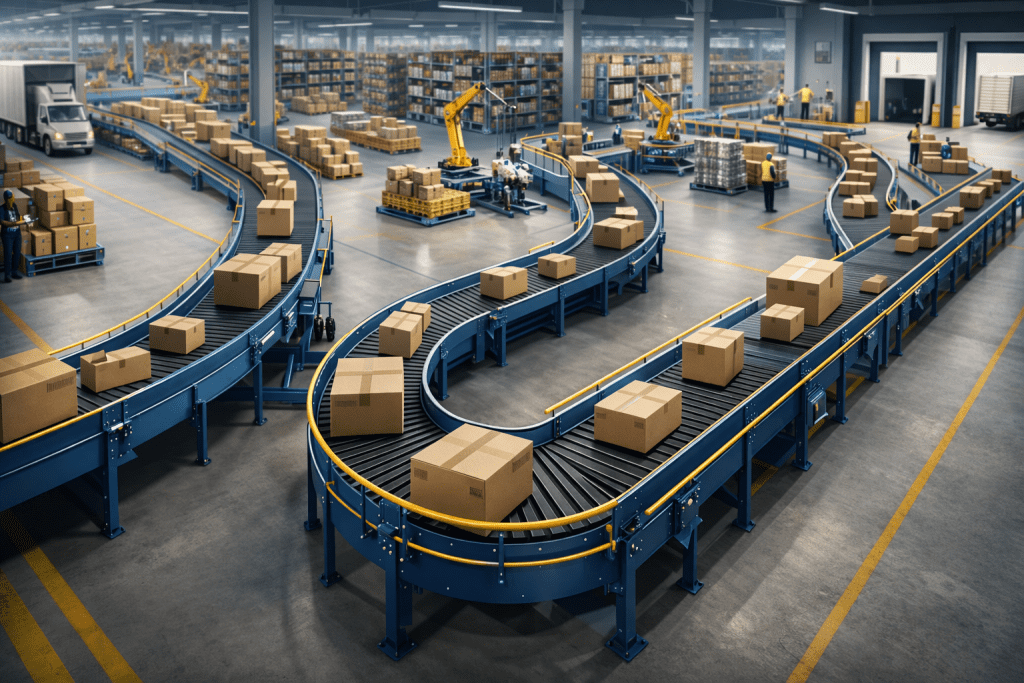
Think of an industrial belt conveyor as the circulatory system of your facility. It’s the vital network that keeps materials, products, and packages moving in a constant, reliable flow, connecting every part of your operation into a single, productive unit. Without it, your entire workflow could grind to a halt.
The Role of an Industrial Belt Conveyor in Modern Operations
A conveyor isn’t just another piece of equipment; it’s the backbone of modern material handling. Just like arteries move blood where it’s needed, a conveyor system transports goods from receiving to storage, from production lines to packing stations, and finally out to the shipping docks. This non-stop motion is what fuels the efficiency of today’s fast-paced warehouses and manufacturing plants.
Putting the right system in place is a strategic upgrade for your whole operation. It immediately boosts productivity by automating the repetitive tasks that tie up your team, freeing them to handle more valuable responsibilities. Not only does this cut down on manual handling and labor costs, but it also makes the workplace significantly safer by minimizing the need for lifting, carrying, and pushing.

The benefits of a well-integrated conveyor system are too significant to ignore. Take a look at this quick summary:
Key Benefits of Industrial Belt Conveyors at a Glance
| Benefit Area | Operational Impact |
|---|---|
| Increased Throughput | Moves more products in less time, directly boosting productivity. |
| Reduced Labor Costs | Automates repetitive manual tasks, freeing up staff for higher-value work. |
| Improved Safety | Minimizes physical strain and lifting, leading to fewer workplace injuries. |
| Enhanced Accuracy | Reduces human error in sorting and routing, improving order fulfillment. |
| Better Space Utilization | Creates clear, organized pathways for material flow, optimizing your floor plan. |
| Operational Consistency | Provides a steady, predictable flow of materials, preventing bottlenecks. |
As you can see, the impact goes far beyond just moving boxes from point A to point B. It’s about creating a more efficient, safer, and more profitable operation from the ground up.
Driving Operational Excellence
The numbers tell the story. Belt conveyors make up a massive share of the total conveyors market, proving just how essential they are across countless industries. Their versatility lets them handle almost anything, from tiny components to large boxes, making them a cornerstone of modern logistics and production.
Properly integrated, industrial belt conveyors become key components in broader Industrial Automation Solutions, creating a seamless workflow that eliminates bottlenecks and maximizes your facility’s output.
Ultimately, the right industrial belt conveyor system isn’t just a purchase. It’s a fundamental improvement that pays you back every day through greater speed, reliability, and safety. As customer demands get tougher and delivery times shrink, facilities with optimized material handling are the ones that will win. We can help you explore all the different types of conveyors to find the perfect fit for your operation.
Breaking Down the Industrial Belt Conveyor
To make a smart investment in a conveyor, you need to know exactly what you’re buying. Think of it like looking under the hood of a car—understanding the core components and how they work together helps you spot quality engineering and long-term value. A great system is more than just a moving surface; it’s a carefully balanced machine built for performance and durability.
When you break it down, a conveyor has five essential parts. Each one has a specific job, and the quality of each directly impacts the entire system’s efficiency, maintenance needs, and lifespan.
The Conveyor Belt
This is the most obvious part, the moving surface that carries your products. But not all belts are created equal. They’re made from a variety of materials, including PVC, rubber, or polyurethane, and each one is suited for different jobs.
A standard PVC belt might be perfect for handling packages in a warehouse, but a food processing plant will need a food-grade belt that’s easy to sanitize. The belt’s construction—its thickness, texture, and internal reinforcement—is what determines its load capacity and how well it stands up to wear and tear.
The Frame and Structure
The frame is the backbone of the whole system. It’s the skeleton that holds everything together, and it has to be rigid enough to handle the full load without bending or warping. You’ll typically see frames built from high-quality steel or aluminum.
The frame’s design also dictates the conveyor’s shape, whether it’s a simple straight line, a steep incline, or part of a complex, winding layout. A well-engineered frame ensures every other component stays perfectly aligned, which is critical for reducing friction and extending the life of both the belt and the motor. If you’re thinking about future growth, this is where it starts; a modular frame makes it much easier to modify or expand down the road.
A conveyor system’s reliability is built on the strength of its frame. A robust, well-aligned structure is the foundation that prevents premature wear on every other component, saving significant maintenance costs over the system’s life.
The Drive System
The drive system is the engine that makes the whole thing go. It’s made up of a motor and a reducer (or gearbox) that work together to turn the drive pulley, which in turn moves the belt. The motor’s horsepower and the reducer’s gear ratio are calculated precisely based on the belt speed and load capacity you need.
You’ll find three main placements for the drive, each with its own advantages:
- Center Drive: Tucked underneath the middle of the conveyor, this is the go-to option for reversible systems where you need the belt to run in both directions.
- End Drive: Mounted at one end of the conveyor, this is the most common and cost-effective setup for one-way material flow.
- Internal Drive: For spots where space is tight or you need to eliminate external moving parts for safety, the motor is housed right inside a roller. This creates a clean, compact design.
Pulleys and Rollers
Pulleys and rollers are the last key pieces of the puzzle. The drive pulley, powered by the motor, is what grips the belt and puts it in motion. At the opposite end, the tail pulley (often called an idler pulley) spins freely, guiding the belt on its return trip.
Supporting the belt all along the frame are the rollers. These small but essential components are critical for cutting down friction between the moving belt and the static frame. High-quality rollers with smooth bearings are a hallmark of a superior system—they minimize the energy needed to run the conveyor, keep operational noise down, and prevent the belt from wearing out too fast. Skimping on roller quality is a common mistake that always leads to more maintenance and expensive downtime.
If you’re unsure which components are right for your needs, our experts are here to help. Contact us for a free, no-obligation layout and design consultation.
How to Choose the Right Industrial Belt Conveyor
Picking the right industrial belt conveyor is one of the most critical decisions you’ll make for your facility’s material handling strategy. This choice directly impacts your throughput, operational efficiency, and long-term return on investment. The goal is to match the conveyor to the specific job you need it to do—ensuring the system works for you, not against you.
With several types available, each engineered for a different task, it can feel like a complicated choice. But when you break them down by their intended use, the selection process gets much clearer. Let’s look at the main types of industrial belt conveyors to find the perfect fit for your operation.
Flat Belt Conveyors
The flat belt conveyor is the quintessential workhorse of the material handling world. It’s a simple, effective design featuring a flat, continuous belt that glides over a series of rollers or a flat slider bed. This versatility makes it the most common choice across a huge range of industries, from manufacturing and assembly to packaging and distribution.
Picture an assembly line where workers are adding parts to a product as it moves along. That’s a classic job for a flat belt system. It provides a stable, consistent surface perfect for moving individual items, boxes, and totes in a straight line. Thanks to their straightforward construction, these systems are also cost-effective and easy to maintain.
Modular Belt Conveyors
Modular belt conveyors offer a huge advantage in durability and flexibility. Instead of one single, continuous belt, they’re built from countless interlocked, hard plastic segments. This creates an incredibly rugged surface that can handle sharp or abrasive products far better than a standard fabric belt.
The real benefit here is maintenance. If one section of the belt gets damaged, you just pop out the broken modules and replace them—no need to swap out the entire belt. This dramatically cuts down on downtime and repair costs. It makes them ideal for food processing, where sanitation and frequent washdowns are a must, as well as for handling heavy or jagged parts in manufacturing. You can even find specialized options, like those in our AmbaFlex spiral conveyors, that use modular designs to move products vertically.
This flowchart breaks down the core components that are common across most industrial belt conveyor systems.

Understanding how the belt, frame, and motor all work together is the first step toward choosing a system that’s built for longevity and performance.
Inclined and Declined Conveyors
When you need to move products between different floors or just elevate them to another piece of equipment, an inclined or declined belt conveyor is the tool for the job. These systems are essentially flat belt conveyors built at an angle, but with one crucial addition: a textured or cleated belt surface.
This special surface provides the grip needed to stop items from sliding back down. For steeper angles or for moving loose materials, you’ll see cleats—raised barriers spaced along the belt—to keep everything in place. These conveyors are essential for connecting different stages of an automated system, like moving finished goods from a production line up to a mezzanine for storage.
By selecting the correct conveyor type from the start, managers can avoid common production bottlenecks and reduce manual handling needs, leading to a safer and more productive work environment. The planning phase is critical for long-term success.
The push toward automation is a huge driver in the growth of the industrial belt conveyor market. Adopting predictive maintenance can slash system failures significantly, pushing the average belt life from 3-5 years to as long as 7-10 years.
Making the Right Choice for Your Operation
Choosing the best conveyor comes down to a careful look at your product, your process, and your environment. A side-by-side comparison can make this much simpler and point you toward the ideal solution.
This quick table breaks down the key differences to help guide your decision.
Industrial Belt Conveyor Type Comparison
| Conveyor Type | Best For | Load Capacity | Key Advantage |
|---|---|---|---|
| Flat Belt | General transport, assembly lines, inspection stations | Low to Medium | Versatility and cost-effectiveness |
| Modular Belt | Food processing, harsh environments, handling sharp items | Medium to High | Durability and easy maintenance |
| Inclined/Declined | Moving products between elevations or floors | Low to Medium | Space-saving vertical transport |
With lead times for industrial equipment on the rise, getting your system design finalized sooner rather than later helps you lock in an installation slot and steer clear of project delays. A well-defined plan always leads to a smoother implementation.
If you’re still not sure which industrial belt conveyor is the right fit for your facility, our team is here to help. We provide free layouts and designs with no obligation to map out the most efficient solution for your unique workflow. Contact Us today or give us a call at 800-326-4403 to speak with a material handling expert.
Understanding Key Conveyor Specifications
Picking the right industrial belt conveyor really boils down to knowing how to read the spec sheet. These numbers aren’t just technical jargon; they directly impact your productivity, safety, and long-term costs. Getting fluent in these key metrics means you’ll invest in a system that not only works for you today but can also grow with you tomorrow.
It’s like choosing a delivery truck. You wouldn’t buy a small van to haul heavy pallets. In the same way, you have to match the conveyor’s capabilities to the job at hand. This means looking past the price tag and digging into the core performance stats that define what the system can actually handle.
Load Capacity and Speed
Two of the most important specs to get right are load capacity and speed. Load capacity is usually measured in pounds per linear foot. Pushing this limit is asking for a system failure—it causes premature wear on the motor, the rollers, and the belt itself. A mismatched load capacity is a fast track to frequent downtime and expensive repairs.
Belt speed, measured in feet per minute (FPM), dictates your facility’s throughput. While faster might seem better, the perfect FPM depends on your specific operation.
- Assembly lines often need a slower, more deliberate speed for people to do their work.
- Sorting and distribution centers rely on higher speeds to move huge volumes of packages quickly.
- Fragile items might require a much gentler pace to keep them from getting damaged.
Getting the balance right between load and speed is the secret to an efficient material handling system that works.
Incline Capabilities and Belt Material
Need to move products up or down? You’ll be looking at an incline conveyor. The maximum angle a conveyor can handle comes down to the belt’s surface. A standard, smooth PVC belt might be fine for a gentle slope, but steeper angles demand a belt with a high-grip surface or even cleats to stop items from sliding back down.
The belt material itself is a massive decision. It affects everything from durability and maintenance to whether it’s suitable for your work environment.
- PVC (Polyvinyl Chloride): The all-rounder. It’s a versatile and cost-effective pick for general package handling.
- Rubber: This is your go-to for toughness. It offers fantastic grip and durability, making it perfect for abrasive materials or rough environments.
- Modular Plastic: Incredibly durable and a breeze to repair since you can just swap out a single section. You’ll often see it in food processing or on lines with sharp turns.
- Polyurethane: The specialist. It has superior resistance to oils, chemicals, and abrasion, which is why it’s common in manufacturing and pharmaceutical labs.
Choosing the right material from the get-go saves you from having to replace the belt too soon and ensures your system can handle the unique challenges of your facility.
A conveyor system engineered with the correct specifications is an asset that delivers a strong return on investment. An underspecified system, however, quickly becomes a liability, creating bottlenecks and driving up maintenance costs.
Get the Right Specs for Your Project
Translating your operational needs into technical specifications can be complex. That’s why we offer free quotes and design consultations with no obligation to ensure every detail is perfect. Our experts will help you define the exact load capacity, speed, and materials needed for optimal performance.
Request a Quote or call us at 800-326-4403 to get started.
Putting It All Together: A Practical Checklist
When you’re evaluating an industrial belt conveyor, run through this checklist to make sure you’ve covered all the critical specs. Answering these questions will point you straight to the perfect system.
- What’s the max weight of a single item? This helps lock in the minimum pounds-per-linear-foot capacity.
- What’s the total weight on the conveyor at any given time? This confirms the overall system load and what kind of motor you’ll need.
- How many items do you need to move per minute? A quick calculation here will tell you the belt speed (FPM) you require.
- Will the conveyor run on an incline or decline? If the answer is yes, you’ll need a specialized belt with a high-friction surface or cleats.
- What’s the operating environment like? Think about temperature, moisture, and any exposure to chemicals or oils. This will narrow down your belt material choices.
- Are the products fragile, sharp, or abrasive? This is a key factor in choosing both the belt material and its surface texture.
Finalizing these specifications early in the planning process gives you a major advantage. With current demand for industrial equipment, having a clear design helps secure your place in the installation queue, preventing project delays and getting you to peak operational efficiency that much faster. For a personalized evaluation, Contact Us for a free layout and design.
Getting Installation and Maintenance Right
The true cost of an industrial belt conveyor isn’t on the purchase order. It’s revealed over years of operation. Getting the installation right from day one and sticking to a consistent maintenance plan are what guarantee a long, productive service life and the lowest total cost of ownership. A well-cared-for system just works—smoothly, efficiently, and safely.
On the other hand, a system that’s rushed into place or ignored can quickly turn into a massive headache. It becomes a constant source of production bottlenecks, frustrating downtime, and serious safety risks. Think of it this way: proper setup and upkeep transform your conveyor from just another piece of equipment into a reliable, powerhouse asset for your entire operation.

A Checklist for a Smooth Start
A flawless installation is the foundation for years of trouble-free performance. It’s tempting to rush this stage, but that almost always leads to nagging alignment and tensioning problems later. This is where professional planning pays off. Using our free design services ensures your layout is fully optimized before a single piece of hardware shows up, helping you sidestep those common and costly project delays.
Here’s a simple checklist to guide you through a smooth installation:
- Check Your Foundation: First, make sure the floor is level and can handle the full weight of the conveyor when it’s loaded up.
- Assemble the Frame: Follow the manufacturer’s guide to the letter. Every support needs to be square and perfectly vertical.
- Install Pulleys and Rollers: Mount the main head and tail pulleys, then get all the carrying and return rollers in place. Give each one a spin to make sure it moves freely.
- Get Everything Lined Up: This is critical. Use a string line or a laser to confirm every pulley and roller is perfectly aligned with the others and sits at a perfect right angle to the frame.
- Track and Tension the Belt: With the belt on, apply some initial tension. Now, run the conveyor at its slowest speed to watch how the belt tracks. You’re looking for it to run dead center. Make small, patient adjustments until it’s perfect.
Staying Ahead of Downtime with Proactive Maintenance
A proactive maintenance plan is your best defense against expensive, unexpected breakdowns. Don’t wait for something to fail. Regular check-ups allow you to spot and fix small issues before they snowball into operation-stopping emergencies. To really get the most out of your system, it’s worth exploring strategies for mastering repair of industrial equipment efficiently.
Feel free to adapt this sample schedule to match your system’s workload and operating environment.
Preventative Maintenance Schedule
| Frequency | Task | Focus Area |
|---|---|---|
| Daily | Walk the Line | A quick visual inspection for debris, belt tears, or any new or unusual noises. |
| Weekly | Check Belt Tracking | Make sure the belt is still running centered on all pulleys and rollers. |
| Monthly | Inspect Key Components | Look for signs of wear on pulleys, rollers, and bearings. Lubricate parts as needed. |
| Quarterly | Verify Belt Tension | Check and adjust the belt tension. This prevents slippage and reduces wear and tear. |
| Annually | Motor and Reducer Check | A deeper dive into the drive system to check its performance and spot potential issues. |
The role of belt conveyors is only getting bigger. As e-commerce continues to surge, well-maintained systems are absolutely essential for hitting tight fulfillment deadlines in busy distribution hubs.
Don’t Overlook Safety and Compliance
When it comes to your team, safety is non-negotiable. Making sure your system is fully OSHA compliant isn’t just about protecting your people—it’s about protecting your business from serious liability. Proper guarding is a huge part of this. We offer a full lineup of solutions to keep your system safe; you can learn more about our conveyor guard options.
Key Takeaway: A structured, disciplined approach to installation and maintenance has a direct impact on your bottom line. It extends the life of your equipment, prevents costly shutdowns, and creates a safe workplace for your team.
Planning your installation with our experts gets you up and running faster. Request a Quote or give us a call at 800-326-4403 for a free design consultation.
Your Next Steps with MH-USA
We’ve covered a lot of ground, from the nuts and bolts of conveyor components to the nitty-gritty of technical specs. If there’s one thing to take away, it’s this: the right conveyor system isn’t just a piece of equipment. It’s a workhorse that drives efficiency, improves safety, and ultimately boosts your bottom line. Making a smart choice now is the bedrock of a solid material handling strategy.
As you shift from planning to action, remember what makes MH-USA different. We’re not just about selling high-quality products. We’re committed to providing competitive pricing and the fastest shipping and delivery in the industry. That means you get a top-tier system without the project-stalling wait times common elsewhere.
Choosing us means you’re not just buying equipment. You’re getting a dedicated partner obsessed with optimizing your facility’s productivity and ensuring a smooth integration from day one.
Your Next Step to a More Efficient Operation
The decisions you’re making right now will directly shape your facility’s throughput and safety for a long time. With high demand for industrial equipment stretching project timelines, getting your plans locked in sooner rather than later is a smart move—it secures your spot in the installation queue and helps you sidestep potential delays.
We make it easy and risk-free to get started. Our team offers free layouts and designs with no obligation, so you can see exactly how the perfect belt conveyor system will look and perform in your space. This isn’t guesswork; it’s expert guidance designed to set your project up for success.
Ready to build a more productive, reliable operation?
Request a Quote online for a detailed estimate, or give us a call at 800-326-4403 to speak directly with a material handling specialist. For a solution built specifically for your facility, Contact Us today.
Frequently Asked Questions
When you’re looking to invest in a conveyor system, you’re bound to have a few questions. Getting the right answers upfront helps you make a solid decision that lines up with your facility’s goals and your budget. Let’s tackle some of the most common questions we hear from managers and buyers.
How Do I Determine the Right Belt Material for My Products?
Choosing the right belt material is one of the most critical decisions you’ll make for your conveyor’s performance and longevity. It all comes down to what you’re moving and the environment you’re moving it in. Start with the product itself—think about its weight, size, and texture. Is it abrasive? Does it have sharp edges?
Next, look at the surrounding environment. Factors like extreme temperatures, exposure to oils or chemicals, and any specific sanitation requirements will immediately help you zero in on the best options.
- PVC (Polyvinyl Chloride): This is the workhorse for general-purpose package and tote handling in most warehouses. It’s versatile and a great value.
- Rubber: If you’re dealing with abrasive materials or just need that extra grip to keep things from sliding, rubber is an incredibly durable choice.
- Polyurethane: For cleanroom environments or applications where products might be oily, polyurethane is your go-to. It offers excellent resistance to both chemicals and abrasion.
- Modular Plastic: In food processing or any area with frequent washdowns, modular plastic belts are a game-changer. They’re tough, easy to clean, and simple to repair if a section gets damaged.
Matching the belt to the job from day one is the surest way to prevent premature wear and keep your whole system running at peak performance.
What Is the Typical Lifespan of an Industrial Conveyor?
How long a conveyor lasts depends on a few key things, but a well-maintained system is absolutely a long-term asset. The frame itself, if it’s specified correctly for your loads, can easily last for decades. It’s the components that see constant action—like the belt and rollers—that have a more variable lifespan.
Ultimately, longevity comes down to build quality, how hard you run it, and—most importantly—proactive maintenance. It’s simple: a belt running 24/7 in a gritty environment will wear out faster than one used just a few hours a day for lightweight boxes.
By sticking to a consistent preventive maintenance schedule (regular checks on belt tension, tracking, and bearing lubrication), you can expect the belt and other moving parts to serve you well for many years. A little proactive care goes a long way in maximizing your return on investment.
Can a Belt Conveyor System Be Modified Later?
Yes, absolutely. In fact, that’s one of the biggest advantages of modern industrial conveyors—their modularity. Business needs are always changing, and your material handling system has to be able to keep up without forcing you to start from scratch.
Most systems today are designed to be easily extended, shortened, or completely reconfigured as your facility grows or your workflow changes. This kind of scalability is a must-have for any growing business.
Planning for future growth is one of the most valuable steps you can take. By working with an expert during the initial design phase, you can ensure your system is built with scalability in mind, making future modifications faster and far more cost-effective.
With demand for industrial equipment often pushing project timelines out, planning ahead gives you a serious advantage. Our free design services ensure your initial layout supports your long-term vision, helping you sidestep delays and get your system up and running sooner.
Partner with the experts at Material Handling USA to get the right answers for your facility. We provide free quotes and layouts with no obligation to ensure your industrial belt conveyor is a perfect fit from day one. Contact Us or call our team at 800-326-4403 to start your project today.