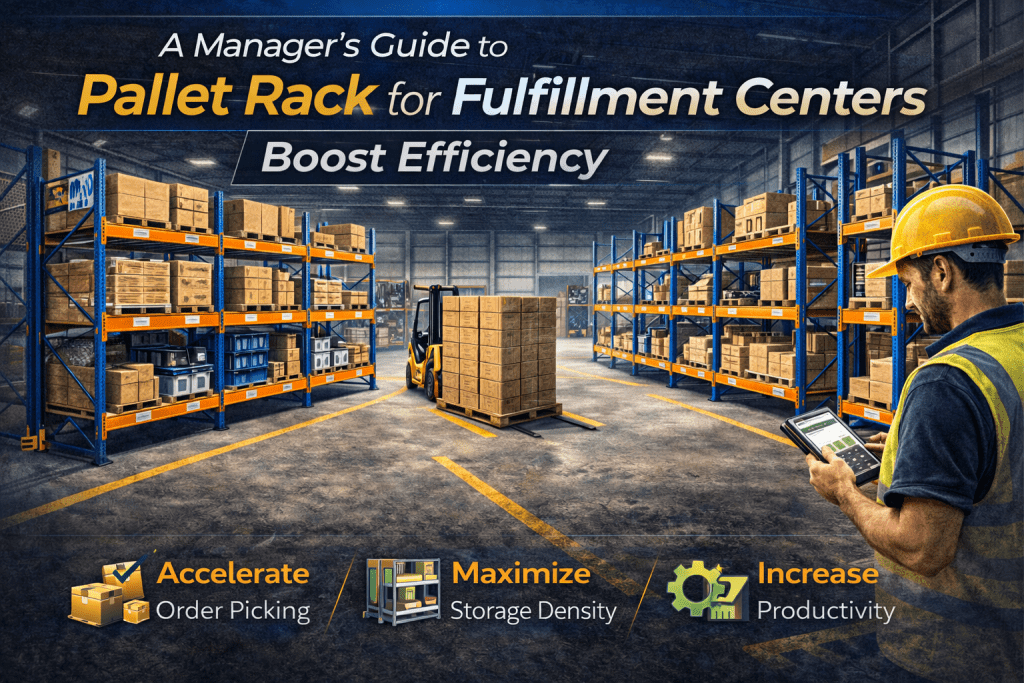
Choosing the right pallet racking is more than just an operational box to check—it’s a foundational decision that can make or break your fulfillment center’s success. The system you install is the literal backbone of your entire operation. It dictates picking speed, defines how efficiently your team works, and directly impacts inventory accuracy. This guide isn’t about simple definitions; it’s about how the right pallet rack for fulfillment centers builds a more fluid, responsive, and scalable business from the ground up.
The Strategic Role of Racking in Modern Fulfillment
In a fast paced fulfillment environment, your racking system isn’t just static shelving. It’s the core infrastructure that either turbocharges your workflow or creates crippling bottlenecks. Every single choice, from the width of your aisles to the height of your beams, has a ripple effect on how quickly you can get orders out the door and how well you’re using every inch of your space. A well designed system turns what could be logistical nightmares into a serious competitive advantage.
This way of thinking is more critical now than ever. The global pallet racking market is booming, driven by the relentless growth of e commerce and the urgent need for smarter, denser warehouse layouts. Projections show the market soaring from USD 12.27 billion in 2025 to a staggering USD 27.34 billion by 2034, and online retail is the engine behind that growth. This trend underscores a simple truth: pallet racks are the essential framework for the kind of high density storage that urban fulfillment centers depend on, where every square foot comes at a premium.
From Simple Storage to Operational Engine
The key is to stop thinking of racking as passive storage and start seeing it as an active part of your operational engine. When you do, you’ll find it directly solves the most common headaches fulfillment managers face every single day.
- Taming SKU Proliferation: Modern fulfillment centers are swimming in an ever changing sea of products. A flexible racking system lets you adapt your storage profiles on the fly, without needing a costly and disruptive reconfiguration.
- Surviving Demand Spikes: Seasonal peaks can bring an inefficient warehouse to its knees. An optimized layout, however, ensures you can scale your throughput to meet that demand without scrambling to add more labor or find more space.
- Boosting Labor Efficiency: When your pickers can get to inventory quickly and safely, their productivity skyrockets. The right rack system cuts down on travel time and minimizes how many times a product has to be handled.
A thoughtfully designed pallet rack system is the first step toward building a truly efficient fulfillment operation. It’s the framework that supports every other process, from inventory receiving to final shipment.
Fulfillment centers grapple with unique pressures that standard warehouses don’t. The table below breaks down how specific racking features can directly address these common pain points.
Fulfillment Center Challenges and Racking System Solutions
| Common Challenge | How the Right Racking Solves It | Key System Feature |
|---|---|---|
| High SKU counts with varying turnover | Allows different storage media in one system for fast, medium, and slow movers. | Hybrid systems (e.g., selective rack with pallet flow lanes) |
| Pressure for faster order picking | Positions high velocity items closer to pickers, reducing travel time. | Pick modules, carton flow, or forward pick locations |
| Limited floor space and high rent costs | Maximizes vertical space, increasing storage capacity in the same footprint. | Very Narrow Aisle (VNA) or high density systems like Drive In |
| Seasonal inventory fluctuations | Provides the flexibility to adjust slotting and storage density as inventory levels change. | Adjustable beams and versatile rack types |
| High labor costs and low productivity | Creates ergonomic pick paths and reduces unnecessary handling and walking. | Slotting optimization software and well placed pick tunnels |
By looking at your racking this way, you’re not just buying steel; you’re investing in solutions that give your operation a real edge.
Turning Challenges Into Advantages
When you view your racking infrastructure as a strategic asset, you start turning common logistical hurdles into strengths. Proper planning ensures you’re not just storing goods, but actively making your entire fulfillment cycle faster and more accurate. A key part of this planning involves a solid understanding of pallet capacity calculations to optimize both storage and transport.
Ultimately, the goal is a system that grows and flexes with your business. An investment in the right racking solution pays for itself over and over in smoother operations and long term scalability. Our experts specialize in designing these systems, and we offer free layouts and designs with no obligation to help you see the potential in your facility. To learn more about maximizing vertical storage space in your warehouse, check out our detailed guide for more expert insights.
Choosing the Right Pallet Rack for Your Fulfillment Flow
Picking the right pallet rack system for your fulfillment center isn’t about finding a one size fits all solution. It’s about matching the hardware to your unique operational flow. Every type of rack comes with its own set of advantages and trade offs that directly hit your picking speed, storage density, and how you manage inventory. This guide goes beyond basic definitions to break down how each system really works in a fast paced fulfillment environment.
The first step is getting honest about your operational reality. Are you juggling thousands of different SKUs that need to be accessible at a moment’s notice? Or are you storing massive quantities of just a few hot selling products? The answer to that question will point you toward the racking system that delivers the best return on your investment.
To make this a bit clearer, this chart visualizes that initial choice between high SKU accessibility and high storage density.

This decision tree shows the main fork in the road: if your operation has high SKU diversity, you’ll likely lean toward selective racking. If you need to cram as much product as possible into every cubic foot, you’ve got to explore high density options.
Selective Racking: The Standard for SKU Accessibility
For fulfillment centers managing a wide, constantly changing mix of products, Selective Pallet Racking is the industry standard for good reason. Its design gives you 100% selectivity, which means every single pallet is directly accessible from an aisle. You never have to move another pallet to get to the one you need.
This feature is absolutely critical for piece picking and each picking operations where speed and direct access are everything.
The trade off, of course, is storage density. Because every row of racking needs its own aisle, selective racking takes up the most floor space of any system. But for many e commerce operations, the incredible benefit of immediate access to any SKU far outweighs the lower density.
High-Density Systems: Maximizing Your Footprint
When your primary goal is to maximize storage capacity, high density systems are where you need to look. These solutions are all about reducing the number of aisles, which lets you store significantly more product in the same square footage.
-
Double Deep Rack: This is a simple evolution of selective racking, storing pallets two deep instead of one. It gives you a nice bump in density but cuts your selectivity in half, since you have to move the front pallet to get to the one behind it. It’s a solid compromise for operations that consistently have multiple pallets of the same SKU.
-
Drive-In and Drive-Thru Racks: For storing huge quantities of uniform products, Drive In racking is a beast. Forklifts drive right into the racking structure to place or pull pallets. This system gives you phenomenal density but it operates on a Last In, First Out (LIFO) basis, making it a poor choice for anything with an expiration date.
-
Push-Back Racking: This system offers a great blend of density and selectivity. Pallets sit on nested carts that glide on inclined rails. When you load a new pallet, it pushes the one behind it back one position. It’s another LIFO system, but it lets you store pallets several deep while still accessing them all from a single aisle.
-
Pallet Flow Rack: This dynamic system is the gold standard for First In, First Out (FIFO) inventory management. Pallets are loaded from the back and flow down a slight incline on rollers to the front for picking. It’s perfect for date sensitive goods like food, beverages, or pharmaceuticals, as it makes stock rotation completely automatic.
The decision between FIFO and LIFO systems is fundamental. Pallet Flow (FIFO) ensures older stock is used first, while systems like Drive-In and Push-Back (LIFO) prioritize the most recently stored items.
The explosion of e commerce has put immense pressure on fulfillment centers to be more efficient, and the right pallet rack is a huge part of that equation. Pallet racks are unsung heroes, especially in North America, which holds a massive 37.1% of the global market share in 2025, driven by warehouse automation. For facilities managers, this means systems like selective or drive in racks that can boost storage capacity by 50-80% compared to just stacking pallets on the floor are no longer optional—they are essential for staying profitable as urban land costs soar.
Matching Rack Type to Fulfillment Strategy
Choosing the right system comes down to a clear eyed assessment of your inventory profile. The table below is a practical cheat sheet, connecting common fulfillment scenarios to the ideal racking solution to help guide your decision.
Pallet Rack System Comparison for Fulfillment Centers
| Rack Type | Storage Density | SKU Selectivity | Best For… | Typical Fulfillment Use Case |
|---|---|---|---|---|
| Selective | Low | High (100%) | High SKU counts, direct access needed | 3PLs or e commerce with diverse, fast moving inventory |
| Double Deep | Medium | Medium (50%) | Multiple pallets of the same SKU | Storing reserve stock behind picking locations |
| Drive-In | Very High | Low | Large volumes of uniform products, LIFO | Bulk storage of non perishable goods or seasonal items |
| Push-Back | High | Medium | High density storage with moderate SKU count, LIFO | Cold storage or buffering stock for manufacturing lines |
| Pallet Flow | Very High | High (at pick face) | Date sensitive products, FIFO inventory rotation | Food and beverage distribution, pharmaceutical fulfillment |
At the end of the day, the best pallet rack for a fulfillment center is one that aligns perfectly with your inventory velocity, SKU count, and operational goals. For a deeper dive into the technical details, you can review our guide on pallet rack specifications.
Our team can also help you visualize these options in your own facility. Getting the layout right from the start is critical for avoiding delays and keeping your project on track. Call us at (800) 326-4403 to talk about your project.
Designing Your Layout for Maximum Efficiency
Once you’ve zeroed in on the right type of pallet rack for your fulfillment center, the next make or break step is designing the layout. This is where theory hits the concrete, and even tiny decisions can ripple through your daily efficiency, operating costs, and team safety. A great layout is a careful balancing act between cramming in as much storage as possible and keeping a smooth, clear path for people, equipment, and inventory.
This goes way beyond just drawing rectangles on a floor plan. It’s a series of technical calculations and strategic moves that will become the blueprint for your entire operation. Getting these details right from the very beginning is absolutely non negotiable.
Mastering the Core Calculations
Before a single upright frame goes up, you need to understand the numbers that will keep your operation safe and running like a well oiled machine. Two of the most critical calculations are load capacity and aisle width. Get either of these wrong, and you’re looking at catastrophic failure or crippling bottlenecks down the line.
Beam and Upright Frame Capacity
It’s crucial to understand that beams and uprights have separate and distinct load capacity ratings. You have to respect both to keep your system safe.
- Beam Capacity: This is the maximum weight a single pair of horizontal beams can hold. You figure this out by adding up the weight of the heaviest pallets you’ll ever store on that level. Always plan for your worst case scenario load, not the average.
- Upright Frame Capacity: This is the total weight a single upright frame can support. Calculate it by adding the weight of all pallet loads in one bay—from the floor to the top—that the frame is holding up. This capacity is also affected by the vertical distance between your beam levels, a key detail our design experts always factor in.
Overloading your racking is one of the most dangerous and costly mistakes you can make in a warehouse. Always, always consult the manufacturer’s capacity charts and never push past the stated limits for beams or uprights. Our team bakes these precise calculations into every free layout we provide.
Defining Your Aisle Width
The width of your aisles is directly tied to the type of lift trucks and equipment you use. This decision creates a fundamental trade off between how much you can store and how much your equipment will cost.
| Aisle Type | Typical Width | Required Equipment | Key Advantage |
|---|---|---|---|
| Standard Aisle | 12’+ | Standard Sit Down Forklift | Uses common, lower cost equipment. |
| Narrow Aisle (NA) | 8′ to 10′ | Reach Truck or Stand Up Forklift | Increases storage capacity by 20-25%. |
| Very Narrow Aisle (VNA) | 6′ or less | Turret Truck or Order Picker | Maximizes storage density, often adding 40-50% more pallet positions. |
Squeezing your aisles lets you fit more rows of racking into the same building, giving your storage capacity a serious boost. But, and it’s a big but, the specialized equipment needed for NA and VNA systems comes with a much higher price tag. You’ll need to weigh your available space against your capital budget to make the right call.

Essential Design Details Beyond the Basics
A truly efficient and safe layout thinks about more than just racks and aisles. Details like flue space and using your vertical cube are what separate a good design from a great one. To really get the most out of your physical space and workflow, you should check out some best practices on how to design warehouse layout for efficiency.
Flue Space for Fire Safety
“Flue space” is the name for the open gaps you leave between and behind your pallets. These aren’t optional—they’re required by fire codes. In case of a fire, these gaps allow water from overhead sprinklers to reach the lower levels of the rack. Your layout must account for both transverse (side to side between pallets) and longitudinal (between back to back rows) flue spaces.
Maximizing the Vertical Cube
The most wasted space in most warehouses? The air above your head. Designing your system to take full advantage of your building’s clear height is one of the fastest ways to increase storage without expanding your footprint.
The push for more density and speed is reshaping the whole industry. The heavy duty pallet rack market is expected to grow from USD 795 million in 2025 to over USD 1.16 billion by 2035, a trend driven by automation and the insatiable demand for e commerce space.
Think about it: in a typical 175,000 sq ft fulfillment center, the right racking can double the number of pallets stored just by going vertical. When you integrate that with conveyors, you can slash retrieval times by as much as 40%.
Trying to navigate all these technical details can feel overwhelming. That’s why our free layout and design services are so valuable. Our experts handle these critical calculations for you, delivering an optimized plan with no strings attached. Proper planning means you avoid expensive installation delays and get a system that works perfectly from day one.
Integrating Racking with Picking Strategies and Technology
A truly efficient fulfillment center is more than just steel and concrete. It’s a finely tuned machine where the physical layout and the operational processes work in perfect harmony. Your choice of pallet rack for a fulfillment center isn’t a decision you make in a vacuum. It’s the foundation that either enables or cripples your picking strategies and tech adoption, directly hitting your speed, accuracy, and bottom line.

The right system becomes the physical framework for your workflow. An intelligent layout doesn’t just store products; it actively guides your team and technology toward peak performance.
Matching Racking to Picking Methods
Different picking strategies demand different rack setups. I’ve seen operations try to force a piece picking workflow into a high density system built for bulk storage, and it’s a recipe for disaster. The trick is to align your rack’s natural strengths with your operational needs.
-
Piece-Picking and Case-Picking: When your team is picking individual items or full cases to fill orders, Selective Racking is the undisputed champion. It offers 100% selectivity, giving pickers immediate, clear access to every single pallet location. In a high SKU e commerce world, that direct access is everything for minimizing travel and maximizing picks per hour.
-
Bulk Replenishment and Reserve Storage: On the other hand, if your goal is storing large quantities of the same product to replenish forward pick locations, high density systems are the way to go. Systems like Drive-In or Push-Back Racking trade that one on one selectivity for a massive boost in storage capacity, making them perfect for holding reserve inventory in a tight footprint.
Integrating Racking with Essential Technology
Modern fulfillment centers run on technology, and your racking has to be designed to accommodate it from day one. Connecting your physical layout with your digital tools is what separates a good operation from a truly great one.
A Warehouse Management System (WMS) is the brain of the operation, but it needs a well organized physical space to do its job. A smart racking layout lets a WMS execute advanced slotting strategies, putting your fastest moving items in the most accessible spots to slash travel time.
Think of your racking system as a crucial part of your technology stack. It’s the physical interface where your digital inventory, picking instructions, and automation commands become real-world actions.
Advanced picking technologies also depend on specific rack configurations:
- Pick-to-Light/Put-to-Light Systems: These systems use lights and displays mounted directly on the racks to guide pickers. The racking has to be set up to allow for clean installation and high visibility of this hardware.
- Voice Picking Systems: While less dependent on the rack structure itself, the overall layout—clear labeling, unobstructed pick faces, logical flow—is vital for the speed and accuracy of any voice directed workflow.
Preparing for an Automated Future
The rise of robotics is changing the game in fulfillment. Whether you’re bringing in automation now or just planning for it down the road, your racking layout has to be ready.
Autonomous Mobile Robots (AMRs) and Automated Guided Vehicles (AGVs) need the right environment to work effectively. Your layout has to account for this.
- Adequate Aisle Width: You need enough room for safe, two way traffic of both robots and people.
- Clear Floor Space: Robots need dedicated spots for charging stations and staging areas.
- Unobstructed Pathways: The system relies on clear paths, free from debris or temporary obstacles that could throw off robot navigation.
By thinking through these factors during the initial design phase, you ensure your facility is future ready. Our team provides free layouts and designs with no obligation, helping you plan a system that supports you today and grows with you tomorrow. Contact Us to begin designing a tech enabled fulfillment center.
Safety Compliance and Essential Accessories
Getting your pallet rack for fulfillment centers designed for pure efficiency is only half the battle. If you don’t build that system on a solid foundation of safety, you’re putting your people, your products, and your entire operation at risk. A truly optimized system is a safe one, and that means knowing the rules and using the right gear.
This isn’t just about best practices; it’s about compliance. Overlooking the standards set by governing bodies can lead to massive fines and crippling downtime, not to mention the obvious human cost.
Adhering to Critical Safety Guidelines
The Occupational Safety and Health Administration (OSHA) is the authority here. Their guidelines aren’t suggestions—they’re the benchmark for running a safe warehouse, and you need to know them inside and out.
The official OSHA eTools page for warehousing is a goldmine of information, covering common hazards like improper storage and forklift accidents.
This resource hammers home the basics: keep your aisles clear, make sure racks are stable, and always display load capacity limits. These fundamentals are your first line of defense against most warehouse accidents.
A core piece of this puzzle is professional installation. It might be tempting to save a few bucks and have your team do it, but that’s a classic rookie mistake. Certified installers live and breathe this stuff. They understand seismic codes, proper anchoring techniques, and the exact torque specs needed to ensure the whole structure is sound. Paying for their expertise upfront will save you from catastrophic—and far more expensive—problems down the road.
You can’t just set it and forget it. Routine inspections are absolutely non-negotiable. A quick daily walkthrough to spot a damaged upright, a dislodged beam, or an overloaded shelf can be the difference between a simple fix and a total system collapse.
Essential Accessories for Protection and Performance
Beyond the basic beams and uprights, a handful of accessories can dramatically boost the safety and lifespan of your racking. Think of these not as optional add ons, but as essential components for any busy fulfillment center.
Column and Post Protectors
Let’s be real: forklifts are going to hit your racks. It’s not a matter of if, but when. A solid hit to an upright can compromise the integrity of the entire bay.
- Column Protectors: These are your heavy hitters. They’re beefy steel guards anchored directly to the floor at the base of an upright, designed to absorb serious impacts from lift trucks.
- Post Protectors: These are a lighter duty option, often clipped or bolted right onto the rack frame itself for an added layer of defense.
Putting these in place is easily one of the most cost effective moves you can make to prevent costly repairs and keep your system stable.
End of Aisle Guards
The ends of your rack rows are the most vulnerable spots in the whole warehouse. They take a constant beating from forklifts turning in and out of the aisles. End of Aisle Guards are tough, anchored barriers that shield the entire end frame from those damaging corner impacts.
Wire Decking for Versatility and Safety
In a fulfillment center, wire decking is pretty much a must have. These wire mesh panels simply drop into place over your beams, creating a solid shelf surface. The benefits are huge:
- Safety: They stop poorly placed pallets from falling through the beams. More importantly, they catch any loose boxes or broken pallet fragments that could otherwise fall and injure someone below.
- Compliance: This is a big one. The open mesh design is a key fire safety feature. It allows water from your sprinkler systems to pass through to lower levels, which is a non negotiable requirement in most fire codes.
Choosing the right accessories is a critical step in building a resilient, safe, and compliant system. We stock a full range of high quality safety products designed to protect your investment. You can Shop Now for rack protectors and wire decking online or Request a Quote for a complete safety package tailored to your facility.
Let’s Get Your Project Right From The Start
This guide has laid out the critical decisions involved in selecting and designing the right pallet rack for a fulfillment center. This isn’t just about buying steel; it’s a choice that directly shapes your profitability, how fast you can get orders out the door, and your ability to handle future growth. Getting this investment right means building the physical backbone of your entire fulfillment strategy.
The most effective way to navigate this process is by partnering with a team that has been in the trenches. At Material Handling USA, you get more than just a vendor. You gain access to competitive pricing, high quality materials, and what we proudly stand behind: the fastest shipping and delivery in the industry.
Our process is designed to give you a clear advantage from day one.
- Free, No Obligation Layouts and Designs: Our experts will map out a custom plan for your space, optimizing every square foot for density and workflow—at no cost to you.
- Free Quotes: You’ll get transparent, detailed pricing so you can budget with confidence and see the clear value we bring to the table.
Planning ahead is everything. Engaging with our team today helps you lock in your project timeline and sidestep the installation delays that are all too common in a high demand market. Moving forward sooner ensures your operation is perfectly positioned for whatever comes next.
There are a few ways to get started. You can Request a Quote online, call an expert directly at (800) 326-4403, or Contact Us to begin your free design process.
Your Top Pallet Racking Questions, Answered
When you’re designing a fulfillment center, the questions about pallet racking can come thick and fast. Let’s tackle some of the most common ones we hear from managers on the ground.
What’s the Best Rack Type for a High SKU Count?
When you’re juggling thousands of different SKUs, there’s really only one answer: Selective Pallet Racking. It’s the industry standard for a reason.
Its biggest advantage is 100% selectivity. That means your crew can get to any pallet, at any time, without having to move another one out of the way. In a fast paced piece picking operation, that direct access is everything—it slashes wasted time and keeps your pickers moving.
How Do I Figure Out the Right Load Capacity?
Getting load capacity right is a two step process, focusing on both the beams and the uprights.
First, look at your beams. You need to identify the absolute maximum weight of your heaviest fully loaded pallet. Your beam pair’s capacity rating must be higher than that number. No exceptions.
Second, calculate the upright frame capacity. This is done by adding up the total weight of all the pallets stored in a single bay (from the floor to the top beam level).
A word of caution here: these calculations are not something to guess at. Factors like beam length, the vertical space between your shelves, and local seismic codes can drastically change the final numbers. Our team provides a free assessment to make sure your system is both safe and cost-effective. Don’t leave it to chance.
Do I Really Need Wire Decking on My Racks?
For almost any fulfillment center, the answer is a definite yes. We highly recommend wire decking, and in many places, it’s actually required by local fire codes.
Wire decking provides a solid, stable shelf for your pallets and, just as importantly, stops stray boxes or items from falling through the rack.
The real clincher is fire safety. The open mesh design of wire decking is critical because it allows water from your sprinkler systems to pass through to lower rack levels. This is a non negotiable fire code requirement in many jurisdictions. Plus, it makes it easier to see your inventory and gives you the flexibility to store items that aren’t on a full pallet.
What’s the Typical Wait Time for a New Racking System?
Lead times can really vary depending on how complex your project is and what type of racking you choose. That said, at Material Handling USA, we pride ourselves on having the fastest shipping and delivery in the industry. Standard, in stock parts can often be out the door in just a couple of business days.
For bigger, more complex installations, the key is planning ahead. The sooner you engage with our team for a free layout and quote, the better. It allows us to lock in the inventory and schedule installers to hit your deadline. A little proactive planning on your end helps you completely sidestep the supply chain headaches that can derail a project.