If your warehouse, factory, or distribution center needs enclosed office space, break rooms, or specialty rooms, you do not have to start a construction project. In-plant modular buildings are prefabricated structures that install inside your existing facility in days — not months.
This guide covers how in-plant modular buildings work, the types available, where they are used, and how they compare to traditional construction.
What Is an In-Plant Modular Building?
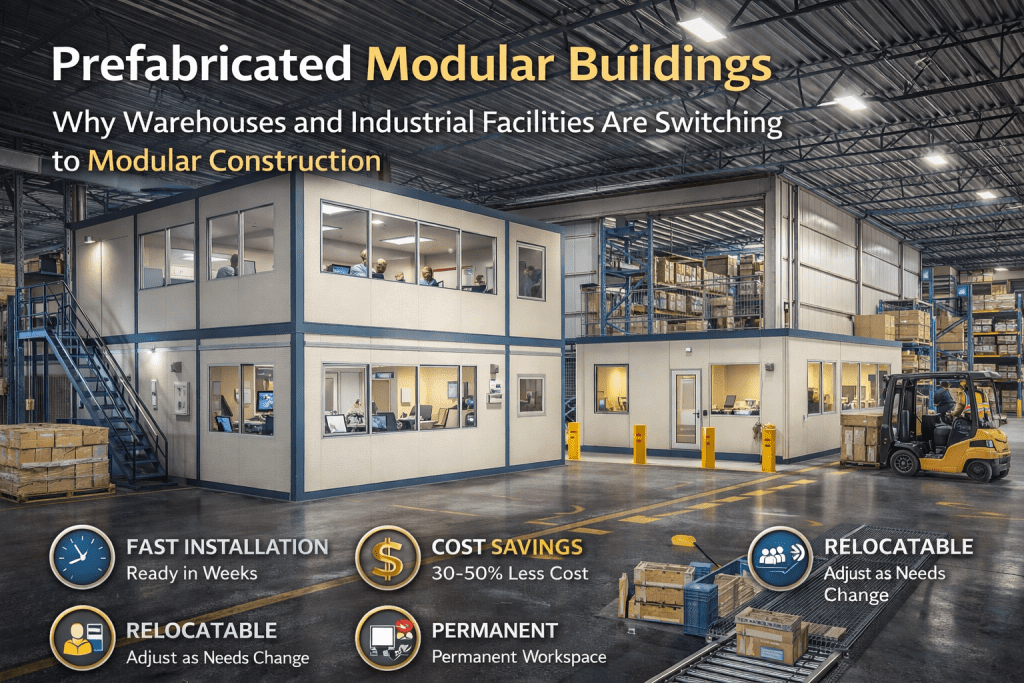
An in-plant modular building is a prefabricated enclosed structure designed to be assembled inside a warehouse, factory, or other large facility. The walls, ceiling, doors, and windows are manufactured off-site and shipped to your location, where they bolt together on your existing floor.
The result is a fully enclosed, climate-controlled room inside your building — no foundation, no exterior construction, and no permanent modification to the host structure.
Common Types and Uses
In-Plant Offices
The most common application. These provide air-conditioned office space for managers, supervisors, and administrative staff right on the warehouse or factory floor. Standard features include:
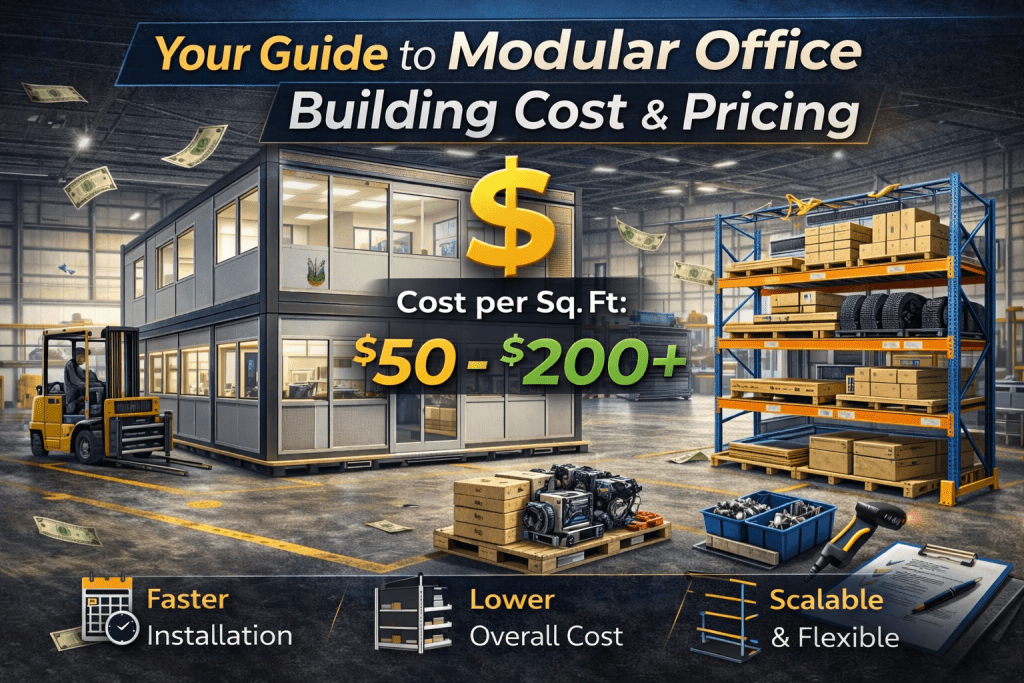
- Insulated wall and ceiling panels (typically 3-inch thick)
- Large windows for visibility to the production floor
- Electrical wiring, lighting, and HVAC connections
- Single or double doors
- Sizes from 8×8 feet to multi-room complexes
Two-Story Offices
When floor space is limited, two-story modular buildings stack a second level on top of the first. This doubles your enclosed space without using additional floor area. Combined with a mezzanine platform, two-story offices can overlook the entire warehouse floor.
Break Rooms and Lunchrooms
OSHA and employee welfare guidelines often require designated break areas. Modular break rooms provide an enclosed, climate-controlled space for employees to eat, rest, and take breaks away from the warehouse environment.
Guard Booths and Security Stations
Placed at building entries, loading docks, or parking lot gates, modular guard booths give security personnel an enclosed, climate-controlled workspace. Standard sizes start at 4×6 feet for single-person stations.
Quality Control Rooms
Manufacturing and distribution operations that require inspection or testing areas use modular buildings to create controlled environments separate from the general warehouse. These can include specialized lighting, power, and ventilation.
Server and Equipment Rooms
Sensitive electronics and servers need enclosed, climate-controlled spaces. Modular buildings can be outfitted with dedicated cooling, fire suppression, and access control. Pair with security cages for additional physical protection.
Clean Rooms and Controlled Environments
Some modular buildings are designed with air filtration, positive pressure, and sealed construction to create clean room environments inside industrial facilities.
Wall Panel Options
| Panel Type | Description | Best For |
|---|---|---|
| Vinyl-covered gypsum | Drywall core with vinyl surface | Standard offices, break rooms |
| Steel-skinned foam core | Steel faces with insulating foam core | Industrial environments, sound reduction |
| FRP (fiberglass reinforced plastic) | Moisture and chemical resistant panels | Food processing, wash-down areas |
| Polycarbonate or acrylic | Transparent or translucent panels | Maximum visibility, security booths |
| Fire-rated panels | 1- or 2-hour fire rating | Code compliance, hazardous areas |
Modular Buildings vs Traditional Construction
| Factor | Traditional Construction | Modular Building |
|---|---|---|
| Timeline | Weeks to months | Days to 2 weeks |
| Cost | $80-$250+ per sq ft | $40-$120 per sq ft |
| Disruption | High — dust, noise, restricted access | Low — components bolt together on-site |
| Permits | Full building permits required | Simpler permit process in most jurisdictions |
| Relocatable | No — permanent construction | Yes — can be disassembled and moved |
| Expandable | Requires new construction | Add panels to increase size |
| Tax treatment | Real property (higher taxes) | Often classified as equipment |
Installation Process
- Site assessment — Measure the area, check ceiling clearance, and identify utility connections
- Design and configuration — Select size, panel type, door and window placement, and electrical/HVAC layout
- Manufacturing — Panels and components are fabricated off-site (typically 2-4 weeks)
- Delivery — All components arrive on a truck, flat-packed for easy handling
- Assembly — Panels bolt together on your floor. A typical single-room office installs in 1-2 days. Multi-room complexes may take 3-5 days.
- Utility connection — Electrical, HVAC, and data lines are connected to your building systems
No welding, no concrete, no heavy construction equipment. The building goes up around your ongoing operations.
Design Considerations
- Ceiling height — Standard modular buildings are 8 to 10 feet tall. Make sure your warehouse ceiling provides adequate clearance above the building for sprinklers, lighting, and ventilation
- Floor loading — Modular buildings distribute weight across a large area, so standard warehouse floors typically support them without reinforcement
- Fire code — Your local fire marshal may require specific panel ratings, sprinkler modifications, or egress paths
- Sound control — Insulated panels reduce noise from the warehouse. Additional sound-dampening options are available for noisy environments
- ADA compliance — Ramps, wider doors, and accessible layouts are available for buildings that must meet ADA requirements
Material Handling USA provides complete design services including building layout, panel selection, and utility planning for in-plant modular buildings.
Frequently Asked Questions
How much does an in-plant modular office cost?
A basic single-room modular office starts around $8,000 to $15,000 for smaller sizes. Larger multi-room buildings with full HVAC and electrical can range from $30,000 to $100,000+. The cost per square foot is typically 40 to 60 percent less than traditional construction.
Can I move a modular building to a new location?
Yes. Modular buildings are designed to be disassembled and reassembled. If you relocate to a new facility, the building can come with you. This is a major advantage for companies that lease warehouse space.
Do modular buildings require permits?
Permit requirements vary by jurisdiction. In many areas, prefabricated structures that do not alter the building envelope require simpler permits than traditional construction. Your local building department can confirm what is needed.
How long does a modular building last?
Quality modular buildings with steel-framed construction last 20+ years with normal use. Panel replacement and hardware updates can extend the life indefinitely.
Can I add a modular building on top of a mezzanine?
Yes. This is a popular configuration. A mezzanine platform provides the elevated floor, and a modular building sits on top, creating an elevated office with views across the warehouse floor.
Need an in-plant office or modular building? Contact Material Handling USA for a free consultation. We will help you select the right size, panel type, and configuration for your facility.