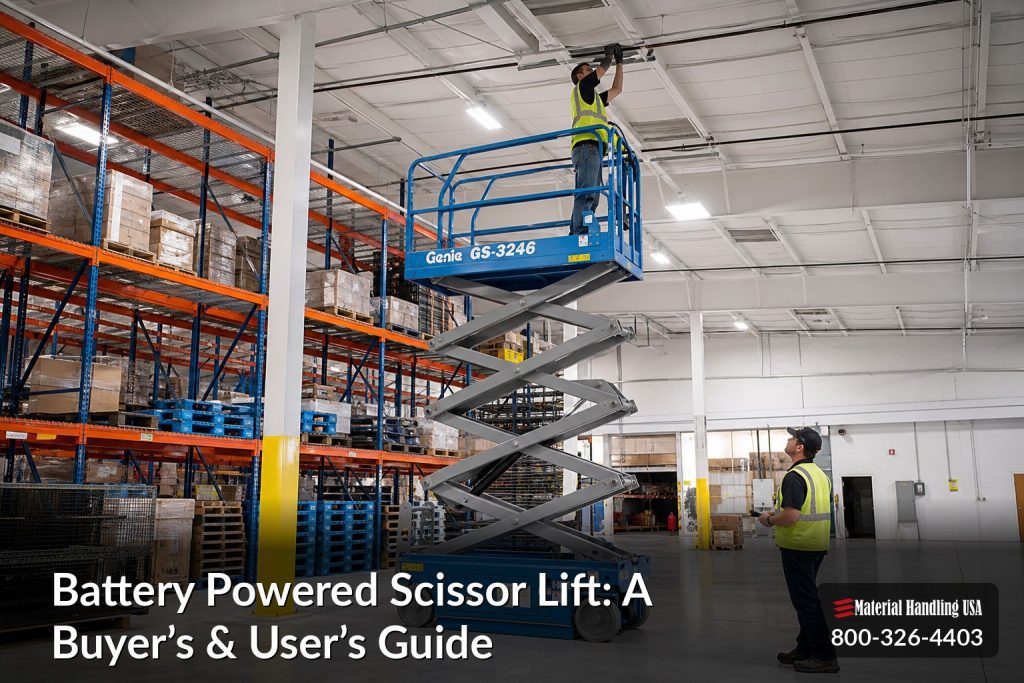
A battery operated scissor lift gives workers a stable platform for straight-up access without engine exhaust. It can be a strong fit for warehouses, plants, and finished indoor spaces. The right choice still depends on the work, travel path, charging plan, and inspection process.
This guide answers the questions buyers and operators ask most: can you use a scissor lift while it is plugged in or charging, how long the battery of an electric scissor lift lasts, how long charging takes, what power the charger needs, and what to do when the platform gate will not latch.
Quick answer: In most cases you should not operate a scissor lift while it is charging or plugged in. Many electric scissor lifts have a charger interlock that disables drive and lift functions while the charger is connected to AC power, and moving a plugged-in lift can damage the cord, plug, or charger. Battery runtime and charge time are model- and use-specific, so read the lift and charger manuals. If a pre-start inspection finds a gate that will not latch, do not operate the lift. Secure it, report it, and keep it out of service until the defect is corrected.
Can You Use a Scissor Lift While It’s Plugged In or Charging?
The short answer is no. Treat “can you operate a scissor lift while charging” as a no unless the operator manual for that exact machine says otherwise. Charging is a parked activity. The lift should sit in its charging area with the platform lowered and the charger connected until the charge cycle is done.

Why most electric scissor lifts will not run while plugged in
- Charger interlock. Many electric scissor lifts include a charger interlock. When the onboard charger is connected to an AC outlet, the interlock cuts power to the drive and lift circuits. The controls will not respond until the cord is unplugged. This is a designed safety feature, not a fault.
- Cord and plug damage. If a lift does move while plugged in, the cord can be pulled out of the outlet, pinched under a wheel, or torn from the charger. A damaged cord or charger is an electrical and fire hazard and takes the lift out of service.
- Trip hazard. A live cord stretched across a work area is a trip hazard for the operator and everyone walking nearby.
- Interrupted charge cycle. Chargers run a sequence that ends with a finishing or maintenance stage. Pulling the plug part way through, or drawing power from the battery while it charges, shortens the useful charge and can shorten battery life over time.
- Manual and warranty. Operator manuals commonly instruct the user to charge in a ventilated area with the platform lowered and to disconnect the charger before operation. Operating outside the manual can void warranty coverage and puts the employer on the wrong side of its own safety program.
What to do when the battery runs low mid-shift
- Lower the platform and drive the lift to its charging area while it still has charge. Do not push a nearly dead lift to the last percent.
- Plug in the charger and confirm the charge indicator shows charging.
- Use a second lift, or reschedule the elevated task, instead of improvising a way to work while the machine is plugged in.
- Where the manual allows opportunity charging, such as on many lithium-ion systems, plug in during breaks and lunch so the lift starts each block of work with more charge.
- Log the event. Repeated mid-shift shortfalls point to a duty-cycle mismatch, an aging battery, or a charging routine problem that needs a fix.
Can you leave a scissor lift plugged in overnight?
Most onboard chargers are designed to complete the cycle and then drop into a maintenance or float stage, so leaving the lift connected overnight is usually the intended routine. Confirm this in the charger manual for your unit. For flooded lead-acid batteries, keep the battery compartment ventilated as the manual directs, because charging releases hydrogen gas. Check the indicator lights before the shift starts and report any abnormal or fault indication instead of driving the lift away.
What Is a Battery Operated Scissor Lift?
A battery operated scissor lift is a mobile elevated work platform with an onboard battery system. Crossed supports raise the platform straight up. This differs from a boom lift, which reaches outward as well as upward.
The phrases battery operated scissor lift, battery powered scissor lift, and electric scissor lift are often used for the same equipment category. The terms do not tell you the battery chemistry, charger type, runtime, or allowed environment. Those details must come from the specific machine’s manual and data plate.
For background on how the category developed, the original article referenced this overview of scissor lift development. For equipment selection, focus on the task and the machine in front of you.

Battery Operated Scissor Lift Selection Table
Use this decision table before comparing brands or asking for a quote. It keeps the discussion tied to the facility and the job.
| Decision | What to verify | Why it matters |
|---|---|---|
| Working height | Highest task point and safe platform position | Avoids a lift that cannot place the worker correctly |
| Platform and load | People, tools, parts, and platform space | Prevents crowding and overload |
| Travel path | Doors, aisles, turns, ramps, floor loading, and storage area | Confirms the lift can reach the job |
| Indoor or outdoor use | Surface, slope, weather, tires, and machine rating | Separates slab use from rougher conditions |
| Battery system | Chemistry, condition, service needs, and replacement support | Shapes uptime and maintenance work |
| Charging plan | Charger, circuit, parking area, ventilation, and shift window | Reduces avoidable downtime and cord hazards |
| Inspection and training | Operator authorization, checklist, defect reporting, and service process | Keeps unsafe equipment out of use |
Browse MH-USA’s lifting and material transport equipment solutions to compare access methods, then call (800) 326-4403 to review your facility and application.
Scissor Lift Battery Runtime and Battery Life
How long does the battery of an electric scissor lift last?
There is no responsible one-number answer. A battery may support a different amount of work in two facilities even when the lift model is the same. Travel distance, lift cycles, platform load, floor condition, temperature, battery age, and charging habits all change usable runtime.
Runtime also means different things to different buyers. One crew may drive between many work areas. Another may park the machine and raise the platform only a few times. Compare the planned duty cycle with the manufacturer’s guidance instead of treating a general web estimate as a promise.
How to estimate scissor lift battery runtime
- List the expected travel distance, lift cycles, platform load, and shifts per day.
- Identify when the lift can return to its charging area.
- Review the exact battery and charger manuals for the unit.
- During the first weeks, record start charge, end charge, work performed, and unusual conditions.
- If runtime drops suddenly, remove guesswork. Have the battery, charger, connections, and machine checked under the service procedure.
Scissor lift battery life versus daily runtime
Daily runtime is the usable work between charges. Battery life is the longer period before the battery can no longer meet the required duty cycle and needs service or replacement. Charging habits, storage, temperature, discharge depth, battery care, and machine condition affect both.
Do not compare lead-acid and lithium-ion systems by purchase cost alone. Compare the approved charging routine, maintenance work, available charging window, service support, and fit with the actual shift.
What shortens the battery life and daily runtime of an electric scissor lift
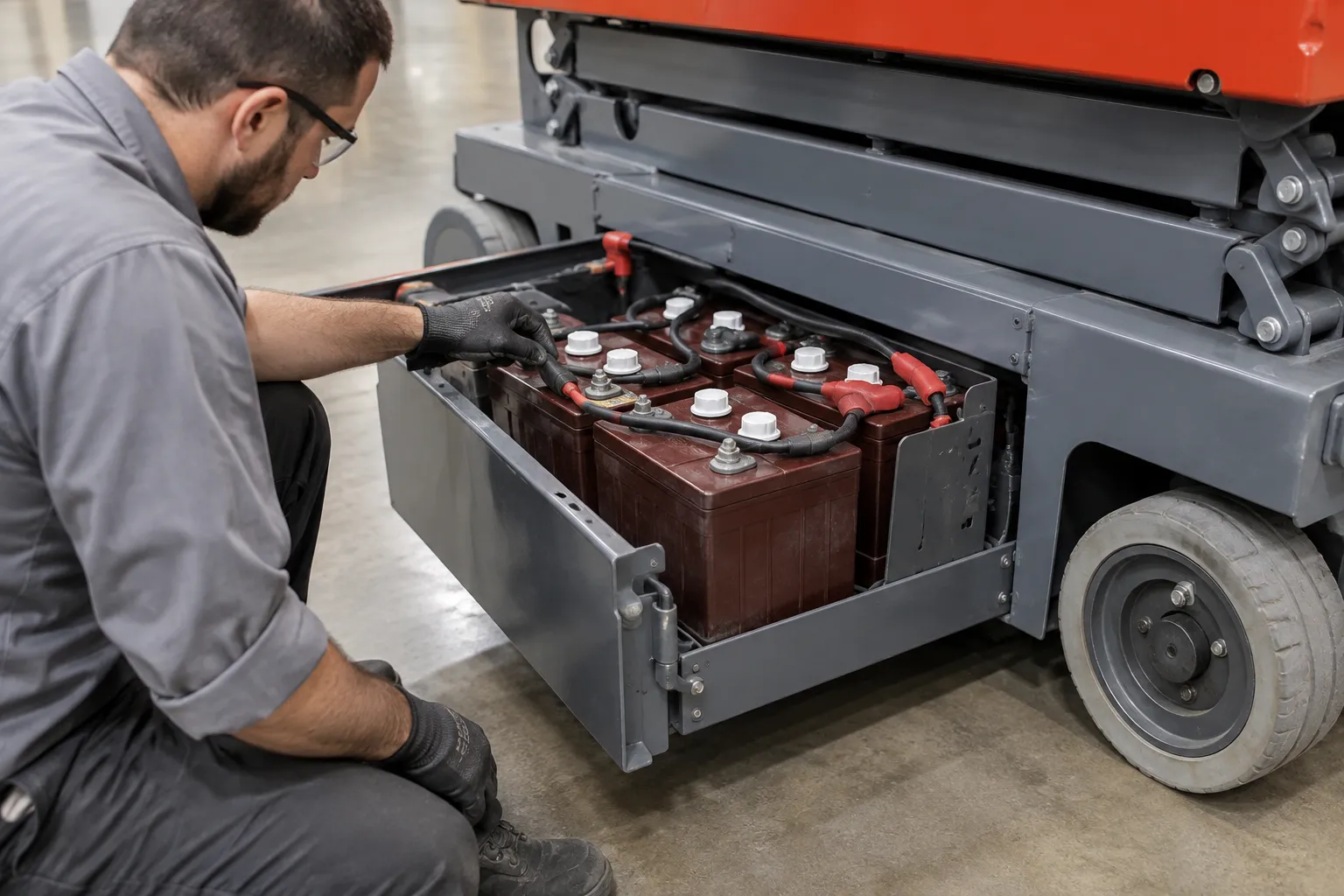
When people ask “how long does the battery of an electric scissor lift last,” they usually mean one shift of work. These are the factors that decide whether a lift finishes the day or stops early.
| Factor | Effect on runtime | What to do |
|---|---|---|
| Driving distance | Drive motors draw far more energy than raising the platform a few times | Stage material near the work so the lift moves less |
| Lift cycles and load | Every full raise with a heavy platform load uses stored energy | Plan the work so the platform stays up for several tasks instead of cycling |
| Floor condition and slope | Rough or uneven floors and ramps increase drive current | Choose the flattest travel path and fix floor damage |
| Cold temperatures | Cold batteries deliver less usable capacity | Store and charge the lift in a heated area when possible |
| Battery age and water level | Old or under-watered lead-acid batteries lose capacity | Follow the watering and inspection schedule in the manual |
| Partial or interrupted charging | The lift starts the shift without a full charge | Plug in at the end of every shift and let the cycle finish |
| Corroded or loose cables | Voltage drop and heat at the connection | Inspect terminals and cables during the pre-start check |
What makes a long runtime electric lift
A long runtime electric lift is less about one headline number and more about matching the battery system to the shift. Compare these points when a supplier says a lift will run all day.
- Battery chemistry. Lithium-ion systems generally allow opportunity charging during breaks and hold voltage more evenly through the discharge. Flooded lead-acid systems cost less up front and are well understood, but they prefer full charge cycles and need watering and cleaning.
- Battery capacity relative to the machine. A larger battery pack in a heavier lift does not automatically mean more working time. Ask how the manufacturer measured its duty cycle.
- Drive system type. Ask whether the lift uses electric drive motors or hydraulic drive. The drive type changes how much energy travel uses, so compare runtime claims between lifts with the same drive type.
- Your charging window. A lift that can charge fully between shifts, plus top up at lunch, will outperform a larger battery that never gets a complete cycle.
How Long Does a Scissor Lift Take to Charge?
Charge time depends on the battery chemistry, battery condition, charger output, remaining state of charge, and surrounding conditions. The correct source is the charger and lift manufacturer’s instructions. A general time from another model may be wrong for yours.
Build a charging plan around the shift
- Use the charger specified for the lift and battery.
- Park in the designated charging area with the platform lowered.
- Keep the cord and plug protected from traffic and damage.
- Follow site requirements for the charging space and inspection.
- Record repeated charging faults or a noticeable loss of runtime.
Scissor lift power requirements for charging
Most slab electric scissor lifts carry an onboard charger that plugs into a standard grounded AC outlet. The exact voltage and current the charger needs are printed on the charger label and listed in the manual. Use those values, not a general estimate, when you plan the charging area.
- Match the outlet to the charger label. Confirm the outlet voltage, receptacle type, and grounding match what the charger requires. Do not use adapters that defeat the ground pin.
- Give the charger a clean circuit. Avoid sharing the circuit with heaters, compressors, or other high-draw equipment that can trip the breaker part way through the cycle.
- Follow the manual on extension cords. If the manual allows one, use a heavy-gauge grounded cord rated for the load, keep the run as short as practical, and protect it from traffic. Never daisy-chain cords.
- Use GFCI protection where required. Damp or wash-down areas and outdoor outlets usually call for it under the site’s electrical code.
- Treat the charging area like a battery charging area. OSHA 1910.178(g) sets requirements for battery charging areas on powered industrial trucks, including ventilation for gassing batteries, protection of the charging apparatus, and no smoking. Many facilities apply the same practices to scissor lift charging bays, and the ventilation point matters for any flooded lead-acid battery.
- Keep small batteries separate. Do not stack tool packs and radios on the lift to charge. A lithium-ion battery charging safety cabinet keeps hand tool and device batteries contained and away from the machine.
Whether you can use the lift while it is plugged in is covered at the top of this guide. The short version: park it, charge it, and unplug it before you operate.
Pre-Start Inspection: What if the Platform Gate Will Not Latch?
The long search question has a short answer: do not use the lift. A gate that will not latch is a safety-related defect. Lower and secure the machine, follow your site’s out-of-service or tag procedure, report the problem, and have a qualified person evaluate it before the lift returns to service.
OSHA’s scissor lift guidance says employers should train workers to report equipment defects and maintenance needs. The original article linked to OSHA’s main site at https://www.osha.gov/. The more specific neutral reference is OSHA’s scissor lift safety guidance. The machine’s manual and your employer’s procedure still control the exact inspection and lockout steps.

How to complete a scissor lift pre-start inspection
- Park and secure the lift: Place the lift on a firm, level surface in the inspection area. Lower the platform and follow the site’s control procedure.
- Inspect the access system: Check the ladder or entry steps, platform floor, guardrails, entry gate, gate latch, and any chain or bar. The entry gate must close and secure as designed.
- Test controls and safety functions: Follow the manufacturer’s pre-use checklist for ground controls, platform controls, emergency stop, emergency lowering, alarms, steering, brakes, tires, and other listed items.
- Check the work area: Confirm floor condition, slope, overhead hazards, nearby traffic, clearance, and the planned travel path.
- Remove a defective lift from service: If the gate will not latch or another safety item fails, do not operate the lift. Secure it, report it, and have it evaluated under the manufacturer and employer procedure.
Scissor lift QR code access and digital pre-start checklists
Many newer lifts and rental fleet machines carry a QR code decal near the ground controls or on the manual box. Scanning it with a phone usually opens a mobile page with the operator manual, the pre-start inspection checklist, safety decals, and a way to report a fault. Some fleet systems go further and use the QR code or a personal code to confirm the operator is trained and authorized before the controls unlock. If your lift has a QR code, make it part of the pre-start routine so the checklist is completed and saved, and make sure the operator still knows how to find the printed manual on the machine when a phone is not available.
Do not improvise a gate repair. Do not tie, wire, or hold the gate closed as a substitute for the designed latch. Keep the lift out of service until the defect is corrected under the proper procedure.
When a No-Battery Low-Level Access Lift May Fit
A no-battery low-level access lift may be a manual push-around platform or another nonpowered product intended for lower work. It can make sense for short, occasional tasks on a smooth, controlled floor when the equipment is designed for that use.
Compare working height, platform stability, load, setup time, movement, floor condition, and how often the worker must reposition. A lower purchase or maintenance burden does not make a product suitable for every task. Never use a ladder, pallet, or improvised platform as a substitute for approved access equipment.
Indoor, Outdoor, and Special-Environment Choices
Battery power does not automatically make a lift suitable for every location. Slab-style units are commonly selected for controlled indoor floors. Outdoor work may require a unit rated for the surface, slope, weather, and travel conditions.
The original article gave one market example through Snorkel’s product announcement. Treat any product announcement as model-specific information, not a rule for other lifts.
Scissor lifts are one part of a wider access and handling plan. Our warehouse safety equipment guide and OSHA warehouse storage compliance checklist cover the guardrail, signage, and inspection items that sit alongside lift operation.
Hazardous or paint-room work may call for a different power source and equipment design. Review MH-USA’s compressed air lifts for paint rooms and dangerous areas when battery electric is not the right fit.
Frequently Asked Questions
How long does the battery of an electric scissor lift last?
There is no single runtime for every electric scissor lift. Battery condition, load, travel distance, lift cycles, temperature, floor conditions, and operator habits all affect the result. Compare the manufacturer’s duty-cycle guidance with your actual shift and keep a usage log during the first weeks of operation.
How long does it take a scissor lift to charge?
Charge time depends on battery chemistry, battery condition, charger output, and how far the battery was discharged. A full cycle on a lead-acid lift is usually planned as an overnight charge. Use the charger and charging procedure specified for the lift and let the cycle finish.
Can you use a scissor lift while it’s plugged in or charging?
No, in most cases. Many electric scissor lifts have a charger interlock that disables drive and lift functions while the charger is connected to AC power. Even without an interlock, moving a plugged-in lift can damage the cord, plug, or charger and creates a trip hazard. Park the lift in its charging area, lower the platform, and disconnect the charger before use.
Can you leave a scissor lift plugged in overnight?
Usually yes. Most onboard chargers finish the cycle and then hold the battery in a maintenance or float stage. Confirm this in the charger manual for your unit, keep the battery compartment ventilated as directed for lead-acid batteries, and check the indicator lights before the shift starts.
What are the power requirements to charge a scissor lift?
Most slab electric scissor lifts have an onboard charger that plugs into a standard grounded AC outlet. The required voltage and current are on the charger label and in the manual. Give the charger a circuit that is not shared with heavy loads, follow the manual on extension cords, and use GFCI protection where the site requires it.
What should happen if the platform gate will not latch during a pre-start inspection?
Do not use the lift. Lower and secure it, mark it out of service under your site procedure, and report the defect to the supervisor or equipment owner. A qualified person should inspect and correct the problem before the lift returns to service.
What affects scissor lift battery life?
Charging habits, depth of discharge, storage conditions, temperature, maintenance, and the number of travel and lift cycles all affect battery life. Follow the battery and lift manufacturer’s instructions, record service, and investigate a sudden drop in runtime.
Can a battery powered scissor lift be used outdoors?
Only when the lift is rated for the surface, slope, weather, and operating conditions. A slab-style indoor unit is not automatically suitable for rough ground. Check the manual and data plate before moving the lift outside.
Choose the Right Lift for Your Facility
Share the working height, load, travel path, floor conditions, charging window, and task list with the MH-USA team. We can help you compare scissor lifts, lift tables, and other lifting and material transport equipment without guessing at a model.
Request a project review or call (800) 326-4403.