
Rack System Comparison Calculator
Selective, double-deep, push-back, drive-in, pallet flow, VNA or mobile racking — the right answer comes from your pallets per SKU, your rotation rule and how much you move in a day. Enter those and see every system ranked, the positions each one holds in your footprint, and exactly which ones your own rules disqualify.
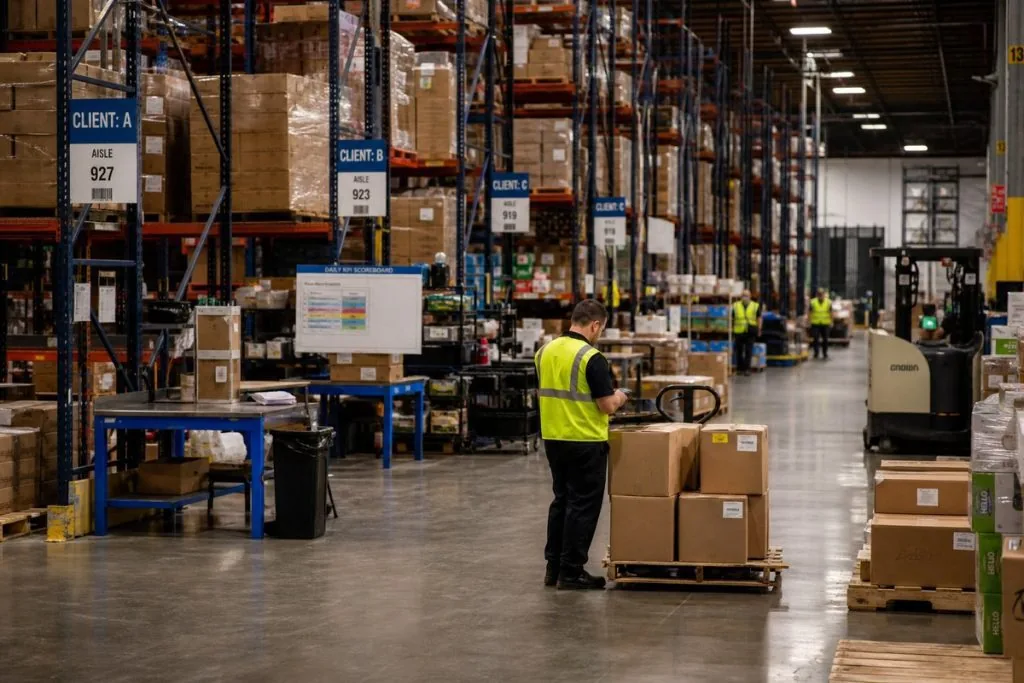
Rack type is a storage decision disguised as a steel decision
Almost every rack project starts with a quote request for the system somebody already has in mind — usually selective, because that is what the last building had. The steel then gets priced, ordered and installed, and eighteen months later the operation is out of room again, or half the lanes are half empty, or the FIFO rule that the quality system requires turns out to be impossible in the configuration that was bought.
The decision that actually mattered was made before anyone drew a bay. Pallets per SKU decides whether a deep lane can ever be filled. The rotation rule decides whether LIFO systems are legal in your operation at all. Daily throughput decides whether density becomes a bottleneck. Clear height decides whether narrow-aisle equipment can ever pay for itself. None of those are questions a price list answers.
So this asks them first. It takes your pallet count, SKU count, rotation rule, selectivity requirement, throughput and building height, ranks seven rack systems against that profile, shows how many positions each would hold in your floor area, and says plainly — with the reason — which ones your own inputs rule out.
Who this is for
- Operations and warehouse managers re-racking or fitting out a building
- Distribution and 3PL teams whose SKU profile has outgrown the original layout
- Cold storage, food and pharma operations working under a strict rotation rule
- Anyone about to request a rack quote who wants to be sure they are asking for the right system
What you need to hand
- Pallets stored at peak, and how many distinct SKUs occupy pallet positions
- Your rotation rule: strict FIFO, FIFO preferred, or LIFO acceptable
- How much selectivity you need — every pallet, most pallets, or whole lots
- Pallets in and out on a normal day, put-away plus full-pallet picks
- Clear height to the lowest obstruction, and the floor area available for rack
- Whether it is cold or freezer storage, and whether the footprint is fixed
Don’t have all of it? Every field that can be left blank, can be — the tool tells you which missing number would change the answer most.
Compare the systems against your profile
Your ranking, the positions each system holds and every disqualification appear on this page immediately. We only ask for your details if you want the comparison emailed, want an engineer to validate the configuration, or want the recommended system priced.
Prefer a full window? Open the rack comparison calculator in a new tab.
How it works
Enter your inventory profile
Pallets at peak and active pallet SKUs. The ratio between them — pallets per SKU — is the single number that decides whether deep-lane storage can work, because a lane that cannot be filled with one SKU wastes more space than it saves.
State the rotation rule honestly
Strict FIFO is a hard constraint, not a preference. It rules out push-back and standard drive-in outright, and it is the reason pallet flow exists. If a quality system or a shelf-life requirement dictates it, say so here.
Set your selectivity requirement
Needing to reach every pallet directly is legitimate, and it is expensive in floor area. Being able to work in whole lots is what makes density affordable. Most operations are somewhere in between, and the honest answer changes the ranking completely.
Add throughput and the building
Daily pallet moves decide whether a dense system becomes a bottleneck — mobile racking with one open aisle cannot support a high-turn operation. Clear height decides how many beam levels you get and whether narrow-aisle equipment can ever pay for itself.
How to read your comparison

Pallets per SKU is printed first because it governs everything else. Around one or two, selectivity wins and deep lanes will honeycomb. Around three to eight, push-back and double-deep start to pay. Above roughly six with few SKUs, drive-in becomes genuinely dense rather than merely deep.
Positions per system are what your entered floor area would hold at the beam levels your clear height allows, using a planning figure for gross area per position that includes a share of aisle. Every one of those figures is listed in the assumptions, so you can see what moved the answer.
Disqualifications are shown, not hidden. If strict FIFO rules out push-back, or your clear height rules out VNA, or your throughput rules out mobile racking, the system still appears in the list with the reason attached. A comparison that quietly drops options is not a comparison.
The density gain compares the densest system your rules still allow against plain selective rack in the same floor area. If that number is small, your constraints — not your building — are what is limiting capacity, and that is a useful thing to know before anyone prices steel.
Honeycombing is the caveat on every dense system. The figures assume lanes are actually filled with a single SKU. In practice partial lanes are what erode the gain, which is why the real pallets-per-SKU distribution matters more than the average this tool works from.
What this tool does not do
This is a shortlist built from the numbers you enter. It is not a rack design, a structural calculation, a permit submission or a quote.
- Positions per bay depend on pallet dimensions, weight, overhang and whether loads are stackable — none of which this tool asks for.
- Deep-lane density assumes full lanes. Honeycombing in a real operation reduces every dense system below the figures shown here.
- Aisle width is set by your lift equipment, and changing rack type often means changing the fleet — a decision with its own cost and training implications.
- Rack capacity, slab suitability, anchorage and seismic design are engineered per project and must be verified by a qualified person before anything is ordered.
- Sprinkler design and commodity classification can cap storage height and rule out configurations regardless of the building’s clear height.
- No pricing is produced here. Cost per position depends on configuration, quantity, freight and installation.
Products and related tools
Pallet rack systems
Selective, drive-in, push-back and flow rack, engineered and installed.
Mobile shelving and high-density storage
Recover aisle floor area when the footprint cannot change.
Warehouse Opportunity Scanner
Start here if you are not yet sure whether rack type is the real problem.
SKU Upload Analyzer
Get your real pallets-per-SKU distribution instead of an average.
Rack Damage Photo Assessment
Existing steel has to be inspected before load or configuration changes.
Delivery Deadline Planner
Check whether the system you choose can be in service by your date.
Common questions
Which pallet rack system is the most space-efficient?
What is the difference between push-back and drive-in rack?
Can I run FIFO in a high-density rack system?
How many pallets per SKU do I need before deep lanes make sense?
Is VNA worth it?
Does this give me a price?
Have an engineer validate the configuration before you buy steel
Send the comparison in with your pallet dimensions, your lift equipment and a drawing or a few photos. We will check the system against your real loads, slab, seismic category and sprinkler design, and then price the configuration that actually works.