
Tire Storage Rack Systems for Warehouses, Tire Shops & Distribution
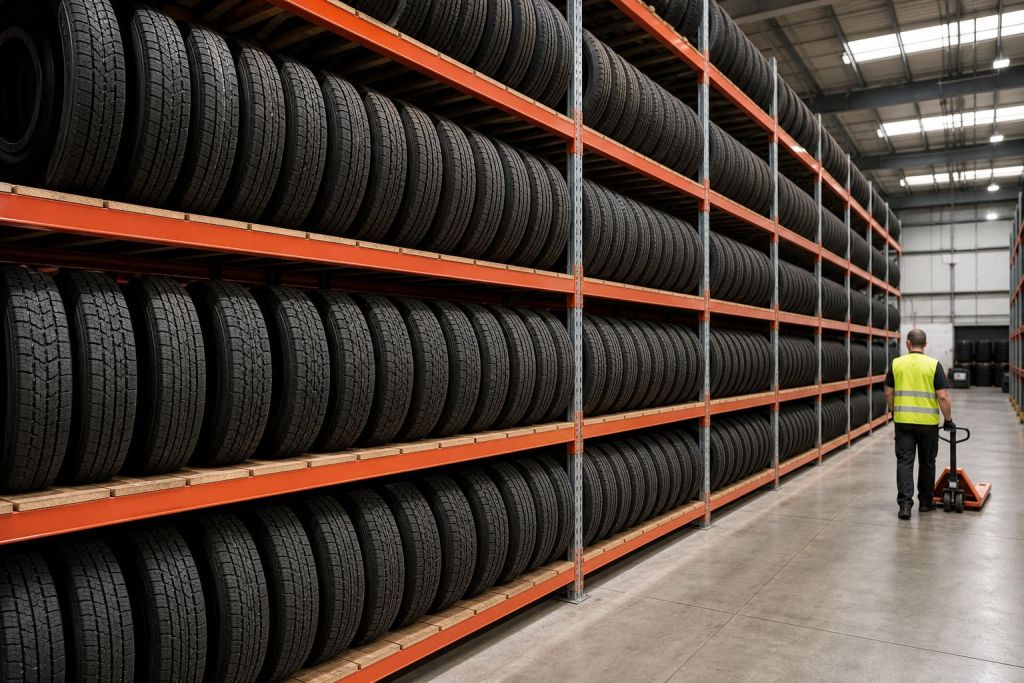
A tire storage rack has to do more than hold weight: tires are round, heavy in bulk, easy to damage and impossible to stack neatly — which is why the right tire storage rack is its own design problem, not a shelf you buy by the foot. This is the engineering thinking we used to design one for Commercial Tire, built on our pallet rack platform.
2019
Year Commercial Tire worked with us
Pallet rack
Product category we supplied
Tire service & distribution
Application
Round loads
Why standard beam assumptions fail
Plan your layout before you buy
Configure upright height, beam width, bay count, and load levels in our free 3D Pallet Rack Configurator, then get an instant bill of materials and request a quote.
The project
Commercial Tire is a tire sales and service business. Material Handling USA supplied pallet rack for the company in 2019. The client, the year and the product category are the only project details we publish — we do not publish layouts, dimensions or contract values for any customer.
What we can share is the engineering thinking behind tire storage, because it comes up in almost every tire shop, retread plant, truck-stop service centre and distribution warehouse we quote. Tires sit awkwardly between two worlds: they are bulky enough to want pallet rack systems sized for pallets, but they are handled loose, one at a time, like small parts. Getting the balance right is what separates a tire warehouse that ships fast from one where every pick is a wrestling match.
Shop Tire Storage Racks Online
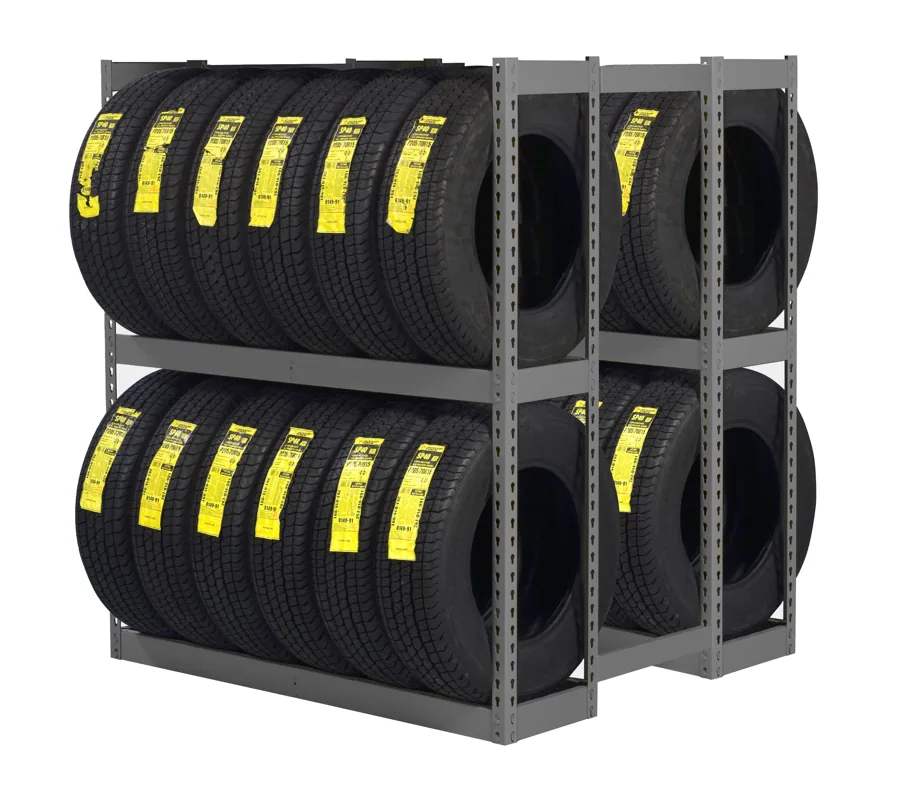
Genuine tire racks you can order online: sectional tire shelving, single- and double-entry tire racks and a mobile tire rack. Prices are current store prices for the lowest-priced in-stock starter unit in each line; add-on bays and other sizes are in each category. Some common sizes are in stock at select manufacturers, subject to confirmation. For full rooms on pallet rack, request a quote.


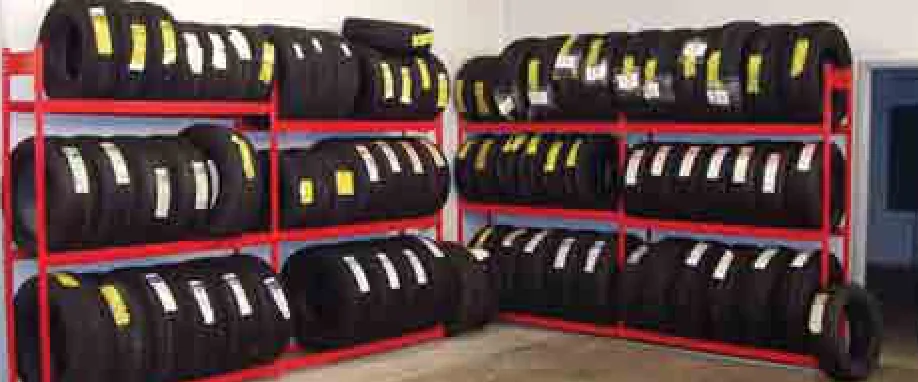
Free Tire Rack Builder: how many bays do your tires need?
Enter your tire count, size mix, passenger, light-truck or commercial truck, and mounted or loose. The free builder works out tires per level, levels and how many bays of tire rack you need from real catalog rack sizes, then sends the plan to a specialist. Final pricing is quoted.
Why tires break the usual racking assumptions
They are not stackable in any structural sense. A stack of tires is a column of compressible rubber. It leans, it settles, and above a certain height it becomes a topple risk. Unlike cartons, tires give you no help carrying load from the level above. Where you do need to build upward without fixed steel, that job belongs to purpose-built stackable tire racks, which carry the load through their own frames rather than through the rubber.
They are light individually and heavy in bulk. One passenger tire is trivial to lift. A full bay of truck tires is not, and light-duty shelving bought on the strength of “it’s only tires” is the most common failure we are called to look at.
They deform if stored wrong. Stored flat under weight, or hanging unsupported over a beam edge, tires take a set. Bead and sidewall damage from bad storage turns saleable stock into scrap, and the loss never shows up in the racking budget.
Picking is loose, not palletized. Inbound tires often arrive banded on pallets or loose-loaded in a trailer; outbound they leave one or four at a time. The storage system has to serve both a pallet-in and a piece-out flow.
Inventory is deep and slow-moving in the tail. A tire business carries a long tail of sizes that turn a few times a year alongside a handful of fast movers. Treating both the same way wastes either space or labour. For the retail end of that problem — back room, bay-side and customer-set storage — see tire shop storage racks.
Store tires on the tread, not on the sidewall
Tires are designed to carry load through the tread when stored upright. Long-term storage lying flat under the weight of the stack above is what causes sidewall flex and set. The rule shapes the whole rack: it is why tire levels are shallow and wide rather than deep and tall.
Pallet rack, dedicated tire rack or carousel
There are three genuinely different ways to store tires indoors, and most operations end up with two of them.
| Option | How it works | Best where | Watch out for |
|---|---|---|---|
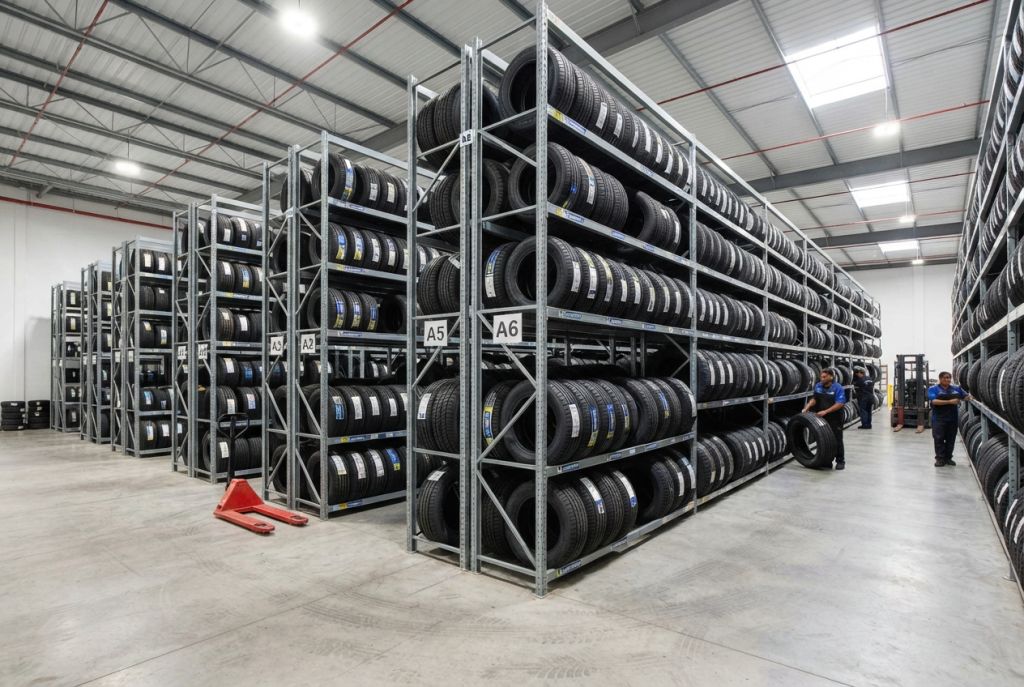
| Pallet rack with decked levels | Standard uprights and beams with wire decking; tires stand on the tread across the deck | Distribution and reserve stock; mixed pallet and loose storage; high ceilings | Deck must be rated and the level heights set for the tallest tire you carry |
| Dedicated tire racking | Purpose-made rails or cradles at close vertical pitch, sized around tire diameter | Service centres and retail back-of-shop where every pick is loose | Low flexibility — the pitch suits tires and little else |
| Vertical tire carousel | Motorised carousel brings the wanted level to an ergonomic pick height | Tight footprints with height to spare and high pick rates | Capital cost and maintenance; needs power and clear headroom |
In practice a busy tire operation runs reserve stock on selective pallet racking or structural rack at the back of the building, dedicated tire levels in the pick face, and — where floor space is the binding constraint — a vertical tire carousel at the service counter. The mistake is choosing one system for the whole building because it suited one part of it. Large-format commercial, bus and off-the-road tires push these choices further still — see our guide to heavy-duty truck tire storage racks for beam spans, deck ratings and bay depth sized around real truck tire weights and diameters.
Weighing a carousel against racking? The carousel side of that decision lives on our Vidir pages: the Vidir tire carousel product page, the tire carousel buyer’s guide and, for Wasatch Front shops, the Utah tire carousel page.
Shelving tire racks vs. wall-mount tire racks
The other decision every buyer faces is where the rack lives: standing on the floor as a shelving-style tire rack, or fixed to a wall.
Franchise stores have an extra wrinkle here, because they hold retail stock, mounted assemblies and customer-held sets in the same room — see dealership tire storage. Most tire shops, dealerships and warehouses with more than a few dozen tires outgrow wall-mount racks quickly and move to shelving-style tire storage racks built on decked pallet rack — see rack, tire rack or carousel above for how to choose between those three.
For the full comparison, including whether your wall can carry a rack, tires per foot of wall and wall-side shelving as the middle option, see wall-mount tire racks vs. tire shelving.
Loading, decking and capacity
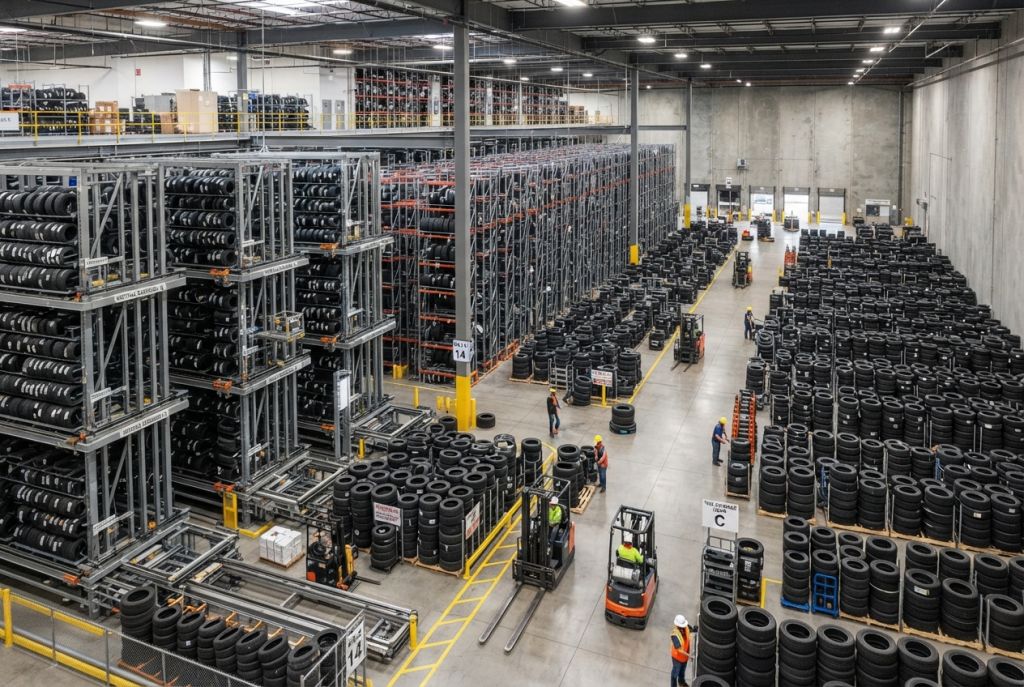
Decking is not optional. Tires standing on bare beams can roll, tip and fall through. Decked levels — usually wire decking — give a continuous surface, let sprinkler water through and let you see the level from the aisle. Confirm the deck capacity as well as the beam capacity; they are separate ratings and the deck is often the weaker link.
Set the level pitch from your largest tire, not your average. Beam levels spaced for passenger tires will not take a light-truck or agricultural tire, and re-pitching a loaded run later is a full unload-and-rebuild job. Decide the size mix per bay at the design stage. Where capacity is the binding constraint, pitching levels by size band is the cheapest gain available — see high-density tire storage racks for the full set of density levers and the fire-code limits that cap them.
Capacity is per beam pair, uniformly distributed. Manufacturers publish beam capacity for a uniformly distributed load at a stated span, and tires loaded wall-to-wall across a deck are close to that ideal — but only if the deck spreads the load as designed. Keep the load application drawing and see pallet racking weight capacity for how the numbers work.
Do not fill to the roof by default. Loose picking above about shoulder height means ladders or a lift for every pick. Reserve the high levels for pallets and banded bundles, and keep the piece-pick face low.
Layout, slotting and picking
Tire warehouses live or die on slotting. The physical rack is simple; the discipline is where the money is.

Protecting the product itself
Rack design for tires is partly a product-preservation problem, and this is the part most storage quotes ignore.
Keep rubber away from ozone sources. Electric motors and equipment that produces ozone accelerate rubber ageing. That is a layout constraint: do not put long-term tire stock in the same corner as the compressor room or a battery charging area.
Sunlight and heat matter. Direct sunlight through a dock door or skylight onto the same bay all summer is not the same environment as the middle of the building. Where a wall of glazing exists, use it for staging rather than long-term inventory.
Clean steel, no sharp edges. Burrs on cut decking, damaged beam edges and stray banding will scuff a sidewall every time a tire is dragged across them. It is worth a walk of the pick face specifically looking for what is scratching stock. That matters most where you store mounted assemblies: tire and wheel assembly storage racks covers protecting rim finishes, sizing levels for real assembly weight and keeping customer sets together.
Date-code rotation is a storage decision. Tires carry DOT date codes and the oldest stock should ship first. First-in-first-out is easy to say and hard to do in a deep lane, which is another argument for single-deep selective storage in the fast-moving sizes.
For the complete checklist, covering upright versus stacked storage, mounted and unmounted tires, ozone, heat and UV, prep and seasonal sets, read how to store tires properly.
Overhead tire storage lifts above service bays
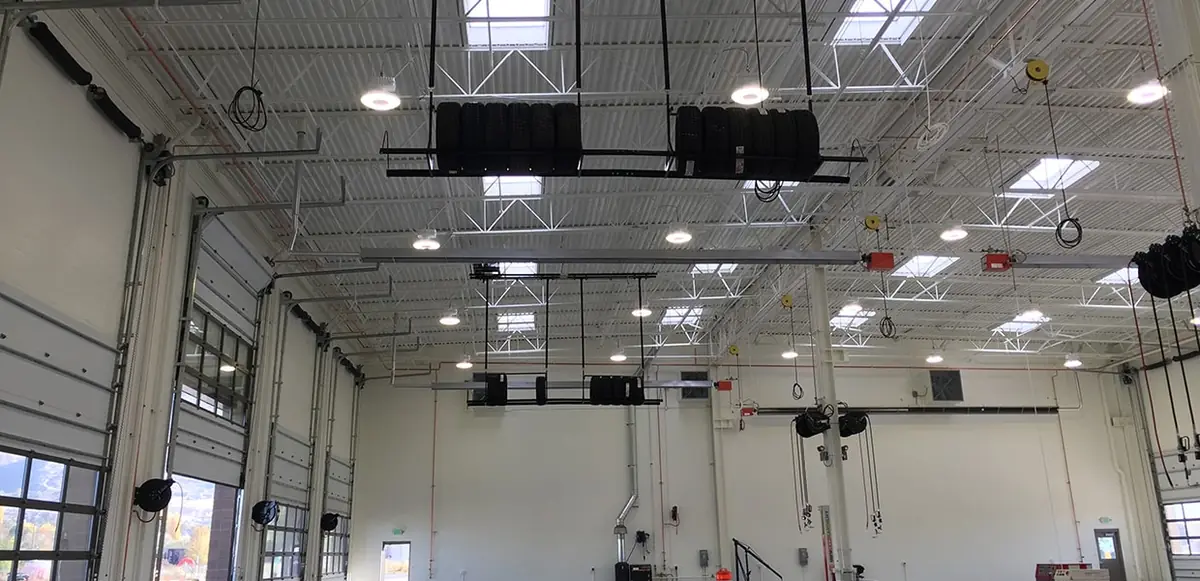
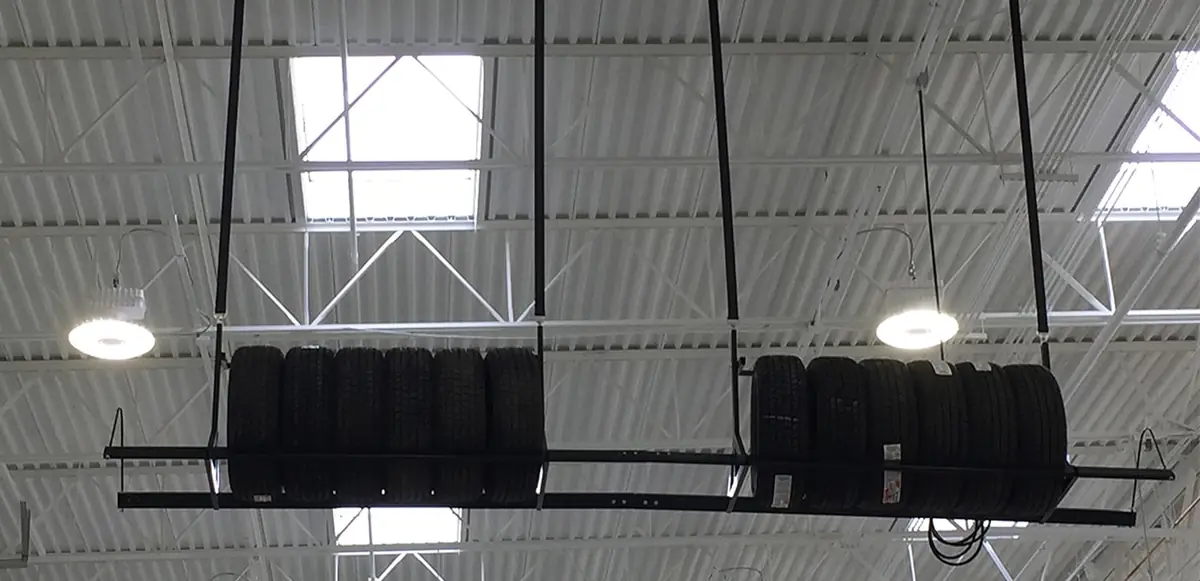
When the floor and walls are full, you can also store tires in the air above the bays. A ceiling-mounted tire lift lowers to working height for loading, then rises above the vehicles, so you get storage without building a mezzanine.
How a tire lift works
Tires stand upright in a steel rack that hangs from cables. Staff lower it to waist height, load or pull a set, and raise it back to the ceiling. Our partner Lift and Store, which has built overhead lifts since 1992 and reports more than 10,000 installations, rates its tire rack at up to 44 tires and its standard lifts at up to 800 lb per 8-ft section.
It works best for slow stock like seasonal sets, customer storage and overflow. Fast-moving sizes should stay in tire shop storage racks at floor level.
Before you plan one
- Structure: the lift hangs from the roof or ceiling framing, so an installer or engineer confirms it can carry the loaded lift.
- Clearances: keep it clear of sprinkler heads, lights, heaters, hose reels and the travel of vehicle lifts and overhead doors.
- Power: each lift needs power at the ceiling and a hold-to-run switch where staff can see the load move.
- Safety: the manufacturer lists a motor brake that holds the load at any height, a free-fall arrestor, aircraft-grade cables and a double upper limit switch. Warranty is 5 years mechanical and 1 year electrical, and lead time is about six weeks.
We are an authorized Lift and Store dealer, so we can quote overhead lifts together with your racking. Dealers can see how this fits a service department in our dealership tire storage guide.
Safety, fire and inspection
- Treat tire storage as its own fire commodity. Rubber tires are classified separately in sprinkler design because of how they burn. Storage height, arrangement and whether tires are on-tread or on-side all feed the sprinkler requirement under NFPA 13. Settle this with your fire protection engineer and the authority having jurisdiction before you fix beam elevations — raising a rack after the sprinklers are designed is expensive.
- Keep the flue spaces clear. Sprinkler performance in rack storage depends on transverse and longitudinal flues staying open. Tires pushed back to squeeze in one more is exactly how flues close up.
- Anchor and install to the drawing. Capacity and seismic performance assume the rack is plumb, anchored and built as engineered. Our rack installation teams set it that way, and it matters more in the Intermountain West than most of the country.
- Protect the aisle-end frames. Loose tire handling means constant traffic close to the uprights. Column protectors and rack guards are cheaper than an upright replacement and far cheaper than a collapse.
- Inspect on a schedule and after every impact. A struck upright reduces the capacity of the whole bay until it is repaired — see rack repair and inspection.
- Do not free-stack to the ceiling. Floor-stacked tires are convenient and unstable; OSHA requires stored material to be stacked and secured against sliding or collapse. If it is worth stacking that high, it is worth racking.
Two documents are worth naming: ANSI MH16.1, the standard for the design, testing and utilization of industrial steel storage racks, and OSHA 1910.176 on materials handling and storage. Neither substitutes for a stamped design for your building, your seismic design category and your real loads.
Quick lube and express service stations hit it from a third direction, with almost no floor to spare: see tire storage racks for service stations and quick lube shops. Fleet and municipal shops face the same problem from the other direction — a small tire inventory inside a busy parts room. That layout is covered on our fleet and municipal garage parts storage page, and Utah-specific projects are on our Utah tire storage rack page. For a small delivery-fleet example of this, see our Petaluma Butane Distributors fleet tire storage case study.
Colorado buyers can start with our guide to tire storage racks in Denver, Colorado, which covers Denver’s 6-foot high-piled rule for rubber tires, seasonal swap storage and Front Range delivery.
Warehouse and distribution center tire racks
Tire volume in a warehouse or distribution center is different from a service bay: more SKUs, deeper reserve positions, and receiving/shipping cycles that move whole pallets rather than single tires. High-density tire storage racks pack the most tires into the smallest footprint using narrower aisles and taller bays, while heavy-duty truck tire racking is built for the size and weight of commercial and OTR tires. Both configurations still follow the same slotting and decking rules covered above — the difference is bay depth, level height and beam rating sized for volume rather than a single counter.
For a regional example, our guide to tire warehouse and distribution center racking in Utah walks through receiving, reserve and wholesale pick zones for tire distributors and wholesalers, including how bay sizes change between passenger and truck tire stock.
Buying for several rooms, stores or a distribution center at once? Our guide to wholesale tire racks and multi-location orders explains how starter and add-on units add up across a run, how to standardize one spec across sites, and how freight and phased deliveries work.
Comparing every option, including carousels and shelving? See our overview of tire storage systems, and a recent project: tire storage rack for an auto salvage yard in West Valley City.
Get a free quote
Tell us what you are storing, the room size and your timeline. A project specialist will follow up with layout options and pricing. Prefer to talk? Call (800) 326-4403.
Tire Storage Rack FAQs
What is a tire storage rack?
Can you store tires on standard pallet rack?
How should tires be stored — upright or lying flat?
How high can tires be stacked on a rack level?
Is a tire carousel better than racking?
Does tire storage change our sprinkler requirements?
What causes tire racking to fail?
What is the best tire rack for a warehouse or distribution center?
What is driving demand in the tire storage rack market?
Utah pallet rack project: This case study supports our Utah pallet rack design and installation guide and, at the top level, our main pallet rack systems hub.
Racking Designed Around How Tires Are Actually Handled
Tell us your size mix, your pick rates and your building, and we will design storage that protects the product and the people.
Faster Picking on Existing Rack
Need faster access to slow-moving pallets deep in a bay? Heavy duty metal pallet rack roll-out shelves mount directly onto your existing rack structure so workers pull inventory forward instead of reaching into the bay.