
Home › Pallet Rack › Tire Storage Rack › Tire Shop Storage Racks
Tire Shop Storage Racks
A tire shop back room fails in predictable ways: levels pitched for the wrong size, fast movers in the far corner, customer sets mixed with sale stock. Here is how to lay out, size and label shop racking so the room holds more and the technician walks less.

Steps per job
The metric shop racking really moves
Size bands
What level pitch should follow
Customer sets
Kept separate from sale stock
Marked aisles
The baseline safety requirement
Why tire shop storage fails in the same three ways
Retail tire shops are one of the few operations where storage sits inside the production area. The back room is not a warehouse that feeds a shop; it is part of the job. Every minute a technician spends finding a tire is a minute the bay is not turning, which is why shop racking should be judged on steps per job rather than on cubic feet.
Three failures show up almost everywhere, and none of them is about buying more steel.

The good news: the fixes are cheap
Two of those three failures are corrected with a tape measure, a label printer and an afternoon of moving stock. Only the third normally needs any new steel, and usually not much.
That order matters, because shops are routinely sold equipment to solve problems that were layout problems. Re-pitching levels to the size bands you actually hold, and moving the fast movers to the bay, will usually recover more usable capacity than any purchase — and it tells you exactly how much storage you still need to buy, if any.
What follows is the sequence we use when laying out a shop back room, from zoning through to labelling. If you are still deciding between rack types in general rather than laying out a shop, start with the tire storage rack overview.
Shop Tire Shop Racks Online
Genuine tire racks you can order online. Prices are current store prices for the lowest-priced in-stock starter unit in each line; add-on bays, other sizes and freight are in each category. Some common sizes are in stock at select manufacturers, subject to confirmation. Larger rooms on pallet rack are quoted.


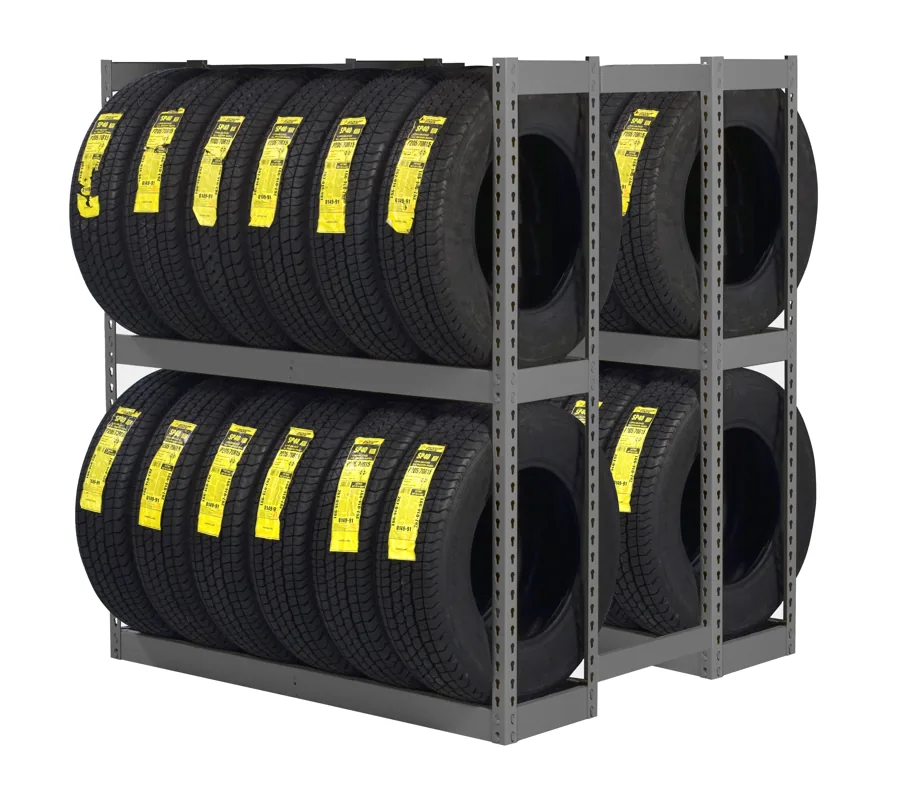
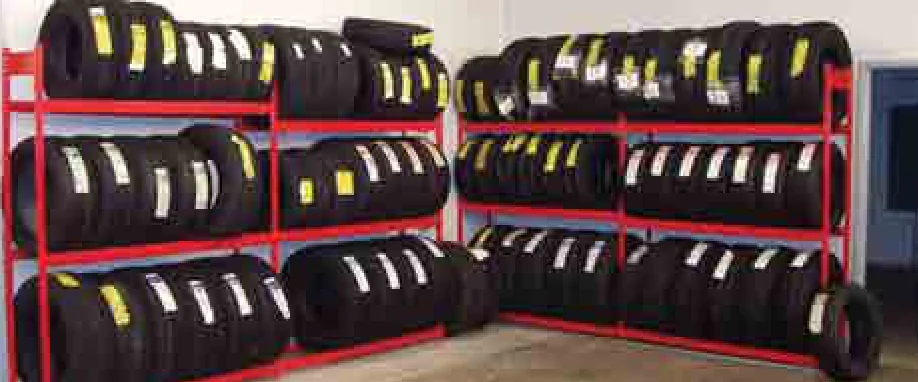
Zone the back room before you place a single bay
A shop back room has four distinct jobs to do, and they want different storage. Drawing the zones first is what stops the room turning into one undifferentiated wall of tires.
| Zone | What lives there | What it needs | Where it goes |
|---|---|---|---|
| Bay-side fast pick | The sizes fitted daily, plus consumables. | Hand height, single-deep, fully selective, no equipment to reach. | Within a few steps of the lift. |
| Bulk and slow-moving | Long-tail sizes, seasonal stock, backup inventory. | Height and depth are acceptable here; access can be slower. | The far wall or the upper levels. |
| Receiving and staging | Incoming deliveries before they are put away. | Clear floor, not a permanent storage location. | By the delivery door, marked and kept clear. |
| Customer sets and holding | Sets awaiting fitting or pickup, seasonal changeovers. | Physically separate, tagged by set, racked in pickup order. | Near the counter or the collection door. |
The one zone shops forget
Receiving. When there is no marked staging area, deliveries land in the aisle and stay there until someone has time, which blocks the aisle, hides stock from the system and creates exactly the accumulation that a safety inspection flags. A painted rectangle by the door with nothing stored in it permanently is one of the highest-return square metres in the building.
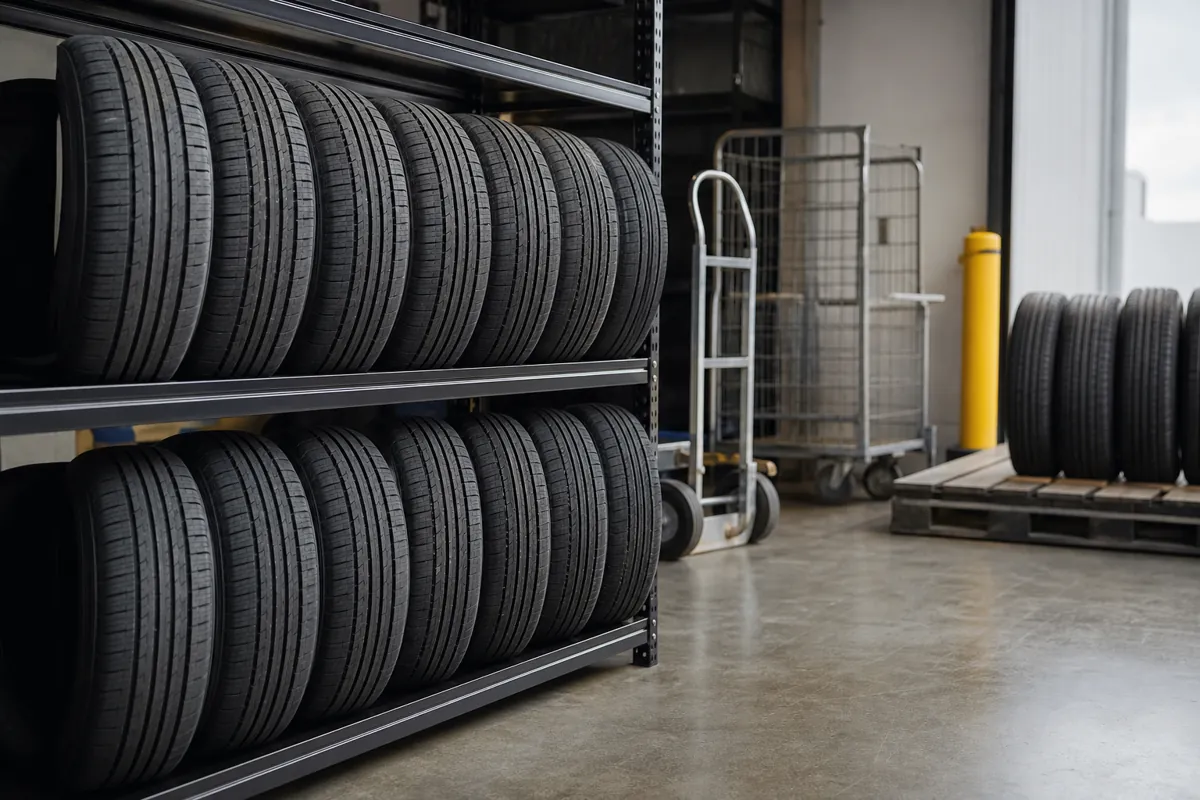
Getting the delivery flow right
Stage, count, put away, in that order. Putting stock away straight off the truck feels faster and is how counts drift and sizes end up in the wrong bay.
Put away oldest-first. Tire storage guidance is explicit about using oldest stock first;
that only works if put-away puts new stock behind, not in front.
Keep the staging rectangle empty. The moment it becomes overflow storage, the aisle becomes the new staging area.
Size the levels to your mix, not to a catalogue
Every capacity figure in a brochure assumes a tire size. Four measurements per size band are enough to design the whole room, and they take one afternoon to collect.
Section width per size band
How wide the tire is across the tread and casing. This sets how many nest along a beam. Measure the widest common size in the band, not an average.
Overall diameter per size band
Diameter plus handling clearance sets the beam pitch. This is the number that decides whether you get four levels or five under the same ceiling.
Peak count per size band
How many of each band you hold at your busiest, not annual volume. Storage built for the wrong band is wasted floor.
Fitting frequency per band
How often each band is actually fitted. This decides what goes bay-side and what goes to the back wall — and it is the measurement shops most often skip.
Then compute rather than guess
Tires per level = usable beam length / section width. Levels = usable height / (diameter + clearance). Multiply for tires per bay, and compare it against what the room holds today.
As a sanity check while you plan, published guidance across the industry consistently lands in the same range: roughly four to five standard passenger tires per beam pair, three to four SUV or light-truck tires, and two to three commercial truck sizes. Use those to sketch, then design from your own measurements. If a large share of your work is commercial, the design is governed by weight rather than bulk and heavy-duty truck tire storage racks is the page that covers it.
Band the pitch, do not average it
Running one pitch for passenger sizes and a separate, taller pitch for light-truck and commercial sizes is the single most common capacity win in a shop back room. Uniform pitch across a mixed inventory is convenient to build and expensive to own, because every smaller tire pays for the clearance the biggest one needed.
Want your back room laid out properly?
Send your size mix, peak counts, floor plan and clear height. We will lay out the zones, pitch the levels to your bands and show what the room can hold before anything is quoted.
The rack options that make sense in a shop
Shops rarely need exotic equipment. These four cover almost every retail and service layout, and the fixed ones are built from the same components as our pallet rack systems — standard, serviceable steel that can be re-pitched and extended as the mix changes rather than replaced.
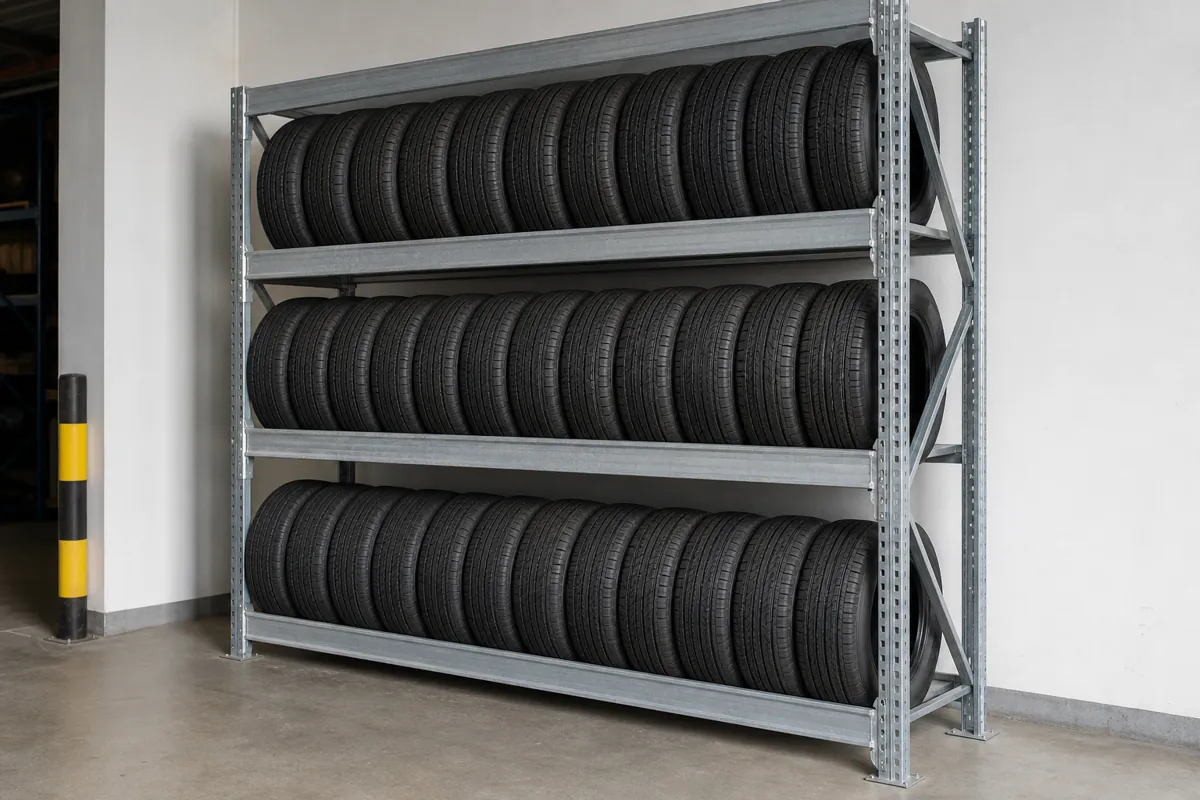 Freestanding multi-level tire baysThe workhorse. Selective bays with beam levels pitched by size band, hand loaded, every position directly picked. Best value and the easiest to reconfigure later.
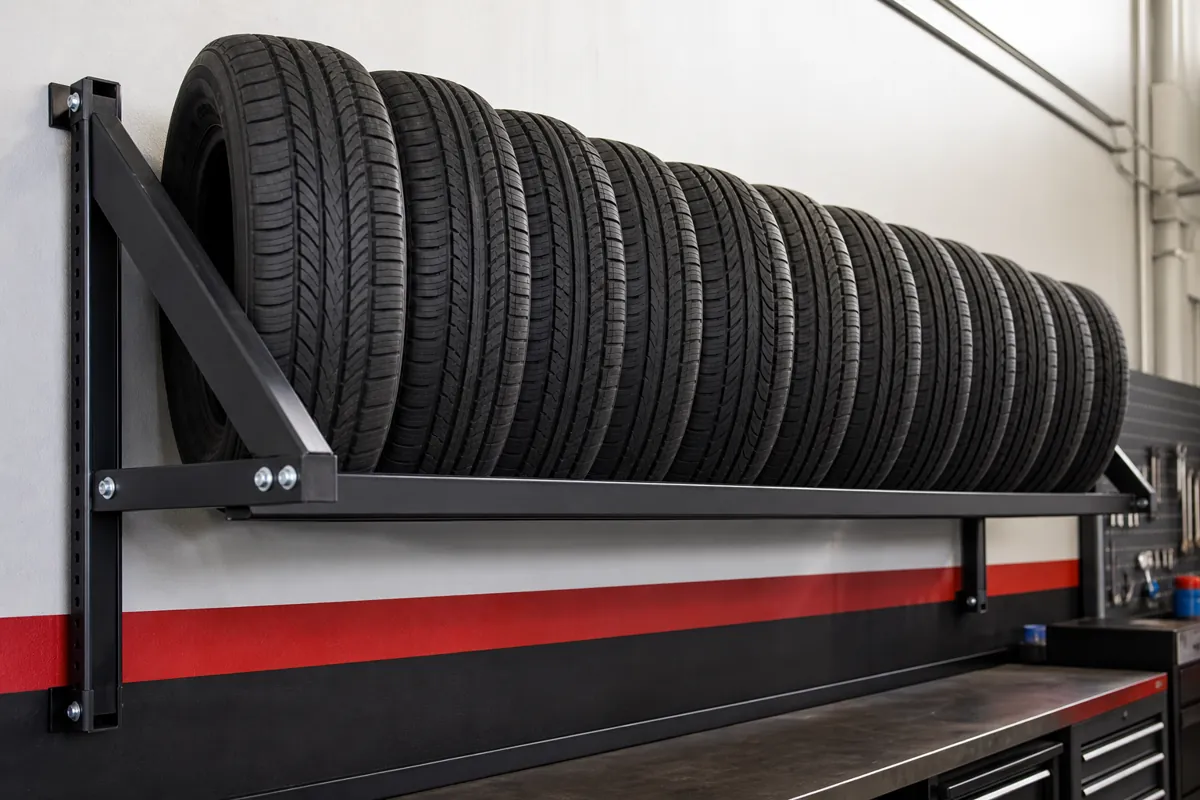 Wall-mounted tire racksBrackets that turn otherwise dead wall above a bench or bay into fast-pick storage. Excellent for the few sizes fitted every day; limited capacity and dependent on the wall structure.
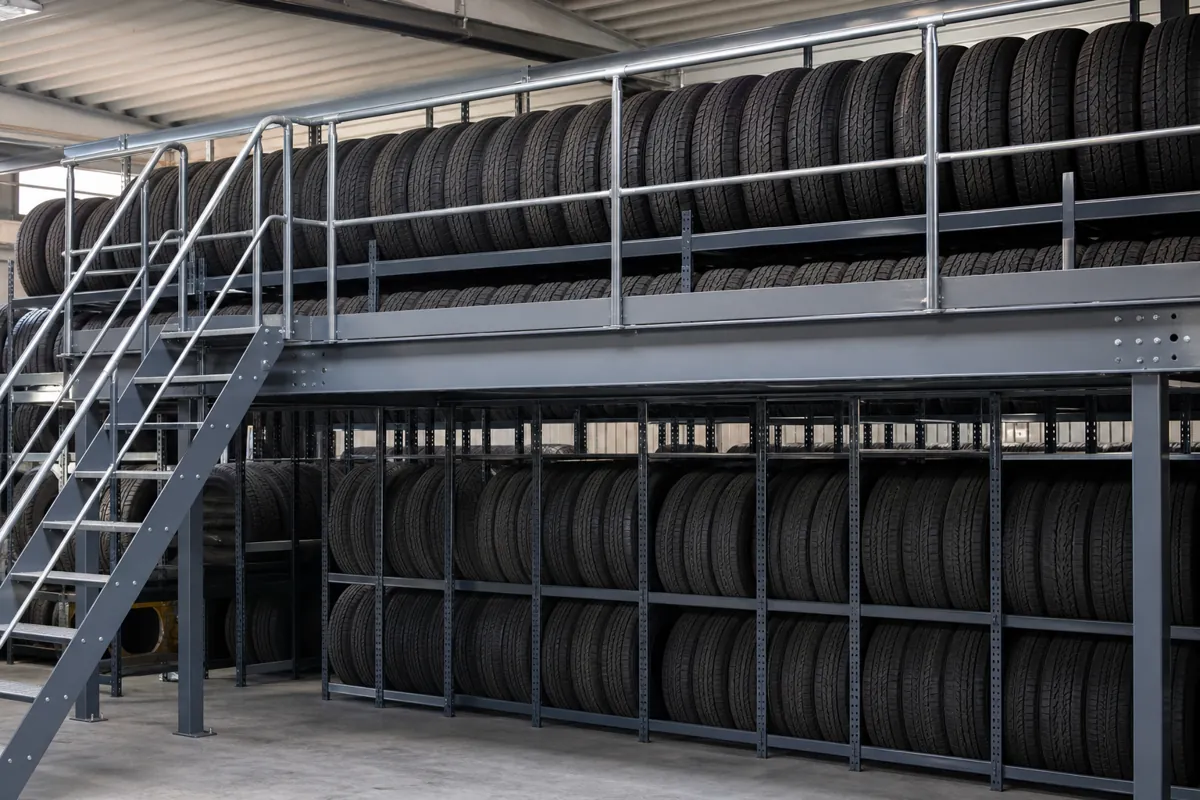 Overhead platform or mezzanine storageUses the height in a tall shop by putting slow-moving stock above. A building decision as much as a rack one: floor loading, access and fire protection all change.
 Customer set holding racksA physically separate, tagged area for customer property, racked in pickup order. Small, cheap and the fix for the most damaging failure in a shop back room.
Two options sit outside that list. A vertical tire carousel converts height into one access opening and earns its cost where floor area is genuinely expensive and volume is stable. At the other end, stackable and portable tire racks handle a seasonal changeover surge without committing floor space year-round. And if tires are being walked across the shop all day rather than searched for, the constraint is handling: mobile and rolling tire storage racks deals with that directly.
Labelling and stock control: the cheapest upgrade in the building
Most shops can describe where a size lives but cannot point to a location code for it. That difference is worth minutes on every job, and it is the reason two shops with identical racking can run at very different speeds.
- Use a simple bay-level-position code and mark it on the beam where a technician can read it from the aisle, not on the stock.
- Record the location against the stock in whatever system you already run. A location nobody can look up is decoration.
- Assign locations by fitting frequency, then review it seasonally. The fast movers change; the layout usually does not.
- Keep one flexible face for the long tail. Every shop stocks odd sizes, and forcing them into a rigid scheme is how the scheme dies.
- Mark capacities per level where heavy commercial sizes share a room with passenger stock, so nobody has to guess what a beam is rated for.
- Decide the decking early — wire decking or solid shelves change what a level holds and how securely tires stay put.
- Rotate oldest stock first as a written rule, not a habit. Tire storage guidance is explicit about it, and put-away is where it succeeds or fails.

What good labelling is worth
Take a shop fitting thirty tires a day. If finding stock costs an extra ninety seconds per job because there is no location code, that is roughly forty-five minutes of bay time a day — more than a job’s worth, every day, from a problem solved by a label printer.
The arithmetic is deliberately simple, and you should run it with your own numbers rather than ours. The point is that shop storage is judged by time, not by cubic feet, and time is where the return is.
Customer sets and seasonal changeover
The moment a shop starts holding customer property, storage stops being an inventory problem and becomes a service promise. A mixed-up set is not a stock discrepancy; it is a customer.
- Physically separate customer property from sale stock. Different bays, ideally a different area, so a set can never be sold by mistake.
- Tag by set, not by tire, with customer, vehicle and wheel position, and use the same code that appears in your booking system.
- Rack in pickup order, with this month’s appointments nearest the door. Seasonal changeover is a scheduling problem before it is a storage one. Express service buildings holding the same sets in two or three bays are covered on service station and quick lube tire storage.
- Store sets on the tread, never on the sidewall, and never stacked flat under other sets — a deformed customer tire is a warranty conversation.
- Mounted sets need more care than loose tires: the rim finish becomes the thing you are protecting. Tire and wheel assembly storage racks covers level and decking choice for assemblies.
- Plan the peak, not the average. Changeover season can double the sets held; stackable and portable frames absorb that surge without permanent floor space.
Where seasonal storage becomes a business, not an overhead
Shops that store customer sets well tend to turn it into a paid service, because the customer keeps coming back to the tires. That only works if retrieval is quick and reliable, which means it depends entirely on the tagging and the layout — not on how much storage you own.
Safety, fire protection and inspection
Shop back rooms are inspected against the same requirements as warehouses, with the added complication that rubber tires are treated as a high-challenge commodity. None of this is onerous, but it is easier to design in than to retrofit.
What we will and will not tell you
We will size the racking, pitch the levels, zone the room and tell you honestly where a storage idea is likely to collide with fire protection. We will not certify that an arrangement is compliant in your building — that determination belongs to the fire protection engineer of record and the authority having jurisdiction.
- Install it properly and keep it plumb. A shop bay takes knocks; see rack installation.
- Inspect on a schedule and take damaged components out of service rather than nursing them along — rack inspection and repair.
- Protect uprights where equipment works, particularly at aisle ends and near the delivery door.
A practical sequence for re-racking a shop
If you do nothing else on this page, do these six steps in order. The first three usually cost nothing but time.
Measure the mix and the fitting frequency
Section width, diameter, peak count and fitting frequency by size band. One afternoon sets up every decision that follows.
Draw the four zones
Fast pick, bulk, receiving, customer holding. Mark them on the floor before moving any steel.
Re-pitch the levels by size band
Reset beam heights to the bands you hold, with honest handling clearance. This is where the missing level per bay usually comes from.
Move the fast movers to the bay
Reassign locations by fitting frequency. Steps per job is the metric; nothing else in this list moves it as much.
Label and record locations
Bay-level-position codes on the beams, recorded against stock. Cheap, fast, and the change staff notice most.
Then, and only then, price new storage
With the room working properly you will know exactly what is still missing — and often it is much less than it looked at the start.
Where this fits in the wider tire storage decision
A shop is one of five environments this cluster covers, and the one where access matters most and height matters least. If the building genuinely cannot hold what you carry after the layout work above, high-density tire storage racks works through the levers that add real capacity. If your work is mostly commercial vehicles, heavy-duty truck tire storage racks deals with the weight side. And the tire storage rack overview remains the right starting point when the whole layout is still open.
Whichever direction it goes, shop racking should be standard, serviceable steel from the same pallet rack range we install in warehouses — because a shop that grows can extend and re-pitch what it already owns instead of starting again.
Get a free quote
Tell us what you are storing, the room size and your timeline. A project specialist will follow up with layout options and pricing. Prefer to talk? Call (800) 326-4403.
Tire Shop Storage Rack FAQs
What kind of racking does a tire shop actually need?
How many tires fit on one rack level?
How high should tire racking be in a shop?
Should tires be stored on the tread or on the sidewall?
Where should the racking go relative to the service bays?
How do I stop customer sets getting mixed up?
Do I need location labels in a shop this small?
What are the safety rules that inspectors actually check?
Is a tire carousel worth it for a shop?
Get your back room laid out properly
Send your size mix, peak counts, floor plan and clear height, and we will zone the room, pitch the levels to your bands and show what it can hold before anything is quoted. Call (800) 326-4403.