
Home › Pallet Rack › Tire Storage Rack › Heavy-Duty Truck Tire Racks
Semi-Truck & Heavy-Duty Truck Tire Storage Racks
Semi-truck, bus and OTR tires are the heaviest, bulkiest, most awkward thing a storeroom is asked to hold. This page covers storage racks for semi-truck tires in fleet shops, tire dealers, retreaders and warehouses (not the spare-tire carrier mounted on the truck itself). Here is how the racking should actually be specified — weights, diameters, beam capacity, decking, floor loads and the fire-code constraints most quotes ignore.
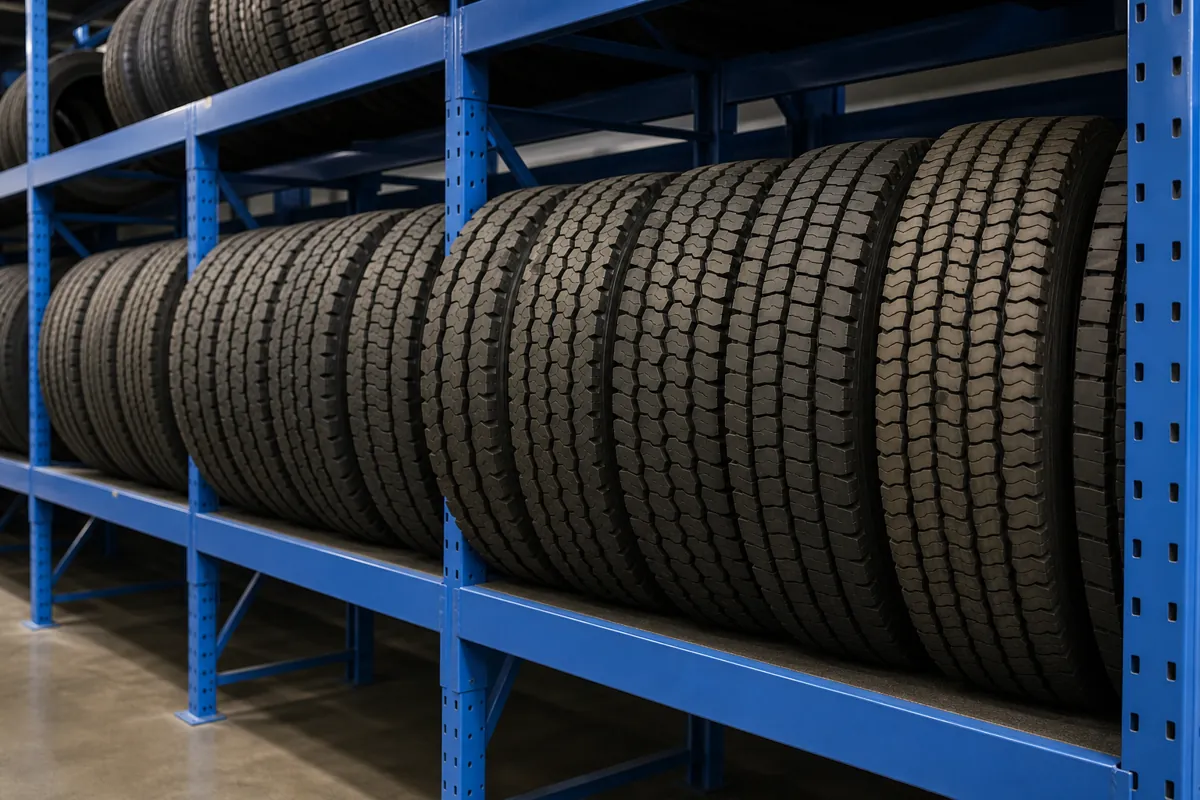
41-44 in
Typical overall diameter of a Class 8 truck tire
125-135 lb
Published weight of a single 11R22.5 casing
On tread
The only sensible way to store a heavy radial
NFPA 13
Rubber tire storage has its own sprinkler criteria
Why truck tires break a normal racking specification
A pallet rack layout for cased goods assumes a load that is roughly cubic, roughly uniform, and delivered on a pallet by a forklift. A commercial truck tire is none of those things. It is round, it is dense, it will not sit still, it is heavier than a person should lift, and it usually arrives loose rather than unitised. Every assumption baked into a general-purpose rack quote — beam span, load distribution, bay depth, pick height — needs re-examining before it is applied to truck and OTR rubber.
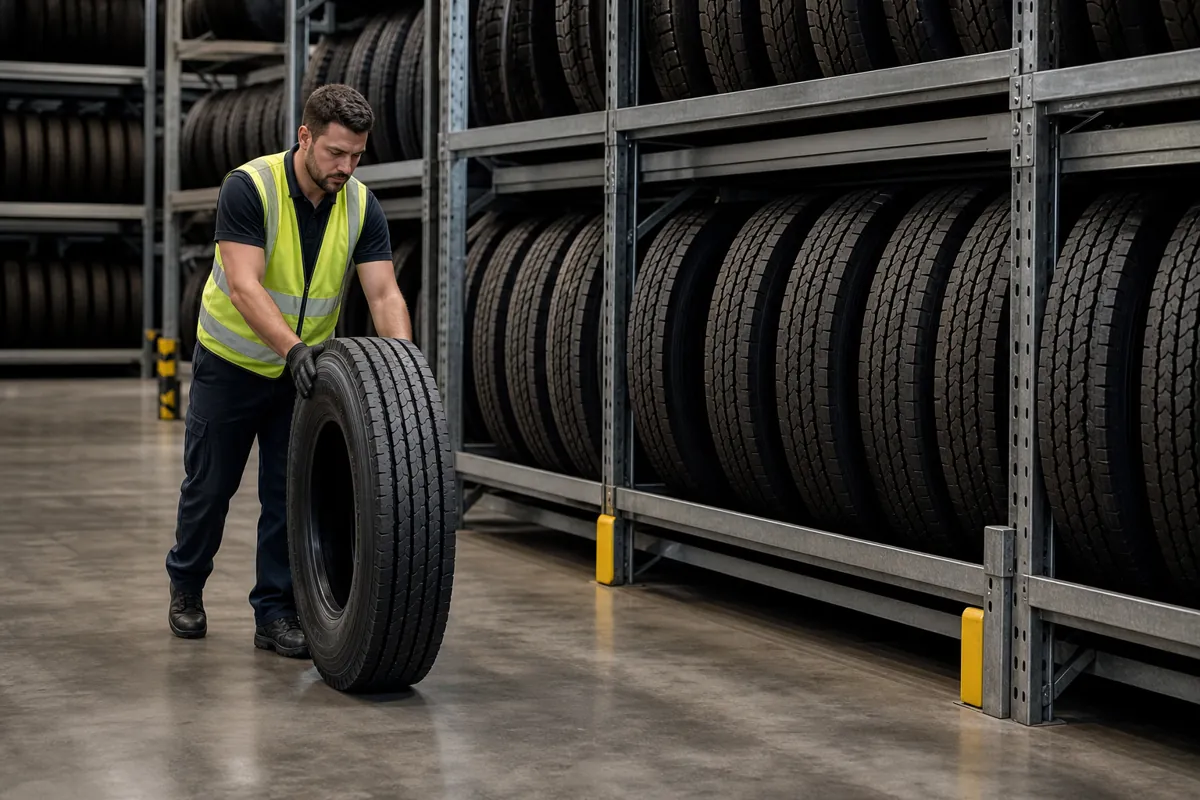
Four differences that change the design
Weight is concentrated, not spread. A row of truck tires puts a heavy load into a short length of beam rather than distributing it across a pallet footprint. Uniformly distributed load ratings from a catalogue can flatter a beam badly in this application.
The load rolls. A tire standing on its tread wants to move. Without continuous support and a positive stop, tires walk between beams, lean into the aisle and fall from height.
Handling is manual more often than planned. Truck tires are moved by rolling and levering as well as by forklift, so roll-off height, floor surface and aisle width matter as much as cube efficiency.
The commodity is a fire-protection category of its own. Rubber tires are treated separately in sprinkler standards, and the storage arrangement itself is an input to the required protection.
None of this makes truck tires unsuitable for racking. It means the racking has to be selected against the real load, and that a heavy-duty tire installation usually looks more like a structural pallet rack job than a light shelving job. If you are still deciding between racking, dedicated tire shelving and vertical carousels, the tire storage rack overview compares those options side by side before you get into the engineering detail below.
Shop Heavy-Duty Tire Racks Online
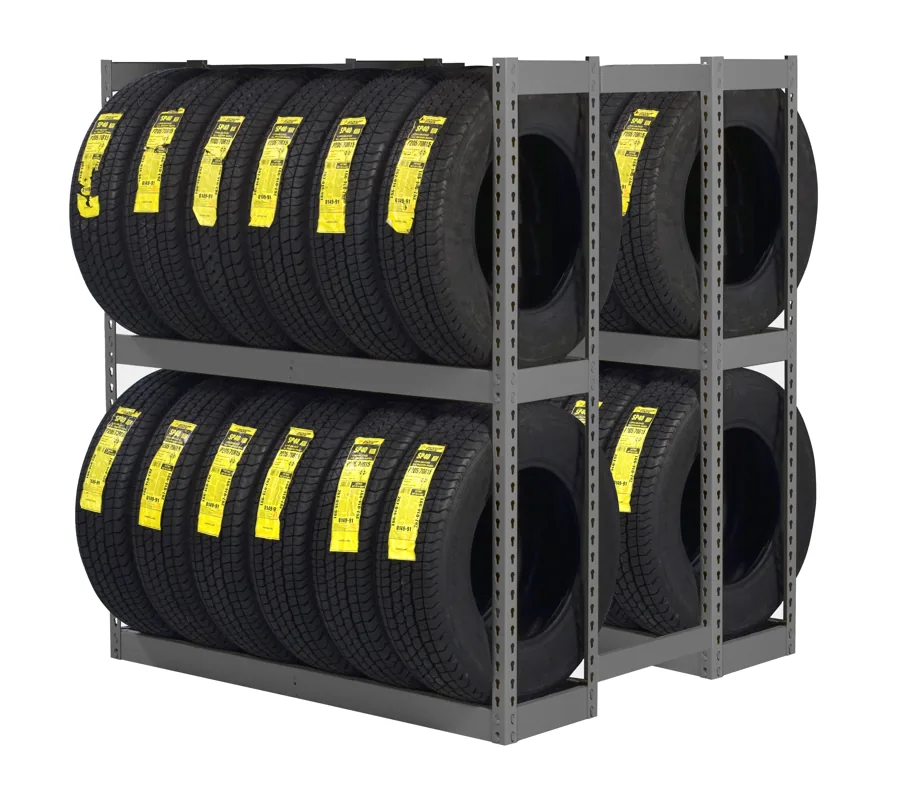
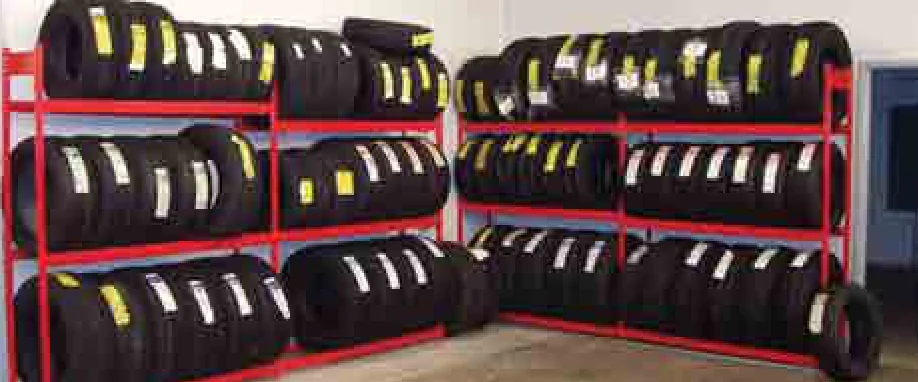
Genuine tire racks you can order online. Prices are current store prices for the lowest-priced in-stock starter unit in each line; add-on bays, other sizes and freight are in each category. Some common sizes are in stock at select manufacturers, subject to confirmation. Larger rooms on pallet rack are quoted.

Collect five numbers before anyone quotes a rack
Most bad truck tire racking decisions trace back to a quote issued without these five figures. They take an afternoon to gather and they determine everything downstream.
| What to measure | Why it decides the design | Where to get it |
|---|---|---|
| Overall diameter of your largest size | Sets bay depth, level spacing and how many tires fit a face. | Manufacturer data sheet for each size you actually stock. |
| Weight per tire and per assembly | Sets beam capacity at your span, deck rating and floor loading. | Data sheet weights; weigh a mounted assembly if you store wheels. |
| Tires per size, and turnover | Decides which sizes get roll-off height and which go up high. | Your inventory system, twelve months of movement. |
| Clear ceiling height and sprinkler position | Caps storage height; sprinkler clearance is a code requirement. | Building drawings, plus a physical measurement. |
| Floor slab thickness and condition | Governs base plate, anchoring and whether the load is acceptable. | Original slab detail or a structural assessment. |
Do not average your tire sizes
A mixed truck tire inventory is not one load case. If a facility stores 11R22.5 highway tires alongside a handful of loader tires, the racking must be designed for the worst case in each bay it is placed in — not for a fleet-wide average that no individual bay ever sees.
The four ways truck tires actually get stored
These are not interchangeable. Each solves a different combination of volume, size mix, handling equipment and building constraint, and larger operations usually run more than one.
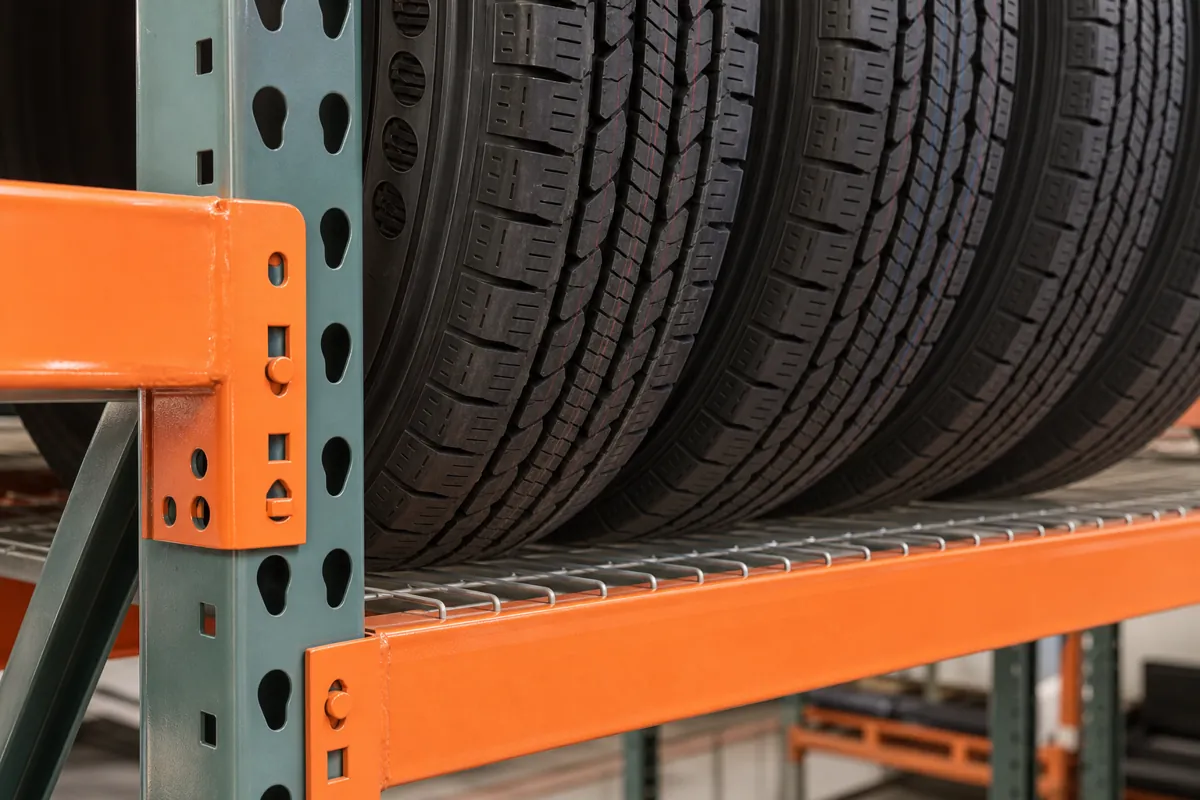
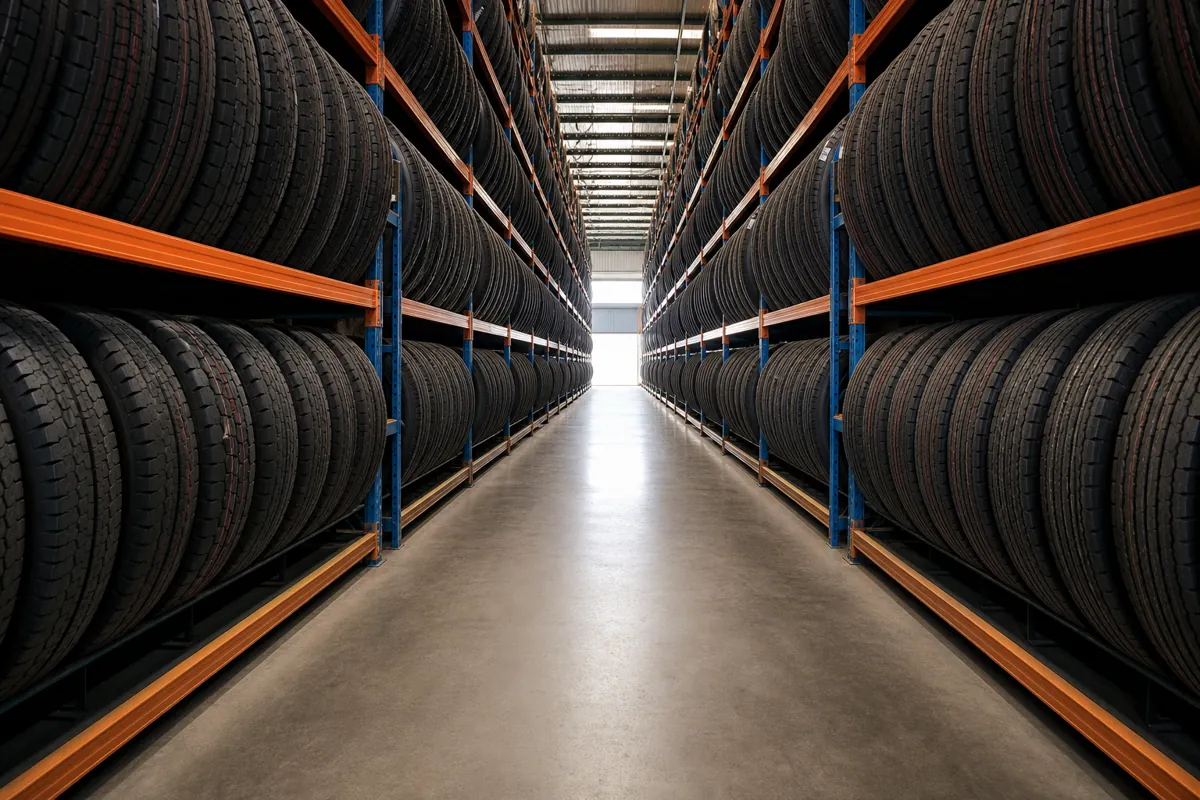 Structural rack, tires on treadThe default for high-volume truck and OTR storage. Heavy structural uprights and beams, continuous deck, tires standing on the tread in rows. Best cube per square foot and the most forgiving of impact.
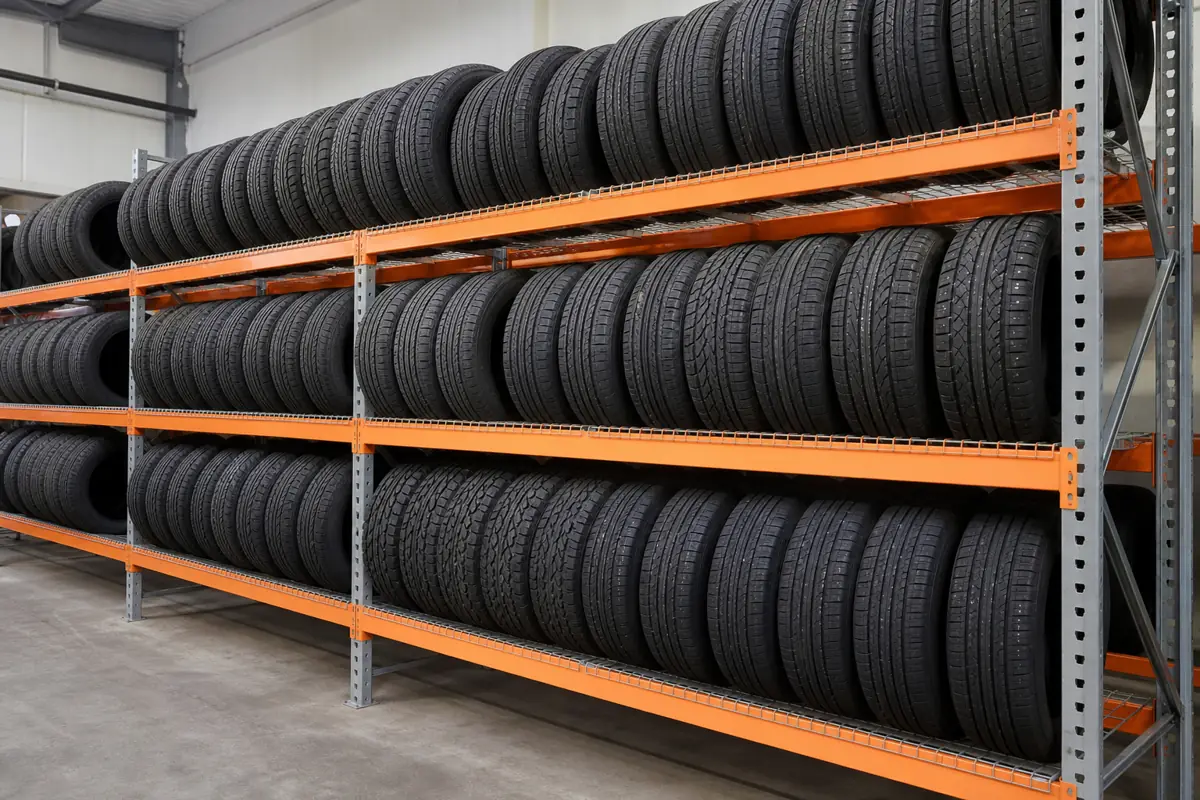 Roll-formed selective rack, upratedCommon in tire retail and service operations with passenger and light-truck mixes plus a small truck tire range. Works well when the beam level and deck are specified for the real load rather than a default.
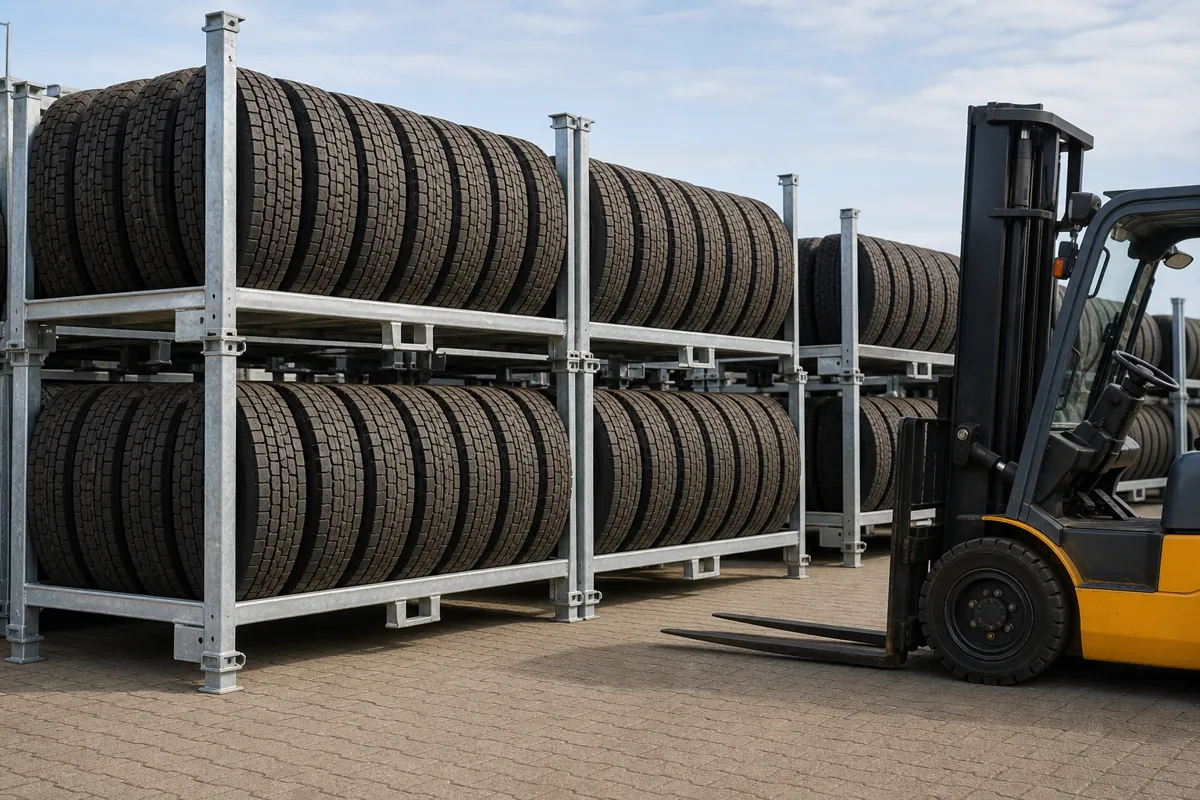 Portable stack and folding racksMoved and stacked by forklift, nested when empty. Excellent for yard storage, seasonal surge and outbound staging, weaker on cube efficiency and pick access than fixed racking.
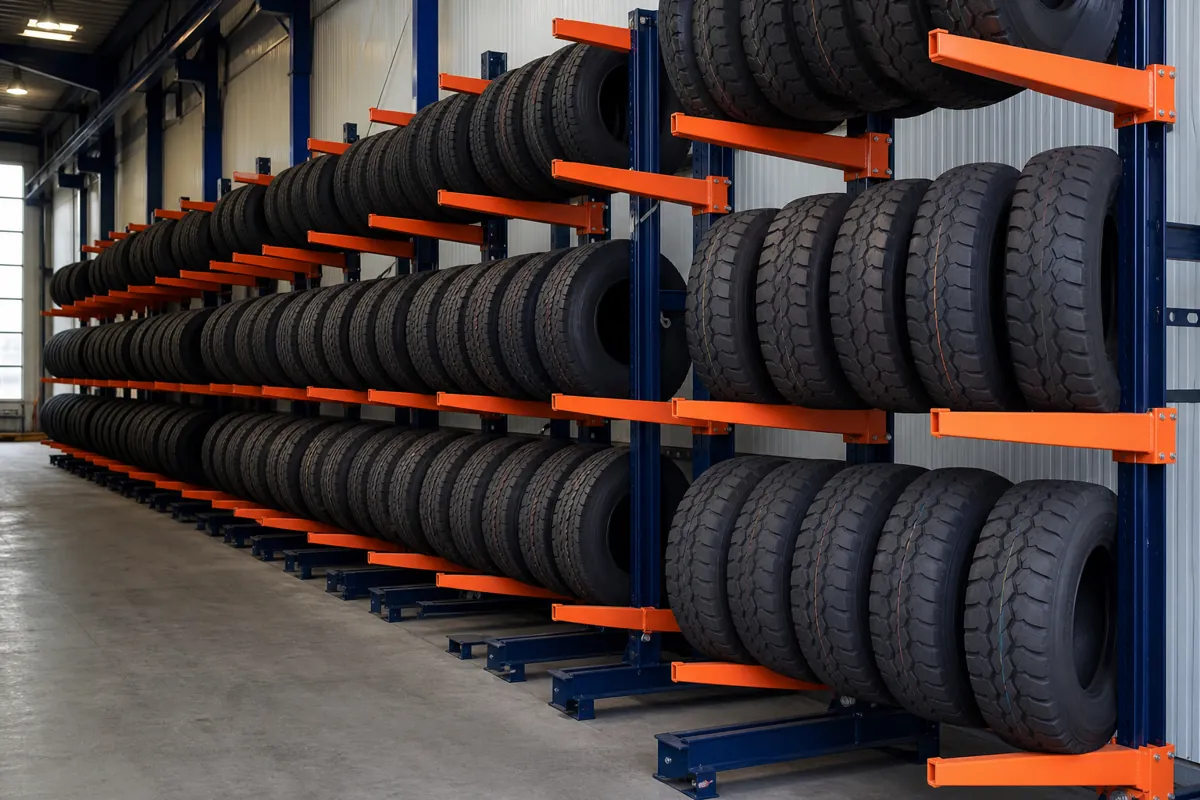 Cantilever and specialist framesUsed where tires or tire-and-wheel assemblies do not suit a beam-and-deck bay, or where full-depth access from one side is essential. Specified case by case against the load and reach.
A dealership or shop with a small truck tire range alongside a large passenger inventory should also look at mobile and rolling tire racks, which trade cube efficiency for the ability to bring stock to the bay. The trade-offs there are quite different from a fixed installation.
Beams, decking and where capacity really goes wrong
Capacity failures in tire storage are almost never a beam snapping under a catalogue-rated load. They are mismatches: a rating taken at the wrong span, a load pattern the rating never assumed, or a deck asked to do a job it was not rated for.
Read the capacity the way an engineer does
Capacity is per beam pair, at a stated span. Widen the bay and the rating drops. A beam figure quoted without its span is not a specification. Our guide to pallet racking weight capacity works through how those ratings are published and misread.
Uniformly distributed is an assumption, not a fact. Tires loaded tight into one half of a bay are not a uniform load. Where loading cannot be controlled, the level should be designed for the pattern staff will actually create.
The deck has its own rating. Wire mesh decking is rated separately from the beams, and it is the deck — not the beam — that carries the concentrated contact patch of a tire sitting between beams.
Design for damage. A truck tire storeroom sees forklift contact. Column protection and end-of-aisle guarding are part of the capacity conversation, because a struck upright no longer carries its rated load. See rack guards and column protection.
| Specification item | What to require | Common mistake |
|---|---|---|
| Beam capacity | Rated at your actual bay span, for the heaviest size stored in that bay. | Quoting a rating from a narrower span. |
| Load pattern | Design for the way staff will really load a level, not for an ideal spread. | Assuming uniform distribution in a hand-loaded tire bay. |
| Decking | Continuous support rated for tire point loads, with a fire-protection review. | Beams only, or swapping mesh for solid deck without checking sprinklers. |
| Deflection | Agree an acceptable deflection limit in writing. | Accepting visible sag as normal. |
| Upright and frame | Column, footplate and bracing selected for the total column load and impact risk. | Sizing the frame from the top level only. |
| Anchoring | Anchors per the manufacturer’s design for the slab you actually have. | Reusing an anchor schedule from a different building. |
Have the load calculated, not estimated
Send us your tire sizes, counts and building constraints and we will come back with a layout and a load case you can hand to a plan reviewer.
Bay depth, level spacing and clearance
Dimensional planning for truck tires is unusual in that the load dimension you must respect is a diameter, and diameters do not stack neatly into standard pallet geometry.
- Bay depth comes from the largest overall diameter you store, plus working clearance, plus a decision about whether the bay is loaded from one side or both.
- Level spacing has to clear the tire height with room to roll a tire in and out, not just to set it down. A level that fits the tire but not the hand movement will be loaded badly.
- Overhang into the aisle is a safety and code problem, not an aesthetic one. If tires protrude past the upright line, aisle widths and flue clearances no longer mean what the drawing says.
- Flue spaces between back-to-back rows and between rows and walls are fire protection features. They are not spare space to be filled with tires later.
- Sprinkler clearance above the top level is a code requirement with a specified minimum; top-level height should be set from it rather than from the height of the steel.
- Aisle width must match the equipment you will actually operate, loaded. Our forklift aisle width guide works through the calculation properly.
The overhang trap
A bay specified for 41 inch tires and then used for 44 inch tires does not fail structurally — it quietly loses its aisle clearance and its flue space. If your size mix is likely to grow, specify the depth for the largest tire you can foresee, because retrofitting depth means new frames.
Floor loading, anchoring and seismic design
Dense storage concentrates a lot of weight into a small number of base plates. In a truck tire installation the total column load can be high enough that the slab, not the steel, becomes the governing constraint.

What has to be checked
Column load into the slab. Add up the real stored weight per bay and divide it into base plates. Compare that against the slab’s capacity, not against a general rule of thumb.
Anchor detail. Anchors are part of the engineered design. Slab thickness, edge distances, joint locations and existing cracking all affect what can be used.
Seismic requirements. In seismic regions rack design is governed, and rack configurations are engineered accordingly — heavy, high-centre-of-gravity tire storage is exactly the kind of load case where this matters.
Existing damage. If you are adding to existing racking, have it inspected first. Loading a damaged frame heavier is the fastest route to a collapse. See rack inspection and repair.
Rack design in the United States is governed by the industry standard for industrial steel storage racks, ANSI MH16.1, and by the adopted building code. That is the framework a properly engineered tire installation is designed and permitted within, and it is why load capacities should arrive as calculated values rather than as sales figures. Installation matters just as much as design — see pallet rack installation for how a compliant install is actually executed.
Fire protection: the constraint that is usually discovered too late
Rubber tire storage is a recognised high-challenge fire commodity, and it has its own dedicated treatment in sprinkler standards. NFPA 13 provides specific protection criteria for rubber tire storage, with tables that vary by storage method — on tread, on side, laced, palletized, fixed rack — and by storage height against ceiling height. FM Global’s data sheet on the same subject exists for the same reason.
The practical consequence is unusual and worth stating plainly: how you arrange the tires is an input to the fire protection design, not a detail to be settled afterwards. Changing from on-side to on-tread storage, adding a level, going to a taller upright, or substituting solid decking for open mesh can all move you into a different protection category.
- Fix the intended storage arrangement and storage height before the sprinkler design is finalised.
- Keep transverse and longitudinal flue spaces as designed, and do not let stock creep into them.
- Respect the required clear distance between the top of storage and the sprinkler deflectors.
- Treat any change to decking type as a fire-protection change, not a hardware substitution.
- Confirm the final arrangement with your fire protection engineer and the authority having jurisdiction.
- Keep aisle and egress widths clear of stored tires — a blocked aisle is both a code and a life-safety failure.
We design the storage; the AHJ approves the protection
We will lay out and engineer racking to suit an agreed storage arrangement and height, and we will flag where an arrangement is likely to affect sprinkler criteria. What we will not do is tell you your building is compliant — that determination belongs to your fire protection engineer and the authority having jurisdiction, and any supplier who promises otherwise is selling you a risk.
Handling, layout and the injuries you are designing out
Truck tire storerooms generate manual handling injuries: shoulders, backs and crushed feet. Layout is the main control available, and it is far cheaper than any of the alternatives.
OSHA does not publish a tire-rack-specific standard; the relevant duties come from general requirements on materials storage and handling — keeping storage areas free of hazards, stacking and securing material against collapse or sliding, and keeping aisles clear. Fleet and municipal operations often run tire storage alongside parts storage, and the two should be planned together rather than competing for the same floor: see fleet and municipal garage parts storage.
Buying, installing and keeping it safe
A truck tire rack is a piece of structural steel that people work under every day. Buy it as engineering, not as a commodity.
Measure and count
Tire sizes, diameters, weights, quantities and turnover. Building height, sprinkler position, slab detail, door and aisle constraints.
Agree the storage arrangement
On-tread, level spacing, single or double entry, storage height. Get the fire protection implications reviewed at this point.
Engineer the layout and loads
Bay and frame selection, beam capacity at real spans, deck rating, anchoring, seismic where applicable. Load values calculated, not estimated.
Install and document
Installed to the design, anchored as specified, load capacities posted, protection fitted, and the drawings and load data handed over.
Inspect and maintain
A scheduled inspection with a named owner, damaged components taken out of service, and any layout change re-checked against the original design.
| Ask your supplier | A good answer sounds like | A bad answer sounds like |
|---|---|---|
| What is the beam capacity at my bay span? | A calculated figure tied to your span and load case. | A single catalogue number with no span stated. |
| What is the deck rated for? | A separate deck rating with the tire contact load considered. | “The decking is included.” |
| How does this arrangement affect sprinklers? | A flag to involve the fire protection engineer early. | “That is not our area.” |
| What does the slab need to carry? | Column loads per base plate, with an anchoring detail. | “It will be fine, we do this all the time.” |
| What happens when a frame gets hit? | An inspection regime and a repair or replace policy. | Silence, or a claim that the rack is indestructible. |
Shop tire racks online
Standard tire rack units for passenger and light-truck sizes are available directly from our online store. Heavy truck and OTR installations are engineered to order — request a quote and we will size the steel to your tire mix.
 FastRak Tire Storage Rack, 3 ShelvesBoltless tire storage bay for passenger and light-truck sizes, in starter and add-on units.
 Four-Level Tire RackAdd-on and starter configurations for shops standing tires on the tread at pick height.
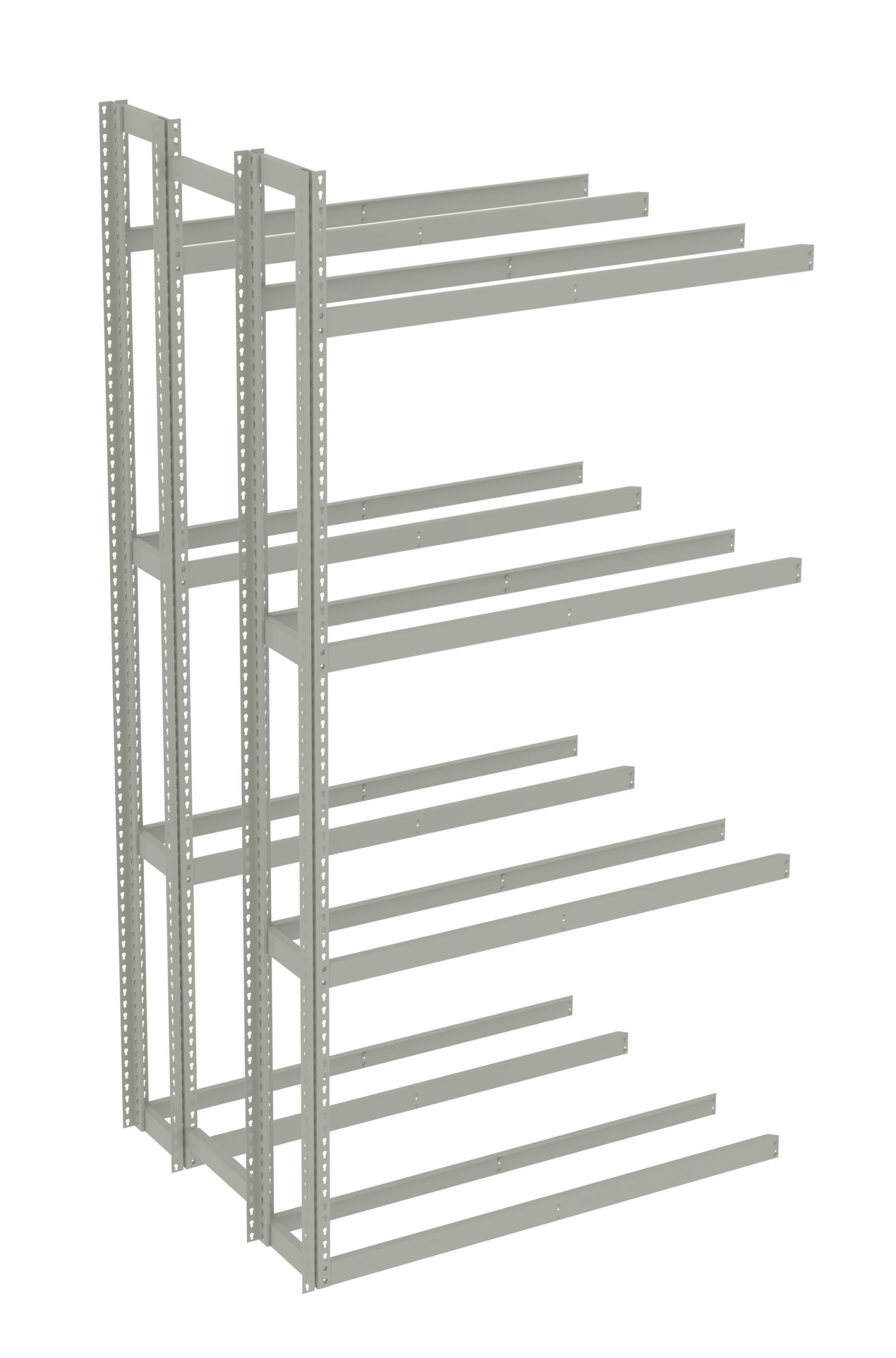 60″W x 120″H Double Entry Tire Rack AdderDouble-entry tire rack adder unit for aisles loaded from both faces.
Get a free quote
Tell us what you are storing, the room size and your timeline. A project specialist will follow up with layout options and pricing. Prefer to talk? Call (800) 326-4403.
Semi-Truck & Heavy-Duty Truck Tire Rack FAQs
What is the best rack for storing semi-truck tires?
How much does a commercial truck tire actually weigh?
Can I store truck tires on standard pallet rack?
Should truck tires be stored on the tread or on the sidewall?
How deep should a truck tire rack bay be?
Do truck tire racks need wire decking?
What does the fire code say about rubber tire storage?
How do we handle tires at height safely?
Are portable stack racks an alternative to fixed racking?
Can these racks go outdoors or in an unheated yard?
How long does a truck tire rack project take?
Rack your truck tires around how they are actually handled
Send us your tire sizes, counts and building constraints. We will come back with a layout, a calculated load case and a quote. Call (800) 326-4403 or request a quote online.