
Home › Pallet Rack › Tire Storage Rack › Mobile & Rolling Tire Racks
Mobile and Rolling Tire Storage Racks
A rolling tire rack solves a handling problem, not a density problem. Here is where mobile tire racks and carts genuinely beat fixed shelving, how to specify casters and load ratings properly, and how to size a fleet without quietly losing storage capacity.
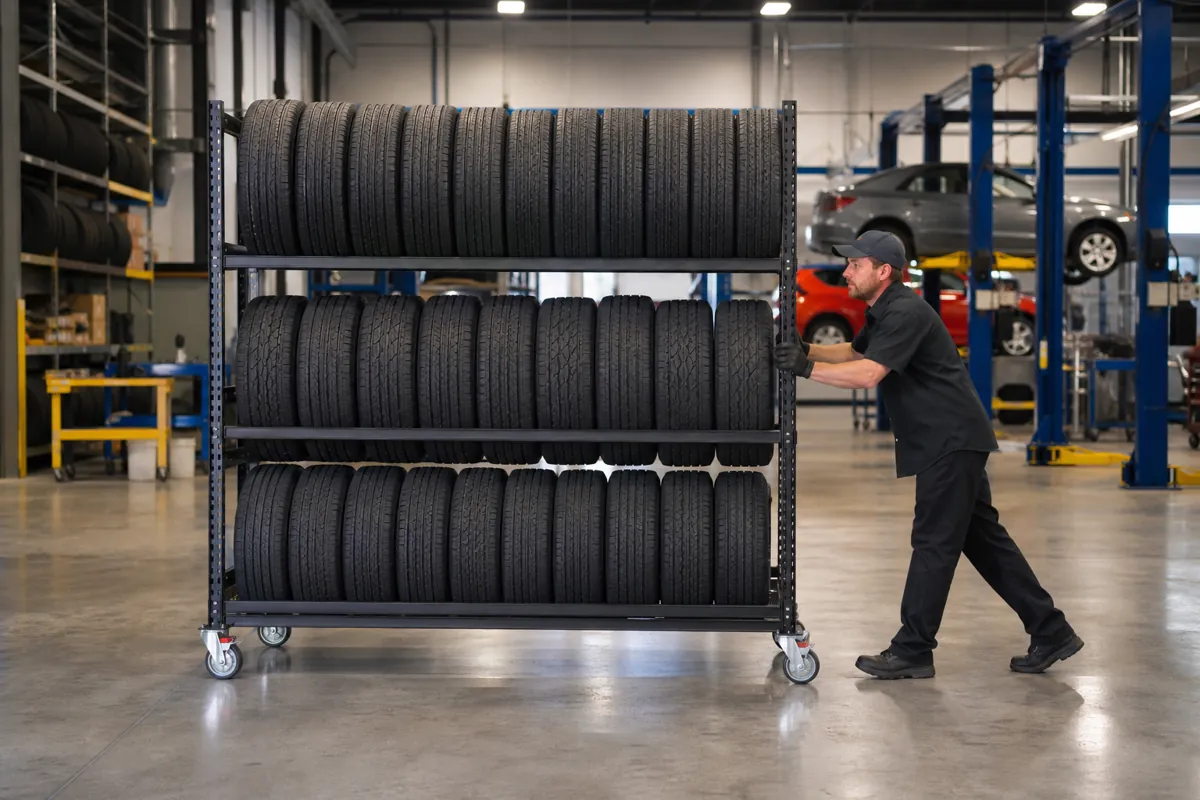
Handling
The problem mobility actually solves
Loaded weight
The number that sizes the casters
Bottom level
Where the heavy sizes belong
Unit + level
How a mobile location must be coded
Mobility solves a handling problem, not a space problem
The most common reason a mobile tire rack disappoints is that it was bought to fix the wrong problem. If the storeroom is full, a rolling rack will not help — it holds fewer tires per square foot than a fixed bay, because it has to stay stable and needs room to move. What a mobile rack does extremely well is remove walking, carrying and double-handling from the working day.

The four situations where mobility pays
Stock has to reach the bay. If technicians walk tires one at a time from a storeroom to a lift, a rolling rack turns four trips into one and takes the load off the technician’s shoulders.
Sets must stay together. Seasonal storage, fitted assemblies and customer sets are far easier to keep intact on a unit that travels than in a shared fixed location.
The layout keeps changing. Where floor use shifts with the season or the workload, a fixed bay is a commitment and a mobile unit is not.
Staging and outbound. Loading a van or a truck from mobile units is faster and safer than building a floor stack next to the door.
If you have not yet decided between fixed racking, mobile units and vertical storage, start with the tire storage rack overview, which compares the options against volume, floor area and handling. For heavy commercial sizes there is a separate discussion again — see heavy-duty truck tire storage racks, because truck and OTR weights rule most rolling units out immediately.
Shop Mobile and Fixed Tire Racks Online
Genuine tire racks you can order online. Prices are current store prices for the lowest-priced in-stock starter unit in each line; add-on bays, other sizes and freight are in each category. Some common sizes are in stock at select manufacturers, subject to confirmation. Larger rooms on pallet rack are quoted.
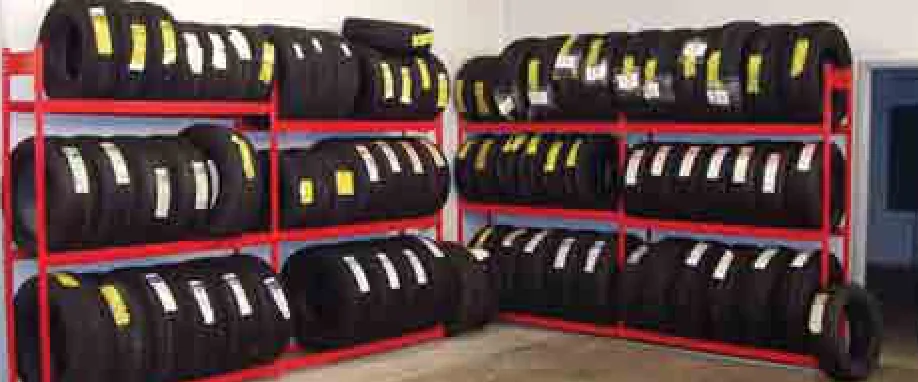

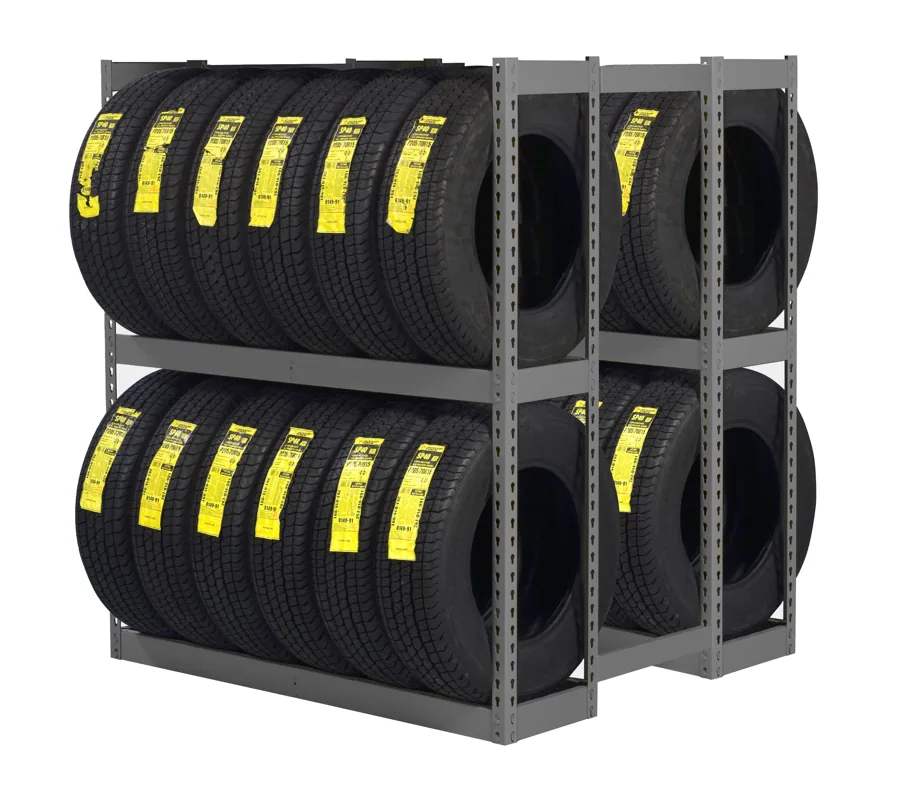
What mobility costs, stated honestly
Every supplier will tell you what a mobile rack gains. Here is the other column, so the decision is made with both.
| Trade-off | Why it happens | What to do about it |
|---|---|---|
| Lower storage density | A mobile unit cannot use the full building height and needs clearance to move. | Keep bulk inventory on fixed racking; use mobile units for the working and staging layer. |
| Height limits from stability | A tall, top-heavy unit on casters is a tipping risk when loaded and pushed. | Accept the height limit; put heavy sizes on the bottom level. |
| Floor dependence | Casters transmit every joint, crack and threshold to the operator. | Survey the travel route before specifying; upsize wheel diameter. |
| Location control gets harder | A moving unit breaks any location code tied to floor position. | Code by unit and level, not by aisle position. |
| Wear and maintenance | Casters, brakes and welds wear in a way fixed steel does not. | Put mobile units into a routine inspection round with the racking. |
| Handling effort scales with load | Required push force rises with weight, wheel size and floor condition. | Set a maximum loaded weight per unit and a two-person rule where needed. |
A simple test before you buy
Ask: if these tires never had to move, would fixed racking store them better? If the answer is yes, you are buying mobility for the handling benefit alone — which is a perfectly good reason, as long as you know that is what you are paying for and you are not expecting extra capacity as well.
The mobile options, and what each is really for
 Mobile tire rack (bay on casters)A full storage bay with heavy locking casters, repositioned rather than continuously pushed. Replaces a fixed shelving bay where the layout has to stay flexible.
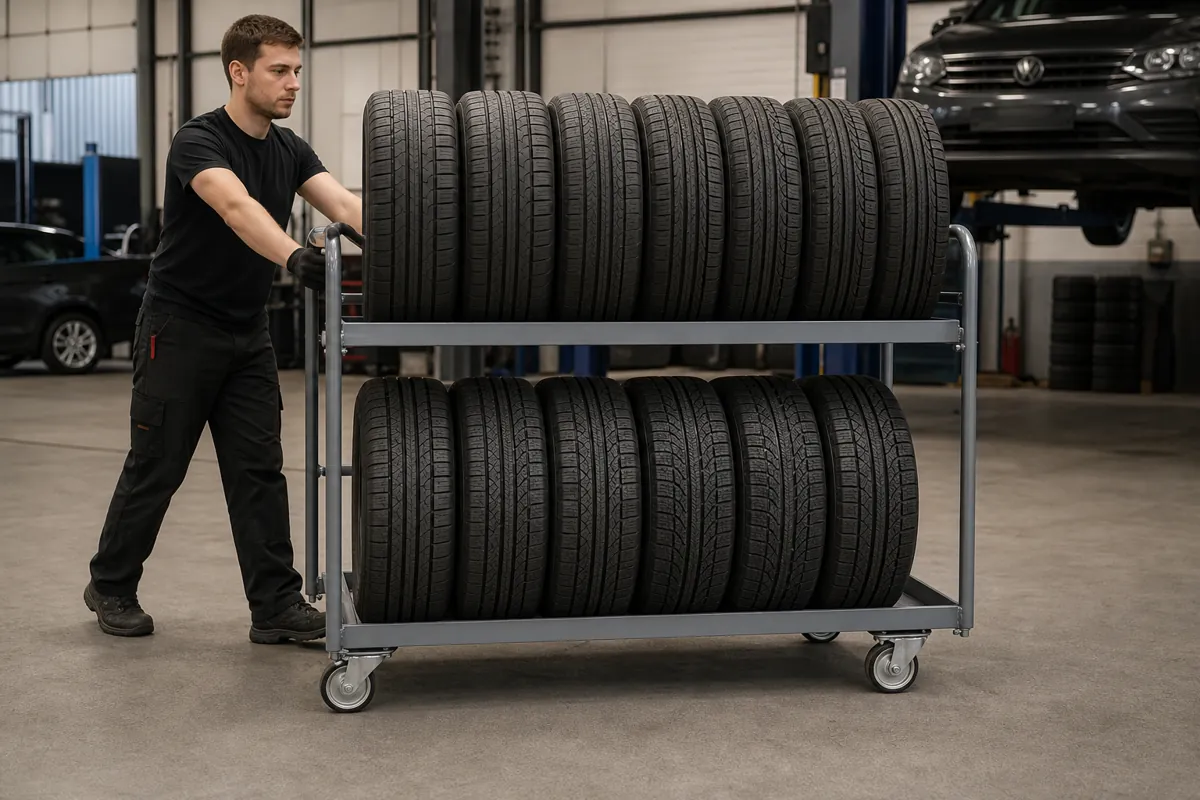 Tire cart / trolleySmaller, pushed by one person, sized to move a handful of sets between store and bay. The workhorse of seasonal changeover and set-based storage.
 Portable stack racks on castersStackable and nestable frames that can be moved loaded. Strong for surge and outbound staging, weaker on picking and cube efficiency.
 Mobile carriage racking (track-mounted)A different animal: fixed rows on powered or mechanical carriages that share one aisle to recover floor area. High density, not portability.
The last of those is worth separating clearly in your head. Mobile carriage racking recovers floor area by removing aisles — it is a density play, and the units do not leave their rails. A rolling tire cart recovers labour, not floor space. Buying one when you needed the other is the most expensive mistake available in this category. Where density is the whole problem and volumes are stable, a vertical tire carousel is the third option to price.
Specifying casters and load ratings properly
This is where mobile tire storage is most often under-specified, because ‘heavy duty’ is a marketing phrase rather than a rating. Three numbers make a specification.
The three numbers
1. Load per level. Take the heaviest tire size that level will hold, multiply by how many fit, and use that — not an average. This sets the shelf or arm rating.
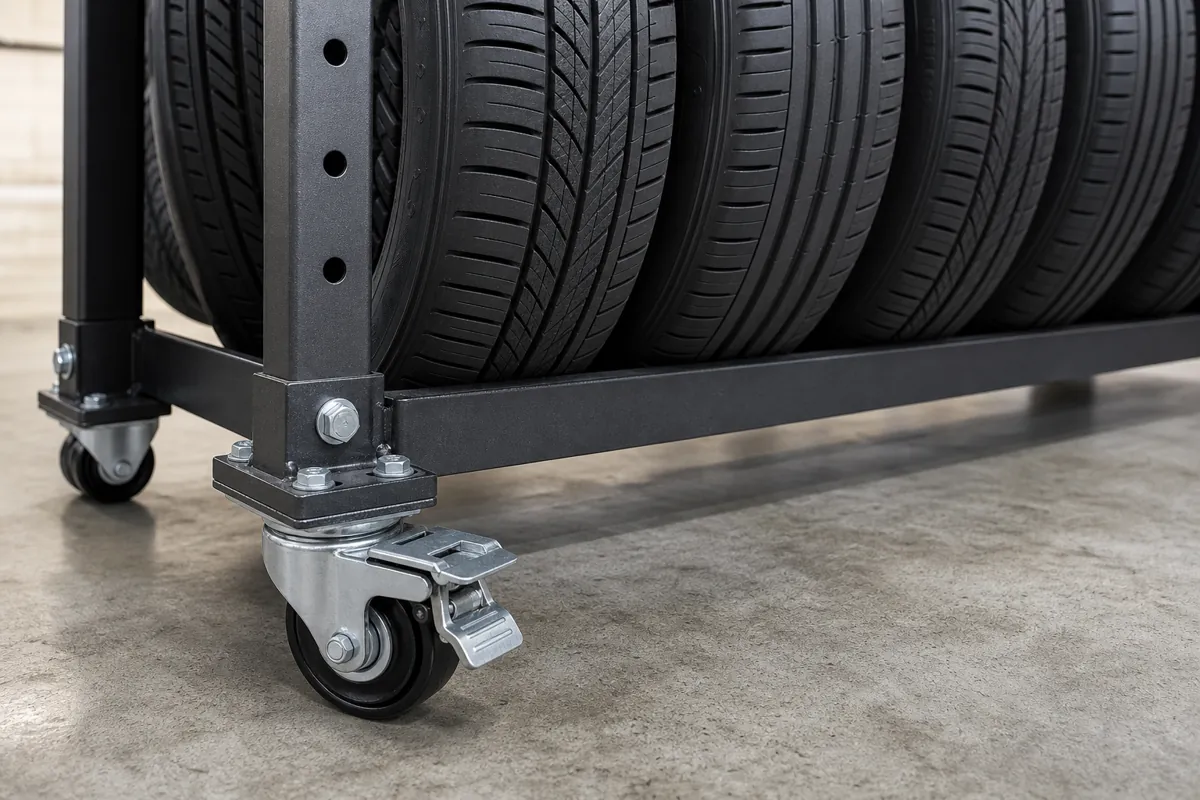
2. Total loaded weight. Add every level plus the unit’s own weight. Divide across the casters, keep a genuine margin, and require a documented per-caster capacity for the result. Never accept a rating that only holds if the load is perfectly even, because it never is.
3. Required push force. This is what determines whether staff can actually move it. It rises with load and falls with larger wheel diameter and harder, better-rolling wheels on a good floor. Where the number is uncomfortable, the fix is a bigger wheel, a lighter unit or two people — not a stronger push.
- Locking casters on at least two corners, and a habit of using them. A loaded unit that rolls while being loaded is a foot injury waiting to happen.
- Swivel and rigid layout chosen for how the unit is steered: all-swivel for tight manoeuvring, two rigid for straight-line control over distance.
- Wheel material matched to the floor — softer treads roll quietly over imperfections and protect the slab, harder treads roll with less effort on good concrete.
- Low centre of gravity by design: heavy sizes on the bottom level, and a documented maximum load for the top level.
- Handle height and grip suited to pushing, not pulling. Pushing is safer and staff will do whatever the handle invites.
- Frame protection where units share space with forklifts — the same logic as rack guards applies to anything a truck can clip.
Not sure whether to go mobile or fixed?
Tell us your tire volumes, floor area and how the stock moves. We will size both options and show you the trade-off in your own numbers.
Floors and travel routes: survey before you specify
A mobile rack is only as good as the worst ten feet of its route. Walk the route with a tape measure before anyone quotes.
Seasonal changeover: the workflow mobile racks were made for
A seasonal tire operation is a short, intense flow problem. Hundreds of sets arrive within a few weeks, each has to remain identifiable as a set, and most of them leave again in a single window months later. Fixed racking stores them; mobile racks move them.
Receive onto a unit, not onto the floor
The set goes straight onto a labelled level of a mobile unit at the point of removal. No floor stack, no second handling.
Record unit and level
The customer or vehicle reference is held against unit ID and level, so the set is findable wherever the unit ends up.
Park by outbound window, not by arrival order
Group units by when the sets will be wanted back. Season-out storage sorted by return window collapses the retrieval effort.
Retrieve by moving the unit
Bring the whole unit to the bay for the day’s bookings instead of walking individual tires all day.
Audit and reset
At the end of the window, reconcile units against records, inspect casters and brakes, and reset labelling before the next season.
Where mobile storage quietly fails
Not through steel failure — through record keeping. A unit that has been moved and a record that still points at a floor position is the same as a lost set. Decide the location convention before the first unit arrives, not during the busiest week of the year.
Labelling and inventory control on a moving location
Fixed racking gets location codes from geography. Mobile storage cannot, and the fix is straightforward as long as it is decided deliberately.
- Give every unit a permanent, visible unit ID on both long sides, so it can be read from either aisle.
- Label each level within the unit, top to bottom, in a fixed convention across the fleet.
- Store the location as unit + level, never as an aisle position.
- Where a unit has a normal home, record the home position separately — useful for finding it, not as the inventory location.
- Keep set integrity explicit: a set that will not fit one level should be flagged, not silently split.
- Audit a sample of units regularly. Mobile inventory drifts faster than fixed inventory, and small audits stop it becoming a full stock take.
The same slotting logic that makes a parts room work applies here — fast movers at the best height, heavy items low, dead stock out of the prime zone. Our notes on automotive parts warehouse shelving and slotting cover the reasoning, and it transfers directly to tires.
Sizing a mobile fleet without over-buying
Buying too many units clutters the floor; buying too few sends staff back to carrying. The sizing is arithmetic, not intuition.
| Step | Calculation | Note |
|---|---|---|
| 1. Peak stock to be mobile | Tires that must move, held at once — not total inventory. | Bulk stock stays on fixed racking; only the moving layer is sized here. |
| 2. Real capacity per unit | Tires per level at your largest common size, times levels. | Use your own measured sizes, never a headline figure. |
| 3. Base unit count | Peak mobile stock divided by real capacity per unit. | Round up, always. |
| 4. Circulation allowance | Add units for those in transit, being loaded and being unloaded. | A fleet with zero spare units stalls at the first bottleneck. |
| 5. Parking check | Units times footprint, against marked parking area available. | If parking does not fit, the fleet is too big for the building. |
| 6. Handling check | Loaded weight per unit against agreed push force and route. | Fail this and you buy a fleet nobody wants to move. |

The hybrid answer is usually right
Most tire operations end up with a clear split: fixed selective racking or dedicated tire racking for bulk inventory at density, and a modest fleet of mobile units for staging, seasonal sets and anything that must reach a bay. That split is cheaper than either extreme, because each layer is doing the job it is good at.
It also protects you from the classic failure — solving a density problem with mobility, running out of space anyway, and ending up with both a full storeroom and a floor full of carts. Fix the density with pallet rack systems sized for the cube you actually have, then add mobility deliberately on top of it.
The safety rules worth writing down
OSHA does not publish a mobile-tire-rack standard; the duties come from general materials storage and handling requirements — secure stacking, storage areas kept free of hazards, and clear aisles and passageways. Translated into a tire shop, that means six rules.
- Brakes on whenever the unit is being loaded or unloaded. No exceptions.
- Heavy sizes on the bottom level, and a stated maximum for the top level.
- Push, do not pull, and set a two-person rule above an agreed loaded weight.
- Tires on the tread, never on the sidewall, and never overhanging the frame into an aisle.
- Marked parking positions clear of aisles, exits, electrical panels and sprinkler risers.
- Casters, brakes and welds on the inspection round with the fixed racking, with damaged units taken out of service rather than nursed along.
Fire protection still applies to mobile storage
Rubber tire storage is a high-challenge fire commodity regardless of what it is standing on. Parking loaded units in an aisle, under a sprinkler riser or against an exit changes the fire and life-safety picture of the room. Agree parking positions with whoever is responsible for the building’s fire protection, and confirm anything unusual with the authority having jurisdiction.
Shop tire racks online
Standard mobile and fixed tire rack units are available directly from our online store. For a sized fleet, a hybrid layout or heavy commercial sizes, request a quote and we will work it out against your own numbers.
 Mobile Tire Rack, Two LevelRolling tire rack on casters for moving stock between storeroom and service bay.
 FastRak Tire Storage Rack, 3 ShelvesFixed boltless tire bay for the bulk inventory layer behind a mobile fleet.
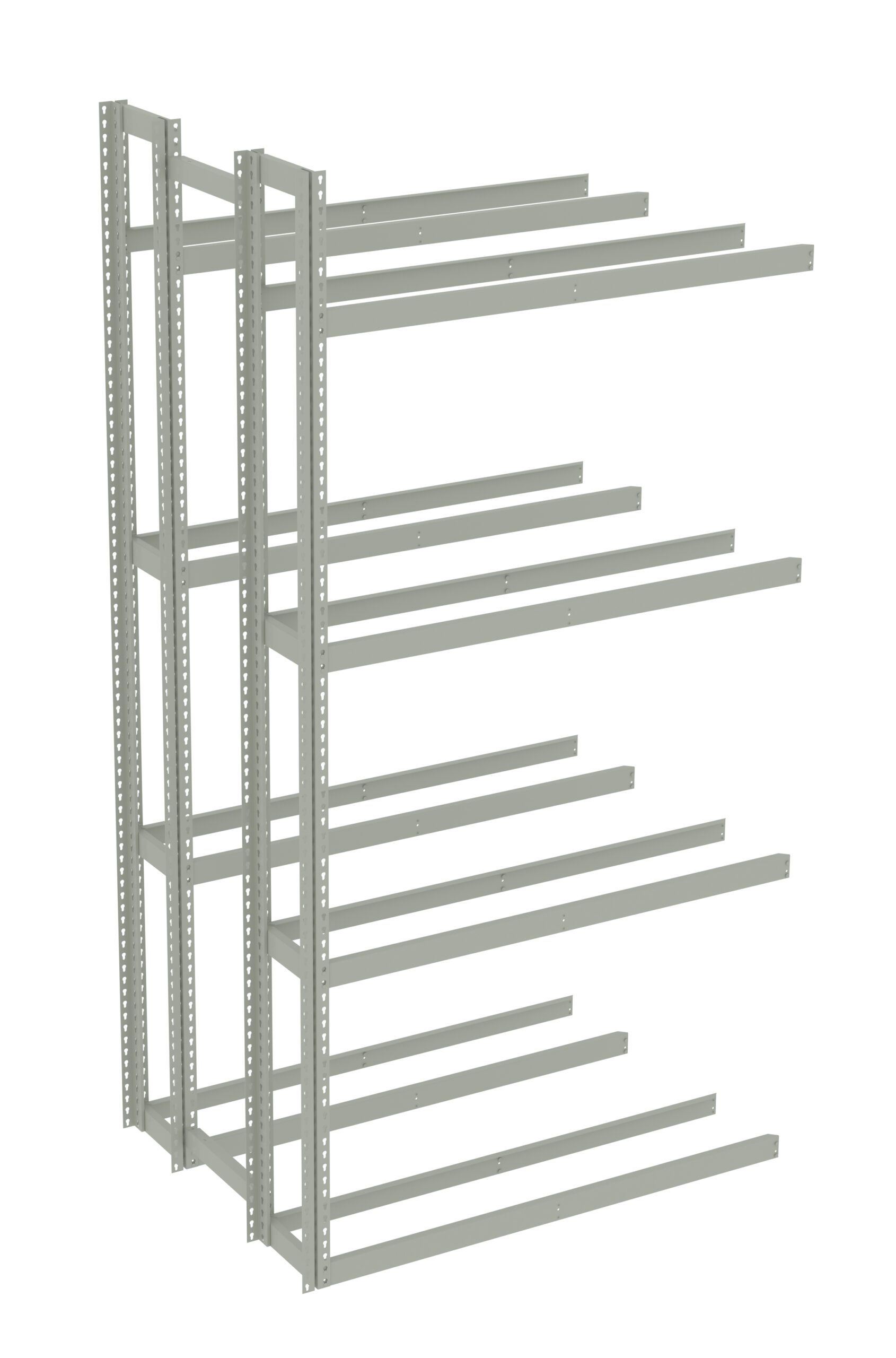 60″W x 120″H Double Entry Tire Rack AdderDouble-entry fixed tire rack adder for aisles worked from both faces.
Get a free quote
Tell us what you are storing, the room size and your timeline. A project specialist will follow up with layout options and pricing. Prefer to talk? Call (800) 326-4403.
Mobile and Rolling Tire Rack FAQs
What is the difference between a mobile tire rack and a tire cart?
How many tires does a rolling tire rack hold?
Are mobile tire racks safe to move when loaded?
Do rolling racks lose storage capacity compared with fixed racking?
What floor do mobile tire racks need?
What caster specification should I ask for?
Are mobile racks good for seasonal tire storage?
How do we label and track tires on mobile racks?
Mobile racks or a tire carousel?
Can we mix mobile and fixed tire storage?
Get the mobile-versus-fixed decision right first time
Send us your tire volumes, floor plan and how the stock actually moves. We will size both options, price the hybrid, and tell you plainly which one fixes your constraint. Call (800) 326-4403.