
Wall-Mount Tire Racks vs. Tire Shelving
A wall rack gets a few tires off the floor for very little space. Tire shelving on that same wall holds several times as many and asks less of the wall. Here is how to tell which one your shop needs.
Shop Wall-Side Tire Racks Online
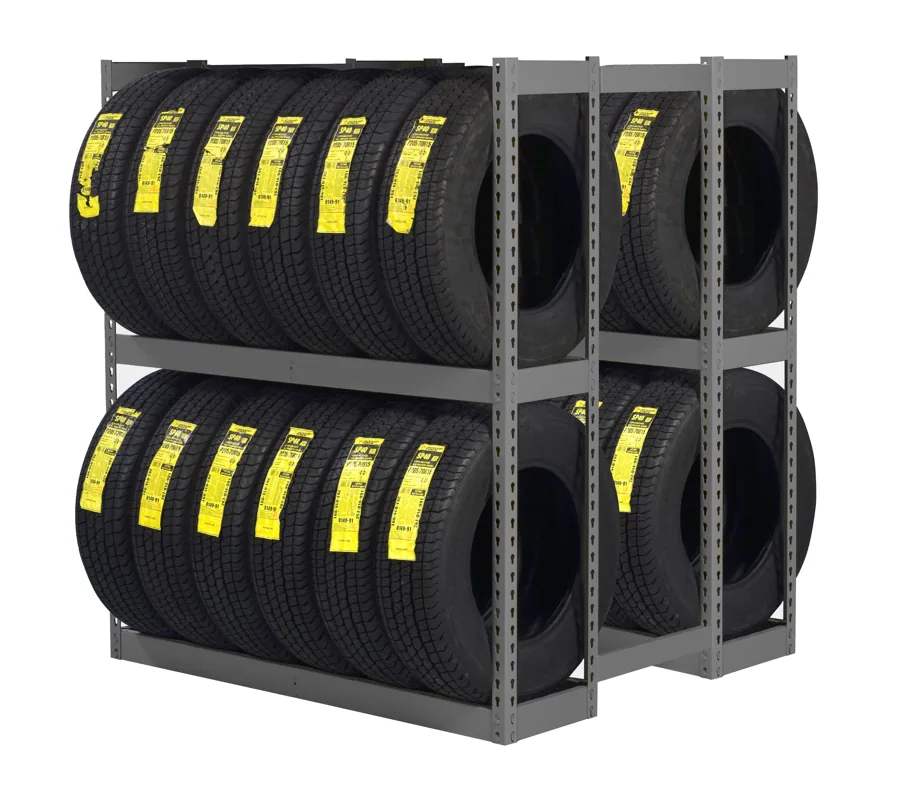
We do not sell wall-mount tire brackets online. These are the genuine tire racks in our store; single-entry units load from one face and stand against a wall, which is the usual upgrade from a wall rack. Prices are current store prices for the lowest-priced in-stock starter unit in each line; some common sizes are in stock at select manufacturers, subject to confirmation.


When a wall-mount tire rack is the right call
Small counts, tight floors, tires you rarely touch
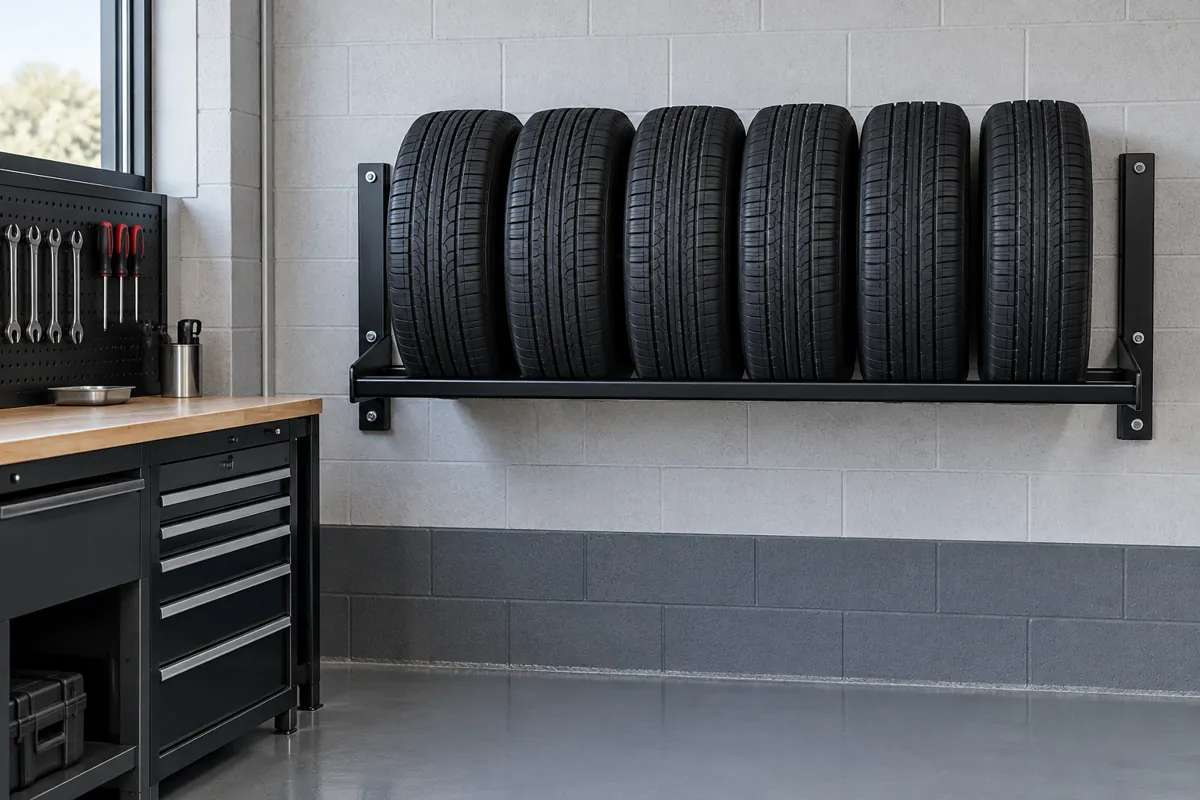
A wall-mount tire rack is a pair of brackets with support arms that hold one row of tires off the floor. It needs no floor space at all, which is why it is popular in home garages and one-bay shops.
In a commercial setting it earns its place for a handful of tires: a loaner set, the shop’s own spares, a customer set waiting for a lift, or tires parked above a workbench where nothing else fits.
It is not built for retail stock or seasonal storage. One row per wall, a ceiling on weight and the need for a strong wall all cap it early.
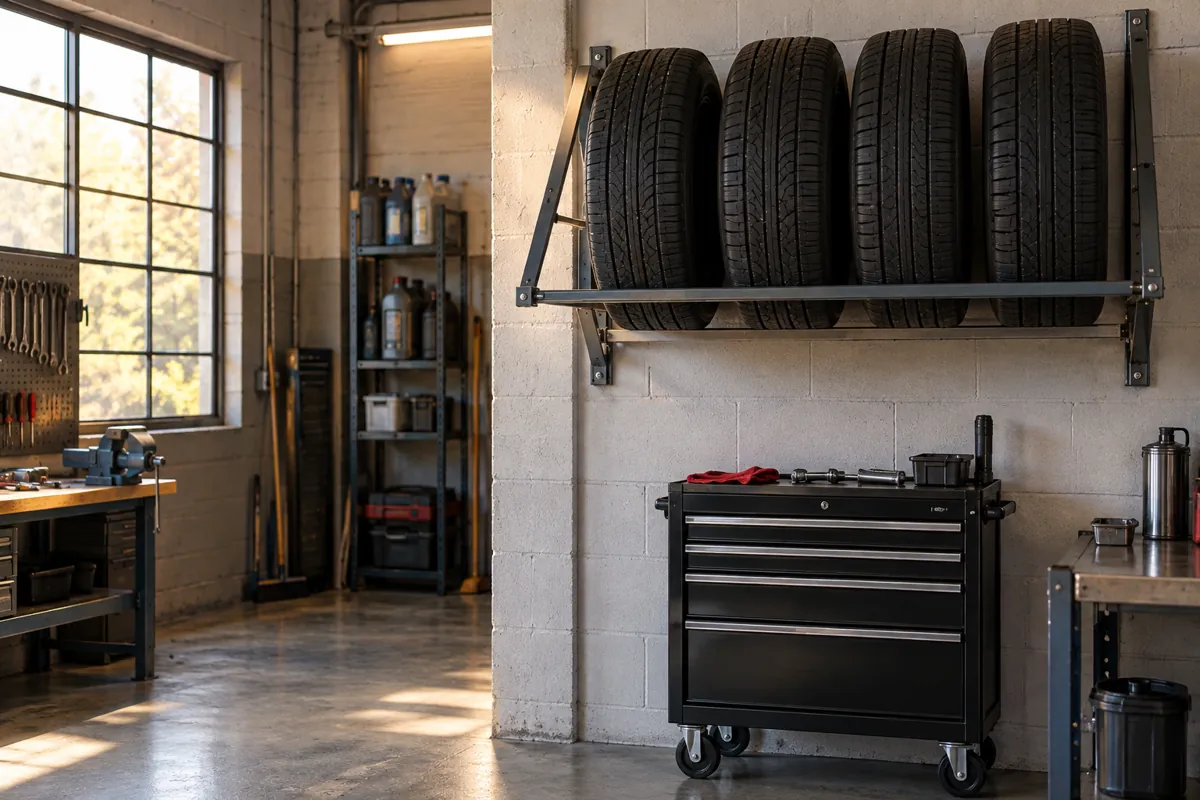
- Good fit: under a couple of dozen tires, a free stretch of strong wall, floor space that has to stay clear for a lift, a door swing or a walkway.
- Poor fit: growing retail inventory, customer seasonal sets, mounted assemblies in volume, light truck and commercial tires, or a wall made of metal panels or light partitions.
Wall-mount tire racks vs. tire shelving, side by side
Most buyers are really choosing between four formats. The hub’s shelving vs. wall-mount summary gives the short answer; here is the detail.
| Wall-mount rack | Wall-side tire shelving (single-entry) | Freestanding double-entry | Mobile tire rack | |
|---|---|---|---|---|
| Floor space | None | About the depth of one tire | Depth plus an aisle on each side | Its footprint, wherever it is parked |
| Levels | Usually one row | Several levels to the height you choose | Several levels, both faces | Usually two or three, kept low |
| What carries the load | The wall and its fasteners | The floor (anchored per the maker; wall tie optional) | The floor | Casters on the floor |
| Best for | A few spares or loaners | Stock and sets along a wall | Center-of-room storage | Moving sets between bays |
| Grows by | Another bracket, if wall allows | Adding add-on bays to the run | Adding bays | Another cart |
| Watch for | Wall construction, weight rating | Anchoring, top-of-storage height | Aisle width, anchoring | Stability, parking out of aisles |
Wall-side shelving is the format most shops overlook. It keeps the floor nearly as clear as a wall rack, because it is only about one tire deep, but it stands on the floor and stacks several levels high. For rooms that need tires picked from both sides, see high-density tire storage racks; for moving sets around the shop, mobile and rolling tire racks.
Is your wall up to it?
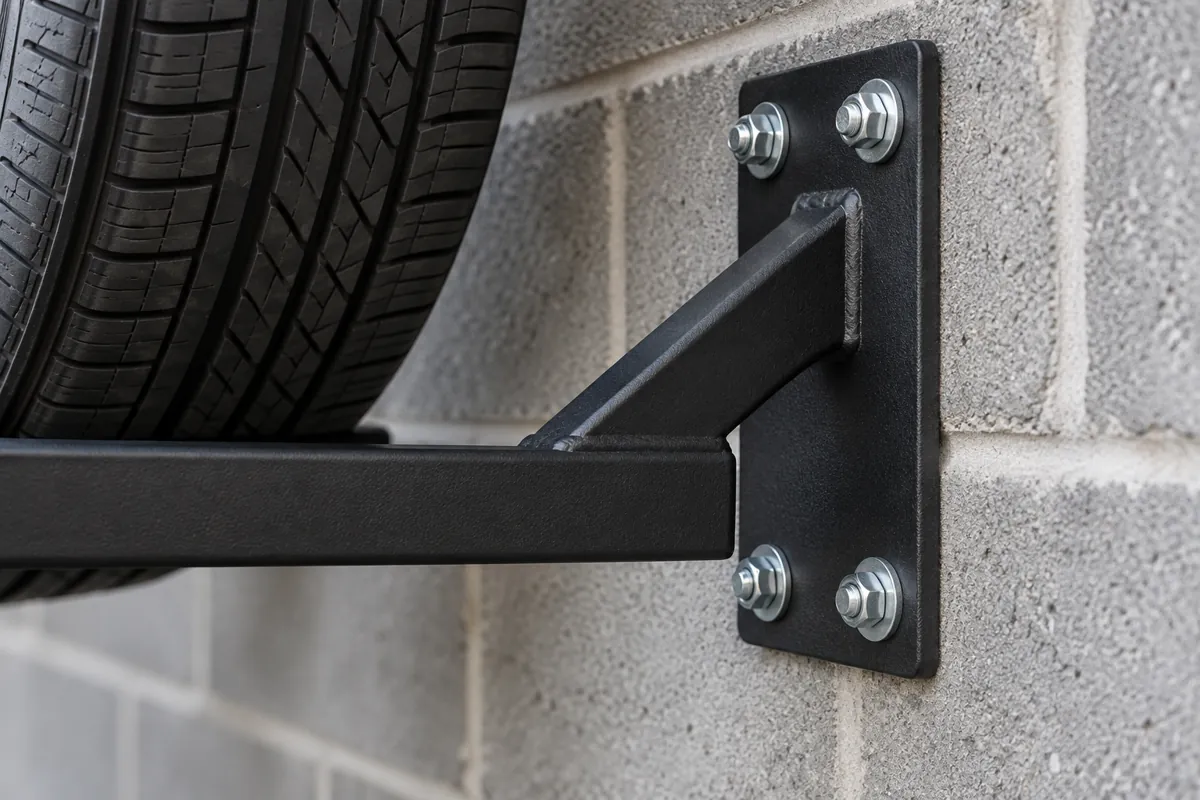
The wall is the rack’s foundation
A wall-mount tire rack is only as strong as what it is fastened to. Before buying, find out what the wall is:
Concrete or filled masonry can usually take anchored brackets, using the anchors the rack maker specifies. Wood or steel stud walls need fasteners into the framing, not the sheathing. Metal panel and light partition walls, common in pre-engineered shop buildings, generally cannot take tire loads at all.
When in doubt, ask whoever maintains the building. A rack pulling out of a wall drops its tires on whoever is underneath.
- Use the rack maker’s weight rating and fastening instructions; do not improvise anchors.
- Keep loaded wall racks out of door swings, lift arms and walkways, and high enough to clear heads.
- Do not mount above electrical panels, heaters or hot pipes, and keep tires away from sunlit windows.
- Store unmounted tires cradled on the tread, not hung from a single peg.
Capacity: tires per foot of wall
The quickest way to compare formats is to count tires per foot of wall. Passenger tire section widths run from roughly 195 to 275 millimeters, about 8 to 11 inches, so a foot of shelf holds a little over one passenger tire standing on its tread. Light truck tires are wider and hold fewer.
| Same 8-foot stretch of wall | Levels | Approximate passenger tires |
|---|---|---|
| One wall-mount rack row | 1 | About 8 to 12 |
| Wall-side shelving, 3 levels | 3 | About 24 to 36 |
| Wall-side shelving, 4 levels | 4 | About 32 to 48 |
These are planning numbers, not ratings: real capacity depends on your tire sizes, the level heights and the rated load of each level. Mounted assemblies and light truck tires change the weight per level sharply, which matters even more on a wall rack where the wall carries it all. For the full set of capacity levers, see high-density tire storage; for heavy casings, heavy-duty truck tire racks.
Count bays, not guesses: try the Tire Rack Builder
Wall racks run out of room fast. Enter your tire count and sizes and the builder shows how many bays of tire shelving or pallet-rack tire rack the same tires need, with the run length against your wall. Final pricing is quoted.
Wall-side tire shelving: the usual upgrade
Wall-rack footprint, shelving capacity
When a shop outgrows its wall racks, the next step is usually a run of shallow tire shelving standing against that same wall. Single-entry units are loaded and picked from one face, so the back can sit close to the wall.
The floor carries the load, so the wall only has to be a wall. Where the maker’s instructions call for a wall tie, it adds stability; it does not replace floor anchors.
Starter-and-add-on bays let the run grow one section at a time. Our tire shop storage racks page covers sizing for a working back room.
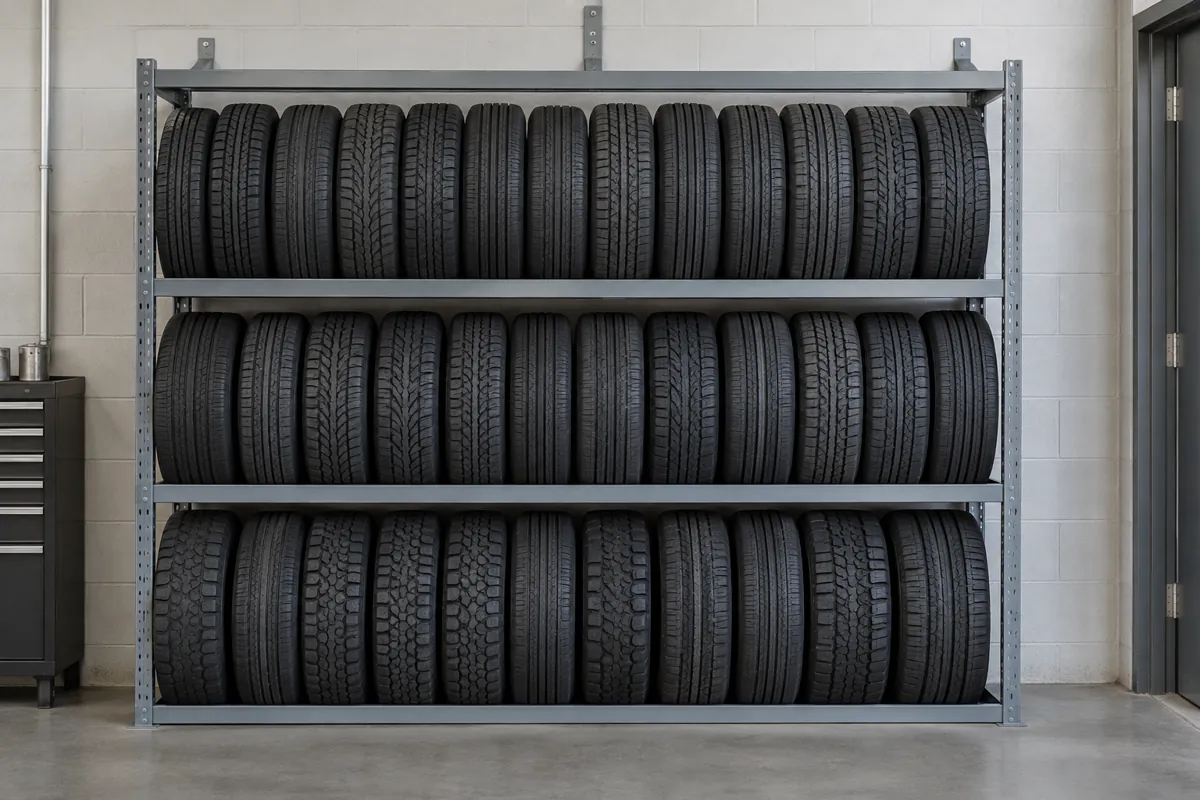
Set level heights from the largest tire you carry, keep the top of storage within what your building and fire code allow, and keep the aisle in front clear. In Utah, our tire rack installation, anchoring and permits guide covers when tall shelving needs a permit. For the storage basics that apply to any format, read how to store tires properly.
Layouts that replace wall racks
 Full-length wall runContinuous tire shelving along the longest wall, the room’s center left open for work and carts.
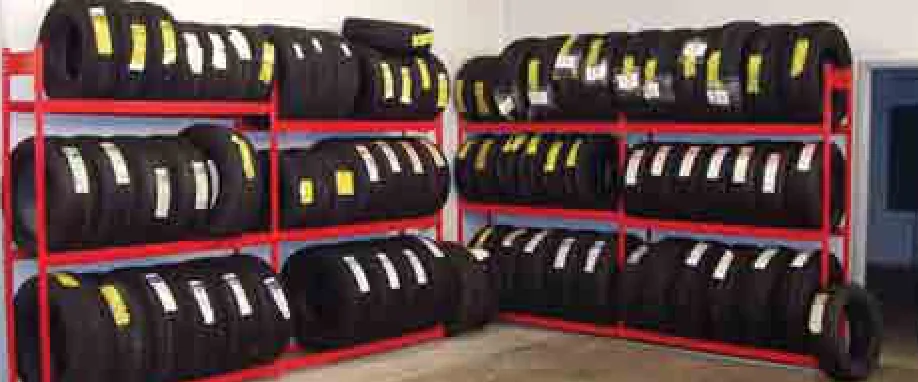
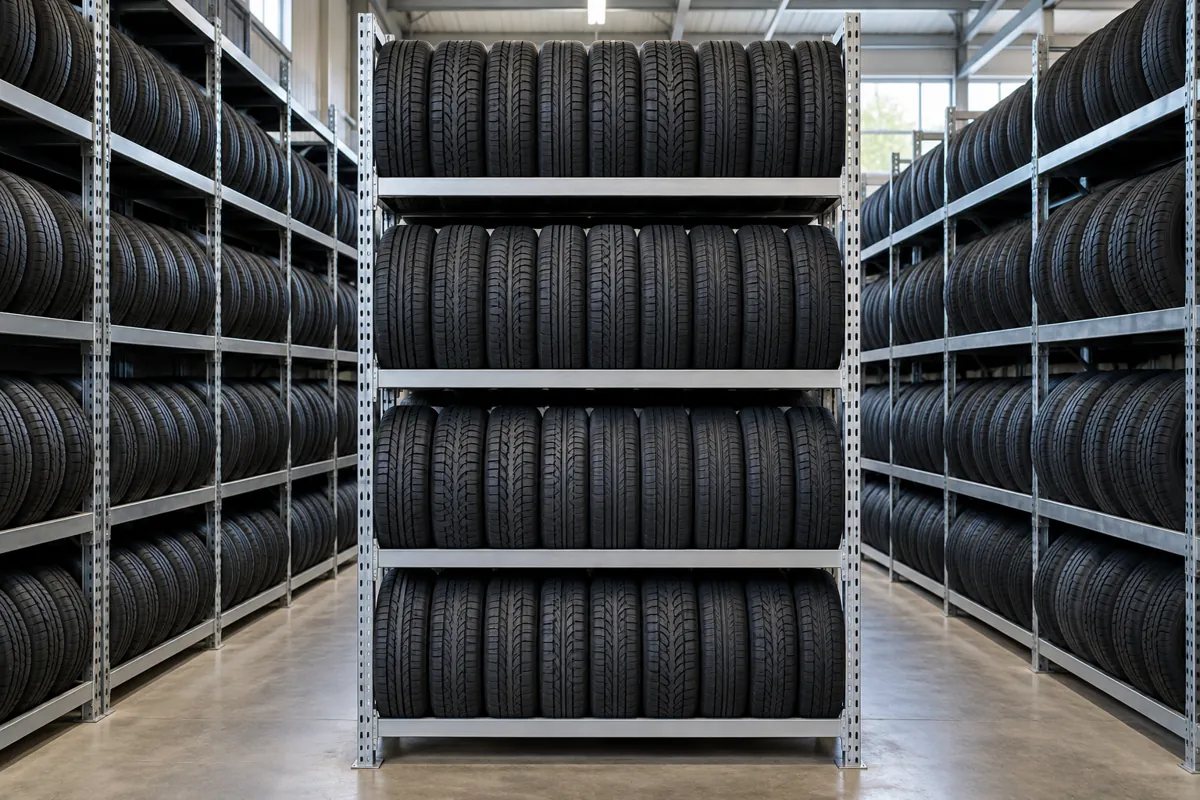 Double-entry center rowsRacks reachable from both aisles for rooms that need more capacity than the walls give.
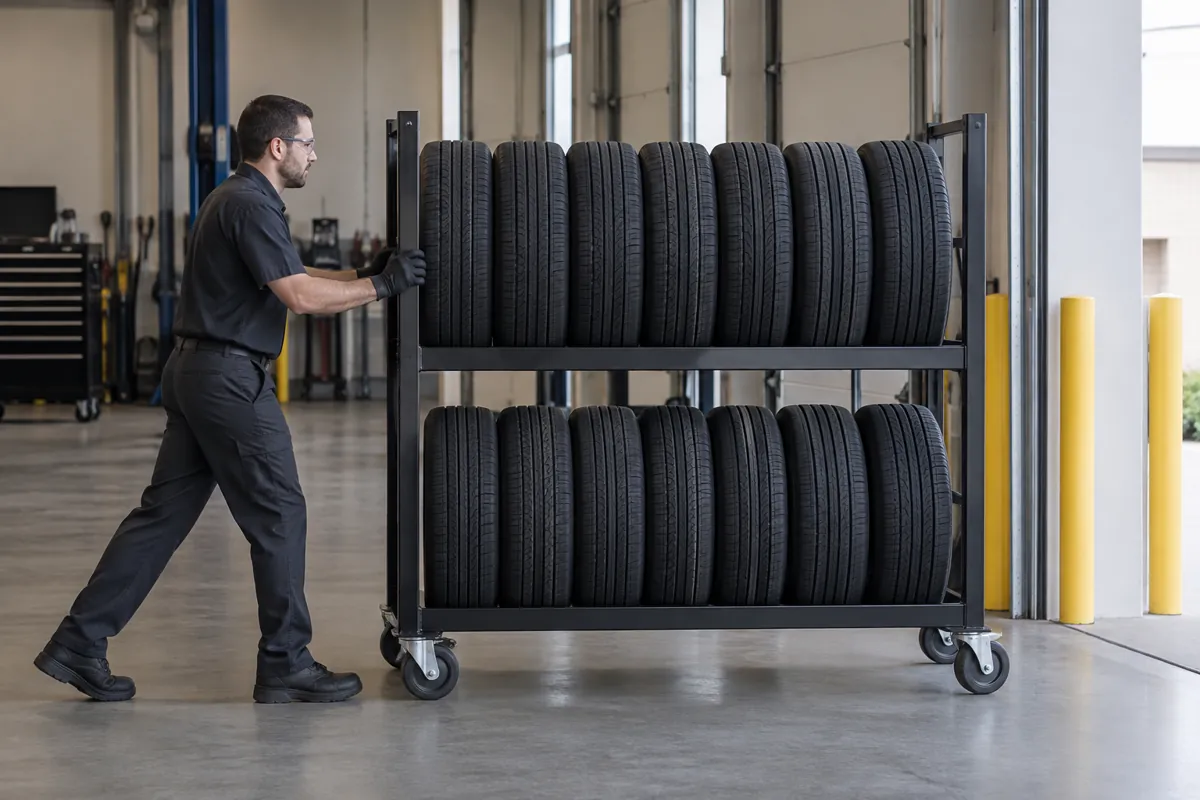 Mobile racks at the baysSets roll to the lift and back to storage; kept low and parked out of the aisle.
Dealerships combine all three with seasonal storage rooms; see dealership tire storage. Quick-lube and service stations usually need one wall run and a cart; see service station and quick-lube tire storage. Bigger rooms move to decked pallet rack, compared on the commercial tire storage racking hub.
Wall-mount or shelving? A quick decision list
Outgrowing your wall racks?
Send the wall length, ceiling height and how many tires you hold by size. We will tell you how much a shelving run on that wall can hold and quote it.
Get a free quote
Tell us what you are storing, the room size and your timeline. A project specialist will follow up with layout options and pricing. Prefer to talk? Call (800) 326-4403.
Wall-mount tire rack FAQs
Are wall-mount tire racks strong enough for a shop?
How many tires fit on a wall-mount tire rack?
Do you sell wall-mount tire racks?
What is the difference between single-entry and double-entry tire racks?
Should tire shelving be fastened to the wall?
Can I hang unmounted tires on wall pegs?
Is wall-mount or floor shelving better for a dealership?
Do wall-mount tire racks need a permit?
Need more tire storage than a wall rack gives?
Tell us the wall, the room and the tire mix, and we will recommend and quote the right tire racks. Call 800-326-4403.