Your yard is full, the next truck is already on the schedule, and the rack quote still looks like a catalog page. That is the usual spot for a West Valley City buyer who stores steel, lumber, pipe, block, rebar, and bagged goods in the same Salt Lake Valley yard. Operations wants picks to stay fast. Maintenance wants uprights that survive forklifts. Procurement needs a number that matches actual loads.
Construction supply yard racking West Valley City starts with the material, not the pallet count. Measure what arrives, how it sits, and which truck moves it. Then shortlist two rack types and send those notes for a layout review.
Rack Options That Fit a Construction Supply Yard
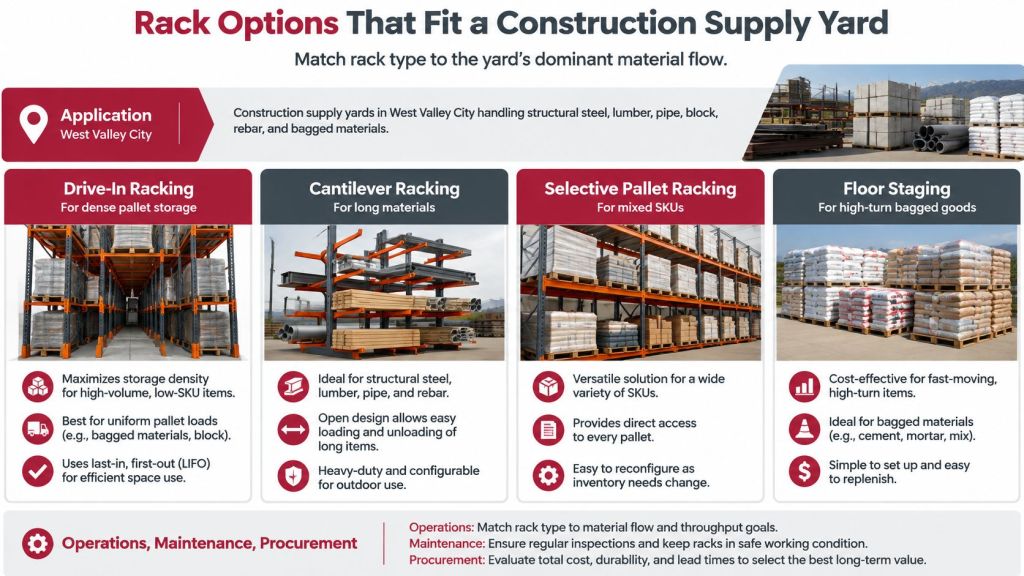
West Valley City yards rarely store one neat pallet size. Structural steel, lumber, pipe, block, rebar, and bagged materials share the same aisles. Pick the rack from the dominant material first. Use pallet count only after that choice is clear.
| Configuration | Best Fit | Access and Density | Main Trade-Off |
|---|---|---|---|
| Selective pallet rack | Mixed SKUs and frequent picking | Every pallet reachable, lower density | Needs wide aisles for forklift travel |
| Drive-in or drive-through rack | Large volumes of one product | High density, last in first out access | Forklifts enter bays, higher impact risk to uprights |
| Push-back rack | Medium volumes, several pallets per lane | Good density, last in first out access | Carts and rails add cost and need regular inspection |
| Cantilever rack | Long, bulky or irregular materials such as pipe and lumber | Open arms, no pallets required | Load limits and arm bracing must be engineered |
| Double-deep rack | Dense storage with fewer aisles | Two pallets deep per bay, reach truck needed | Slower retrieval for the rear pallet |
Selective pallet rack keeps every pallet open. It fits mixed SKUs and steady picks. Density is lower, and the forklift needs a full turning aisle.
Drive-in or drive-through rack packs one product deep. Density is high. The forklift drives into the bay, so upright hits are more likely. Drive-through gives a second exit when the lane must empty from both ends.
Push-back rack holds several pallets in one lane on carts and rails. Density is good, and the face pallet stays reachable. Those moving parts need regular checks, and the lane is last in, first out.
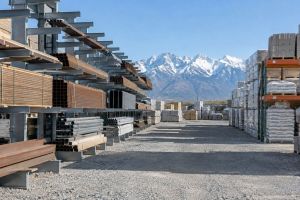
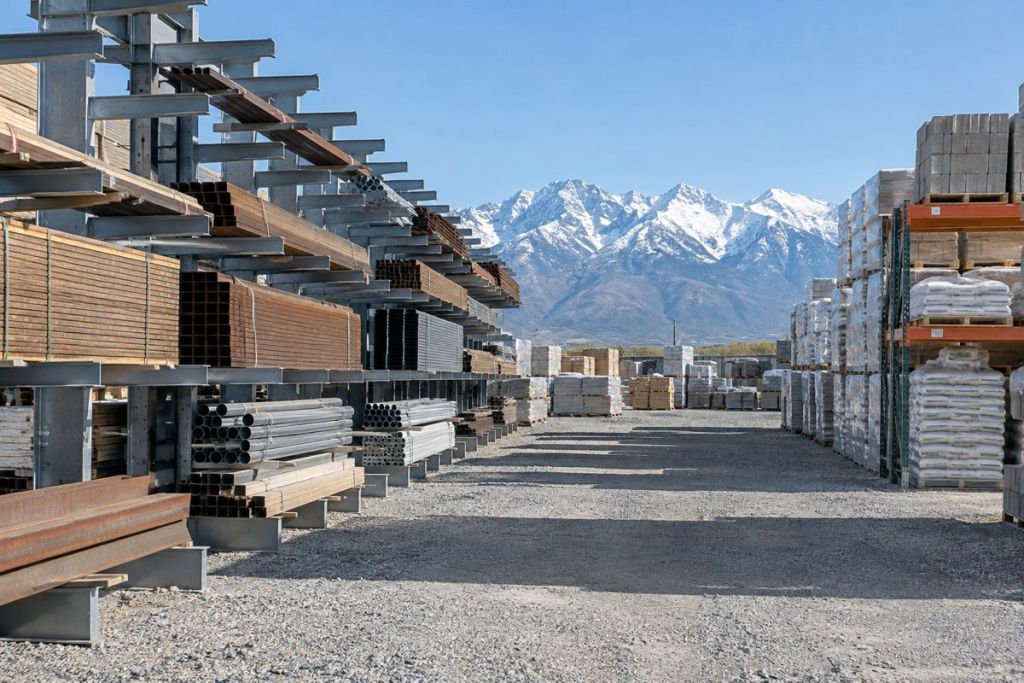
Cantilever rack is the long-stock choice. Open arms hold pipe and lumber without pallets. Arms, bracing, and posted limits have to be engineered for the bundle, not guessed from a catalog. A building materials yard cantilever rack layout shows how arms are set for that kind of stock.
Double-deep rack stores two pallets per bay and cuts aisle count. You need a reach truck. The rear pallet is slower to pull, so it should be the slower mover.
Practical rule: Match the rack to the material that takes the most space or the most picks. Then shortlist a second option only if the first one fails the forklift path.
Floor staging still belongs in the plan for high-turn bagged goods that should not sit in a deep lane. Some common rack sizes are stocked at select manufacturers, subject to confirmation.
Materials That Drive the Rack Choice
Start with an inventory sheet, not a rack catalog. List every material with weight, length, bundle size, and how it arrives.
The customer mix around a West Valley City yard is broader than house builders. In 2023, construction employed 55,407 people statewide, and construction was 6.8% of employment in the Wasatch Front South labor market, which includes the Salt Lake Valley, according to the Utah Department of Workforce Services construction brief. Nonresidential work on that same brief grew faster than construction overall, and those jobs bring larger bundles and longer staging.
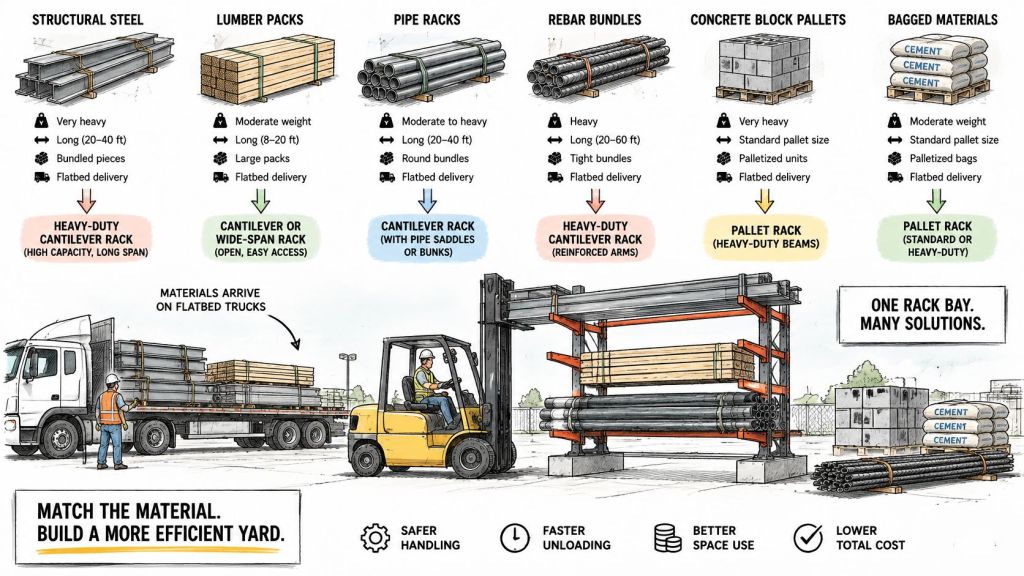
- Block and brick: Selective or double-deep rack works when each beam level has a load plaque that matches the pallet weight.
- Rebar and pipe: Use cantilever arms or cradles with backstops so a bundle cannot roll into the aisle.
- Mixed lumber: Cantilever storage needs a posted length limit on each arm.
- Bagged goods: Keep them dry, covered, and away from stock that fails when it gets wet.
- Fasteners: Bins on shelving beat a pallet position for small hardware.
- Packaged chemicals: Give them a segregated spot and treat hazard communication as part of the location choice.
A one-product yard can test drive-in or push-back first. A many-SKU yard with frequent picks usually needs selective rack. Most mixed yards need both, one run for pallets and one for long stock.
Sizing, Layout and Traffic Checks Before You Order
A scaled plan beats a pallet-position guess. OSHA warehousing guidance says employers must stack loose material so it cannot fall, keep storage clear of trip and fire hazards, and not exceed shelving or rack capacity, as stated in OSHA warehousing hazard solutions. That is why each beam level needs its own plaque.

- Map the trucks. Record forklift type, turning radius, dock approaches, and semitrailer paths. A tight corner is where uprights get hit. The common miss is measuring the straight aisle and ignoring the dock turn.
- Measure each load. Capture length, width, height, bundle weight, and pallet or cradle size. A "standard pallet" note hides the long bundle that will not fit the bay.
- Set aisle width and post the limit. Put clearance signs at aisle ends so a staged bundle does not become the new aisle edge.
- Confirm capacity by beam level. A plaque for the whole frame does not cover a heavier top beam. Heavier bundles belong on the level that was rated for them.
- Separate people from trucks. Mark walk routes and add end protection where trucks approach. Pedestrian paint with no guard still fails on the first missed turn. Teams that explore safe movement on construction sites treat routes and equipment paths as one plan.
- Cap height on unstable stock. Long goods need a maximum height plus backstops or decking. Stacking until the bundle looks stable is not a limit.
- Inspect on a schedule. Check bent frames, shifted beams, missing anchors, and overloaded bays. Unload and isolate a damaged bay the same day. Outdoor bays also need a look after snow, not only after a crash.
Undersized turns raise collision odds. A hit can bend an upright and cut the capacity you thought you bought.
Send a scaled plan with aisle widths, equipment paths, dock approaches, pedestrian routes, and maximum load heights. A pallet rack design review can turn those measurements into a layout before you order steel.
Permits and Documents West Valley City Projects Need
Most yard rack is tall enough to need a permit conversation before you buy it. Salt Lake City racking permit guidance requires a building permit for storage racks over 5 feet 9 inches high. That city is a regional benchmark, not your permit office. West Valley City adopts the International Building Code, with state amendments, inside city limits. Confirm the edition the city is using before you order.
Documents to gather
- Dimensioned racking plan: Rack types, heights, and aisle widths.
- Commodity description: What you store and how it is packaged or secured.
- Stamped structural set: Plans and calculations from a Utah-licensed structural engineer.
- Seismic note: The Salt Lake City benchmark requires seismic design of storage racks under ASCE 7-22.
- Inspection note: That same guidance subjects storage racks to special inspection under IBC 1705.13.7.
The rack package has to meet the site. Include slab condition, base plates, anchors, and clearances from sprinklers, lights, exits, and doors. A project that disturbs one acre or more can also need stormwater permits. Catalog capacity does not replace that package.
Have a qualified structural professional check seismic design and anchorage before the purchase order. A Utah pallet rack permit and engineering example shows how design and permitting sit in the same project, not after the steel arrives.
Outdoor Yard Loads From Wind, Snow and Seismic Design
An outdoor rack frame carries wind, snow, and seismic loads the same way a building frame does. West Valley City building design criteria publish the values in the table and point designers to IBC Chapter 16.
| Design Criterion | West Valley City Value | Effect on Yard Racking |
|---|---|---|
| Wind speed, Category II structures | 103 mph | Sets lateral load on tall rack and outdoor frames |
| Winter design temperature | 8°F | Informs cold-weather material and anchor planning |
| Frost line | 30 inches | Relevant to footings and any anchor or foundation work |
| Seismic Design Category | D | Drives seismic anchorage and bracing design |
| Structural reference | IBC Chapter 16 | Sets the structural requirements the rack design must meet |
103 mph wind is a lateral load on tall columns, cantilever arms, and any canopy. Put 8°F winter design temperature into anchor and material planning, not just a comfort note. A 30-inch frost line matters wherever a footing or anchor enters the ground. Seismic Design Category D drives bracing and anchorage. Indoor-rated steel can look serviceable and still miss wind, snow, seismic force, corrosion, drainage, and anchor performance.
Ground snow load is measured as a pressure in pounds per square foot, so the exact value for the structure must come from West Valley City before roof and frame design. Snow load drives the roof and frame design. Long steel, pipe, lumber, and masonry create high overturning loads. Keep heavy stock low and wide. Where roof edges shed snow onto a yard canopy, some sites browse exposed fastener panel snow guards as part of the roof assembly. That product does not replace the rack load case.
After snow season, inspect anchors and frames. Separate moisture-sensitive goods. Guard end uprights where trucks turn. Call a structural engineer when a frame or slab is damaged. Denser rack shortens travel. It can also slow recovery and raise impact damage when aisles, staging, and emergency access are not drawn together.
The engineer needs wind, snow, and seismic criteria, exposure, corrosion plan, drainage, anchor and slab details, and the overturning case for the longest and heaviest bundles.
Decision Guide for Common Buyer Scenarios
Use the table as a starting point, not a stamped design. Match the material you move most. Then send the items in the third column.

| Buyer Scenario | Starting Configuration | Send With Your Request |
|---|---|---|
| Single-product lumber or block yard with steady forklift turnover | Selective or double-deep, based on pallet count | Pallet dimensions, weights and turnover rate |
| Pipe, rebar or long-stock yard | Cantilever arms with backstops | Lengths, bundle weights and bundle dimensions |
| High-volume uniform product yard | Drive-in or push-back | Pallets per lane and forklift type |
| Mixed materials with frequent picks | Selective with mixed bays | Aisle plan, ceiling height and dock layout |
| Outdoor or semi-enclosed expansion | Configuration set after engineering review | Site plan, exposure notes and slab details |
A steady lumber or block yard can test selective rack, or double-deep if the pallet count justifies a reach truck. Pipe and rebar start on cantilever arms with backstops. A uniform high-volume product can test drive-in or push-back once you know pallets per lane and the truck that enters the lane.
Mixed picks want selective bays, plus the aisle, height, and dock sketch. An outdoor expansion should wait for engineering before you lock a model. If two rows fit your yard, plan first for the load that is heaviest or longest.
Replacing old rack can include removal and reinstallation in the quote when you say so in the request. A layout review turns the scenario into drawings, load plaques, and the inputs a permit set needs.
Installation, Lead Time and Service Planning
Two quotes can name the same rack model and differ by five figures because only one covers the site work. A pallet rack quote can include assembly and anchoring, engineering, permit support, equipment rental, removal of existing rack, and other site work. A steel-only price will always look cheaper. Compare quotes on scope, not on the steel line.
The calendar follows one order, and it rarely compresses:
- Engineering and permit review.
- Slab and anchor verification.
- Delivery route and access check.
- Installation and anchoring.
- Inspection.
- Load plaques posted and clearances marked.
- Scheduled service inspections after the system is in use.
Steps one and two decide the date. Incomplete submittals, missing weights, or an unknown slab are among the most common causes of delay, so resolve them before a truck is booked. A catalog ship date is not an install date, and treating it as one is how a yard ends up with steel on the ground and no crew cleared to anchor it.
Steel pricing can move. In August 2025, the Producer Price Index for steel mill products increased 13.1% year over year, according to the Associated General Contractors of America's reading of Bureau of Labor Statistics data in an ENR third-quarter 2025 cost report. That figure is a 2025 index change, not today's price. An earlier quote still gives purchasing a number to test before the next revision.
What a buyer controls is the start date of the file. Send the dimensioned site plan, slab thickness and reinforcing, pallet or bundle weights, forklift type, and the load plaque data with the request, and engineering and anchor review begin immediately instead of after three rounds of questions. Starting sooner keeps an install window open, cuts the chance the yard is down in a busy construction month, and leaves room to fix slab, access, or permit issues before they become a change order. No fixed week count holds across sites. The review set and the site set the date.
Frequently Asked Questions
Does every yard rack need a permit?
Racks over 5 feet 9 inches need a building permit in the Salt Lake City benchmark. Confirm the West Valley City rule, and the code edition, before you buy. Shorter storage can still need a review if anchors, fire access, or the building are involved.
Can standard indoor rack go outside?
Not as a straight move. Outdoor use needs an engineered load case for wind, snow, seismic force, corrosion, drainage, and anchors. Indoor capacity ratings do not cover that case.
Which configuration suits pipe and rebar?
Cantilever arms with backstops are the usual start. Send lengths, bundle weights, and bundle size so arm limits can be set before anyone quotes a bay count.
Who stamps the rack design?
A Utah-licensed structural engineer stamps the structural plans and calculations. You still confirm with West Valley City which edition and which inspections apply to your site.
Does a quote cost anything?
Material Handling USA offers a free pallet rack quote, and a layout can be prepared with no obligation once the load and building facts are in. You are not buying steel by asking for the drawing.
How early should a request go out?
Early enough to clear permits and slab questions before the install window you want. Engineering and anchor checks, not the delivery truck, usually hold the date.
Can existing rack be replaced?
Yes. Removal and reinstallation can sit in the same quote if the request says the old system has to come out. Leave that line off and the price will not include it.
What is the most common planning mistake?
Sizing from pallet count and skipping forklift turning paths. The second miss is one load plaque for a whole bay instead of a limit on each beam level.
Request a Layout Review and Quote for Your Yard
Construction supply yard racking West Valley City comes down to four decisions. Choose the rack from the material. Measure loads and forklift traffic. Gather the permit documents. Plan the outdoor load case before you order.
We lay out the system and quote it with you after we have pallet or load sizes, ceiling height, and forklift type. Add outdoor exposure notes if the frame is not fully inside. Pallet rack services include design, permitting, and installation, and the quote itself is free.
Send this with the request:
- A scaled site plan with aisles, dock approaches, and pedestrian routes.
- A load sheet with weights, lengths, and bundle sizes.
- Forklift type and turning radius.
- Slab and anchor details, if you have them.
- Intended rack heights and any expansion you already expect.
Local context sits on the West Valley City pallet rack page. Early planning keeps install windows open and reduces schedule slips while reviews are still on paper. Request a Quote or Contact Us. Call (800) 326-4403 or email Sales@MH-USA.com.
Material Handling USA designs and supplies rack for the loads a construction yard moves, then quotes the layout from your sizes, height, and forklift. If you are sorting construction supply yard racking in West Valley City, a free layout review is the cleanest next step before steel is ordered. Visit Material Handling USA to start that review.