
Home › Laboratory Material Handling Solutions
Laboratory Material Handling Solutions
Storage, transport and workflow equipment for clinical, research, pharmaceutical, analytical and testing labs — shelving, casework, carts, cold-room storage, high-density systems and cleanroom entry. Specified, quoted and installed by MH-USA. We represent Eagle Group and its Eagle MHC division.
1997
Serving labs in the West
1947
Eagle Group founded
304/316
Stainless specified
50
States shipped
Laboratories Are a Logistics Problem With Science on Top

Every laboratory is judged on what happens at the bench, and almost every laboratory loses time somewhere else: a reagent three rooms away, a storeroom where the aisle is the only staging space, a cold room where boxes sit on the floor. Instruments get specified carefully; the storage around them gets the leftover budget, and the lab lives with it for fifteen years.
MH-USA approaches a lab as a flow: material arrives, is staged, is stored at the right temperature and height, moves to the point of use, and leaves as product, waste or archived samples. Our job is the infrastructure that carries it — shelving, casework, work surfaces, carts, high-density storage, gowning equipment, sinks and waste handling — chosen for the chemistry, cleaning regime and traffic of your rooms.
We represent Eagle Group, founded in 1947 in Clayton, Delaware, and its Eagle MHC division — stainless inset casework, cleanroom tables, gowning equipment, lab sinks, countertops and a deep catalog of wire, solid and polymer shelving. One schedule, one submittal set and one freight coordination instead of five vendors blaming each other when a bench lands two inches long.
Laboratory Types We Equip
The word “lab” covers rooms with almost nothing in common: a hospital core lab runs 24 hours; a teaching lab is empty three months a year and abused for nine; a pharmaceutical suite is a controlled environment where a wrong finish is a deviation. Here is how the storage problem changes by lab type.
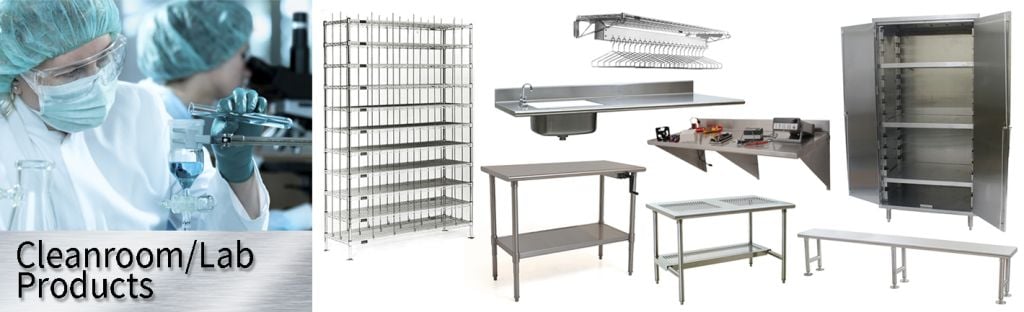
 Clinical & Hospital LabsCore lab, chemistry, hematology, microbiology and pathology: high specimen throughput, continuous reagent replenishment and a constant fight for storage in a room sized a decade ago. Wire shelving on mobile kits, secure modules and carts that survive 24-hour use.
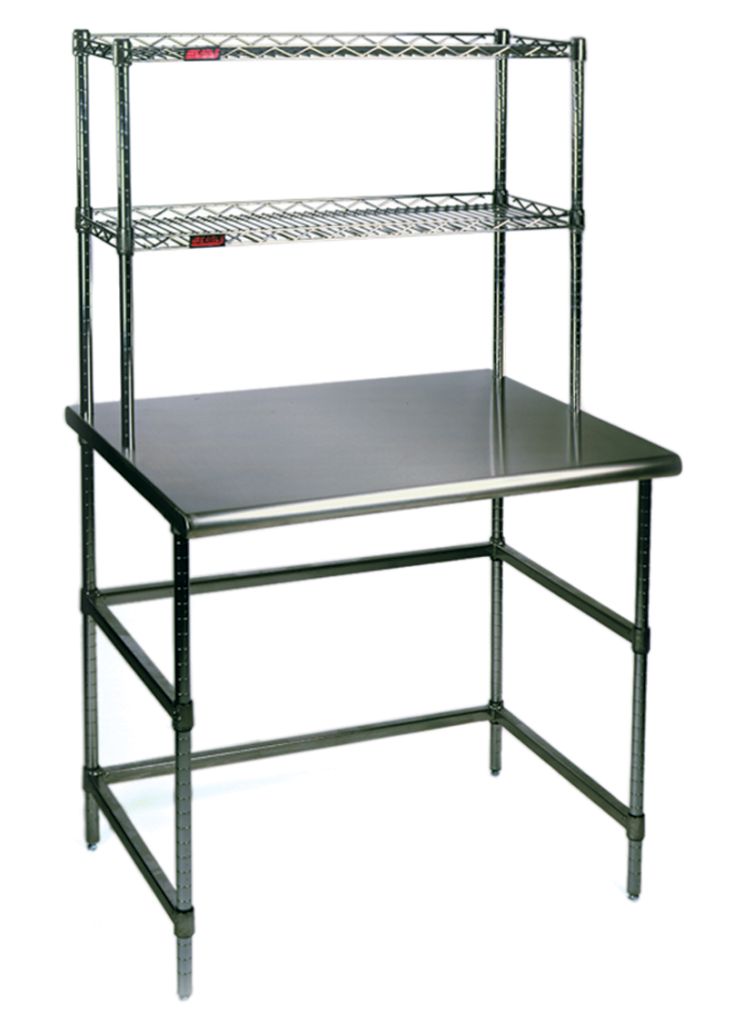 Research & University LabsPI labs, core facilities and teaching labs. Layouts change with the grant cycle, so height-adjustable work surfaces, reconfigurable overshelves and shelving that moves without a contractor beat a perfect first-day layout.
 Pharmaceutical & BiotechCompounding, formulation, fill-finish support and QC: controlled environments, documented cleaning, laminar flow and electropolished stainless surfaces. Gowning and material transfer are part of the design, not an afterthought.
 Analytical & QC LabsInstrument-heavy rooms where the storage problem is standards, solvents, columns and consumables, and where bench vibration and chemical resistance drive the specification.
 Cannabis, Food & Environmental TestingHigh-volume intake with chain-of-custody, retention that grows forever, gowning for processing areas, and stainless surfaces that take daily sanitation chemistry.
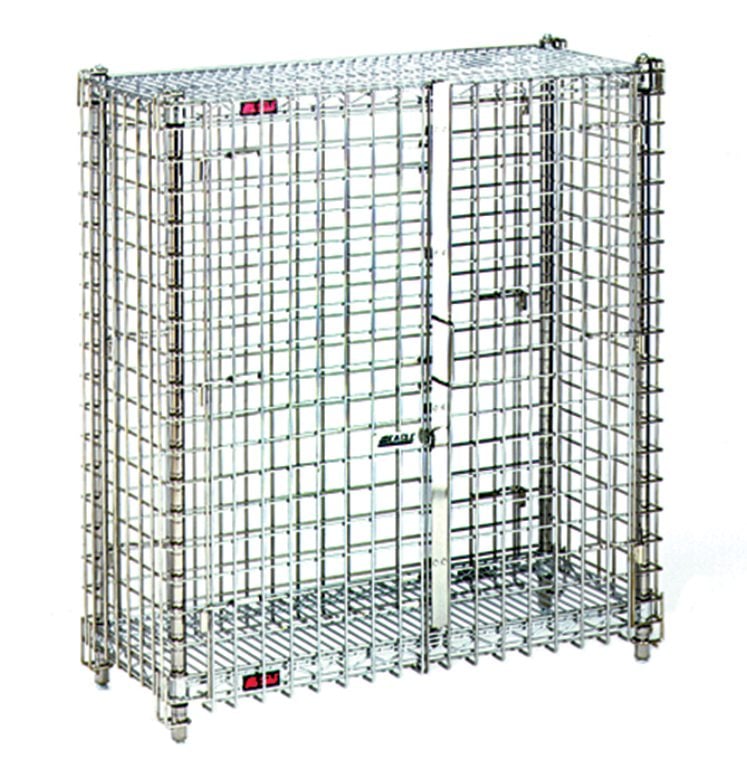 Forensic & Evidence LabsStorage where access control is the specification: lockable modules and cabinets, evidence shelving and layouts that keep custody chains short and visible.
The Lab Material Handling Workflow, End to End
Before anyone picks a product, map the material path. Nearly every storage complaint we are asked to fix is a sequencing problem: something is stored where it is not used, or staged where people walk. Each step below has a matching equipment decision.
Receiving, Bulk Storage and the Room Nobody Planned
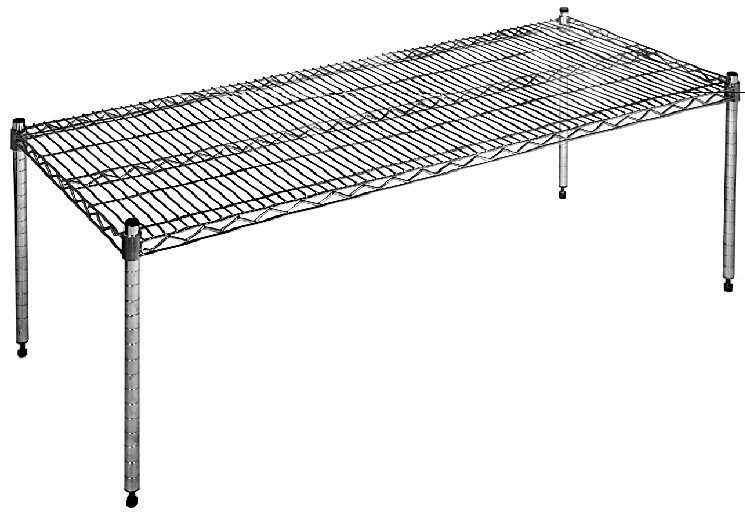
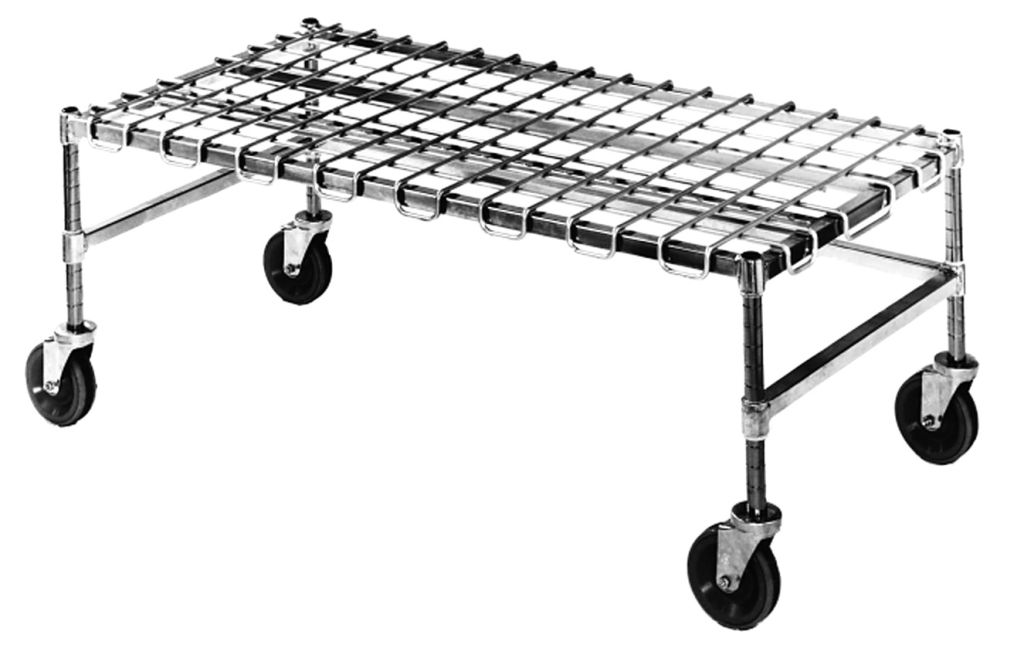
Lab receiving areas are almost always undersized, and the compensating behavior is predictable: cases on the floor. That is a cleaning problem, a moisture problem and — in an audited environment — a finding waiting to happen. Dunnage platforms and racks get bulk cases 14 inches off the floor on grooved posts with a three-sided frame supporting maximum load, and open wire lets air move so moisture does not sit under a carton. Mobile versions add four 5-inch casters, two braked, so the bulk position rolls out for cleaning.
Above the dunnage line, the decision is shelf material. Wire is the default: it moves air, does not collect dust and is the cheapest adjustable capacity. Solid shelving with a raised marine edge earns its place where small vials fall through wire and spills need containing; polymer belongs where cleaning chemistry is aggressive. Because everything indexes to the same calibrated 1-inch grooved posts, one bay can carry a solid bottom shelf, wire above it and a locking module in the middle.
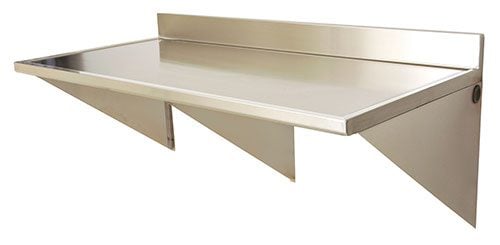
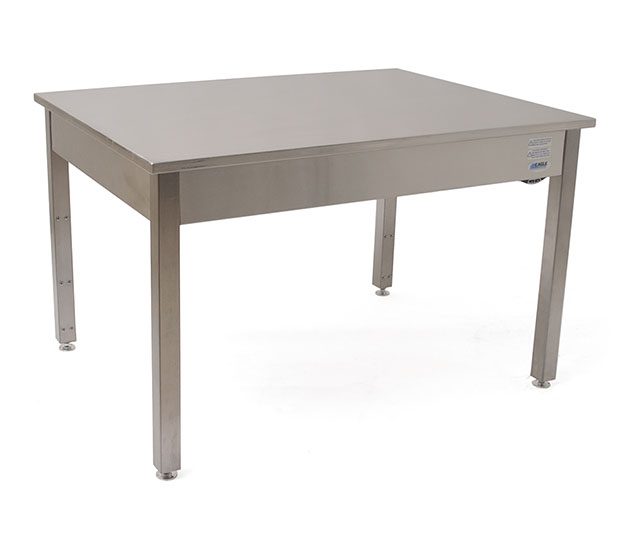
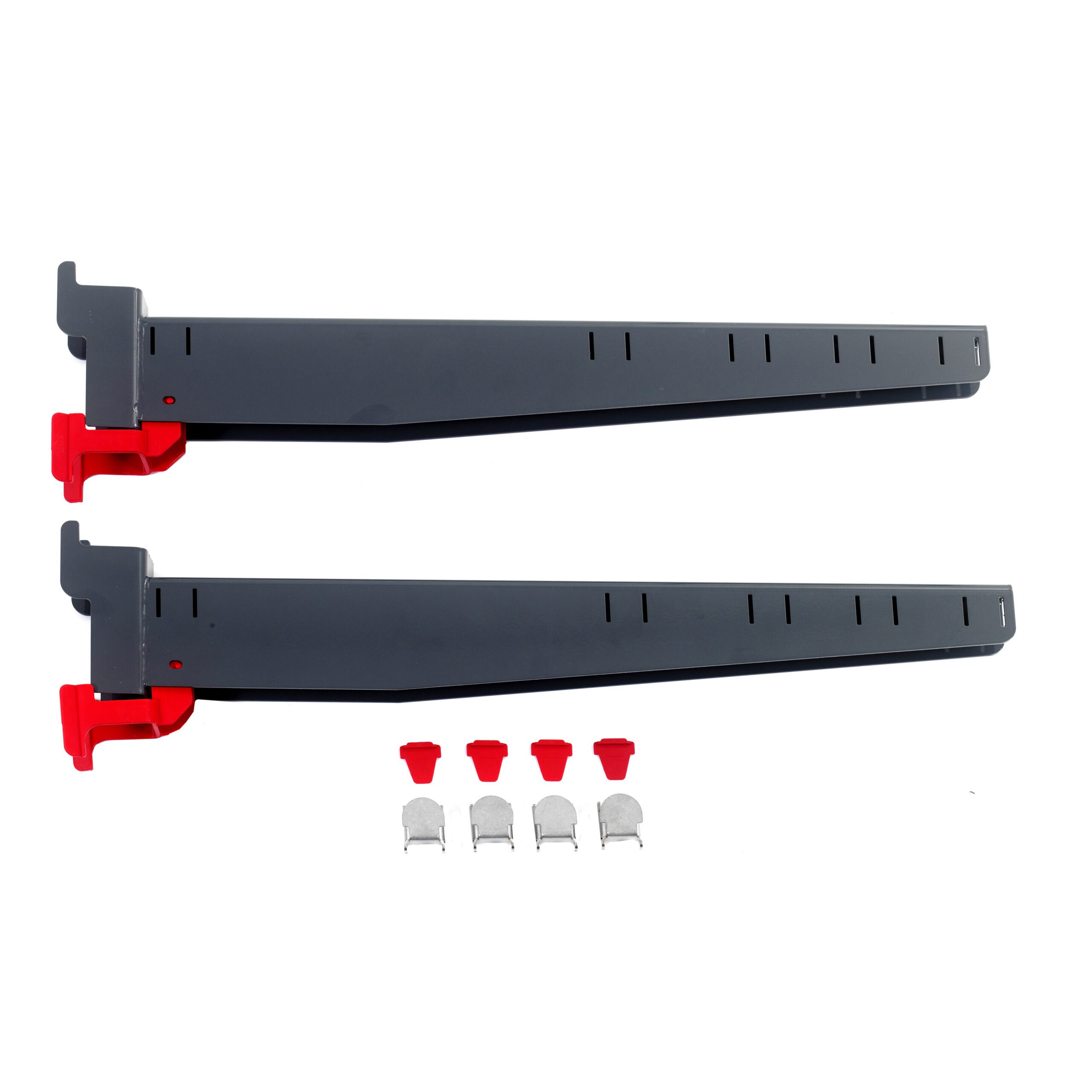
Give receiving a real work surface too — a wall-mounted stainless table with 14-gauge brackets keeps the floor clear for rolling cabinets and makes wash-down realistic. What you want to avoid is unpacking on the only bench that is also a work bench.
Where cantilever shelving wins
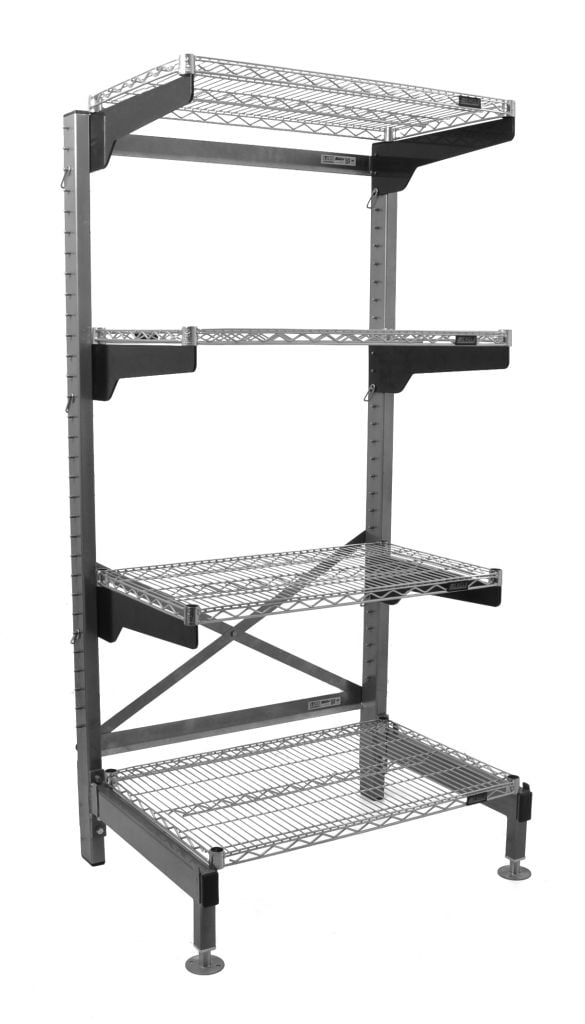
Q-LEVER cantilever shelving hangs shelves off a single 76-inch upright with no wall bolting and adjusts in 2-inch increments without tools — so you can add wall storage in a leased building where drilling is not allowed, and move it when the program changes.
Reagent, Consumable and Controlled-Item Storage
Split this problem in two. Bulk stock lives in the storeroom, is picked weekly and should be dense. Working stock sits within arm’s reach of the bench, is picked hourly and should be shallow and visible. Labs that use one solution for both either walk constantly or hoard at the bench.
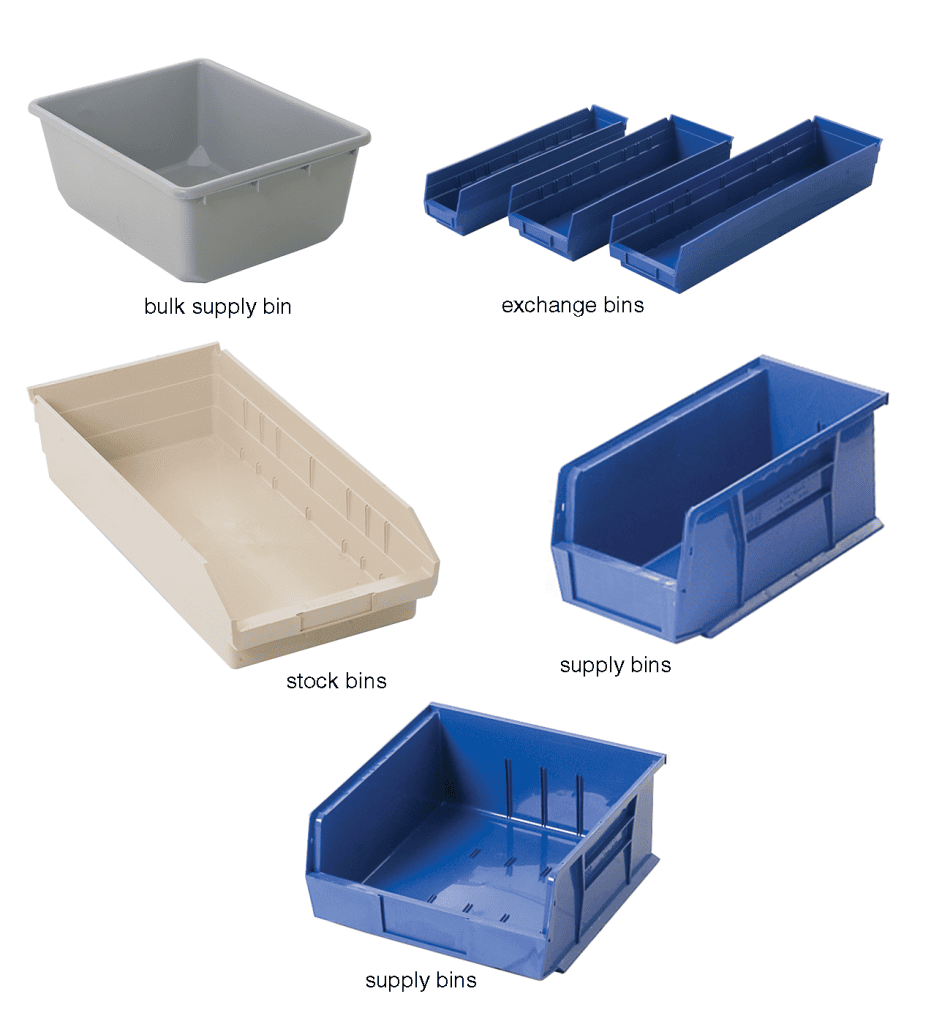
For bulk stock, depth helps: 24-inch shelves, full-height posts and stackable polypropylene bins with molded label slots that nest and divide. For working stock go shallow — 14 to 18 inches — and put it on an overshelf or wall shelf so the bench stays a bench.
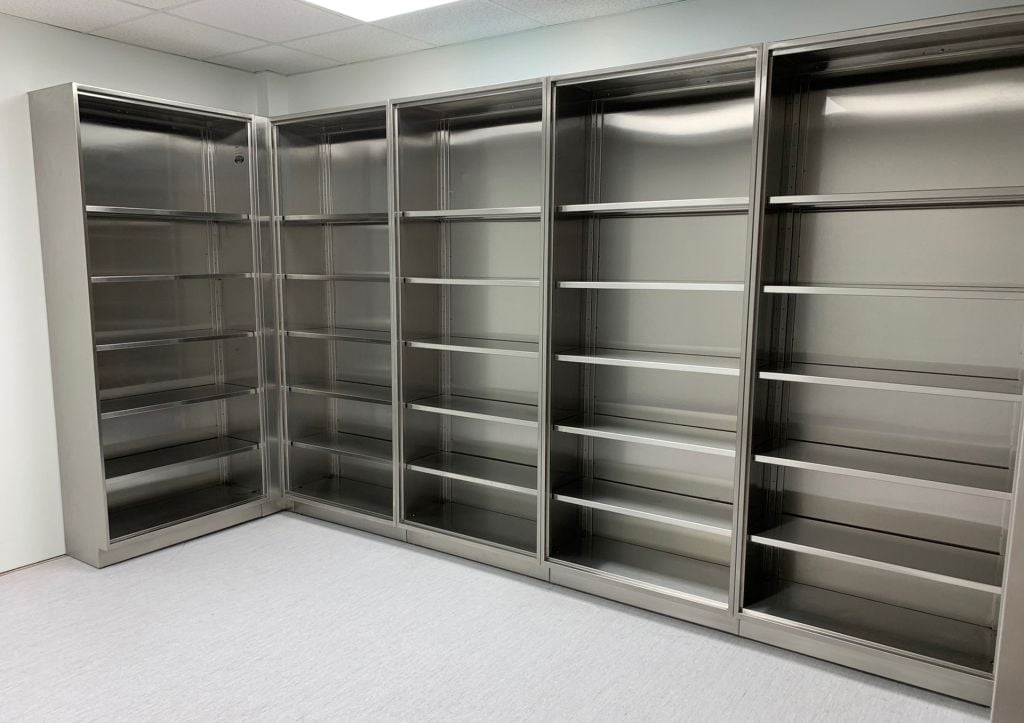
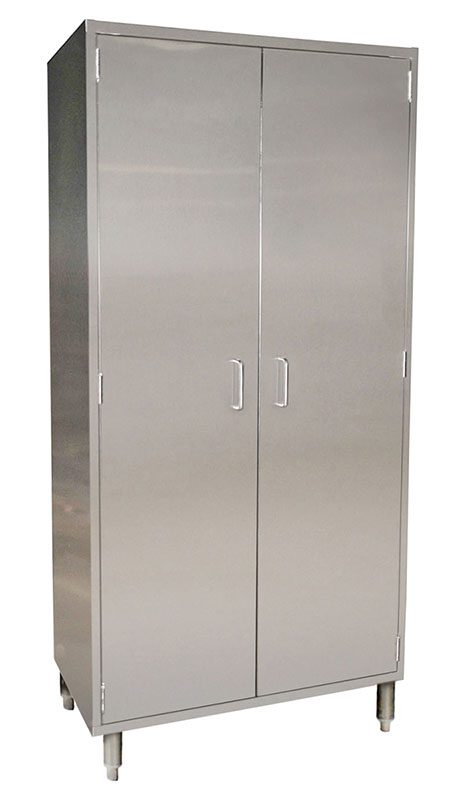
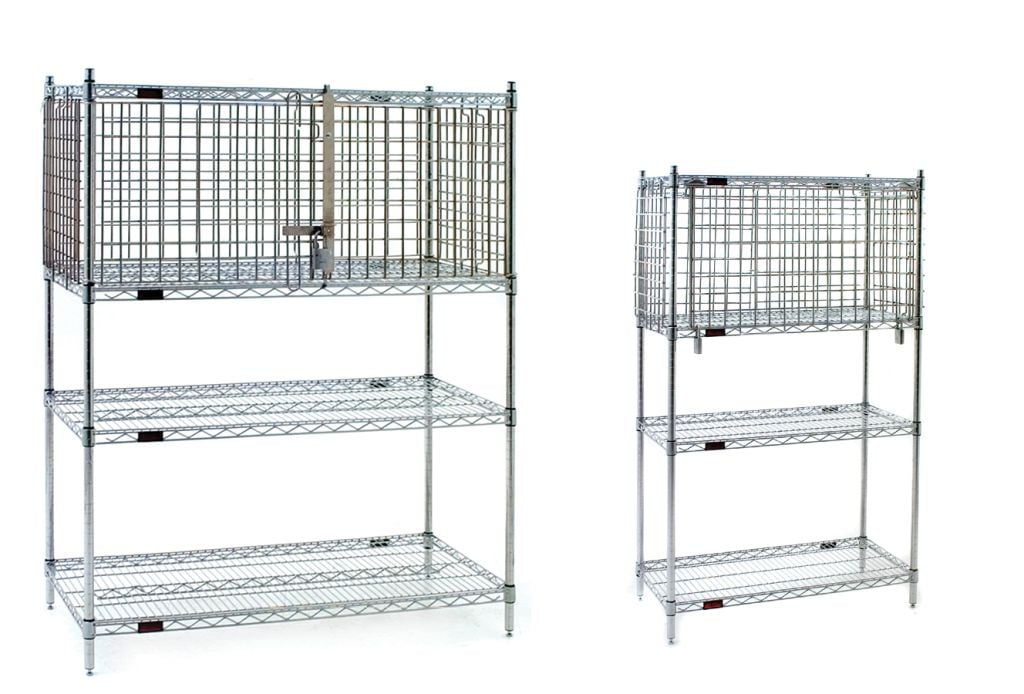
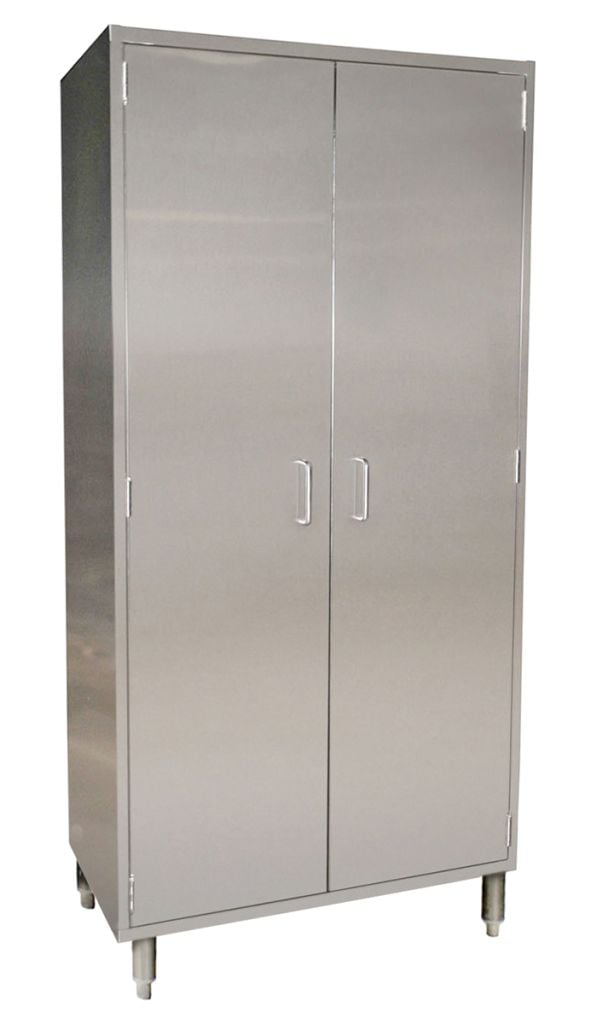
Controlled items are a separate specification. Security modules convert part of an existing shelving unit into a lockable compartment with hinged or flip-up doors. Mini security units are a self-contained 40-inch-high chrome wire cabinet with a full-access double door and hasps for a padlock — often the fastest way to give reference standards or scheduled material a defensible home. Where the requirement is enclosed and wipeable rather than merely locked, a stainless vertical storage cabinet — type 304 body, adjustable shelves, optional sloped top for laminar flow rooms, 5-inch brake casters — is the better answer.
And label the shelf, not the box — shelf markers and bin labels are what make a par-level system survive staff turnover.
Not sure how much storage your lab actually needs?
Send us a floor plan and a rough line-item count. We will come back with a bay-by-bay layout, model numbers, and where the high-density system pays for itself.
Request a Lab Storage Layout Call (800) 326-4403 Call (800) 326-4403
Sample, Specimen and Cold-Room Storage
Sample storage has one property no other lab storage shares: it only grows. Plan for expansion in the layout, not the shelf count — leave a run’s worth of wall, keep post heights consistent, and standardize on one shelf width so nothing becomes an orphan.
Cold rooms punish the wrong finish faster than any other room. Chrome is wrong where condensation cycles daily; epoxy-coated wire or type 304 stainless on stainless posts survives. Keep the bottom shelf high enough to clean under, leave clearance at the evaporator, and prefer open wire so cold air circulates through the load rather than around it. Where freezers carry the samples, the problem moves to the freezer farm’s surroundings: staging carts, a work surface for pull-and-log, and secure storage for boxes waiting to go back in.
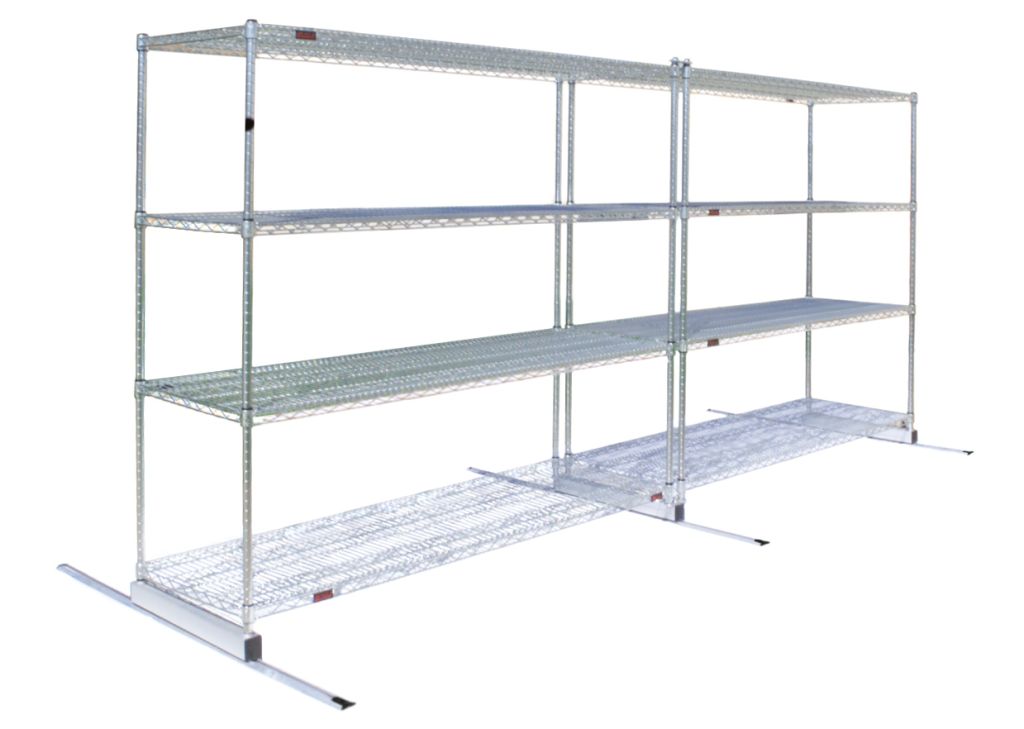
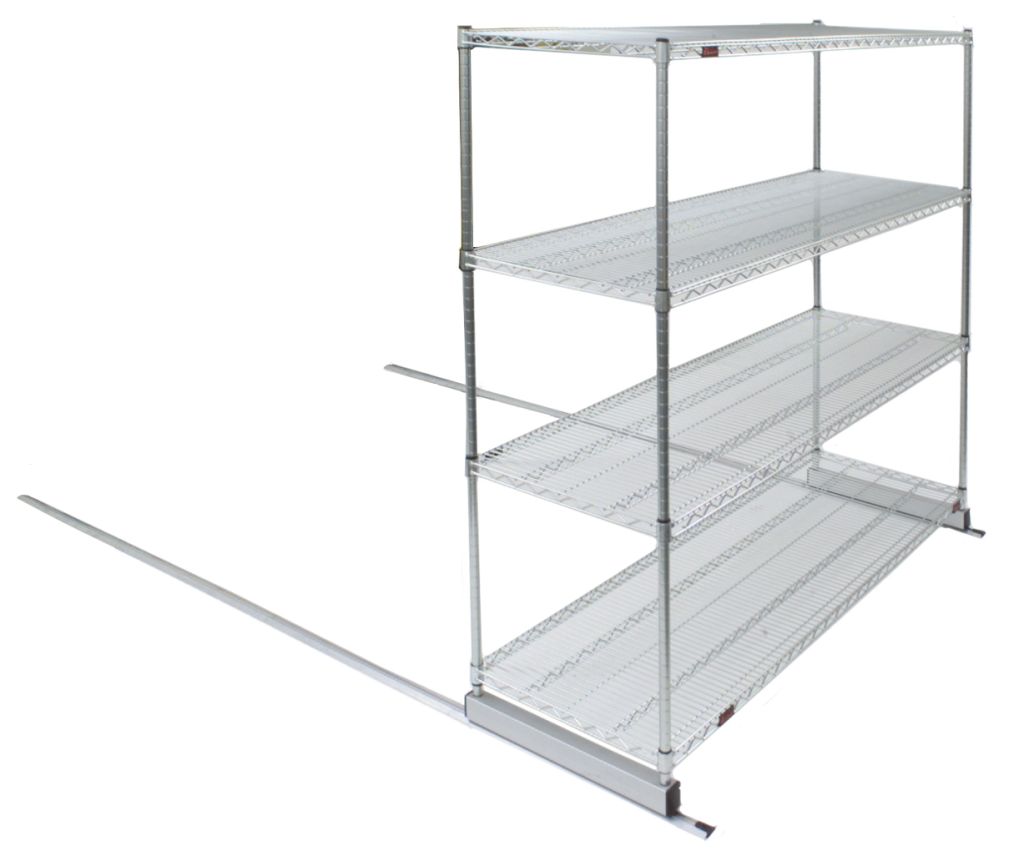
For high-volume retention, high-density mobile shelving is usually the only way to buy capacity without buying a room. Eagle’s Floor-Trak systems mount wire shelving on non-corrosive aluminum tracks with end stops, using aircraft-quality aluminum skate kits with stainless inserts and hardened steel bearings; double-deep does not sacrifice rollability. The tradeoff is one open aisle at a time — fine for archives, wrong where four people pick all shift.

Sizing a transport cart fleet
Count trips, not carts: runs per shift times departments served, plus carts parked loaded at either end. Then check door width, elevator depth and the tightest corridor turn before ordering. A stainless three-shelf cart with 1-inch upturns stops racks walking off in a hallway.
Work Surfaces, Overshelves and Bench-Level Storage
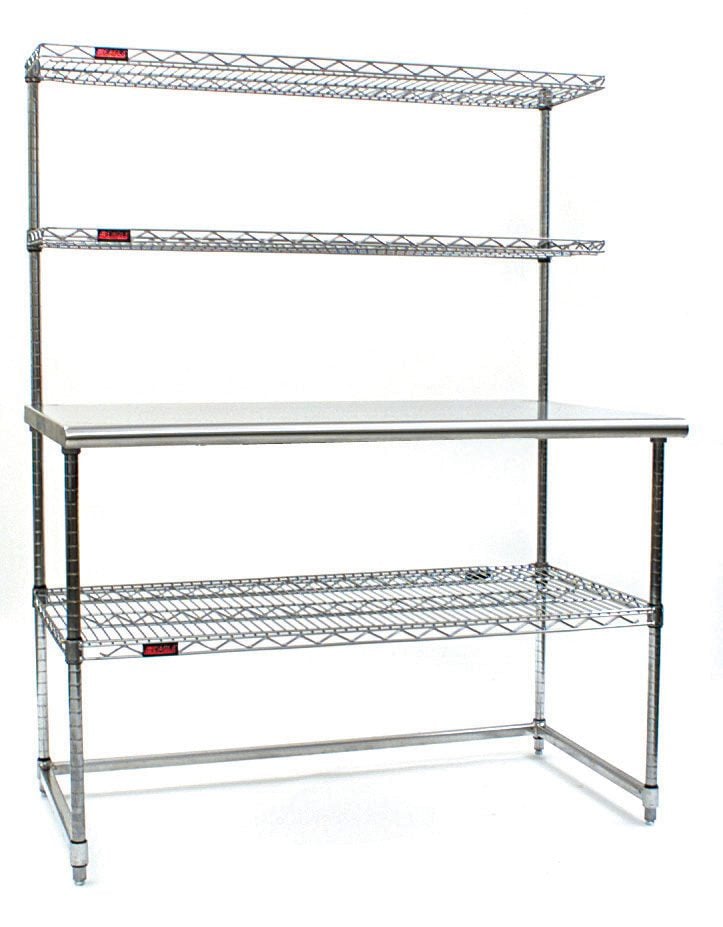
The bench is where storage decisions become ergonomic decisions. Eagle’s AdjusTable work surface systems put a solid or perforated stainless top — brushed or electropolished, hat-channel reinforced — on numbered posts calibrated in 1-inch increments (33-inch front, 63-inch rear, 29-inch front posts for wire overshelves). The numbering is the useful part: two people can reset a bench or overshelf level without a tape measure, making a shared research bench reconfigurable in an afternoon instead of a work order.
Overshelves come in two philosophies: wire overshelves on the rear posts keep the shelf accessible and let light through, while cantilevered overshelves clear the back of the bench entirely. Below the top, choose a wire undershelf, an H- or C-frame open base, or nothing where a rolling cabinet slides in.
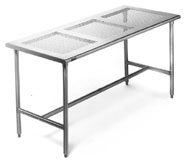
In controlled environments, perforated cleanroom tables change the airflow math: 14-gauge type 304 tops with 3/4-inch perforations, rolled edges, ends turned down 90 degrees for flush installation, and a uni-lok gusset welded into the hat channel to limit lateral movement. Height-adjustable tables — pinned-leg 30 to 37 inches, electronic-drive 29 to 40 inches — suit stations shared by staff of different heights.
Bench and workstation selection lives on our laboratory furniture page, and shelving series comparisons live on laboratory shelving and storage. This page covers the flow between them.
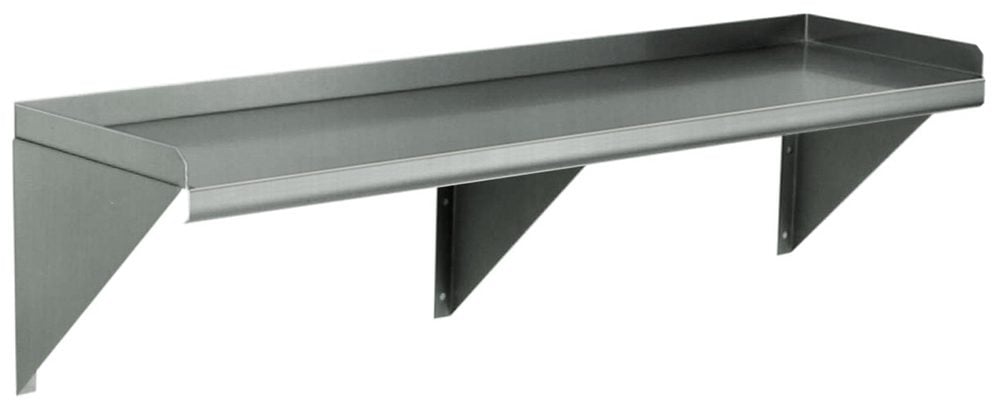
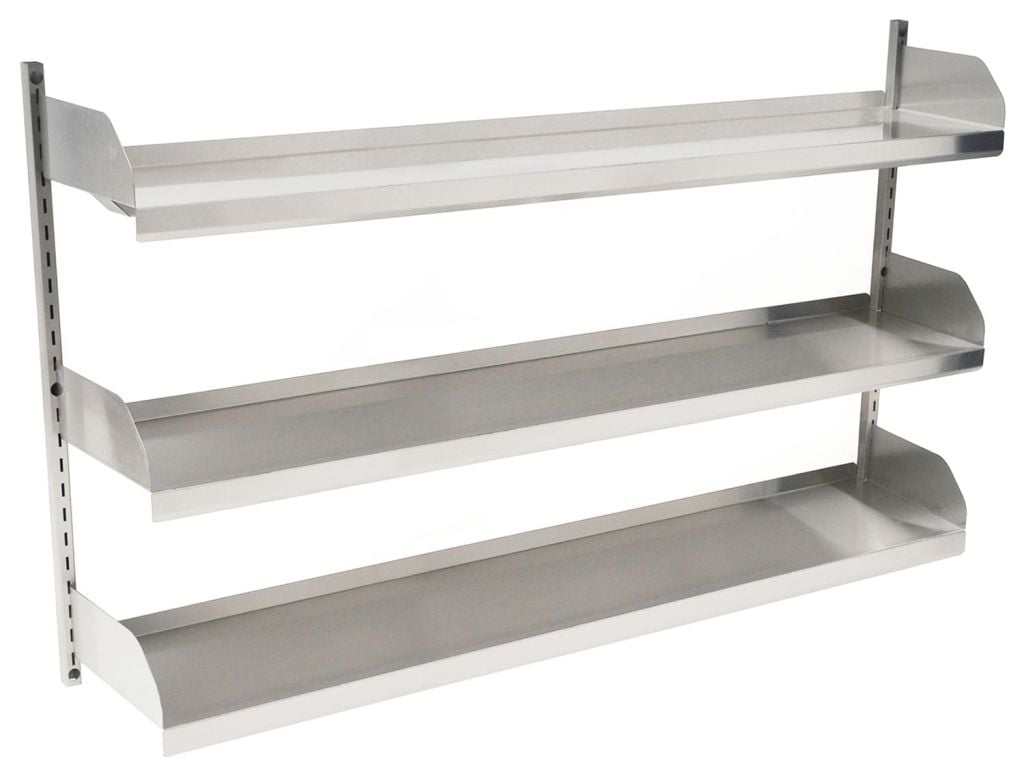
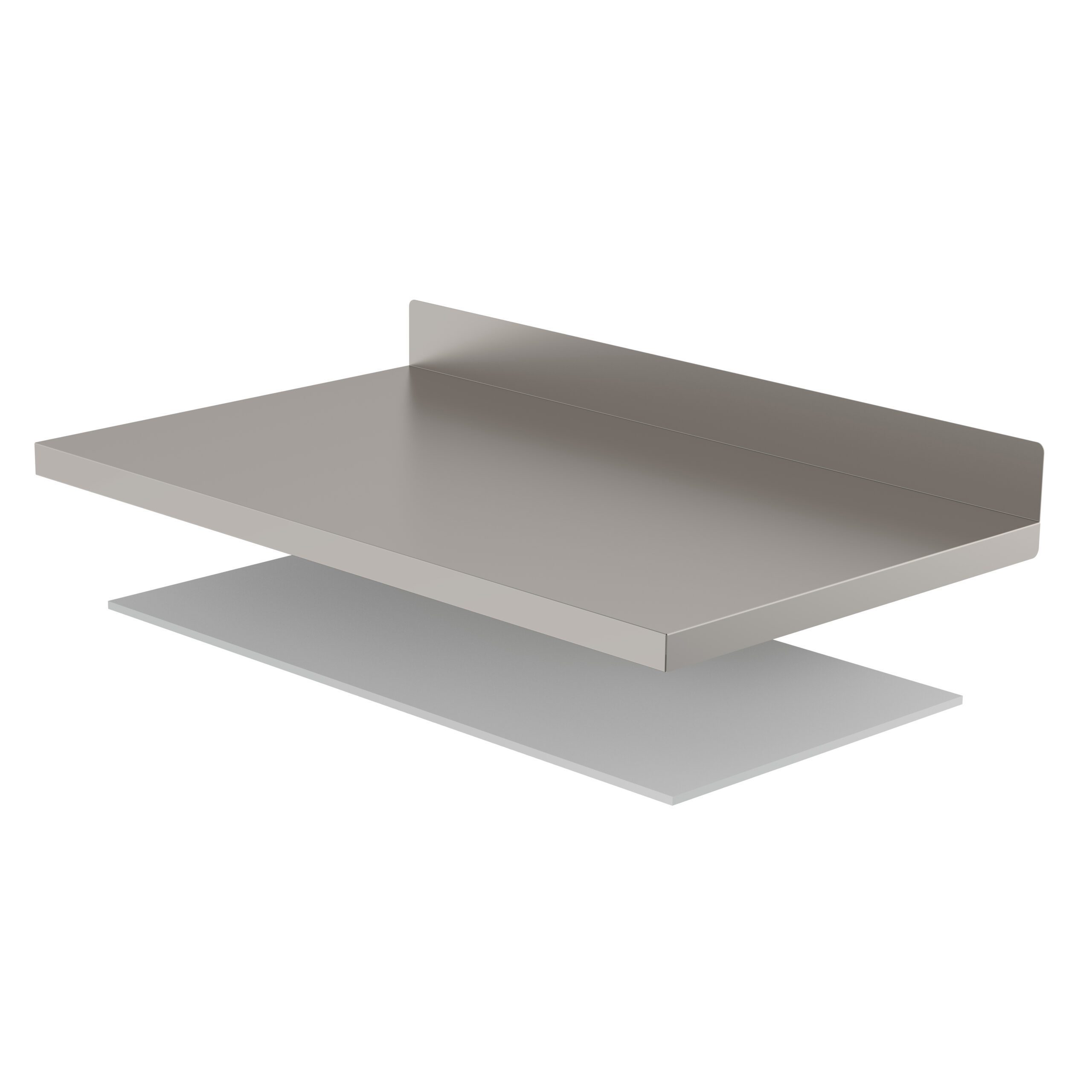
Stainless lab wall shelves are worth specifying rather than defaulting: 16-gauge stainless with a reinforced center hat channel and a 1.25-inch rear upturn, adjusting in 1.5-inch increments, with bookends and an optional front wire retaining ledge. In a seismic region — most of our territory — that ledge is not a nicety.
Laboratory Furniture: Casework, Benches and Work Surfaces
Storage flow only works if the fixed furniture underneath it is right. Casework sets the footprint of every room, benches set how people work at the instrument, and the countertop decides what chemistry the surface survives. MH-USA specifies all three together — steel, stainless, phenolic, epoxy and laminate — so the base cabinets, the bench system and the work surface arrive as one coordinated package instead of three separate orders that do not line up on site.
Start with the full overview on our laboratory furniture page, then go deeper on the component you are specifying:
Laboratory Casework
Base, wall, tall, sink-base and ADA cabinets in steel, stainless, phenolic and laminate — how each construction behaves in wet, corrosive and cleanroom rooms.
Lab Benches & Workstations
Fixed, mobile, wall-hung and height-adjustable benches with overshelves, power, ESD options and reconfigurable frame systems.
Lab Countertops & Work Surfaces
Epoxy resin, phenolic resin, stainless 304/316, solid surface and laminate compared on chemical resistance, heat, moisture and cost.
Furniture and storage are quoted together on the same layout. Send a floor plan or a room list to 800-326-4403 and we will lay out casework, benches, work surfaces and the storage around them as one package.
Gowning, Cleanroom Entry and Garment Staging
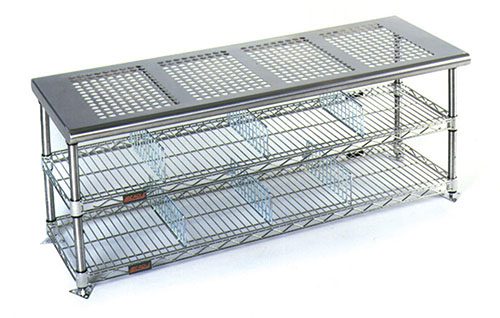
A gowning room fails for geometric reasons far more often than product reasons. If the bench is not long enough to define a clean and a dirty side, people step over it; if hooks sit on the wrong side, gowns cross the line. Size the bench to the people entering at shift change, not to the wall you have left.
Eagle builds gowning benches at two tiers. Perforated-top stainless benches use 3/4-inch perforations on 1-inch centers for roughly 40 percent laminar flow, with rolled edges, 500-lb capacity, 18-inch 16-gauge type 304 legs, triangular foot plates for floor bolting and Quad-Truss wire undershelves for shoes. Wire gowning benches are the economical tier at about 62 percent laminar flow, with four 18-inch legs, a three-sided channel frame and one wire shelf up to 72 inches — right for less demanding rooms or while a space is brought into clean.
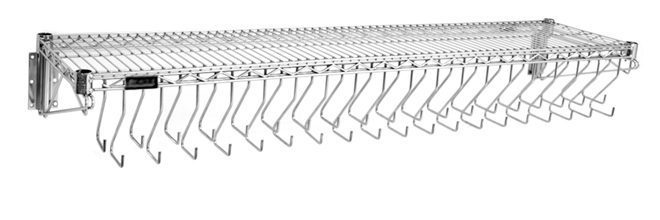
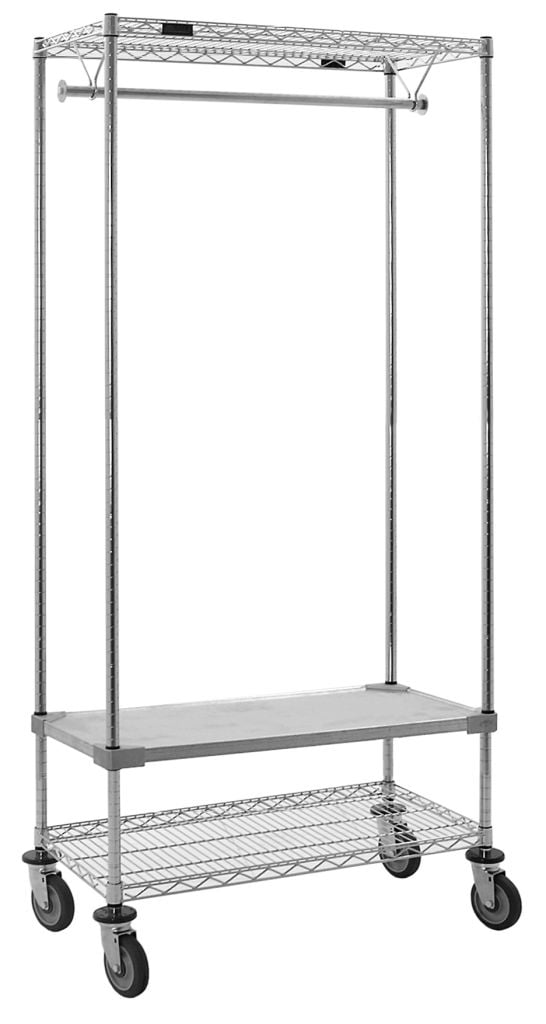
Garment storage is the other half. Wall-mount gowning racks in a 14-inch width come in 48-inch (30 hooks), 60-inch (38 hooks) and 72-inch (46 hooks) lengths in electropolished or chrome; mobile garment racks with a chrome hanger bar and 5-inch casters handle laundry staging.
The full controlled-environment range is covered on our Eagle cleanroom products page, with entry-specific detail on gowning room essentials and bench selection on cleanroom gowning benches.

Glassware, Wash-Up, Sinks and the Waste Path
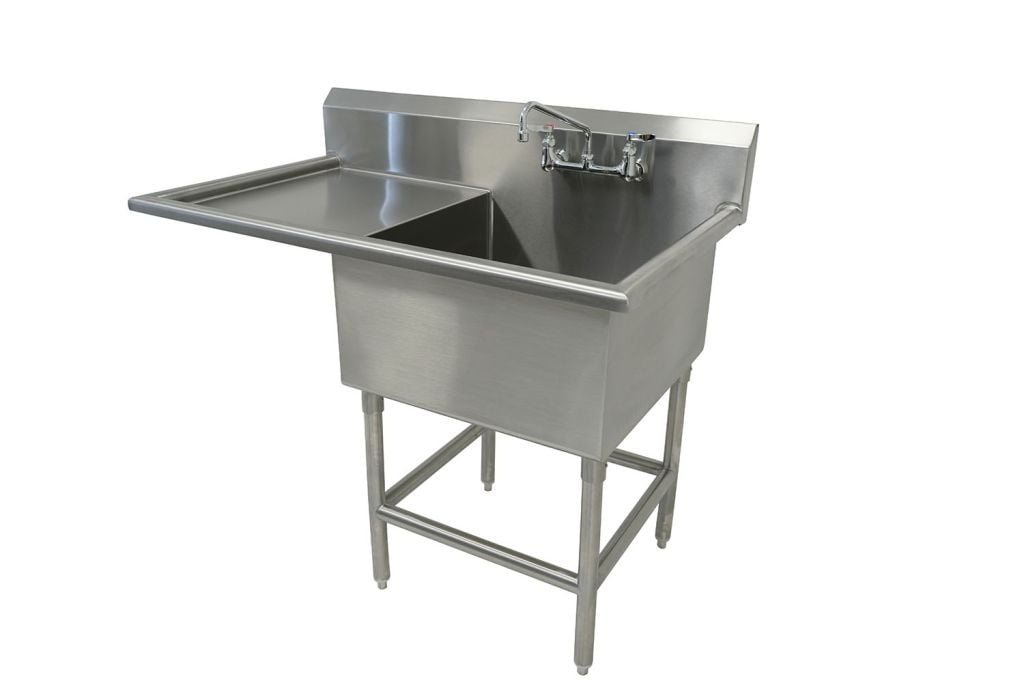
Wash-up is the part of a lab that looks like a commercial kitchen, and it fails the same way: soiled and clean cross. Lay the room out as a line — soiled landing, sink, wash, dry, clean staging.
Laboratory service sinks in 14-gauge type 304 — welded polished bowls, radius corners, rolled edges, 8-inch backsplash — come in one, two or three compartments with or without sloped drainboards. Three compartments plus a drainboard is the glass-wash workhorse; a single deep bowl suits rooms where a washer does the volume. Drop-in bowls and no-deck sinks let a sink live inside a fabricated countertop run.
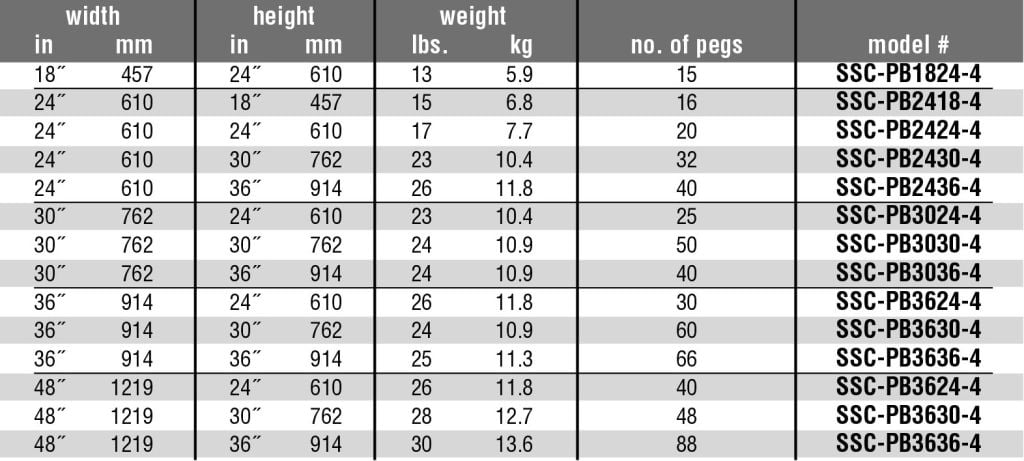
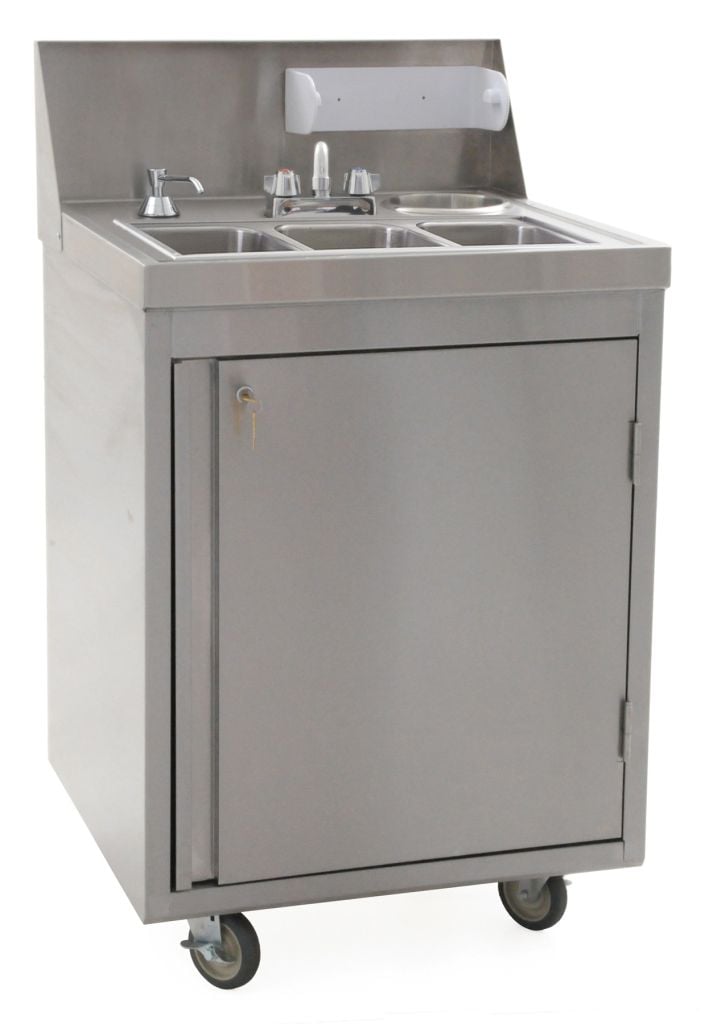
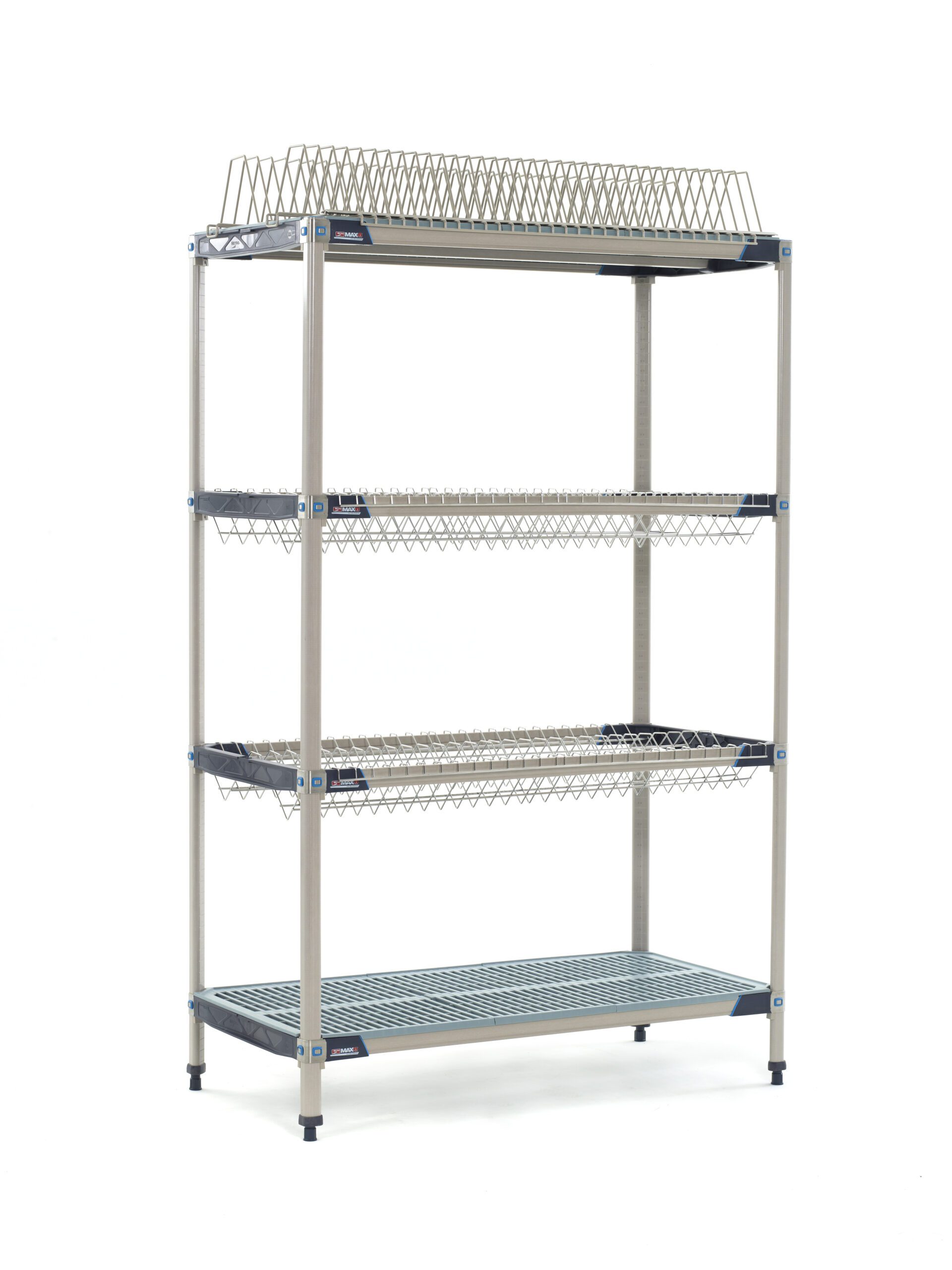
For drying, stainless pegboards with 6-inch polymer pegs, a 4-inch drip trough and 36 inches of drain tubing beat a rack of towels and take no floor space. Where there is no plumbing, a portable hand sink cabinet with a 115-volt pump, 5-gallon fresh and 7-gallon waste tanks, faucet, soap and towel dispensers and a GFCI outlet solves hand hygiene without a plumber.
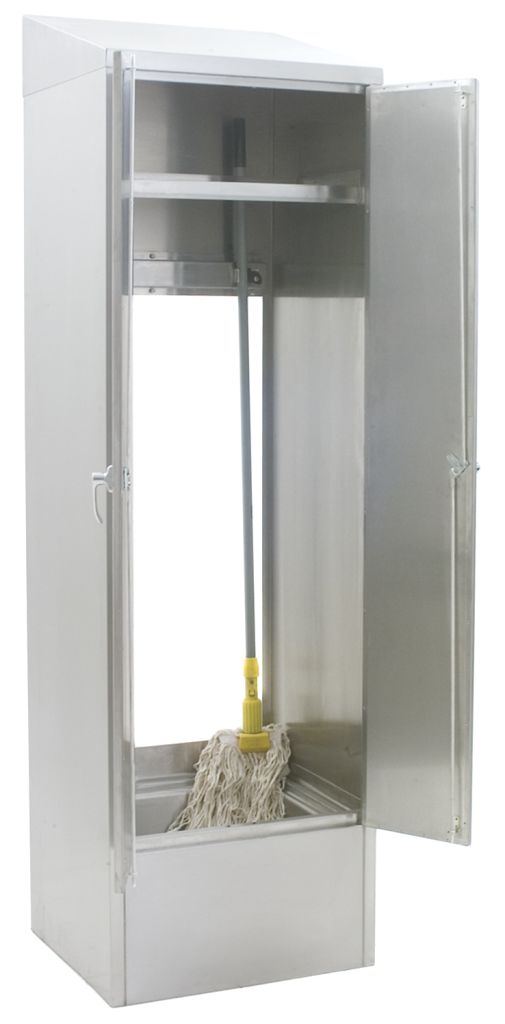
Waste and janitorial usually get no space in the plan. A mop sink storage cabinet with a deep-drawn seamless 8-inch bowl, 15-degree sloped top and open back that envelops the wall service faucet keeps that position enclosed and wipeable. Waste staging should be mobile and sized for the pickup interval, not the daily volume.
Choosing a Lab Storage System: Comparison
Most lab storage arguments come down to a handful of candidates. This is how we compare them.
| System | Best for | Typical construction | Density | Watch out for |
|---|---|---|---|---|
| Stationary wire shelving | Storerooms, bench-adjacent working stock, cold rooms | Chrome, epoxy-coated or type 304 stainless wire on grooved numbered posts | Baseline | Chrome in humid or cold-cycled rooms; small items falling through |
| Solid & polymer shelving | Small vials, spill containment, aggressive cleaning chemistry | Hemmed heavy-gauge solid shelf with raised marine edge, or molded polymer | Baseline | Less airflow than wire; heavier to reconfigure |
| High-density mobile (Floor-Trak) | Sample retention, archives, consumable bulk stores | Wire shelving on aluminum track with skate kits, single- or double-deep | 40–50% more in the same room | One aisle open at a time; verify floor flatness before install |
| Cantilever (Q-LEVER) | Wall storage where drilling or bolting is restricted, changing layouts | 76-inch upright, wire or solid shelves, tool-free 2-inch adjustment | Wall-line only | Load rides on the upright — plan the footprint, not just the wall |
| Enclosed & secure storage | Controlled substances, reference standards, evidence, kits | Security modules, mini security units, or type 304 cabinets with keyed locks | Lower per square foot | Access policy should drive the choice, not cabinet cost |
| Stainless casework & countertops | Fixed benches, sink runs, pharmaceutical and pathology suites | 16 or 14 gauge type 304 or 316, coved corners, seams to spec | Fixed | Made to size — field verify before fabrication releases |
A note on finishes
Chrome is fine in dry, climate-controlled rooms and nowhere else. Epoxy-coated wire handles humidity and refrigeration. Type 304 stainless is the general lab standard for wet, cleaned and audited areas. Type 316 is the aggressive-chemistry upgrade — worth it in specific rooms, wasted building-wide.
How We Plan, Specify and Install a Lab Package
Walk the flow
We start with the material path, not the product list. Half the wins on a lab project come from moving a storage location, not buying a better shelf.
Field verify
Rooms are measured after the walls exist. Column locations, door swings, elevator depth, corridor turns and floor flatness all constrain product choice.
Specify by room
Finish, gauge and shelf type get chosen per room against chemistry, cleaning regime and temperature — not one blanket specification. Where certification or standards conformance matters, we confirm model-by-model in writing.
Submittal package
Model numbers, spec sheets and CAD or Revit files pulled for the schedule, so lab planners and engineers can drop them into the drawing set.
Lead time and freight
Standard shelving, carts, dunnage and gowning equipment generally ship in a couple of weeks; casework, fabricated countertops, custom sinks and track systems are made to size and take longer. Freight is quoted with the equipment.
Delivery and install
Phased delivery in occupied buildings, install windows around lab downtime and knock-down products where access demands it. We ship nationwide from Salt Lake City.
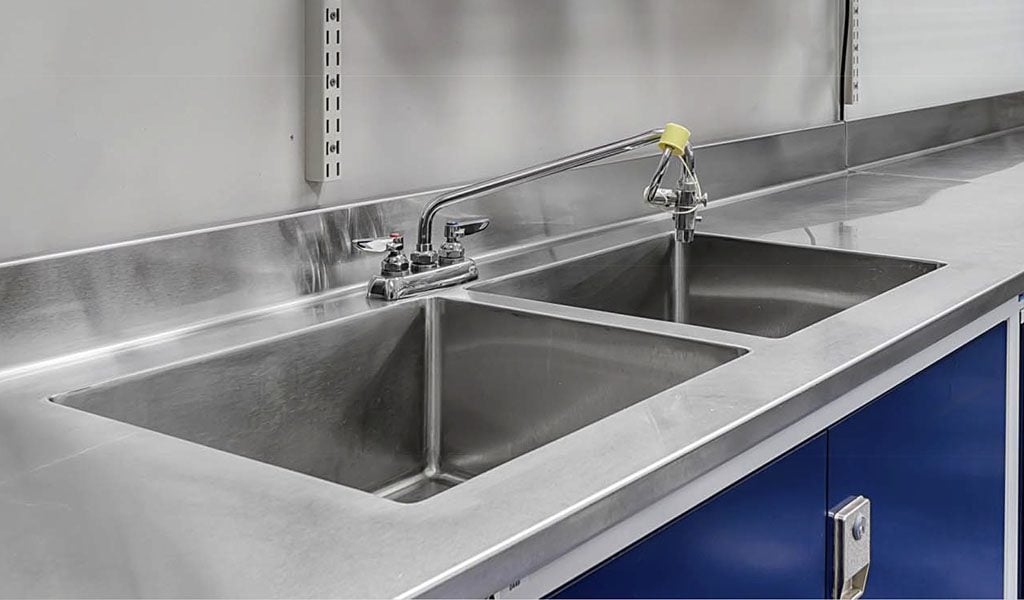
Custom is normal here. Eagle’s SpecFAB division handles modifications to standard models — a relocated sink bowl, a non-standard length, a cut-out for a drop-in instrument — and fully fabricated countertops. Stainless countertops run 16 or 14 gauge in type 304 or 316, with square or box marine front edges, splashes to specification, coved sanitary corners, and a mechanical hairline seam or field-welded joint. Maximum length without a seam is 144 inches, reduced by 5.5 inches per end splash — the dimension that decides whether a 16-foot bench run has a visible joint.
We do not sell your instruments. What we do is make sure the infrastructure around the science is specified once, correctly, by someone who has seen the same room fail before.
Turnkey Laboratory Solutions: Design, Instrument Support and Infrastructure
Some projects arrive as a product list. Others arrive as an empty shell and a program document, and the question is not which shelf to buy but how the whole room should work. Those are the projects where turnkey laboratory solutions earn their keep: one team plans the layout, specifies the fixed and mobile infrastructure, produces the submittal package, and phases delivery and installation so the lab opens on schedule instead of opening around a punch list.

Design and space planning come first. Lab design is really three overlapping constraints: the workflow (samples should move forward, never back through a dirty zone), the clearances (aisle width, door swings, elevator depth, and the space a technician needs to open a full-extension drawer while someone passes behind), and the services (where power, gas, vacuum and drains land, because they fix the bench line for the life of the room). We lay out the storage and work surfaces against those three before anyone talks about model numbers. Modularity matters as much as capacity: adjustable-height tables, knock-down bases and shelving that re-posts on 1-1/2-inch centerlines let a room absorb a new instrument in an afternoon instead of a renovation.
Customized laboratory solutions are the norm, not the exception. Very few labs fit an unmodified catalog run. Eagle’s SpecFAB division modifies standard models — a shortened base, a relocated bowl, a cut-out for a drop-in instrument — and MH-USA specifies knee-space apron kits in type 304 stainless (24 to 48 inch widths, 22 inch depth, 5 inch apron, with or without a 3 inch drawer on full-extension ball-bearing slides) to convert standing casework runs into seated analytical stations.
Analytical Instrument Storage and Bench Support

Analytical instruments fail quietly when their consumables live somewhere else. Columns, cuvettes, vials, septa, calibration standards and spare tooling belong within arm’s reach of the instrument that uses them, sorted so a technician can find the right one without opening five drawers. Standing-height single-bank base cabinets at 35 inches with ten 3-inch full-length drawers give roughly one drawer per consumable class in the footprint of a single cabinet, in stainless construction that survives solvent wipe-down. Heavier accessories — pump modules, gas regulators, spare detectors — go behind full-height hinged doors with an adjustable intermediate shelf rather than on an open shelf where they collect dust.
Above the bench, the rule is different: keep mass low and keep the balance clear. Three-shelf modular wall systems in 16-gauge type 304 stainless, with 1-1/4 inch rear upturns, 4-1/2 inch downturned bookends and a center hat channel, hang consumables at eye level on 36-1/2 inch uprights without adding vibration paths to a bench-mounted analytical balance. Anything that vibrates, heats or weighs stays off the shelf and on the floor or on its own table.
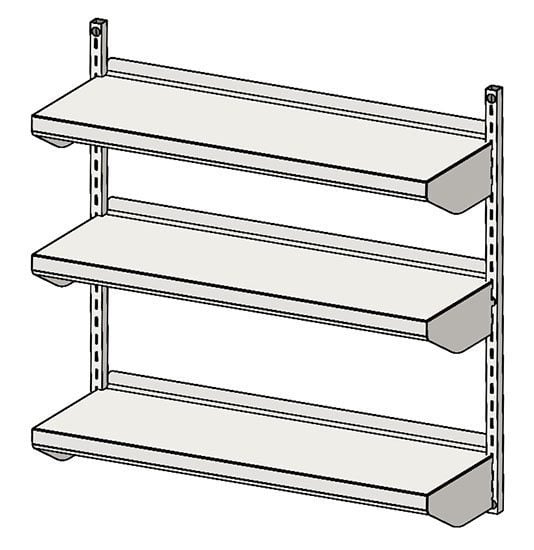
Laboratory systems, not loose parts. The reason we quote laboratory storage solutions as a package is that the pieces interact: shelf depth sets aisle width, aisle width sets cart size, cart size sets door and elevator requirements, and the wash-up layout decides where clean glassware can dry without being carried back through a dirty corridor. Buying each item separately usually produces a room that is individually correct and collectively slow. When we scope laboratory infrastructure for a new build or a retrofit, the deliverable is a room-by-room schedule with model numbers, finishes, lead times and freight — one document your planner, contractor and purchasing team can all work from.
Shop Laboratory Storage Products Online
A selection of lab storage and workstation products available directly from our online store. For full packages, custom sizes, casework and freight-rated orders, request a quote.

Every Laboratory Page We Publish
This hub covers the workflow; these pages go deep on the individual product areas.
- Laboratory furniture — casework, benches, workstations and height-adjustable tables
- Laboratory shelving & storage — shelving series, posts, accessories and mobile kits
- Eagle cleanroom products — perforated tables, overshelves and controlled-environment equipment
- Gowning room essentials — benches, racks, hooks and cleanroom entry layout
- Cleanroom gowning benches — bench tiers, laminar flow percentages and sizing
- Eagle lab products — the Eagle MHC laboratory catalog overview
- Sanitation-rated shelving solutions — shelving for wet, clean and high-sanitation rooms
- Utility carts — transport carts for samples, supplies and inter-department runs
- Healthcare material handling solutions — the hospital and clinical facility twin of this page
Design & price it online: Metro Workcenters & Furniture Configurator
Configure Starsys workcenters, gowning benches and cleanroom furniture in our free Metro Workcenters & Furniture configurator — build the layout, see a full bill of materials and save or send the quote in minutes. Need a different Metro product? Browse all 17 tools in the Metro configurator hub.
Laboratory Material Handling FAQs
What does laboratory material handling actually cover?
Can shelving go inside a cold room or walk-in freezer?
How much floor space does high-density mobile shelving save in a lab storeroom?
What stainless type and gauge should a lab specify?
Are your lab products certified for our regulatory environment?
Do you ship laboratory equipment outside Utah?
What are the key considerations when designing a laboratory?
Can you provide a turnkey laboratory package rather than individual products?
Get a Laboratory Storage Layout and Quote
Send your floor plan, equipment schedule or a photo of the room to Sales@MH-USA.com, or call (800) 326-4403. We will return a layout, model numbers, lead times and freight.