
Parts & Kitting Storage Planner
Where each part class should live, what belongs at the line, what belongs central, and what your kit rate implies for carts and workstations. Enter your catalogue, your cells and the pain you feel today, and the concept appears on screen — with every planning assumption named, no pricing, and a person confirming all of it before anything is quoted.
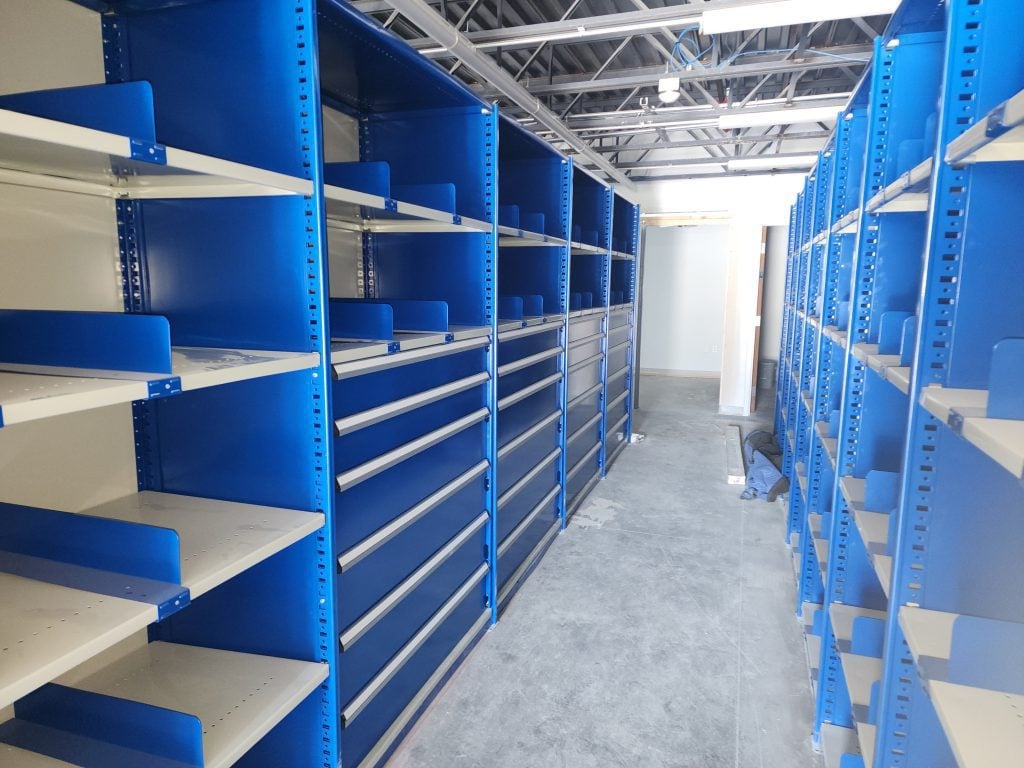
The line does not stop because of storage. It stops because of the walk.
Ask an assembler where the last hour went and the answer is rarely assembly. It is a missing fastener, a bin that was not replenished, a kit that arrived four lines short, a walk to the crib and a wait at the window. None of that appears in a routing, and none of it is fixed by buying more shelving.
It is fixed by deciding, deliberately, where each class of part lives. Fast movers belong within arm’s reach of the operation that consumes them. Regular movers belong in a central store that replenishes on a rhythm. The slow tail belongs somewhere dense and out of the way. Kits belong on a cart whose geometry was decided before the aisles were, not after.
This planner produces that concept from your own numbers: your part-number count, your size mix, how often parts move, how many cells you feed, how many kits you build a day, and what actually hurts today. It names every assumption it makes — including the ones it wants you to replace with real pick history — and it produces no prices and no product specifications, because those come from a person who has seen the parts.
Who this is for
- Manufacturers and equipment OEMs feeding assembly cells or lines
- Manufacturing and industrial engineers designing a line-side material presentation
- Materials and supply chain managers introducing or fixing kitting
- Plant managers dealing with stockouts, searching, WIP clutter or traceability findings
What you need to hand
- Active part numbers, roughly
- The typical size mix — mostly small, balanced, mostly large, or long and awkward
- How often parts are picked, from weekly to several times a shift
- How many assembly cells or lines you feed
- Kits per day, and lines per kit if you know it
- What hurts today: stockouts, searching, WIP clutter, quality and traceability, floor space, incomplete kits
- Any clean, ESD, secure or traceability requirement you have to meet
Don’t have all of it? Every field that can be left blank, can be — the tool tells you which missing number would change the answer most.
Plan your parts storage and kitting
Your part-class split, media mix, line-side versus central recommendation and kitting notes appear on this page immediately. We only ask for your details if you want a PDF copy, a free Manufacturing Storage & Material Flow Review, or to talk to a specialist.
Prefer a full window? Open the parts and kitting planner in a new tab.
How it works
Describe the catalogue
Part-number count, size mix and how often parts move. These three decide almost everything about the media and where it sits.
Describe the line
How many cells or lines are fed, how many kits are built a day, and how many lines are on a kit. This is what sizes the cart fleet and the kitting area.
Say what hurts
Stockouts, searching, WIP clutter, quality findings, floor space or incomplete kits. The concept has to fix the symptom you actually have, not the generic one.
Read the concept
Storage media by part class, line-side versus central, kit cart implications, workstation notes and any secure or clean requirement — each with the assumption behind it.
How to read your concept
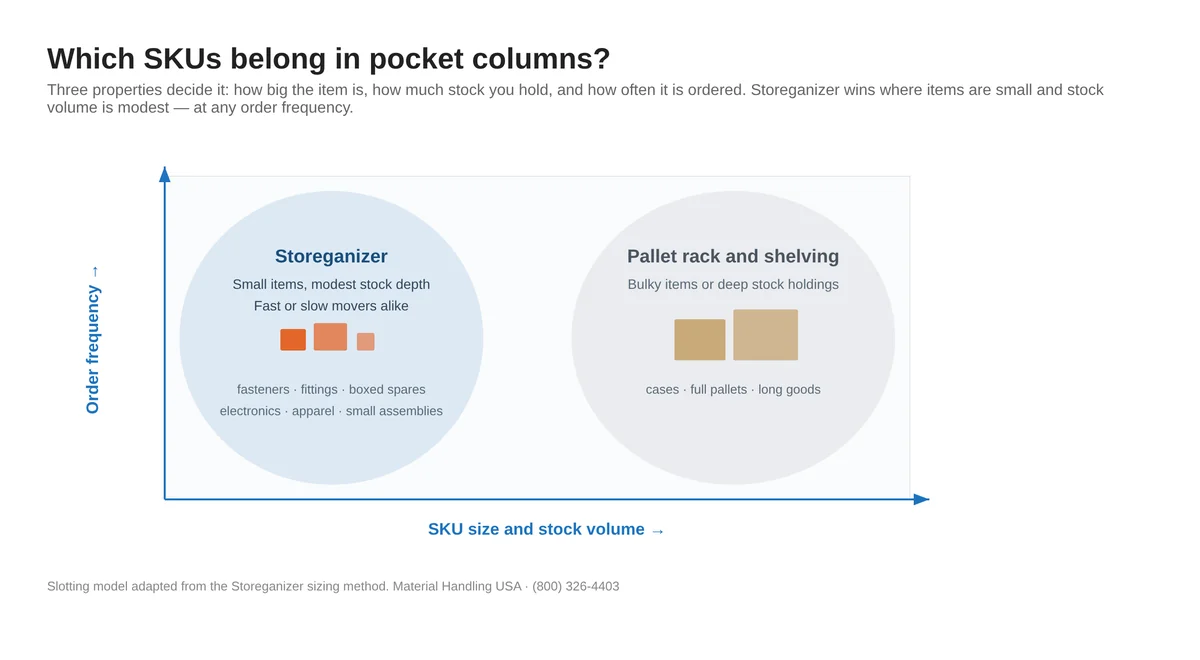
The part-class split is planned against a 20/30/50 activity assumption until your pick history says otherwise. It is stated as an assumption for a reason: it is the single input most worth replacing with real data, and doing so is free.
Line-side versus central is a capacity question, not a preference. A cell can only present so many part locations before the presentation becomes its own walk, so the planner caps the line-side face and sends the rest to a central store served by kits or routes.
The media mix names families, not products: presented bins and flow rails for fast small parts, drawers and bin shelving for the regular class, dense pocket or vertical storage for the small slow tail, rack and cantilever where the mix is large or long. Sizes, containers and quantities come from a person who has seen the parts.
The kit cart figure is arithmetic on your kit rate at three to six turns per cart per day, before any allowance for carts staged at the line. Cart geometry then sets aisle widths and pick-face heights, which is why it is decided early rather than last.
Clean, ESD, secure and traceability requirements are treated as constraints, not features. Each one narrows media, containers and layout before anything else does, and each one is confirmed in writing against your standard — never assumed here.
What this tool does not do
This is a planning concept built from the numbers you enter. It is not a designed layout, a bill of materials, an engineered specification or a quote.
- The activity split is an assumption until it is replaced by a real pick-history export.
- Container, media and cart choices depend on part geometry, weight and any clean or ESD standard, none of which a web tool can verify.
- Line-side capacity assumes the cell has the wall, upright and bench space to present the locations shown — a walk-through decides that.
- Nothing here constitutes a compliance, cleanroom, ESD or traceability certification.
- No pricing is produced here and no product specification is implied. A person confirms every element of this concept, and the quantities behind it, on a quote.
Products and related tools
Workstations and workbenches
Point-of-use storage for the parts an operator touches every hour.
Manufacturing storage shelving
The central store for the regular-moving class.
High-density pocket storage
Compress the small, slow-moving tail into the height you already have.
Pallet rack and cantilever
For the large, long and palletised share of the catalogue.
Tool cribs and secure enclosures
One controlled issue point for high-value parts, tooling and gauges.
Manufacturing Floor Space Recovery Calculator
See what the storage change is worth in recovered production floor.
SKU Upload Analyzer
Replace the assumed activity split with your real pick history.
Common questions
What if we do not kit yet?
Where does the 20/30/50 split come from?
Does this recommend specific products?
Does it price anything?
We have ESD and cleanroom requirements. Does that change the concept?
What is the free Manufacturing Storage & Material Flow Review?
Book a free Manufacturing Storage & Material Flow Review
Send the concept in with a cell layout or a few photos. We will walk the parts, the kits and the path between them, and come back with what to change first — including where kitting is not worth doing at your volume.