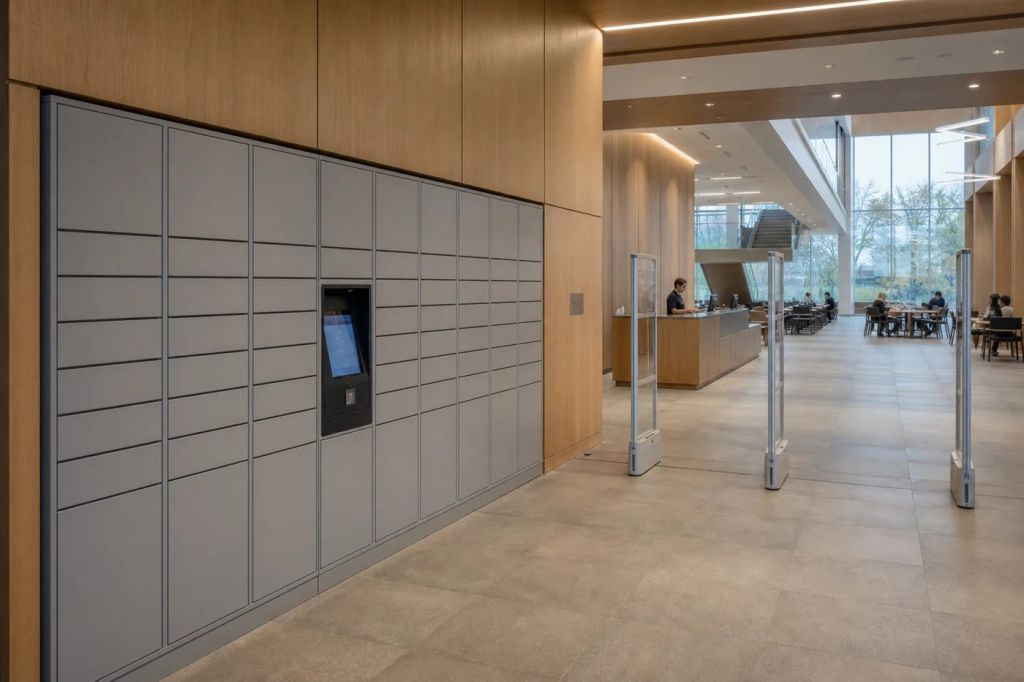
A lobby manager starts the day by moving yesterday’s packages off the front desk. Couriers wait while staff sort boxes. Residents ask where their orders went. Floor space disappears under a pile of cartons. A parcel locker system can fix that, but only if the bank is sized for how deliveries really arrive and how long people take to pick them up.
This guide is for multifamily property managers, office facility teams, architects, and buyers planning a new locker bank or replacing one that keeps overflowing. It shows you how to gather demand data, choose a door mix, test package fit, plan for peak season, and check layout and accessibility rules before you order.
Quick answer: how to size a parcel locker system
- Size for your busiest weeks (usually the holiday season), not an average day.
- Count doors, not cubic feet. One package uses one door, no matter how much room is left over.
- Most of the mix should be small and medium doors. Too many large doors can lower real capacity.
- Pickup time matters as much as delivery volume. Slow pickup ties up doors.
- Set two pass/fail tests: a maximum average occupancy and a maximum number of overflow packages per week.
- Check reach ranges, clearances, power, and data before the layout is final.
Why Parcel Locker System Sizing Matters
Package volume keeps putting pressure on lobbies, mailrooms, and front desks. In Europe, parcel locker networks reached nearly 155,000 lockers by the end of 2023, a 29% increase from 2022, while parcel shops passed 349,000 locations, according to research on parcel locker infrastructure. Networks can grow fast. A single building still needs its own careful plan.
Getting the size wrong fails in one of two ways:
- Too small: packages end up on the floor or at the desk again, staff handle more boxes, and residents or employees lose trust in the system.
- Too large: you pay for doors that sit empty and give up wall or floor space you could use for seating, storage, or tenant services.
Measure operations, not just headcount
Unit count or employee count is only a starting point. A good plan looks at occupancy rate, packages per person, peak-week demand, and dwell time (how long a package sits before pickup). A door holding a package until evening can’t take another delivery that day. A big bank can act like a small one if people collect slowly.
Offices work the same way. Delivery patterns, work schedules, remote days, and courier access decide usable capacity. Plan for returns, oversized shipments, and items that will never fit a standard door.
Practical rule: Size the locker bank for your busiest realistic period, then check that it still works when pickup slows down.
If your ownership team is new to lockers, start with how parcel delivery lockers work so everyone understands the daily routine before approving a layout.
Properties that also manage visitor entry should plan intercoms and access control at the same time. This Wisenet Security Ltd intercom guide covers intercom basics. Keep entry control separate from the locker capacity decision, but place the two together early so they don’t compete for the same wall.
USPS Mailboxes vs. Package Lockers: Two Different Sizing Rules

People often mix up two kinds of equipment, and they are sized in different ways:
- USPS mail receptacles (wall-mounted centralized mailboxes with built-in parcel lockers) are loaded by the postal carrier. Their parcel lockers follow the USPS standard, including a fixed ratio to mailboxes. More on that below.
- Smart package lockers are open to UPS, FedEx, Amazon, USPS, and other couriers. Residents or staff get a code or app alert. There is no federal formula for these. You size them from your own delivery data.
Most of this guide is about the second kind, because that is where buildings run out of room. If your project includes new mailboxes, meet the USPS ratio first, then size the smart locker bank to handle the rest of the package load. Our smart locker systems page explains the multi-carrier options.
Information You Need Before You Configure
Gather four groups of inputs before you ask for a layout. Missing one usually means a redesign after the bank has been quoted.
1. Demand profile
Write down the number of occupied units or active employees, packages per person, delivery days, peak periods, and typical pickup times. Include move-in seasons, holidays, lease renewals, and onboarding waves.
Track dwell time, not just volume. A package picked up in two hours uses capacity very differently from one that sits for two days. Your plan should state the pickup window you assume and what happens to packages nobody collects.
2. Parcel mix

Measure a sample of real deliveries for one to two weeks, ideally including a busy week. Sort them into small, medium, large, and irregular. Note poly bags, tubes, grocery totes, and other shapes that don’t behave like boxes.
A bank built around lots of large doors often wastes space. A balanced mix gives couriers a better chance of finding a door that fits without using more room than the package needs.
3. Site constraints
Record wall length, floor area, ceiling height, floor type and condition, the path people take to reach the lockers, door swing conflicts, and where couriers will stage. Smart lockers need power and usually a network connection. Cameras need a clear view of the bank.
Check accessibility at the locker face early, not after the drawing is done. People need approach space, a reachable screen and handles, and a clear path even when doors are open.
4. Operating policy
Decide how alerts, pickup deadlines, returns, failed deliveries, and overflow will work. Will couriers load directly? Can staff override a door? Where do packages go when no door fits? Many buildings pair lockers with a small staffed package room using package room shelving for overflow and oversized items.
For a wider view of what lockers can solve, see how smart lockers solve business challenges. The goal is not a door count pulled from thin air. It is a written list of assumptions that ownership, management, and the installer can all review.
Comparing Compartment Size Families
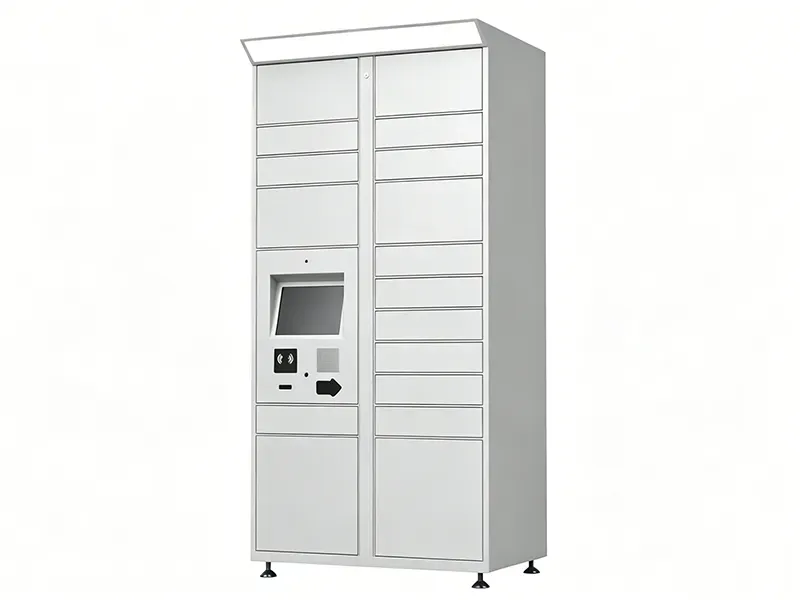
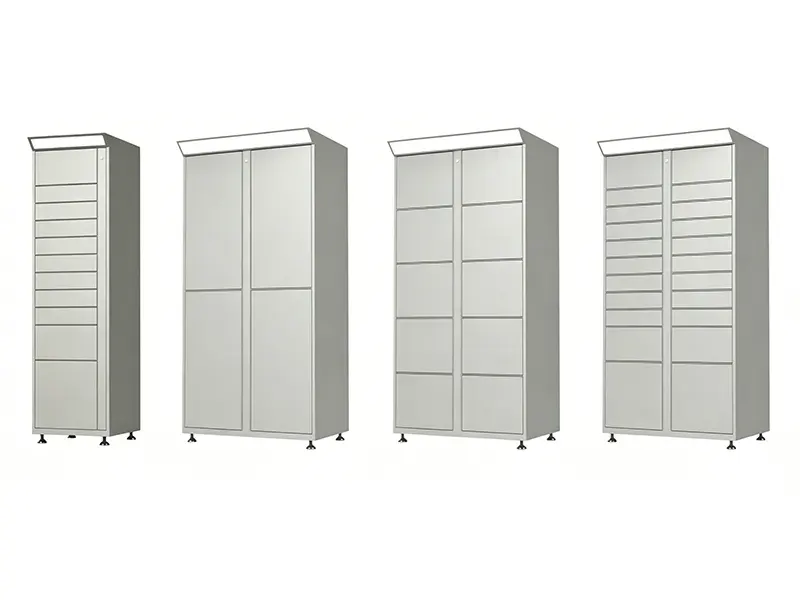
A good locker bank uses several door sizes instead of treating every package like a big one. Your exact mix should come from measured deliveries, but each size has a clear job.
| Size Family | Opening | Common Items | Job in the Bank |
|---|---|---|---|
| Small | Short, compact opening | Padded mailers, poly bags, small boxes | Handles the most frequent deliveries without wasting door space |
| Medium | Standard opening for everyday boxes | Common carrier boxes, clothing, household items, office supplies | Main working capacity for most sites |
| Large | Taller or deeper opening | Shoe boxes, bundled orders, bigger office deliveries | Takes what won’t fit a medium door without using an oversized bay |
| Oversized | Extra wide, tall, or deep | Grocery totes, bulky boxes, odd shapes | Keeps special deliveries from spilling into staff overflow |
| Specialty | Built for a set purpose | Returns, refrigerated items, controlled handoffs | Supports a specific workflow standard doors can’t |
For postal installations, the USPS STD-4C standard sets minimum inside dimensions of 15 inches high by 12 inches wide by 15 inches deep for a standard parcel locker and 18 inches high by 12 inches wide by 15 inches deep for a large parcel locker. Those minimums matter for mailbox projects. They don’t replace a review of your own package mix, and smart package lockers set their own door sizes by model, so compare each maker’s published dimensions against your measured parcels.
Sizing insight: More large doors do not mean more capacity. If small packages land in large doors, you end up with fewer usable doors, not more.
Modular towers make it easier to adjust the bank as delivery patterns become clear. Look for a sensible door mix, clear numbering, durable materials, and easy access to the power and network the control unit needs. Price matters, but so do material quality, install access, and the cost of fixing a poor configuration later. Our locker specifications page is a helpful reference when you compare options.
How to Match Compartments to Your Real Parcel Mix

Matching by volume is not enough. A package’s shape decides whether a door works, so use a dimension-fit check, not a simple cubic-foot comparison.
- Record length, width, and height for your sample packages.
- Check each package against the door depths first.
- Test the other two dimensions against each door width and height that is deep enough.
- Pick the smallest door that fits without forcing the package or blocking the latch.
| Parcel Type | Shape | Best-Fit Door | When to Go Up a Size |
|---|---|---|---|
| Flat mailer | Thin, broad, flexible | Small | When it can’t go in without bending or blocking the latch |
| Compact box | Small, rigid, shallow | Small or medium | When packaging adds thickness |
| Standard box | Moderate in every direction | Medium | When any one side is bigger than the opening |
| Bulky box | Tall, deep, or wide | Large | When it won’t go in without force |
| Irregular item | Round, soft, or uneven | Large or oversized | Send to staff overflow or a specialty area |
Capacity belongs to doors, not cubic feet. Your planning sheet should show the door each package would use and the reason for any size bump.
Irregular items need a clear rule. Save an oversized column for tubes, totes, and poly bags, or send those deliveries to a package room. Good lighting and clear door labels help couriers pick the right door. Carton sizes also change over time, so review the mix yearly. For a sense of how many standard carton sizes shippers use, see this range of postal boxes with free UK delivery.
Real-World Example: Sizing a 133-Unit Building
One of the few published studies on this topic comes from the University of Washington’s Urban Freight Lab. Researchers installed a common-carrier locker in a 26-story, 133-unit condominium in downtown Seattle and tracked every package for seven months in 2020 (Ranjbari et al., Transportation Research Record). Here is what they found:
- The locker had four towers with 55 doors: 19 small, 28 medium, and 8 large. That is about 0.4 doors per unit.
- Residents received 6,823 packages. Average daily deliveries nearly doubled from 23.9 in June to 46.1 in December.
- The package mix was about 47% small, 38% medium, and 13% large.
- Median time to pickup was 4.2 hours, but the average was 12.5 hours because a few packages sat for days. 84% were picked up within 24 hours.
- Peak occupancy hit 51% in mid-December, more than four times the June average of 12%.
With building managers, the team set two tests: average occupancy under 60% and no more than five excess packages per week. They then simulated six common tower setups using fall demand:
| Setup | Towers | Small / Medium / Large doors | Avg. occupancy | Excess packages | Passed? |
|---|---|---|---|---|---|
| I | 4 | 37 / 19 / 8 | 28% | 1.9 | Yes |
| II | 5 | 25 / 25 / 10 | 32% | 4.8 | Yes |
| III (installed) | 4 | 19 / 28 / 8 | 31% | 4.8 | Yes |
| IV | 3 | 19 / 18 / 6 | 39% | 12.8 | No |
| V | 4 | 13 / 21 / 10 | 37% | 14.2 | No |
| VI | 4 | 19 / 8 / 12 | 39% | 19.4 | No |
What this teaches: every setup passed the occupancy test, but only the ones with more small and medium doors kept overflow in check. The three-tower bank was too small. Setups V and VI had the same tower count as the winners but gave too much space to large doors, and they overflowed three to four times as often. Door mix mattered as much as door count.
Use this as a pattern, not a formula. Your building’s ratio will depend on your residents, carriers, and pickup habits. The method (measure, set two tests, compare setups) works anywhere.
A Practical Sizing Workflow You Can Follow
Use these steps to turn delivery records into a layout ownership can approve.
- Estimate peak demand. Start with average daily deliveries, then add a written adjustment for holidays, move-in periods, and slower pickup. Show the average, the peak assumption, and why they differ. Don’t hide the multiplier in a spreadsheet.
- Profile the package mix. Assign each measured package to the smallest door that fits. Keep irregular items in their own group.
- Set your pass/fail tests. Pick a maximum average occupancy and a maximum number of excess packages per week. The Seattle study used 60% and five, agreed with building managers. Choose numbers your staff can live with.
- Compare configurations. Test two or three tower setups against your peak demand and pickup times. Choose the smallest one that passes both tests.
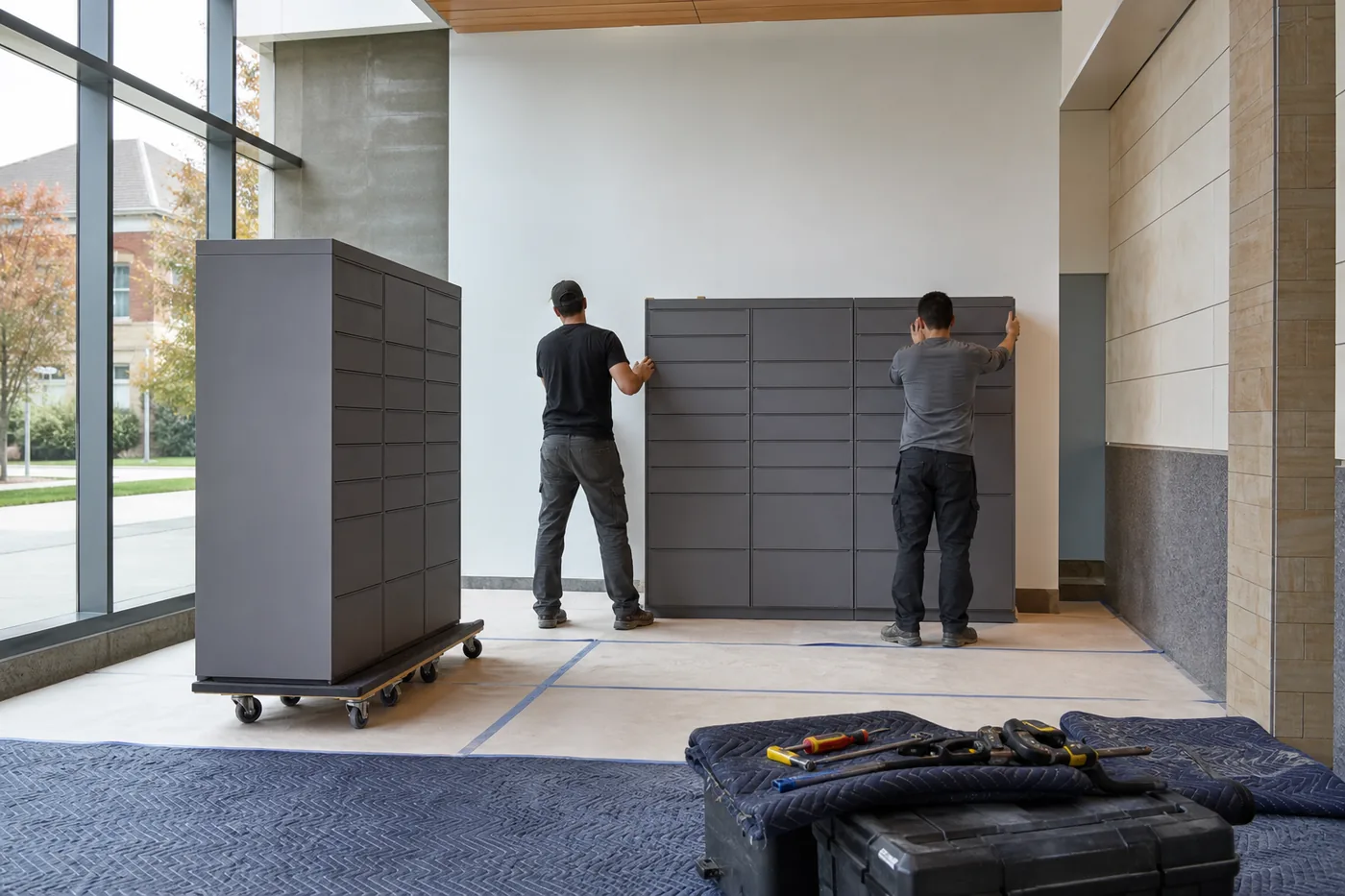
- Convert doors into towers. Build the count from standard tower layouts, including the tower with the control screen. Check that it fits the wall and leaves room to add towers later.
- Validate the physical layout. Check reach ranges, approach paths, open-door clearance, camera views, courier staging, power, and network. A wall with enough length can still fail if couriers have nowhere safe to stop or the control unit can’t connect.
Attach your demand worksheet, package measurements, occupancy and overflow tests, door mix, floor plan, utility notes, and accessibility review to the proposal. That saves a second approval meeting.
Want a second set of eyes on your numbers?
Send us your unit or employee count, a sample of package sizes, and a photo or drawing of the wall. We will suggest a door mix and tower layout and send an itemized quote.
Request a parcel locker quote or call (800) 326-4403
How to Evaluate Locker Size and Capacity for Your Office or Building Package Volume
If you are asking how to evaluate locker size and capacity for your office package volume, use the same test for any building: count doors at your busiest time and see if the bank still has room. Pull two to four weeks of delivery logs from the front desk, mailroom, or carrier receipts. Include one busy stretch if you can, like November and December.
- Count packages per day. Note the average day and the busiest day.
- Note how long items sit. Same-day pickup frees doors fast. Packages left over a weekend or during remote-work days tie them up.
- Sort by size. Tally how many items would fit a small, medium, large, or oversized door.
- Multiply doors needed by days held. A door holding a package for two days counts as two door-days. Add up door-days at your peak and compare that with the doors in the bank.
- Check the overflow plan. Decide where items go when every door of the right size is full.
For offices, the reception desk is often the pain point. Which parcel lockers are best suited for a busy business reception? Usually a bank placed near the desk, with mostly small and medium doors, badge or mobile code access, and alerts sent the moment a package lands. That lets staff stop handing out boxes all day. Our guide to parcel locker systems for offices covers office workflows in more detail. This article stays focused on the sizing math.
Which Package Locker Configurations Work Best for Buildings With High Delivery Volumes?
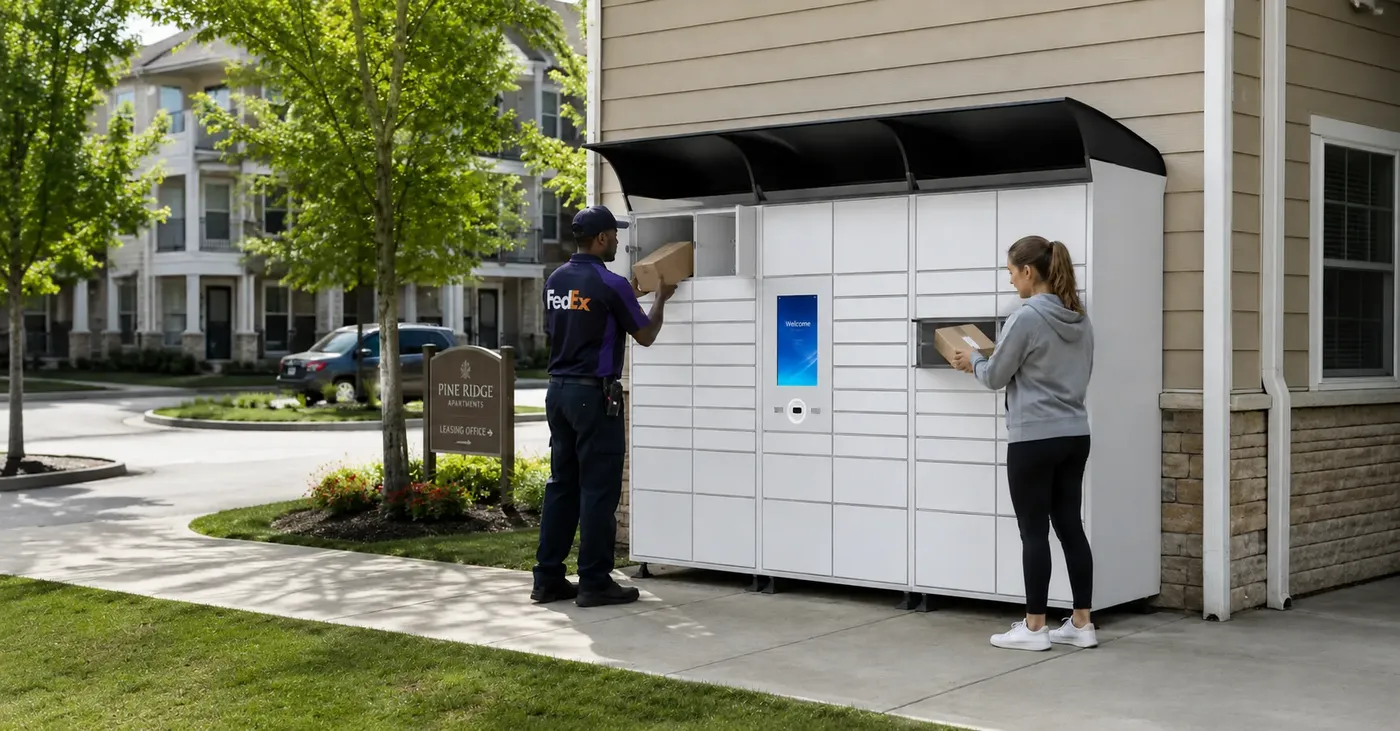
High-volume buildings do best with layouts that keep doors turning over and keep couriers moving. The best package locker configurations for high delivery volumes usually share these traits:
- Mostly small and medium doors, since those hold the bulk of daily deliveries.
- One control screen per bank, with room for a second on very long banks so two couriers can load at once.
- An overflow plan, like a secure package room or shelving, for peak days and bulky items.
- Pickup rules, like reminder alerts and a set hold time, so slow pickup does not lock up doors.
- Space to add towers on the same wall when volume grows.
Which locker configurations reduce carrier time-per-delivery?
Carrier time drops when the courier can find a free door of the right size fast. Configurations that help include a clear door mix (so the system rarely runs out of a size), a courier screen at the start of the bank, staging space for a cart in front of the towers, and a direct path from the loading door or entry. Banks split across several rooms, or mixed in with mailboxes, slow couriers down. When you compare layouts, walk the courier route from the curb to the screen and back.
Zone dividing lockers: splitting one bank into zones
Large sites often split a single bank into zones. One zone may serve residents, another staff, another returns or outbound items, and some systems let you set aside doors for a building, floor, or department. Zone dividing in software lets you size each group by its own demand instead of guessing for the whole site. When you plan zones, give each one its own small, medium, and large doors, and keep a shared pool for overflow. Ask each maker how its software assigns and moves doors between zones before you settle the count.
Choosing a Locker Configuration by Building Type
The table below turns common questions into a starting point. Use it with your measured package data, not in place of it.
| Building or use | Main sizing driver | Configuration to start with | Watch out for |
|---|---|---|---|
| Mid-size apartment building | Packages per unit and weekend dwell time | Indoor bank, mostly small and medium doors, a few large doors, room to add towers | Holiday peaks and move-in weeks |
| Large or high-volume complex | Peak-day volume and courier wait time | Long bank with a courier screen at the start, zones by building, plus an overflow room | Couriers queuing at one screen |
| Office with a busy reception | Same-day pickup and remote-work days | Bank beside reception, badge or mobile access, mostly small and medium doors | Packages held over long weekends |
| Retail returns and pickup | Return volume and pickup windows | Separate zone or bank for returns, customer-facing screen, some large doors | Returns mixed with outbound orders |
| Multi-site portfolio | Consistency across locations | Same software and door family at every site, sized site by site | Copying one site’s door count to all |
How to choose the right parcel locker system for an apartment complex
To choose the right parcel locker system for an apartment complex, start with your unit count, then adjust for how residents really shop and pick up. A mid-size building with young renters may get more deliveries per unit than a senior community. Compare at least two door mixes against your peak week, check that the bank fits the wall you have, and confirm the software works with your access control and resident app. For apartment package room layouts and resident workflows, see our article on smart locker systems for apartment package rooms, and compare models on our apartment parcel lockers page.
Which indoor parcel locker models are best for apartment buildings?
The best indoor model is the one whose door sizes match your measured packages and whose footprint fits your lobby or package room. Rather than chase a brand name, compare models on door size options, tower width and height, control screen placement, ADA reach range, software and app features, and how easy it is to add towers. Ask for each model’s published door dimensions and check them against your largest common box.
What are the most secure parcel locker configurations for apartment complexes or office buildings?
Security depends on where the bank sits and how access works, not only on the cabinet. The most secure setups place the bank inside a controlled entry, keep it in view of a camera, use one-time codes or app-based pickup, and keep an audit log of every drop-off and pickup. Fully enclosed towers with no gaps between doors and a solid back against the wall help too. For outdoor or semi-public spaces, ask about weather ratings and how the unit is anchored. Plan intercom and building entry systems at the same time so couriers can reach the bank without a staff escort.
What are the best parcel locker solutions for retailers handling high-volume returns?
Retailers handling high-volume returns often do best with a separate returns zone, or a separate bank, so returned items never compete with pickup orders for doors. Size the returns zone by how many returns arrive per day and how often staff empty it. Larger doors matter more here, since returns often come back in odd packaging.
How Do Open Locker Networks Scale Across Locations?
An open locker network lets more than one carrier or retailer use the same lockers. Across several sites, scaling works best when every location uses the same software and door family, so staff, couriers, and users see the same steps everywhere. Each site still needs its own sizing. A downtown office and a suburban complex will not have the same volume or dwell time, so never copy one site’s door count to the next. Central reporting helps here: compare occupancy and overflow across sites, then add towers where the numbers show strain. Learn more about our smart locker software, hosting, and integration options.
How to Evaluate Energy-Efficient and Low-Maintenance Parcel Lockers

Energy use and upkeep affect the long-term cost of a locker bank as much as its size. When you evaluate energy-efficient and low-maintenance parcel lockers, ask each maker:
- How much power the control unit draws and whether the screen sleeps when idle.
- Whether a solar or battery option exists for sites without power nearby.
- What finish and materials are used, and how they hold up to cleaning and daily use.
- How locks, hinges, and screens are serviced, and whether parts can be swapped on site.
- How software updates are delivered and whether remote support is included.
A right-sized bank also saves energy and upkeep. Fewer empty doors means fewer parts to maintain.
Parcel Locker Cost: Pricing Models and Contract Terms
We will not quote a single price here, because cost depends on door count, door mix, indoor or outdoor use, software, and install conditions. What we can do is show you what drives the number so you can compare quotes fairly.
What is the average cost to install parcel lockers for a 50-unit complex?
For a 50-unit complex, the cost to install parcel lockers comes down to these items:
- Door count and mix from your sizing work. This is the biggest driver.
- Number of control screens and any added kiosk features.
- Indoor or outdoor, since outdoor units may need canopies, weather ratings, or anchoring.
- Site prep, including power, network, wall blocking, and floor leveling.
- Delivery and installation, including freight, stairs, and after-hours work.
- Software, whether it is a one-time license or a monthly plan.
The fastest way to a real number is an itemized quote based on your delivery data. Request a parcel locker quote or call (800) 326-4403.
What are the typical pricing models and contract terms for multifamily locker systems?
Multifamily locker systems are usually bought outright, leased, or set up with a monthly software or service fee on top of the hardware. When you compare offers, read the contract terms for the length of the software agreement, what support and repairs are included, who owns the hardware at the end, whether fees are per door or per site, and what it costs to add towers later. Ask for each option in writing so you can compare total cost over the years you plan to use the lockers.
Sizing Pitfalls and Code Constraints
The most common mistake is sizing for last Tuesday. Average volume can look fine while holiday demand, slow pickup, or one big office order causes overflow. Other mistakes to avoid:
- Too many large doors. As the Seattle example shows, this can cause more overflow, not less.
- Ignoring dwell time. A few packages left for days can quietly take a column out of service. Set a pickup deadline and a plan for uncollected items.
- No room to grow. Leave wall space and a power path for another tower.
- Forgetting returns. If residents or staff send packages out, plan doors or a drop-off spot for them.
- Planning power and data last. Moving an outlet or network drop after install is costly.
USPS parcel locker ratio for mailbox installations
For mail receptacles, USPS STD-4C requires at least one standard parcel locker for every ten customer mailboxes, as shown in the USPS parcel locker ratio requirements. Sites with fewer than ten mailboxes don’t have to include one, but USPS encourages it. Lockers used to meet that ratio must be at least 15 inches high, as this parcel locker installation guidance notes. These rules affect the size of the mailbox cabinet and how much package volume it can take on its own.
Mounting height matters too. Mailbox installation guides call for the lowest parcel locker floor to be at least 15 inches above the finished floor and at least one customer compartment below 48 inches, according to this mailbox placement guidance. Always confirm current USPS rules with your local postmaster before ordering mailboxes.
Accessibility at the locker face
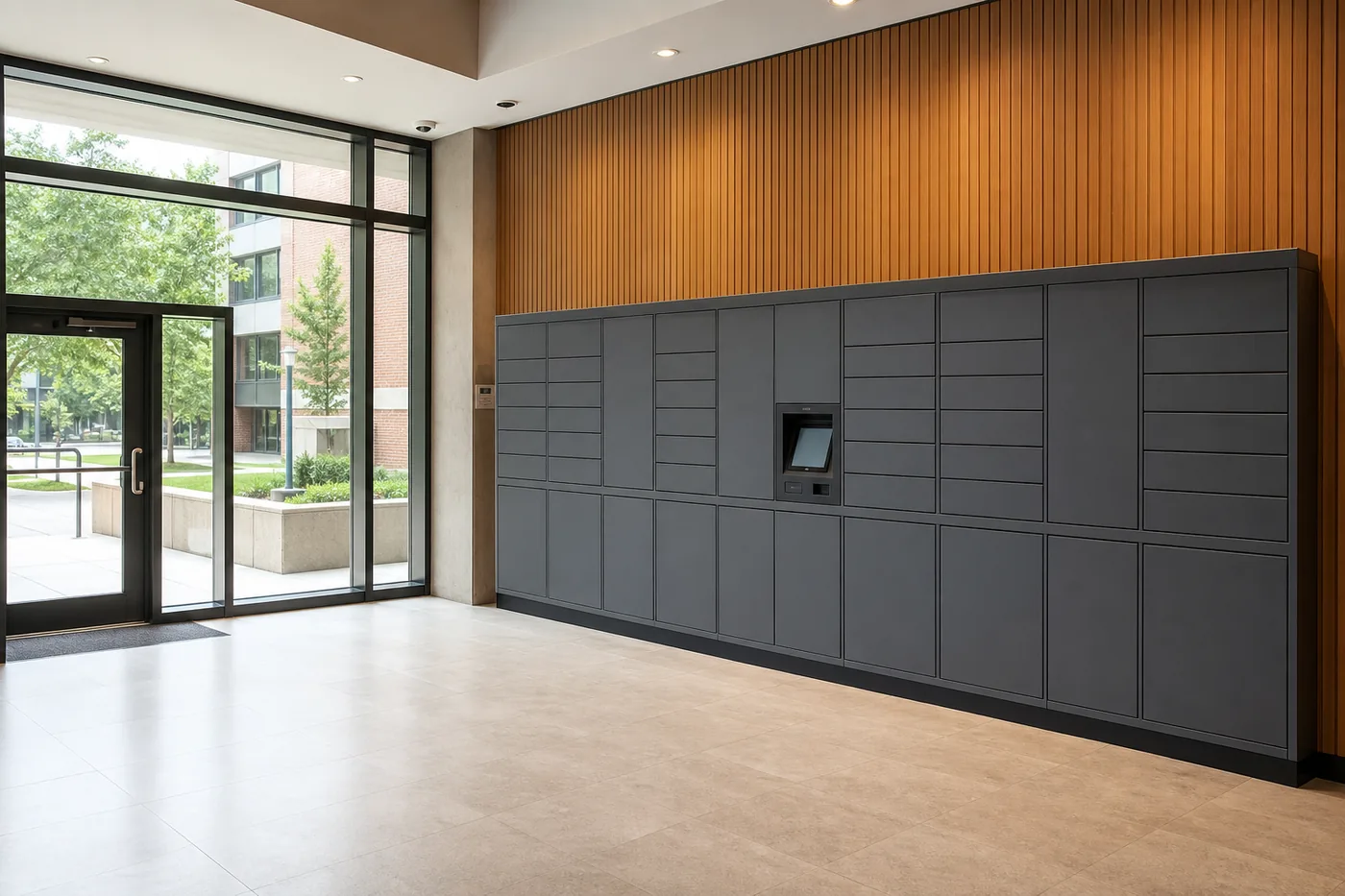
Under the 2010 ADA Standards, parts people must operate, such as screens, keypads, and handles, generally need to sit within a 15 to 48 inch reach range when the reach is unobstructed, with clear floor space in front (see the U.S. Access Board guide to operable parts). In practice, that means placing the control screen and enough doors inside that band, keeping the approach path clear, and making sure open doors don’t block the route.
Local building, fire, electrical, and accessibility rules also apply. Have your design professional confirm them before approval. A code-ready layout protects capacity because it keeps doors reachable and the system usable for everyone it serves.
Next Steps and How Our Team Helps
A solid proposal makes four things clear: the demand assumption, the occupancy and overflow tests, the door mix, and the physical layout. If any of these is missing, you are comparing cabinet counts instead of complete solutions.
Start with a site walk. Confirm wall length, ceiling height, floor, approach path, courier staging, power, network, and camera views. Then check your door mix against measured packages and decide which items go to overflow or specialty handling.
Material Handling USA helps property managers, facility teams, and architects plan parcel locker projects. We can review your delivery data and site plan, suggest a door mix and tower layout, provide itemized quotes for bid comparison, and coordinate delivery and installation with your team. Explore our parcel lockers and smart locker and package locker options, or learn about smart locker software and integration. Utah projects can start with our Utah parcel lockers page, and apartment or condo properties can compare models and door sizes on our apartment package lockers page.
A well-planned locker bank can also help facilities drive revenue and cut costs by cutting manual package handling and freeing up space. Starting early gives you time to fix power and network conflicts and avoid rework after move-in.
Related reading: smart locker systems for apartment package rooms, parcel locker systems for offices, and our complete smart locker systems guide.
Parcel Locker Sizing FAQ
How many parcel lockers do I need per apartment unit?
There is no single rule for smart package lockers. In one published Seattle study, a 133-unit building worked well with 55 doors, about 0.4 doors per unit. Your number depends on packages per resident, pickup speed, and peak season, so measure your own deliveries first.
What is the USPS parcel locker ratio?
For USPS mail receptacles built to STD-4C, the rule is at least one standard parcel locker for every ten customer mailboxes. Sites with fewer than ten mailboxes are not required to have one. This ratio applies to postal mailboxes, not to multi-carrier smart package lockers.
What size are USPS parcel lockers?
USPS STD-4C sets minimum inside dimensions of 15 inches high by 12 inches wide by 15 inches deep for a standard parcel locker, and 18 by 12 by 15 inches for a large one.
Should I buy more large compartments to be safe?
Usually not. Large doors take up the space of several small ones. If small packages end up in them, you lose usable doors. Most sites need mostly small and medium doors, with a few large and oversized ones for bulky items.
What occupancy rate should a parcel locker run at?
Pick a target with your building staff. The Seattle study used a maximum average occupancy of 60% plus no more than five overflow packages per week. Lower targets give more room for holiday spikes but need more doors.
How does pickup time affect locker size?
A lot. Every hour a package sits, its door can’t take another delivery. If pickup slows by the same share that deliveries grow, the effect on occupancy is similar. Pickup deadlines and reminder alerts help free up doors.
What are the ADA requirements for parcel lockers?
The 2010 ADA Standards call for operable parts, like screens, keypads, and handles, to be within a 15 to 48 inch reach range with clear floor space in front when the reach is unobstructed. Check local codes too, and have your design professional confirm the final layout.
Can I add more lockers later?
Most smart locker systems are modular, so you can usually add towers later. Plan for it now by leaving wall space, a clear floor, and a path for power and network next to the bank.
Plan Your Parcel Locker Bank With Material Handling USA
Material Handling USA can turn your package data and site limits into a right-sized locker layout, an itemized quote, and a coordinated install plan. Start with our smart locker systems, request a free quote, visit Material Handling USA, or call (800) 326-4403.