
Cantilever Rack Systems
Open-front storage for long, bulky, and irregularly shaped items — lumber, pipe, steel bar, furniture, plywood, and more. No front columns means full-length access from any level. For a worked example, see how a lumber yard racking system combines cantilever rack with pallet rack for palletized building materials. Roll stock is another case for arms rather than beams — see how we approach pallet racking for a print and packaging operation storing skids, rolls and finished cartons.
What Is Cantilever Rack?
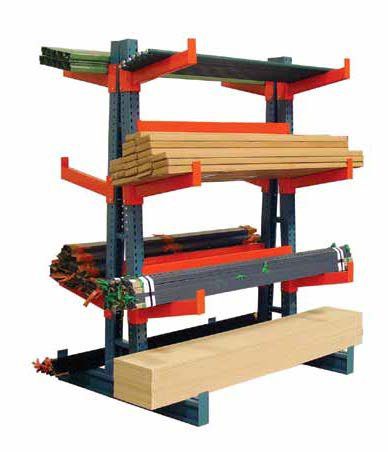
An open-face racking system with horizontal arms extending from vertical columns — designed for items that are too long, wide, or irregularly shaped for standard pallet rack.
Cantilever rack eliminates front columns entirely. Instead of storing items between vertical uprights, cantilever uses horizontal arms projecting from a single row of columns. This gives you unobstructed access to the full length of every storage level — perfect for lumber yards, steel service centers, furniture warehouses, and pipe storage facilities.
The system is available in single-sided (against a wall) and double-sided (freestanding, accessible from both sides) configurations. Arms are adjustable in height and can be angled upward to prevent loads from sliding off. Material Handling USA designs, supplies, and installs cantilever rack systems across the United States.
How Cantilever Rack Works
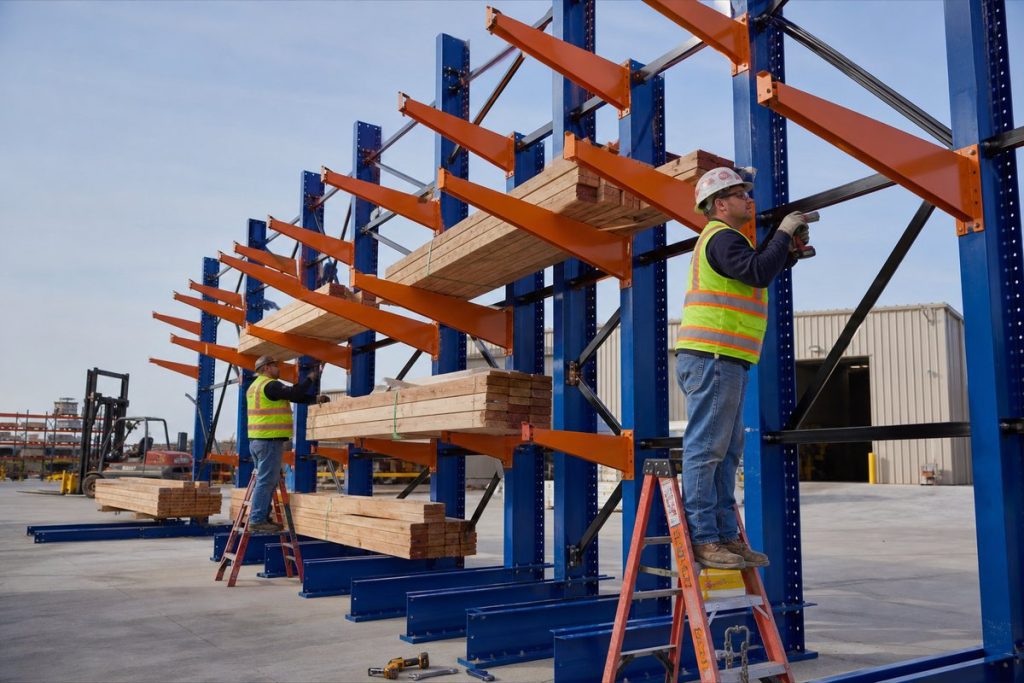
Vertical columns bolt to a base that anchors to the floor. Horizontal arms bolt or pin into holes on the column face and can be repositioned as storage needs change. Diagonal and horizontal bracing connects columns for structural stability. Loads are placed directly onto the arms by forklift, overhead crane, or manually for lighter items.
Cantilever Rack Configurations

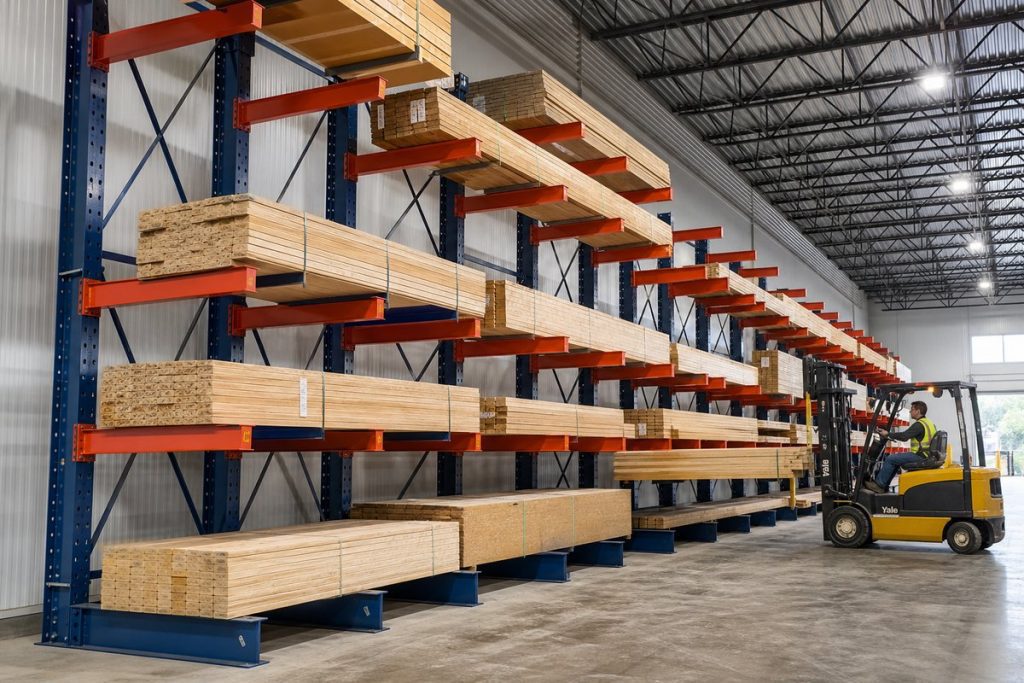
Single-Sided Cantilever
Arms project from one side of the column only. Designed to be placed against a wall or building perimeter. Base extends in the opposite direction for stability. Column capacities up to 11,200 lbs for heavy-duty models.
Best for: Wall-mounted storage, lumber yards along building perimeters, retail displays

Double-Sided Cantilever
Arms project from both sides of the column. Freestanding design accessible from two aisles. Provides double the storage per footprint compared to single-sided. Column capacities up to 22,400 lbs.
Best for: Center-of-warehouse applications, steel service centers, high-volume lumber storage
Medium-Duty Cantilever
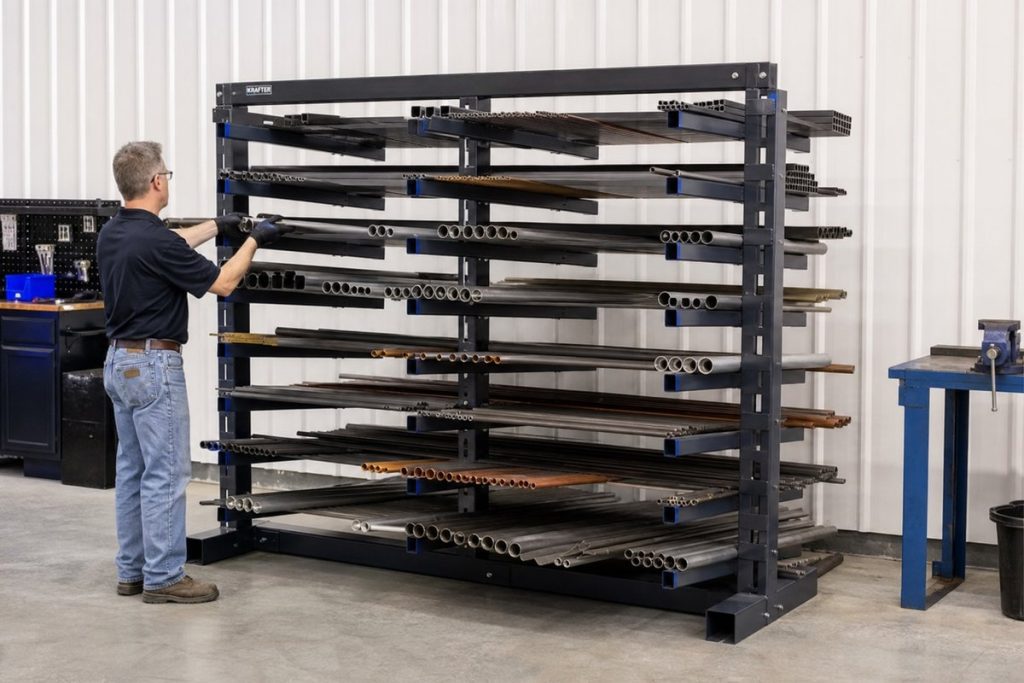
Lighter-weight option for bars, pipes, rods, and tubing. All units 79″ tall with arms adjustable in 1½” increments. Arms available in 12″, 18″, and 24″ lengths with welded end-stops. Assembles in under 10 minutes.
Best for: Pipe storage, bar stock, metal rod inventory, light manufacturing
Technical Specifications
Heavy-Duty Cantilever
| Component | Options | Capacity |
|---|---|---|
| Column Heights | 8′, 10′, 12′ (custom heights available) | Up to 22,400 lbs/column (double-sided) |
| Arm Lengths | 24″, 36″, 48″ | 900 – 2,200 lbs per arm |
| Arm Angles | 4° incline, 20° incline, straight | Inclined arms prevent load rolloff |
| Brace Widths | 3′, 4′, 6′, 8′ spans | Sets for 8’/10′ and 12′ column heights |
| Arm Adjustment | Every 3″ on column face | Repositionable without disassembly |
| End Stops | Optional bolt-on for heavy-duty arms | Prevents load from sliding off arm end |
Medium-Duty Cantilever
| Component | Options | Capacity |
|---|---|---|
| Column Height | 79″ standard | Single-sided and double-sided |
| Arm Lengths | 12″, 18″, 24″ | 600 – 1,000 lbs per arm |
| Arm Adjustment | Every 1½” on column face | Fine-tuned to product dimensions |
| Brace Beams | 36″, 48″, 72″ | 4 beams required per section |
| Assembly | Bolt-together design | Under 10 minutes per section |
Applications & Industries
🪵 Lumber & Building Materials
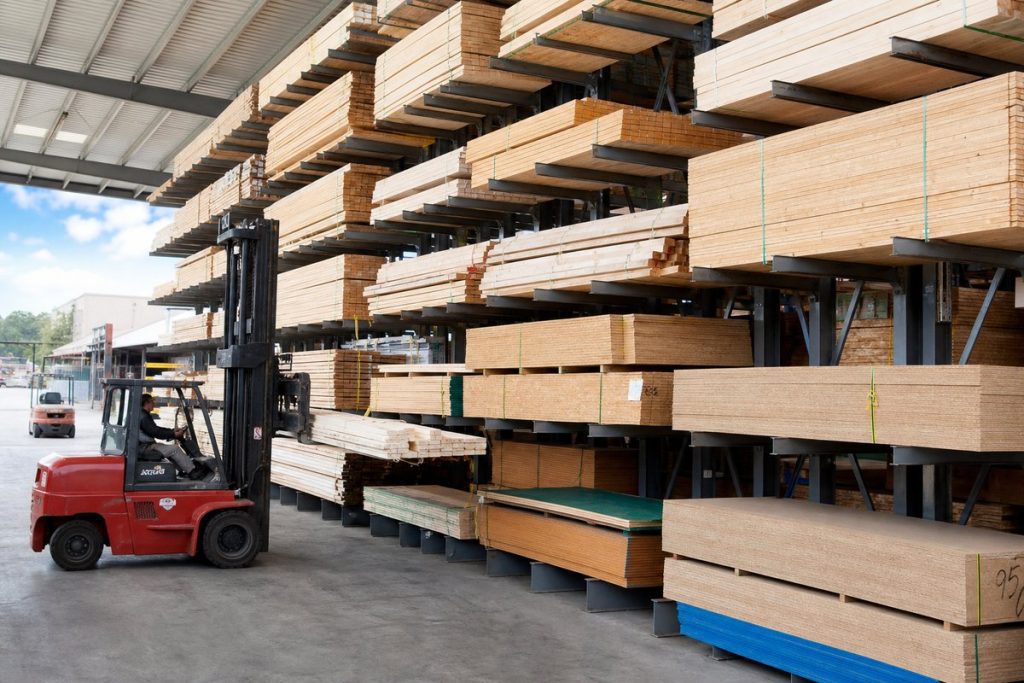
The #1 application for cantilever rack. Dimensional lumber, plywood sheets, OSB, MDF, and trim all store cleanly on arms. Forklifts access full bundles from the front without obstructions. Most lumber yards and building supply stores use cantilever exclusively.
🔩 Steel & Metal Service Centers

Store steel bar, angle iron, channel, pipe, tube, and flat stock. Heavy-duty cantilever handles the weight. Inclined arms keep round stock from rolling off. Organize by size, gauge, and alloy for fast picking.
🛋️ Furniture & Appliances

Sofas, mattresses, table tops, and large appliances that don’t fit in standard pallet rack. Cantilever’s open front allows loading oversized items without worrying about upright spacing.
🏗️ Construction & Contractor Supply
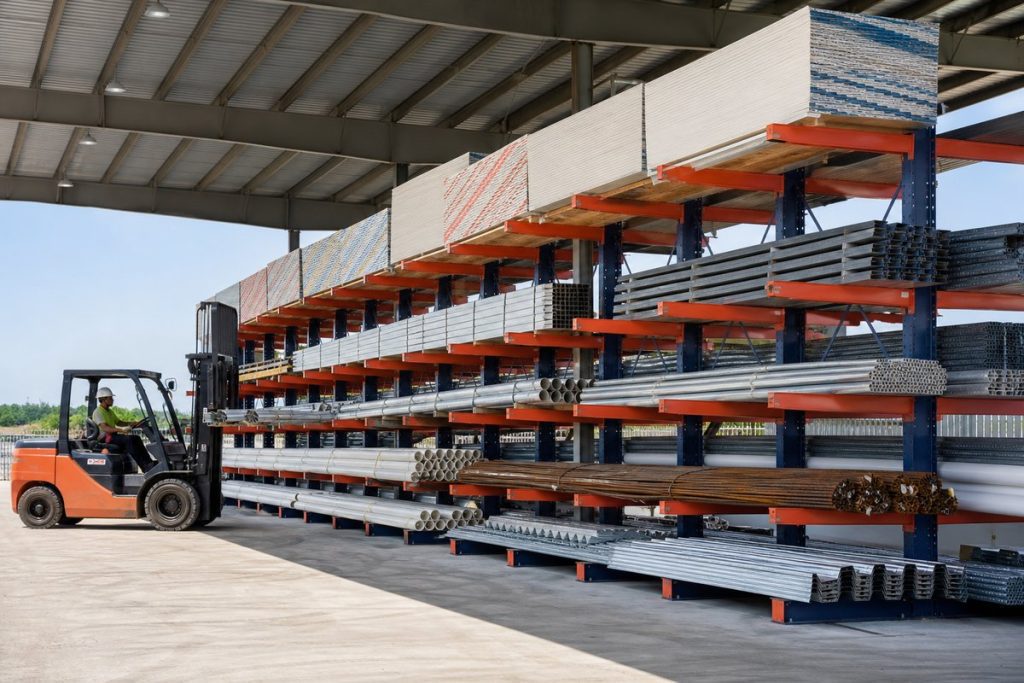
Drywall, conduit, rebar, PVC pipe, metal roofing panels, and prefab components. Cantilever keeps long materials organized and accessible on job sites and in contractor warehouses.
🚗 Automotive & Manufacturing
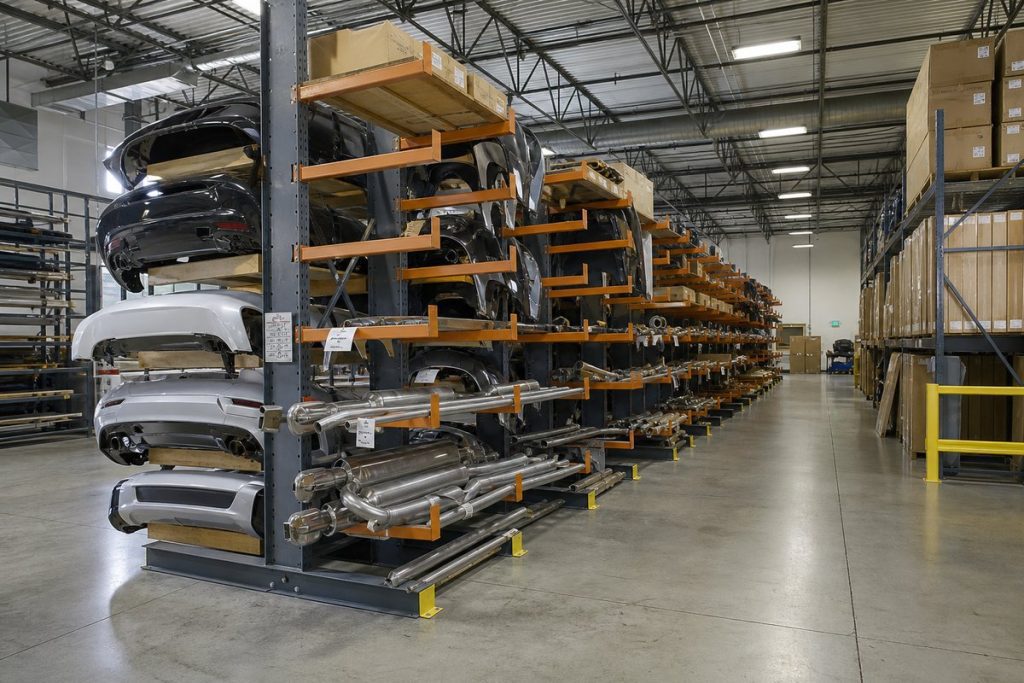
Bumpers, exhaust systems, trim moldings, sheet metal blanks, and raw material bar stock. Cantilever is common in auto parts distribution and manufacturing staging areas.
📐 Carpet, Fabric & Rolls

Carpet rolls, vinyl flooring, fabric bolts, paper rolls, and wire spools. Cantilever arms support the full length of rolled materials without sagging or deformation.
Advantages of Cantilever Rack
- No front columns — unobstructed access to every storage level
- Handles any length — 2-foot pipe to 24-foot lumber beams
- Adjustable arms — reposition in 1½” to 3″ increments as product mix changes
- Single or double sided — wall-mount or freestanding configurations
- Heavy-duty capacity — up to 22,400 lbs per column (double-sided)
- Inclined arm options — prevents round stock from rolling off (4° and 20° angles)
- Fast assembly — medium-duty units assemble in under 10 minutes
- Forklift and crane compatible — load with standard equipment
- Indoor or outdoor — galvanized options for outdoor lumber yards
- Bolt-together design — damaged components replace individually without welding
Cantilever vs. Standard Pallet Rack
| Feature | Cantilever Rack | Standard Pallet Rack |
|---|---|---|
| Front Access | 100% open — no columns | Limited by upright spacing |
| Best Item Shape | Long, bulky, irregular | Palletized, uniform sizes |
| Item Length | Unlimited (add more columns) | Limited to beam span (typically 8’–12′) |
| Arm/Level Adjustment | Every 1½”–3″ | Every 2″ (beam in teardrop) |
| Inventory Rotation | FIFO (all positions accessible) | FIFO for selective, varies by type |
| Typical Industries | Lumber, steel, pipe, furniture | Distribution, food, manufacturing |
Choose cantilever if: Your items are longer than 8 feet, irregularly shaped, or cannot be palletized. Also ideal for items stored at varying lengths within the same system.
Choose standard pallet rack if: Your inventory is palletized, uniform in size, and fits within standard beam spans.
When to Choose Cantilever Rack
Cantilever rack is purpose-built for long, bulky, and irregularly shaped items that don’t fit on pallets. If your product can’t sit on a standard 48×40 pallet, cantilever is likely the answer.
Ideal Products for Cantilever
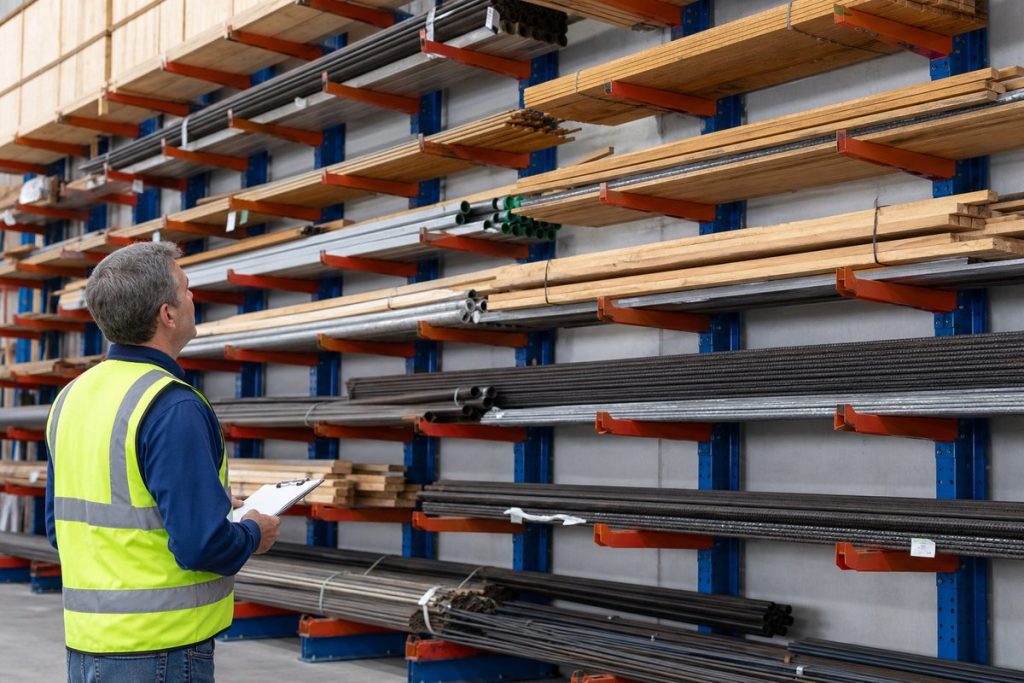
- Lumber & plywood — 2×4s, dimensional lumber, sheet goods, engineered wood products
- Steel & metal stock — Bar stock, tubing, pipe, angle iron, flat stock, rebar
- PVC & conduit — Electrical conduit, plumbing pipe, PVC bundles
- Furniture & fixtures — Countertops, doors, window assemblies, cabinets
- Carpet rolls & fabric — Rolled goods that need horizontal support across their full length
- Drywall & sheet metal — Flat materials stored vertically or horizontally in bulk
Single-Sided vs. Double-Sided
🔹 Single-Sided
Arms extend from one side of the upright column. Place against walls to maximize floor space. Ideal for building perimeters, lean-to structures, or anywhere you need one-sided access. Less stable — requires wall anchoring or heavier bases.
🔹 Double-Sided
Arms extend from both sides of a shared center column. Creates freestanding rows accessible from two aisles. More stable and cost-effective per storage position. Best for open floor areas with forklift access on both sides.
💡 Indoor + Outdoor Versatility
Cantilever rack works indoors and outdoors. For outdoor installations (lumber yards, pipe storage, steel service centers), we specify galvanized or powder-coated finishes to resist corrosion. Roof structures can be added to protect weather-sensitive materials.
Installation & Structural Considerations
Cantilever rack handles forces very differently from pallet rack. Proper engineering prevents the most common — and most dangerous — failure mode: tipping.
⚖️ Base & Overturning Resistance
Unlike pallet rack where weight pushes straight down through uprights, cantilever arms create a tipping moment — the farther the load extends from the column, the more force tries to tip the system. Heavy-duty base plates, diagonal bracing, and proper anchoring counteract this force. Single-sided systems are especially prone to tipping without adequate anchoring.
🏗️ Concrete Requirements
Cantilever rack exerts different forces on the floor than pallet rack. The anchor bolts resist uplift (pulling out of the floor), not just shear. Minimum 6″ concrete thickness is typical, but heavy-duty systems may require 8″+ or special foundation work. For outdoor installations on asphalt, concrete pads are poured at each column location.
🌊 Seismic Engineering
Cantilever rack’s tall, narrow profile and cantilevered loads make it particularly sensitive to seismic forces. The overturning moment increases dramatically during an earthquake. In Utah’s seismic zone, PE-stamped calculations are required — MH-USA includes seismic engineering on every cantilever project.
⚠️ Loading Rules That Prevent Tip-Over
Always load from the bottom up and unload from the top down. A fully loaded bottom arm with empty upper arms is stable. Empty bottom arms with loaded upper arms raises the center of gravity dangerously. For single-sided cantilever, never load arms unevenly along the row — distribute weight across all columns. Post load capacity charts at each row and train operators on loading sequence.
Arm Configuration & Load Planning
Cantilever rack is more customizable than any other system. Arm length, spacing, and capacity are all engineered to your specific products.
Arm Length Selection
| Arm Length | Typical Products | Capacity Range |
|---|---|---|
| 24″–36″ | Bar stock, small pipe bundles, metal flat stock | 1,000–3,000 lbs/arm |
| 36″–48″ | Lumber bundles, sheet goods (plywood, drywall), tubing | 1,500–5,000 lbs/arm |
| 48″–72″ | Large lumber packs, furniture, carpet rolls, long steel | 2,000–6,000+ lbs/arm |
Column Spacing
Column spacing determines how long your stored items can be and how many support points they have. Standard spacing is 4′, 5′, or 6′ on center. Longer items need wider spacing — but wider spacing reduces arm capacity because each arm supports more of the load. For 20-foot lumber, 4-foot column spacing gives 5 support points; 5-foot spacing gives 4.
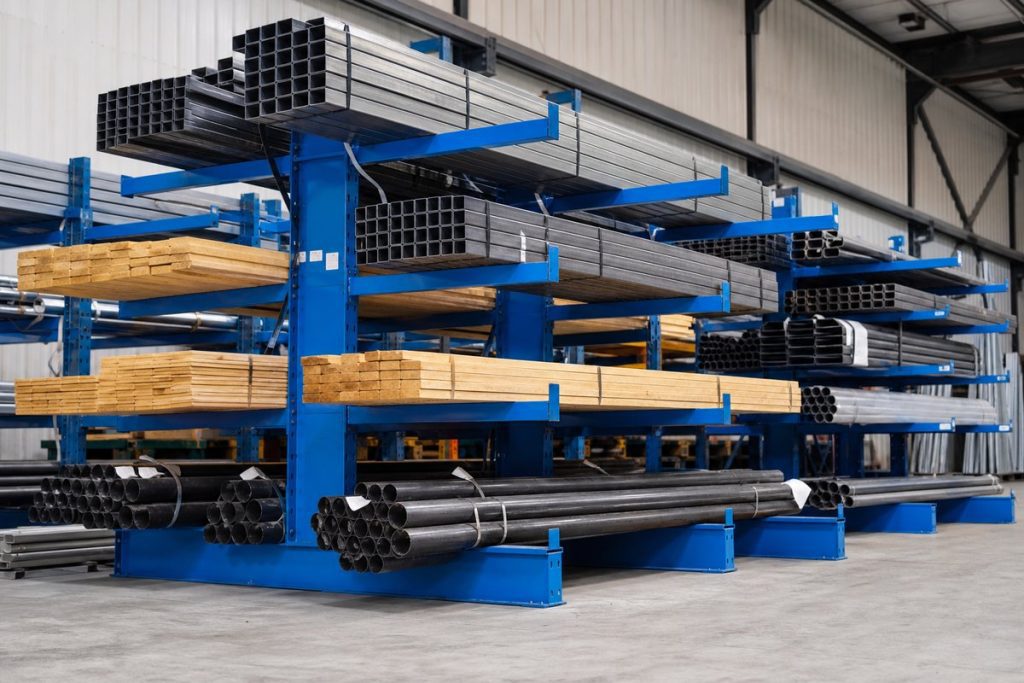
💡 Mix Arm Lengths on the Same Column
You’re not limited to the same arm length on every level. Many operations use longer arms on the bottom levels (for bulky items loaded by forklift) and shorter arms higher up (for lighter, hand-loaded items). MH-USA designs mixed-arm systems that maximize storage for your specific product mix.
What Affects Cantilever Rack Cost?
Cantilever rack pricing varies dramatically based on configuration. Here are the factors that drive your project cost.

📐 Arm Length & Capacity
Longer arms and higher weight capacities require heavier steel. A 48″ arm rated at 3,000 lbs costs significantly more than a 24″ arm at 1,000 lbs. The arm is the most repeated component — small per-arm savings multiply across the entire system.
📏 Height
Taller columns (16’+) require heavier gauge steel, more bracing, and more substantial base plates. The tipping forces increase with height. Most cantilever systems run 8–20 feet; above 20 feet, engineering costs increase significantly.
🌧️ Indoor vs. Outdoor
Standard cantilever uses painted or powder-coated finishes adequate for indoor use. Outdoor installations need galvanized columns, arms, and hardware — adding 20–35% to material cost. Roof structures add further cost but protect inventory from weather damage.
Inspection & Maintenance for Cantilever Rack
Cantilever rack takes heavy impacts from forklifts and cranes loading bulky materials. Regular inspection prevents tip-over — the most dangerous cantilever rack failure mode.
Inspection Checklist
| Component | Check For | Frequency |
|---|---|---|
| Column plumb | Lean, tilt, or deflection from vertical | Weekly |
| Arm connections | Loose pins, bent connectors, cracks at column interface | Monthly |
| Arm deflection | Permanent bend/sag indicating overloading | Monthly |
| Base plates & anchors | Loose anchors, cracked concrete, plate deformation | Monthly |
| Horizontal bracing | Missing or loose bracing between columns | Monthly |
| Corrosion (outdoor) | Rust, coating failure, weld degradation | Quarterly |
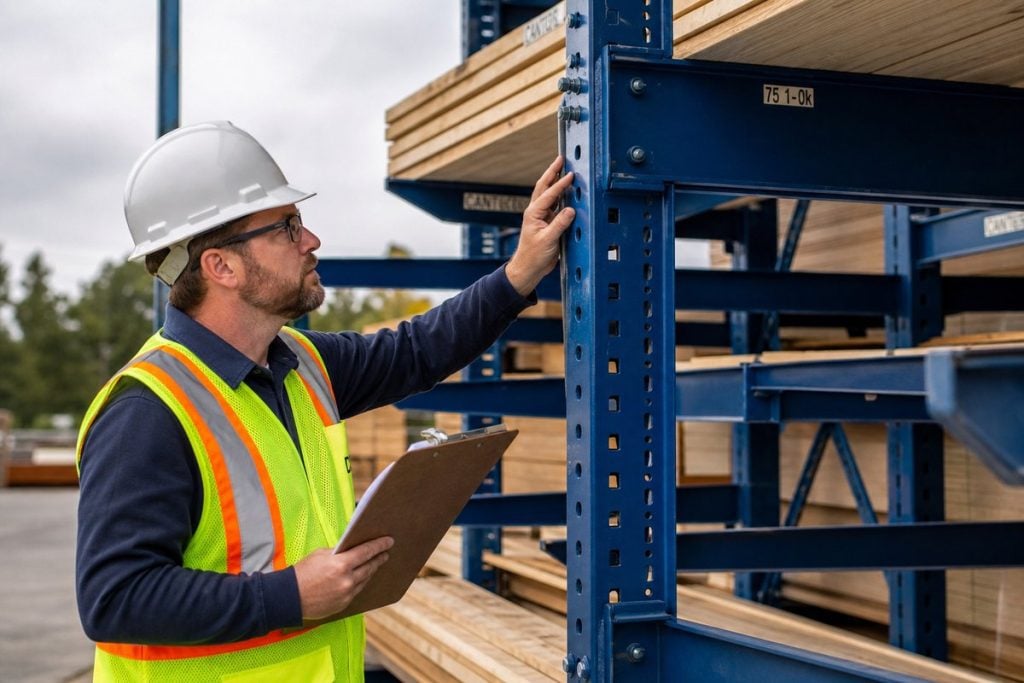
🔧 Arm Replacement & Upgrades
Cantilever arms are designed to be removable and replaceable. If your product mix changes, arms can be swapped for different lengths or capacities without replacing the entire system. Bent or damaged arms should be replaced immediately — a bent arm has lost its engineered load capacity. Schedule a cantilever rack inspection →
Frequently Asked Questions
How much weight can cantilever rack hold?
Individual arm capacities range from 600 lbs (medium-duty, 24″ arm) to 2,200 lbs (heavy-duty, 24″ arm). Column capacities reach 22,400 lbs for heavy-duty double-sided units. Material Handling USA engineers each system for your specific load requirements.
Can cantilever rack be used outdoors?
Yes. Galvanized cantilever rack is available for outdoor lumber yards, steel service centers, and building material storage. Galvanized finish resists rust and corrosion from weather exposure.
What’s the difference between single-sided and double-sided cantilever?
Single-sided cantilever has arms on one side only — designed to sit against a wall. Double-sided has arms on both sides and sits freestanding in an aisle, accessible from both directions. Double-sided provides 2× the storage per footprint but requires aisle access on both sides.
How do I prevent round materials from rolling off the arms?
Use inclined arms (4° or 20° upward angle) and optional end-stops. The incline creates a natural cradle that holds pipe, bar stock, and rolls in place. End-stops bolt to the arm tips as an additional safety barrier.
Can cantilever rack store carpet rolls and fabric bolts?
Yes. Cantilever is the standard solution for roll storage in flooring, fabric, and paper industries. Arms support the full length of the roll without sagging. Longer arms (36″–48″) accommodate wider rolls.
Explore More Pallet Rack Solutions
Need Cantilever Storage for Your Operation?
Material Handling USA designs, supplies, and installs cantilever rack systems for lumber yards, steel service centers, manufacturing facilities, and warehouses nationwide.
Online Store
Shop at MaterialHandling-USA.com
Need rack components or warehouse supplies? Shop online for fast delivery:
Warehouse Equipment & Supplies
Pallets
Stretch Wrap & Shrink Film
Shipping Labels & Tags
Shop pallet rack & accessories →