
Pallet Flow Rack Systems
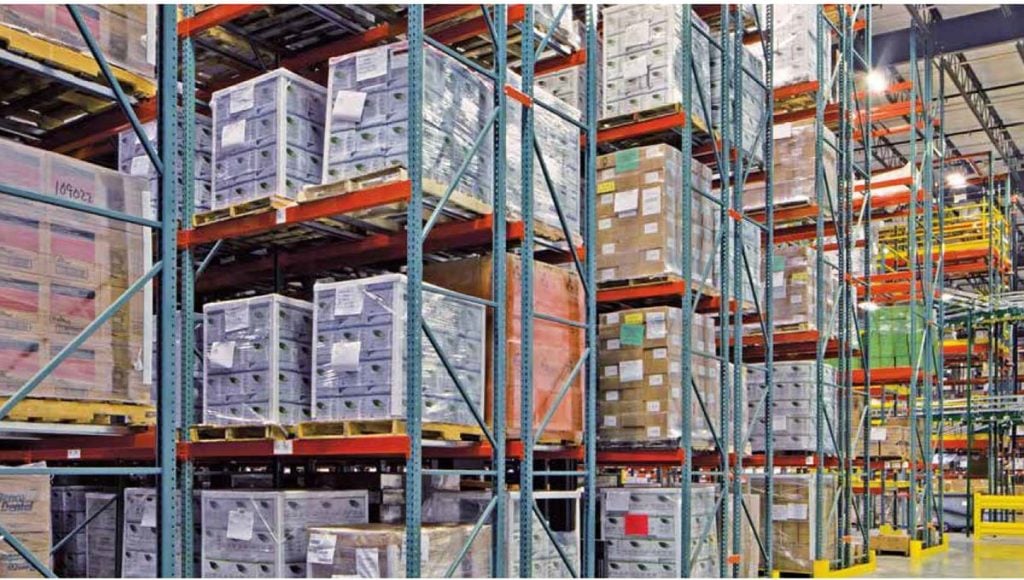
Gravity-fed, high-density pallet storage with guaranteed FIFO inventory rotation. Pallets load at the back, flow to the front on roller conveyors, and pick from a single aisle — no forklifts inside the rack.

What Is Pallet Flow Rack?
A gravity-driven, deep-lane storage system that automatically advances pallets from the loading aisle to the picking aisle — ensuring perfect first-in, first-out (FIFO) inventory rotation.
Pallet flow rack (also called gravity flow rack or dynamic flow storage) uses inclined roller conveyors mounted inside a structural rack frame. Pallets are loaded by forklift at the higher (back) end of the lane. Gravity pulls each pallet forward on the rollers toward the lower (front) pick face. When the front pallet is removed, the next pallet automatically rolls into position — no operator intervention required.
This system is the gold standard for operations that must maintain strict FIFO rotation — food and beverage distribution, pharmaceutical warehousing, cold storage, and any facility where product expiration dates, lot codes, or date-sensitive inventory drive the operation. Material Handling USA designs, supplies, and installs pallet flow rack systems across the United States.
How Pallet Flow Rack Works
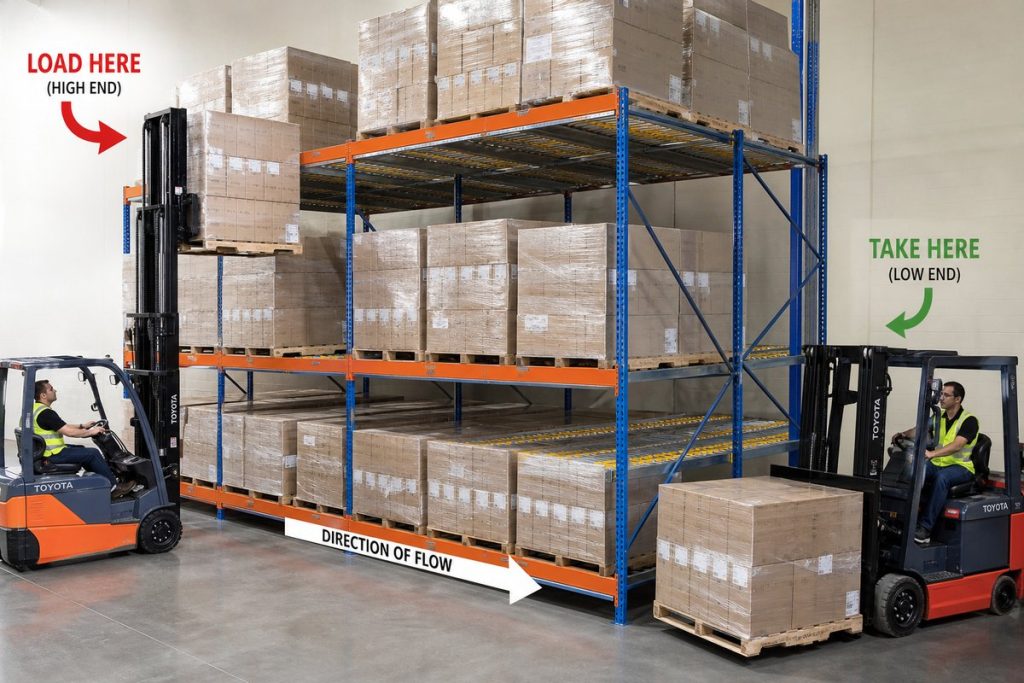
Loading side (back): A forklift places pallets on the elevated end of the lane. Each lane is pitched at a slight decline — typically 3% to 5% grade — so gravity moves the pallet forward on the roller conveyor tracks.
Pick side (front): Pallets queue up at the front of the lane. The operator picks from the lowest pallet position. When that pallet is removed, the next one rolls forward into the pick position automatically.
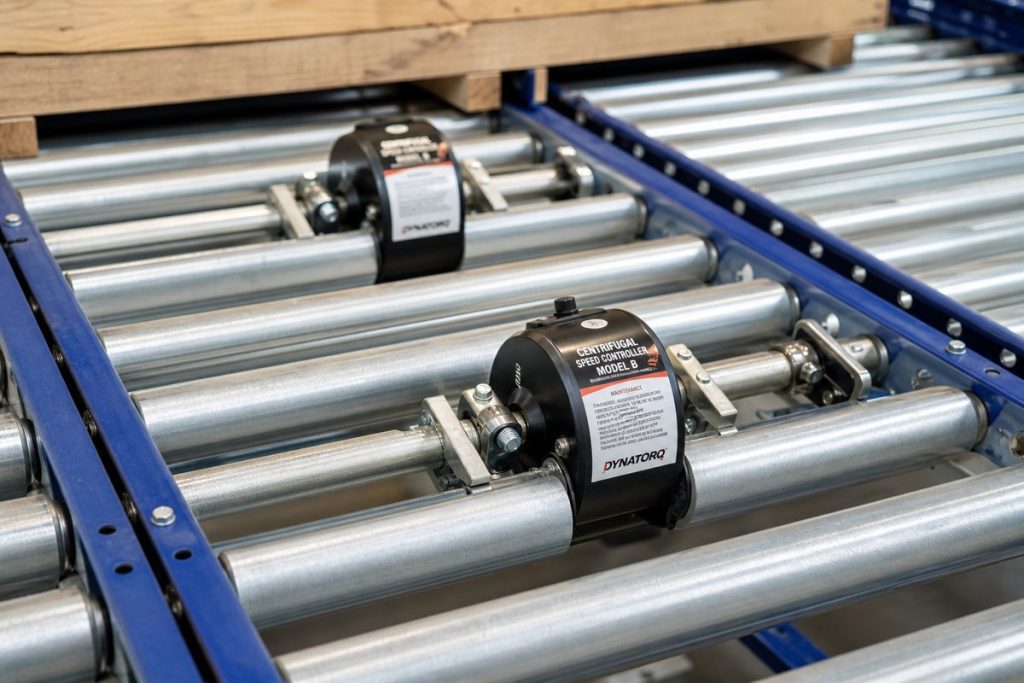
Speed controllers and brakes: Built-in speed controllers (centrifugal brakes) regulate pallet speed as it travels down the lane, preventing damage and controlling flow. Pallet separators at the pick face hold the next pallet back until the front position is clear.
Pallet Flow Configurations
Pallet flow systems are engineered for specific pallet weights, lane depths, and throughput requirements.
Full-Width Roller Beds
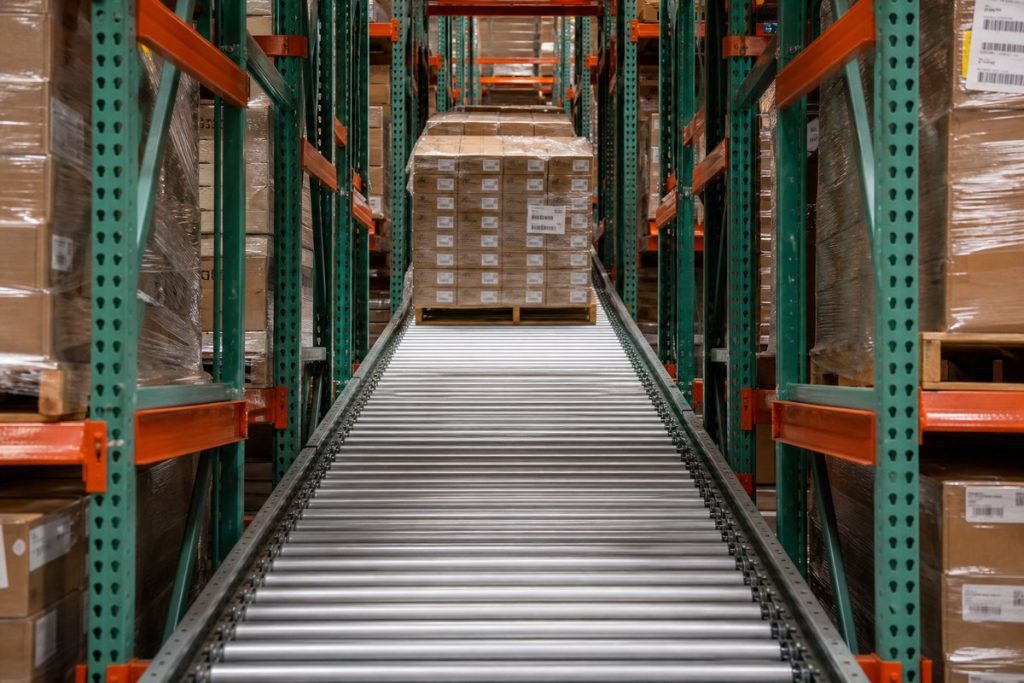
Standard configuration with rollers spanning the full width of the lane. Best for consistent pallet sizes. Handles up to 2,500 lbs per pallet. Multiple rollers across the width ensure stable, even flow.
Best for: Standard 48″×40″ pallets, food/beverage distribution, pharmaceutical warehousing
Rail-Style (Wheel) Flow

Uses steel wheels mounted on rails instead of full-width rollers. Lower profile, lower cost per lane. Works well with lighter loads and uniform pallet quality. Common in carton-level or light-duty pallet applications.
Best for: Lighter pallets under 1,500 lbs, consistent pallet quality, temperature-controlled environments
Chain-Driven Flow
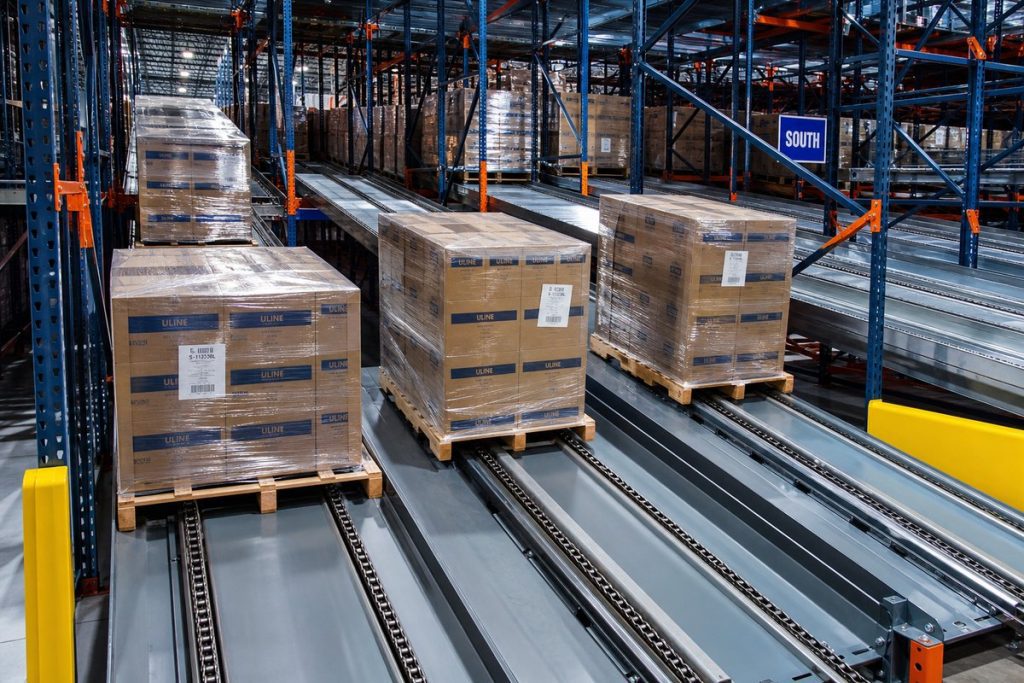
Uses non-continuous chain on inclined tracks for controlled pallet movement. The chain engages under gravity and provides smooth, controlled flow. Good for heavier loads where roller systems may allow too much speed.
Best for: Heavy pallets (2,000+ lbs), long lanes (15+ pallets deep), high-throughput operations
Technical Specifications
Engineering data for pallet flow rack system design.
System Parameters
| Parameter | Typical Range | Notes |
|---|---|---|
| Lane Depth | 2 to 20+ pallets | Most common: 5–10 deep |
| Pallet Weight Capacity | 1,500 – 3,000 lbs per pallet | Heavier loads available with engineered systems |
| Lane Width | 44″ to 54″ clear | Sized to pallet width + clearance |
| Grade / Pitch | 3% to 5% (3/8″ to 5/8″ per foot) | Steeper pitch for lighter loads |
| Speed Controllers | Every 8–12 feet of lane | Centrifugal brakes regulate pallet speed |
| Pallet Separators | At pick face | Hold next pallet until front is removed |
| Frame Heights | 12′ to 30’+ | Multi-level configurations common |
| Compliance | RMI / ANSI MH16.1 | Seismic engineering included |
Roller Conveyor Specifications
| Roller Type | Capacity (per lane) | Speed Control | Best Application |
|---|---|---|---|
| Full-Width Rollers | Up to 2,500 lbs/pallet | Centrifugal brakes | Standard pallets, high volume |
| Steel Wheel Rails | Up to 1,500 lbs/pallet | Drag brakes | Lighter loads, uniform pallets |
| Chain-Type Flow | Up to 3,000+ lbs/pallet | Chain resistance | Heavy loads, long lanes |
| Magnum Roller | Up to 4,000 lbs/pallet | Centrifugal + separator | Very heavy duty, freezer |
Key Components of a Pallet Flow System
Every pallet flow installation requires these precision-engineered components working together.
Roller Conveyor Tracks
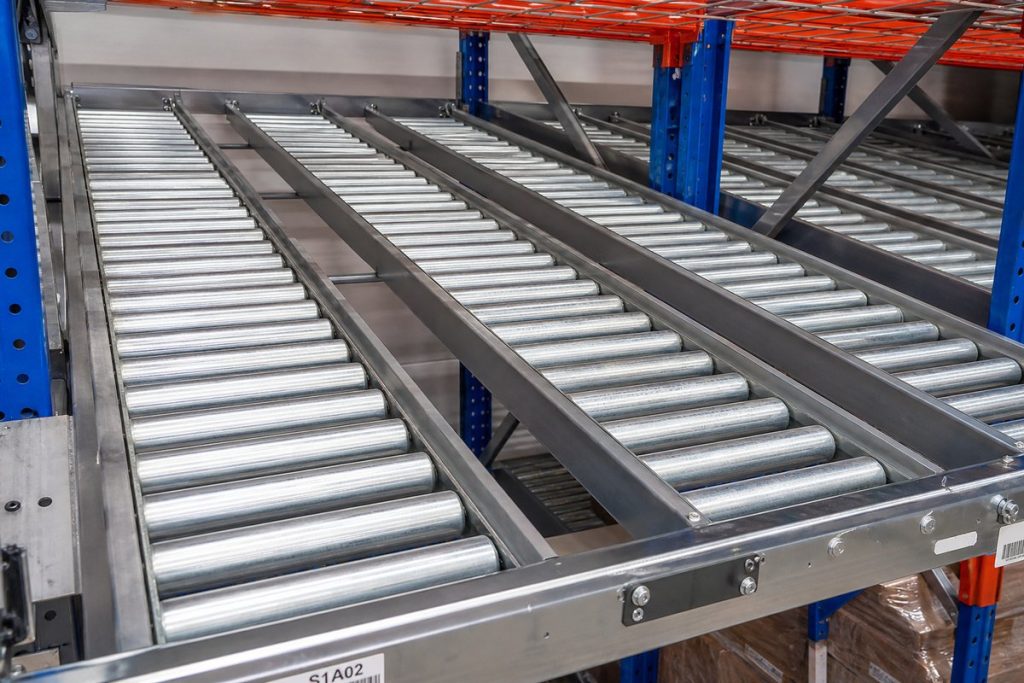
The heart of the system. Steel rollers mounted in formed-channel tracks at a controlled pitch. Full-width beds for heavy pallets, wheel-rail for lighter loads. Zinc-plated or galvanized for cold storage environments.
Speed Controllers
Centrifugal braking devices placed at intervals along the lane. They slow the pallet to a controlled 10–15 feet per minute as it descends. Essential for preventing damage to product and rack structure.
Pallet Separators
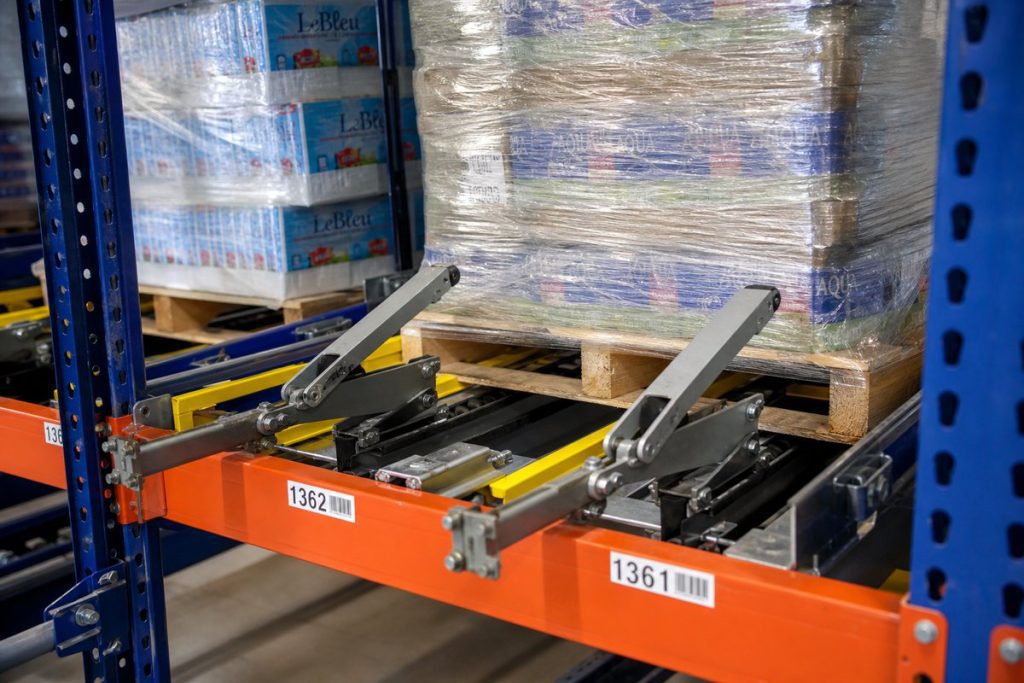
Mechanical devices at the pick face that hold the next pallet back while the front pallet is being picked. Prevents pallets from surging forward when the pick position opens. Spring-loaded or pneumatic designs available.
Structural Rack Frame
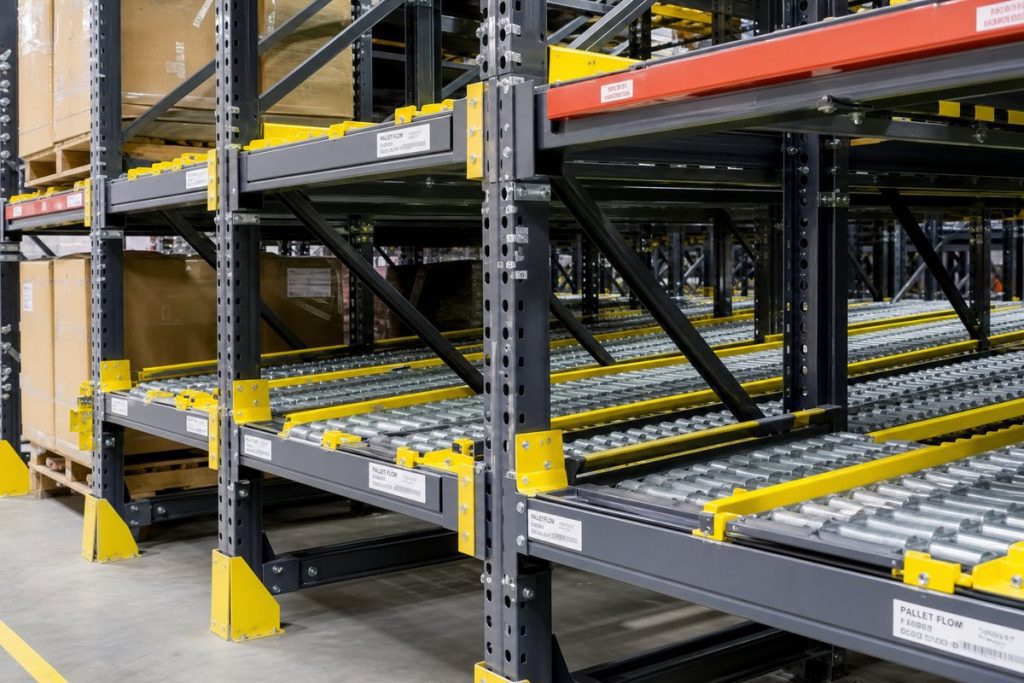
Heavy-duty structural steel uprights and beams support the roller conveyor system. Pallet flow requires structural (not roll-formed) rack due to the concentrated loads and dynamic forces from moving pallets.
Entry Guides
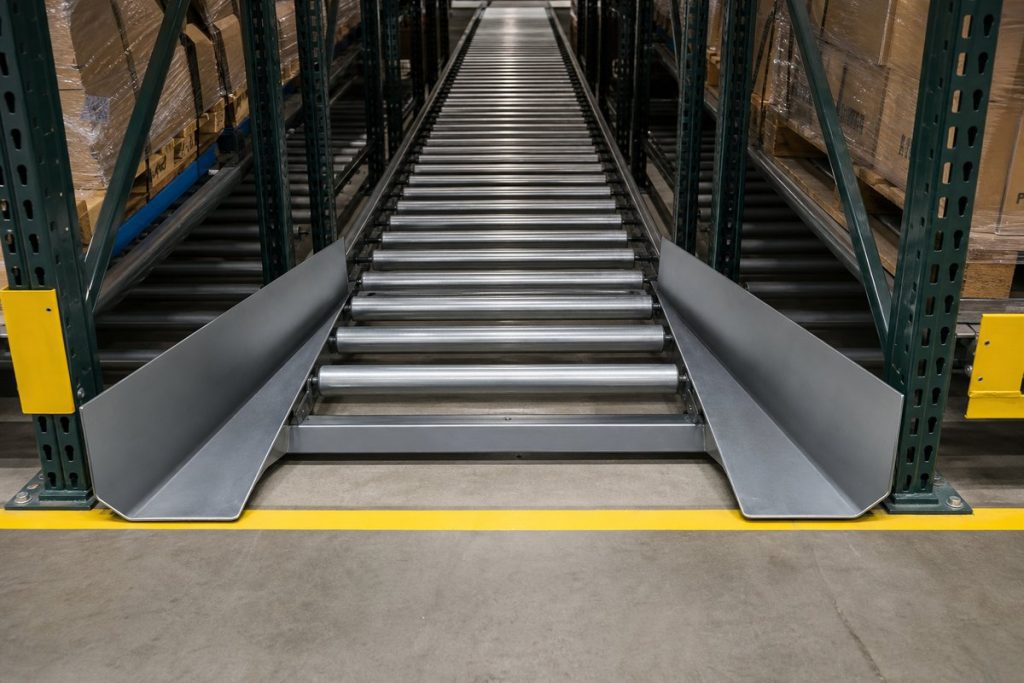
Funnel-shaped guides at the loading end that center the pallet ontotheroller bed. Prevents misalignment that could cause jams. Critical for operations with varied pallet quality or automated loading.
Lane Indicators
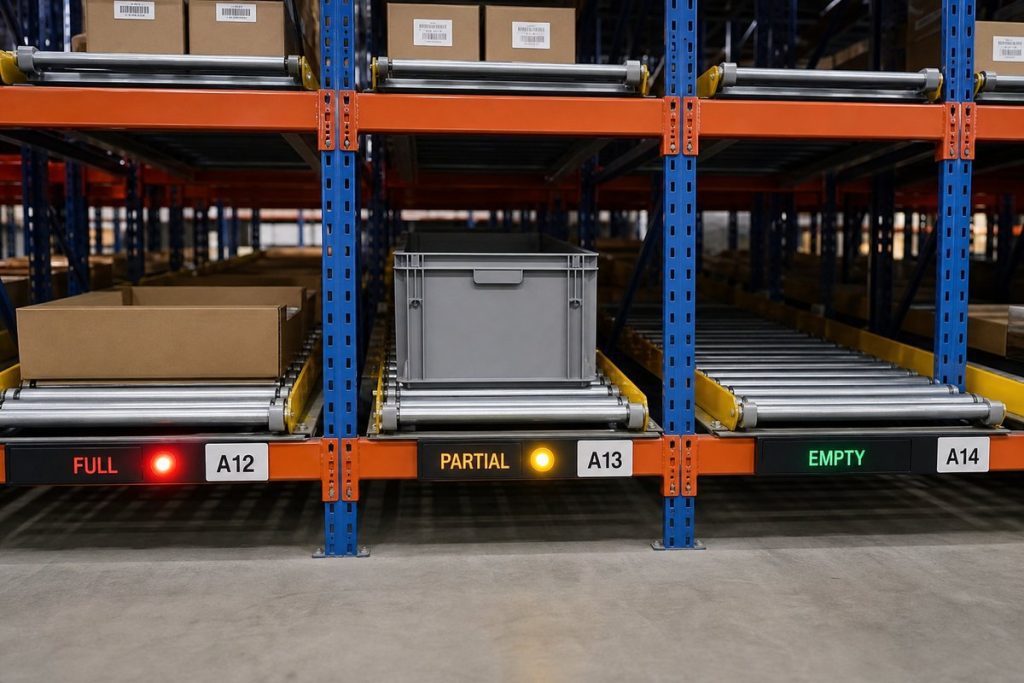
Visual flags or sensors that show lane status — full, empty, or partially loaded. Helps forklift operators quickly identify which lanes need loading. Mechanical flag systems or electronic sensor options.
Applications & Industries
Pallet flow rack is the system of choice for high-throughput operations that require strict FIFO inventory rotation.
🍔 Food & Beverage Distribution

The #1 application for pallet flow. Dairy, meat, produce, frozen foods, and beverages all require strict date-code rotation. Pallet flow ensures the oldest product is always picked first — automatically. No reliance on operators to follow FIFO procedures.
💊 Pharmaceutical & Healthcare
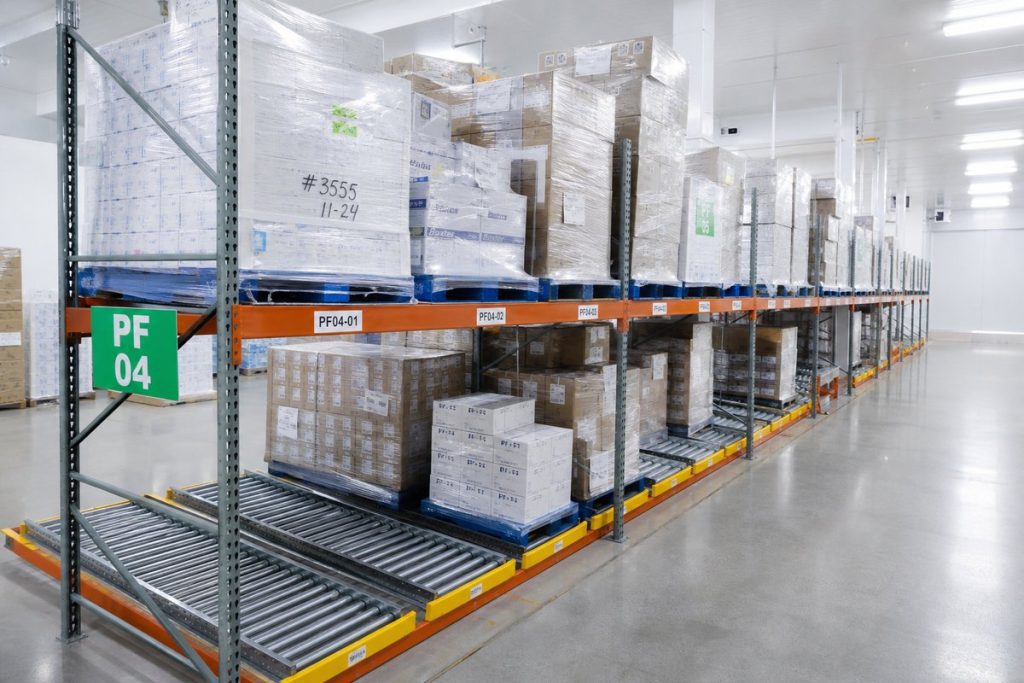
FDA-regulated facilities require documented FIFO for lot-controlled inventory. Pallet flow provides automatic lot rotation without operator judgment. Ideal for temperature-controlled pharmaceutical distribution centers.
❄️ Cold Storage & Freezer
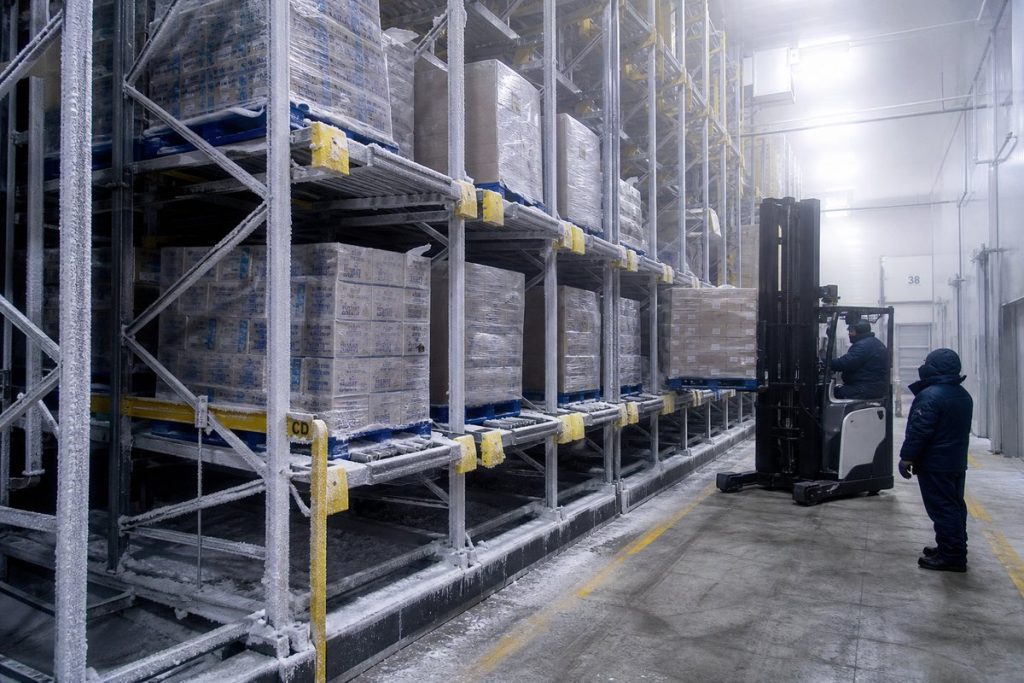
Maximize expensive cold storage space with deep-lane flow storage. Galvanized rollers and zinc-plated components withstand freezer environments. Reduces forklift time inside the freezer — load from one end, pick from the other.
📦 High-Volume Distribution

3PL warehouses and high-volume DCs handling fast-moving SKUs in large quantities. Separate loading and picking aisles improve traffic flow and reduce forklift congestion. One lane per SKU — automatic replenishment at the pick face.
🏭 Manufacturing Staging
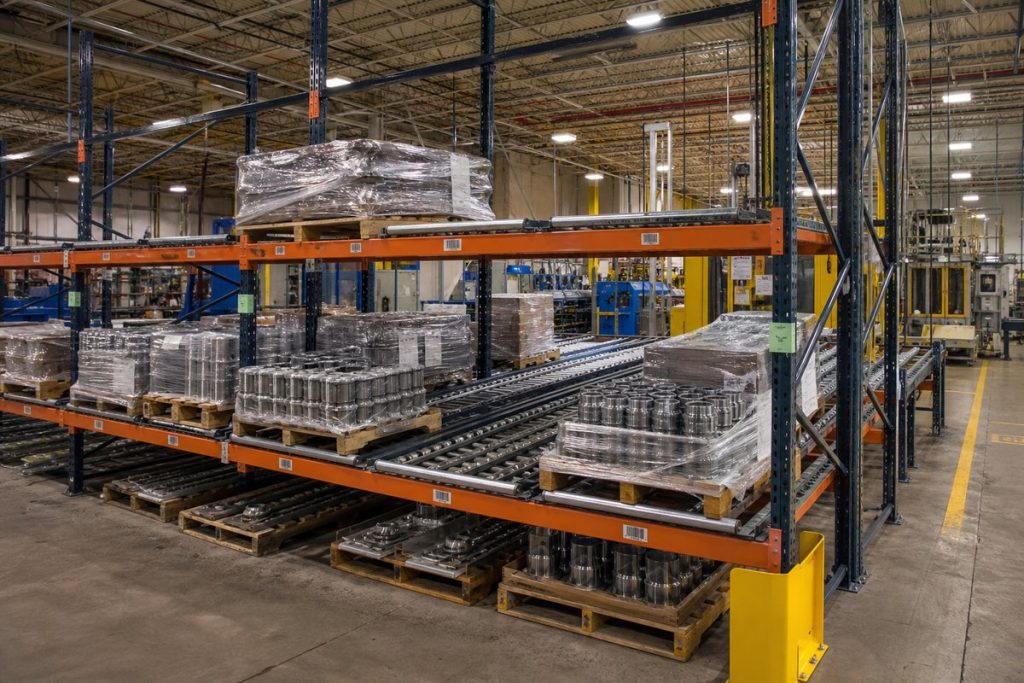
Buffer storage between production lines. Raw materials flow to the production side automatically as they’re consumed. Finished goods queue in flow lanes for shipping. Reduces internal transport and staging labor.
🧪 Chemical & Hazmat Storage
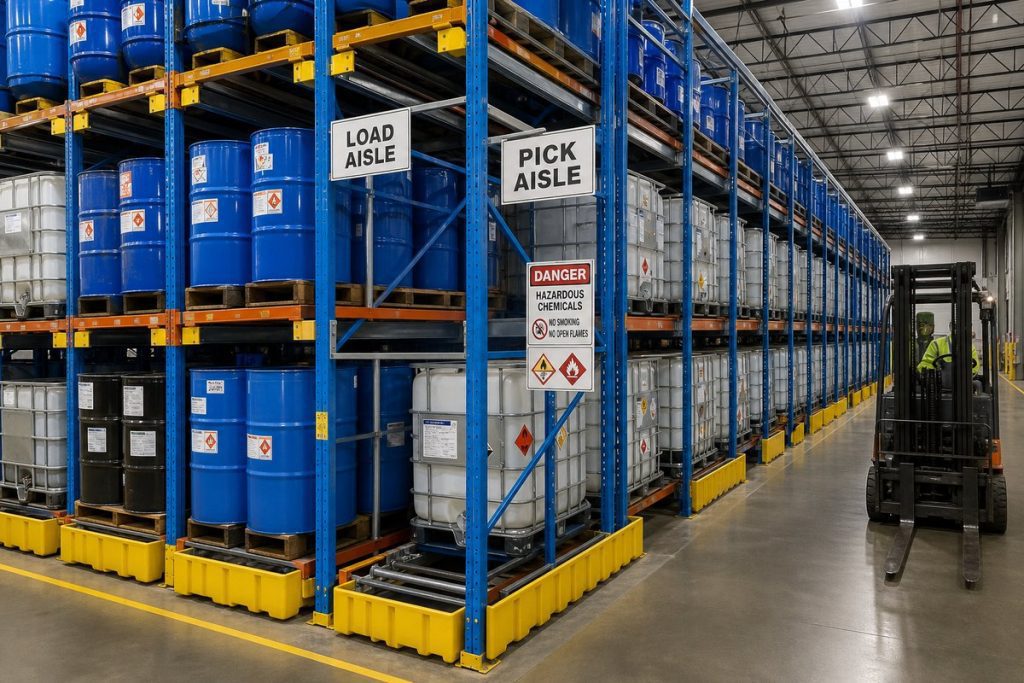
FIFO rotation is critical for chemicals with shelf-life limitations. Pallet flow minimizes operator exposure time in hazmat storage areas. Separate loading and pick aisles keep traffic patterns clean and safe.
Advantages of Pallet Flow Rack
The premium FIFO storage solution for high-density, date-sensitive operations.
- Guaranteed FIFO — automatic first-in, first-out rotation with zero operator decision-making
- Maximum storage density — 60%+ more storage vs. selective in the same footprint
- Separate load/pick aisles — eliminates forklift congestion and improves safety
- Automatic replenishment — gravity advances the next pallet into pick position instantly
- Reduced labor — no travel into rack lanes, no manual pallet rotation
- Perfect for perishables — date-code rotation is built into the system design
- Cold storage optimized — galvanized components, less forklift time in freezer
- High throughput — fast pick rates from dedicated pick face
- Scalable lane depths — 2 deep to 20+ deep per lane based on SKU velocity
- Lower product damage — speed controllers prevent impact at pick face
Material Handling USA designs and installs pallet flow systems for distribution centers, cold storage, and manufacturing facilities nationwide
Pallet Flow vs. Other Storage Systems
Pallet flow delivers the best combination of density and FIFO compliance — but it’s a premium investment.
| System | FIFO? | Density | Cost | Best For |
|---|---|---|---|---|
| Pallet Flow | ✅ Automatic | Very High | Higher | Date-sensitive, high-throughput, cold storage |
| Selective | ✅ Manual | Standard | Lowest | Many SKUs, fast picking, general warehousing |
| Drive-In | ❌ LIFO | Very High | Medium | Few SKUs, bulk storage, non-perishable |
| Push-Back | ❌ LIFO | High | Medium-High | Moderate SKUs, 2–6 deep, fast access |
| Cantilever | ✅ Manual | Low | Medium | Long/bulky items — lumber, pipe, furniture |
| Narrow Aisle | ✅ Manual | Higher | Higher | Selective + density (narrower aisles) |
Quick Decision Guide
Choose pallet flow if: You handle perishables or date-coded inventory, need guaranteed FIFO rotation, have fewer SKUs in high volume, operate a cold storage or freezer facility, or want to separate loading and picking operations for safety and efficiency.
Consider alternatives if: You have many SKUs with low volume each (selective rack is more flexible), FIFO is not required (drive-in or push-back are less expensive), or your budget is limited (pallet flow has higher per-position cost than other density systems).
Not sure? Request a free warehouse design consultation — we’ll analyze your inventory profile and recommend the right system.
When to Choose Pallet Flow Rack
Pallet flow is the only high-density system that guarantees true FIFO inventory rotation. Here’s when it’s the right investment.
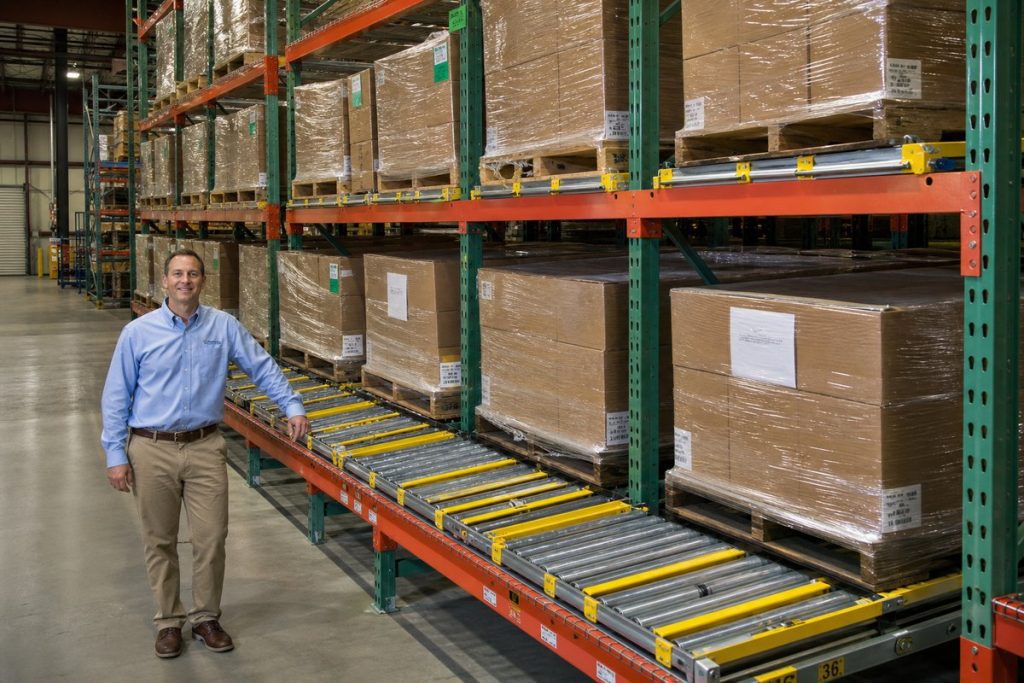
Ideal Conditions for Pallet Flow
- FIFO is mandatory — Perishable goods, pharmaceuticals, chemicals with expiration dates, or any product where the oldest inventory must ship first
- High throughput required — Separate load and pick aisles eliminate forklift congestion. Two operators can work the same SKU simultaneously without waiting
- Moderate SKU count, high volume — 10–30 SKUs with deep inventory buffers. Each lane holds one SKU, 5–20 pallets deep
- FDA or regulatory compliance — Food, beverage, and pharmaceutical operations that require documented lot rotation and audit trails benefit from guaranteed FIFO
- Cold storage — Like drive-in, pallet flow maximizes density in expensive refrigerated or frozen environments — but with FIFO that drive-in can’t provide
When Pallet Flow Is NOT the Best Fit
- ❌ FIFO isn’t needed — If inventory rotation doesn’t matter, drive-in or push-back provides similar density at lower cost
- ❌ Many SKUs with low depth — If each SKU only needs 2–4 pallets deep, pallet flow’s roller system is overkill. Use selective rack instead
- ❌ Tight budget — Pallet flow is the most expensive high-density system per bay due to roller conveyors, brakes, and speed controllers. The FIFO guarantee is the reason to pay the premium
- ❌ Non-standard pallets — Damaged, undersized, or overhanging pallets jam roller lanes. Pallet flow requires consistent, quality pallets
💡 Not Sure? Start with a Hybrid
Use pallet flow for date-sensitive SKUs (dairy, beverages, pharmaceuticals) and selective rack for everything else. MH-USA designs mixed systems that give you FIFO where it matters and cost savings where it doesn’t.
How FIFO Works in Pallet Flow Rack
The gravity roller system creates automatic, guaranteed first-in, first-out rotation without any operator decision-making.
The Load-to-Pick Workflow
Load from the High End
A forklift places a pallet on the inclined roller lane from the loading aisle (back/high side). The pallet rolls by gravity toward the pick face.
Gravity Does the Work
Speed controllers and brakes regulate the flow rate so pallets descend smoothly — even at 2,000+ lbs. No motors, no electricity, no controls needed.
Pick from the Low End
A different forklift picks the front pallet from the pick aisle (front/low side). The next pallet automatically rolls forward to the pick face. The oldest product is always picked first.
📊 Throughput Advantage
Because loading and picking happen from separate aisles, pallet flow systems can handle 2–3× the throughput of drive-in rack. Two forklifts work the same SKU without waiting — one loads, one picks.
Installation & Safety Requirements
Pallet flow rack is the most complex storage system to install correctly. Here’s what distinguishes a professional installation.

🔧 Roller Lane Assembly
Each lane is assembled from modular roller sections, speed controllers, and end stops. Lane width must precisely match your pallet size — typically 42″ or 48″. Rollers must be level side-to-side while maintaining the correct front-to-back pitch (3–5% grade, depending on pallet weight).
🛑 Speed Control & Braking
Without speed controllers, a 2,000 lb pallet on a 20-foot incline would accelerate dangerously. Centrifugal brakes, speed controllers, and pallet separators are spaced throughout each lane. These components are calibrated to your specific pallet weight range during installation.
🏗️ Seismic Engineering
Pallet flow systems are among the heaviest rack configurations due totheroller mechanisms and deep pallet loading. Seismic calculations must account for the dynamic effect of pallets rolling during an earthquake. In Utah, PE-stamped engineering is required — included with every MH-USA project.
⚠️ Warning — Pallet Quality Matters More Than Any Other System
Broken pallet boards, protruding nails, and non-standard sizes jam roller lanes and damage speed controllers. Establish a pallet quality standard before installing pallet flow rack. Reject damaged pallets at receiving. The #1 cause of pallet flow maintenance calls is damaged pallets — not equipment failure.
What Affects Pallet Flow Rack Cost?
Pallet flow is the most expensive high-density pallet storage system — but for operations that require guaranteed FIFO, the ROI is compelling.

📐 Lane Length & Depth
Longer lanes = more roller sections, more speed controllers, and more braking mechanisms per lane. A 10-deep system requires roughly 2× the roller components of a 5-deep system. But longer lanes store more pallets per aisle, improving the ratio of storage to aisle space.
⚖️ Pallet Weight & Speed Control
Heavier pallets need more speed controllers per lane and heavier-duty rollers. A lane handling 2,500 lb pallets might need one speed controller every 8 feet; at 1,200 lbs, every 12 feet may suffice. Weight directly affects the number and type of braking components.
🔄 Full-Width vs. Skate-Wheel
Full-width roller lanes handle all pallet types and weights more reliably. Skate-wheel lanes cost less but require higher-quality pallets with consistent bottom boards. The right choice depends on your pallet quality and throughput.
💰 ROI Beyond Storage Density
Pallet flow’s ROI goes far beyond space savings. Calculate the cost of expired product your operation writes off annually due to poor rotation. Add the labor cost of manual FIFO management (relocating pallets, checking dates, maintaining logs). Include regulatory compliance risk — an FDA lot traceability failure can result in recalls costing millions. For food, beverage, and pharmaceutical operations, pallet flow often pays for itself in avoided waste and compliance risk within 12–24 months.
Maintenance & Inspection for Pallet Flow Rack
Pallet flow has more moving parts than any other rack system. Preventive maintenance keeps lanes flowing and prevents costly downtime.
Maintenance Schedule
| Component | Check For | Frequency |
|---|---|---|
| Rollers | Seized rollers, debris buildup, damaged bearings | Weekly |
| Speed controllers | Proper braking action, wear, debris clogging | Monthly |
| Pallet separators | Proper engagement, spring tension, alignment | Monthly |
| End stops | Secure mounting, impact damage, pallet containment | Weekly |
| Lane guides | Alignment, pallet tracking straight, no drifting | Monthly |
| Uprights & structure | Standard rack inspection — plumb, connectors, anchors | Quarterly |
| Full lane test | Run test pallet through empty lane — check flow speed, braking, and positioning | Quarterly |

🔧 Preventive Maintenance Pays Off
A jammed pallet flow lane doesn’t just lose one pallet position — it blocks every pallet behind it, potentially 10–20 positions per lane across multiple levels. Preventive maintenance costs a fraction of emergency lane repairs and lost throughput. Schedule a pallet flow system inspection →
Frequently Asked Questions
What is the difference between pallet flow rack and carton flow rack?
Pallet flow rack handles full pallets (1,000–3,000+ lbs) on heavy-duty roller conveyors inside structural rack frames. Carton flow rack handles individual cartons or cases (typically under 100 lbs each) on lightweight wheel tracks that fit inside standard selective rack beams. Both use gravity for FIFO rotation, but pallet flow is a heavy-duty structural system while carton flow is a picking accessory for selective rack.
How deep can pallet flow lanes be?
Standard pallet flow lanes range from 2 pallets deep to 20+ pallets deep. Most installations are 5–10 pallets deep. Deeper lanes require more speed controllers to manage pallet velocity. The maximum practical depth depends on pallet weight, roller type, and building height — Material Handling USA engineers each lane for your specific application.
Can pallet flow rack work in freezer and cold storage?
Yes. Pallet flow is one of the best systems for cold storage because it minimizes forklift time inside the freezer. Loading and picking happen from separate aisles — operators spend less time in the cold. Components are available in galvanized steel and zinc-plated finishes that resist corrosion in freezer environments down to -20°F.
What kind of pallets work with pallet flow?
Standard GMA pallets (48″×40″) work best. The pallets must be in good structural condition — broken or warped pallets can cause jams in the roller conveyor. Many facilities use slave pallets (captive plastic pallets) in flow lanes to ensure consistent quality. The pallet bottom boards must run in the direction of flow (lengthwise) for proper roller engagement.
How much does pallet flow rack cost?
Pallet flow rack is a premium system — typically 3×–5× the cost per pallet position compared to selective rack. The higher cost is justified by guaranteed FIFO, higher density, reduced labor, and lower product loss from expired inventory. A 5-deep pallet flow lane costs less per position than a 2-deep lane because the structural frame cost is spread across more positions. Contact Material Handling USA for a project-specific quote.
Does pallet flow rack need to be anchored to the floor?
Yes. Pallet flow systems use structural rack frames that must be anchored per ANSI/RMI MH16.1 standards. The dynamic loads from moving pallets create forces that must be transferred to the foundation. Seismic engineering is required in zones like Utah. Material Handling USA provides engineered anchor plans with every installation.
Explore More Pallet Rack Solutions
Need Guaranteed FIFO for Your Warehouse?
Material Handling USA designs, supplies, and installs pallet flow rack systems engineered for your exact inventory profile, throughput requirements, and facility layout.