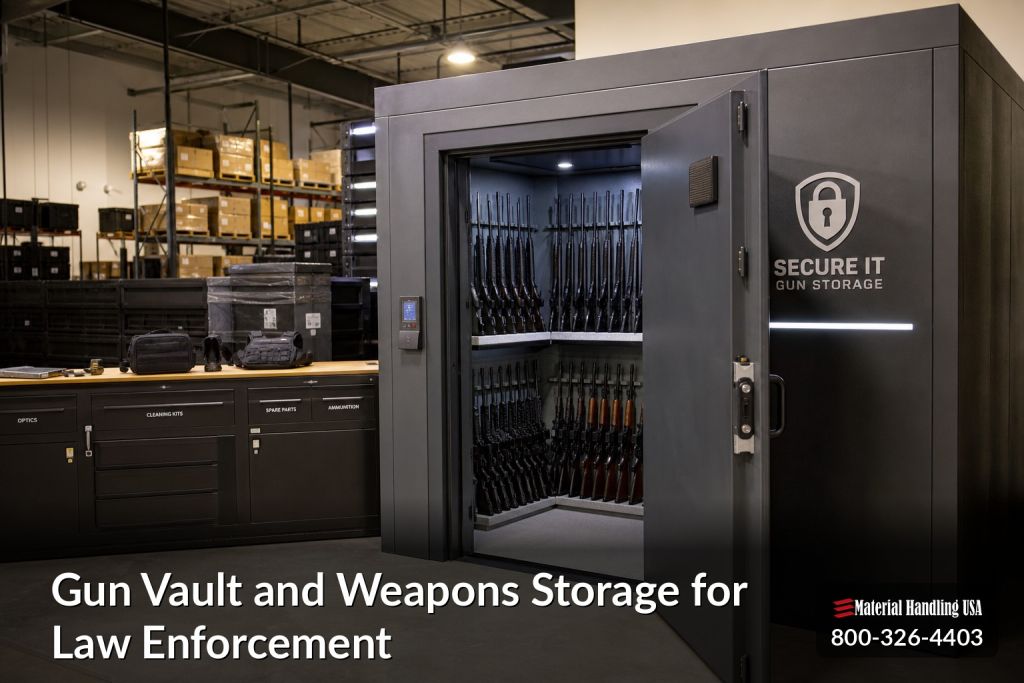
A busy armory does not fail because the steel is weak. It fails because the room, the rack, the lock, and the log were never designed to work together during a real shift change. If your team is trying to move duty weapons, seized firearms, or temporary holds through a tight handoff window, the right gun vault and weapons storage for law enforcement is the difference between a controlled process and a daily bottleneck.
Law enforcement agencies already use temporary storage as part of normal operations. A multi-state survey found that 74.8% of LEAs reported providing temporary firearm storage, compared with 47.6% of gun retailers, and the follow-up study in Colorado and Washington found 53% of LEAs offered temporary, voluntary storage upon request, while 61% had ever offered it PMC study on temporary firearm storage practices. That matters because storage is no longer just a back-room security issue. It is part of how agencies handle issue and return, evidence, crisis-related surrender, and officer safety.
What Law Enforcement Weapons Storage Really Means
A shift change at a mid-sized agency exposes storage weaknesses fast. One officer returns a patrol rifle, another checks out a shotgun, a supervisor needs a keyed record, and someone from evidence is waiting on a firearm that still has to stay accounted for. If the room is built like a closet with a lock, the whole handoff stalls.
Gun vault and weapons storage for law enforcement is a working system, not a steel box. It combines physical barriers, access control, storage hardware, and documentation so the agency can protect weapons and still reach them quickly when operations demand it. That is why the earlier survey summary matters. It shows that temporary storage already sits inside normal agency workflow, not off to the side as a rare exception temporary storage survey summary.
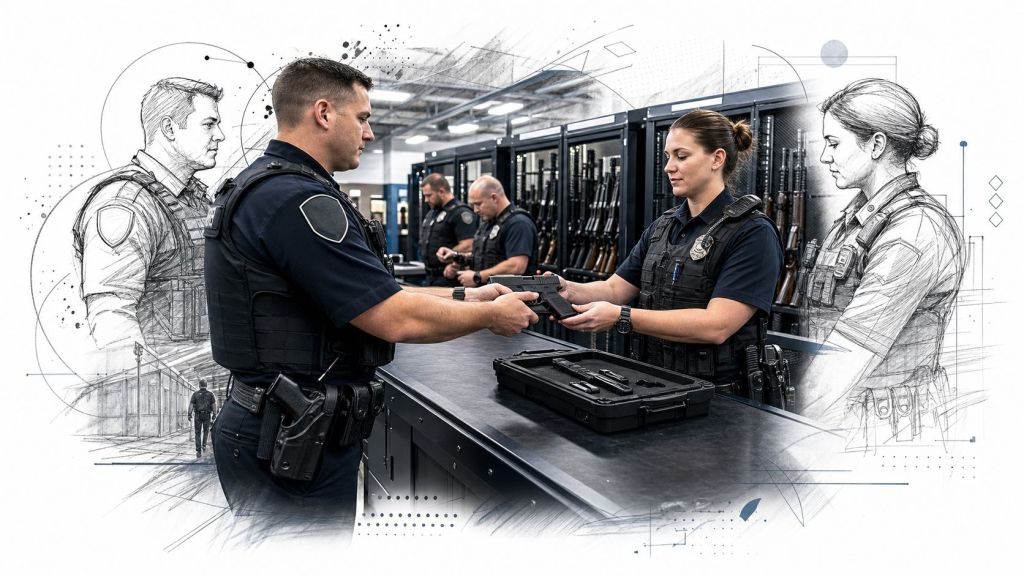
The right way to judge a storage room is by the handoffs it has to survive. The vault keeps unauthorized people out, the access system decides who gets in, the rack or cabinet keeps inventory organized, and the log shows what moved and when. If any one layer is weak, the room gets slower, and the staff start working around it.
Practical rule: If officers wait on the room, the room is designed wrong. Security that creates daily friction pushes people toward shortcuts, and shortcuts are where errors begin.
Temporary storage also has to support broader public safety workflows. Agencies that handle secure holds, crisis intervention needs, or evidence-adjacent storage have to balance access control, chain-of-custody, and rapid retrieval under uneven demand. This is the true test of a weapons storage program, and the AI-ready gate access platform is worth reviewing as a reference point for modern credential control and audit-ready entry in a secure environment.
Core Components of a Compliant Weapons Storage Room
A compliant storage room is built in layers, like a house with a reinforced shell, a locked front door, a secured interior closet, and a sign-in system at the entry. If one layer is missing, the rest have to compensate. That is expensive, and it usually shows up later as delay, confusion, or audit trouble.
The structure comes first
The outer shell matters more than most buyers think. For higher-security armory environments, GSA's modular vault specification calls for a six-sided modular vault with at least 15 minutes of protection against multilevel tool attack GSA modular vault systems. That minimum matters because the goal is delay, not fantasy-proofing. A room that slows a breach gives staff and responders time to react.
Inside the room, the storage method has to fit the mission. A vault door without a usable interior layout is still a headache. A secure room with poor aisle width, bad lighting, or awkward cable routing slows retrieval and increases mistakes. That is why the physical shell and the interior plan have to be designed together.
Access control is the second layer
The Department of the Interior says firearms not in an officer's immediate control must be appropriately secured, and cached firearms should be in locked containers or secured spaces such as cages, vaults, or weapons rooms with high-security locks and accountable key or credential control DOI firearms standards handbook. Vermont goes further for relinquished firearms, requiring two levels of physical security and separate locked ammunition storage Vermont DPS firearm storage guidelines.
That is the point. Security is not just steel. It is steel plus rule-based access plus separation of controlled items.
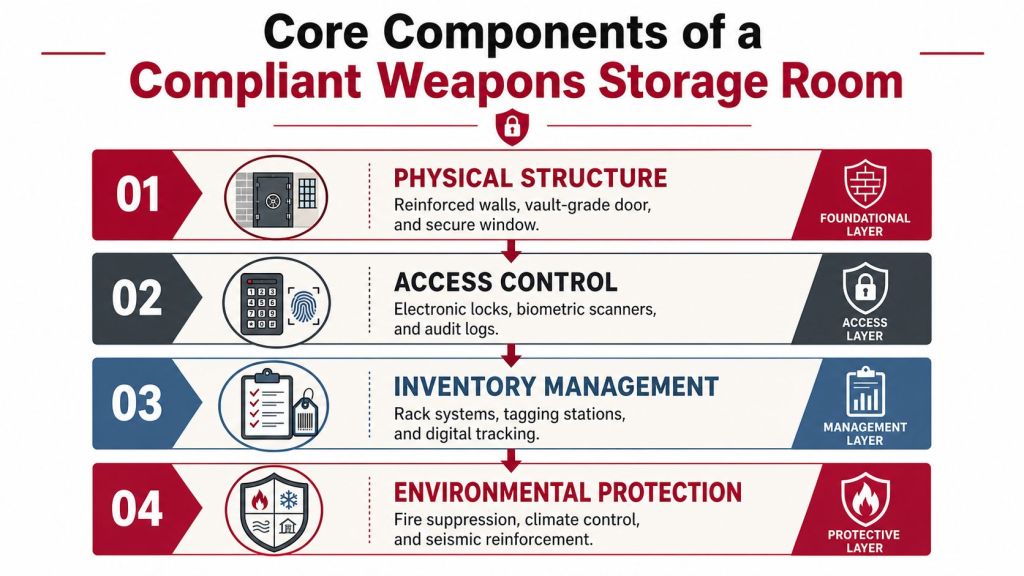
The inventory layer keeps the room usable
A room can be secure and still fail operationally if staff cannot tell what is where. That is why racks, tagging stations, and clear segregation for duty weapons, evidence, and temporary holds matter. A sound layout reduces missed items and avoids the most common failure mode, secure but not findable.
Vaults, Cabinets, Racks, and Cages Compared
The wrong product choice usually happens when a buyer asks, “How many guns does it hold?” That question is too small. The question is, “How does the room perform during shift changes, evidence handoffs, and emergency issue?”
| Storage Type | Protection Level | Best For | Access Speed | Typical Capacity |
|---|---|---|---|---|
| Modular vaults | Highest, when properly specified | Major armories, mixed inventories, higher-risk storage | Moderate | High |
| Heavy-duty cabinets | Good for controlled storage | Smaller agencies, backup storage, limited inventory | Fast | Low to medium |
| Freestanding racks | Basic to moderate, depends on enclosure | Patrol long guns, organized duty issue areas | Very fast | Medium |
| Wire-mesh security cages | Moderate, layered security | Evidence rooms, shared secure zones, flexible layouts | Fast to moderate | Medium to high |
A modular vault makes sense when the agency needs a true secure room with controlled entry and a planned interior. The modular vaults page at MH-USA is the right starting point if the project needs a walk-in solution instead of scattered storage points. That is usually the better path for larger inventories or rooms that must support multiple functions.
Cabinets work when the inventory is smaller and the process is simple. Racks work when speed matters and the room is already controlled. Cages fit environments where visibility and separation matter, but full vault construction is not needed. For a full comparison of weapons storage solutions by capacity and security level, review the options before you commit to one product family.
Bottom line: workflow decides the product family. Capacity matters, but it is not the only factor. A busy patrol division and a small evidence hold room need different answers.
Key Specifications and Features That Actually Matter
Steel gauge gets too much attention in sales talk, but it is only one piece of the purchase. The buyer should care about how the room resists attack, how fast staff can use it, and whether the design supports clean operation over time.
Read the hardware, not the brochure
California's gun safe standards show the kind of construction details buyers should insist on. The standard references at least 10,000 possible lock combinations, at least three steel locking bolts of 1/2-inch thickness, 12-gauge steel exterior walls for single-walled safes, and doors made from at least one layer of 7-gauge steel or two layers of 12-gauge steel construction California gun safe standards. Those numbers are for consumer-safe standards, but they are still useful as a baseline for buyers who want real material definitions instead of vague “heavy-duty” language.
For higher-density armory cabinets, a DoD-oriented specification calls for fully welded heavy-gauge steel, minimum 18-gauge side walls, minimum 16-gauge top and bottom, a structure that can support at least 1,500 lbs, and nine interlocking contact points Weapons rack specification. That is the kind of detail that tells you whether the cabinet is built for the job or just looks secure.
Control systems should match the workflow
Mechanical locks are durable and simple. Keypad locks speed up issue and return. Card readers and biometric systems help when multiple shifts need controlled access and a clean audit trail. The right choice depends on how much throughput the room needs and how often supervisors have to review access history.
Ventilation, power, and lighting are easy to ignore until they cause trouble. If the room also stores evidence or gear that needs condition control, those utilities become part of reliability, not comfort. Tamper sensors and surveillance should be treated as investigative tools, not decoration, because they tell you what happened when a discrepancy shows up.
A useful vendor question is blunt. How does the system perform when three officers are trying to get in, one supervisor is auditing, and evidence has to move out the same hour. If the vendor cannot answer that, the spec sheet is incomplete.
Evidence Storage, Chain of Custody, and Workflow Design
A storage room fails when the weapon is secure but the process around it is loose. That is the core problem. If staff cannot show where an item came from, where it went, and who handled it, the room becomes a liability no matter how strong the vault door looks.
Agency storage is rarely just long-term storage. Temporary holding, intake, and transfer activity are part of the same room, so the layout has to support movement as well as protection. The workflow has to match how evidence is received, tagged, and returned, not how a catalog page imagines it.
Four workflows that need different layout rules
- Shift-change issue and return needs fast access, clear labeling, and a direct path from the entry point to duty storage.
- Evidence intake needs segregation, documentation, and a place for items that are not ready for release.
- Forensic handoff needs clean movement between authorized stations with no confusion about who had custody last.
- Temporary community storage needs controlled intake, separate holding, and a return process that does not contaminate the rest of the room.
Those workflows do not belong in the same open lane. A single wall of racks rarely solves the problem because it mixes fast retrieval with controlled handling. Separate zones, obvious tags, and controlled transfer paths cut down on process drift and make it easier to prove custody later.
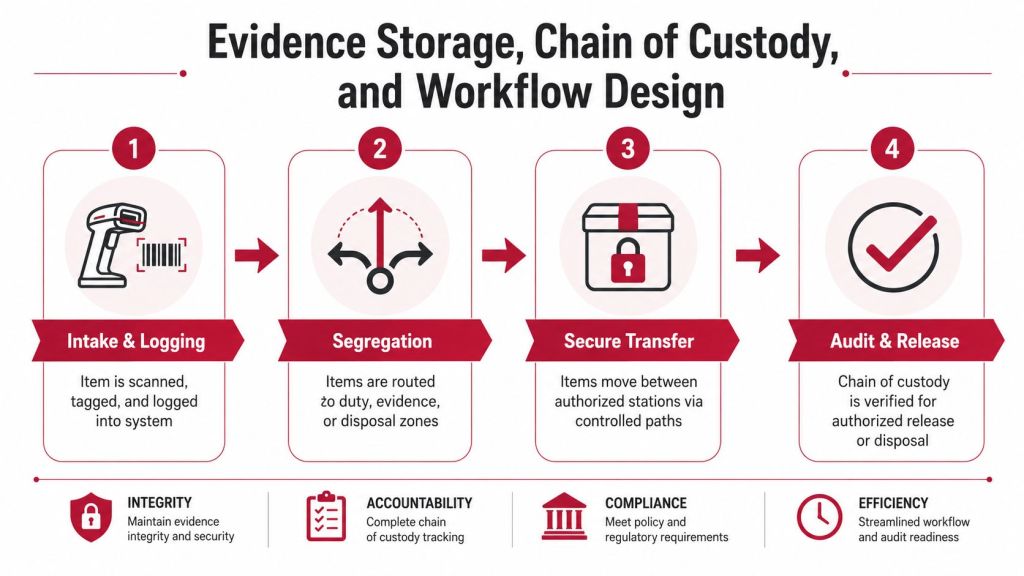
Best practice: Separate the room into duty, evidence, and hold zones before you pick the hardware. If you build the room first and sort the workflow later, staff will create shortcuts.
Agencies that need a cleaner starting point for room planning can review evidence storage room design options and use them to shape controlled storage zones and traceable movement paths.
Planning, Buying, and Permitting Your Storage Upgrade
A storage project goes smoother when the agency treats it like a facility upgrade, not a purchase order. Start with the space, not the catalog. A bad room can make a good product feel wrong.
The buying sequence that avoids rework
- Site survey and threat review. Measure the room, door swings, ceiling clearance, power, and travel paths before anything gets ordered.
- Requirements definition. Decide what must be stored, who needs access, and what has to be separated.
- Product selection. Match the storage type to the workflow, not just to the inventory count.
- Permitting and code review. Local approvals can affect layout, anchoring, and fire protection.
- Installation and acceptance testing. Verify lock function, access control, and retrieval flow before the room goes live.
That sequence sounds basic, but it prevents the most common mistake, ordering hardware before the final room layout is settled. Once a vault or cabinet is delivered, moving doors, walls, or utilities gets expensive fast.
Design help should happen before the drawings are frozen
Material Handling USA offers complimentary layout design services, which is useful when the agency wants to visualize aisle widths, clearances, and storage zoning before it commits to a final layout. Their team also works on secure storage, evidence rooms, and related facility planning, so the design conversation can happen early instead of after equipment arrives.
For buyers comparing storage compliance resources, Dasco weapon storage compliance guidance is another practical reference point during planning. It is easier to fix a drawing than to move installed steel.
The agencies that do this early usually get a cleaner install and fewer change orders. They also avoid the delays that come from discovering the wrong door swing, the wrong clearance, or the wrong utility path after fabrication is already underway.
Maintenance, Testing, and Long-Term Value
A weapons storage room is not a one-time project. It is a living part of the facility, and it needs routine checks if you want it to stay reliable. The agencies that get the most value out of the investment treat maintenance as a schedule, not an afterthought.
Monthly checks should cover lock function, door alignment, rack condition, and obvious wear. Quarterly reviews should include access log review, sensor testing where installed, and a visual check of organization and labels. If the room stores evidence or sensitive items, humidity and ventilation also deserve attention because condition issues can create handling problems later.
Growth planning matters too. A room that can add capacity without a full rebuild saves time and avoids disruption. Modular systems are useful here because the facility can expand in stages as inventory grows or workflows change.
Documentation should stay current. If auditors or leadership want proof of control, the room needs records that match the physical layout and the access rules in use. That is where many agencies lose time. The room may be fine, but the paperwork no longer matches the process.
The financial case is straightforward. A better layout cuts wasted movement, reduces confusion at the door, and keeps future retrofit work smaller. The operational case is even clearer, because a well-planned storage room helps staff get in, get what they need, and get out without slowing the rest of the shift.
If you're planning a new vault, a weapons room retrofit, or a better evidence-storage layout, Material Handling USA can help with product selection, free layout support, and a quote that fits your timeline. Visit Material Handling USA to discuss competitive pricing, fast shipping, and a storage plan built around your agency's workflow, or contact the team at 800-326-4403 and Sales@MH-USA.com for a free consultation.