Your pickup orders are ready, but the service counter is busy, a customer is waiting outside, and staff are searching for a bag behind the register. Smart locker order pickup for Utah retailers can separate routine handoffs from orders that need personal help. The right setup starts with what you sell, when customers collect it, and where your building can support secure access.
For operations managers and equipment buyers, the goal isn't to automate every order. It's to choose a configuration that fits the work without creating new problems with storage, customer access, or missed pickups.
Smart Locker Order Pickup for Utah Retailers and Which Setup Fits
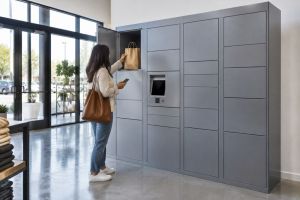
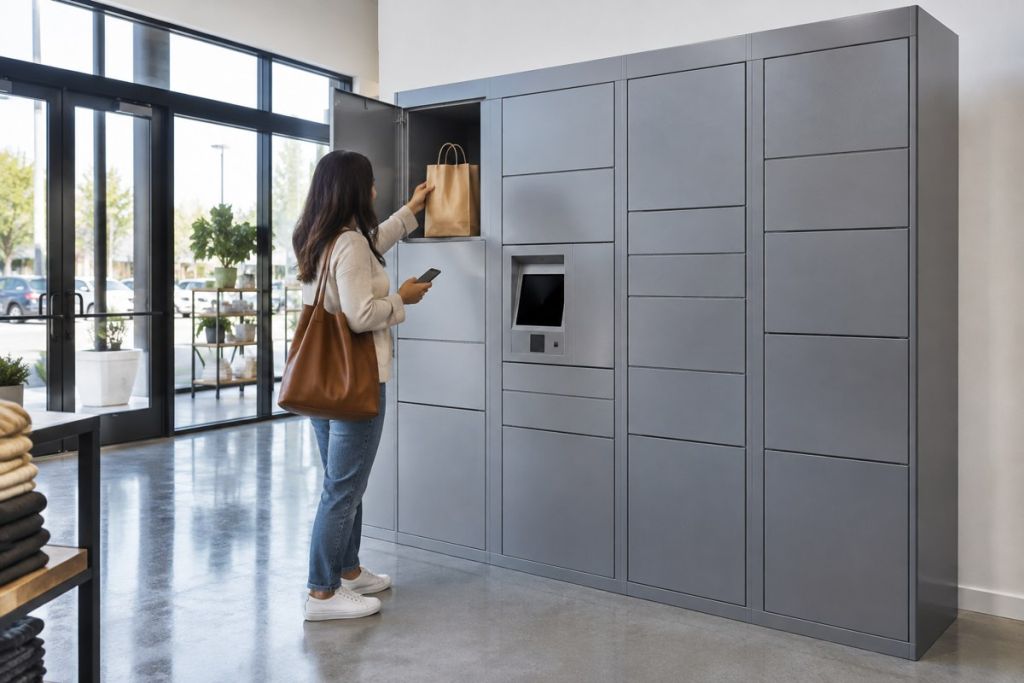
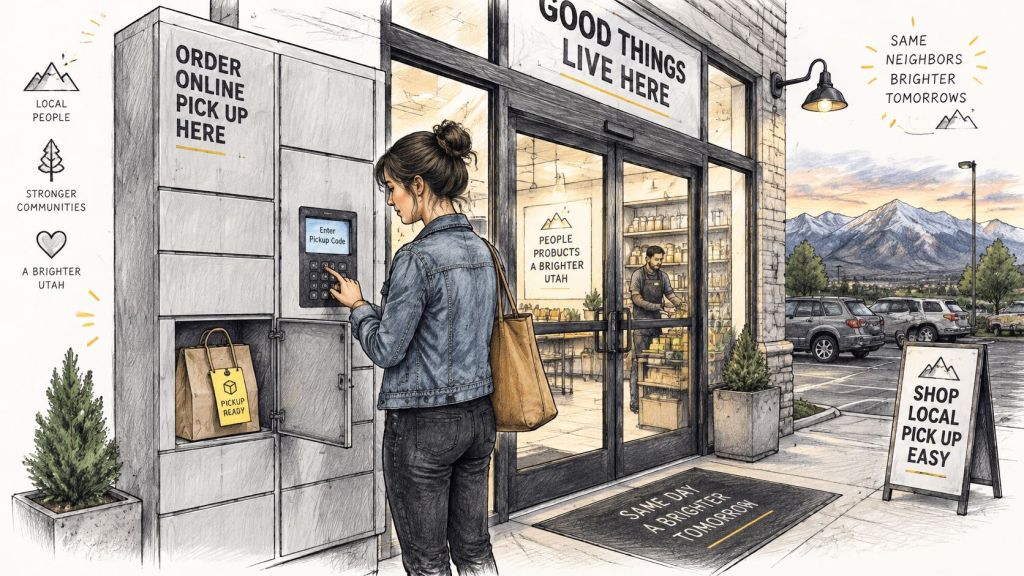
Which locker setup fits your operation? A smart locker holds prepaid orders in assigned compartments. Customers use an approved code or credential to open the correct door without joining a counter queue.
The U.S. Census Bureau reports $79.042 billion in Utah retail sales in 2022, or $23,377 per capita, a statewide measure of retail activity rather than locker demand.
Start with location and order mix, not cabinet appearance. An indoor bank may suit a specialty store, while outdoor collection needs equipment selected for the actual exposure and access conditions.
Smart locker configurations compared
| Configuration | Typical location | Best fit | Main trade-off |
|---|---|---|---|
| Single indoor bank | Inside the entrance or vestibule | Smaller stores with mostly small, prepaid orders | Limited door-size mix and capacity |
| Multi-door indoor bank | Entrance, lobby or stockroom wall | High-volume stores with mixed item sizes | Needs wall space, power and network access |
| Covered outdoor bank | Under a canopy or vestibule overhang | Parking-lot pickup and extended collection hours | Needs weather protection and lighting review |
| Outdoor bank at a separate site | Parking area or satellite facility | Multi-location retailers serving nearby customers | Requires site-use review, access control and owner approval |
| Staffed counter with locker add-on | Customer service area | Mixed pickup with oversized or exception orders | Staff time still needed for exceptions |
A canopy doesn't make an indoor cabinet suitable for outdoor use. Confirm the manufacturer's environmental rating, mounting requirements, and operating conditions before approving that location.
Run these tests before comparing Utah smart locker options:
- Order volume: Count prepaid orders leaving each week.
- Physical fit: Check whether complete orders fit the proposed doors.
- Usable location: Identify sheltered space near the entrance or loading zone.
Keep a staffed route where customers need advice, identity checks, or help carrying goods. A locker should remove predictable handoffs, not hide complicated ones.
Which Retail Orders Belong in a Locker
The useful question isn't whether an item can fit inside a locker. It's whether the complete order can wait there safely and be collected without staff help.
In the 2024 Morning Consult survey for FedEx of 2,103 U.S. consumers, fielded May 23 through May 28, 40% preferred next-day home delivery, 19% preferred in-store pickup, and 18% preferred curbside pickup; in-store preferences reached 26% for pet supplies and 25% for clothing or retail, according to the FedEx report.
Use those national preferences to choose categories for a local test, not to forecast Utah locker use.
Order types and locker eligibility
| Order type | Locker fit | Route to plan |
|---|---|---|
| Small, durable, prepaid items | Good fit | Locker bank |
| Apparel, accessories and household goods | Good fit within door size | Locker bank |
| Pet supplies in bags or boxes | Good fit within door size | Locker bank after a size check |
| Oversized or heavy items | Poor fit | Counter or curbside |
| Temperature-sensitive goods | Poor fit unless equipment provides controlled storage | Counter or curbside after supplier confirmation |
| Age-restricted or high-value items | Case by case | Counter with identity check |
| Returns brought to the locker | Case by case | Defined returns route |
As a planning scenario, a store receiving 1,000 eligible online orders monthly would have roughly 190 favoring in-store pickup and 180 favoring curbside if its customers matched those survey shares. Neither group automatically becomes locker demand.
Pull your own order history by product category, packed dimensions, and weight. For controlled storage, compare refrigerated food lockers against the product's holding needs, monitoring requirements, and response plan for equipment failure.
Order changes also need a cutoff. Mayra's guidance on editing orders before fulfillment is useful when defining when customers can change an order before staff assign a compartment.
Practical rule: Every eligible category needs a second route for damaged packaging, incorrect items, unavailable compartments, or customers who need assistance.
Sizing Compartments, Layout and Access Points
Collection time drives capacity. Daily order counts alone won't tell you how many doors you need, because an order occupies its compartment until someone retrieves it.
An automated-locker simulation published in Logistics found that an 85-compartment station could reach 125 parcels per day with pickup times of approximately four hours, 47% above the maximum in its once-daily-delivery scenario.
That's a model, not a Utah field trial. Its useful lesson is that faster collection frees doors for the next order.
Sizing inputs to measure before the quote
| Sizing input | How to measure it | Effect on compartment count |
|---|---|---|
| Peak-day pickup arrivals | Count orders collected on the busiest day and hour | Identifies demand peaks; compare against loading times to estimate simultaneous occupancy |
| Pickup delay | Track hours between the pickup notice and collection | Longer delays hold compartments longer |
| Share by door size | Sort recent orders into small, medium and oversized | Sets the door mix for each size class |
| Carrier drops | Record drops per day and arrival times | Reserves compartments for replenishment |
| Temperature-sensitive share | Flag orders needing controlled storage | Routes those orders away from standard doors |
Measure usable internal dimensions and clear door openings, not just cabinet width. A box may fit inside a compartment but still fail to pass through its opening.
Build the count from actual occupancy
- Count peak-day order arrivals by required door size.
- Estimate pickup delay from order history or a pilot.
- Add capacity for carrier replenishment if carriers will load the system.
- Reserve separate routes for oversized and temperature-sensitive orders.
- Add a buffer for missed collections and doors temporarily out of service.
Don't treat small and large doors as interchangeable capacity. A bank can have empty compartments and still reject an order because none are large enough.

Place carrier-loaded lockers where drivers can reach them without crossing the sales floor. For staff-loaded systems, measure the picking and loading route too, since a convenient customer location can create a long walk for employees.
Allow space for an open door, a customer with bags, mobility devices, and a short queue. Keep power, network connections, and lighting within practical reach, and review camera coverage without recording customer credentials.
Before fixing the final count, log door-open events, compartment dwell time, abandonment, and utilization by size. Size the final bank around the busiest operating pattern, not an average day.
Utah Permits, Zoning and Accessibility Checks
Does an outdoor locker need building, zoning, or site-use review? Confirm that with the municipality before ordering. Storefront placement, parking-area placement, and a separate pickup facility can raise different questions.
West Haven City's 2026 ordinance addresses storage lockers within self-storage facilities, restricts those facilities through zoning and setbacks, prohibits business operations from individual units, and bars overnight occupancy.
That ordinance is not a retail smart-pickup-locker rule. It illustrates why the city needs a clear description of your proposed use rather than a product name alone.
Complete a documented site review
- Planning office: Confirm the zoning classification and whether the proposed pickup location needs site-use review.
- Building and fire officials: Review electrical work, mounting, exit routes, door swings, and required clearances.
- Property approval: Obtain written landlord or owner consent for exterior walls, sidewalks, or parking spaces.
- Site operations: Review lighting, surveillance, delivery access, drainage, and protection from vehicle contact.
- Accessibility: Check approach space, operating force, screen and reader reach, and accessible compartment assignment.
- Business use: Verify whether a separate pickup site changes licensing or operating approvals.
Ask an accessibility reviewer to test the physical controls and any customer-facing web portal against the standards that apply to your private business. Confirm the applicable rules with counsel rather than assuming a touchscreen is accessible because it has large buttons.

Food sellers have another review to complete. A home-based producer can check Utah's cottage food rules through Ovenbell as an initial reference, then confirm the proposed collection method with the responsible authority.
A locker installation guide doesn't certify a site. Local officials determine the applicable approval requirements.
Coordinate the retailer, property owner, municipality, and fire and building officials early. Submit a drawing showing the cabinet footprint, customer approach, loading route, and nearby exits so reviewers can assess the actual installation.
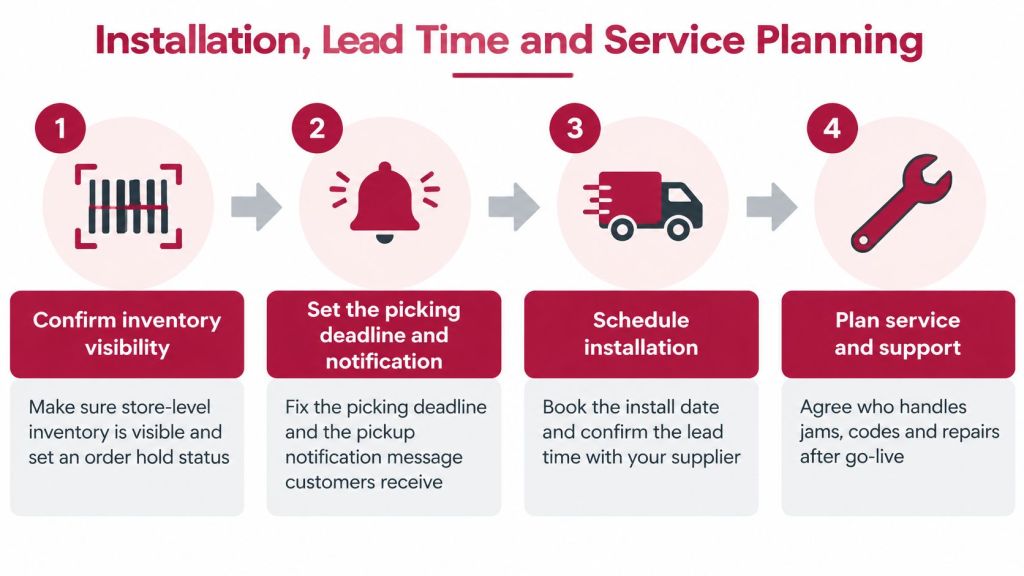
Installation, Lead Time and Service Planning
Start with the order system, not freight scheduling. A locker can't correct inaccurate inventory.
Digital Commerce 360 reported that 65.4% of retail chains in its 2023 Top 1000 displayed in-store stock status online. For your project, verify that stock is both visible and reserved before the customer receives a ready-for-pickup message.
From quote to first pickup
- Verify inventory: Confirm store-level stock visibility and an order hold status.
- Set the picking deadline and write the notification customers will receive after loading.
- Define access: Confirm the credential, any identity check, and what happens to unclaimed orders after the collection window.
- Approve the site plan and complete required permit reviews.
- Prepare utilities: Confirm power, network, mounting, and cable protection.
- Schedule freight, delivery, and installation, then test complete transactions with sample orders.
- Assign support: Train staff on exceptions and name the service contact.
Our process includes coordinating freight, delivery, and installation so the order arrives ready to use. We design and install storage solutions around each customer's needs, including space and timing constraints.
Prevent the avoidable failures
- Codes issued too early: Send the collection notice only after the correct order is loaded and the compartment is secured.
- No failed-pickup rule: Define reminders, escalation, removal, and inventory release.
- Large doors omitted: Test packed orders against the proposed openings.
- Utilities excluded: Assign responsibility for electrical and network work before installation.
- No support owner: Document who handles jams, invalid codes, outages, and replacement parts.
Lead time depends on configuration, manufacturing, and site approvals. Get delivery assumptions and installation dates in writing before committing to a public opening date.
If stock availability enters the discussion, some common sizes are stocked at select manufacturers, subject to confirmation. Don't treat that as confirmation that the complete electronic system, finish, or door mix is available.
Choosing a Locker Setup by Buyer Scenario
Choose the row that matches your orders and building, then measure the condition most likely to rule that setup out. A large cabinet won't solve poor access, and outdoor placement won't help if customers only collect during store hours.
Locker setup by buyer scenario
| Buyer scenario | Likely setup | Measure first |
|---|---|---|
| Single-location retailer with mostly small orders | Single indoor bank | Weekly prepaid pickups and peak collection hour |
| High-volume store with mixed item sizes | Multi-door indoor bank with staffed exceptions | Peak-day arrivals and oversized order share |
| Store with large parking area and extended hours | Covered outdoor bank | Out-of-hours pickup demand and lighting conditions |
| Multi-site retailer | Satellite bank at a separate site | Site-use approval status and customer travel distance |
| Grocery or pharmacy with temperature-sensitive items | Locker for eligible items, staffed pickup for the rest | Share of temperature-sensitive orders |
For a small specialty retailer, a compact indoor bank is a sensible starting point only if peak occupancy fits. Leave expansion space rather than filling every available wall with the initial installation.
A busy mixed-merchandise store needs more than added doors. Keep its exception counter easy to find so customers with bulky goods or collection problems don't block the locker terminal.
Check the whole handling route
Outdoor pickup works best when customers can find and reach the bank without crossing active loading paths. A satellite location adds another handling step, so evaluate replenishment responsibility and customer travel before treating it as an extension of the store.
The stockroom can also be the main constraint. The Salt Lake City retail stockroom mobile shelving application offers a related planning reference when picking and staging space need attention alongside customer pickup.
Decision check: If bulky or controlled-storage orders dominate, keep those orders on a staffed route rather than forcing them into a standard locker plan.
Write down your buyer scenario and the measurement you can't yet answer. Put that gap in the quote request so the layout review addresses it directly.
Smart Locker Questions Utah Buyers Ask
Can a locker bank move when the store layout changes?
Relocation may be possible, but don't assume every bank is free-standing or easy to move. Check anchoring, module connections, utilities, and the new site's approval requirements before including relocation in the purchase plan.
Does a locker need power and a network connection?
Most electronic configurations need power and a data connection for controls and order updates. Confirm the connection method, outage behavior, and recovery process for the proposed model.
Who should own pickup notifications and access codes?
The retailer should control the customer communication rules and responsibility for access. Agree how the order system issues notifications and how the locker validates credentials; this parcel locker workflow guide provides useful background.
Can a small store start with a few doors?
Yes, if measured peak occupancy supports that choice. Confirm whether future modules can connect to the initial system and whether expansion would require another terminal or software change.
Can a bank serve more than one store?
Only if the site, software, replenishment routes, and customer instructions support shared use. Define which store resolves missing items and failed collections before launching it.
How should we compare lockers with staffed pickup?
Track labor minutes per completed pickup, customer collection time, abandonment, and support contacts over the same period. Include basket value and add-on purchases so a faster handoff isn't mistaken for an automatic commercial gain.
Request a Layout Review and Quote for Your Utah Site
Smart locker order pickup for Utah retailers works best when the equipment matches the order mix and the building. Choose eligible products, size doors around collection behavior, confirm local approvals, and prepare the inventory workflow before scheduling installation.
A useful quote request includes:
- Demand: Monthly and peak-day order counts.
- Order mix: Packed dimensions, weights, and oversized or temperature-sensitive shares.
- Collection policy: Desired pickup hours and holding window.
- Site drawing: Entrances, parking, loading access, and available wall or floor space.
- Utilities: Power and network availability.
- Project limits: Permit status, target timeline, and budget range.
Our process starts with what you need to store, secure, organize, or move, plus your space and timing constraints. Early planning helps resolve approval and integration questions before they turn into installation delays.
Keep optional marketing software separate from the equipment budget. If loyalty software is part of the wider project, you can see monthly loyalty app rates from BonusQR as a separate cost reference, rather than treating it as a locker requirement.
Put the scope in writing
Material Handling USA is headquartered in Salt Lake City and serves customers nationwide. Our local service areas include Salt Lake City, Provo, Ogden, Park City, St. George, Logan, Lehi, and Orem.
We offer free layouts and designs with no obligation, free quotes, competitive pricing, quality materials and products, and fast shipping and delivery. Confirm project-specific availability and timing in the written scope.
Material Handling USA offers layout planning and equipment coordination to match retail pickup lockers to your orders, customer access, and site constraints. Contact Us at Material Handling USA for a free design or layout consultation and quote, with your site drawing and order-size mix ready. Call (800) 326-4403 to discuss your Utah pickup project.