

Equipment cases are blocking the cart route, sealed containers need more space, and another deployment is approaching. Before you ask for more shelves, you need to know which items can share a bay, which must stay separate, and how staff will record every move.
Boltless shelving for Utah election equipment storage rooms should support a custody and retrieval system, not just increase shelf count. For county clerks, facility managers, maintenance teams, and procurement leads, the best starting point is an inventory with weights, handling rules, and assigned locations.
What Utah Election Storage Rooms Hold
Say your county storage room holds scanners in protective cases, cartons of forms, folded signs, and sealed ballot containers. Staff need the scanners for testing, but the retained containers must remain undisturbed. Putting everything wherever it fits makes those different duties harder to manage.
Utah's legislative performance audit found that the state's 29 counties used physical safeguards during the 2022 primary election, including camera monitoring, locked rooms, and equipment locks and seals. A shelf layout should preserve those controls by leaving seals visible and inspection routes open.
Election storage zones and what each one needs
| Zone | Typical contents | Handling rule | Shelving implication |
|---|---|---|---|
| Equipment zone | Voting devices, ballot scanners, tabulators, peripherals | Locked access and seals checked before use | Level bays with clear inspection aisles |
| Archive zone | Sealed ballot containers and retained materials | Sealed, labeled, and retained until authorized disposal | Heavier containers low, labels facing the aisle |
| Staging zone | Equipment awaiting deployment or return | Check-out and check-in logged | Near the entrance, with outgoing and returned items separate |
| Accessories and supplies | Cables, cases, testing supplies, forms, signs | Counts completed on a set schedule | Small-parts bins on adjustable levels |
| Quarantine zone | Damaged or returned devices awaiting review | Held until reviewed | Dedicated, isolated bays |
Boltless shelves adjust as the equipment mix changes. That helps when a replacement case needs more vertical clearance or supplies move into standardized bins. It doesn't mean every zone should use the same deck or shelf spacing.

Planning rule: Judge usable capacity by what staff can identify and retrieve without moving unrelated inventory.
Boltless Shelving Configurations for Utah Election Storage Rooms
| Configuration | Best fit | Load check before ordering | Access trade-off | Change later |
|---|---|---|---|---|
| Open boltless shelving, single depth | Equipment zone and general bays | Rated load per shelf and per bay | Full visibility, no lock on its own | Easy to re-level |
| Boltless shelving with wire decking | Cables, small cases, accessories | Decking rating and edge retainers | Good airflow and sightlines; small items need bins | Approved decking can be swapped |
| Boltless shelving with solid particle board decks | Archive zone and sealed containers | Deck rating for container weight | Flat support, but no view through the deck | Re-level and reuse compatible decks |
| Heavy duty boltless shelving, stronger lower levels | Heavy devices and equipment cases | Lower-level rating and anchorage plan | Heavy items low for safer handling | Upper reach remains limited |
| Lockable cabinet or mobile shelving | Restricted or highest-value items | Cabinet load or mobile system rating, plus locking controls | Controlled access, slower retrieval | Planned footprint limits changes |
Choose decks around the load
Single-depth open shelving is a useful baseline for equipment cases. Staff can see each asset and remove it without reaching behind another case. Double-depth storage may fit more equipment, but it introduces extra handling and can hide labels.
Wire decking suits bins and cases with stable bases. Check whether case feet bridge the wires properly. Solid particle board gives cartons continuous support, but moisture exposure and deck condition need attention.
For heavy devices, confirm both the shelf rating and the total bay rating. A rating for an evenly spread load doesn't automatically cover a case resting on small feet or caster wheels. Utah's legislative election-equipment report provides the physical-security context for treating handling and storage as controlled operations.
Shortlist alternatives by zone
Compare open wire-deck and solid-deck bays for equipment. For archives, compare solid-deck fixed shelving with an engineered mobile option. For accessories, compare open bins with lockable cabinets where access restrictions justify them.
Shelving isn't the security barrier. Get the manufacturer's ratings, approved shelf arrangement, and accessory compatibility in writing before ordering. Don't assume a stronger deck increases the capacity of the beams or posts.
Sizing Bays, Aisles and Retrieval Space
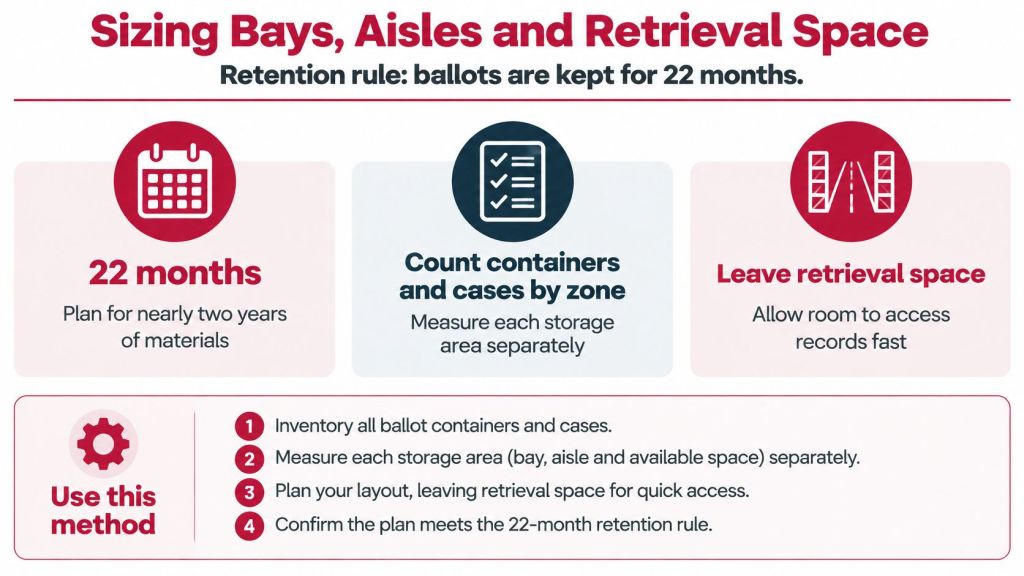
Sizing starts with the retention load, not the room's empty walls. Utah election materials must be held for the retention period set by state law, and they can be called for audit before destruction. Count the archive separately from the next deployment's equipment: the two share floor space but move on different schedules.
For a structural benchmark, the federal records-storage standards call for industrial shelving strong enough for the stored load and braced against collapse under full load. Treat that as a strength floor rather than Utah election-room law; the manufacturer's rating on the unit you order still governs each bay.
Measure the work, not just the walls
- Count by zone and election. Include retained containers, reserve devices, accessories, and items awaiting review.
- Measure the largest items. Record outside case dimensions, handles, hinges, and loaded cart width.
- Set usable bay depth. Sealed containers should sit fully supported without overhang, since a carton riding the front edge gets dragged out instead of lifted.
- Test retrieval clearance. Allow room to turn a cart, read a label, and lift a case without striking adjacent equipment. Every container that has to come out to reach another one adds handling time during an audit request.
- Place heavy loads low. Keep awkward cases out of overhead storage.
- Reserve growth space. Leave identified capacity for incoming materials rather than relying on the aisle. Adjustable shelf levels let you re-space a bay when the container mix changes between cycles.
Retrieval space is part of the custody system: a cramped aisle turns one records request into a chain of extra moves.
Use equipment vendor dimensions and site-approved clearances. Mark the proposed shelving footprint on the floor with tape, then walk a loaded cart through it while a second person checks sight lines to the lowest level.
Lighting belongs on the measurement sheet too. If shelf shadows make seals hard to inspect, review fixture placement during layout planning; Black Rhino Electric's business lighting installation resource offers context for that electrical work.
A bay that fits the container but leaves no room for hands isn't a finished storage solution.
Utah Security Rules and Custody Labels
A tidy room isn't necessarily a secure room. Under Utah Code Section 20A-4-202, election officers must package and retain election materials in a secure location, and retained materials must not be altered or changed. Shelving should make those duties easier to carry out and document.
Utah administrative election guidance specifies sealed archival receptacles labeled with their contents, election name and date, and destruction date. It also calls for documented seal numbers when used, documented access to archived containers, and access limited to authorized County Clerk staff and personnel.
Build the location and movement record
Use shelf labels to identify locations. Keep the required container labels intact and readable.
- Assign zone codes for archives, equipment, staging, accessories, and quarantine.
- Identify each location with aisle, bay, and level fields.
- Tag devices and cases with an asset identifier or barcode tied to the inventory.
- Record movements with the asset, location, staff member, destination, custody status, and return information.
- Reconcile inventory after deployment and return, preserving an audit trail when correcting entries.
Utah Code Section 20A-5-406 requires documented chain of custody and protection against unauthorized access when equipment is delivered to polling places. A location system should support that handoff without confusing outgoing cases with returned equipment.
Use the principles in our bin and location labeling guide to build consistent location codes. Confirm the final label format and movement fields with the county clerk.
Review the room and building together
Utah's voting-equipment safeguards call for secured storage that prevents unauthorized access. Keep badge or key permissions current, protect camera sightlines, and provide a defined inspection area.
Have the site team review floor construction, anchor locations, seismic restraint, sprinkler coverage, electrical access, and exit routes. Don't drill anchors before checking slab restrictions and concealed services. Keep electronics off the floor and away from likely water exposure.
If a project considers separate enclosed storage, storage security from Pacific Mobile Structures offers context for enclosure planning. Any enclosure still needs review for authorized access, environmental protection, and the county's custody procedures.
Installation, Lead Time and Service Planning
Confirm the layout and rated loads before releasing the order. The quote should distinguish product, freight, unloading, inside delivery, installation, anchors, bracing, and packaging removal. Otherwise, apparently similar prices may cover very different scopes.
Schedule the work outside testing and early voting peaks. If inventory must move temporarily, assign approved holding locations and maintain custody records throughout the move.
Install in a controlled sequence
- Prepare the site. Clear the work area, verify floor level, and mark bays and approved anchor points.
- Assemble and inspect. Boltless shelving assembles without tools, but connections still need checking for full engagement. Follow the selected manufacturer's instructions.
- Complete restraint work. Install anchorage or bracing specified by the site review. Tool-free shelf assembly doesn't make anchoring tool-free.
- Load and hand over. Start with lower levels, check stability, apply labels, and enter the final bay map into the inventory system.
Our boltless shelving installation guide can help facilities teams organize assembly and handoff questions.

Put service responsibilities in writing
Assign an owner to inspect damaged decks, loose connections, impact damage, and changed shelf arrangements. Recheck ratings and the location map after reconfiguration.
Lead time belongs in the quote, not in an assumption. Some common sizes are stocked at select manufacturers, subject to confirmation. Confirm the complete order's availability, delivery method, and installation window before committing to a room shutdown.
Buyer Scenarios and Which Setup Fits
Shelving setup by buyer scenario
| Buyer scenario | Recommended setup | Confirm before quote |
|---|---|---|
| Small office with few devices and no archive | Open boltless shelving in a locked room | Floor load, access control, aisle width |
| County with a large retained archive | Solid-deck archive shelving, separate equipment bays | Container weight, full retention volume, seal visibility |
| Shared room with records and equipment | Zoned bays with lockable cabinets for restricted items | Access rules and camera sightlines |
| Frequent staging and deployment | Open shelving near the entrance, separate staging bays | Retrieval time, cart access, staging capacity |
| Seasonal surge in equipment moves | Adjustable shelving reconfigured on a schedule | Approved arrangements and load rechecks |
Ask the question that changes the purchase
For a small office, can authorized staff reach every device directly? If yes, simple open bays may be enough. If staff must shift cases to reach other cases, compare a different bay width or an added run before buying deeper shelves.
For an archive-heavy county, what does the fullest container weigh? That answer helps determine deck selection and whether the proposed density needs a closer floor review.
In a shared room, who may access each category? Different permissions may justify cabinets or physical separation rather than more labels alone.
For frequent deployment, can staff stage the outgoing load without blocking returns? Give that workflow space before adding reserve shelves.
A seasonal surge needs a controlled reset. Define who can move levels and who verifies the new configuration before loading resumes.

Use our boltless shelving buying guide to organize the final comparison around dimensions, loading, accessories, and delivery scope.
Budget check: Compare the installed, usable system. A lower shelf price doesn't cover missing restraints, delivery labor, or a layout that requires double handling.
Questions Buyers Ask Before Ordering
Does boltless shelving secure ballots by itself?
No. Room access, seals, authorized personnel, observation, and custody records provide the controls. Open shelving provides organized support and visibility.
How much retained storage should the layout include?
Count everything that must remain on site until authorized disposal, including materials still subject to review or hold. Don't base archive capacity only on the latest election's containers.
What shelf rating should we specify?
Use the selected manufacturer's written shelf and bay ratings. Describe case feet, wheels, and uneven loading so the review covers actual contact points, not just total weight.
Where should heavy equipment cases go?
Place them on accessible lower levels with suitable handling clearance. Where sliding is a concern, ask for compatible retainers that won't interfere with lifting or seal inspection.
Can shelf levels change between elections?
Yes, within the manufacturer's approved configurations. Update the bay map and verify capacity after changes, especially when removing levels or increasing shelf spacing.
Can we assume standard units will arrive quickly?
No. Confirm the selected size, decking, accessories, freight arrangements, and delivery destination together. An available frame doesn't mean the full room package is ready.
What should accompany a quote request?
Send a measured room sketch, inventory, loaded weights, case dimensions, access rules, site constraints, and target delivery window. Photos help explain doors, utilities, and obstructions.
Does a layout review certify election security?
No. It's a storage and handling plan, not an election-security certification. Election officials and the building team retain responsibility for approving their respective procedures and site requirements.
Request a Layout Review and Quote Before Your Next Cycle
A storage room that works in January can fail by October. Sealed containers pile in faster than staff can log them, a retained case ends up parked in the working aisle, and the bay map no longer matches the shelves. The right boltless shelving for Utah election equipment storage rooms closes that gap by treating the room as a custody and retrieval system, where each layout choice is judged by audit trail, retrieval time, and safe handling.
A strong request package gives reviewers enough to judge those three things:
- Room information. Dimensions, ceiling height, doors, columns, floor details, and photos of anything that limits sightlines or door clearance.
- Inventory information. Equipment weights, case sizes, container counts, signs, and boxed supplies, with items under review or hold marked separately from active stock so the layout can keep them apart.
- Operating rules. Restricted zones, inspection needs, staging tasks, and the custody documentation each movement has to support.
- Project scope. Delivery access, installation needs, restraint review, and the preferred work window relative to the election calendar.
The Utah boltless shelving planning hub provides application context before you send anything. Starting early leaves room to compare layouts, coordinate approvals, and resolve delivery or installation conflicts before election work fills the calendar.
Material Handling USA's in-house specialists provide layout and permitting support for storage projects, and listings include Equipto V-Grip shelving, Interlake heavy duty boltless shelving, and Jaken boltless shelving. These heavy-duty units assemble without tools and offer adjustable shelf levels, with choices in sizes, colors, and materials to match the workspace. Selection still starts with your loads and handling needs.
Share your room sketch and inventory by phone, email, or the online form to start a customized solution. Visit Material Handling USA to explore storage options for rooms that need clear locations, safe handling, and controlled staging.


