
Automotive Parts Room Design – Layout & Workflow Optimization
A comprehensive resource for optimizing your dealership or repair shop’s parts department for peak efficiency, accuracy, and profitability.
Talk with a specialist. Call (800) 326-4403 or Email Sales@MH-USA.com
The Engine of Your Service Department
An automotive parts room is more than just a storage area; it is the heart of a dealership’s service and repair operations. Every minute a technician spends waiting for a part is a minute of lost billable time. Every mispicked part leads to rework, delays, and frustrated customers. An efficient, well-organized parts room is a direct driver of profitability and customer satisfaction. However, designing one requires careful consideration of layout, storage equipment, and workflow. This guide provides a detailed framework for a successful automotive parts room design, helping you turn your parts department from a cost center into a competitive advantage. Ready to have our team design and install it for you? See our Automotive Parts Room Design service.
Explore Custom Solutions Today!
Upgrade Your Tool Storage– Invest in an automotive rolling tool cart and transform your workshop into an organized, efficient workspace.
Core Principles of Parts Room Design
From initial layout to final workflow, every choice matters.
1. Layout & Space Planning
A successful design begins with a thorough analysis of your space and inventory. The goal is to create a logical flow that minimizes travel time for your staff. Start by mapping out key zones: receiving, bulk storage, primary picking (for fast-moving parts), and dispatch. The relationship between these zones is critical. The receiving area should allow for easy unloading and inspection, while the dispatch counter should be conveniently located for technicians.
Inventory analysis is the next step. Use your management system to identify your fastest-moving parts (Group A), medium-movers (Group B), and slow-movers (Group C). Group A parts should be stored in the most accessible locations, close to the dispatch counter, to reduce picking time. Slower-moving and bulk items can be stored in less central areas. Always plan for growth. A good design incorporates flexibility, with space allocated for future inventory expansion and potential changes in your business model.
2. Storage Equipment Selection
Choosing the right equipment is essential for maximizing storage density and accessibility. A mix of storage types is almost always the best solution. Our comprehensive guide to storing auto parts covers this in detail.
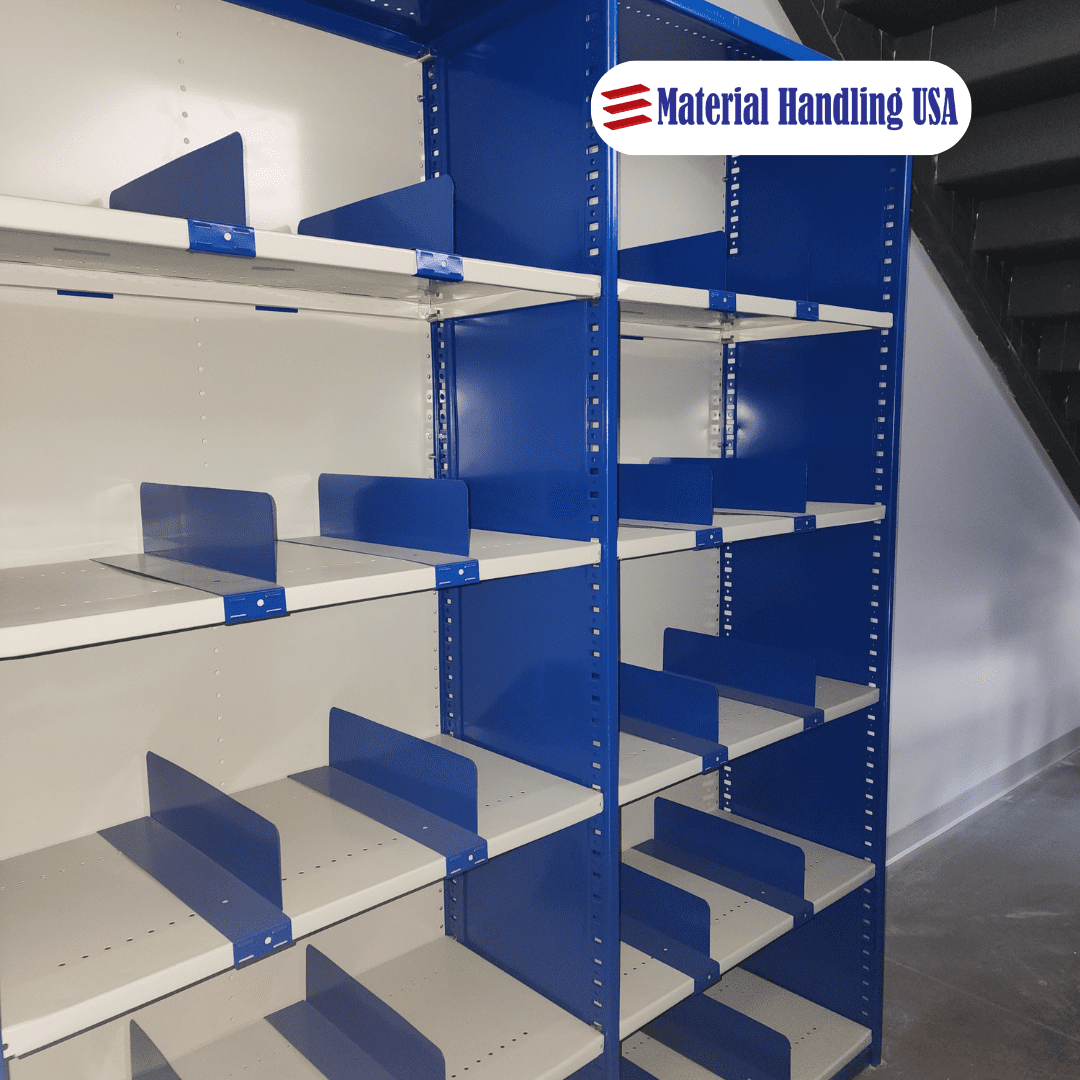
Automotive Shelving: This is the backbone of most parts rooms. Open-style Metro wire shelving is excellent for visibility and airflow, while solid steel shelving is ideal for heavy or bulky items. Adjustable shelves provide the flexibility to adapt as your inventory changes.
Modular Drawers: For small parts like sensors, fasteners, and electrical components, high-density modular drawers are superior to open bins. They offer up to 70% more storage capacity in the same footprint, keep parts clean, and improve organization and picking accuracy.
Specialized Racking:Awkward items require unique solutions. Dedicated tire storage systems, hanging racks for exhaust pipes, and cantilever racks for long items like molding are essential for a truly organized space. For maximum density, consider an automated tire carousel.
3. Workflow Optimization
An efficient workflow minimizes wasted steps and maximizes productivity. The process should be seamless from receiving to dispatch. When parts arrive, they should be inspected and immediately put away in their designated, clearly labeled location. A disorganized receiving area is a common bottleneck.
The picking process must be optimized for speed and accuracy. A well-organized slotting strategy (placing the right parts in the right locations) is key. For technicians, consider implementing a parts request system that allows them to order parts electronically from their bay. This reduces foot traffic and allows parts staff to pick and deliver items efficiently. Providing staff with automotive rolling tool carts can further streamline the process of delivering parts directly to the service bays, reducing technician travel time and keeping them focused on repairs.
Ready to Build a High-Performance Parts Room?
Explore our solutions and see how we have helped other dealerships transform their operations.
The Benefits of a Well-Designed Parts Room
An investment in organization is an investment in profitability.
Increased Technician Productivity
Faster parts retrieval means less downtime for technicians, leading to more completed repair orders per day.
Improved Inventory Accuracy
A logical layout and clear labeling reduce picking errors and make cycle counting faster, leading to better inventory control.
Maximized Space Utilization
High-density storage solutions like modular drawers and vertical carousels allow you to store more parts in less floor space.
Enhanced Employee Safety
Proper storage of heavy and bulky items, combined with clear aisles, reduces the risk of workplace accidents and injuries.
FAQs
Tires are bulky and consume valuable floor space. The best solution is to go vertical. Specializedtire storage systemsallow you to store tires safely and densely. For the ultimate in space savings and efficiency, considerautomated tire storage, such as a Vidir tire carousel. These systems bring the tires directly to the operator, maximizing vertical space and dramatically speeding up retrieval time.
When you cannot expand outwards, you must expand upwards and increase density. Replace open shelving used for small parts with high-density modular drawer cabinets. This can recover up to 70% of your floor space. Consider installing a mezzanine to add a second level of storage for bulk or slow-moving items. Finally, automated storage and retrieval systems (AS/RS) like vertical lift modules offer the highest possible storage density in a minimal footprint.
The most critical first step is data analysis. Before you move a single shelf, you need to understand your inventory. Analyze your sales data to determine your fast and slow-moving parts. Measure your existing inventory to understand the size and quantity of the items you need to store. This data-driven approach ensures that your new design is based on reality, not guesswork. It allows you to select the right equipment and create a layout that truly supports your operational needs. If the room is being rebuilt or relocated while it stays open, see parts department remodel and relocation storage planning.
Parts Room Layout & Workflow Design
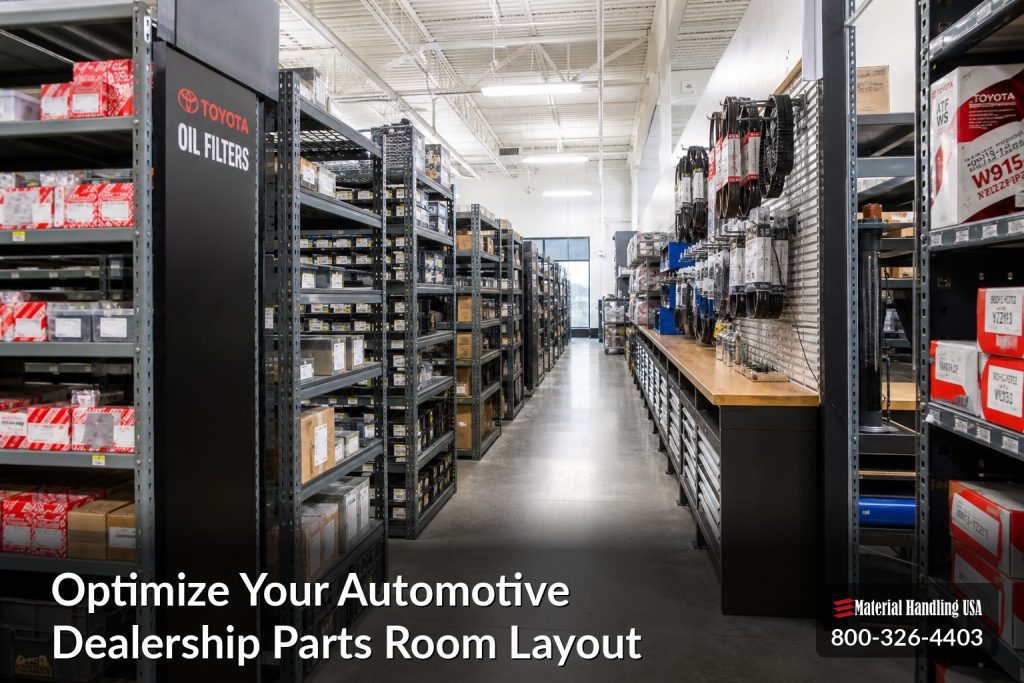
An efficient parts room layout starts at the counter where technicians request parts and works backward through the storage zones to the receiving door where new inventory enters. The layout must minimize the distance a parts clerk walks between the counter and the most frequently requested items — what industrial engineers call the golden zone. Fast-moving parts (oil filters, brake pads, spark plugs, common fasteners) should be within arm’s reach of the service window. Slower-moving items can be stored further from the counter in higher-density storage systems.
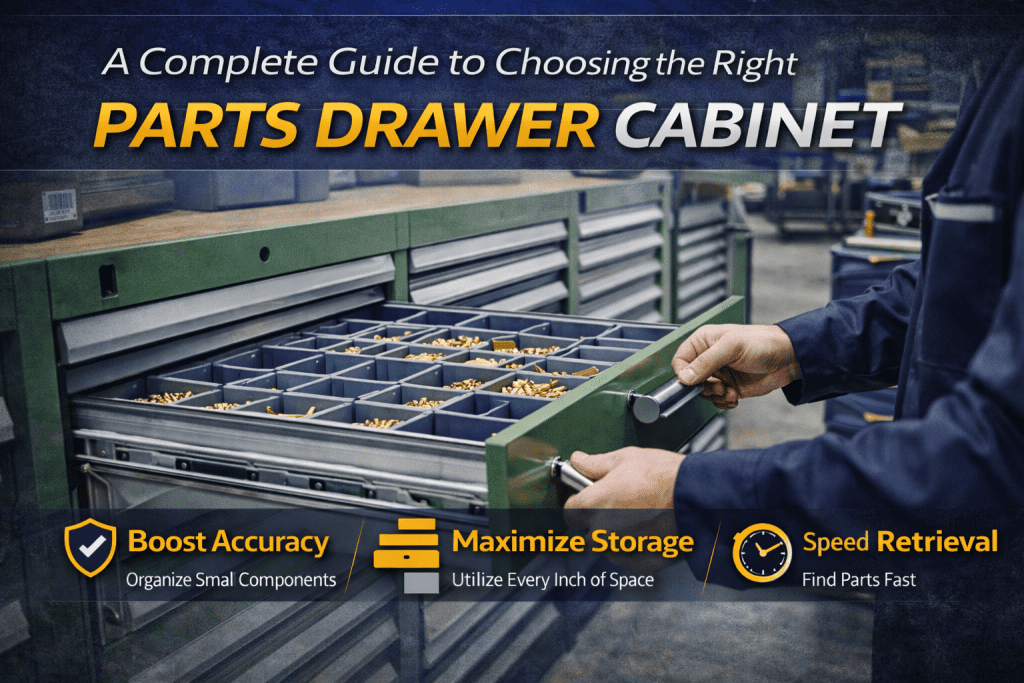
Drawer cabinets from Borroughs are the optimal storage solution for the golden zone. Each drawer presents its entire contents when opened — the clerk sees every part in the drawer simultaneously and picks the correct item without moving boxes, reaching behind other items, or climbing a ladder. A single Borroughs 30-inch-wide cabinet with 15 drawers replaces approximately 12 linear feet of conventional open shelving while providing better organization, faster picks, and complete dust protection for sensitive components.
Beyond the golden zone, open shelving stores medium-sized parts (alternators, water pumps, headlight assemblies, body trim) that are too large for drawers but too light for pallet storage. Cantilever rack handles long and awkward items — exhaust pipes, drive shafts, roof rails, and running boards. Vidir vertical carousels store the heaviest and most space-consuming items — tires, bumpers, windshields, and body panels — in a compact motorized system that delivers items to the operator at waist height.
Traffic flow is critical in high-volume parts operations. The layout should create one-way flow from receiving through put-away to pick to counter service, with designated staging areas at each transition point. Receiving inspection, returns processing, and warranty parts should have dedicated zones that don’t interfere with the main pick-and-serve workflow. Our layout designs include traffic arrows, staging zone dimensions, and equipment clearances that prevent congestion during peak demand periods. The dock end of that flow is covered in detail in parts receiving and put-away storage.
Drawer Cabinet Configurations & Accessories
Borroughs industrial drawer cabinets are available in 11 standard widths (from 22 to 60 inches) and 6 heights (from 28 to 75 inches), creating 66 basic cabinet configurations before drawer layout customization begins. Each cabinet accepts interchangeable drawer heights — 2-inch, 3-inch, 4-inch, 6-inch, 8-inch, and 12-inch drawers can be mixed within a single cabinet to match the specific part sizes stored in that location.
The interior of each drawer is customized with adjustable partition dividers that create individual compartments for each part number. Standard partitions come in 2-inch increments and can be positioned to create compartments from 2×2 inches (for tiny hardware) to the full drawer width (for large flat items). Foam inserts are available for protecting precision machined components, bearings, and electronic modules that require cushioned storage.
Full-extension drawer slides are standard on all Borroughs cabinets, allowing the clerk to see and access the entire drawer contents without reaching into the cabinet. Heavy-duty slides support 400-pound drawer loads — sufficient for storing steel fasteners, dense metal components, and heavy tooling. Drawer interlock mechanisms prevent more than one drawer from opening simultaneously, which prevents the cabinet from tipping forward under load. Key-locking cabinets secure high-value parts (OEM electronics, precious metal catalytic converters, key blanks) that require controlled access.
Inventory Management & Parts Slotting
A parts room is only as good as its organization. Parts slotting — the process of assigning each part number to a specific storage location — determines how quickly clerks can find items and how efficiently storage space is utilized. Material Handling USA offers parts slotting services as part of our design package, using your inventory data to assign every part number to the optimal drawer, shelf, or carousel position based on size, weight, pick frequency, and category grouping.
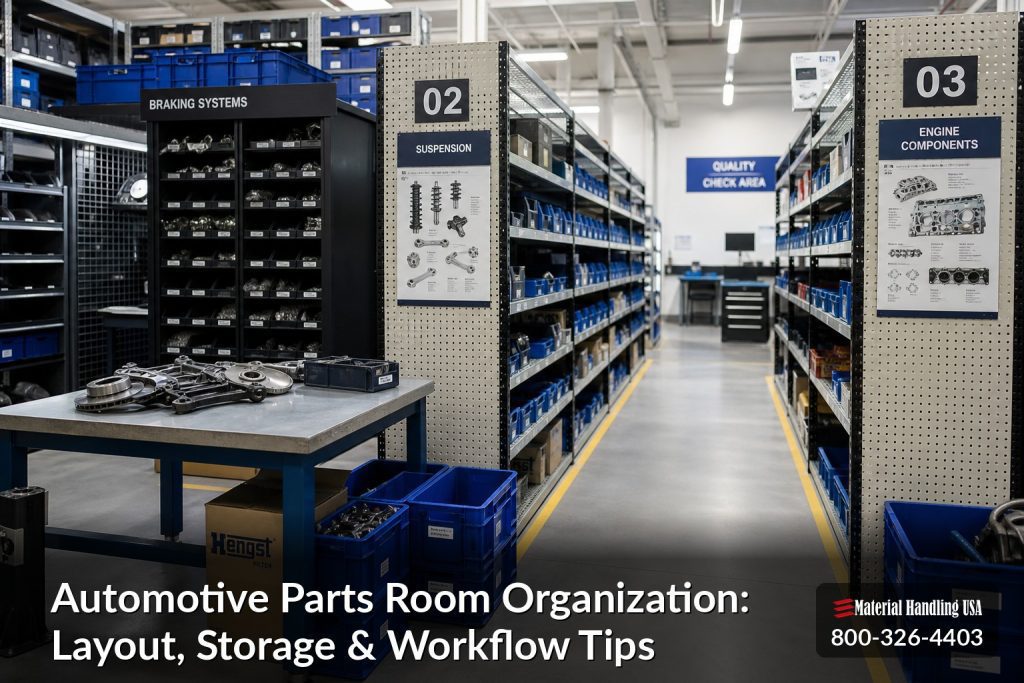
The slotting methodology follows velocity-based principles similar to warehouse layout optimization. A-velocity parts (top 20% of picks) are positioned in drawer cabinets at waist height within arm’s reach of the service counter. B-velocity parts go on open shelving at easy-access heights. C-velocity parts (seldom requested) can be stored on upper shelves, in less accessible locations, or in the Vidir carousel where items are retrieved mechanically. Within each zone, parts are grouped by vehicle system (brakes, electrical, engine, suspension) so related items are physically adjacent — reducing clerk travel when multiple parts are needed for the same repair.
Proper slotting also maximizes storage density by matching storage medium to part size. A small O-ring stored on an open shelf wastes 95% of the available shelf space. The same O-ring in a drawer compartment uses only the space it needs, leaving the remaining compartments for other small parts. Conversely, a large bumper assembly crammed into shelf racking wastes space above and around it. That bumper belongs in a Vidir carousel where the shelf height adjusts to the exact part dimension. Right-sizing the storage medium to the part size typically recovers 30–50% of wasted space — space that translates directly into additional inventory capacity without expanding the room.
Vidir Vertical Carousels for Parts Storage

Vidir vertical carousels are motorized storage systems that bring parts to the operator rather than requiring the operator to walk through rows of shelving searching for items. The carousel consists of carriers (shelves) suspended on a chain drive that rotates vertically — like a Ferris wheel — delivering the requested carrier to the access opening at waist height. A single Vidir carousel occupying a 10×4-foot floor area and extending to ceiling height replaces 75–100 linear feet of conventional shelving.
For automotive parts rooms, Vidir carousels excel at storing bulky items that waste space on conventional shelving: bumpers, fenders, hoods, windshields, tires, exhaust systems, and body panels. Each carrier shelf adjusts in height to match the stored item, eliminating the wasted vertical space between shelves that plagues conventional shelving storing mixed-size parts. The enclosed carousel also protects stored parts from dust, handling damage, and unauthorized access — important for expensive body panels and glass that are easily damaged on open shelving.
Vidir integrates with parts inventory management systems through barcode and RFID interfaces. The parts clerk scans a part number or enters it on the touchscreen, and the carousel rotates to present the carrier containing that item. This eliminates the search-and-walk time that consumes 60–70% of a parts clerk’s productive hours in a manually organized parts room. Studies of parts room operations consistently show that vertical carousels improve parts clerk productivity by 2–3× and reduce incorrect picks by over 90%.
Dealer groups and fleet maintenance operations with multiple service bays benefit the most from carousel systems because their parts rooms handle high transaction volumes where search-and-walk time directly impacts technician productivity. Every minute a technician waits for a part is a minute of lost billable labor. A carousel-equipped parts room that cuts average retrieval time from 3 minutes to 30 seconds delivers measurable improvement in shop productivity and revenue per bay per day.
Getting Started with Parts Room Design
Material Handling USA designs complete parts room solutions for automotive dealerships, fleet maintenance operations, heavy equipment dealers, and independent repair facilities. Our design process begins with an inventory analysis — we review your parts catalog, transaction history, and growth projections to size the storage system correctly. Undersized parts rooms run out of space within 2–3 years, forcing expensive expansion or off-site storage. Oversized parts rooms waste capital on equipment that sits empty. Our data-driven approach right-sizes the system for your current inventory plus 3–5 years of projected growth.
The design package includes a detailed floor plan showing drawer cabinet positions, shelving runs, carousel placement, service counter layout, and traffic flow paths. Each storage location is assigned specific part categories based on the velocity-based slotting methodology — ensuring the fastest-moving parts are always within arm’s reach of the service counter. We specify exact cabinet configurations (drawer heights, compartment layouts, label systems) and shelving dimensions (width, depth, shelf spacing) for every position in the parts room.
Installation is managed as a turnkey project — Material Handling USA coordinates equipment delivery, assembly, and parts migration so your dealership experiences minimal disruption to daily operations. Most parts room installations complete over a weekend or during a planned service department shutdown. Our installation team assembles all equipment, installs bin labels, and works with your parts manager to execute the slotting plan so every part is in its assigned location when the parts room reopens for business Monday morning. Contact us today for a free parts room design consultation.
Manufacturer detail and specifications: Borroughs automotive shelving (Box Edge Plus® parts room shelving, 400 lb high-density drawers and service workstations) · automotive parts storage · automotive modular drawers · parts room shelving.
Shop Bin Storage Systems Online
Buy select items directly from our online store, or request a quote for volume, custom sizes and freight-rated orders.
Related Products & Resources
Ready to Get Started?
Contact our team for a free design consultation and quote.