
Parts Receiving and Put-Away Storage
Freight arrives all morning, the counter is busy, and the cartons pile up. Here is how to design the receiving bench, staging lanes, put-away carts and location system so inbound parts reach their shelf the same day — and stop living in the aisle.

Receiving is a workstation
Bench height, reach and tooling decide how fast a shipment clears
Staging needs lanes
Undesignated floor becomes permanent storage within a week
Put-away is where accuracy is won
Location labels and a fixed rule beat memory and good intentions
Aisles are not staging
Federal rules require aisles and passageways to be kept clear and in good repair
The pile in the aisle is a storage design problem
Ask a parts manager where their department is losing time and the answer is rarely the picking. It is the
inbound side: stock orders, emergency orders, dealer transfers, returns coming back, cores going out and
wholesale receipts all arriving into a space that was never designed for them. The visible symptom is a stack
of cartons along an aisle. The real cost is quieter — parts that are physically present but not yet
shelved cannot be found by anyone, so they are re-ordered, back-ordered, or sold as unavailable.
Receiving and put-away is the part of a parts room most often left out of the layout. Shelving gets planned
carefully, the counter gets planned carefully, and the inbound flow gets whatever floor is left. This page
covers that flow specifically: the bench, the staging area, the carts, the location system and the discipline
that makes same-day put-away realistic. It fits inside our wider
automotive parts storage systems guidance and sits alongside our
parts room design, layout and workflow page, which addresses the room as a whole.

Design the receiving station as a workstation
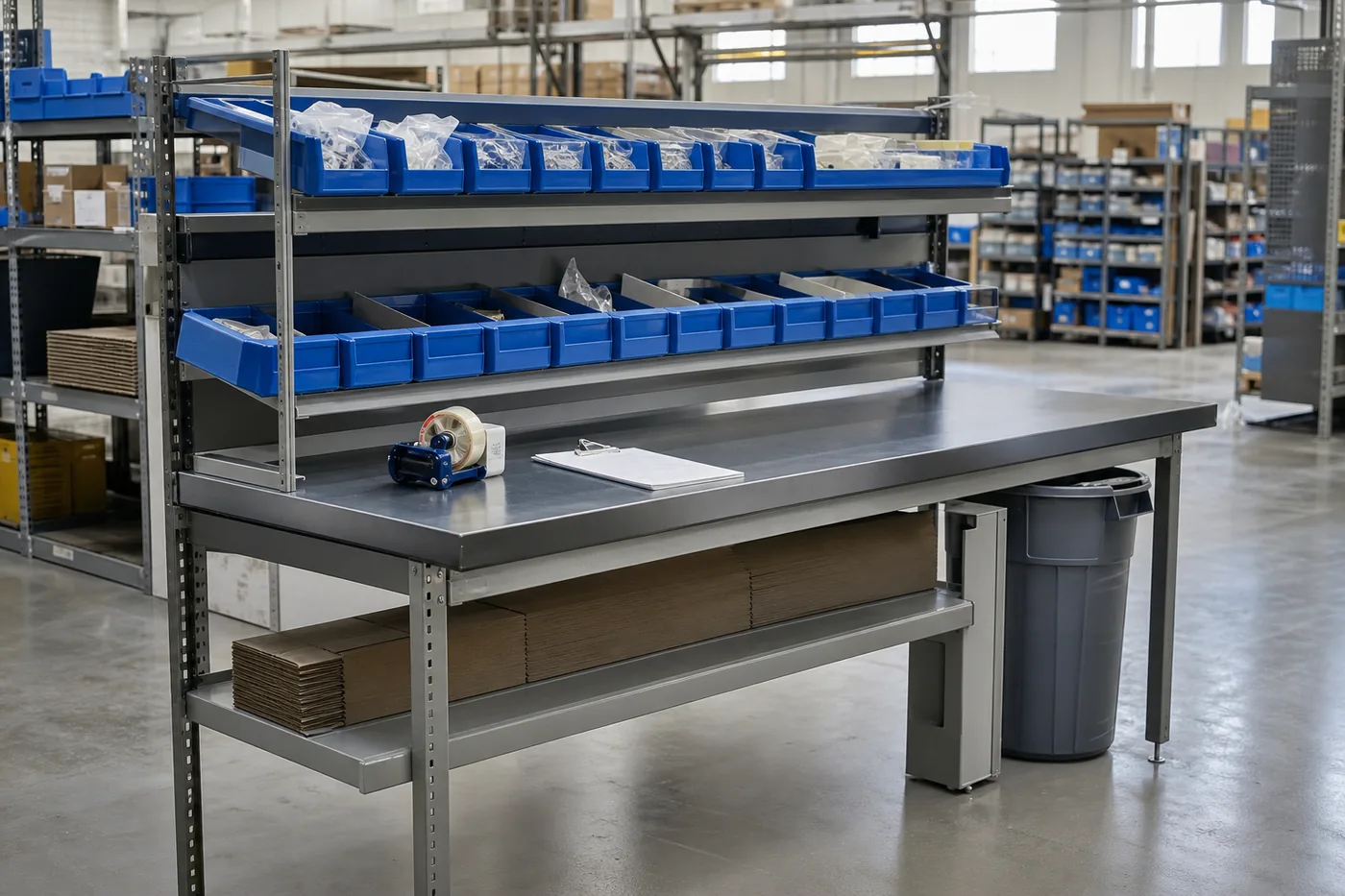
Almost every slow receiving process traces back to a bench that is the wrong height, the wrong size, or in
the wrong place. Checking in a shipment involves opening cartons, comparing to a packing list, scanning or
keying, labeling, sorting into destinations and disposing of packaging. If any of those steps requires walking
away from the bench, the shipment takes twice as long and the surface fills up.
- Right height for the work. Most check-in is standing light assembly work, which suits a
bench near elbow height. Heavy unpacking suits a lower surface. If both happen, an adjustable-height bench
earns its cost. - Enough surface, deliberately sized. Size the bench for the largest routine shipment, not
the average one, and keep a defined clear working zone that nothing is allowed to occupy permanently. - Everything at the bench. Terminal or tablet, scanner, label printer, tape, knife, marker,
trash and recycling, and a bin rail with the packaging supplies. Each missing item is a walk per shipment. - Sort destinations, not one pile. A shelf or cart position per destination — stock,
counter, special order and will-call, technician waiting, wholesale route, returns and cores — turns a
pile into a set of small, finishable tasks. - Light it properly. Part numbers on cartons and labels are read all day at this bench.
- Put it on the path. The bench belongs between the receiving door and the shelving, not
across the department from either.
Our Borroughs automotive shelving page covers the bench, workstation and shelving families
that suit this area, and bin shelving covers packaging and small-parts staging.
Staging: temporary space that stays temporary
Every department needs somewhere to put freight between the door and the bench. The failure mode is not
having staging — it is having staging that is undefined, so it grows, and then never empties.
| Staging need | What it holds | How to keep it honest |
|---|---|---|
| Inbound freight lanes | Pallets and totes waiting to be checked in, usually clearing within hours. | Mark the lanes on the floor, size them for the normal delivery volume, and treat a full lane as a signal to stop and process rather than to spill over. |
| Checked-in, awaiting put-away | Parts already received into the system but not yet shelved. | This is the most dangerous pile because the system says the part is on hand. Cap it: a fixed number of carts, and the rule that a cart is emptied before it is refilled. |
| Special orders and technician-waiting parts | Parts that must not be shelved into stock at all. | A separate labeled location system with a name or repair order number per position, checked daily so nothing goes stale. |
| Outbound: wholesale routes and transfers | Picked orders waiting for a driver. | Its own lanes away from the pick aisles. Our wholesale delivery staging guidance covers this in detail. |
| Returns, cores and warranty | Material moving out of the department, often slowly. | A dedicated area with its own routine. Left in receiving, it consumes the space the inbound flow needs every morning. |
| Packaging and waste | Cardboard, banding, pallets and dunnage. | A container that is emptied on a schedule and located next to the bench, not down the aisle. |
Aisles are not staging
OSHA 29 CFR 1910.176(a) requires sufficient safe clearances for aisles where mechanical handling equipment is used and requires aisles and passageways to be kept clear and in good repair, and 1910.176(b) requires stored material to be stable and secure against sliding or collapse. Staged freight in an aisle fails both. Designing enough staging is the practical way to comply.
Put-away: where inventory accuracy is actually created
Put-away is a five-second decision repeated hundreds of times a week, and the quality of that decision is
what your on-hand accuracy is made of. It is a design problem more than a training problem.
Give every location an address
Aisle, bay, shelf, position — printed on the shelf edge, in a consistent scheme, readable from the aisle. Put-away accuracy that depends on remembering where something lives cannot survive a busy day or a new hire.
Decide fixed versus random, and be consistent
Fixed locations suit a stable fast-moving core; random or dynamic locations use space better across a large slow-moving tail. Mixed schemes work only when the rule for which is which is written down.
Slot by velocity and weight
Fast movers in the golden zone between roughly knuckle and shoulder height, heavy items low, slow movers high or remote. The NIOSH revised lifting equation starts from a 51-pound load constant reduced by horizontal distance, height, twisting, frequency and grip, which is why heavy items stored high are a real risk and not just an inconvenience.
Put away by route, not by carton
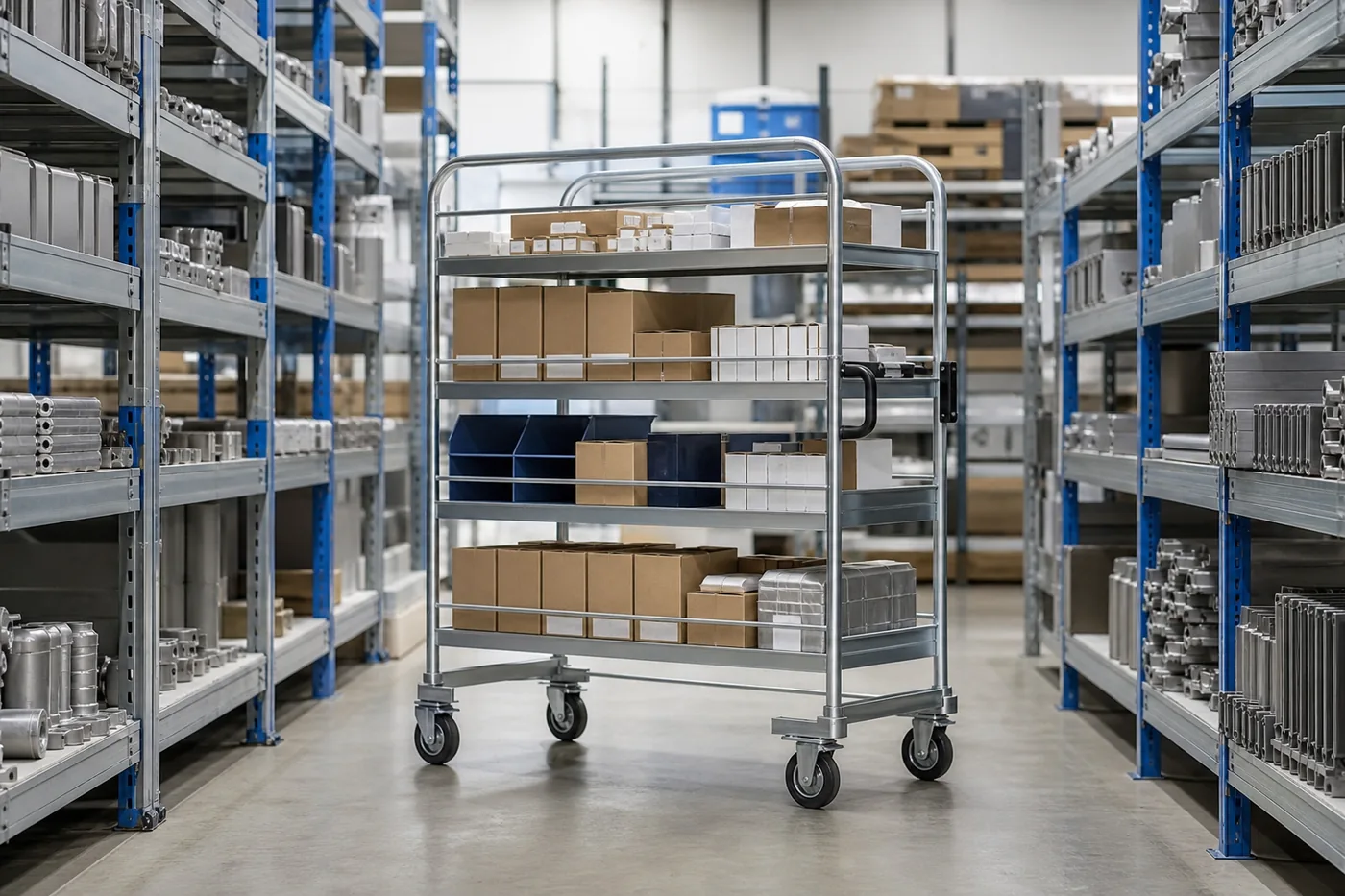
Sort the cart into location sequence and walk the aisles once. Random-order put-away multiplies the walking distance for the same work.
Handle exceptions at the bench
New parts with no location, superseded numbers, damaged freight and quantity discrepancies get resolved during check-in. Deferred exceptions become the permanent pile.
Close the loop with cycle counting
Count a small set of locations continuously rather than shutting down for an annual count. Persistent errors point to a put-away or slotting problem worth fixing at the shelf.
Measure the clock, not the pile
Time from delivery to shelved is the metric worth posting. Same-day is a reasonable target for stock orders in most departments once the space exists to support it.
Want the receiving and put-away area designed into your parts room?
MH-USA lays out parts departments across Utah, Idaho, Nevada and the Mountain West — receiving benches, staging, shelving, drawers, bins and labeling — and installs the whole package.
The equipment list for a receiving and put-away area
- Time from delivery to shelved, measured for a normal week rather than estimated.
- The largest routine inbound shipment, in pallets and cartons, and how many arrive at once on a peak morning.
- How many destinations a received part can have in your process, and whether each has a physical home.
- Whether every stocking location has a printed, readable address today.
- How special orders and technician-waiting parts are stored and how often they are reviewed.
- Where returns, cores and warranty material sit, and whether they sit in the receiving footprint.
- The distance from the receiving door to the bench, and from the bench to the fastest-moving shelving.
- Whether any current staging is standing in an aisle, and what it would take to give it a real location.
How much space does a parts receiving area need?
What is the right height for a parts receiving bench?
Should parts locations be fixed or random?
How do we stop received parts from sitting unshelved?
Where should special-order and technician-waiting parts be stored?
How does put-away affect inventory accuracy?
Can the receiving area share space with returns and cores?
What does OSHA require around staging and aisles?
Fix the inbound side of your parts department
Tell us how freight arrives and where it ends up today. MH-USA will design the receiving bench, staging lanes, put-away carts, shelving and labeling so parts reach their location the day they arrive.