
Home | Warehouse Optimization | Storeganizer
Storeganizer: High-Density Pocket Storage That Turns Rack Space Into Pick Faces
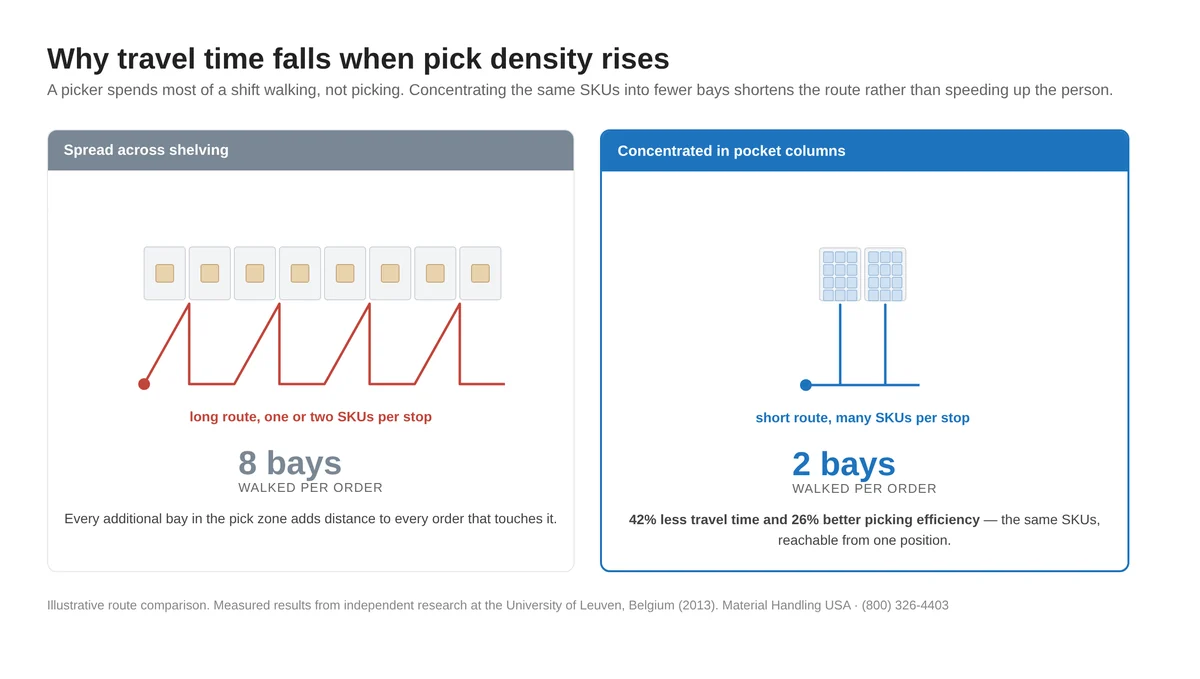
Storeganizer is a high-density pocket storage system that fits inside your existing pallet rack. MH-USA sells, designs and installs it across the USA. Vertical columns of textile pockets replace shelving for small, slower-moving SKUs, up to four rows deep — independent research measured 40% more usable space, 42% less operator travel and a 26% gain in picking efficiency.
+40%
More usable storage space
-42%
Operator travel time
+26%
Order-picking efficiency
10 yr
Rip-and-crack warranty
What Storeganizer is

Pallet racking is excellent at what it was designed for: storing pallets of fast-moving product. It is a poor container for a box of fittings. Put small, slow-moving SKUs on shelves inside a rack bay and most of the cube in that bay stays empty — you are paying rent, lighting and heating on air.
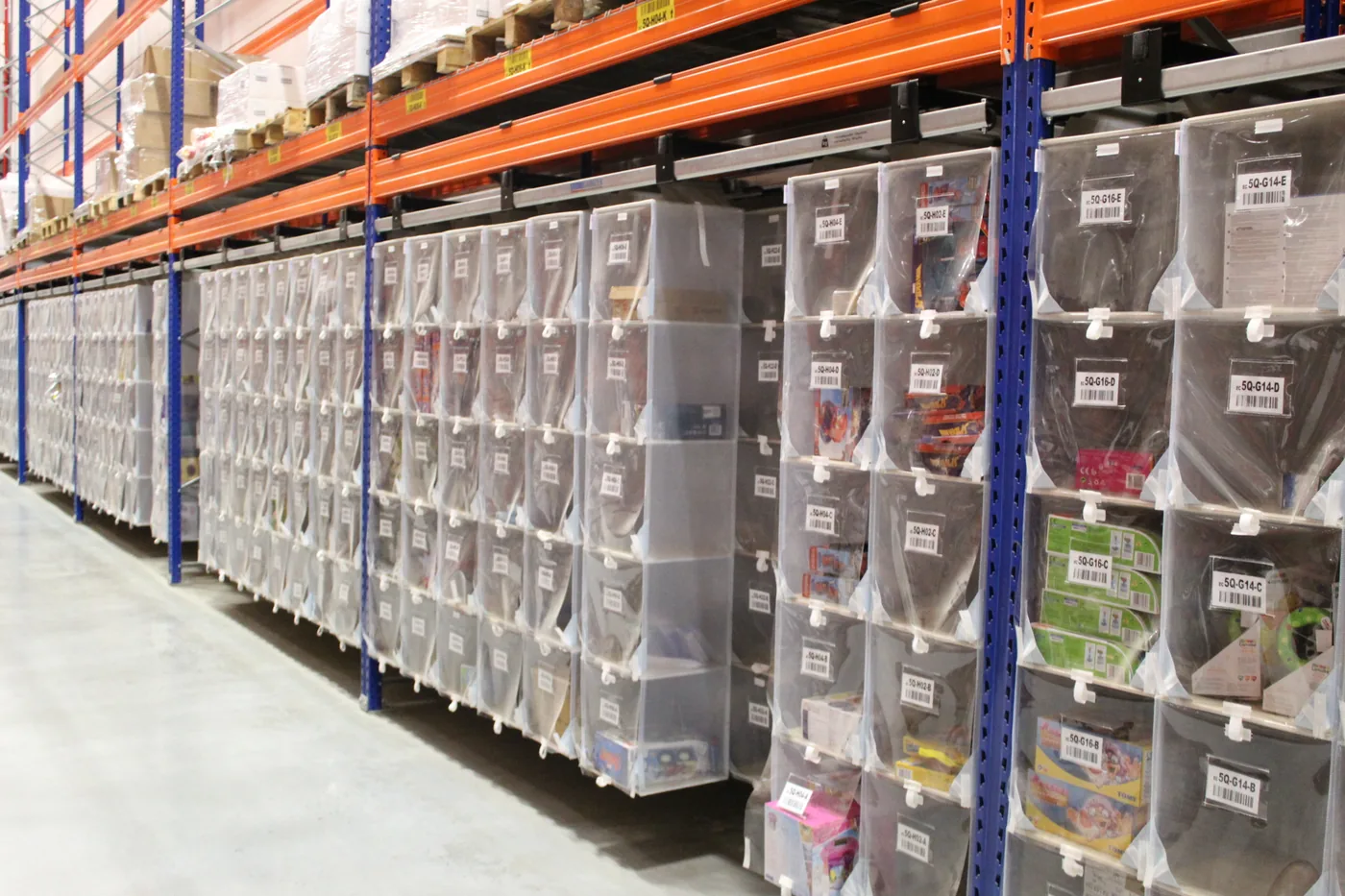
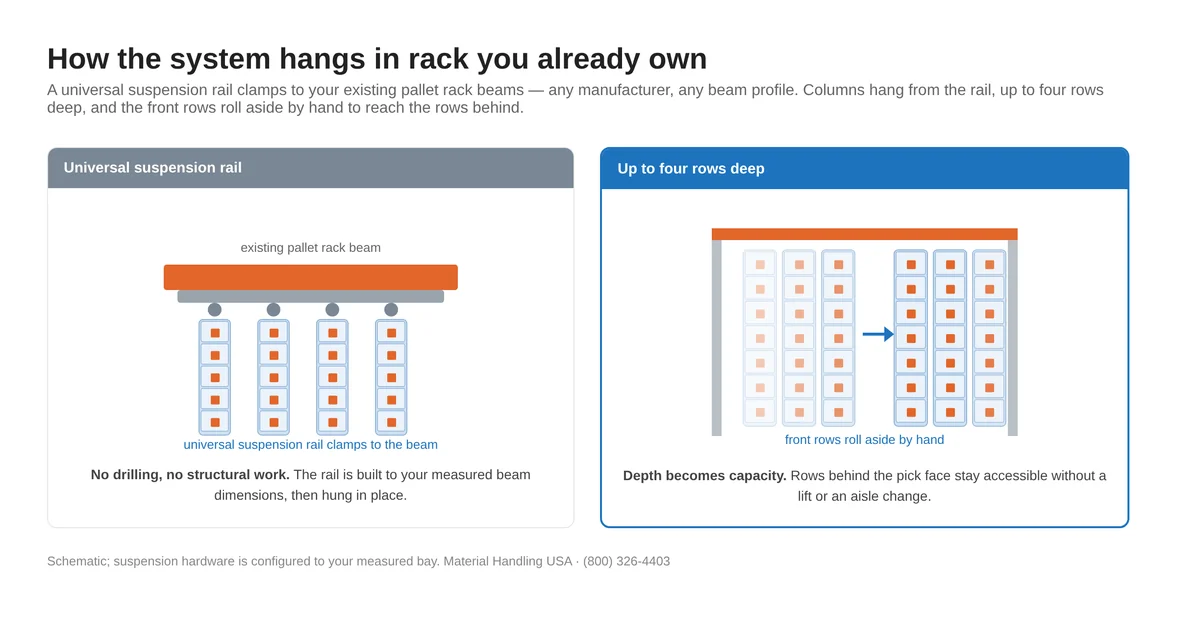
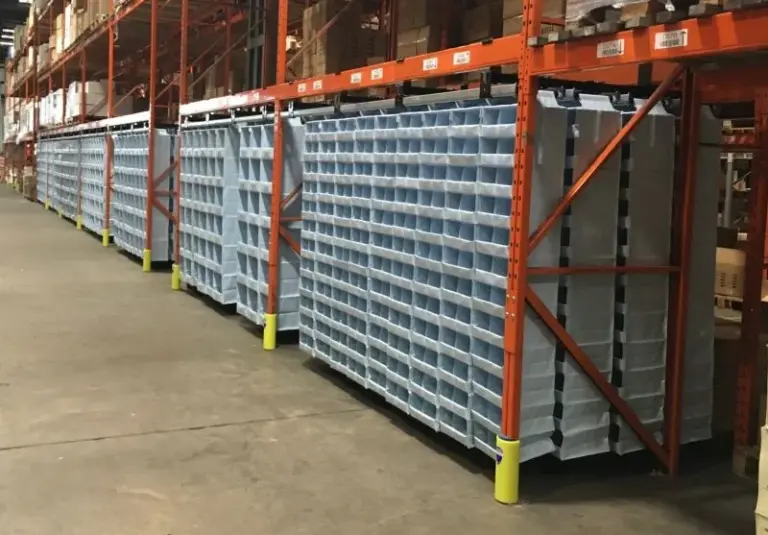
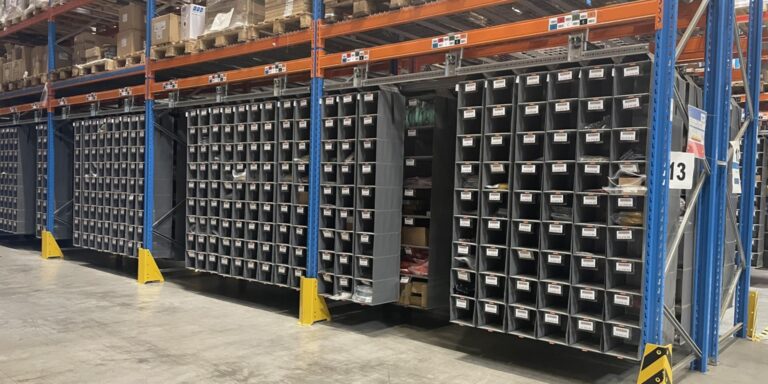
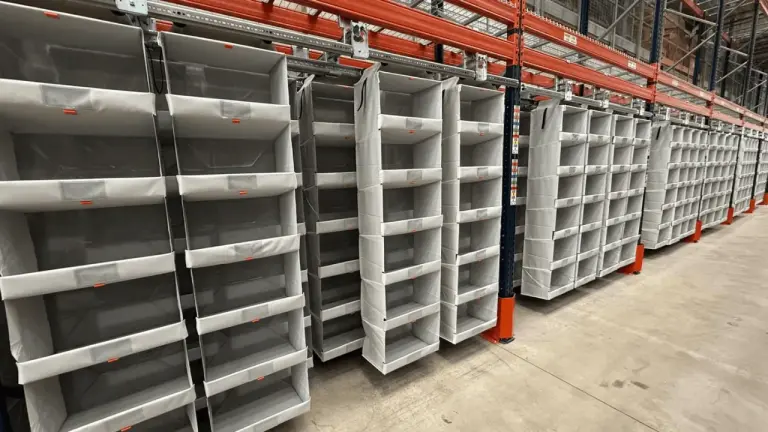
Storeganizer is the original slim-fit storage system built to solve exactly that. Instead of shelves, a bay is filled with vertical columns of suspended pockets made from coated industrial textile. Each pocket is one pick location. Columns hang from a universal top bar that sits on your existing rack beam, and they can be suspended up to four rows deep in the bay. Because the columns are light, the front rows roll sideways by hand to expose the rows behind them.
The result is a dense, walk-up pick face where a run of shelving used to hold a handful of boxes. A single 96" high bay can hold 252 extra-small pick locations. Nothing is automated, there is no software to integrate and there are no moving parts to maintain — which is why it is often specified as the low-risk alternative to a vertical carousel, a vertical lift module or a low-level mezzanine.
Who makes it, who installs it
Storeganizer is manufactured by KTP conTeyor, the Belgian reusable-packaging specialist that developed the system as a spin-off from its automotive textile dunnage business. Material Handling USA supplies, designs, quotes and installs Storeganizer for customers across the United States from our Salt Lake City base.
How it works
Four things make the system work the way it does. None of them require you to change how your warehouse is run.

The performance numbers, and where they come from
The three headline figures quoted for Storeganizer — 40% more usable storage space, 42% less travel time and a 26% gain in order-picking efficiency — come from independent research carried out at the University of Leuven in Belgium, comparing a Storeganizer installation against conventional rack-and-shelf storage. The manufacturer also publishes a 40% carbon-footprint reduction for the system.
Those are averages, not a promise. What they translate to in your building depends on one thing: how much of your rack is currently holding small items in locations far larger than the items need. Warehouses with a long tail of slow-moving SKUs on wide-span shelving typically see the biggest gain. Operations that are already dense and mostly full-pallet see less.
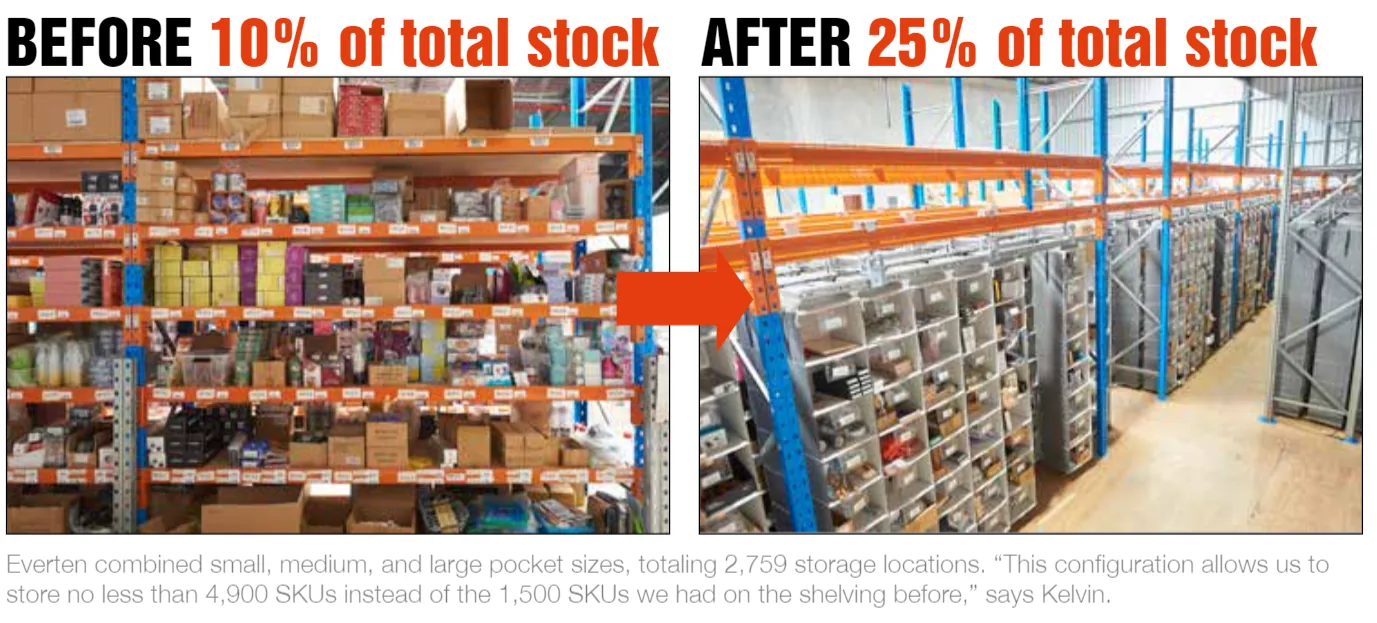
Individual results reported by users have been considerably larger than the averages. Online kitchenware retailer Everten Supplies combined small, medium and large pockets across 18 bays to create 2,759 storage locations in 50 m² of floor; the share of its stock lines held in that footprint rose from 10% to 25%, and mispicks fell by about half. That is why we quote the study figures for planning and then measure your own before-and-after during the design survey.
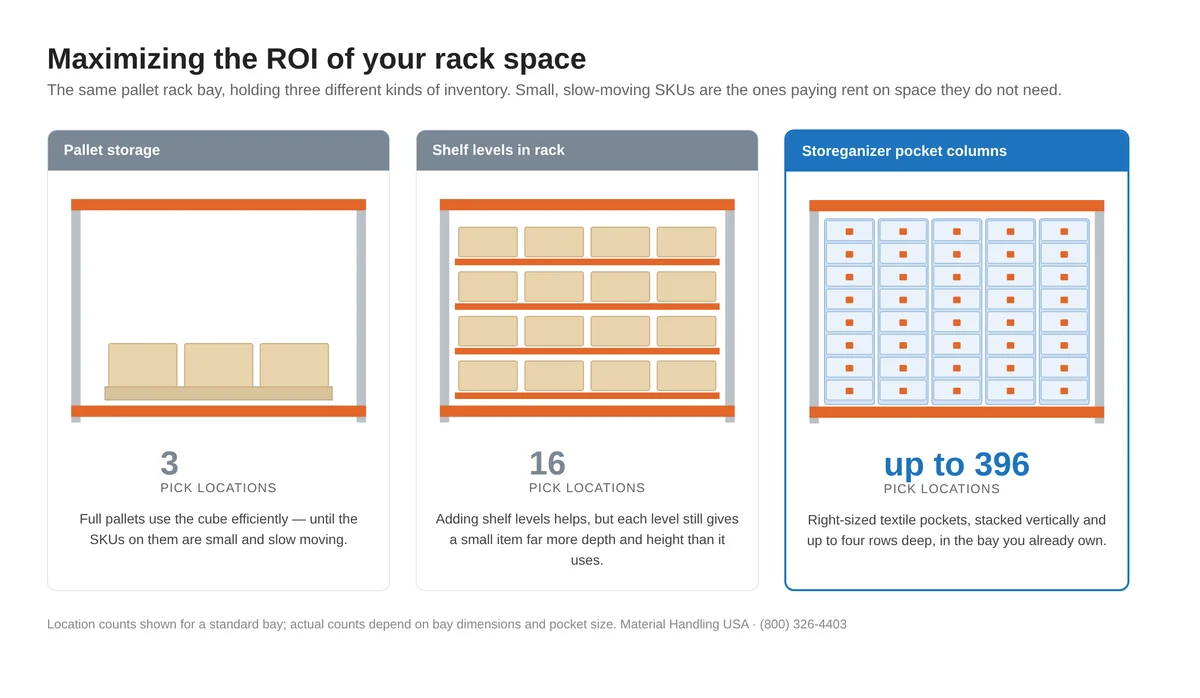
The arithmetic is easier to see than to describe. A bay holding pallets of small parts offers a handful of pick locations; the same bay converted to pocket columns offers hundreds, because each pocket is sized to the item instead of to the pallet. That is the whole mechanism behind the space figure — nothing is compressed and nothing is stacked less safely.
What belongs in Storeganizer — and what does not
Excellent fit
- Small and medium parts that currently sit in oversized shelf locations
- A long tail of slow- and medium-moving SKUs with low quantity per SKU
- Spare parts, MRO consumables, fittings, fasteners and repair kits
- E-commerce singles, apparel and bagged goods
- Aftermarket and dealer parts inventory
- Returns processing and temporary pick lines
- Anything where you need many more pick faces in the golden zone
Not the right tool
- Heavy items — capacity is measured in tens of pounds per pocket, not hundreds
- Full-case and full-pallet fast movers, which belong on beams, flow rack or carton flow
- Long or rigid product such as bar, pipe and extrusion, which belongs on cantilever rack
- Sharp, unpackaged parts with exposed edges, unless a heavier textile grade is specified
- Items that must be locked or sealed for security or evidence chain-of-custody
- Sites where a closed, climate-sealed or fully automated enclosure is a hard requirement
An honest sizing rule of thumb
If a part fits comfortably in a shoebox, turns less than daily, and currently occupies a shelf location several times its own volume, it is a Storeganizer candidate. If it needs a forklift or two hands and a back brace, it is not.
Which SKUs earn their place in a pocket
Slotting decides whether a conversion pays for itself. Three properties of an item settle it: how large the item is, how much stock you hold of it, and how often it is ordered. Size and stock volume determine whether a pocket can hold it at all. Order frequency determines where in the building the bay should sit — not whether pockets are the right home.
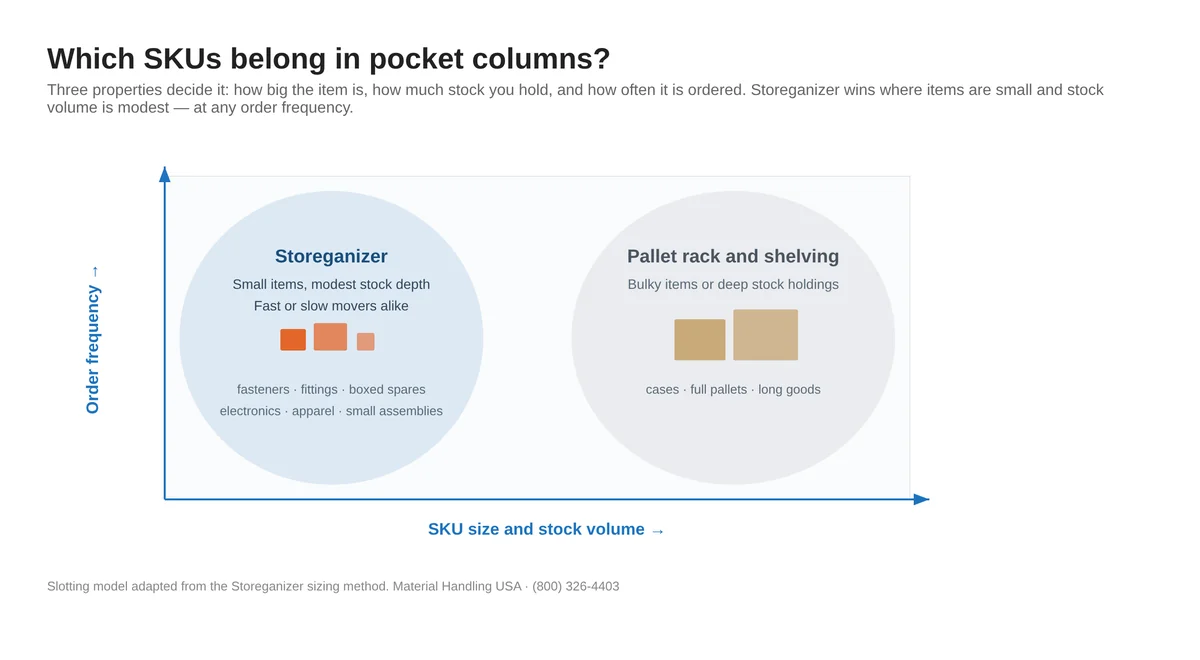
Reading the model
- Small item, modest stock, any frequency. The clearest win. Fasteners, fittings, seals, connectors, boxed spares and small assemblies each get their own address in a fraction of the space.
- Small item, deep stock. Split it: pick face in pockets, replenishment stock on a pallet above. The pocket becomes a forward pick location rather than the whole inventory.
- Bulky item. Leave it in pallet rack, on boltless shelving or on cantilever. Pockets carry up to 44 lb (20 kg) each and are not a substitute for case or pallet storage.
- Very high-velocity item. Consider carton flow for case picking alongside pockets for the long tail — the two coexist well in the same aisle.
This is the analysis we run before quoting, and it is also what the Storeganizer Configurator is built around. If you want the method in more depth, the warehouse slotting optimization guide covers how to profile a SKU base before you move anything.
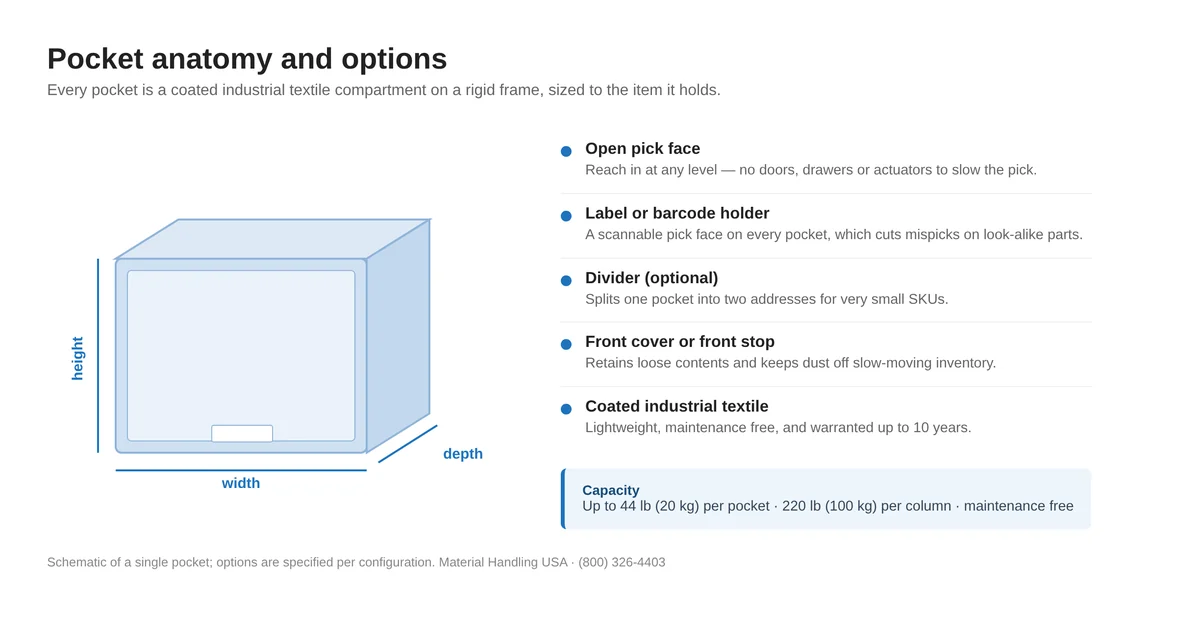
Pockets, columns, dividers, covers and labels
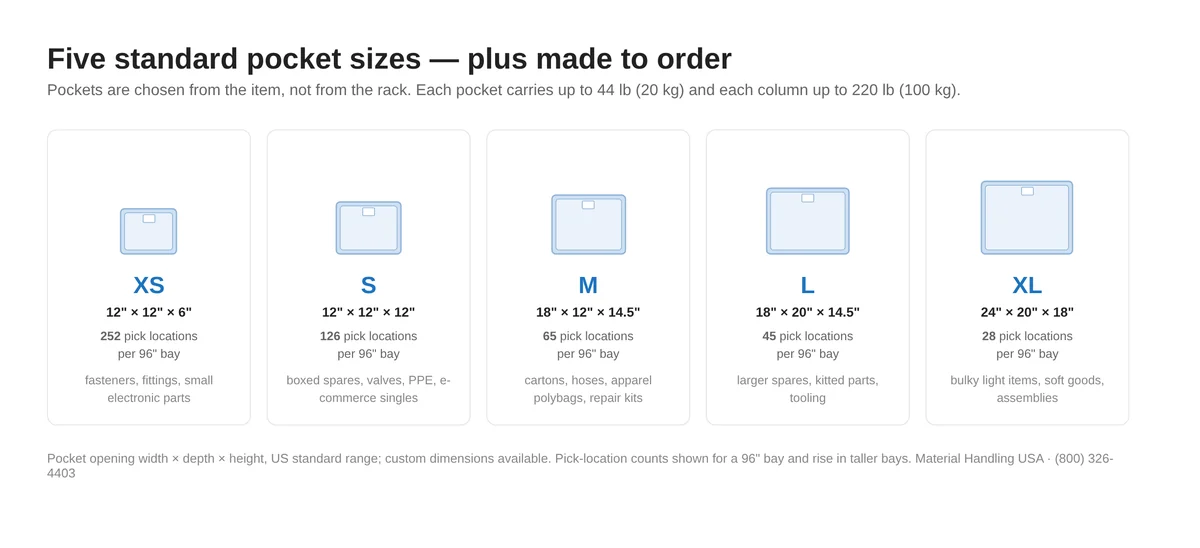
A Storeganizer solution is assembled from a small number of parts, which is what keeps it flexible. Columns of pockets hang from universal steel top bars. Pocket dimensions are selected from the standard US range below, or made to order. Every configuration can be extended later by adding bays or changing pocket styles — you are not locked into the first layout.
| Pocket style | Pocket opening (W x D x H) | Pick locations per 96″ bay | Per 144″ bay | Typical contents |
|---|---|---|---|---|
| Extra Small | 12″ W x 12″ D x 6″ H | 252 | 396 | Fasteners, fittings, small electronic parts, sachets, sample kits |
| Small | 12″ W x 12″ D x 12″ H | 126 | 198 | Boxed spares, valves, PPE, e-commerce singles |
| Medium | 18″ W x 12″ D x 14.5″ H | 65 | 110 | Cartons, hoses, apparel polybags, repair kits |
| Large | 18″ W x 20″ D x 14.5″ H | 45 | 75 | Bulkier cartons, moulded plastics, sub-assemblies |
| Extra Large | 24″ W x 20″ D x 18″ H | 28 | 44 | Large cartons, bagged goods, light bulky returns |
Location counts are per bay for a full four-row-deep configuration at the stated bay height, 42" deep. Mixed pocket sizes within a bay are also possible.

Options
Textile grades
The fabric specification sets both the load the column can carry and how much abrasion it will take before it wears. Most warehouses are specified on Tiger+; heavy or sharp-edged parts and very high pick rates move up the range.
| Grade | Weight | Load per column | Abrasion resistance | Typically specified for |
|---|---|---|---|---|
| Tiger | 3 oz | approx. 70 lb | 50,000 cycles | Light, low-turn inventory in clean environments |
| Tiger+ | — | approx. 100 lb | 150,000 cycles | The standard specification for most warehouses |
| Tiger++ | — | approx. 140 lb | 300,000 cycles | Heavier parts and high-touch pick faces |
| PC380 | 13 oz | approx. 165 lb | 500,000 cycles | Heavy, abrasive or sharp-edged parts, very high pick rates |
Figures are from the manufacturer’s US textile range; the system is rated by the manufacturer at up to 220 lb (100 kg) per column. The rated load for your build is confirmed on your quote before manufacture.
Size your own Storeganizer bays in about two minutes
Pick your bay height, pocket size and bay count in the free Storeganizer Configurator. You get a 3D view of the configuration, the number of pick locations it creates and a bill of materials — no sales call needed to see it.
Full dimensions, textile grades and option detail are on the Storeganizer specifications page.
Rack compatibility and installation
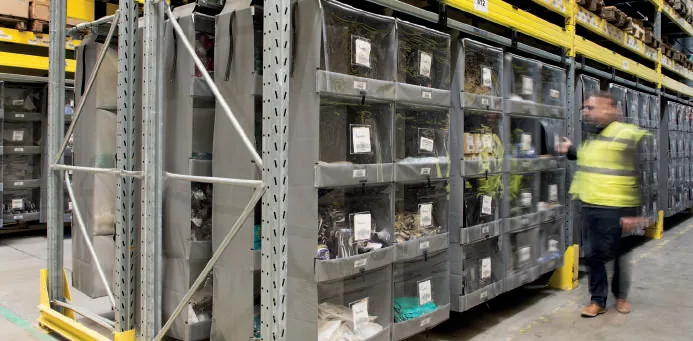
The top suspension is universal, so columns hang from the beams of virtually any pallet rack regardless of manufacturer or beam profile. What we need to know before quoting is straightforward: the bay inner width, the bay inner depth, the usable bay height and the beam height and depth. Standard US configurations are 96", 108" and 144" high bays at 42" deep, with 96" and 144" clear widths the most common.
Installation is fast and non-destructive. Nothing is drilled, welded or bolted into the rack; there is no anchoring, no permit drawing and no electrical work. A column is hung by one person in minutes, and a screw-free assembly option is available. On a typical project our crew hangs a full run of bays in a shift, and because bays can be commissioned one at a time you can keep picking out of the old shelving until the new pick face is stocked.
If the rack you want to use is not there yet, or the bay heights are wrong for the pocket style you need, MH-USA can supply and install the pallet rack as part of the same project — including rack permitting where local code requires it.
Where the return comes from
Load capacity, in plain numbers
Up to 44 lb (20 kg) per pocket and 220 lb (100 kg) per column as standard. A fully configured bay carries well over 3,000 kg. The textile is warranted up to 10 years against rips and cracks, and the system is maintenance free — no annual service contract, no moving parts, no power.
Applications and industries
Any operation with a long tail of small SKUs is a candidate. These are the applications we are asked about most, each with its own configuration considerations.
 High-Density Small-Parts Pocket StorageFasteners, fittings and boxed components that waste most of the cube in a shelf location.
 3PL & E-Commerce FulfilmentMany clients, many SKUs, low units per SKU, and a footprint you cannot grow.
 Spare Parts & MRO StorageCritical spares that must be findable in seconds and are ordered once a quarter.
 Aerospace & Defense PartsSerialised, traceable, high-value small parts in a tightly controlled parts room.
 Retail Backroom & BOPISBackroom inventory, click-and-collect staging and returns processing.
 Pallet Rack Space OptimizationRecovering the cube you already pay for with a hanging pocket storage system, before you lease another building.
Storeganizer compared with the alternatives
Storeganizer is not the only way to densify a small-parts pick face. It competes with shelving, bin systems, carton flow rack and automated storage. Here is the honest short version — the full breakdown is on our Storeganizer vs. shelving, bins, flow rack, VLMs and carousels page, and if the question on your desk is a building project rather than equipment, compare it with a mezzanine or a building expansion. For the bigger picture — what a pick face is and every way to add more in the same footprint — see our guide to warehouse pick faces.
| Option | Density in the same footprint | Cost profile | Moving parts | Best when |
|---|---|---|---|---|
| Storeganizer | Very high for small items | Product-only capital cost, no service contract | None | You have rack and a long tail of small, light SKUs |
| Steel or boltless shelving | Low to moderate | Lowest first cost | None | Items are mixed-size, heavier, or need a flat surface |
| Bin shelving / plastic bins | Moderate | Low | None | SKU count is modest and bins are already standardised |
| Carton flow rack | High for cases | Moderate | Rollers and wheel beds | You pick full cases of fast movers with FIFO replenishment |
| Vertical carousel | High | High capital, service contract, power | Motorised | Security, footprint and goods-to-person matter more than cost |
| Vertical lift module (VLM) | Highest | Highest capital, service contract, power | Motorised | You need throughput, tight access control and WMS integration |
Related pages: boltless shelving · carton flow rack · vertical carousels · AS/RS and VLMs · mezzanines
From inventory analysis to a working pick face
Inventory analysis
We look at your SKU profile — dimensions, weight, velocity and quantity on hand — to work out which items should move off shelving and which should stay where they are.
Measurement & sizing
Bays, beams and the actual parts are measured, using the manufacturer’s Quantisizer process where custom pocket dimensions are needed, so pockets are matched to your product rather than the other way round.
Configuration & layout
Pocket styles, rows deep, columns per bay and bay locations are laid out, including which SKUs land in the golden zone. You can preview the same decisions yourself in the Storeganizer Configurator.
Quote & approval
You receive a quote covering product, freight, tax and installation, with the rated capacity and lead time confirmed in writing before anything is manufactured.
Installation
Our crew hangs the columns in your existing rack — no drilling, no downtime for the rest of the building, and bays can be commissioned in stages.
Slotting & hand-over
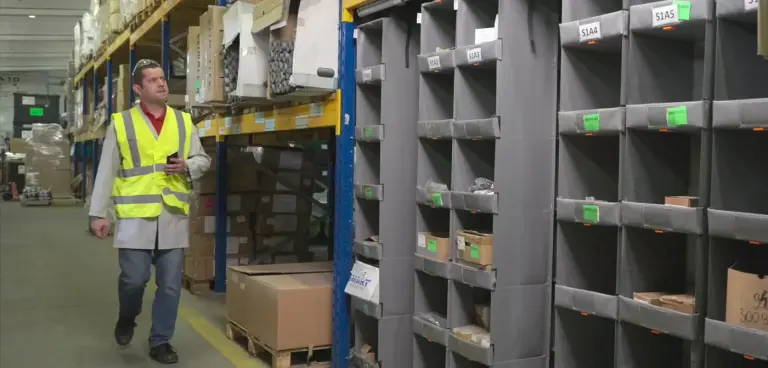
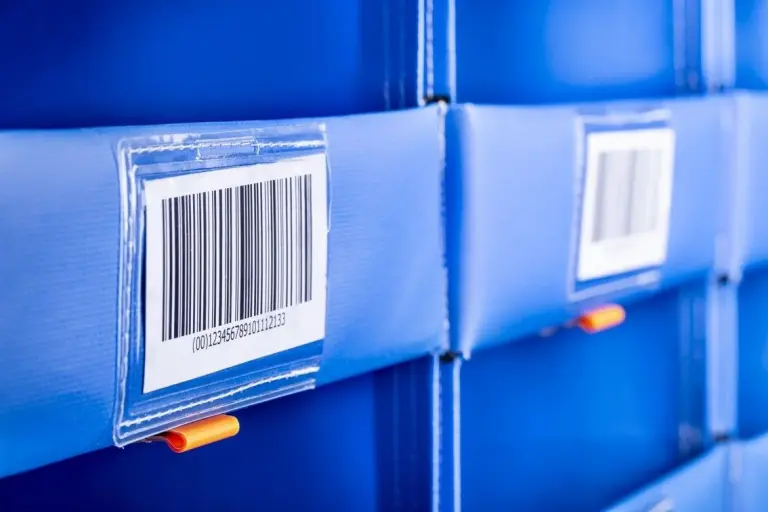
Locations are labelled or barcoded, SKUs are slotted by velocity, and your team picks from the new face. Post-installation support and product evaluation continue afterwards.
Results reported by Storeganizer users
Every figure below is attributed to the operation that reported it. We can arrange a reference call or a site visit with existing users — several of them, including Sundance Catalog, host visitors so prospective customers can move loaded columns themselves and ask the pickers directly.
“Rarely do you achieve a win-win with new products. In this case, there are no disadvantages. These columns increase efficiency; eliminate the need for expensive rack upgrades, site expansion or offsite leases; improve tidiness; reduce staff stress and impress corporate leadership. We only wish we had discovered this earlier.”
“Compared with our previous system, we save no less than 90% of the space in square and cubic feet with densely-packed Storeganizer columns.”

| Operation | What changed | Reported result |
|---|---|---|
| Ingram Micro UK National Distribution Centre | Storeganizer introduced as a key phase of a six-phase warehouse redesign to release space for fast movers | Released twice as much space as the room it replaced at around 80% fill; about 10 seconds faster per pick; 40% more SKUs hit per unit of travel distance; pick rate up from roughly 75 to about 90 lines per hour |
| Chalhoub Group, Dubai region | 8,611 sq ft of static shelving consolidated into 46 Storeganizer bays, three rows deep and six columns high (828 pick modules) | Same inventory in 1,335 sq ft; picking up from 25-30 to 60-80 lines per hour; overall operational efficiency up about 30%; two fewer full-time staff required; fewer mis-picks with one SKU per pocket |
| Everten Supplies | Small, medium and large pockets combined across 18 bays for 2,759 storage locations in 50 m² | Stock lines held in that footprint rose from 10% to 25% of total; mispicks down about 50% |
| Sierra Nevada Corporation aerospace parts room | Shelving replaced with Storeganizer pocket columns in existing rack | Documented on our aerospace parts storage case study |
Related Storeganizer systems
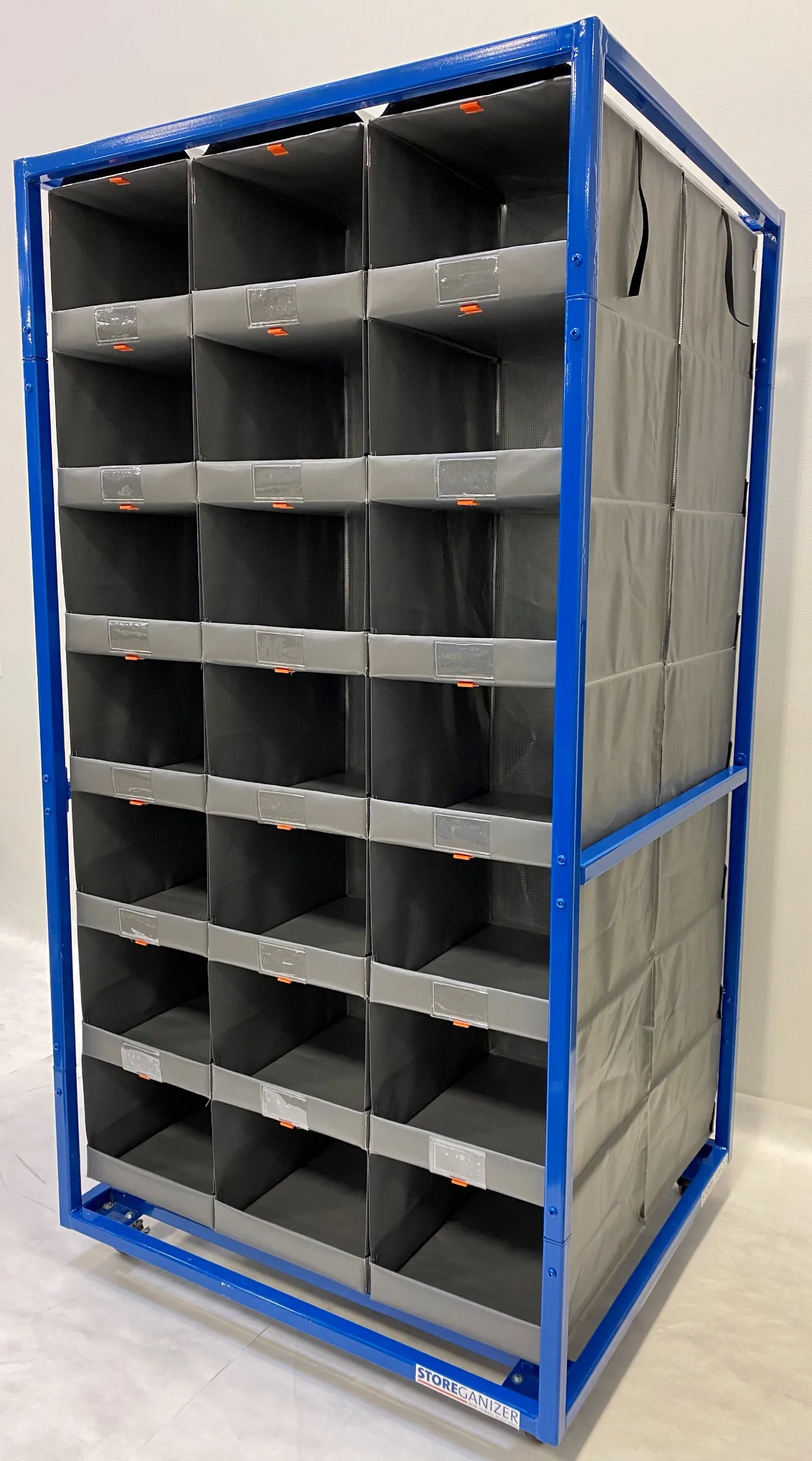 Picking Hive & Pick 360A mobile, self-supporting pocket unit on a standard pallet footprint, used for temporary pick lines, returns processing, BOPIS staging and as a pick face for autonomous mobile robots.
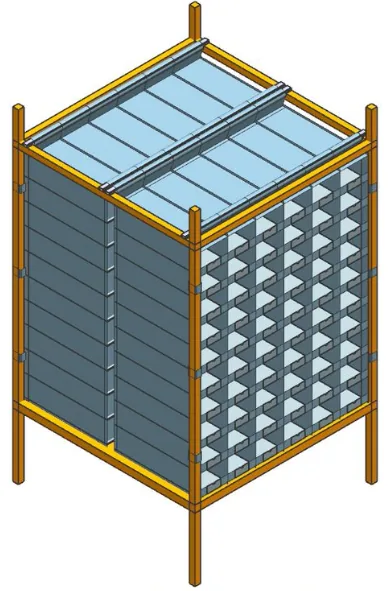 Storeganizer ConfiguratorConfigure bay height, pocket size, bay count, textile grade and options; see the 3D layout, pick-location count and bill of materials.
 Garment-on-hanger & custom textilesHanging garment columns and made-to-order textile solutions from the same manufacturer for apparel and specialised handling.
Who makes Storeganizer
Storeganizer is manufactured by KTP conTeyor, a Belgian group whose original business is reusable industrial packaging for the automotive, electronics and pharmaceutical supply chains. That heritage matters more than it sounds: the pockets are built by a company that has spent decades making coated technical textiles survive being handled thousands of times in a factory, which is why the system carries a warranty measured in years rather than months.
The manufacturer in numbers
| KTP conTeyor | |
|---|---|
| Founded | conTeyor established 1988 |
| Sales | Approximately €165 million (2024) |
| Production | 10 production sites globally |
| Customers | More than 1,200 worldwide |
| Storeganizer developed | 2012 |
| Recyclability | More than 90% of products recyclable |

Where Material Handling USA fits
We specify, configure, supply and install Storeganizer in the United States. That means the slotting analysis, the bay measurements, the configuration, the install and the follow-up all come from one place — and from a team that also designs the pallet rack the system hangs in. If a conversion is the wrong call for your SKU profile, we would rather tell you that than sell you bays that sit half empty.
The sustainability case, and its limits
Storage decisions rarely start as sustainability decisions, but they end up in the same report. Three things about this system are worth putting in front of a facilities or ESG team:
The honest limit: these are manufacturer and research figures, not a measurement of your building. What we can do is calculate the space you would recover from your own bay dimensions and SKU profile, which is the number both the finance case and the carbon case actually rest on. Start with the Storeganizer Configurator or ask us to run it.
Go deeper on Storeganizer
Each of these covers one part of the system in detail — how it works mechanically, how to slot it, what it costs, how it performs in specific industries, and who manufactures it.
 How Storeganizer worksThe suspension system, pocket columns, four rows deep, and installing into existing rack.
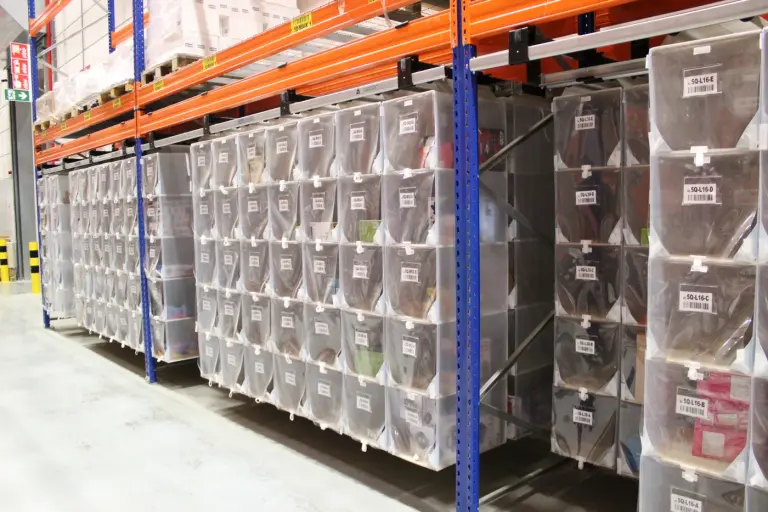 SKU slotting & rack ROIUsing SKU size, stock volume and order frequency to maximise rack-space return.
 Pick facesWhat a pick face is, how to count them per bay, and every way to add more without expanding.
 Cost & ROIWhat drives price, why cost per pick location beats cost per square foot, and payback.
 Electronics & white goodsComponent and appliance-spare ranges: pocket sizing, ESD packaging, picking accuracy.
 Pharmaceutical & medical supplyLot and expiry control, scannable per-SKU locations, and the environmental limits.
 Aviation & MRO partsOne part number per traceable pocket, and what belongs in cantilever instead.
 Sustainability & carbonAvoided space, avoided steel, no operational energy — and what we will not claim.
 Who makes StoreganizerconTeyor: founded 1988, ~€165m sales, 10 sites, and what to verify before buying.
Resources
Ask us for the current Storeganizer US brochure and the specification sheets for the Picking Hive sizes, or take a look at the related MH-USA resources below.
- Storeganizer Configurator — configure and price your own bays
- Improving order-picking efficiency with pocket columns
- Storeganizer pocket sizes, specifications and textile grades
- How Storeganizer works, step by step
- SKU slotting and rack-space ROI
- Storeganizer cost and ROI
- Who manufactures Storeganizer
- Sustainability and carbon reduction
- All MH-USA free design tools
- Brochure and literature library
- Warehouse optimization services
- Warehouse design and layout
- Guide: warehouse slotting optimization
- Guide: improving warehouse efficiency
- Request a consultation or a reference site visit
Storeganizer FAQs
What is Storeganizer?
Is it Storeganizer, Storganizer or Storeganiser?
How much space does Storeganizer actually save?
Will Storeganizer fit my existing pallet rack?
How much weight can a Storeganizer column hold?
How do I identify my Storeganizer unit or column capacity if I do not have a part number?
How many pick locations do I get per bay?
Can I reach the pockets in the back rows?
What options are available?
Is Storeganizer covered by a warranty?
What is Storeganizer made of, and is it recyclable?
How do I get a price?
Find out how many pick faces your rack is hiding
Send us your bay sizes and a SKU list, or configure it yourself in the free Storeganizer Configurator. We will tell you what you would gain — and if Storeganizer is the wrong tool for your inventory, we will tell you that too.
High-Density Parts Storage for Advanced Manufacturing
Manufacturers accumulate small parts faster than they accumulate space. Spare parts, MRO, service inventory and low-runner components quietly consume shelving aisles that production needs back.
Service and spare parts
Equipment OEMs carrying spares for every unit ever shipped are the classic case: thousands of SKUs, low pick frequency, enormous footprint.
MRO on the plant floor
Maintenance inventory stored densely near the equipment it serves shortens downtime without giving up a whole storeroom.
Kitting and line feed
High-density storage next to a kitting bench keeps the components for a kit within a few steps of the person building it.
The measure that matters is SKUs stored per square foot of floor, not shelf feet. Most plants are storing air: a 300mm deep shelf holding a part that occupies 60mm, repeated a few thousand times. Recovering that space is generally the fastest way to free up production floor without touching the building.
This is also the storage that most often gets left out of an expansion plan. If you are adding a line or moving into a new building, it is worth deciding where the spares and MRO live before the equipment layout is frozen, not after.
Elsewhere in the advanced manufacturing cluster
- Advanced Manufacturing Storage Solutions — the cross-category hub for plants, OEMs and equipment manufacturers
- Parts Storage & Kitting — line-side bins, kit carts and staging that feed assembly accurately
- Spare Parts & MRO Storage — the MRO-specific application in more depth
- Parts & Kitting Storage Planner — size a line-side storage and kitting concept for your own part list
Send us a parts list or a photo of the aisle and we will tell you what density is realistically available in your building.
Free Manufacturing Storage & Material Flow ReviewCall (800) 326-4403
Plan this before you buy
Free planning tools you can use right now — results on screen first, no gate to see them.
- Warehouse Automation ROI CalculatorBuild the labour, travel and occupancy business case for automation or high-density storage, with a scenario comparison you can take to finance.
- SKU & Inventory Upload AnalyzerUpload a SKU or inventory list and get a storage-method breakdown, cube and footprint estimate, and the questions to settle before you buy.
Based in Utah or along the Wasatch Front? See Storeganizer Pocket Storage in Utah for local project details and a dedicated Utah project line.