
Home › Storeganizer › How It Works
How Storeganizer Works — High-Density Pocket Storage Explained
A textile pocket system that hangs in the pallet rack you already own, turns unused cube into individually addressed pick locations, and comes out again if you change your mind. Here is the mechanism, step by step.

4 rows
deep in one bay
44 lb
per pocket
220 lb
per column
0
moving parts
The idea in one paragraph
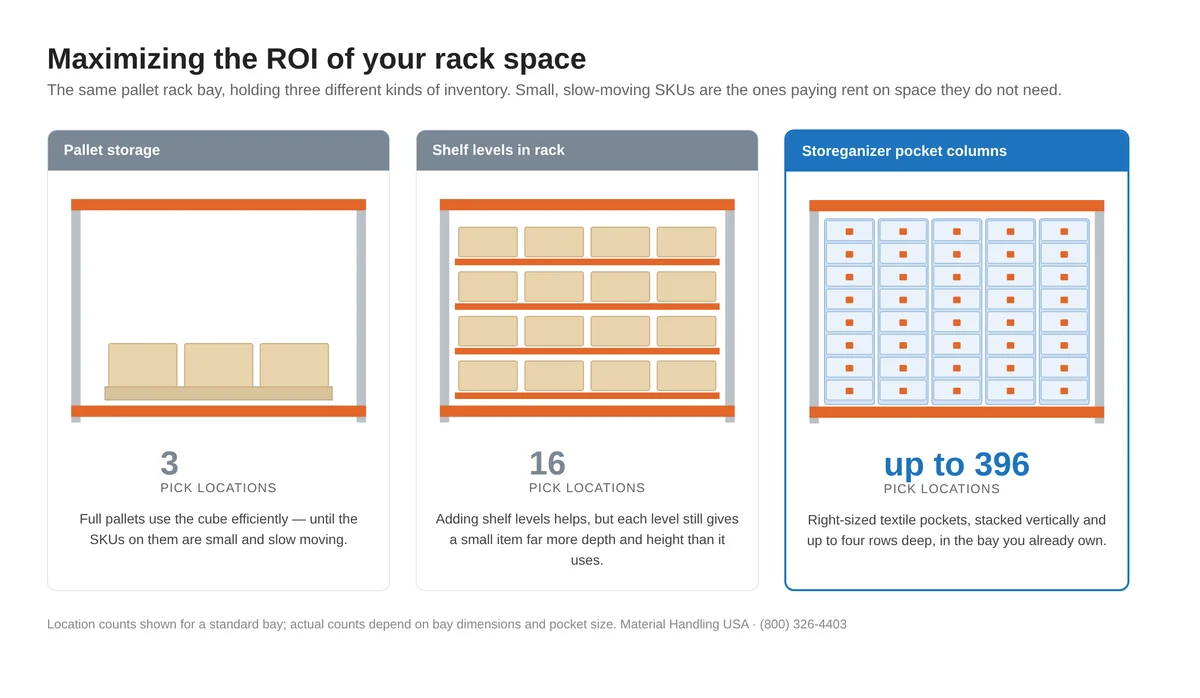
Almost every warehouse stores small items in locations built for large ones. A pallet position is sized for a pallet; a shelf level is sized for cases. Put a bag of fittings in either and most of the space you are paying for is air above and around the item. Storeganizer replaces that geometry: instead of one large location holding several small SKUs, you get many small locations, each sized to a single SKU, occupying the same rack bay. Nothing is compressed, nothing is stacked less safely, and no part of the building changes. The cube that was already there simply gets addressed at item scale.
The universal suspension system
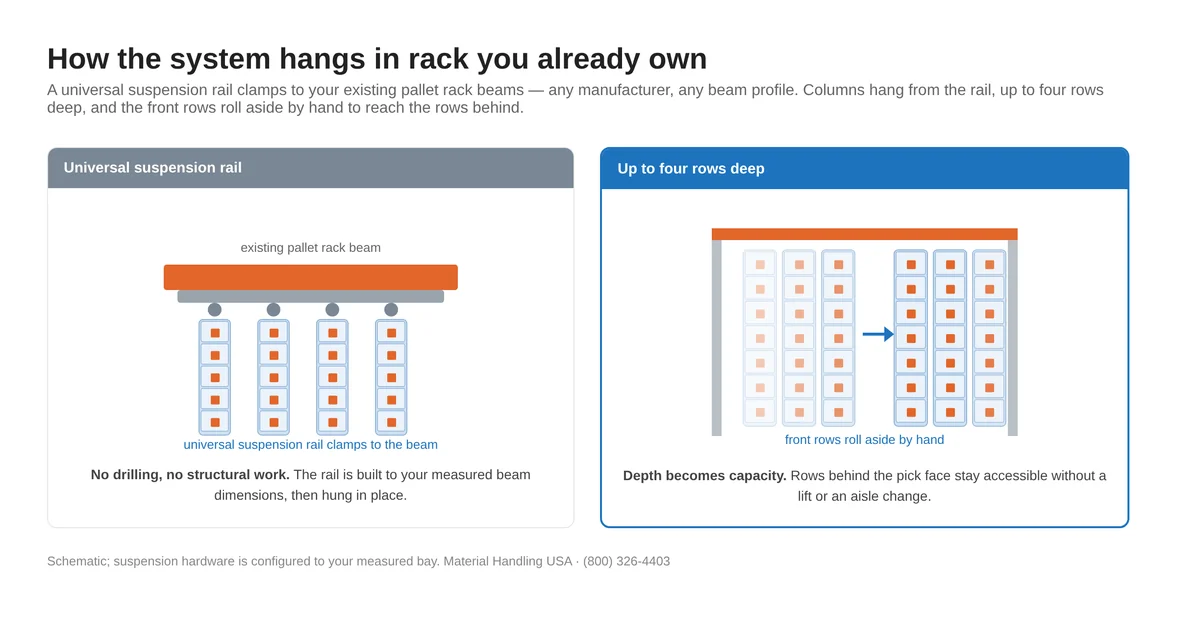
Everything hangs from one component: a steel suspension rail that clamps over your existing pallet rack beam. It is manufactured to the beam dimensions you supply, which is why it fits rack from any manufacturer with any beam profile.
What that avoids is the reason the system installs so quickly:
- No drilling into beams, uprights, floor or wall.
- No anchoring, welding or bolting.
- No permit drawing and no seismic calculation, because no structure is added.
- No electrical work — there is nothing to power.
- No dedicated frame. The rack is the structure.
The practical consequence is that a conversion is a storage decision rather than a construction project. If the bays are standing, the columns can go in — which also means they can come out and go somewhere else. See pallet rack systems if the rack itself is what you need first.
Up to four rows deep, and still reachable
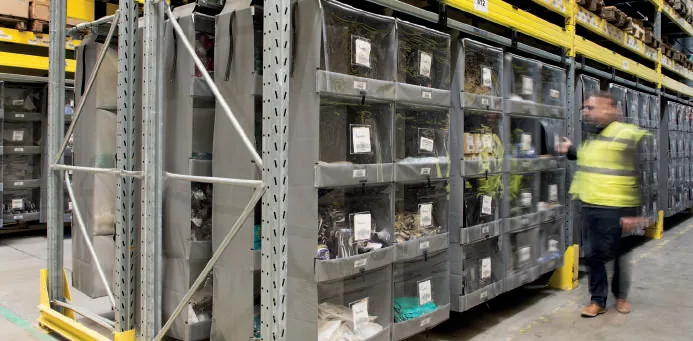
The instinct with any deep storage is to assume the back is inaccessible. Here it is not, because the columns are individually suspended and roll sideways by hand — loaded — so the picker slides the front row aside, reaches the row behind, and lets it back. No lift, no ladder, no aisle change, no sequence to remember.

Why depth matters more than height
Warehouse capacity conversations default to going higher. Depth is the cheaper axis in a small-parts zone, because the depth inside a bay is already paid for and usually wasted — a shelf 42 inches deep holding items four inches deep is wasting more than half of itself before anything else goes wrong.
Four rows of columns in a 42-inch bay turns that depth into four independent pick faces. Combined with the vertical stacking of pockets, that is where the location counts come from — up to 396 discrete locations in a single bay, depending on bay height and pocket size.
The pockets themselves
Each pocket is a coated industrial technical textile compartment on a rigid frame, open at the front. That construction is not incidental — the manufacturer’s original business is reusable industrial packaging, where the same materials survive being handled thousands of times in automotive and electronics supply chains.
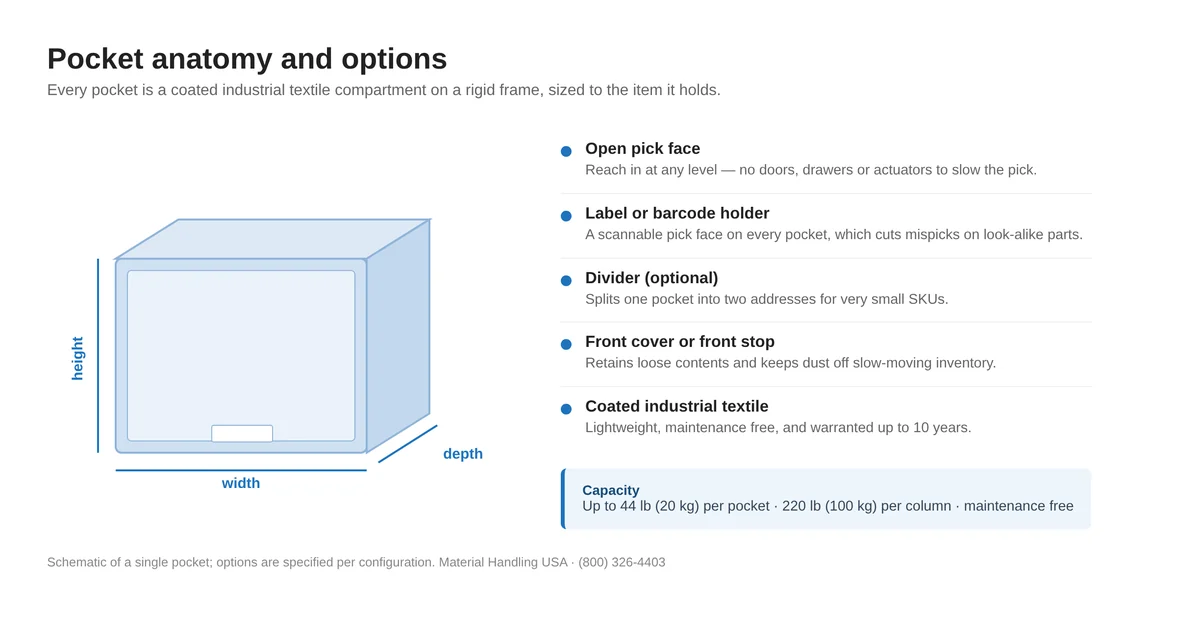
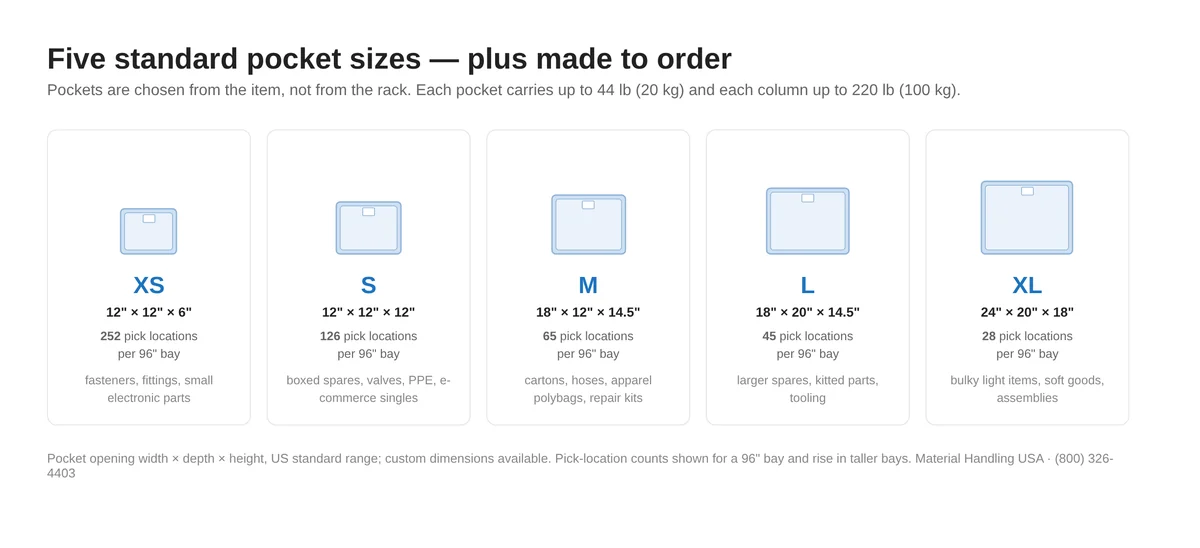
Full dimensions, textile grades and abrasion ratings are on the specifications page.
What installation actually involves
Measure
Bay inside width, bay inside depth, clear height between beam levels, and the beam height and depth. Four numbers.
Manufacture
The suspension rail and pockets are produced to those dimensions, in the sizes chosen for your SKU groups.
Hang
Rails clamp onto the beams; columns hook onto the rails. One person, minutes per column, no tools into the rack.
Slot
Stock goes in by SKU, one part number per pocket, with labels or barcodes applied to the pick faces.
Scaling, relocating and reconfiguring
This is the property that separates a pocket system from buying more shelving, and it is the one most often underestimated at purchase time. Because everything hangs rather than being built:
The part that decides whether it works: slotting
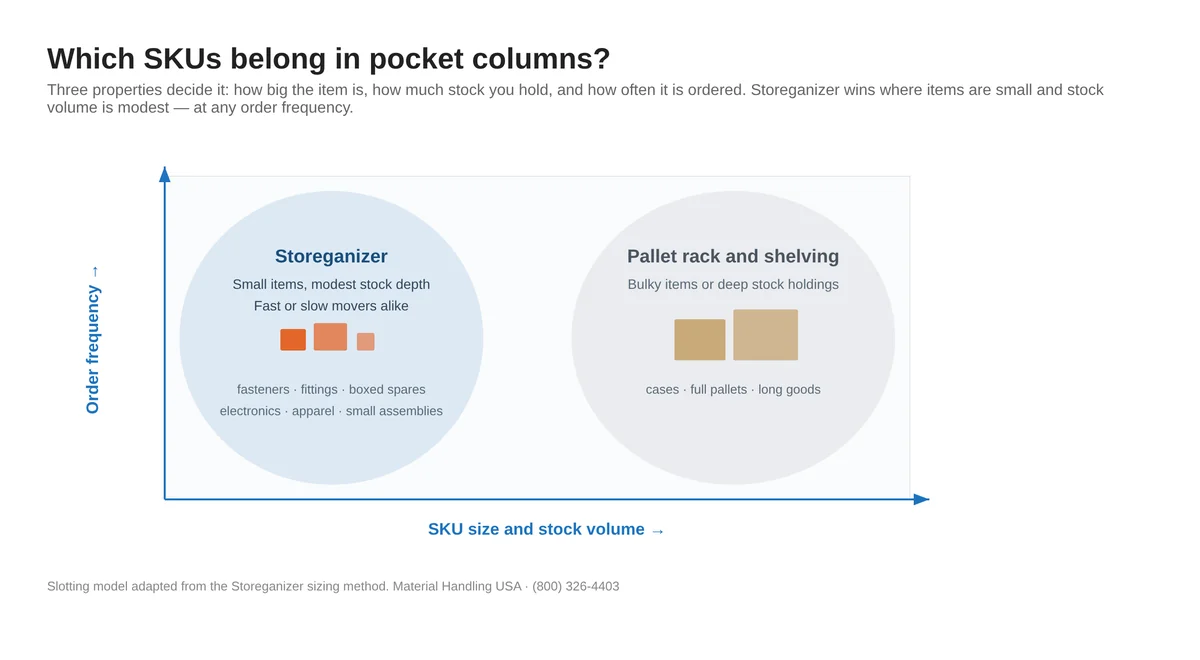
The mechanism above is simple enough that it can be explained in a page. The decision that actually determines whether a conversion pays is less mechanical, and it happens before anything is ordered: which SKUs go into pockets, and which stay where they are. Three properties of an item settle it.
Size, stock volume, order frequency
Size sets the pocket. Take the largest item in the group rather than the average, add handling clearance, and check the weight before the volume — dense small parts hit 44 lb long before they fill a pocket.
Stock volume decides whether the pocket holds all of the inventory or only the pick face. Where you hold real depth of a small item, the usual answer is a pocket at pick level and replenishment stock on a pallet above it.
Order frequency does not decide whether pockets suit the item — it decides placement. Fast movers belong in the bays closest to packing; slow movers can sit further out. Both belong in pockets if they are small.
Getting this wrong is the main way a pocket installation disappoints: a bay configured with one compromise pocket size, into which half the intended SKUs will not fit, so half of them go back onto shelving and the location count never materialises. Mixing two or three pocket sizes in a single bay is normal and almost always better. The SKU slotting and rack ROI page works through the method in detail, and the slotting optimization guide covers how to profile a SKU base before you move anything.
What it does not do
A page explaining how something works should be equally clear about where it stops. Storeganizer is the wrong answer in four situations, and knowing them early saves everybody time:
| Situation | Why pockets are wrong | What to use instead |
|---|---|---|
| Heavy items | 44 lb per pocket, 220 lb per column | Pallet rack or heavy-duty shelving |
| Long or awkward goods | Pockets are compartments, not arms | Cantilever rack |
| Deep stock of fast movers | Case picking needs case flow | Carton flow or push-back rack |
| Secured or controlled items | Pockets are open storage | Rack security enclosures, cages or smart lockers |
The honest test
If your small-parts inventory currently sits in locations far larger than the parts, a conversion will pay. If your building is genuinely out of cube — racked to the roof with fast-moving pallets and no long tail of small SKUs — look at double-deep, mobile rack or a mezzanine instead. We will tell you which one you are.
How Storeganizer works — FAQs
How does Storeganizer work?
Does it need special racking?
How do you reach the rows behind the front row?
How long does installation take?
Does it require maintenance or power?
How much can it hold?
Can it be moved or expanded later?
See what your own bay would hold
Give us four measurements and the SKUs causing trouble. You will get a configuration, a location count, and a straight answer about whether it is worth doing.