
Home › Storeganizer › SKU Slotting & Rack ROI
SKU Slotting and Rack-Space ROI — Which Items Earn Their Location
The storage decision that determines whether a conversion pays for itself is not which system you buy. It is which SKUs go into it. Here is the method, the arithmetic, and the mistakes that cost location count.

3
properties that decide slotting
up to 396
locations per bay
2–3
pocket sizes per bay is normal
44 lb
per pocket limit
Why locations, not square feet, are the unit that matters
Warehouse capacity is almost always discussed in area or in pallet positions, and for pallets that works. For small parts it hides the actual constraint. A parts room does not run out of square feet; it runs out of addresses — distinct places to put a distinct SKU so that a picker can find it without searching. That is why a building can look half empty and still be full, and why adding shelving to a crowded parts room often makes picking slower rather than faster.
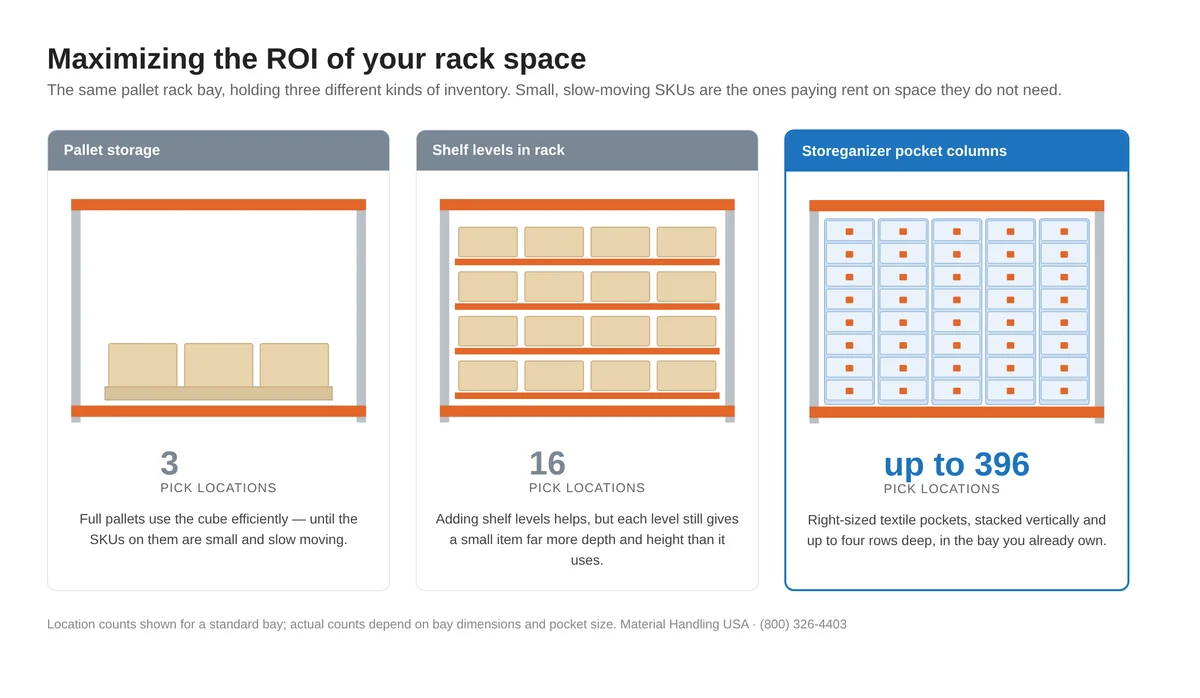
Once you count addresses instead of area, the arithmetic changes. A pallet position holding a mixed pallet of small parts is one address for many SKUs. A shelf level is one address per SKU but sized for a case. A column of right-sized pockets is one address per SKU sized to the SKU. Same bay, three very different answers.
The slotting model: size, stock volume, order frequency
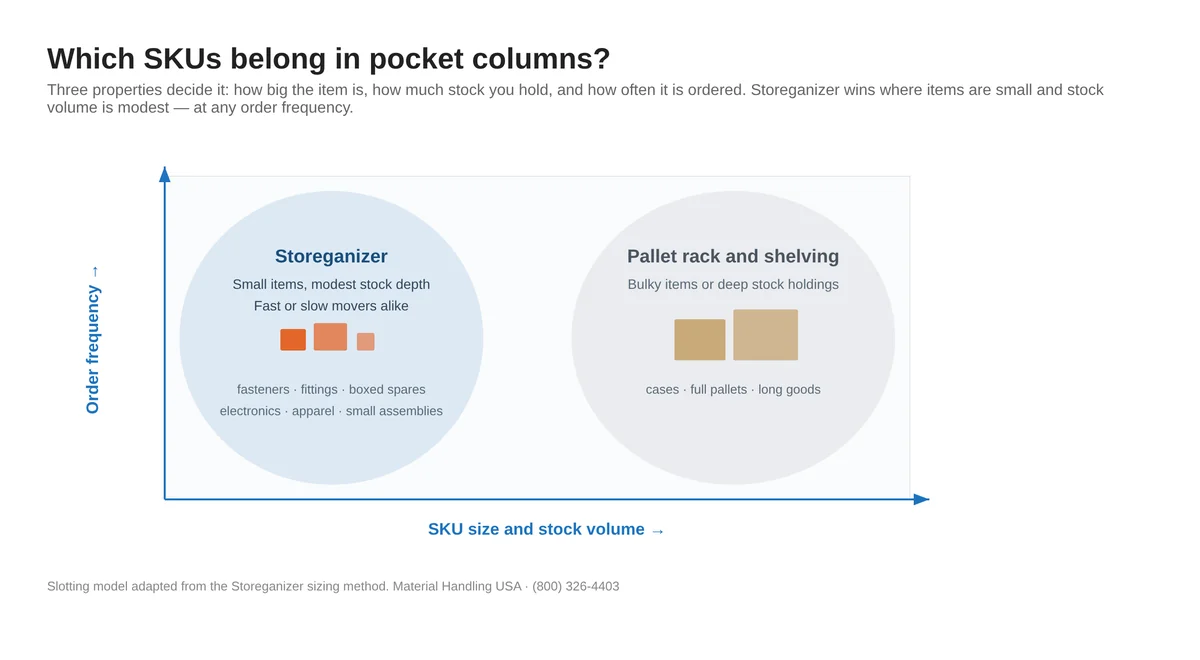
Read the three axes separately
SKU size is a hard constraint. It decides whether a pocket can physically hold the item, and which of the five standard sizes applies.
Stock volume decides how much of the inventory lives in the pocket. Low depth: all of it. High depth: the pick face only, with bulk stock behind or above.
Order frequency is the axis most people misread. It does not determine whether pockets suit the part. It determines placement — which bays, how close to packing, how the pick route runs. Fast and slow movers both belong in pockets if they are small.
The one-line test
If the location currently holding an item is substantially larger than the item, and the item weighs less than 44 lb, it is a candidate. Everything else in the analysis is refinement.
The arithmetic that makes the business case
Two numbers carry almost all of the decision. Both can be produced in an afternoon.
| Number | How to get it | What it tells you |
|---|---|---|
| Locations per bay, before | Count the discrete pick addresses in one representative bay today | Your current address density |
| Locations per bay, after | Configure the same bay with appropriate pocket sizes | Your potential address density |
| Bays required, before / after | Total small-part SKUs divided by each figure | How many bays you get back |
| Cost of the alternative | Rent, fit-out and racking for the space you would otherwise add | What the conversion is actually competing against |
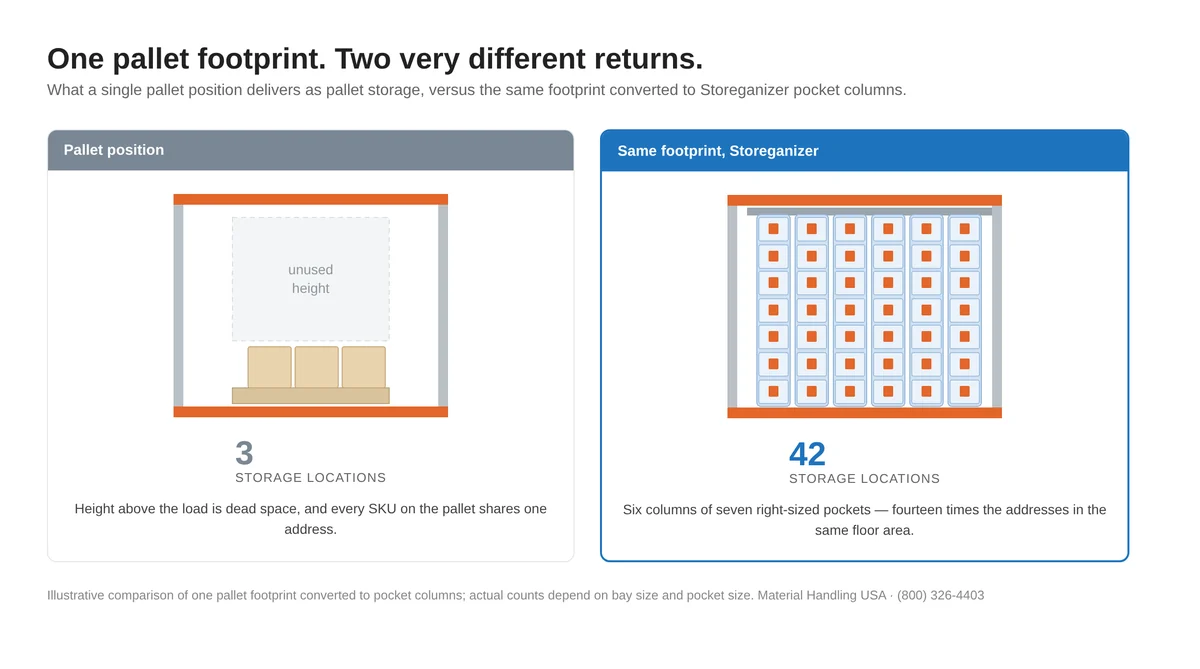
The Storeganizer Configurator returns the “after” number for any bay dimensions and pocket size you enter, which is usually the fastest way to get from a hunch to a figure. For the full cost comparison against leasing space, see Storeganizer cost and ROI.
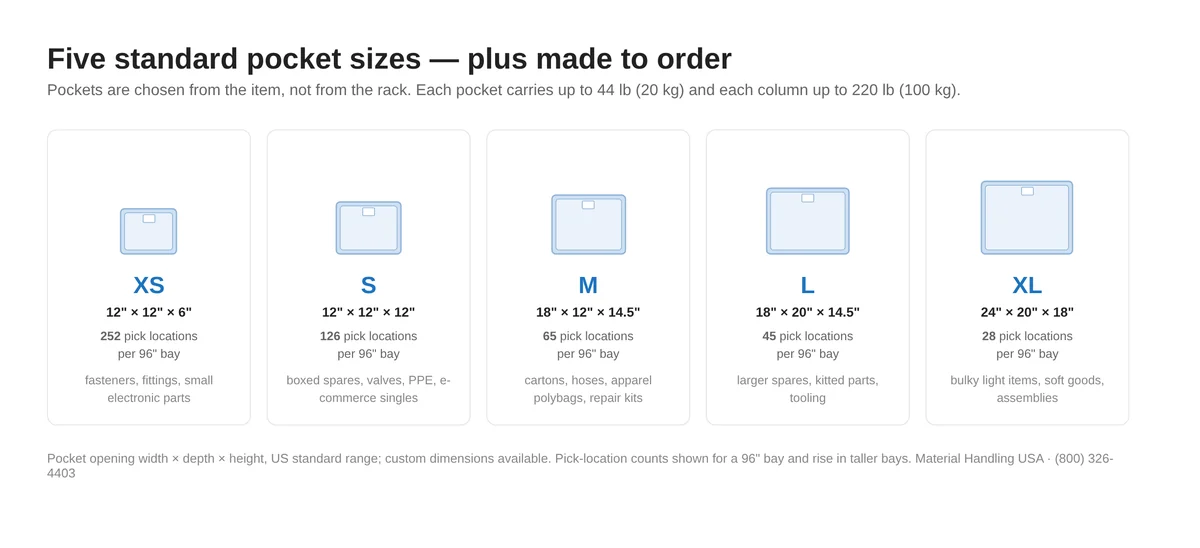
How to size a pocket without guessing
Group the SKUs
Group by physical similarity, not by product family. A fitting and a fastener that are the same size belong in the same group even if the catalogue separates them.
Measure the largest in the group
Not the average. A pocket sized to the average will not close around the outlier, and the outlier is the SKU that ends up back on a shelf.
Add handling clearance
Roughly an inch in each direction so an operator can get a hand in and a part out without fighting the opening.
Check weight before volume
44 lb per pocket, 220 lb per column. Dense parts — fasteners, fittings, castings — hit the weight limit while the pocket still looks half empty.
When a divider beats a smaller pocket
For very small, low-volume SKUs, a divider inside a standard pocket creates two addresses without adding another pocket size to the configuration. That keeps the bill of materials simple, and the divider comes out again if stock depth grows. Front stops do the same job for items that would otherwise roll or slide forward at the pick face.
Four slotting mistakes that cost location count
What this looks like in practice
Two reference installations show the method applied rather than described. Both mixed pocket sizes deliberately, and both reported the location count as the headline outcome:
| Operation | Slotting approach | Reported outcome |
|---|---|---|
| Everten Supplies, online kitchenware | 18 bays combining small, medium and large pockets | 2,759 storage locations in 50 m²; that footprint went from holding 10% to 25% of stock lines |
| CEVA Logistics, 3PL contract site | 26 bays fitted with five distinct pocket sizes | A wide SKU range consolidated from across a 90,000 sq ft site; picking accuracy reported at 100% |
Neither of those results came from a single compromise size. That is the pattern worth copying. Full write-ups: Everten and CEVA Logistics.
Slotting is not a one-time exercise
Every slotting plan starts decaying the day it is implemented, because the SKU base moves. Lines get added, volumes shift, seasonal items arrive and leave, and a part that justified a large pocket last year now ships in half the quantity. In a shelving installation that drift is expensive to correct — you are moving steel. In a pocket system it is not, and that is a genuine operational advantage rather than a marketing one.
What to review, and how often
- Quarterly: placement. Which pockets are being picked most, and are those bays the closest ones to packing? Moving a column is a two-minute job.
- Twice a year: pocket fit. Look for pockets running consistently empty (oversized) or being replenished daily (undersized, or they should be a forward pick face with bulk behind).
- Annually: the boundary. Which items have grown out of pockets and belong back in rack, and which rack items have shrunk into pocket territory?
- On any range change. An acquisition or a new product line is the moment to re-slot, not six months later.

This is also why the reversibility of the system matters at purchase time. A configuration that can be re-slotted, extended a bay at a time, or lifted out and rehung in another building is worth more over ten years than a marginally cheaper installation that is fixed in place. If you are weighing that trade-off, the comparison against shelving, bins, flow rack, carousels and VLMs sets out where each option genuinely wins.
Slotting and rack ROI — FAQs
How do I decide which SKUs go into Storeganizer pockets?
What is rack-space ROI?
Should I use one pocket size or several?
How do I size a pocket correctly?
What if I hold deep stock of a small item?
Does slotting analysis cost anything?
Related reading
 How Storeganizer worksHow Storeganizer high-density pocket storage works: universal rack suspension, up to four rows deep, pocket sizes…
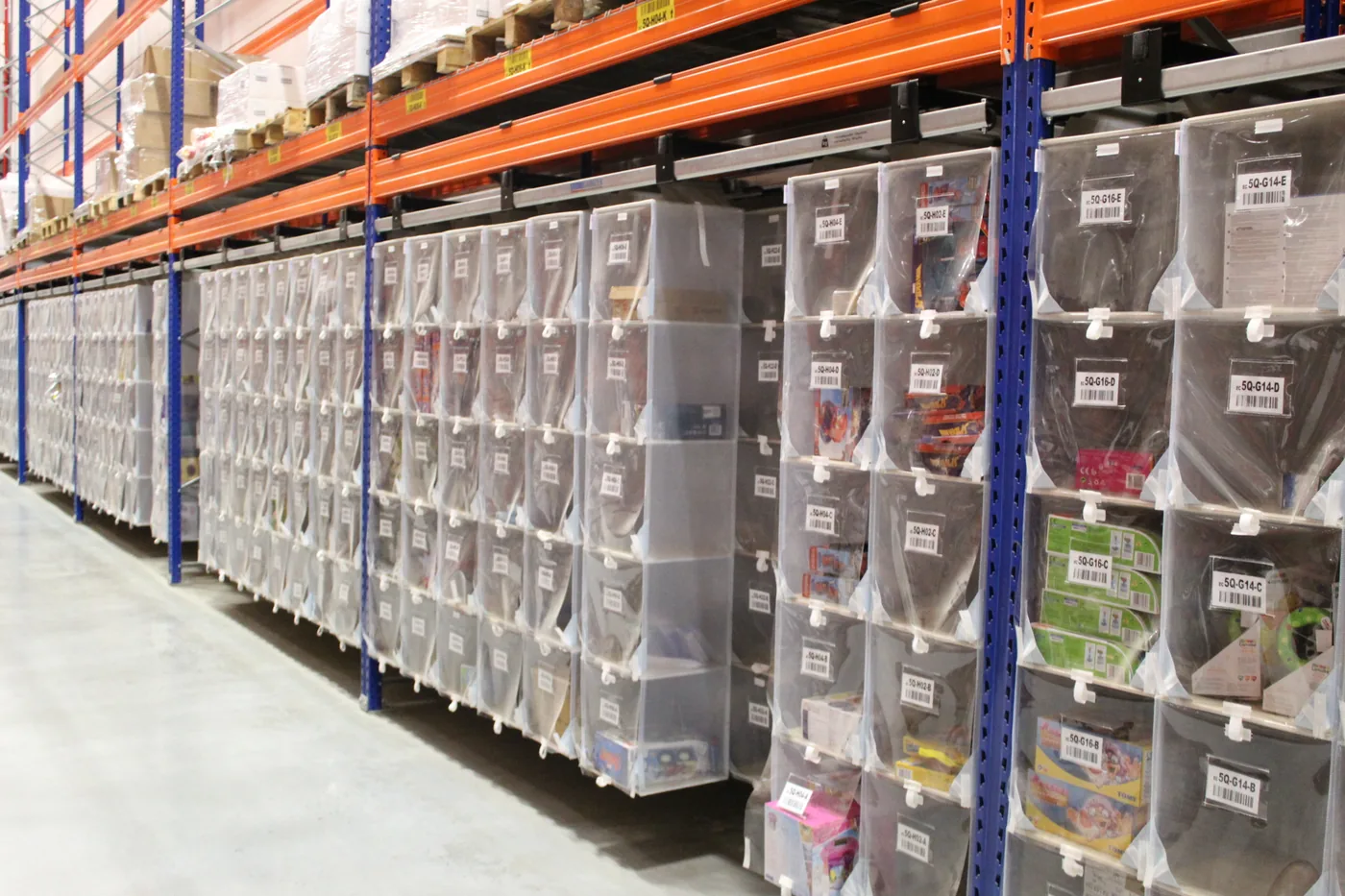 Pallet rack space optimizationRecover the wasted cube in your small-item rack bays. Storeganizer converts half-empty shelving into up to 396 pick…
 Pocket sizes, specifications and textile gradesAll five standard US pocket sizes with pick locations per bay, four textile grades with load and abrasion ratings…
 Guide: warehouse slotting optimizationUnlock major cost savings and faster fulfillment with our expert guide to warehouse slotting optimization. Learn…
 Storeganizer Configurator — configure a bay onlineConfigure Storeganizer high-density pocket storage free online. Enter your pallet rack bay dimensions, choose a…
Let us run the slotting analysis
Send a SKU list and a bay measurement. We will come back with pocket sizes, a location count, and the bays you would get back.