
Home | Storeganizer | Compared With the Alternatives
Storeganizer vs. Shelving, Bins, Flow Rack, Carousels and VLMs
An honest comparison from a distributor that sells all of them. Where pocket columns win decisively, where shelving or automation is the better answer, and the specific head-to-heads customers ask us about.

We sell all of these. Here is how we choose.

MH-USA supplies shelving, bin systems, pallet rack, carton flow, mobile shelving, carousels, vertical lift modules, mezzanines and Storeganizer. That means we have no reason to pretend one product wins every argument, and every reason to get the recommendation right — we install it and we hear about it afterwards.
The honest summary is this: Storeganizer wins decisively when you have a long tail of small, light, low-quantity SKUs and pallet rack to hang columns in. It loses when items are heavy, long, or need to be locked, sealed, climate-controlled or delivered to the operator. Below is the full comparison, followed by the specific head-to-heads customers ask us about.
Storage options compared
| Option | Pick locations in the same footprint | Weight handled | Moving parts | Floor / structure impact | Cost profile | Time to install | Best when |
|---|---|---|---|---|---|---|---|
| Storeganizer pocket columns | 28-396 per bay depending on pocket size | Light: tens of pounds per pocket, roughly 70-165 lb per column by textile grade | None | No — hangs on existing beams | Product only; no service contract | Hours to a shift | A long tail of small, light, low-quantity SKUs in existing rack |
| UNEX SpeedCell | High — bay subdivided into a grid of individually accessible cells | Light to moderate: up to 35 lb per cell, up to 240 lb per column | None — cells slide forward manually | No — installs into rack you already own | Retrofits current rack; no service contract | Days per bay run | A long tail of medium-to-slow SKUs in mixed, irregular cases |
| Boltless / rivet shelving | Low to moderate | Heavy — hundreds of pounds per level | None | Free-standing units; aisles required | Lowest first cost | Hours | Mixed-size and heavy items, work surfaces, archive boxes |
| Steel bin shelving with plastic bins | Moderate | Moderate | None | Free-standing; aisles required | Low | Hours | Standardised bins, modest SKU counts, visual stock control |
| Carton flow rack | Moderate, in cases | Cases | Rollers and wheel beds | Fits in rack; needs pick and replenishment aisles | Moderate | Days | Full-case picking of fast movers with FIFO |
| Vertical carousel | High in a small footprint | Moderate to heavy | Motorised drive | Free-standing; power required | High capital plus service contract | Weeks | Access control, footprint pressure, goods-to-person |
| Vertical lift module (VLM) | Highest in a small footprint | Moderate to heavy | Motorised, with controls | Free-standing; power and integration | Highest capital plus service contract | Weeks to months | Throughput, tight access control, WMS integration |
| Mezzanine with shelving | Adds floor area rather than density | Depends on the shelving | None | Structural: permits, egress, lighting, sprinklers | High | Months | You genuinely need more square footage |
Location counts for pocket columns assume a 42" deep bay, four rows deep, at 96" to 144" bay height. Column load figures are from the manufacturer’s US textile range; the system is rated at up to 220 lb (100 kg) per column and confirmed on each quote.
The head-to-heads
Storeganizer vs. SpeedCell
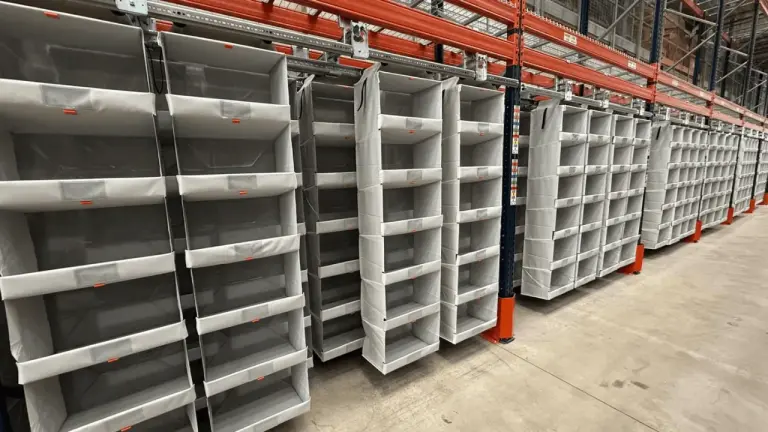
These are the two closest competitors on this page — both convert pallet rack you already own into small-item pick faces, and MH-USA sells both. The mechanical difference is how the item is presented: SpeedCell subdivides a bay into a grid of rigid cells that the operator slides forward to the aisle, while Storeganizer suspends fabric pocket columns that hang from the beams. SpeedCell’s rigid cells suit mixed cardboard cases and irregular shapes well; Storeganizer’s textile pockets pack more locations into the same bay for genuinely small, loose or oddly shaped parts and need no cell hardware to buy or reconfigure. Tell us your SKU sizes and pick volume and we will size both and quote the one that wins — sometimes it is a mix of both in the same run of rack.
Storeganizer vs. shelving and bins
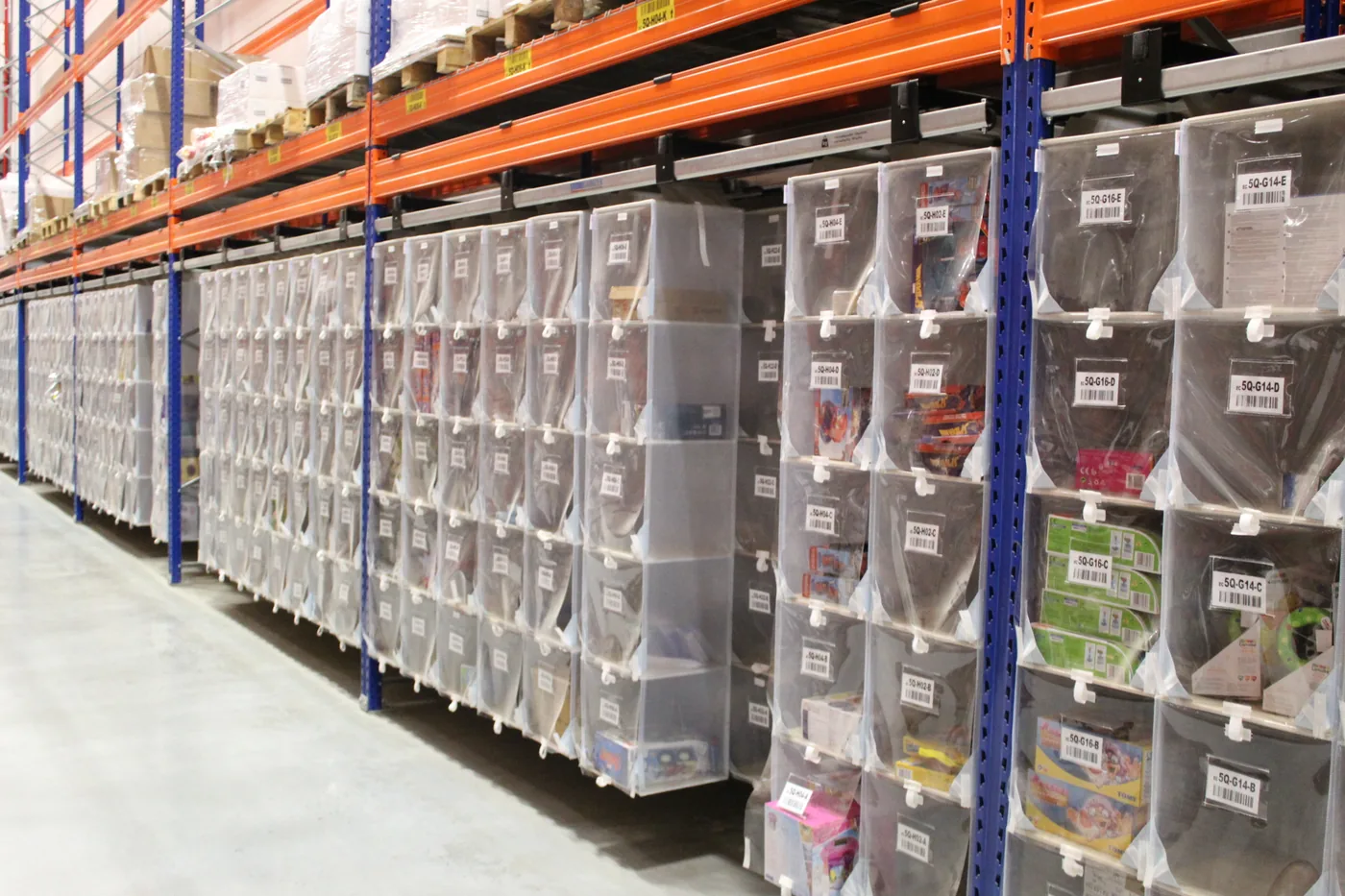
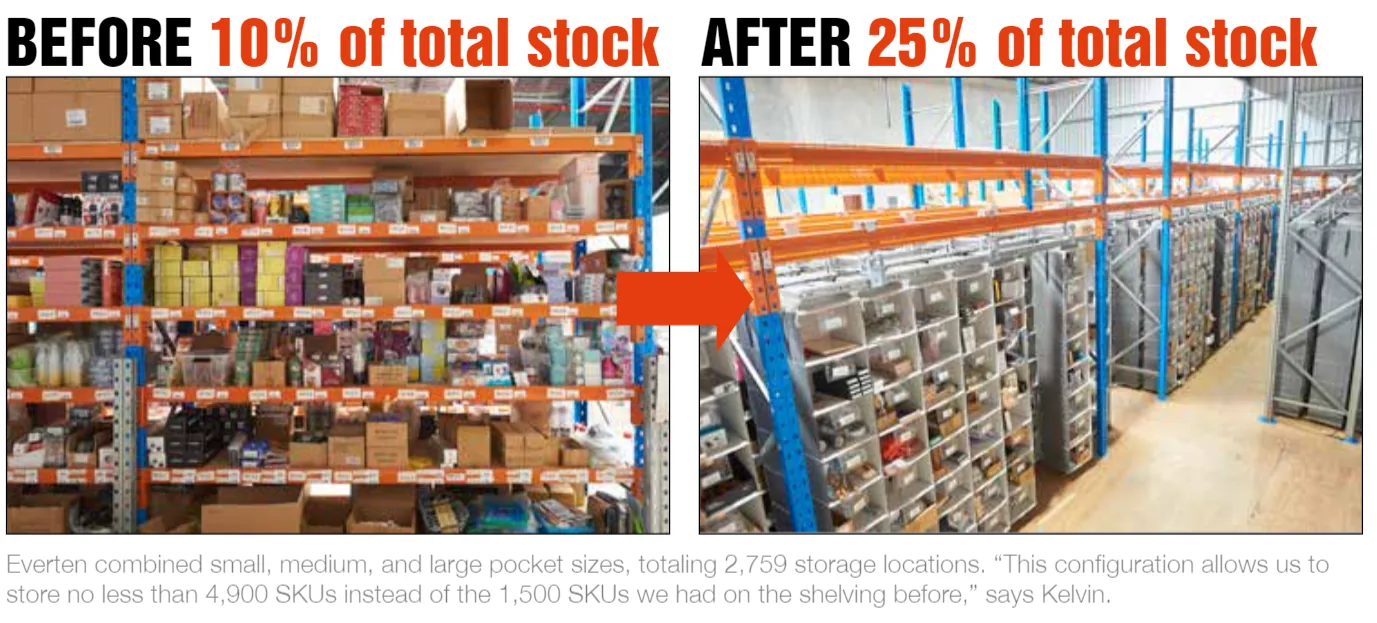
Shelving is cheaper to buy and handles weight that pockets cannot. It is also, for small items, the least space-efficient option available, because every level is sized for the largest thing it might hold and needs an aisle to reach it. If your small-item area is a run of shelving where most locations hold one carton, converting those bays to pocket columns typically multiplies the location count several times over in the same square footage — which is where the 40% average usable-space gain measured at the University of Leuven comes from. Keep the shelving for heavy items, mixed sizes, archive boxes and anywhere you need a flat surface.
Storeganizer vs. carton flow rack
These are not really competitors. Carton flow exists to present full cases of fast movers to a picker with gravity doing the replenishment, and nothing beats it at that job. Pocket columns exist to present hundreds of slow-moving piece-pick SKUs in a small footprint. If a SKU needs replenishing more than once a shift, it belongs on flow; if it is picked twice a week, it belongs in a pocket. Most warehouses that get this right run both, in adjacent bays.
Storeganizer vs. vertical carousels and VLMs
Automated units bring three things pockets cannot: goods-to-person delivery, a closed and controllable enclosure, and very high density in a tiny footprint. They also bring capital cost, power, controls, integration and a service contract, and they concentrate risk — when the unit is down, the inventory inside it is unavailable. Several operations documented by the manufacturer evaluated carousels and paternosters specifically and concluded the benefits were smaller than a pocket-column solution at a fraction of the cost. Others chose the automation, correctly, because throughput and access control were the actual requirement. Our rule of thumb: if the driver is density, start with pockets; if the driver is throughput, security or ergonomics for heavy items, price the automation.
Storeganizer vs. a mezzanine
A mezzanine adds square footage. Pocket columns use the square footage you have. A mezzanine is a construction project — engineering, permits, egress, lighting, sprinkler review, a long lead time and a capital number an order of magnitude larger. The sensible sequence is to densify the existing bays first and then size the mezzanine, if you still need one, against what is genuinely left over. Operations have told the manufacturer that pocket columns eliminated the need for site expansion or an offsite lease outright.
Price the pocket-column option yourself
The free Storeganizer Configurator gives you the pick-location count and a bill of materials for your bay size, so you have a real number to compare against a shelving or automation quote.
When we tell customers not to buy Storeganizer
- The items are heavy — pockets are rated in tens of pounds, not hundreds. Use shelving or rack.
- The items are long or rigid — bar, pipe, extrusion, trim. Use cantilever rack.
- You pick full cases of fast movers all day. Use carton flow.
- The inventory must be locked, audited or held in a sealed enclosure. Use security cages, smart lockers or an automated unit.
- You need goods-to-person because of an ergonomic or throughput requirement. Price a carousel or VLM.
- You genuinely need more floor area, not better density. Look at a mezzanine.
- There is no rack to hang columns in and no budget to add any — although rack plus pockets is often still cheaper than the alternatives.
Explore the Storeganizer cluster
 Storeganizer hubWhat the system is, specs, options, process and results.
 Small-parts warehouse storageRight-sizing pick locations for fasteners, fittings and boxed components.
 3PL & e-commerce fulfilmentMore SKUs per square foot when the footprint cannot grow.
 Spare parts & MRO storageCritical spares findable in seconds without a parts-room expansion.
 Aerospace & defense partsTraceable, high-value small parts in a controlled parts room.
 Pallet rack space optimizationRecover the cube you already pay for before leasing more building.
 Cost & ROIWhat drives price, why cost per pick location beats cost per square foot, and payback.
 How Storeganizer worksThe suspension system, pocket columns, four rows deep, and installing into existing rack.
 Sustainability & carbonAvoided space, avoided steel, no operational energy — and what we will not claim.
Frequently asked questions
Is Storeganizer cheaper than shelving?
How does it compare with a vertical lift module?
Storeganizer or carton flow rack?
Storeganizer or a mezzanine?
Can I use it alongside automation rather than instead of it?
Not sure which one you need?
Send us your SKU profile, your bay dimensions and what is going wrong today. We will recommend the option that fits — including the ones that are not Storeganizer.