
Vertical Carousels — Automated Rotating Storage Systems
Vertical carousels use a continuous loop of rotating carriers to deliver stored items directly to the operator — saving up to 75% of floor space, increasing pick rates by 2–5x, and reducing retrieval errors to near zero. Fast, reliable, and energy-efficient automated storage for manufacturing, distribution, healthcare, and more.
Talk with a specialist. Call (800) 326-4403 or Email Sales@MH-USA.com

What Is a Vertical Carousel?
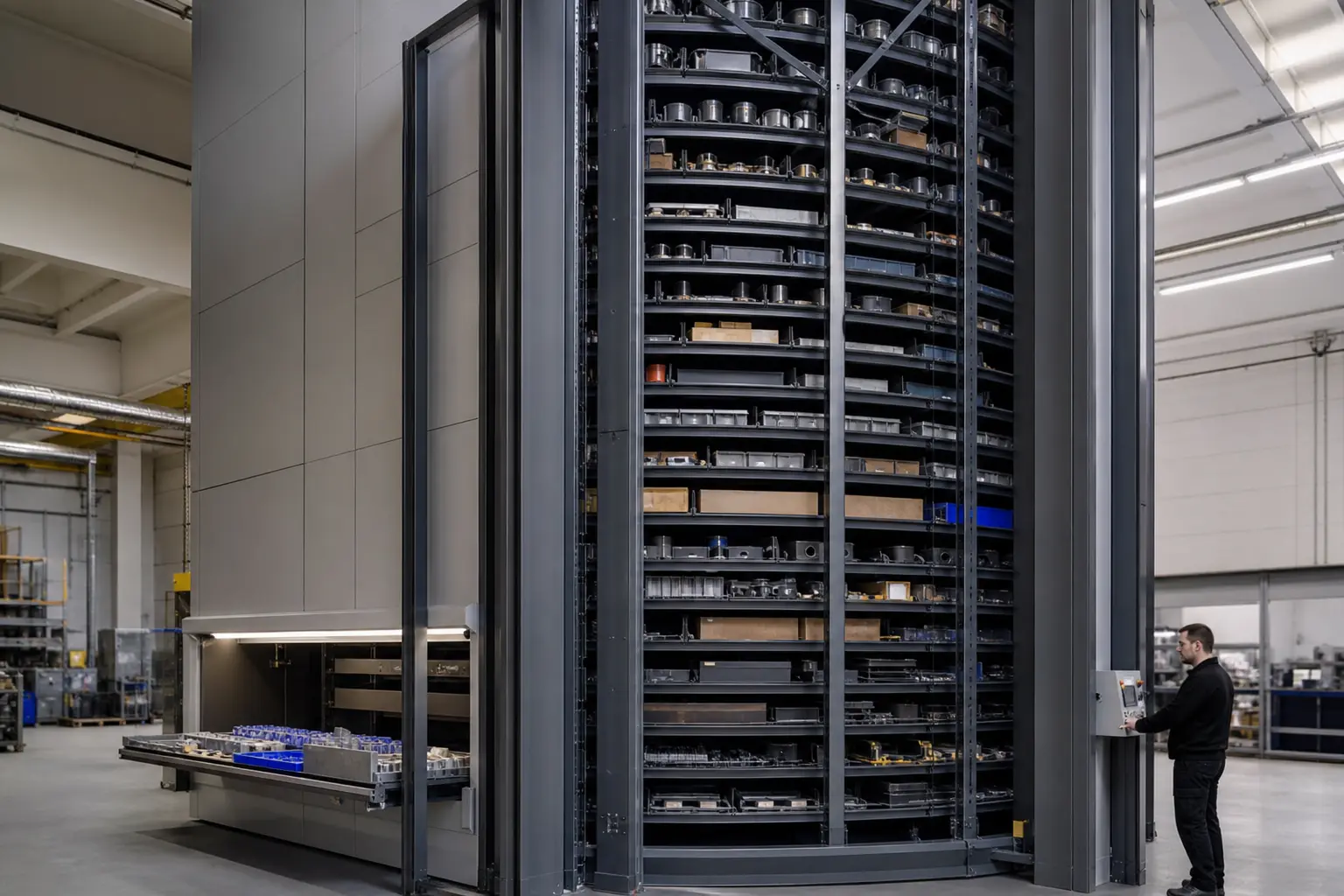
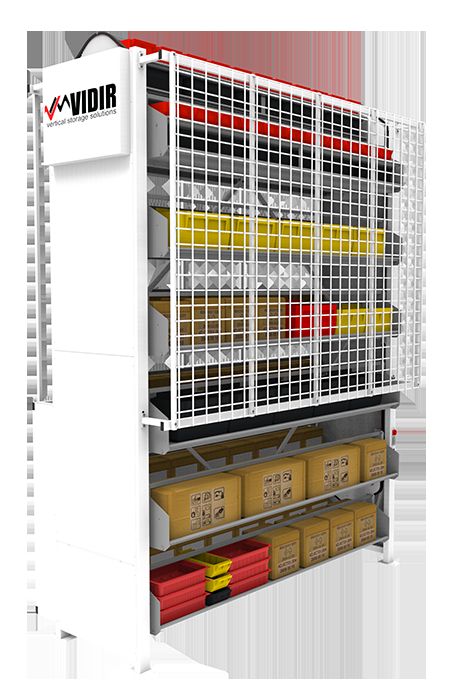
A vertical carousel is an automated storage and retrieval system that uses a series of carriers (shelves or bins) attached to a continuous chain loop, rotating vertically — like a Ferris wheel — to deliver stored items to an ergonomic access opening at the operator’s working height. When an operator requests an item, the carousel rotates via the shortest path to bring the correct carrier to the access window.
Vertical carousels follow the goods-to-person principle: instead of walking to storage locations and searching through shelves, operators remain at a fixed workstation while the carousel brings the items to them. This eliminates walk time, search time, and the physical strain of reaching, bending, and climbing — the primary sources of wasted labor and workplace injuries in conventional storage environments.
The rotating carrier design makes vertical carousels exceptionally fast for applications that require frequent access to a moderate number of SKUs. Because the system always rotates via the shortest path (forward or reverse), average retrieval times are typically 10–20 seconds — making vertical carousels one of the fastest automated storage technologies available. Compared to traditional storage, vertical carousels dramatically outperform static shelving on every key metric.
Material Handling USA supplies and installs vertical carousel systems from Vidir and other leading manufacturers for applications ranging from small parts rooms and electrical supply distribution to hospital pharmacies and military supply depots.
How Vertical Carousels Work — Rotating Carrier Technology
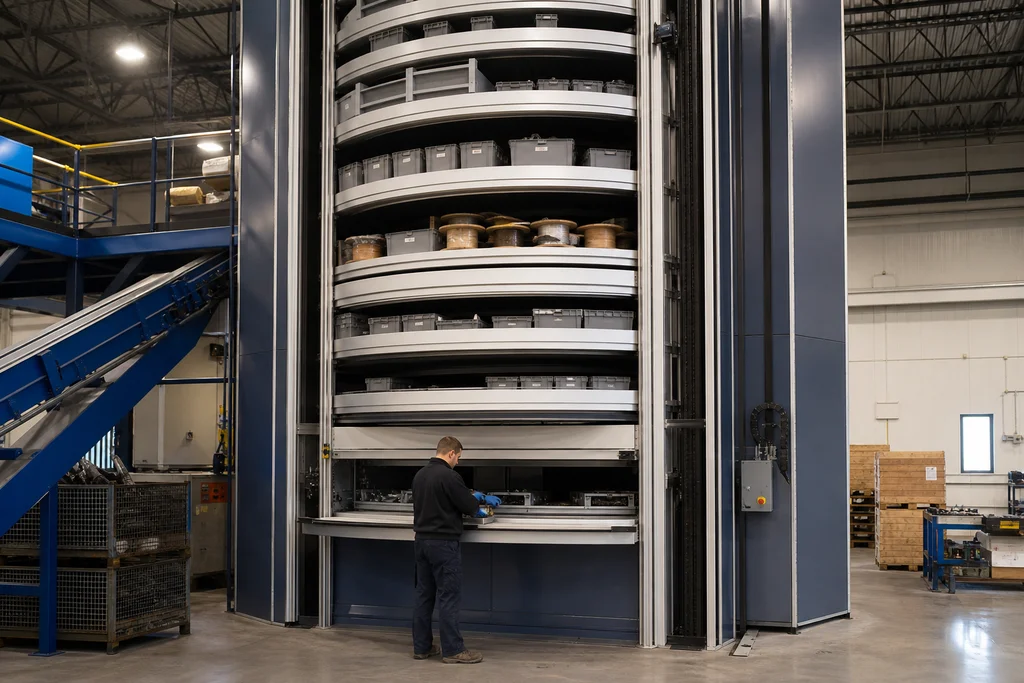
Vertical carousels operate on a simple but highly effective mechanical principle. A series of carriers — typically 20 to 80 per unit, depending on height — are mounted on a continuous chain that travels in a vertical loop around the interior of the unit. A variable-frequency drive (VFD) motor powers the chain, enabling precise speed control and smooth acceleration/deceleration.
Shortest-Path Rotation: When an operator requests an item, the carousel controller calculates whether it is faster to rotate forward or backward to reach the target carrier. This bi-directional rotation minimizes wait times and ensures the fastest possible delivery — typically 10–20 seconds regardless of where the carrier is stored.
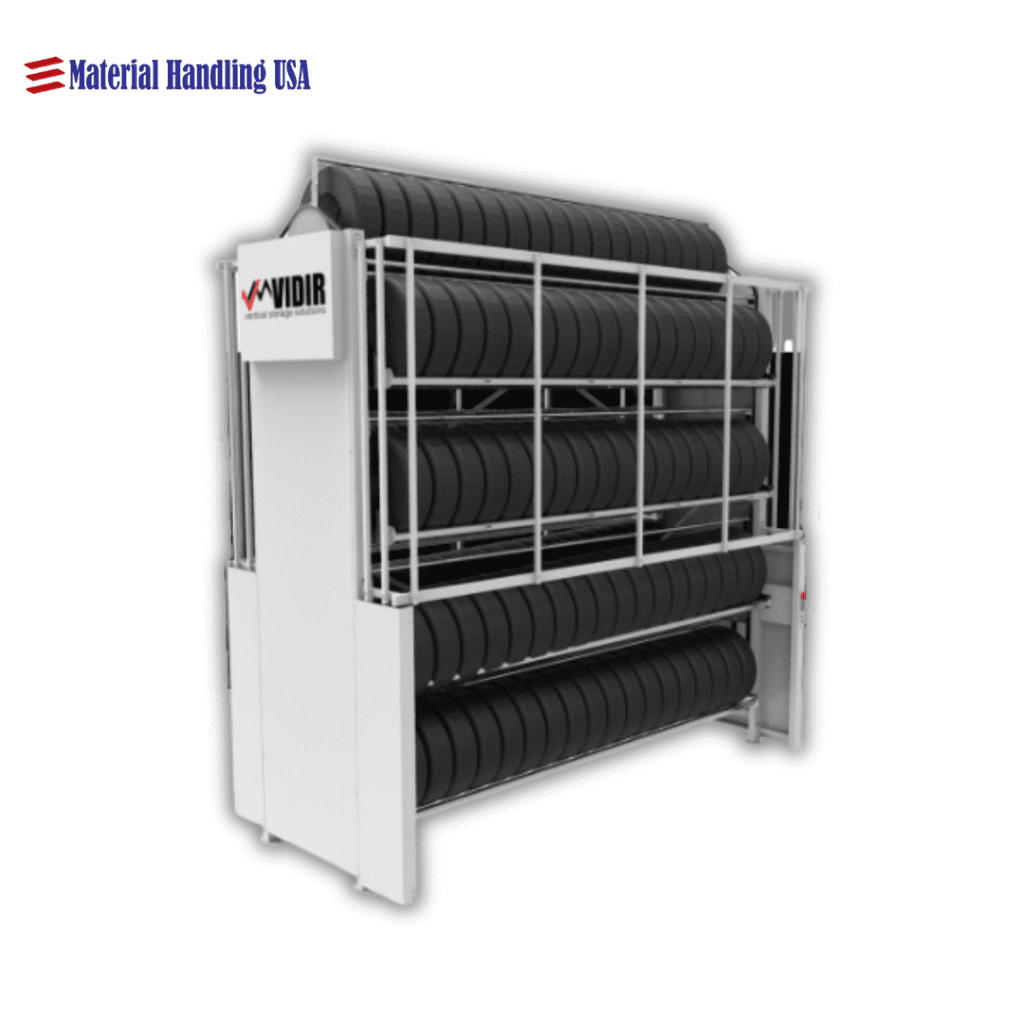
Carrier Configurations: Carriers can be configured as flat shelves for bins and boxes, divided compartments for small parts, specialized racks for hanging garments or wire spools, or heavy-duty platforms for tires, paint cans, and industrial components. This flexibility makes vertical carousels suitable for virtually any item type and industry.
Multi-Unit Pod Configurations: For high-volume operations, 2–4 vertical carousels can be arranged in a pod with a single operator workstation. While the operator picks from one carousel, the others pre-position their next required carriers — a technique called batch picking that can increase throughput to 300–500+ lines per hour.
Software Integration: Modern vertical carousels include touchscreen controllers with inventory management software, pick-to-light indicators, barcode scanning capability, and integration ports for ERP/WMS systems. The software tracks every transaction — puts, picks, counts, and returns — with full timestamp and user identification.
Vertical Carousel Applications by Industry
Vertical carousels excel in environments requiring frequent access to diverse inventories — from industrial parts rooms to healthcare supply chains.


Benefits of Vertical Carousel Storage Systems
Vertical carousels deliver measurable improvements in space utilization, productivity, accuracy, and workplace safety.
Electrical supply operations benefit from our motorized wire spool carousel — built specifically for wire and cable spool storage.

- Up to 75% Floor Space Savings — By storing items vertically and eliminating access aisles between static shelving rows, vertical carousels recover valuable floor space for production, shipping, or additional inventory.
- 2–5x Faster Picking — Goods-to-person delivery eliminates walk time and search time. A single operator at a vertical carousel can pick 150–300+ lines per hour versus 40–60 with manual shelving.
- 99.5%+ Pick Accuracy — Software-guided picking with pick-to-light indicators and barcode verification eliminates the mispicks, miscounts, and bin-location errors that plague manual storage systems.
- Improved Ergonomics & Safety — Items are always delivered to a comfortable working height, eliminating bending, reaching, and ladder climbing. OSHA recordable injury rates in storage areas typically drop 50–80% after carousel installation.
- Real-Time Inventory Visibility — Every transaction is tracked with timestamp, user ID, and quantity. Cycle counts can be performed during normal operations without shutting down the storage area.
- Energy Efficient Operation — Vertical carousels use small-horsepower motors (typically 1–3 HP) and consume minimal electricity — often less than a standard household appliance. LED pick-to-light systems use negligible power.
- Lower Cost Than VLMs — Vertical carousels typically cost 30–50% less than Vertical Lift Modules for equivalent storage capacity, making them an excellent entry point for facilities adopting automated storage.
Vertical Carousel vs. VLM vs. Horizontal Carousel
Compare the three primary automated storage technologies to find the best fit for your application.
| Feature | Vertical Carousel | Vertical Lift Module (VLM) | Horizontal Carousel |
|---|---|---|---|
| Operating Principle | Rotating carrier loop (Ferris wheel) | Inserter/extractor between two columns | Rotating bins on horizontal oval track |
| Floor Space Savings | Up to 75% | Up to 90% | Up to 60% |
| Average Retrieval Time | 10–20 seconds | 15–30 seconds | 8–15 seconds |
| Pick Rate (per hour) | 150–300+ lines | 120–250+ lines | 200–450+ lines |
| Max Carrier/Tray Capacity | Up to 800 lbs | Up to 2,200 lbs | Up to 600 lbs |
| Max Unit Height | Up to 35 feet | Up to 46 feet | 6–8 feet (horizontal span) |
| Best For | High-speed picking, moderate loads | Heavy items, maximum security | Fastest picks, high-volume lines |
| Security Level | Semi-enclosed, access controlled | Fully enclosed, badge/PIN/biometric | Open or light-guard access |
| Item Flexibility | Shelves, bins, hanging garments | Trays with custom dividers, foam | Bins, totes, small parts |
| Typical Cost per Unit | $40,000–$120,000 | $80,000–$200,000+ | $30,000–$80,000 |
| Typical ROI | 12–18 months | 12–24 months | 10–18 months |
Vertical Carousel ROI — Making the Business Case

Vertical carousels offer one of the fastest returns on investment of any automated storage technology. Their lower acquisition cost compared to VLMs, combined with dramatic space and labor savings, typically produces full payback within 12–18 months.
Space Recovery Value: A single vertical carousel occupying 50–100 square feet replaces 300–600 square feet of conventional shelving. At warehouse lease rates of $8–$20/sq ft/year, each carousel recovers $2,000–$10,000 annually in recaptured floor space — space that can be repurposed for revenue-generating activities like additional production lines, packing stations, or inventory expansion.
Labor Productivity Gains: Eliminating walking, searching, and manual counting allows a single operator to do the work of 2–3 workers using traditional shelving. For a facility with two shifts of storage personnel, converting to vertical carousels can reduce staffing by 2–4 FTEs — saving $90,000–$240,000 annually at fully-loaded labor rates.
Error Cost Elimination: Mispicks in manufacturing stop production lines ($500–$5,000 per incident). In distribution, wrong shipments cost $25–$75 each in return processing. In healthcare, medication errors can have life-safety consequences. Vertical carousels with pick-to-light technology reduce these errors by 95–99%.
Throughput Improvement: Faster picking directly translates to faster order fulfillment, reduced backorders, and improved customer satisfaction scores. Many facilities report shipping same-day orders that previously required next-day processing.
Vertical Carousel Types, Sizes & Configurations
Vertical carousels come in a wide range of sizes and configurations to match any space, product type, and throughput requirement.
Standard Shelving Carousels
The most versatile configuration, featuring adjustable shelf carriers that accommodate standard bins, boxes, totes, and loose parts. Shelf heights can be customized within each carrier to store items of varying sizes. Available in widths from 24 to 72 inches and heights from 8 to 35 feet. Weight capacities range from 200 to 800 lbs per carrier depending on the model and manufacturer.
Application-Specific Carousels
Manufacturers like Vidir produce purpose-built carousels for specific product types: garment carousels with hanging rod carriers, tire carousels with tire-cradle carriers, paint can carousels with cup holders, wire spool carousels with integrated dispensing, and carpet carousels with roll-cradling arms. These specialized carriers dramatically improve storage density and handling safety compared to generic configurations.
Multi-Unit Pod Systems
Pod configurations arrange 2–4 carousels around a single operator workstation with shared batch-picking software. While the operator picks from one unit, the other units pre-position their next required carriers. This continuous workflow eliminates wait time between picks and can achieve 400–500+ lines per hour. Pod configurations are the standard for high-volume distribution, e-commerce fulfillment, and large parts rooms.
Enclosed & Climate-Controlled Models
For applications requiring environmental protection or enhanced security, vertical carousels can be configured with full enclosure panels, sealed access openings, temperature and humidity controls, and integrated fire suppression. These configurations are common in pharmaceutical storage, cleanroom supply management, and sensitive electronics inventory — providing the environmental controls of a VLM at a lower price point.
How to Get Started with Vertical Carousels
Free Storage Assessment
Contact Material Handling USA for a complimentary analysis of your current storage footprint, SKU count, daily transaction volume, and workflow requirements. Our specialists will identify the optimal carousel configuration for your space and budget.
Custom Solution Design
Our engineering team designs a complete carousel layout including unit sizing, carrier configurations, workstation placement, and software integration points. We provide detailed 3D renderings so you can visualize the solution before committing.
ROI & Budget Proposal
We deliver a comprehensive proposal with total project cost, projected savings (space, labor, accuracy), ROI timeline, and financing options. Most vertical carousel projects qualify for equipment financing with payments below the monthly savings generated.
Professional Installation
Our certified installation crews handle delivery, rigging, assembly, leveling, electrical connections, and software setup. We coordinate with your facilities team to minimize disruption — most single-unit installations complete in 1–3 days.
Training & Ongoing Support
Every installation includes comprehensive operator training, supervisor training, and maintenance instruction. We provide ongoing technical support, preventive maintenance programs, and software updates to keep your carousels running at peak performance.
Related Automated Storage Solutions
Explore our complete range of vertical storage systems and industry-specific applications.
Vertical Lift Modules
VLM systems for maximum security and heavy-duty storage up to 2,200 lbs per tray.
Vidir Storage Solutions
Vidir vertical carousels for tires, garments, paint, wire spools, and industrial parts.
Frequently Asked Questions About Vertical Carousels
What is a vertical carousel and how does it work?+
How much floor space does a vertical carousel save?+
What is the difference between a vertical carousel and a Vertical Lift Module (VLM)?+
What types of items can be stored in a vertical carousel?+
How fast can vertical carousels pick items?+
What maintenance do vertical carousels require?+
Can vertical carousels integrate with our ERP or WMS?+
How much does a vertical carousel cost?+
Boost Productivity with Automated Vertical Carousel Storage
Our vertical storage specialists will design a custom carousel solution for your facility — complete with layout drawings, ROI analysis, and a no-obligation quote. Get started with a free consultation today.