
Vertical Storage Solutions › Tool Crib & Die/Mold
Automated Vertical Storage for Tool Cribs & Die/Mold Storage
Compare vertical lift modules and pan carousels for cutting tools, dies, molds, jigs, fixtures and packaged MRO parts. Review carrier fit, retrieval demand and the inventory records required for your tool crib.

Transform Your Tool Crib
Machinists waiting for tools, searching through cabinets or discovering an unreturned cutter can delay a job setup. Start the storage review with your actual tools, issue process and return conditions, rather than assuming the same machine and software suit every tool crib.
A vertical lift module retrieves a stored tray to an access opening; a pan carousel rotates carriers to an access point. Compare the usable carrier envelope, loaded weight, clear height and operator handling method with your existing cabinets. Space recovery depends on the actual inventory and layout.
Tool Crib & Die Storage Solutions
Cutting Tools & Inserts
Organize end mills, drills, taps, inserts and reamers by size and type. Confirm how the quoted software records issue and return events and identifies the user.
Dies & Molds
Evaluate dies and molds against the selected machine’s tray rating, concentrated loads, supports and handling method. Do not transfer capacities from a sheet or bar-storage VLS to a small-parts VLM.
Jigs & Fixtures
Store production jigs, fixtures and gauges in identified locations. Review protective supports, carrier clearance and the picking sequence for each job setup.
MRO Supplies
Evaluate packaged fasteners, bearings, seals, belts and compatible maintenance parts in identified bins. Confirm storage conditions and any requested replenishment alerts separately; see the MRO storeroom workflow below.
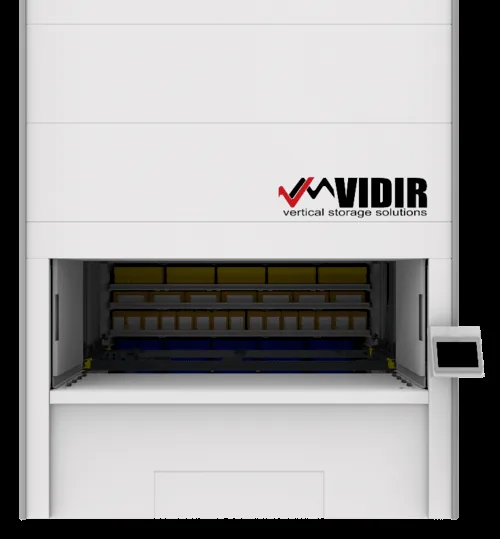
Tray-based Vidir VLM
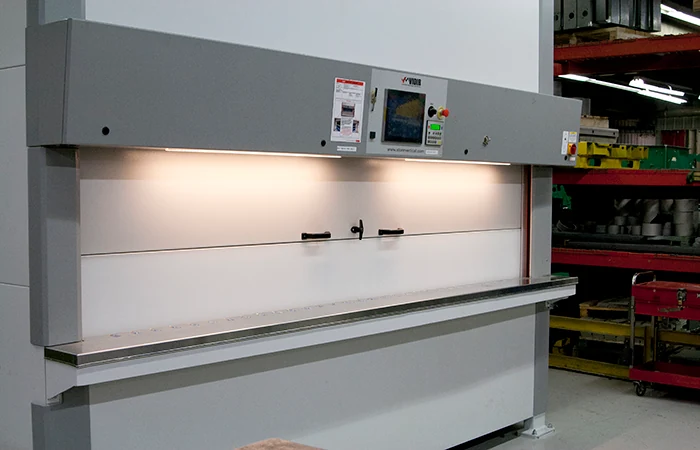
Pan Carousel operator access
MRO storerooms for plant and utility maintenance
A tool crib controls issued tools and production tooling; an MRO storeroom also holds replacement parts and work-package material. The examples below extend the planning discussion to utility-meter and relay shops, municipal pump and valve maintenance, and plant service teams. They are proposed workflows, not claims of Vidir utility installations or qualification for safety-related work.
Meter, relay and control-shop spares
Group packaged meters, relays, sensors, terminals and control components by the identifiers the maintenance team actually uses. Record revision or approved replacement information in the responsible inventory system. A labeled location helps find the part; it does not establish that the part is technically interchangeable.
Compare small-parts carriers against the complete protective package and any dividers. Do not base fit on the bare component dimensions.
Pump, valve and plant repair kits
Bearings, seals, gaskets, belts and compatible packaged valve-service parts can be assessed as individual items or as a job kit. Keep complete kits distinguishable from kits awaiting a component; reserve the kit to a work order only when the agreed record confirms it is ready.
Review preservation needs, shelf-life records where required, carrier clearances and concentrated loads. Oversized or heavy assemblies may need a different storage and handling arrangement.
Storm and outage work packages
Prepare labeled containers for a defined maintenance job, with a contents list and any missing-item status visible before dispatch. Confirm the order in which crews need their kits and how partially used material will be checked back in.
Plan peak issue and return periods together. A machine that meets average demand may still create a queue when several teams replenish at shift change.
Issue, inspect and release—not simply “return to stock”
| Control point | Question to resolve |
|---|---|
| Calibrated-tool issue | Where is calibration status held, who may issue the tool, and how is the current status checked before retrieval? Do not treat a machine location as proof of calibration. |
| Inspected returns | Does a returned tool go to inspection, regrind, repair or available stock? Define both a physical hold position and an authorized status change. |
| Work-order records | Which system owns reservations, cost codes and consumption? Agree which events the machine software sends and which require an operator confirmation. |
| Urgent-stock access | What approved procedure applies during machine maintenance, power loss or a host outage? Identify any critical reserve that should remain independently accessible. |
Vidir tray and carousel inventory tools can support a configured process; min/max alerts, calibrated-tool records, work-order linkage and release-status enforcement must be demonstrated for the quoted package. A carrier is not an inspection system or an automatic purchasing approval.
For the equipment-level trade-off, see automated maintenance spare-parts storage: VLM versus carousel. Keep cutting-tool, die and fixture selection on this tool-crib page. This discussion excludes fuel, radioactive material and contaminated equipment; no nuclear qualification, safety-related traceability or emergency-power capability is implied.
Tool Crib Automation Benefits
- Compare cabinet consolidation against your actual inventory and clear height
- Review usable floor area after allowing for access, replenishment and handling
- Define tool accountability through confirmed issue, return and user records
- Bring a tray or carrier to an access point and test the complete picking task
- Identify missing and unreturned tools using the agreed records and process
- Plan authorized access with training, permissions and a confirmed recovery procedure
- Specify ERP integration through agreed interfaces and transaction testing
Explore Vertical Storage Products
Request a project-specific storage quote
Share your inventory, packaged dimensions and weights, available space and required workflow. We will review the equipment fit and configuration with you.
Frequently Asked Questions
How many modular drawer cabinets can a VLM replace?
The result depends on the tools, cabinet utilization, tray envelope, load and available height. We can compare the existing cabinets with a proposed system after reviewing the inventory and handling space.
Can machinists access tools without a tool crib attendant?
Authorized operator access can be evaluated with the selected controls and software. Confirm permissions, training, issue/return records, supervision requirements and the procedure during a machine or power outage.
How heavy of a die or mold can the system handle?
Confirm the selected model’s tray capacity, concentrated-load limits, supports and loading method using the actual die or mold. Do not assume the rating of a different Vidir product applies.
Does the system track tool usage and consumption?
Define the events you need recorded, including issue, return, inspection and any regrind cycle. Confirm which are supported by the quoted package and which remain in your ERP, tool-management or purchasing system.
Shop packaging and shipping supplies
For routine packing and shipment preparation. These supplies are not Vidir systems or replacement parts.



Automate Your Tool Crib
Free tool crib assessment and automated storage design.