
Industrial Ladders
Rolling warehouse ladders, ship’s ladders, fixed and caged ladders, roof access ladders and crossovers for warehouses, mezzanines, docks and rooftops. Compare ladder types, check the OSHA basics and get one quote for the ladder, freight and installation.
60-90°
OSHA angle range for ladders
50-70°
OSHA range for ship stairs
24 ft
Fixed ladder fall-protection trigger
Nationwide
Quote, freight, install
Shop Industrial Ladders Online
Rolling warehouse ladders, Equipto ship's ladders, folding mezzanine ladders and cross-over ladders are in our online store. Hundreds more sizes are in the categories below, or request a quote and we will match a ladder to your height, space and task.


What Counts as an Industrial Ladder?
Industrial ladders are the climbing equipment built for daily work in warehouses, plants, distribution centers, shops and commercial buildings. They are heavier and more specialized than the stepladder in a janitor’s closet. Some roll on casters to reach stock on high shelves. Some bolt to a wall, a mezzanine or a tank and stay there for decades. Others bridge a conveyor or carry a technician through a roof hatch.
The right one depends on the job: how often people climb, how high they go, whether they carry anything, how much floor space you can give up and whether the ladder is indoors or out. Angle is the quickest way to sort the options. OSHA’s own angle chart for walking-working surfaces groups them like this:
| Angle from horizontal | What OSHA calls it | Typical industrial products | Best when |
|---|---|---|---|
| 30 to 50° | Standard stairs | Mezzanine and platform stairways | People climb often or carry loads |
| 50 to 70° | Ship stairs and alternating tread stairs | Ship’s stairways, alternating tread stairs | Space is tight but climbs are regular |
| Up to 60° stringer slope | Mobile ladder stands (rolling ladders) | Rolling warehouse ladders and rolling stairs | Picking and stocking from shelves and racks |
| 60 to 90° | Ladders | Fixed ladders, steep ship’s ladders, roof access ladders | Occasional access with hands free |
Source: OSHA 29 CFR 1910.25 Figure D-10 and 1910.23(e). See 1910.25 and 1910.23 on osha.gov.
Types of Industrial Ladders
These are the ladder families buyers ask us about most. Each one solves a different access problem, so start with the one that matches your task.
Rolling ladders and rolling stairs
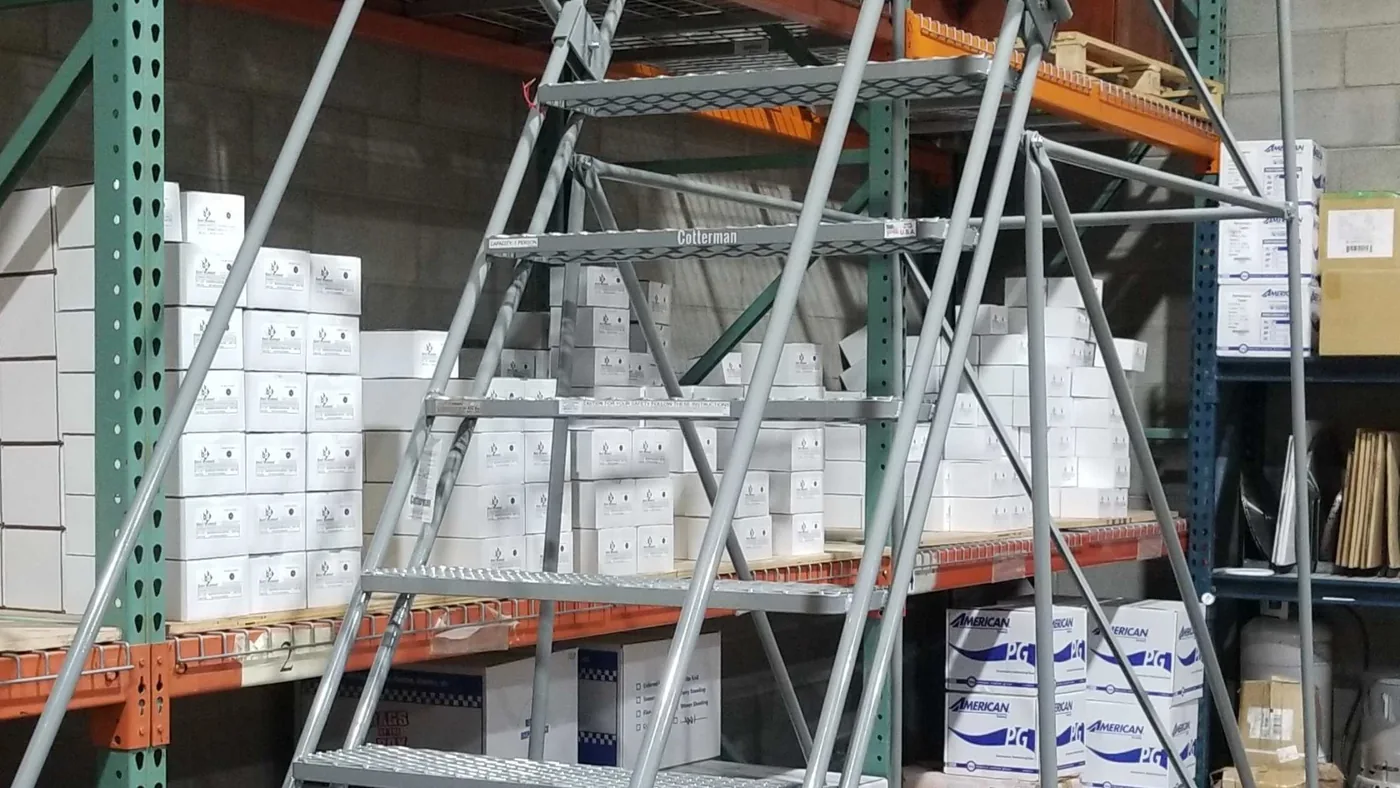
A rolling ladder (OSHA’s term is mobile ladder stand) is a fixed-height set of steps on a rigid base with casters, usually with handrails and a top platform. It is the standard tool for picking and stocking from high shelves and pallet rack. Most sit down on rubber feet or lock their wheels once someone steps on, through spring-loaded casters or a step-activated lock.
You’ll usually choose between a standard climb of roughly 58 to 60° and a gentler 50° climb. The 50° models take more floor space but let people walk down facing forward and carry small items more easily. Vestil sells both 50° and 58° warehouse ladders, and Cotterman builds 50° and 59° series.

Compare 50° and 58° models, step counts and safety features: Rolling ladders and rolling stairs guide
Ship’s ladders and ship stairs

A ship’s ladder is a steep stair with flat treads and handrails on both sides. It fits where a standard stair won’t, such as a mezzanine edge, a platform, a pit or a roof. OSHA defines a ship stair as 50 to 70° with open risers, a rise of 6.5 to 12 in., treads at least 4 in. deep and at least 18 in. wide.
The names overlap in the market. Equipto, for example, lists its Ship’s Ladders at a 75° rise and its Ship’s Stairways at 66 to 70°. A unit steeper than 70° falls in OSHA’s ladder range, so check the actual angle against how your team will use it.
Angles, sizing and OSHA ship stair rules: Ship’s ladders and ship stairs guide
Fixed ladders and cage ladders
A fixed ladder is permanently attached to a building, structure or piece of equipment. It uses the least floor space of any access option, which is why you see it on mezzanines, storage roofs, tanks, pits and machinery. OSHA requires rungs spaced 10 to 14 in. apart, at least 16 in. of clear width and at least 7 in. of clearance behind the rungs. Side rails of through or side-step ladders must extend 42 in. above the landing.
Fixed ladders that rise more than 24 ft need a ladder safety system or personal fall arrest system. Cages alone no longer count on new installations (details in the OSHA section below).
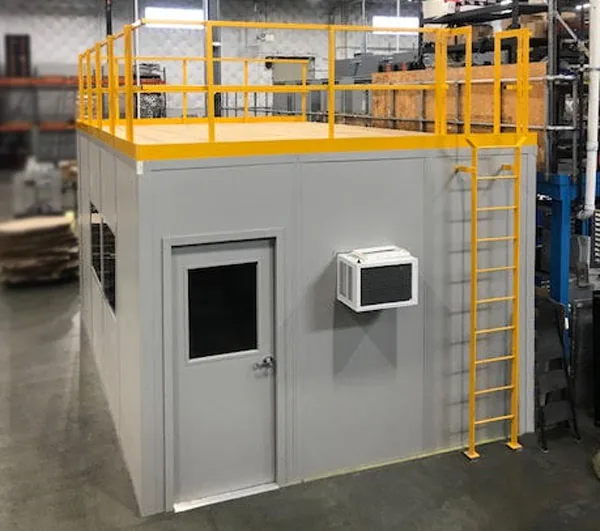
OSHA dimensions, the cage phase-out and ladder safety systems: Fixed ladders and cage ladders guide
Roof access ladders
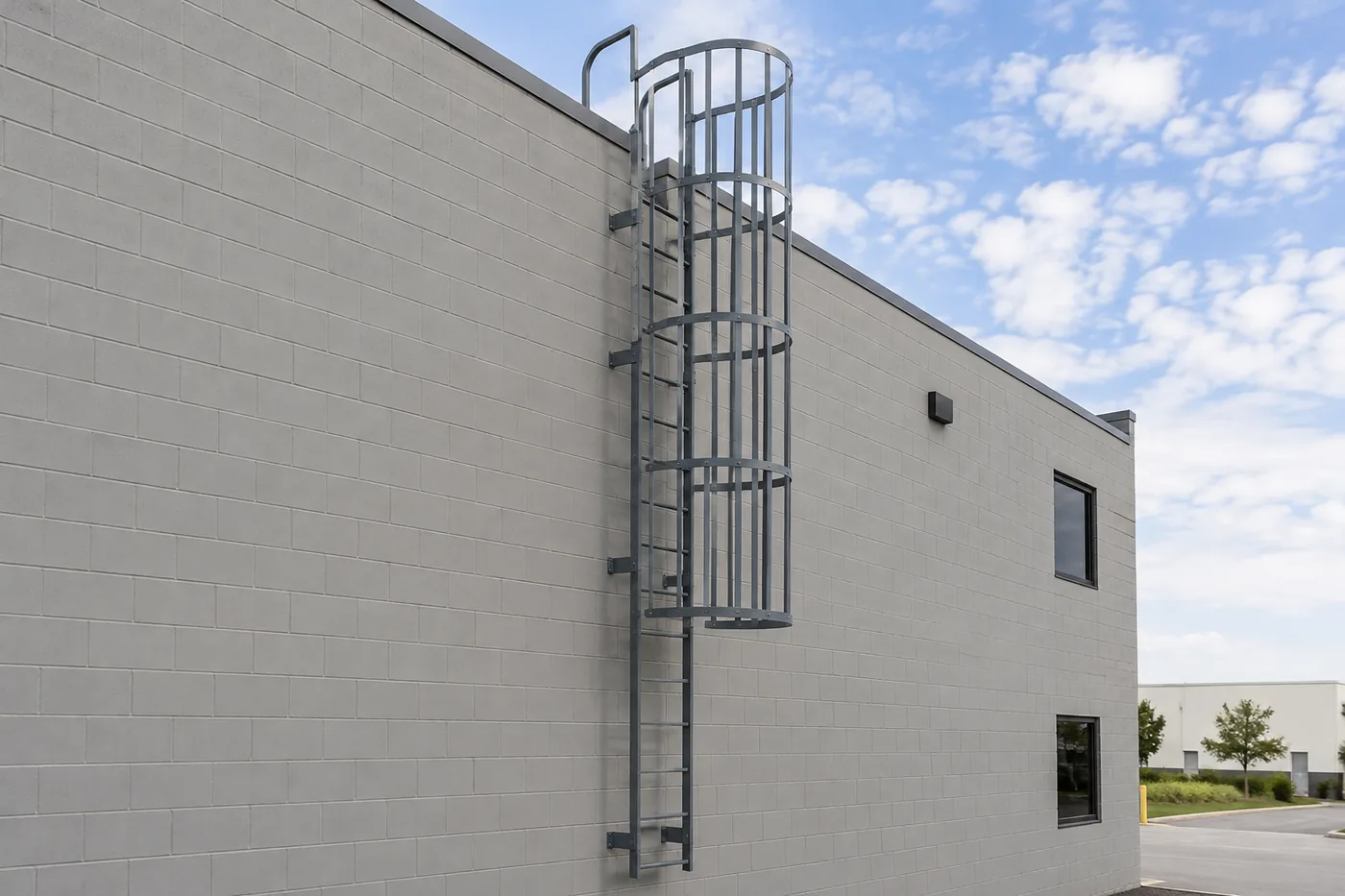
Roof access ladders are fixed ladders that reach a roof, either up an exterior wall to a parapet or eave, or up an interior wall through a roof hatch. Common options are a safety cage, walk-through handrails at the roof edge and a ladder safety system on taller climbs.
The first questions buyers ask us are fixed or modular, which height to order and whether they need a cage. Start with the height from the ground (or the lower roof) to the roof you need to reach, plus the wall type.
Sizing, cages, walk-throughs, hatches and security: Roof access ladders guide
Crossover ladders and bridges
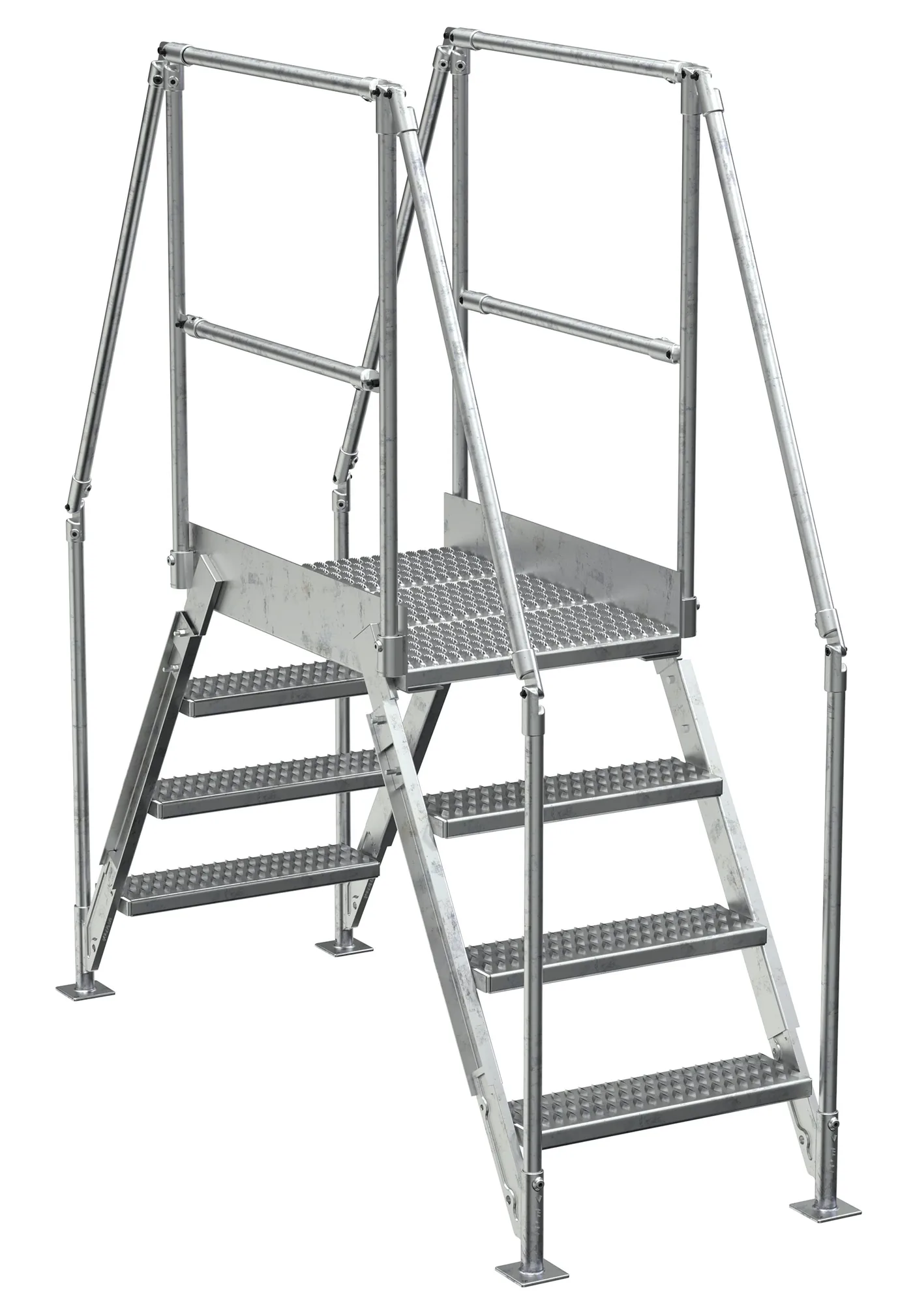
A crossover is two short stairs joined by a platform. It lets people step over conveyors, pipes, ducts, hoses and cords instead of climbing over or ducking under them. Vestil cross-over ladders come in steel, aluminum and galvanized versions with several step heights and platform widths. Equipto adds ship’s-style crossovers and longer crossover bridges for wide conveyor lines. Our crossover stairs guide compares the types and covers rooftop and pipe crossovers.
To size one, measure the height of the obstacle, the width you need to clear and the space at each end for the steps. For elevated walkways over whole process areas, see our industrial catwalks.

Track (rail) ladders
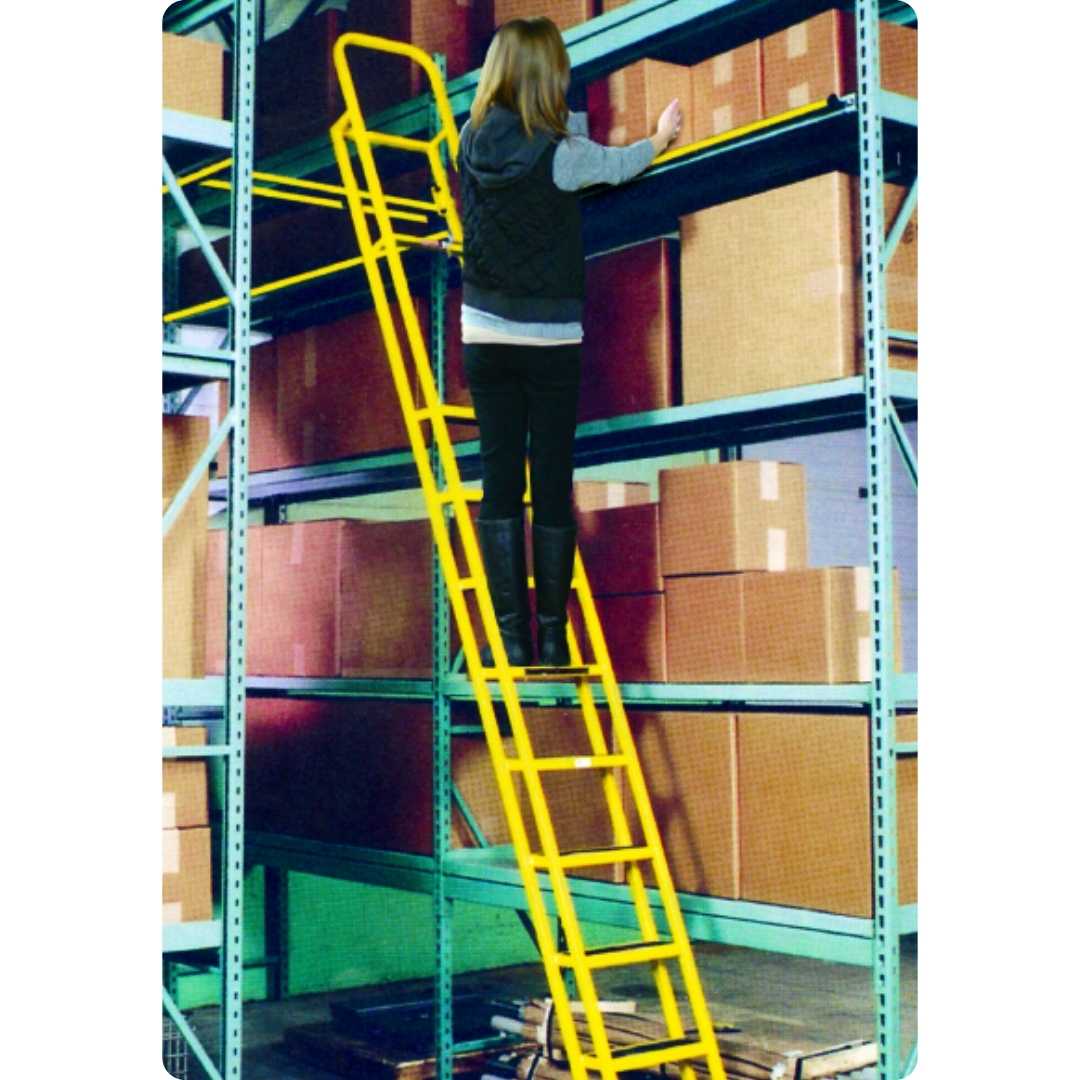
A track ladder hooks onto a rail mounted along the front of shelving and rolls down the aisle, so it is always there and never left blocking the floor. Cotterman’s Single Trak, Dual Trak and Dual Side Trak systems are used in parts rooms, stockrooms, libraries and retail backrooms where tall shelving lines narrow aisles.
Track ladders are planned with the shelving itself. Send us the shelving height and aisle width, or see our shelving solutions.
Other ladders and steps we supply
 Alternating tread stairsTreads alternate left and right so a steep 50 to 70° stair still gives a full step. Vestil offers 56° and 68° models, painted or galvanized.
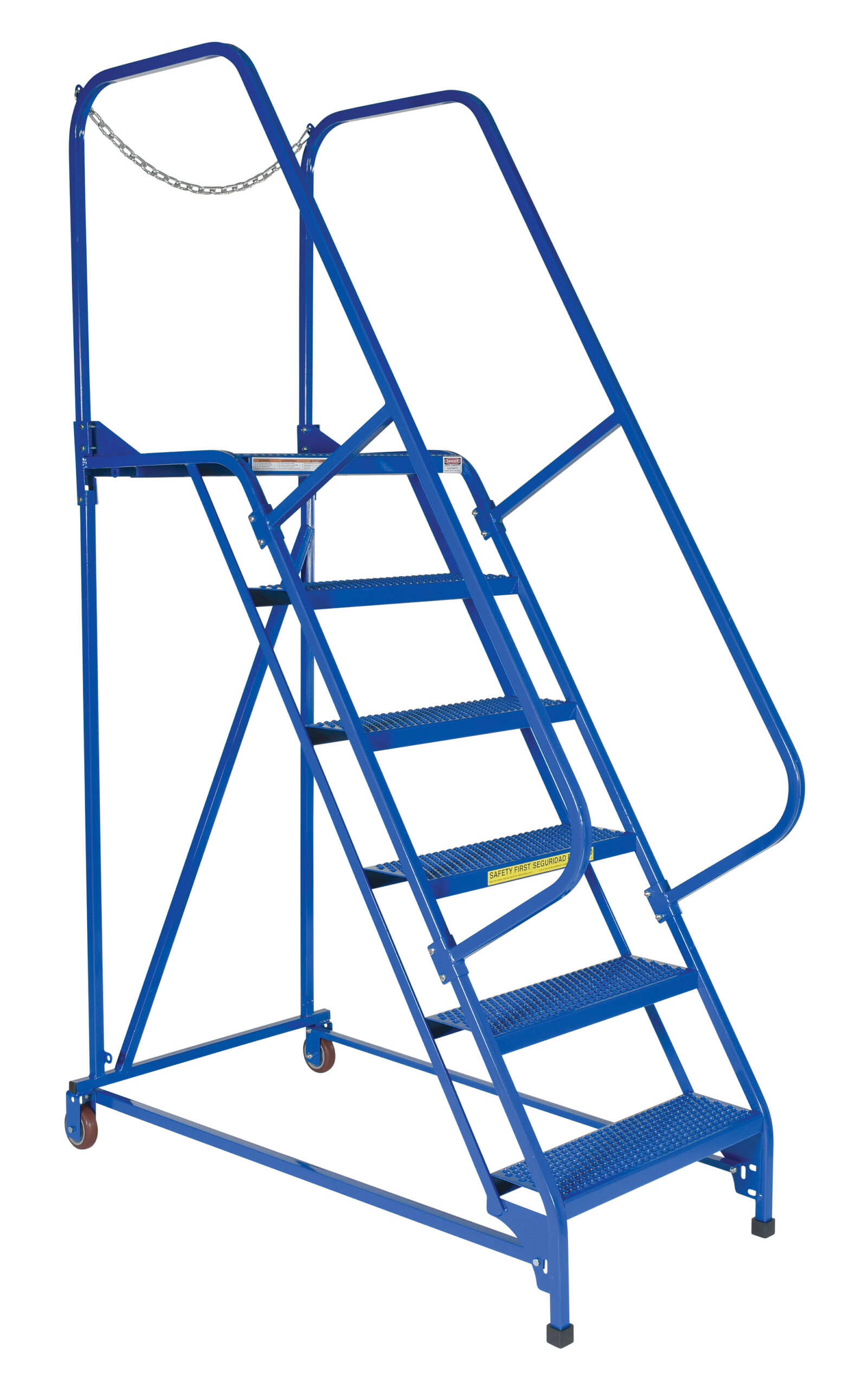 Maintenance and mechanics laddersRolling ladders with a compact base and handrails for maintenance crews working on machines, vehicles and fixtures.
 Folding rolling laddersRolling ladders that fold flat for storage between jobs. Vestil’s Roll-A-Fold comes in 50° and 58° versions.
How to Choose the Right Ladder by Task
Pick the ladder type before you pick a model. These five questions settle most decisions:
- How often do people climb? A few times a month suits a fixed ladder. Several times a shift points to a ship stair or standard stair. Constant picking from shelves calls for rolling ladders.
- Do they carry anything? If climbers need their hands for boxes, tools or parts, a ladder is the wrong tool. OSHA requires one hand on the ladder and bans carrying loads that could cause a fall. Use a stair, a work platform or a lift.
- How high is the landing? Measure from the floor to the top landing, roof or shelf you need to reach. For rolling ladders, a comfortable reach is usually about 5.5 ft above the top step.
- How much floor space can you give up? A fixed ladder takes a few square feet; a 50° rolling ladder or a stair takes far more. Check door heights and aisle widths for rolling ladders too.
- Indoors, outdoors or harsh conditions? Outdoor, washdown and corrosive areas usually need galvanized steel or aluminum, and electrical work needs non-conductive fiberglass portable ladders.
Quick guide: which ladder fits the job
| Task | Usually works best | Key detail to confirm |
|---|---|---|
| Picking cartons from shelving or rack | Rolling warehouse ladder | Top step height and aisle width |
| Daily trips to a mezzanine | Standard stair or ship’s stair | Floor-to-deck height and footprint |
| Occasional mezzanine or platform access | Fixed ladder with a self-closing gate | Height and gate style |
| Reaching a roof | Roof access ladder (exterior or hatch) | Roof height, parapet and fall protection |
| Stepping over a conveyor or pipe | Crossover ladder or bridge | Obstacle height and clear width |
| Tall shelving in narrow aisles | Track (rail) ladder | Shelf height and rail length |
| Tanks, trucks and machines | Tank, dock or maintenance ladder | Mounting point and height |
OSHA Ladder Rules: 1910.23 and 1910.28
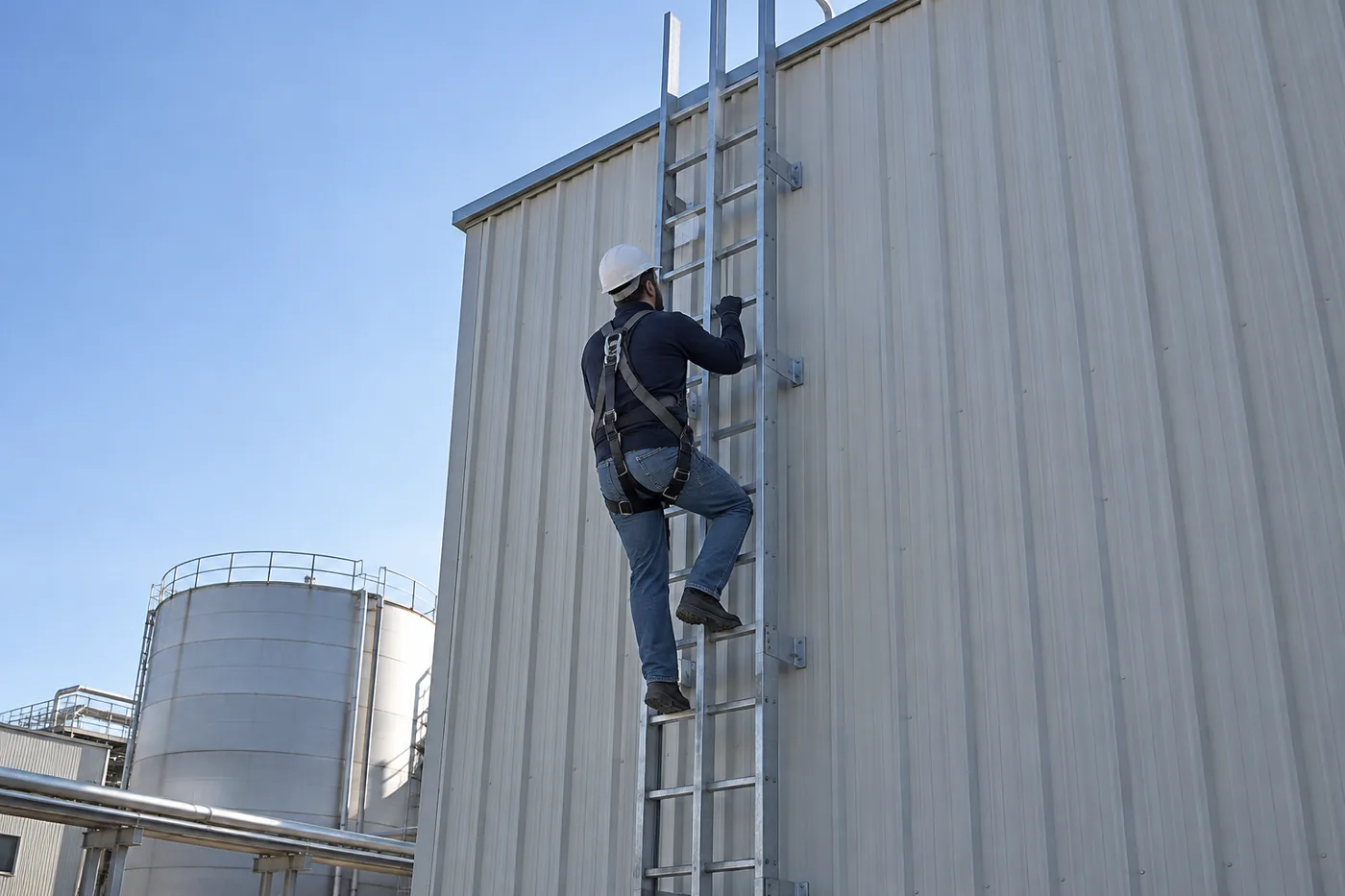
General industry ladders fall under 29 CFR 1910.23 (how ladders are built and used) and 1910.28 (fall protection). The biggest change for fixed ladders came in the 2016 walking-working surfaces rule: cages are being phased out as fall protection.
A ladder safety system is a rail or cable on the ladder with a sleeve, lanyard and body harness. OSHA states plainly that cages and wells are not ladder safety systems. A cage can stay on a ladder that also has a safety system, as long as it doesn’t get in the way.
Fixed ladders more than 24 ft above a lower level
| Situation | What OSHA 1910.28(b)(9) requires |
|---|---|
| Installed before November 19, 2018 | Personal fall arrest system, ladder safety system, cage or well |
| Installed on or after November 19, 2018 | Personal fall arrest system or ladder safety system |
| Any section, cage or well replaced | Ladder safety system or fall arrest in at least the replaced section |
| On and after November 18, 2036 | Every fixed ladder over 24 ft has fall arrest or a ladder safety system |
| Caged ladders with multiple sections | Sections offset, with landing platforms at least every 50 ft |
| Ladder safety system on the ladder | Protects the full climb, with rest platforms at least every 150 ft |
Other OSHA numbers buyers ask about
- Rung spacing: 10 to 14 in. center to center on most ladders (1910.23(b)(2)).
- Clear width: at least 11.5 in. on portable ladders and 16 in. on fixed ladders (1910.23(b)(4)).
- Fixed ladder clearances: 7 in. behind the rungs; without a cage, 15 in. each side of center and 30 in. on the climbing side (1910.23(d)).
- Roof hatches: a counterbalanced hatch cover must open at least 70° from horizontal (1910.23(d)(9)).
- Rolling ladders: steps no more than 10 in. apart and at least 7 in. deep, stringer no steeper than 60°; top steps above 10 ft need handrails at least 36 in. high on three sides (1910.23(e)).
- Use and inspection: inspect ladders before each shift, tag damaged ones “Dangerous: Do Not Use” and remove them from service, and face the ladder while climbing (1910.23(b)).
Your safety team and local authority make the final call on any installation. For a wider warehouse checklist, see our OSHA warehouse storage compliance checklist.
ANSI A14 Standards and Ladder Duty Ratings
Ladder makers design to the ANSI A14 series, written by the ASC A14 committee and published through the American Ladder Institute. These are the parts that matter for industrial buyers:
| Standard | Covers | Note |
|---|---|---|
| ANSI/ALI A14.1 | Portable wood ladders | Rare in industrial use today |
| ANSI/ALI A14.2 | Portable metal ladders | Aluminum and steel step and extension ladders |
| ANSI/ALI A14.3 | Fixed ladders | Current edition dated 2008 |
| ANSI/ALI A14.5 | Portable reinforced plastic ladders | Fiberglass ladders |
| ALI A14.7 | Mobile ladder stands and mobile ladder stand platforms | Administratively withdrawn in January 2022; OSHA 1910.23(e) still applies |
| ANSI/ALI A14.8 | Ladder accessories | Added in 2020 |
Duty ratings for portable ladders
A duty rating is the most weight a portable ladder is built to carry: the person plus clothing, tools and materials. Industrial users should buy Type I or higher.
| Duty rating | Ladder type | Working load |
|---|---|---|
| Special duty | Type IAA | 375 lb |
| Extra heavy duty | Type IA | 300 lb |
| Heavy duty | Type I | 250 lb |
| Medium duty | Type II | 225 lb |
| Light duty | Type III | 200 lb |
Rolling ladders and stairs are rated by their makers instead. Cotterman, for example, lists 350 lb for its welded aluminum rolling ladders, 450 lb for most steel series and 800 lb for its heavy-duty line. Check the rating on the product page or quote.
Materials, Finishes and Treads
- Steel: the strongest and most common for rolling, fixed and crossover ladders. Usually powder coated for indoor use.
- Aluminum: lighter and naturally corrosion resistant, so it is easy to roll and good for damp areas. Load ratings are often lower than steel.
- Hot-dip galvanized steel: the usual choice outdoors, at docks and in washdown areas. Vestil offers galvanized cross-over ladders and alternating tread stairs.
- Fiberglass: used for portable ladders near electrical equipment because it doesn’t conduct electricity when clean and dry.
OSHA requires metal ladders to be corrosion resistant or protected against corrosion.
Tread choices
- Perforated: raised holes give strong slip resistance and let dirt fall through. A good default.
- Serrated grating or grip strut: the most aggressive grip for oily, wet or icy conditions.
- Expanded metal: open design that sheds debris.
- Ribbed rubber or vinyl: quieter and gentler underfoot, for offices, libraries and retail.
- Tread width: rolling ladders commonly come with 16, 24 or 30 in. treads. Wider treads feel steadier but need wider aisles.
Industrial Ladder Applications
These are the places we specify ladders most often, with what to plan for in each.
 Warehouse picking and stockingRolling ladders put pickers at the right height in rack and shelving aisles. Match the top step to the highest pick level and the base to the aisle width.
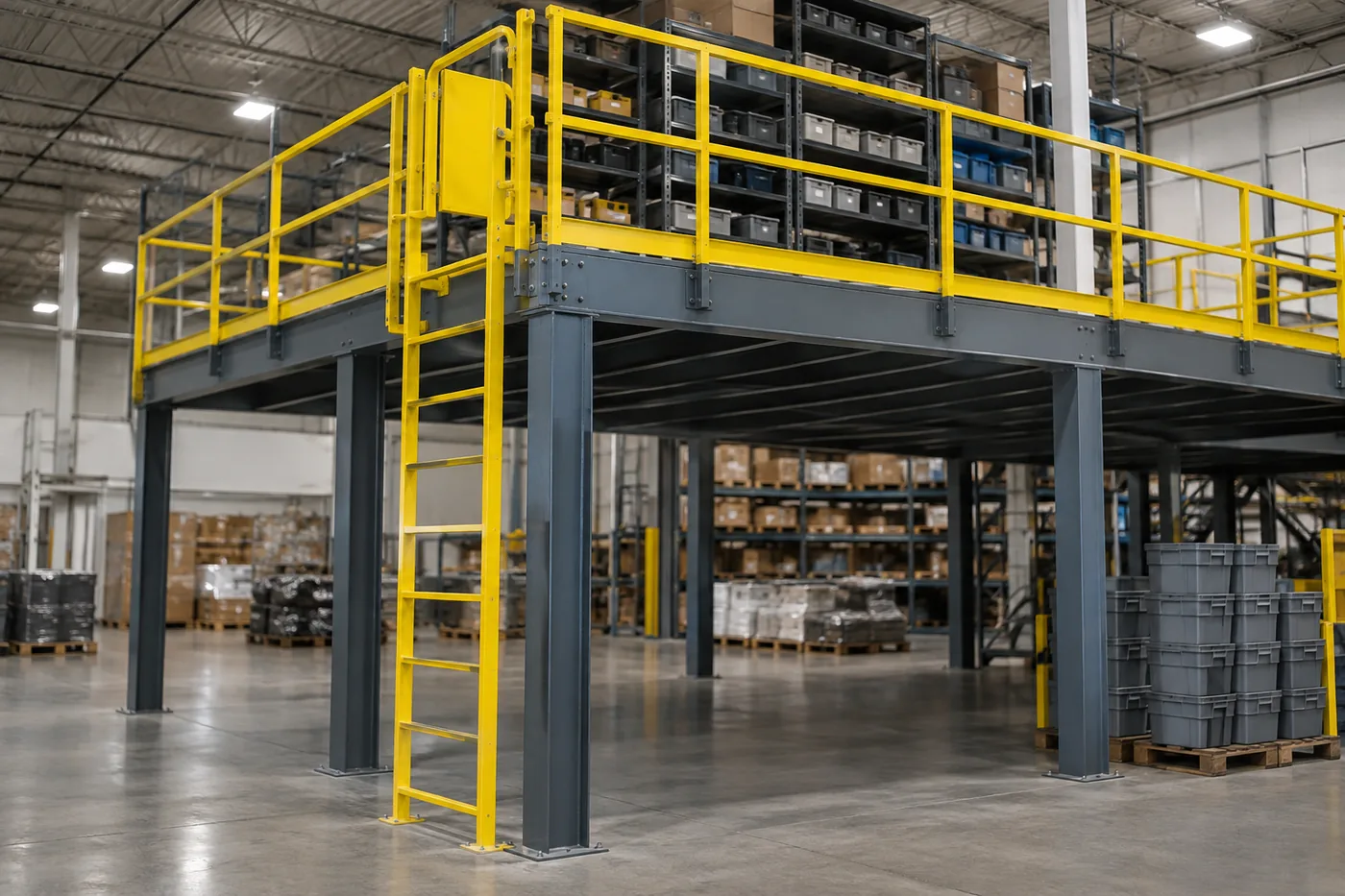 Mezzanines and storage platformsFixed ladders and ship’s ladders give secondary access where a stair won’t fit. Protect the opening with a self-closing gate.
 Loading docksWalk-through dock ladders let drivers and dock crews climb between the drive and the dock floor without jumping down.
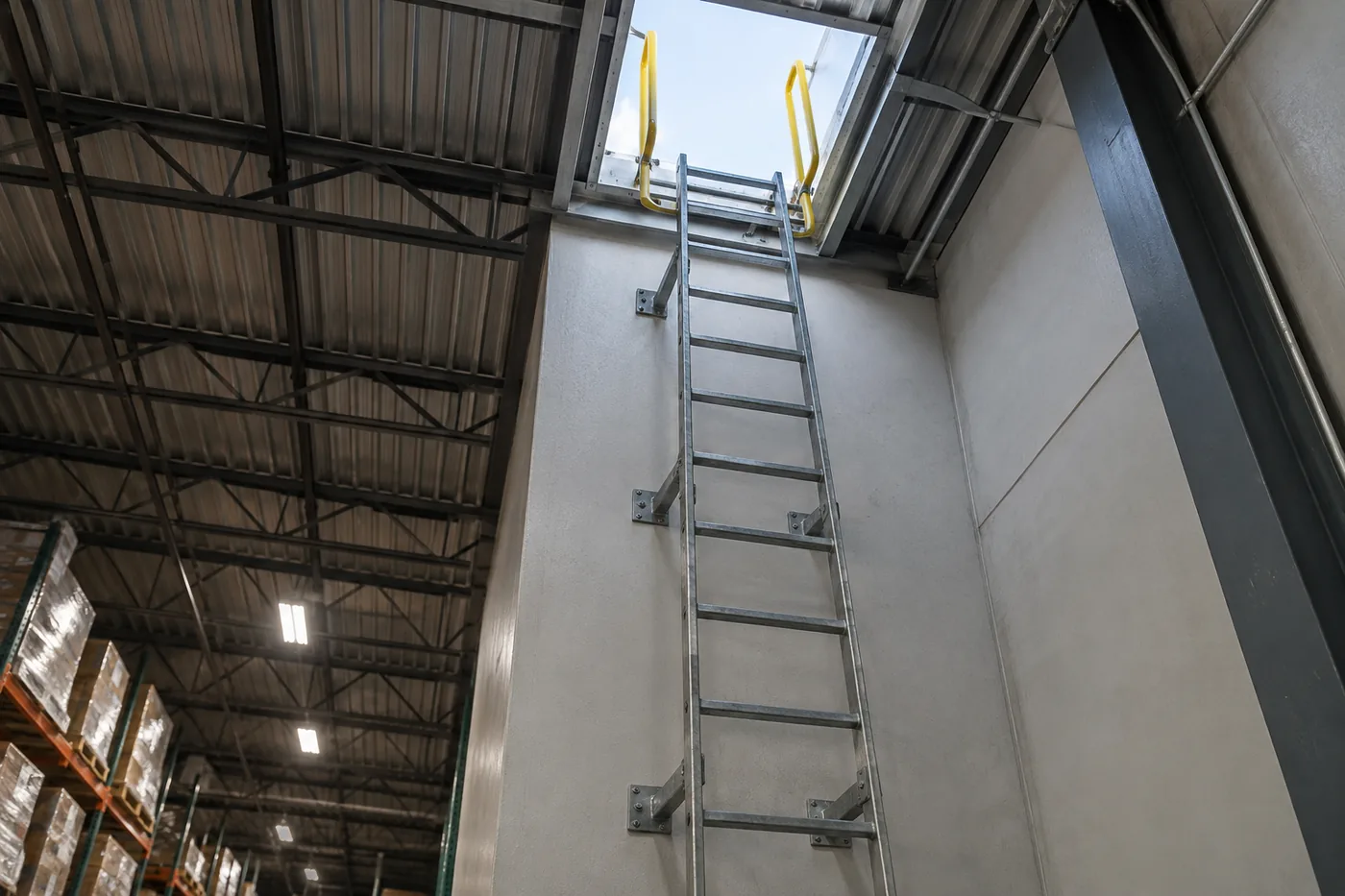 Roofs and rooftop equipmentHatch ladders and exterior roof ladders give HVAC and maintenance crews a safe route to the roof. Plan fall protection for climbs over 24 ft.
 Parts rooms, libraries and stockroomsTrack ladders ride a rail on the shelving, so tall shelving works in narrow aisles without loose ladders.
 Tanks, trucks and machinesTank access ladders, semi-trailer ladders and maintenance ladders reach equipment that people only climb occasionally.
More places ladders solve access problems
- Conveyor lines and process areas: crossovers and ship’s crossovers keep people off the belt. For longer runs, see industrial catwalks.
- Fleet and transit maintenance: rolling stairs and platforms for bus and truck roofs. See bus maintenance platforms.
- Daily routes to upper levels: when climbs are frequent, a stair is safer than any ladder. Compare options on our industrial stairs and work platforms page.
- Gate options at ladder openings: see our mezzanine slide gate example and the Equipto drop gates on Equipto mezzanines and stairways.
Industrial Ladder Brands We Supply
Platform ladders and portable step ladders
Platform ladders are portable stepladders with a standing platform and a high guardrail, so the user stands on a deck instead of a narrow step. They are popular with maintenance crews and facilities teams for short jobs that move around the building. See our Little Giant ladders page for platform, multi-position and fiberglass models, and buy Type I or higher for industrial work.
How to Get an Industrial Ladder Quote
When buyers write to us, the quote goes fastest when the first email answers these questions. Not sure about some of them? Send what you have and a few photos, and we’ll fill in the rest on a short call.
- The task: what people reach, how often they climb and whether they carry anything.
- Heights: floor to landing, top shelf or roof. For roofs, give both the height above the ground and the height above any lower roof the ladder starts from.
- Where it mounts or rolls: wall type (concrete, block, metal panel), parapet or hatch, mezzanine edge, or aisle width and door heights for rolling ladders.
- Indoors or outdoors: plus any washdown, freezer or corrosive conditions.
- Options: safety cage, ladder safety system, walk-through rails, safety gate, deep top step, tread type and width, handrails.
- Assembled or knocked down: many rolling ladders ship ready to climb; others ship partly assembled to save freight.
- Quantity and ZIP code: so freight and installation can be quoted together.
Send the basics
Task, heights, location and photos by form, email or phone.
Match the ladder
We shortlist the ladder type and models that fit your space and the OSHA basics.
Quote with freight
Ladder, options, freight and installation on one quote, with the current lead time.
Deliver and install
We coordinate delivery and installation, or ship ready for your team to set.
Many industrial ladders are built to order, so lead times vary by brand, size and finish. We confirm the current lead time with every quote rather than guess.
Get a free quote
Tell us what people need to reach, the height and where the ladder goes. A project specialist will follow up with ladder options, freight and pricing. Prefer to talk? Call (800) 326-4403.
Industrial Ladder FAQs
What are industrial ladders?
What is the difference between a ship’s ladder and a fixed ladder?
Do fixed ladders still need cages?
What angle should a rolling ladder be?
What does a ladder duty rating mean?
Do rolling ladders ship assembled?
What size roof access ladder do I need?
Do you install industrial ladders?
Need Help Choosing an Industrial Ladder?
Send the task, the height and a photo of the space for a free recommendation and a quote with freight.