
Rolling Ladders & Rolling Stairs
Rolling warehouse ladders, rolling safety ladders with handrails, rolling platform ladders and folding models for picking, stocking and maintenance. Pick the right climb angle, step count and lock, then get one quote for the ladder and freight.
10 in.
Max step rise (OSHA)
60°
Max stringer slope
50°/58°
Common climb angles
Nationwide
Quote and freight
Shop Rolling Ladders Online
Vestil rolling warehouse ladders in 50 and 58 degree climbs, spring-loaded commercial rolling ladders and tilt-and-roll ladders are in our online store in many step counts. Need a different height or a Cotterman model? Request a quote and we will match the ladder to your shelving, aisle and task.


What Is a Rolling Ladder?
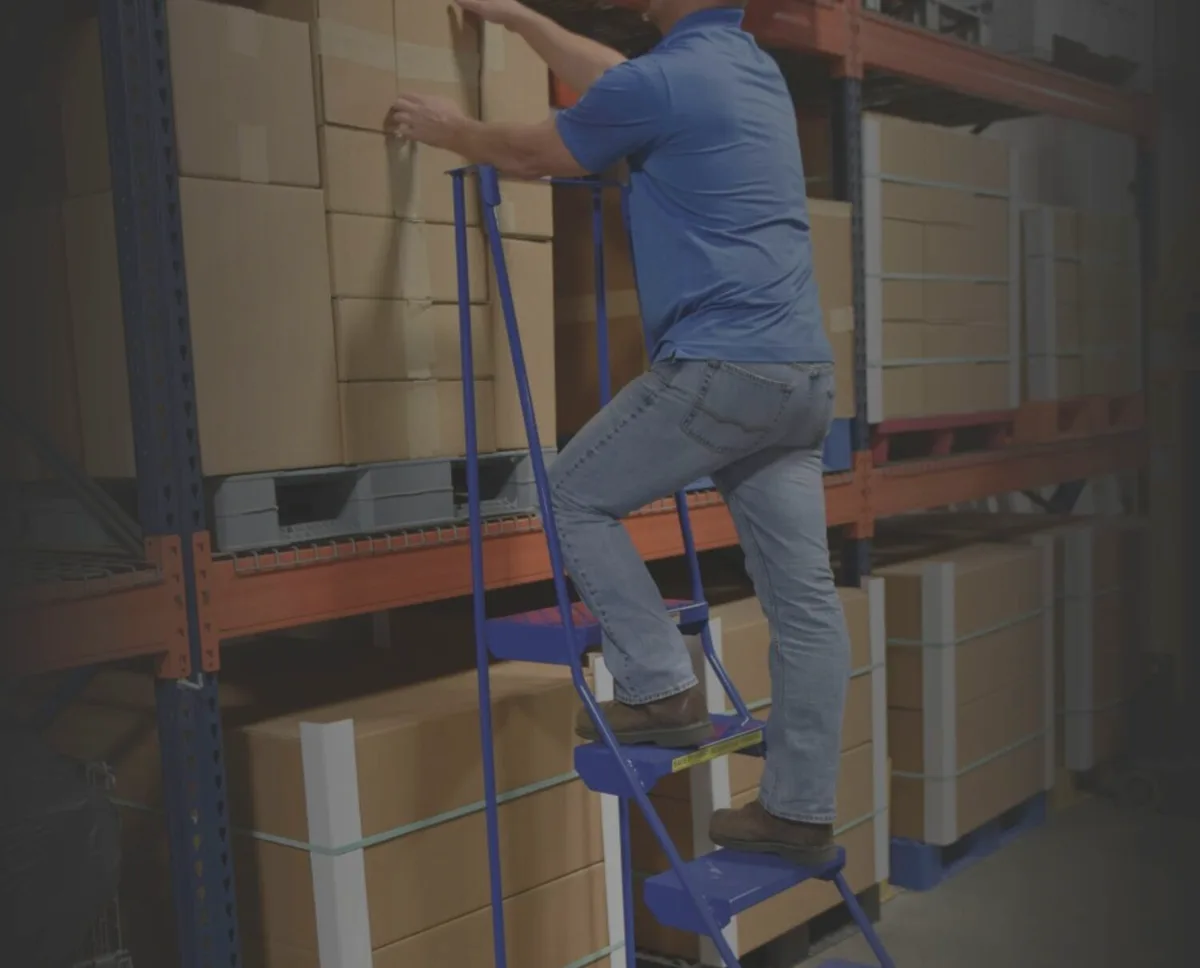
A rolling ladder is a fixed-height steel or aluminum stair on wheels, built so one person can climb to a shelf, rack level or machine and work there with a handrail at their side. OSHA calls it a mobile ladder stand: a self-supporting ladder with casters on a rigid base and steps leading to a top step. Buyers also call it a rolling warehouse ladder, rolling safety ladder, rolling step ladder, rolling stairs or a warehouse ladder with wheels.
It is one family within our wider range of industrial ladders. Fixed and ship’s ladders stay in one place. A rolling ladder goes to the work, then locks so it can’t move while someone stands on it. That makes it the everyday tool for order picking, restocking and inventory counts in warehouses, stockrooms, parts rooms and stores.

This guide covers what the top online listings show (sizes, treads, locks) plus what they usually leave out: how to work out the step count from the height you need to reach, how much floor a 50° ladder really takes compared with a 58° one, which OSHA rules apply to rolling ladders, and what to send us so a quote comes back right the first time.
Types of Rolling Ladders
Most rolling ladders fall into six groups. Start with the group that fits how often people climb, how high they go and where the ladder lives between uses.
| Type | What it is | Typical heights | Best for |
|---|---|---|---|
| Rolling warehouse ladder (standard) | Welded steel stair at about 58-59° with handrails, a top step and a step-activated lock | About 3 to 16 steps | Daily picking and stocking from shelving and pallet rack |
| 50° rolling ladder (easy climb) | Same idea with a gentler stair angle and a longer base | About 3 to 16 steps | Frequent climbs, carrying small items, walking down facing forward |
| Spring-loaded rolling ladder | Compact ladder on spring casters that retract under weight so rubber feet grip the floor | 1 to 5 steps | Retail floors, stockrooms, offices, quick low reaches |
| Rolling platform ladder / work stand | A larger platform area with guardrails, room for tools or a second person | Varies by model | Maintenance, longer tasks at height, two-handed work |
| Folding rolling ladder | Frame folds flat for storage or transport; usually a removable handrail | Mid-height models | Shared ladders, tight back rooms, moving between buildings |
| Tilt-and-roll / maintenance ladder | Sits on fixed feet; wheels engage only when you tilt it to move it | About 2 to 12 steps | Shops, maintenance crews, uneven work positions |
Spring-loaded commercial rolling ladders

For short reaches, a spring-loaded ladder is the lightest and simplest option. Each swivel caster sits on a spring. Step on, and the frame drops onto rubber pads so the ladder can’t roll. Step off, and it rides on its wheels again. No lever to forget.
Vestil’s commercial spring-loaded ladders come in 1 to 5 steps with rubber or perforated steps and dome-protected casters in several colors. Cotterman puts spring-loaded casters on its 1 to 4 step industrial ladders and switches to a foot-activated lock from about 5 steps up. Pick this style when the top step is low and the ladder moves constantly, like a retail sales floor or a stockroom.
Tilt-and-roll and straddle-base ladders
A tilt-and-roll ladder stands on fixed feet. To move it, you tip it back onto its wheels like a hand truck. Because the wheels are off the floor in use, it can’t creep. Vestil’s Tip-N-Roll comes with a standard base, or a straddle base that reaches over a pallet, machine base or other permanent obstruction and includes a removable tool tray.
Maintenance ladders are a close cousin: a compact frame, removable handrail and access chain, made for crews who work on machines, vehicles and fixtures rather than shelving.

50° vs 58° (or 59°) Rolling Ladders
Climb angle is the first real choice. Vestil builds its warehouse ladders at 50° and 58°; Cotterman builds 50° and 59° series. OSHA caps the stringer slope of any mobile ladder stand at 60°, so both are within the rule. The difference is how the ladder feels and how much floor it takes.

58-59° (standard): the classic warehouse ladder. It takes less floor, fits tighter aisles and is the most common choice for picking from shelving and rack. Most people climb it facing the steps, like a steep stair.
50° (easy climb): closer to a building stair. People can walk down facing forward, which feels safer for frequent trips and makes it easier to carry a small carton, while keeping one hand on the rail. The trade-off is a longer base and more weight to push around.
How much longer is a 50° ladder?
With the usual 10 in. step rise, each step adds about 6 in. of floor length at 58-59° and about 8.4 in. at 50° (rise divided by the tangent of the angle). Over a full ladder that adds up fast:
| Steps | Top step height | Stair run at 58° (approx.) | Stair run at 50° (approx.) | Extra length at 50° |
|---|---|---|---|---|
| 4 | 40 in. | 25 in. | 34 in. | about 9 in. |
| 6 | 60 in. | 37 in. | 50 in. | about 13 in. |
| 8 | 80 in. | 50 in. | 67 in. | about 17 in. |
| 10 | 100 in. | 62 in. | 84 in. | about 22 in. |
| 12 | 120 in. | 75 in. | 101 in. | about 26 in. |
| 16 | 160 in. | 100 in. | 134 in. | about 34 in. |
Stair run only. The full base also includes the top step depth and the rear frame, so check the model’s listed base length before you buy. Figures are geometry, not a specific model’s dimensions.
Choose 50° when: people climb many times per shift, they carry small items up or down, some users are uneasy on steep stairs, or the aisle has room for the longer base.
Choose 58-59° when: aisles are tight, the ladder must turn into short bays, it has to fit through narrow doors or a crowded back room, or climbs are quick reach-and-grab trips.
Not sure? Measure your narrowest aisle and send it with your height. We will tell you whether a 50° model will turn and park there.

How Many Steps Do You Need? Sizing by Height
Rolling ladders are sold by step count, and nearly every industrial model uses a 10 in. rise per step. That makes sizing simple arithmetic. Four measurements matter:
- Top step height = number of steps × 10 in. A 6-step ladder puts the top step 60 in. off the floor.
- Working (reach) height is where a person can comfortably work, usually about 5.5 ft (66 in.) above the top step. Cotterman uses the same rule of thumb in its sizing guide.
- Overall height is the top of the handrails, typically about 30 to 33 in. above the top step. It decides whether the ladder fits under lights, sprinklers, mezzanine beams and through doors.
- Base width and length grow with height. Taller ladders need wider bases to stay stable, and lower climb angles need longer ones.
Formula: steps needed = (highest shelf or work point in inches − 66) ÷ 10, rounded up. Example: the top shelf you pick from is 12 ft (144 in.). 144 − 66 = 78; 78 ÷ 10 = 7.8, so choose an 8-step ladder with an 80 in. top step.
| Steps | Top step height | Approx. overall height | Approx. comfortable reach | Notes |
|---|---|---|---|---|
| 3 | 30 in. (2.5 ft) | 60-63 in. | 8 ft | Spring-loaded models common |
| 4 | 40 in. (3.3 ft) | 70-73 in. | 8.8 ft | Last size where spring casters are common |
| 5 | 50 in. (4.2 ft) | 80-83 in. | 9.7 ft | Handrails required from 4 ft top step |
| 6 | 60 in. (5 ft) | 90-93 in. | 10.5 ft | Popular for shelving up to about 10 ft |
| 8 | 80 in. (6.7 ft) | 110-113 in. | 12.2 ft | Typical for 12 ft shelving or 2nd-3rd rack level |
| 10 | 100 in. (8.3 ft) | 130-133 in. | 13.8 ft | Check door heights before ordering |
| 12 | 120 in. (10 ft) | 150-153 in. | 15.5 ft | At OSHA’s 10 ft top-step threshold |
| 13-16 | 130-160 in. | 160-193 in. | 16.3-18.8 ft | Top step over 10 ft: guarded on three sides |
Reach and overall height are typical industry values; exact numbers vary by model and top-step depth. We confirm the drawing dimensions on every quote.

Common sizing mistakes:
- Too tall for the building. Cotterman calls oversizing one of the most common ordering mistakes. A 10-step ladder stands about 11 ft tall at the handrails, which won’t clear a standard 8 ft door or some mezzanine undersides.
- Measuring to the shelf, not the reach. Size to the highest point a hand must reach, then subtract the 66 in. reach.
- Forgetting the base. A tall 50° ladder can be longer than the aisle is wide, so it can’t turn into the aisle.
Locking: Step-Lock vs Spring-Loaded Casters
OSHA 1910.23(e) requires any mobile ladder stand with wheels to have a system that stops horizontal movement when someone is on it, and says the stand must not move while an employee is on it. Makers solve this in four ways:
| Lock style | How it works | Usually found on | Watch for |
|---|---|---|---|
| Spring-loaded casters | Casters retract under body weight; the frame sits on rubber feet | 1 to 4 or 5 step ladders | Worn springs or pads; keep floors clean |
| Step-activated / foot lock (e.g. Cotterman SafeLock) | Pressing a step or pedal lowers the frame onto rubber-tipped legs or locks the wheels | About 4-5 steps and up | Train users to engage it every time |
| Lever lock under the bottom step (Vestil warehouse ladders) | Press the levers below the bottom step; once engaged the ladder can’t be moved | Vestil 50° and 58° warehouse ladders | Release fully before rolling |
| Tilt-and-roll | Wheels touch the floor only when the ladder is tipped back | Tip-N-Roll and maintenance ladders | Heavier to tilt at taller sizes |

Wheel layout matters too. The standard setup is swivel casters at the front and rigid wheels at the rear, which tracks straight down an aisle. Cotterman’s Dual End SafeLock adds swivel casters at both ends for 360° movement, useful when a ladder has to spin in a tight cross-aisle.
Gates and chains. A self-closing gate or chain across the top step stops people from stepping off the back. Vestil sells an optional warehouse ladder safety gate that engages with a press of the foot. OSHA allows removable gates or chains in place of handrails in special-use applications.
OSHA Rules for Rolling Ladders (1910.23(e))
Rolling ladders have their own paragraph in OSHA’s walking-working surfaces rule: 29 CFR 1910.23(e), “Mobile ladder stands and mobile ladder stand platforms.” Definitions are in 1910.21. Here are the numbers in plain language:
| Requirement | OSHA number | Paragraph |
|---|---|---|
| Step width | At least 16 in. | (e)(1)(i) |
| Slip resistance | Steps and platforms slip resistant (built in or applied, e.g. dimpling, coating, tape) | (e)(1)(ii) |
| Strength | Supports at least 4 times its maximum intended load; casters carry their share of 4x the load plus the unit’s weight | (e)(1)(iii)-(iv) |
| Handrails from 4 ft | Top step 4 ft or higher: handrails 29.5 to 37 in. high, measured from the front edge of a step | (e)(1)(v) |
| Stability | Work surface no higher than 4 times the shortest base dimension without outriggers, counterweights or similar | (e)(1)(vi) |
| Movement | Wheeled units have a system to impede movement; no movement with an employee on it | (e)(1)(vii)-(viii) |
| Steps | Uniform, rise no more than 10 in., depth at least 7 in., stringer slope no more than 60° | (e)(2)(i) |
| Top step above 10 ft | Protected on three sides by a handrail at least 36 in. high | (e)(2)(ii) |
| Deep top step | Top step 20 in. or more front to back (above 10 ft): midrail and toeboard | (e)(2)(ii) |
| Standing area | Within the base frame | (e)(2)(iii) |
| Platforms 4 to 10 ft | Handrails at least 36 in. high plus midrails | (e)(3)(ii) |
| Platforms above 10 ft | Guardrails and toeboards on exposed sides and ends | (e)(3)(iii) |
What this means when you buy:
- A 12-step ladder has a 120 in. (10 ft) top step. Go one step taller and the top must be guarded on three sides, and a deep (20 in.+) top step also needs a midrail and toeboard.
- The 4-to-1 rule ties height to base size. A ladder with a 32 in. wide base can have a work surface up to 128 in. without extra stabilizers, which is why tall ladders come with wider treads and bases.
- Rolling ladders have one-person ratings. OSHA defines a mobile ladder stand as designed for use by one employee at a time; for two people or bulky tools, look at a platform model or a work platform.
ANSI note: ANSI A14.7, the old American National Standard for mobile ladder stands, was administratively withdrawn in January 2022. Many makers still describe their ladders as meeting “applicable OSHA and ANSI standards,” but the OSHA paragraph above is the enforceable rule in general industry. California buyers should ask for Cal/OSHA models, which Cotterman offers. Your safety team has the final say; for a broader checklist see our OSHA warehouse storage compliance checklist.
Options: Platform Depth, Treads, Width, Capacity and Folding
Top step and platform depth
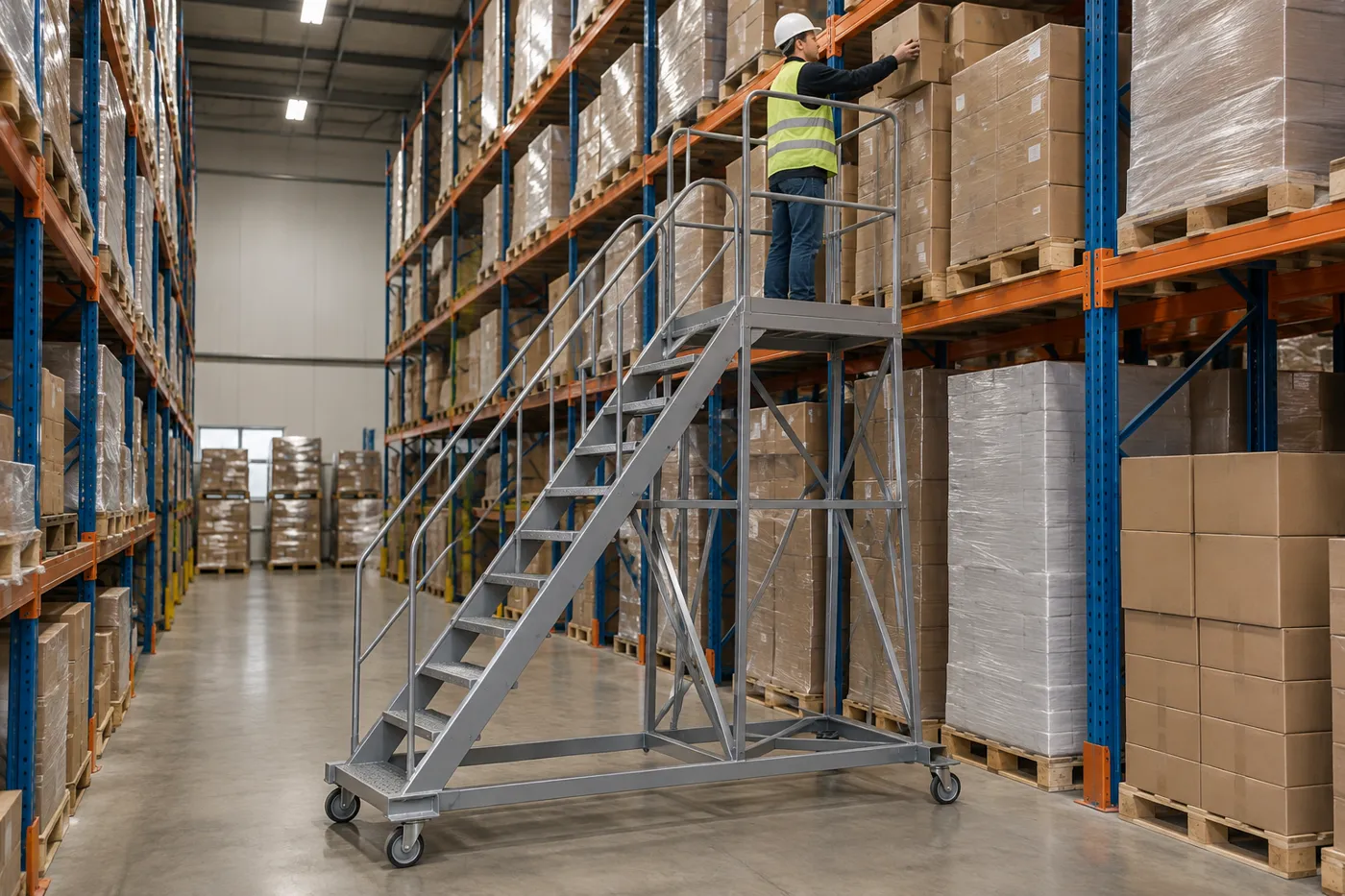
The top step is where people stand, so its depth changes how the ladder works. Cotterman offers top steps of about 10-12 in. (standard), 20-24 in. and 30 in.; Vestil warehouse ladders come with 14 in. or 21 in. top steps. A deeper top step gives room to turn around, set down a tote or rest a scanner, but adds base length, and above 10 ft a top step 20 in. or deeper needs a midrail and toeboard. For tasks that need tools, parts and both hands for minutes at a time, a rolling platform ladder or work stand is the better fit.
| Option | Choices | How to pick |
|---|---|---|
| Tread type | Perforated, expanded metal, serrated grip strut, ribbed vinyl or rubber | Perforated for dry indoor floors; expanded metal or grip strut where mud, water, oil or debris get tracked in; vinyl or rubber for quiet retail and office areas |
| Tread width | 16, 24 or 30 in. (OSHA minimum 16 in.) | 16 in. for narrow aisles; 24 in. feels steadier and is the common warehouse choice; 30 in. for tall ladders, bulky items or a wider base |
| Capacity | Cotterman lists 350 lb aluminum, 450 lb most steel series, 800 lb heavy duty, up to 1,000 lb for its Workmaster line | Add the user, clothing, tools and what they carry; heavy users and parts picking favor heavy-duty models |
| Material and finish | Powder-coated steel (standard), aluminum, stainless on some models | Aluminum is easier to push; stainless or special finishes for washdown and corrosive areas |
| Handrails | Standard handrails, top-step guard on three sides, gate or chain | Handrails are required from a 4 ft top step; three-side guard above 10 ft |
| Accessories | Tool trays, safety gates, larger wheels, Cal/OSHA versions | List them on your quote request so the ladder ships complete |
Folding rolling ladders

A folding rolling ladder collapses its frame so it stores flat against a wall or rides in a van between sites. Vestil’s Roll-A-Fold is built from square tubing with a removable handrail, a deep top platform and large wheels, in 50° and 58° versions with perforated or grip strut steps. Cotterman’s StockNStore is a lightweight folding rolling ladder aimed at small retail stores and tight spaces, and some of its 59° ladders use a Roll-n-Fold frame.
Folding models suit shared ladders and short storage space. For all-day picking, a fully welded ladder is stiffer and needs no setup.
Fitting a Rolling Ladder to Your Aisles, Doors and Floors
Rolling ladders don’t anchor to the floor, so “installation” is really about fit and delivery. Check these before you order:
Measure the narrowest aisle
The ladder must turn into the aisle and still leave room to pass. Compare the aisle with the base length, not just the width.
Check every door and ceiling
Overall height must clear doors, lights, sprinkler heads, mezzanine beams and conveyors on the route the ladder travels.
Look at the floor
Casters need a reasonably smooth, level floor. Cracks, dock plates, cords and floor drains stop small wheels; ask about larger wheels for rough floors.
Plan storage
Decide where the ladder parks when not in use so it doesn’t block fire exits, extinguishers or forklift lanes.
Set up and train
Unpack, finish any assembly, then show users how to set the lock, check it holds before climbing and inspect it before each shift.
Assembled or knocked down? Both exist. Cotterman ships many ladders ready to climb (its “R2C” models) from several plants, and offers partially assembled versions of some series. Ready-to-climb ladders go straight to work but cost more to ship because they take more truck space; knocked-down ladders ship smaller and need bolting together on site. Tall ladders often ship by freight carrier on a pallet, so tell us if the site has no dock or forklift.
Rolling ladders in rack aisles. In pallet rack aisles, keep ladders out of forklift traffic and park them at the end of the aisle when not in use. For tall shelving runs in narrow aisles, a rail-mounted track ladder may fit better than a free-rolling one.

Where Rolling Ladders Work Best
- Warehouse and distribution picking: 6 to 10 step warehouse ladders for upper shelving and the second and third pallet rack levels.
- Retail stockrooms and sales floors: 2 to 5 step spring-loaded ladders with rubber or vinyl treads that are quiet and easy to move.
- Parts rooms and MRO stores: 50° ladders for frequent climbs while carrying small parts.
- Maintenance and facilities: tilt-and-roll and maintenance ladders around machines, lights and HVAC units.
- Offices, archives and libraries: low, finished rolling ladders and track ladders for tall file and book shelving.
- Fleet and vehicle service: rolling stairs and platforms beside trucks and buses; see our bus scaffolding for roof-height work.
Rolling Ladder Brands We Supply
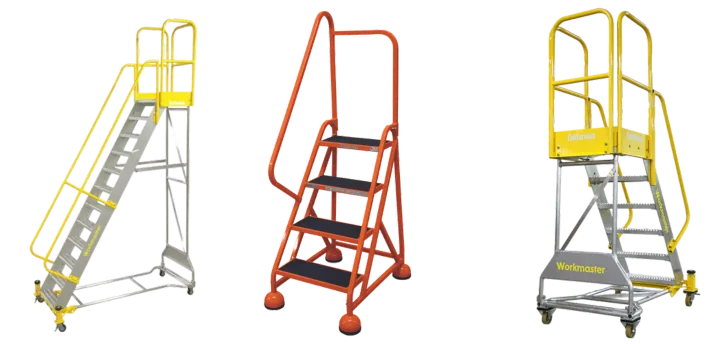
Cotterman has built rolling steel warehouse ladders since the 1940s and today runs plants in several regions. Its Series 1000 (59°) is its best seller and its Series 1200 (50°) gives the gentler climb; both are rated 450 lb with 7 in. deep steps and tread widths from 16 to 30 in. It also makes heavy-duty 800 lb ladders, Workmaster super-duty ladders, aluminum ladders, work stands, track ladders and safety gates.
Vestil rolling ladders on our store include 50° and 58° warehouse ladders up to 16 steps, spring-loaded commercial ladders, Roll-A-Fold folding ladders, Tip-N-Roll ladders and maintenance ladders. For portable stepladders and platform ladders see Little Giant ladders.
What to Send for a Rolling Ladder Quote
Buyers often ask what information we need to order. This list gets an accurate quote and freight price in one pass:
- Height: the highest shelf or work point people must reach, or the top step height you want.
- Aisle and doors: narrowest aisle width, door heights and any low beams or sprinklers on the route.
- Climb angle: 50° or 58-59°, or tell us how often people climb and what they carry.
- Top step: standard or deep (20 in.+), and whether you need a gate or a three-side guard.
- Tread and width: perforated, expanded metal, grip strut or vinyl; 16, 24 or 30 in.
- Capacity: the heaviest user plus tools and parts.
- Delivery: ship-to city, dock or no dock, forklift on site, and assembled or knocked down.
- Quantity and timing: how many and when you need them. Most industrial rolling ladders are built to order, so lead time depends on the model and plant; we confirm it on the quote.
Get a free quote
Tell us what you are storing, the room size and your timeline. A project specialist will follow up with layout options and pricing. Prefer to talk? Call (800) 326-4403.
Rolling Ladder FAQs
What is the difference between a rolling ladder and rolling stairs?
How do I know how many steps my rolling ladder needs?
What angle should a rolling ladder be?
When does a rolling ladder need handrails?
How much weight can a rolling ladder hold?
Step-lock or spring-loaded casters: which is better?
Do rolling ladders ship assembled?
Why do rolling ladder prices vary so much online?
What is the lead time on a rolling ladder?
Can two people stand on a rolling ladder?
Can a rolling ladder be used outdoors or on rough floors?
Do you install rolling ladders?
Need Help Choosing a Rolling Ladder?
Send your reach height, aisle width and a photo of the space for a free recommendation and a delivered quote.