
Fixed Ladders and Cage Ladders
Wall-mounted fixed ladders, caged ladders and ladders with safety systems for roofs, mezzanines, docks, tanks and equipment. Check the OSHA 1910.23 dimensions, plan fall protection over 24 ft and get one quote for the ladder, freight and installation.
10-14 in.
OSHA rung spacing
16 in.
Minimum clear width
42 in.
Rail extension above landing
24 ft
Fall protection trigger
Shop Vestil Fixed Ladders Online
Vestil walk-through dock ladders, tank access ladders and folding mezzanine ladders are in our online store. For roof, wall and caged ladders built to your height, request a quote and we will size the ladder, cage or safety system for you.


What Is a Fixed Ladder?
A fixed ladder is a ladder with side rails or individual rungs that is permanently attached to a building, structure or piece of equipment. OSHA’s definition in 29 CFR 1910.21 includes individual-rung ladders but not ship stairs, step bolts or manhole steps. It is one of the industrial ladders we supply, and it takes up less floor space than any other way to reach a roof, mezzanine, tank or platform.
That small footprint comes with a trade-off. A climber faces the ladder, keeps at least one hand on it and can’t carry a load that could throw off their balance. Fixed ladders suit occasional access by trained staff: roof checks, HVAC service, storage roofs, tank inspections and equipment platforms.
Buyers who write to us usually ask the same four things: which ladder fits a given roof or landing height, whether to order a one-piece welded ladder or a modular one, whether they need a cage, and what we need for a quote. This page answers each one, with the OSHA numbers behind them.
Types of Fixed Ladders
Fixed ladders are sorted by how the climber gets off at the top and by what protects them on the way up. Most projects combine one exit style with one protection style.
| Type | How it works | Typical use |
|---|---|---|
| Through (walk-through) ladder | Side rails continue above the landing and flare apart; the climber steps through between them | Roof parapets, mezzanine edges, platforms |
| Side-step ladder | Rails and rungs run past the landing; the climber steps sideways off the ladder | Platforms and roofs where the ladder sits beside the landing |
| Hatch (roof hatch) ladder | Ladder rises inside the building to a roof hatch, with grab bars above the opening | Interior roof access through the deck |
| Caged ladder | Steel hoops and vertical bars surround the climbing space | Older and shorter ladders, exposed edges |
| Ladder with a ladder safety system | A rail or cable on the ladder with a sleeve connected to the climber’s harness | Any climb over 24 ft on new installations |
| Individual-rung ladder | Separate rungs anchored straight into a wall, pit or structure | Pits, vaults and equipment |
Walk-through vs side-step: which top exit?
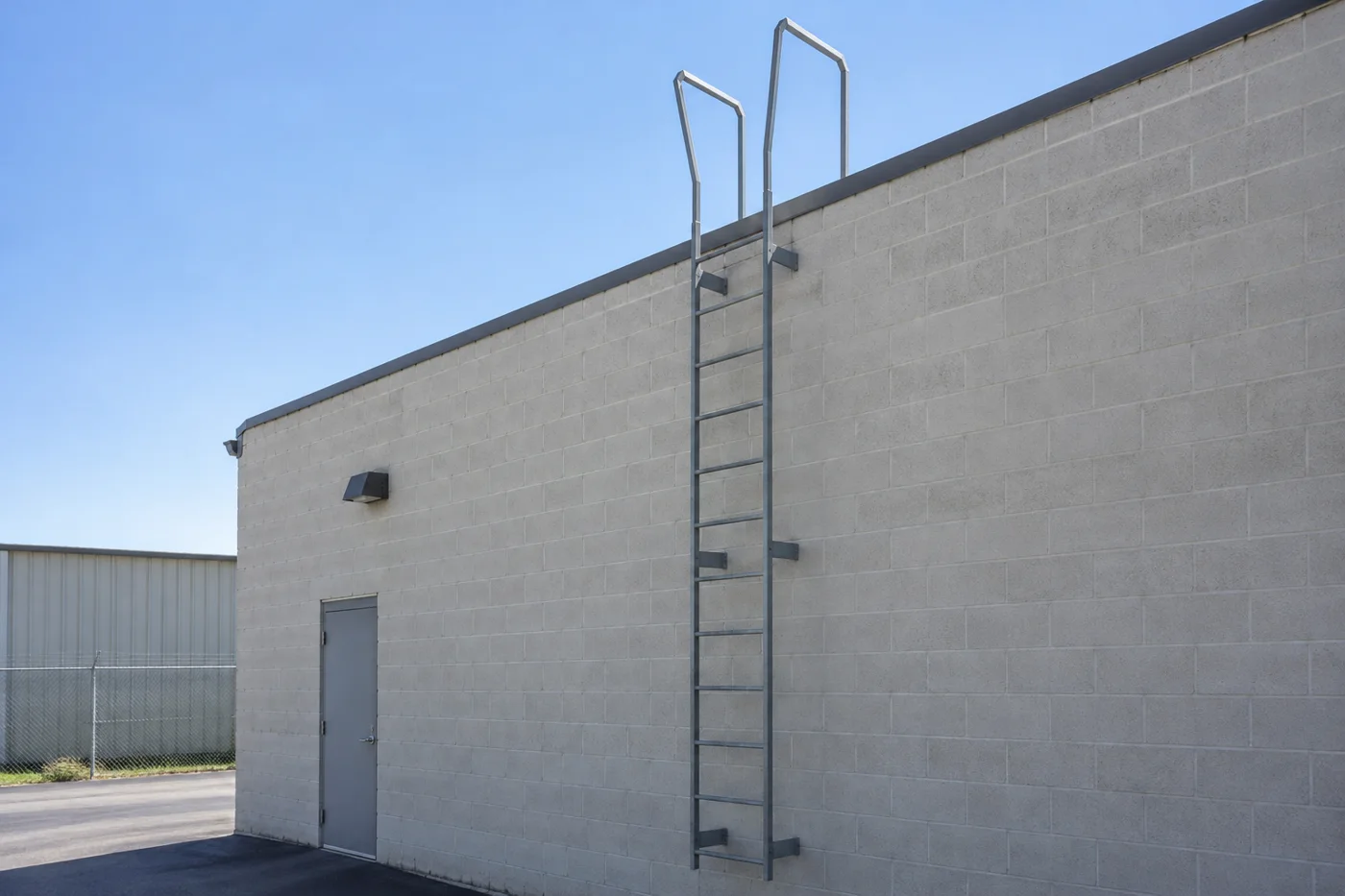
On a walk-through ladder the rails rise at least 42 in. above the landing and flare out to give 24 to 30 in. of clearance (up to 36 in. with a ladder safety system). The rungs stop at the landing, so the climber walks forward between the rails onto the roof. It is the most common choice at a parapet or mezzanine edge.
On a side-step ladder the rails and rungs keep going past the landing, and the climber steps sideways onto it. The step-across distance must be 15 to 20 in., compared with 7 to 12 in. from a walk-through ladder to the edge it serves. Choose side-step when the ladder has to sit beside a platform rather than in front of it.
Welded one-piece vs modular
This is one of the most common questions we get on rooftop ladders. A welded one-piece ladder arrives ready to mount, with fewer joints to check and a fast install, but it ships long and needs room to maneuver into place. A modular ladder ships in shorter bolt-together sections. Cotterman’s Series M modular ladders, for example, use no section longer than 7 ft. That makes them easier to carry through a building, up a hatch or onto a roof, and simpler to fit to an odd height. Cotterman builds its walk-through-handrail welded ladders for climbs under 20 ft, so taller runs are usually modular or built in sections with landings.
OSHA Fixed Ladder Requirements: 1910.23 Dimensions
General industry fixed ladders are covered by 29 CFR 1910.23, with paragraph (b) for all ladders and paragraph (d) for fixed ladders. These are the dimensions buyers and inspectors check most often, taken from the current text on osha.gov:
| Requirement | OSHA dimension | Section |
|---|---|---|
| Rung spacing | 10 to 14 in. between rung centerlines, parallel, level and uniform | 1910.23(b)(1)-(2) |
| Clear width between side rails | At least 16 in. (measured before a ladder safety system is added) | 1910.23(b)(4) |
| Toe clearance behind rungs | At least 7 in. from rung centerline to the nearest object behind the ladder (4.5 in. for elevator pit ladders) | 1910.23(d)(2) |
| Side-rail extension | Through and side-step ladder rails extend at least 42 in. above the access level or landing | 1910.23(d)(4) |
| Parapet access level | The roof if the parapet is cut for passage; the top of the parapet if it is continuous | 1910.23(d)(4)(i)-(ii) |
| Walk-through flare | Rails flared to 24-30 in. clear; up to 36 in. with a ladder safety system | 1910.23(d)(5) |
| Grab bars | Extend 42 in. above the landing; no smaller than the rungs; don’t protrude past the rungs on the climbing side | 1910.23(d)(3), (7), (8) |
| Step-across distance | Through ladders 7 to 12 in.; side-step ladders 15 to 20 in. | 1910.23(d)(12) |
| Side clearance (no cage or well) | 15 in. each side of the ladder centerline to any permanent object | 1910.23(d)(13)(i) |
| Climbing-side clearance (no cage or well) | 30 in. from rung centerline; 24 in. at unavoidable obstructions with deflector plates | 1910.23(d)(13)(ii) |
| Roof hatch | Opens with easy clearance; a counterbalanced cover opens at least 70° from horizontal | 1910.23(d)(9) |
| Pitch | Never more than 90° from horizontal (no backward-leaning ladders) | 1910.23(d)(11) |
Use and inspection rules that apply to every ladder
- Load: fixed ladders must support their maximum intended load, meaning the worker plus everything they carry (1910.23(d)(1)).
- Corrosion: metal ladders must be made of corrosion-resistant material or protected against corrosion (1910.23(b)(6)).
- Inspection: inspect before first use in each work shift; tag a damaged ladder “Dangerous: Do Not Use” and take it out of service until it is repaired or replaced (1910.23(b)(9)-(10)).
- Climbing: face the ladder, keep at least one hand on it and don’t carry anything that could cause a fall (1910.23(b)(11)-(13)).
- Openings: a ladderway floor or platform hole needs guardrails and toeboards on its exposed sides, with a self-closing gate or an offset at the entrance (1910.28(b)(3)(iv)).
ANSI/ALI A14.3 is the consensus standard for fixed ladder design, with the current edition dated 2008 (see the American Ladder Institute). Construction sites follow OSHA 1926 and marine terminals OSHA 1917 instead, and state-plan states can add their own rules. Your safety team and local authority make the final call.
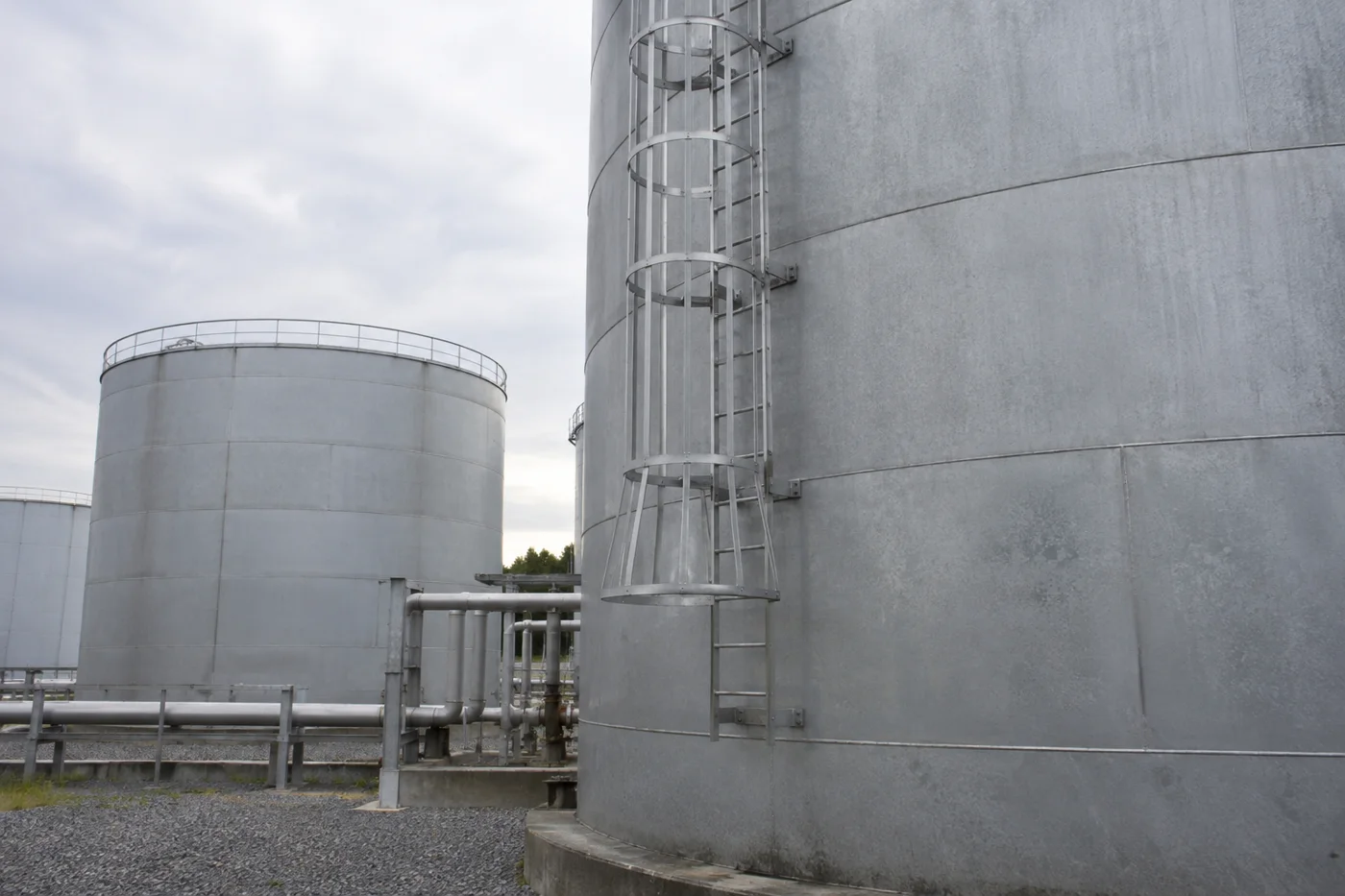
Cage Ladders: Where Cages Stand Under OSHA
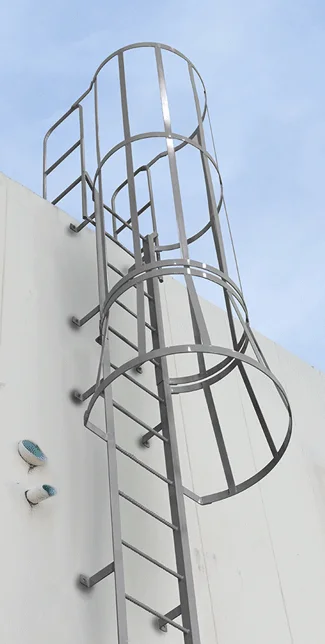
A cage, also called a cage guard or basket guard, is an enclosure fastened to the ladder’s side rails or to the structure behind it that surrounds the climbing space. A well is a complete permanent enclosure around a ladder. For decades a cage was the standard protection on tall fixed ladders.
The 2016 walking-working surfaces rule changed that. OSHA now says plainly that cages and wells are not ladder safety systems. On new fixed ladders that rise more than 24 ft above a lower level, a cage alone no longer counts as fall protection.
Photo: Cotterman
The cage phase-out timeline (fixed ladders over 24 ft)
| Date or situation | What OSHA 1910.28(b)(9) requires |
|---|---|
| Installed before November 19, 2018 | Personal fall arrest system, ladder safety system, cage or well |
| Installed on or after November 19, 2018 | Personal fall arrest system or ladder safety system; a cage alone is not enough |
| Any ladder, cage or well section replaced | Fall arrest or a ladder safety system in at least the replaced section |
| On and after November 18, 2036 | Every fixed ladder over 24 ft has fall arrest or a ladder safety system |
| Caged sections that stay in use | Offset from adjacent sections, with landing platforms at least every 50 ft |
Source: 29 CFR 1910.28(b)(9) and the definitions in 1910.21.
Is a cage still worth adding?
Often, yes. OSHA lets you keep or add a cage alongside a ladder safety system or fall arrest system, as long as it doesn’t interfere with that system (1910.28(b)(9)(iv)). Many owners still want a cage on a ladder near a roof edge, beside moving equipment or in a public area, because it keeps the climber’s body close to the ladder and discourages casual climbing. Cages built under OSHA’s criteria must allow easy entry and exit, run continuously along the ladder except at access and transfer points, and be designed to contain a falling worker and direct them to a lower landing (1910.29(g)). Platforms used with fixed ladders must give at least 24 x 30 in. of standing room.
When is a cage required on a fixed ladder?
Under federal OSHA general industry rules, never on its own anymore: the trigger is height (more than 24 ft above a lower level) and the answer is a ladder safety system or personal fall arrest. Some state plans still write cage rules. California’s Title 8 Section 3277, for example, calls for cages or wells on fixed ladders over 20 ft, allows ladder safety systems in lieu of cages on tower, water tank and chimney ladders, and sets landing-platform spacing by protection type. Check your state plan before you order. Manufacturers also set their own limits, so a ladder’s cage options can vary by brand and height.
Cage sizing basics. On many manufactured caged ladders the cage starts about 7 ft above the base, so the climber can step on freely, and the bottom hoop flares outward for easier entry. Cotterman builds its cages this way and offers left- or right-hand side-step cage exits. At the top, the cage and walk-through rails extend 42 in. above the landing.
Outdoors, ask for a galvanized cage to match a galvanized ladder. Paint wears fastest on hoops and bars that people brush against while climbing.
Ladder Safety Systems for Fixed Ladders
A ladder safety system is designed to stop or reduce a fall from a ladder. OSHA describes it as a carrier (a rigid rail or a flexible cable), a safety sleeve that travels on the carrier, a lanyard, connectors and a full body harness. As the worker climbs, the sleeve slides along with them; if they slip, it locks onto the carrier within a short distance.
This is now the standard fall protection for new fixed ladders over 24 ft. It can be installed with the ladder or retrofitted to an existing one, and it is the usual fix when a caged section is replaced.

What OSHA 1910.29(i) requires of the system
| Requirement | Detail |
|---|---|
| Hands free to climb | The worker climbs up and down using both hands, without holding, pushing or pulling any part of the system |
| Short connection | No more than 9 in. between the carrier or lifeline and the attachment point on the harness or belt |
| Rigid carrier mountings | Attached at each end, with intermediate mountings as needed along the full length |
| Flexible carrier (cable) guides | Attached at each end, with cable guides 25 to 40 ft apart along the length |
| Ladder strength | Mountings and guides must not reduce the design strength of the ladder |
| Drop test | The system and its supports withstand an 18 in. drop of a 500 lb weight |
| Coverage | Protects the full climb, every section, with rest platforms at least every 150 ft (1910.28(b)(9)(ii)) |
Source: 29 CFR 1910.29(i) and 1910.28(b)(9).
Rigid rail or cable?
- Rigid rail: a rail fastened along the ladder, with mountings at each end and intermediate mountings along its length. Easy to see and inspect, and often specified on new ladders.
- Flexible cable: a cable carrier attached at the top and bottom, with cable guides every 25 to 40 ft. Often chosen to retrofit long, straight existing ladders.
- Compatibility: sleeves are made for a specific rail or cable, so buy the carrier and sleeve as one system and keep spare sleeves on site.
- Training: climbers need to know how to inspect the harness and sleeve and how to connect before stepping onto the ladder.
Can you tie off to a fixed ladder? Only to an anchorage that is rated for it. OSHA 1910.140(c)(13) requires fall-arrest anchorages to hold at least 5,000 lb per attached worker, or to be designed, installed and used under a qualified person as part of a complete system with a safety factor of at least two. A rung is not automatically a rated anchorage, which is why tall ladders use a purpose-built safety system.
How to Size a Fixed Ladder
“Which ladder do I need for this roof?” is the question we hear most. Ladders are ordered by the climb, so start with one measurement and work out from there.
Measure the climb
Floor, ground or lower roof to the landing you step onto: roof deck, top of a continuous parapet, platform or mezzanine deck.
Count the rungs
Rungs are spaced 10 to 14 in. apart. On a 12 in. spacing, the number of rungs is roughly the climb in feet plus one.
Add the top exit
Walk-through rails or a side-step extension reach at least 42 in. above the landing.
Check fall protection
Over 24 ft above a lower level? Add a ladder safety system or fall arrest, plus a cage if you want one.
Example: one manufacturer’s rung chart
Cotterman’s Series F fixed steel ladders use 3/4 in. corrugated round rungs on 12 in. centers, 1/4 x 2 x 2 in. steel angle side rails and 7 in. stand-off brackets. A few sizes from its published chart show how rung count relates to the climb:
| Rungs | Top rung to bottom rung | Overall ladder length |
|---|---|---|
| 9 | 8 ft | 99 in. |
| 13 | 12 ft | 147 in. |
| 17 | 16 ft | 195 in. |
| 21 | 20 ft | 243 in. |
Other brands use different rung spacing and part numbers, so we confirm the exact model against your measurement. If the height falls between standard sizes, a modular ladder or a cut-to-fit section usually solves it. Also measure the wall: where the ladder lands, where the top brackets can attach, and any doors, windows, downspouts or equipment in the 15 in. side zone and 30 in. climbing zone.
Ladders taller than one section need planning beyond rung counts. With a ladder safety system the climb can run continuously, with rest platforms at least every 150 ft. Caged ladders that rely on the cage must be broken into offset sections with landings at least every 50 ft.
Mounting Brackets, Anchoring and Installation
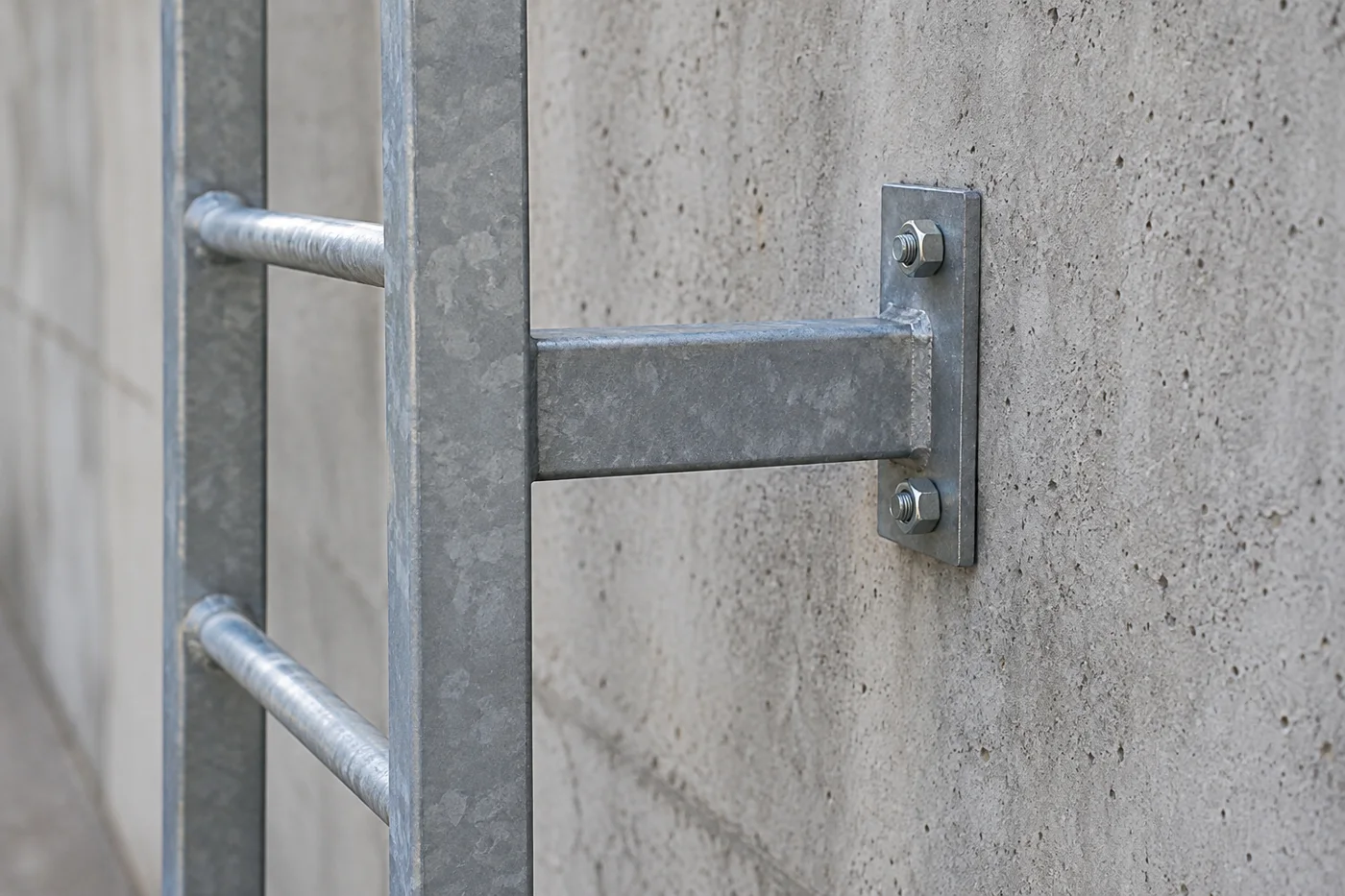
Most fixed ladders hang on welded stand-off wall brackets that hold the rungs at least 7 in. off the wall for toe room, and many sit on the floor or grade at the bottom. Some are floor-mounted only, with the top secured to a platform or parapet. The anchors depend on what you’re attaching to:
- Poured concrete: expansion or adhesive anchors.
- Concrete block: anchors into grouted cells or through-bolts with plates.
- Steel structure: bolted or welded brackets.
- Metal panel walls: brackets to girts or framing behind the panel, never the skin.
Installation checklist
- Verify the wall: confirm what is behind the surface before you choose anchors. Your engineer or the anchor maker sets the type, size and embedment.
- Plumb and level: rungs must be level and evenly spaced once installed, and the ladder can’t lean back past vertical.
- Keep the clear zones: 7 in. behind the rungs, 15 in. each side and 30 in. on the climbing side unless a cage or well is used.
- Fit the top correctly: rails or grab bars 42 in. above the landing, the right step-across distance and a guarded opening with a self-closing gate where the ladder meets a platform or mezzanine.
- Mount the safety system: install the rail or cable to the maker’s instructions without reducing the ladder’s strength.
- Inspect and record: check the ladder before first use, then at the start of each shift it is used, as OSHA requires.
MH-USA designs, supplies and installs access equipment, so we can quote the ladder with installation by our crews or ship it ready for your contractor. For daily routes to an upper level, compare a stair on our industrial stairs and work platforms page; frequent climbing with loads is not a fixed-ladder job.
Galvanized vs Painted: Materials and Finishes
OSHA only asks that metal ladders resist or be protected from corrosion. The right finish depends on where the ladder lives:
| Material / finish | Best for | Watch for |
|---|---|---|
| Painted or powder-coated steel | Dry interiors: mezzanines, storage roofs, equipment platforms | Touch up chips; coating wears on rungs and on outdoor exposure |
| Hot-dip galvanized steel | Exterior walls, roofs, docks, tanks and washdown areas | Dull gray finish; heavier than aluminum; can be painted after prep if color matters |
| Stainless steel | Food, chemical and highly corrosive areas | Highest cost |
| Aluminum | Weight-sensitive installs, roofs, marine and damp areas | Keep apart from dissimilar metals; check the load rating |
Cotterman quotes hot-dip galvanized and stainless steel versions of its fixed ladders, and the Vestil walk-through dock ladders in our store ship in a yellow powder-coated finish for visibility at the dock. For rungs, look for corrugated, serrated or knurled surfaces that grip in wet and icy weather.
Fixed Ladder Options and Accessories
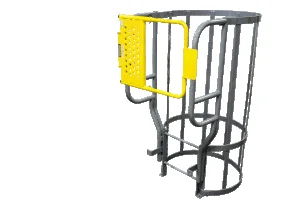
- Walk-through handrails or side-step extensions for a safe step-off at the top.
- Self-closing safety gates where the ladder opens onto a platform, roof or mezzanine. They close automatically behind the climber. See our self-closing safety gates guide for types and sizing.
- Safety cage with a flared bottom, in left, right or walk-through exit versions.
- Ladder safety system (rail or cable), sleeves and harnesses.
- Security door or climb guard that locks over the bottom rungs to stop unauthorized climbing.
- Rest and landing platforms for long climbs, at least 24 x 30 in.
- Roof hatches with grab bars, plus deflector plates at unavoidable obstructions.
Photo: Cotterman
Vestil fixed ladders in our online store
- Walk-through dock ladders: mount to the dock face and project out from it so drivers and dock crews can climb between the drive and the dock floor. Slip-resistant steps, yellow powder coat, 2 to 10 steps.
- Tank access ladders: modular welded steel ladders for inspecting storage tanks, with offset rungs that protect knuckles. Heights from 7 to 15 ft.
- Folding mezzanine ladders: bolt-on or weld-on ladders that ratchet down to climb and fold up out of the way, for infrequent mezzanine access where a fixed ladder would block the floor. Give us your mezzanine height when you order.
Lead times for Vestil ladders are listed on each product page, and we confirm them on every quote. See the full Vestil ladder category for crossovers, alternating tread stairs and rolling ladders.
Where Fixed Ladders Work Best
- Roof access: exterior wall ladders to a parapet or eave, or interior hatch ladders. Plan the parapet exit and fall protection from the start.
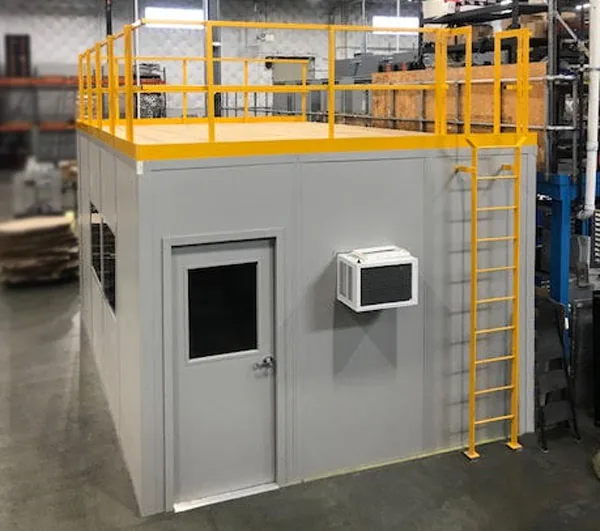
- Mezzanines and storage roofs: secondary access to a mezzanine or the storage roof of a modular in-plant office, with a self-closing gate at the opening.
- Loading docks: walk-through dock ladders from the drive to the dock floor. See our loading dock equipment.
- Tanks, silos and equipment: galvanized ladders and tank access ladders for inspection points.
- Catwalks and platforms: occasional access to industrial catwalks and work platforms.
- Pits and vaults: individual-rung or short fixed ladders where space is minimal.
Fixed ladder, ship’s ladder or stair?
| Option | Angle (OSHA) | Floor space | Best when |
|---|---|---|---|
| Fixed ladder | 60 to 90° | Smallest | Occasional trips, hands free |
| Ship’s ladder / ship stair | 50 to 70° for ship stairs | Moderate | Regular trips in a tight space |
| Standard stair | 30 to 50° | Largest | Daily traffic or carrying tools and parts |
For the full range, including rolling ladders and crossovers, see our industrial ladders guide.
What to Send for a Fixed Ladder Quote
Most fixed ladder quotes can be turned around from one email if it covers these points. Photos of the wall and the top landing answer half of them.
- Climb height: from the ground, floor or lower roof to the landing or the top of the parapet.
- Top exit: walk-through or side-step, parapet height and width, or a roof hatch size.
- Wall or structure: poured concrete, block, steel, metal panel or tank shell, plus any obstructions near the ladder.
- Fall protection: cage, ladder safety system (rail or cable) or both.
- Environment: indoor, outdoor, coastal, washdown or chemical exposure, and the finish you want.
- Extras: self-closing gate, security door, platforms, hatch.
- Welded or modular, access to the site, quantity, ZIP code and whether you need installation.
We’ll match the ladder to the climb, list the OSHA-driven options for that height and quote the ladder, freight and installation together. Many fixed ladders are built to order, so the current lead time is confirmed on the quote.
Get a free fixed ladder quote
Tell us the climb height, the top exit and the wall type. A project specialist will follow up with ladder options, fall protection, freight and pricing. Prefer to talk? Call (800) 326-4403.
Fixed Ladder and Cage Ladder FAQs
What is a fixed ladder?
What are the OSHA requirements for fixed ladders?
When is a cage required on a fixed ladder?
Are cage ladders still OSHA compliant?
What is a ladder safety system?
How far must fixed ladder rails extend above the landing?
What is the difference between a walk-through and a side-step ladder?
Should I choose a galvanized or painted fixed ladder?
Do you install fixed ladders?
Need a Fixed Ladder Sized and Quoted?
Send the climb height, the top exit and a photo of the wall for a free recommendation and a quote with freight and installation.