
Home | Storeganizer | 3PL & E-Commerce Fulfilment
Storeganizer for 3PL and E-Commerce Fulfilment
Absorb a new client’s SKUs without another lease. Storeganizer pocket columns convert half-empty small-item shelving into hundreds of dense, barcoded pick faces inside your existing pallet rack — and unhook and move again when the contract changes.

The 3PL problem: more SKUs, the same building
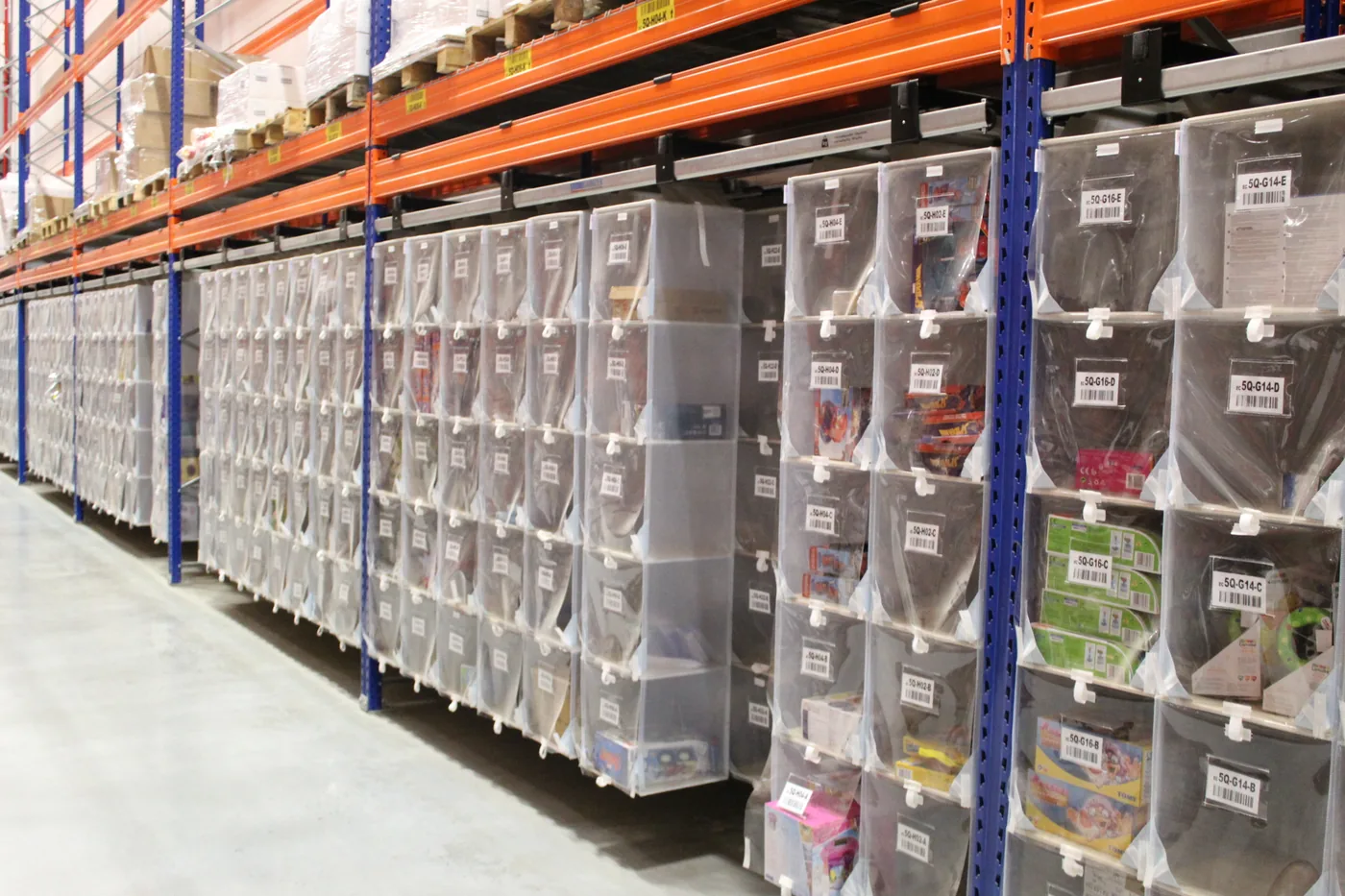
Third-party logistics and e-commerce fulfilment operations run into the same wall from two directions. Client SKU counts keep climbing while units per SKU fall, and the building cannot grow on the timetable the contract was won on. Rent, labour and pick rate are all measured per square foot, so anything that raises SKU density inside the existing footprint goes straight to margin.
The awkward truth is that most of the wasted cube in a fulfilment centre is not in the pallet positions — it is in the small-item shelving. Slow-moving client SKUs sit one carton to a shelf level, and pickers walk past hundreds of feet of half-empty shelving to hit a handful of lines. Storeganizer converts that shelving area into vertical columns of right-sized textile pockets hung in pallet rack, up to four rows deep, and turns a bay into as many as 396 discrete pick locations.
What fulfilment operations have measured
| Operation | Change made | Reported outcome |
|---|---|---|
| Ingram Micro UK National Distribution Centre (technology distribution, three warehouses, 162,000+ sq ft) | Storeganizer introduced as a key phase of a six-phase redesign specifically to release space for fast movers | Released twice the space of the room it replaced while only about 80% full; roughly 10 seconds faster per pick; 40% more SKUs hit per unit of travel distance; pick rate up from about 75 to about 90 lines per hour |
| Chalhoub Group (luxury retail distribution, Dubai region, ~860,000 sq ft across 12 sites) | 8,611 sq ft of static mezzanine shelving consolidated into 46 bays, three rows deep, six columns high — 828 pick modules | Same inventory in 1,335 sq ft; picking from 25-30 up to 60-80 lines per hour; operational efficiency up around 30%; two fewer full-time staff; fewer mis-picks with one SKU per pocket |
| FM Logistic | Evaluated against denser storage alternatives | Reported storing more than twice as much at a lower price, described as an excellent ROI |
| Ingram Micro Northampton | Assessed vertical carousels and paternosters against pocket columns | Concluded the benefits of the alternatives were “far less than those of a Storeganizer solution” |
Figures as reported by the operations named. Independent research at the University of Leuven measured averages of 40% more usable space, 42% less travel time and 26% better picking efficiency versus conventional rack and shelf.
Why it fits a 3PL operating model specifically
Model a client’s SKU profile in the configurator
Set your bay height, choose the pocket size that matches the client’s cartons and see how many pick faces you gain per bay before you commit to a layout.
Designing the fulfilment pick face
The configuration decisions that matter most in a fulfilment environment are different from a parts room. In our experience these are the four that move the numbers:
Slot the golden zone by velocity, not by client
The temptation in a multi-client operation is to keep each client’s SKUs together. Pick rate improves faster if the fastest-moving SKUs across all clients occupy the comfortable working heights and the slow tail goes high or low.
Pick the pocket to the carton, not to the client’s biggest item
One oversized pocket style across a bay throws away most of the density gain. Mixed pocket sizes within a bay are standard and cost nothing extra.
Barcode every pocket from day one
Scan-verified picking is what converts density into accuracy. Label holders are fitted to every pocket face; the location scheme should be designed before install, not after.
Keep rows-deep honest
Four rows deep gives maximum density but adds a roll-aside movement to reach the back. For your fastest lines, two or three rows deep often nets more throughput than four.
Costing the change honestly
The business case for a pocket-column conversion is usually built from four numbers, and it is worth building all four before anyone signs anything. We will help you put them together, and we will tell you if they do not add up.
1. Square feet released, valued at your real occupancy cost
Measure the shelving footprint that comes out of service, not the theoretical cube gain. Value it at your fully loaded occupancy cost — rent, common area, utilities, insurance and rack — not just base rent. In operations that were about to lease overflow space or take an offsite unit, this single line usually dominates the case, because the avoided lease is a recurring cost and the pockets are a one-time purchase.
2. Labour, from lines per hour
Take your current lines per hour on the area being converted and apply a conservative improvement — the independent Leuven research measured 26% better picking efficiency on average, and individual operations have reported considerably more. Convert to hours per week, then to fully loaded labour cost. Be conservative here on purpose: if the case only works at the top of the reported range, it is not a case.
3. Error cost
One SKU per labelled pocket removes the commonest mis-pick cause. If you know your cost per error — the return, the re-ship, the credit, the client penalty — apply your current error rate to the converted lines and take a partial credit. If you do not know it, leave it out of the numbers and note it as upside.
4. Deferred capital
What were you going to buy instead? A mezzanine, a vertical carousel, a VLM, a building expansion? Those alternatives carry not only higher capital cost but power, service contracts and integration effort. Several operations have told the manufacturer they evaluated carousels or paternosters and concluded the benefit was smaller than a pocket-column solution at a fraction of the cost. Where that is true for you, the deferred capital belongs in the case.
What is not in the number
Freight, sales tax and installation are quoted separately by your MH-USA salesperson once we know the delivery address, dock access and unloading arrangements. Lead time is confirmed on the quote. The configurator shows product cost so you can size the case; it is not a landed cost.
Explore the Storeganizer cluster
 Storeganizer hubWhat the system is, specs, options, process and results.
 Small-parts warehouse storageRight-sizing pick locations for fasteners, fittings and boxed components.
 Spare parts & MRO storageCritical spares findable in seconds without a parts-room expansion.
 Aerospace & defense partsTraceable, high-value small parts in a controlled parts room.
 Pallet rack space optimizationRecover the cube you already pay for before leasing more building.
 Order-picking efficiencyCutting travel and mis-picks by rebuilding the pick face.
 How Storeganizer worksThe suspension system, pocket columns, four rows deep, and installing into existing rack.
 Cost & ROIWhat drives price, why cost per pick location beats cost per square foot, and payback.
 Pharmaceutical & medical supplyLot and expiry control, scannable per-SKU locations, and the environmental limits.
Frequently asked questions
Why do 3PLs use Storeganizer rather than more shelving?
Can it be reconfigured when a client leaves?
Does it work for e-commerce singles picking?
How does it handle returns processing?
Can it be part of an automation plan rather than an alternative to one?
Cost the space you would get back
Send us a client SKU profile and your bay dimensions. We will come back with the pick-face count, the square footage released and what it would take to install it.