Packing areas usually fail in slow, expensive ways. Packers take extra steps for tape. Box sizes run out at the station, so people borrow from the next lane. Labels print in the wrong place, carts stack up behind the bench, and supervisors respond by adding labor instead of fixing flow.
That approach gets expensive fast. In e-commerce, the packing station isn't just a bench with a tape gun. It's the point where picked inventory becomes a shippable order, where labor, packaging cost, order accuracy, and carrier readiness all come together. It should be treated like a profit center inside the fulfillment process, not an afterthought.
The pressure is higher than many teams expect. E-commerce fulfillment operations require three times more logistics space than traditional brick and mortar retail for the same sales volume, which changes how packing areas must be planned and distributed inside a facility, as noted in this e-commerce fulfillment space analysis. If your operation is growing, a poor station design won't stay a local annoyance. It becomes a system bottleneck.
Managers who are planning a new line, retrofitting an existing area, or preparing bid packages should start with the full system view. That means inbound cart arrival, box access, dunnage, weighing, label generation, scan confirmation, outbound staging, and future expansion all need to work as one flow. For broader planning context, this guide to e-commerce fulfillment center design built for speed and accuracy is a useful next read.
Introduction The Hidden Cost of Inefficient Packing
A packing station can look busy and still be poorly designed. Many facilities mistake motion for output. If a packer twists to reach void fill, bends for cartons, then walks around the bench to stage finished orders, the station is creating waste with every order.
That waste shows up in four places:
- Labor drift because employees spend time walking, reaching, and correcting
- Order delays because carts and finished parcels clog the same space
- Packaging inconsistency because available materials drive the pack choice
- Scaling problems because the station only works on an average day
Practical rule: If a station depends on individual workarounds to stay productive, the design is already failing.
A strong packing station design for e-commerce fulfillment fixes these issues at the layout level. The goal isn't to make people work harder. The goal is to make the next motion obvious, short, and repeatable.
Workflow Analysis The Blueprint for Your Design
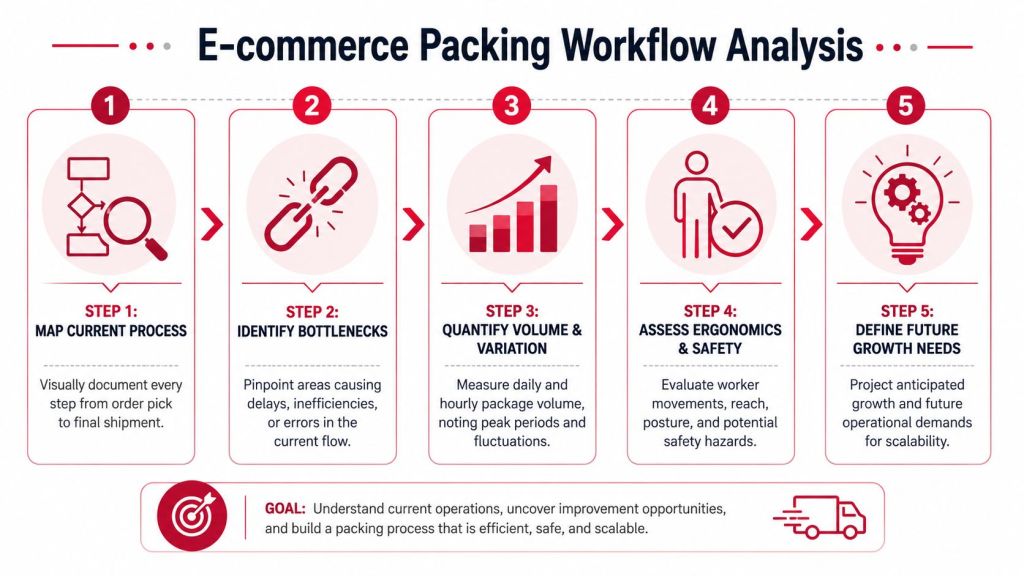
Before buying benches, printers, shelving, or conveyors, map the work. Good design starts with the path of an order, not the catalog page of a workstation.
Start with the order path
Track one order from the moment it reaches packing until it enters outbound staging. Include every touch. This process often reveals hidden delays in places previously assumed minor, such as waiting for labels, checking item counts twice, or searching for the right carton.
A basic map should identify:
- How orders arrive at the station, such as tote, cart, conveyor, or pallet
- What the packer verifies before packing
- Which packaging materials are used most often
- Where weight and label data are entered or confirmed
- How finished orders leave the station
The layout itself should follow a strict linear pattern. The best stations use a left-in, right-out or right-in, left-out sequence so incoming supplies, the main table, and the outbound zone stay on opposite sides without crossing the center line, as described in this guide to linear packing workflow design.
Separate order profiles before you design
Not every order deserves the same station. A single-item apparel order, a mixed-SKU health and beauty order, and a fragile electronics shipment need different support. That doesn't always mean separate departments, but it often means separate lane logic.
Use these questions early:
- Are most orders single-line or multi-line
- Do products need void fill or just a mailer
- Do orders require inserts, kitting, or branded material
- Does the station handle returns, or outbound only
- Will carts queue at the station during peak hours
If your answer changes by product family, design around the variation instead of forcing one universal bench to do everything.
Build around the bottleneck, not the furniture
I've seen buyers choose a workstation first, then try to fit the process around it. That almost always creates compromise. The better method is to define the bottleneck first, then select equipment that removes it.
A quick decision table helps.
| Common bottleneck | What usually causes it | Better design response |
|---|---|---|
| Cart backups | Packing takes longer than order arrival | Add parallel stations or faster outbound handoff |
| Constant reaching | Supplies stored too high, low, or behind packer | Re-slot materials by frequency of use |
| Label delays | Printer is shared or poorly positioned | Put printing at point of pack completion |
| Rework and rescans | Verification happens too late | Move scan check earlier in the sequence |
For station planning tied to actual floor operations, teams often pair this process work with broader picking and packing solutions so the handoff from picking into packing is designed together.
Core Design Principles Layout and Ergonomics
Most layout mistakes come from copying what fits in the room instead of what fits the work. The right station shape depends on flow, SKU mix, and how much support material the packer needs within reach.

Comparing common station layouts
| Layout | Works best for | Main advantage | Main trade-off |
|---|---|---|---|
| Linear | High repeat flow, conveyor-fed lanes, simple outbound | Clean in to out movement | Less wraparound access to supplies |
| L-shaped | Mixed order types, corner installs, compact floor plans | Good separation of tasks | Can introduce turning and reach issues |
| U-shaped | Stations that need many materials close by | Short reach to multiple supplies | Can become cramped if outbound staging is weak |
In most e-commerce environments, a linear station is the safest starting point because it supports predictable handoff and simpler training. L-shaped and U-shaped stations can work well, but only when the material presentation is controlled and the packer doesn't have to twist constantly.
A station isn't efficient because it holds more stuff. It's efficient because it reduces the number of decisions and movements required to finish an order.
Use the golden zone correctly
Ergonomics isn't a comfort upgrade. It's a throughput decision.
According to Digital Main Street's packing station guidance, the golden zone runs from 75 cm to 150 cm and should hold the most frequently used items, such as tape and standard cartons. Less frequently used or oversized materials belong below 75 cm or above 150 cm, and nothing should be stored on the floor. The same guidance notes that this setup, along with a station width of 150 cm to 175 cm, correlates to a 15 to 20% increase in units packed per hour in high-volume settings.
That gives facility teams real placement rules:
- Keep tape, labels, and common cartons in the golden zone
- Place reserve stock higher or lower if it isn't part of every order
- Avoid floor storage because it adds bending and creates housekeeping issues
- Limit bench width so packers can reach tools without extra side steps
If you're training crews or reviewing setup standards, these effective H&S manual handling methods are a practical reference for reducing strain from repeated reaching, lifting, and twisting.
Design for boxes, not for idealized variety
Many teams talk about "all package types" as if every station needs to support every shape equally. That's rarely true in e-commerce. Corrugated packaging held 80% of total market share in 2023, and the same market is projected to grow at a 9.5% compound annual growth rate through 2029, according to Packaging Dive's reporting on square packaging and right-sizing.
That matters because box-dominant operations need:
- Rapid access to multiple standard carton sizes
- Clear locations for void fill
- Smooth print and label application at volume
- Shelving and bins arranged for square, repeatable handling
When the operation is mostly corrugated, the station should support box erection, fill, weigh, label, and discharge with as little turning as possible. Designing around edge cases usually hurts the daily flow.
Essential Equipment and Technology Integration
A productive station is a set of coordinated tools. Miss one category, and the whole line feels slower than it should.
Choosing the bench itself? Our guide to packing and assembly workbenches for Utah fulfillment centers compares bench types, sizes, working heights and load ratings.
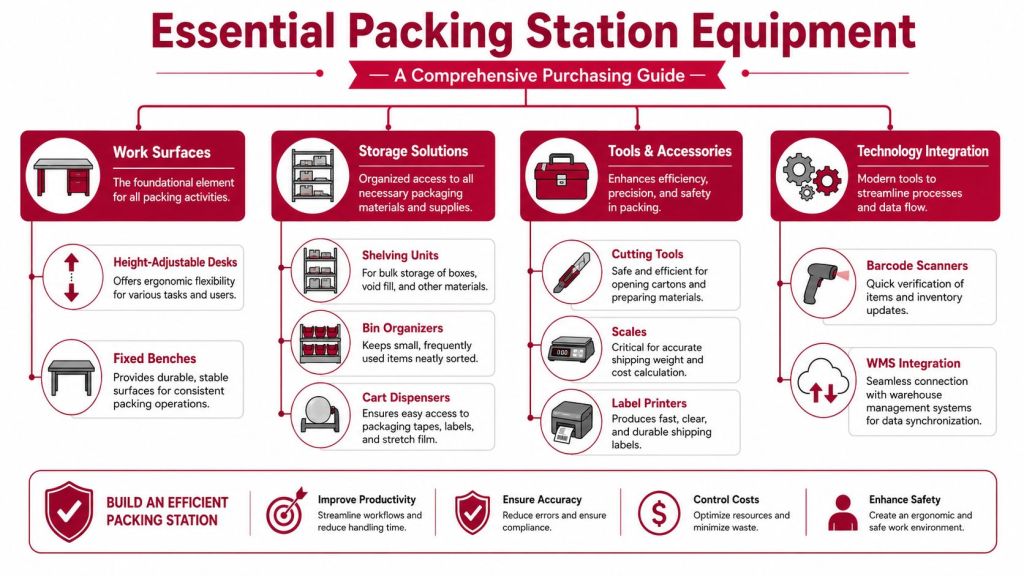
The core equipment stack
Think in layers instead of shopping one item at a time.
| Equipment group | What to select | What to watch for |
|---|---|---|
| Work surface | Fixed bench or height-adjustable workstation | Stability, usable depth, accessory mounting |
| Storage | Shelving, bins, carton racks, overhead holders | Reach distance, refill path, visual control |
| Tools | Tape dispenser, cutters, dunnage access, scanners | Safe placement and one-hand use |
| Output tech | Scale, label printer, barcode verification | Placement at the end of pack cycle |
The biggest miss I see is buying a strong bench with no thought to refill paths. If replenishment staff block packers every time they load cartons or void fill, the station isn't integrated.
Connect the station to data flow
The best packing stations reduce manual entry. Digital Main Street notes that an inline or platform scale linked directly to printing software can pre-calculate weight in real time, which helps eliminate manual entry errors and can reduce shipping cost discrepancies by up to 12% in the cited guidance. That same logic applies to barcode verification and order confirmation.
Technology should support three decisions at the station:
- Is this the correct order
- Is the package complete
- Is it ready to label and release
If the packer has to leave the station screen, handwrite notes, or retype shipment details, the process is doing too much work by hand.
For operations planning outbound flow, it's smart to review how the station will tie into warehouse conveyor systems so packed cartons leave the bench without building a staging pile at the operator's feet.
Buy packaging support with product protection in mind
Because corrugated dominates e-commerce packing, your consumable setup should focus on carton availability, void fill presentation, tape access, and label consistency. For teams reviewing broader product protection practices, this article on choosing secure packing for cargo is a useful companion read.
Field note: A printer that's five feet too far away doesn't look like a system problem on a drawing. It becomes one after a full shift.
A good sourcing checklist should include benches, shelving, bins, scales, scanners, printers, carton holders, dunnage dispensers, and a defined path for replenishment. That's what turns a station from equipment into a functioning work cell.
Scaling Your Design for Peak Seasons and Future Growth
Static stations break first during promotional spikes. They may perform well in normal volume, then collapse when carts queue, cartons run short, and supervisors start creating temporary pack spots on any open table.
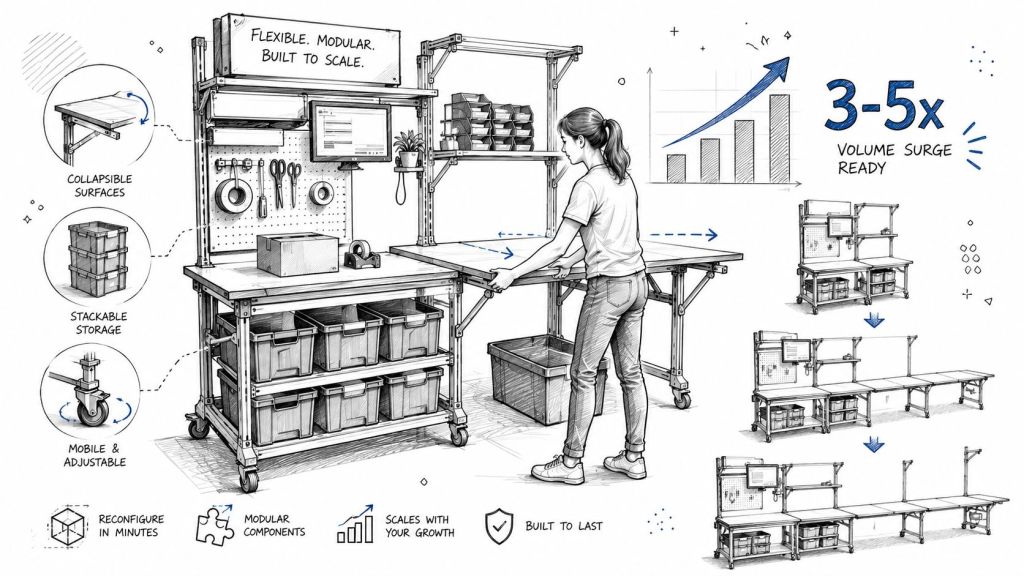
The better approach is modular by design. According to Ops Design's review of e-commerce packing stations, 70% of e-commerce warehouses face 3 to 5x holiday volume surges, yet only 25% use mobile components or modular work surfaces for rapid scaling.
That gap explains why many facilities scramble during peak periods. Their stations weren't built to flex.
Peak volume also drives a returns spike a few weeks later, so it helps to plan the pack area and the returns lane together. See our guide to warehouse return processing and reverse logistics for how to keep returns from overflowing into your packing zone.
What scalable stations include
A scalable design usually has these traits:
- Mobile support components such as rolling supply carts or movable side tables
- Plug-and-play tech locations so printers and scales can be added without rewiring the whole lane
- Modular shelving that can expand with carton variety
- Overflow staging rules so peak volume doesn't block outbound release
Design for the average day and the busiest day
Don't size the core workbench for one extreme week. Size the system so average-day flow is clean, then add planned expansion points.
That can mean:
- a spare location for a second printer
- floor space for an added mobile station
- nearby power and data access
- refill space that doesn't block labor during surge periods
Facilities that move earlier on this planning usually get smoother installation windows and fewer compromises. Waiting until volume forces the issue often means buying around constraints instead of designing through them.
Prioritizing Safety, Sustainability, and Compliance
A fast station that creates injuries, trip hazards, or electrical problems isn't a successful design. Safety needs to be built into the station, not added after the bench is installed.
The basics that can't be skipped
Use a simple compliance check during layout review:
- Keep aisles clear so carts, pedestrians, and outbound parcels don't compete for the same path
- Control cords and power drops for printers, scales, and monitors
- Eliminate floor storage that creates bending and housekeeping problems
- Protect cutting tools with mounted storage and consistent placement
- Review reach, posture, and repetition before finalizing accessory height
For general workplace guidance, an OSHA resource can help teams align local review and training practices with broader expectations for walking-working surfaces and workstation safety.
Sustainability starts with material control
Sustainability in packing doesn't have to mean a complete process overhaul. It often starts with better packaging discipline. Right-sized packaging, recyclable materials, and controlled dunnage use can reduce waste and simplify replenishment.
Teams that handle food-adjacent products or are evaluating packaging choices across departments may find this perspective on sustainable food packaging useful when thinking through material selection standards.
Cleaner material presentation usually improves both housekeeping and pack consistency. Those goals tend to support each other.
Frequently Asked Questions About Packing Station Design
What should be planned before requesting quotes
Bring a basic scope package. Include station count, order profile, carton types, available footprint, power locations, adjacent conveyor or cart flow, and whether you need outbound staging or only pack-and-release capability. Quotes are more useful when the workflow is already defined.
How do you measure station productivity accurately
Measure completed, ready-to-ship orders by station over a consistent period. Pair that with direct observation of walking, waiting, rework, and replenishment interruptions. If one station packs fewer orders but handles more complex kits, treat that separately. Raw output only tells part of the story.
Should returns be processed at the same station as outbound orders
Usually only if return volume is light and easy to isolate. Returns create different inspection, disposition, and repack steps. Mixing them into outbound lanes can slow standard orders. A small dedicated return bench or side station often keeps both flows cleaner.
When is automation worth considering
Consider automated packing support when labor is spending too much time on repeat steps such as weighing, printing, scanning, or carton movement. Automation works best when the manual process is already stable. If the workflow is still messy, automation often locks in the wrong process faster.
Is a height-adjustable bench always better than a fixed bench
Not always. Height-adjustable stations make sense when multiple users share the same workstation or when tasks vary through the shift. Fixed benches can be the better choice when the work is highly standardized and the supporting accessories are already optimized.
What's the most common layout error
Putting too many supplies at the station. Managers often try to avoid replenishment by storing everything nearby. That fills the work cell, crowds the operator, and makes refill harder. The best stations keep only what the packer needs for the current flow.
Conclusion From Blueprint to Reality
Packing station design for e-commerce fulfillment works best when it's treated as a connected system. Workflow comes first. Layout follows the work. Ergonomics improves both safety and output. Equipment has to support the sequence, not interrupt it. And if the station can't scale during peak demand, it isn't finished.
That mindset helps managers avoid a common mistake. Buying benches and accessories without a full process plan usually leads to rework, clutter, and added labor. A stronger design turns packing into a cleaner, faster, more controllable part of fulfillment.
If you're moving this project forward sooner, you usually get better planning flexibility, cleaner install timing, and fewer compromises around space and utilities.
Material Handling USA can help you turn a rough concept into a ready-to-quote plan with free layouts and designs with no obligation, free quotes, competitive pricing, and fast shipping on quality material handling products. If you want expert help with station planning, workflow layout, or product selection, Contact Us or Request a Quote. You can also Call (800) 326-4403 or email Sales@MH-USA.com. If you're ready to source equipment online, browse the catalog and Buy Online through the MH-USA store.
Related Resources