
Picking and Packing Solutions
Order fulfillment design that shortens the pick path, presents inventory at the pick face and turns pack-out into a repeatable station — carton flow, pick modules, powered carts, packing benches and goods-to-person automation, engineered around your order profile.
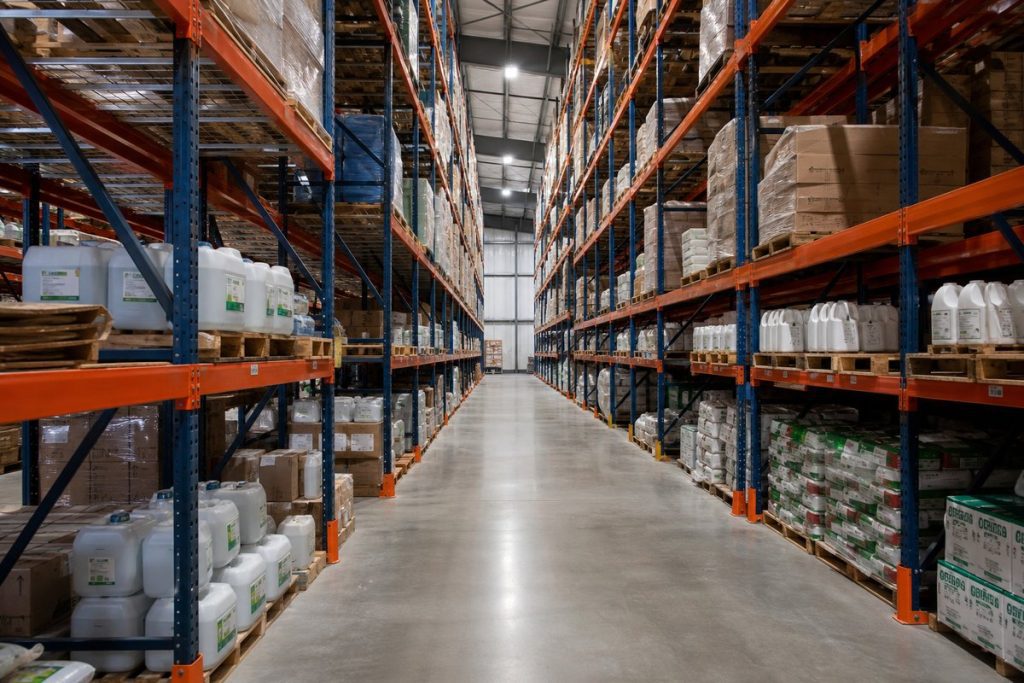
30+
Years designing fulfillment operations
50 lb
Per sq ft carton flow bed rating (from)
132,000 lb
Storage capacity per Vidir VLM
320
Boxes per hour, EffiMat 4 goods-to-person
Fulfillment Is a System, Not a Shopping List
Most fulfillment problems are not caused by slow people. They are caused by a pick face that was never designed: fast movers buried behind slow ones, replenishment crossing the pick aisle, a printer two aisles from the pick zone, and a pack bench that runs out of the right carton size at 3 p.m. Picking and packing are the two most labor-intensive steps in a warehouse, so every foot of travel and every reach you remove shows up directly in cost per order.
Material Handling USA designs the whole path — receiving, reserve storage, forward pick, pack, and staging — and then specifies the equipment that makes the path work. That means the storage medium is chosen per SKU velocity, not per aisle: pallet rack for reserve, carton flow for cases, shelving or high-density cells for pieces, and automation only where the labor math supports it.

What a designed pick face looks like
- Fast movers slotted in the golden zone — roughly knee to shoulder height — so the highest-volume lines never require a bend or a ladder.
- Replenishment loaded from behind or above, so restocking traffic never blocks a picker.
- One clear travel direction per aisle, with pick sequence matching the physical path.
- A consistent container: tote, carton or divided cart, chosen before the pick method.
- Pack stations positioned at the end of the pick path, not across the building from it.
- Labels and locations that read the same on the shelf, on the pick list and in the WMS.
Start with the layout, not the catalog
Send us a drawing or a SKU velocity export and our designers will map your pick path, size the forward pick face and quote only the equipment the layout actually needs.
Request a Quote Warehouse Design Services Call (800) 326-4403
Choosing a Picking Method
The pick method is the decision that drives everything else — the storage medium, the container, the number of touches and whether you need conveyor or a cart. It is chosen from the order profile: lines per order, units per line, SKU count and how concentrated demand is across those SKUs.
| Method | How it works | Best fit | Design notes |
|---|---|---|---|
| Discrete (single order) picking | One picker completes one order from start to finish | Low daily order volume, large multi-line orders, project or kit picking | Simplest to train and audit; travel time per line is the highest of any method |
| Batch picking | One pass through the pick face collects the same SKU for many orders | Many small orders that share SKUs — typical of e-commerce | Cuts travel dramatically; needs a sort step at pack or a cart with divided totes |
| Zone picking | Each picker owns a zone and only picks the lines stored in it | Large pick faces, mixed storage media, multi-shift operations | Pickers learn one zone well; orders must be consolidated downstream |
| Wave picking | Zones release work in timed waves tied to carrier cutoffs | Operations with hard trailer or parcel cutoff times | Ties picking rhythm to shipping; requires WMS wave logic |
| Cluster picking | One picker fills several orders at once from a multi-tote cart | Small parcel orders of 1–5 lines, retail replenishment | Best travel savings without conveyor; cart and tote sizing is critical |
The number that decides it
Profile your orders before you buy anything. Operations with mostly one- to three-line orders almost always win with batch or cluster picking and a divided cart. Operations with large multi-line orders usually win with zone picking and a consolidation step. The same building can run both if the pick faces are zoned for it.

Carts, totes and containers
Cluster and batch picking live or die on the cart. A cart with too few positions forces extra trips; a cart with positions too small forces a second pass at pack. We size cart positions to your actual carton and tote footprints, then match the shelf pitch to the tallest item you routinely pick.
Where pickers also need to print, scan or look up inventory at the point of pick, a powered workstation cart replaces the walk to a fixed station — covered in detail further down this page.
Pick Face Systems We Design and Install
Every card below is a real pick face medium we specify, install and service. Most fulfillment operations use three or four of them at once, split by velocity band.
 Carton Flow BedsGravity beds that drop into your existing pallet rack and keep the front carton presented while replenishment waits behind it. Full-width wheel beds re-slot left to right without rebuilding the level.
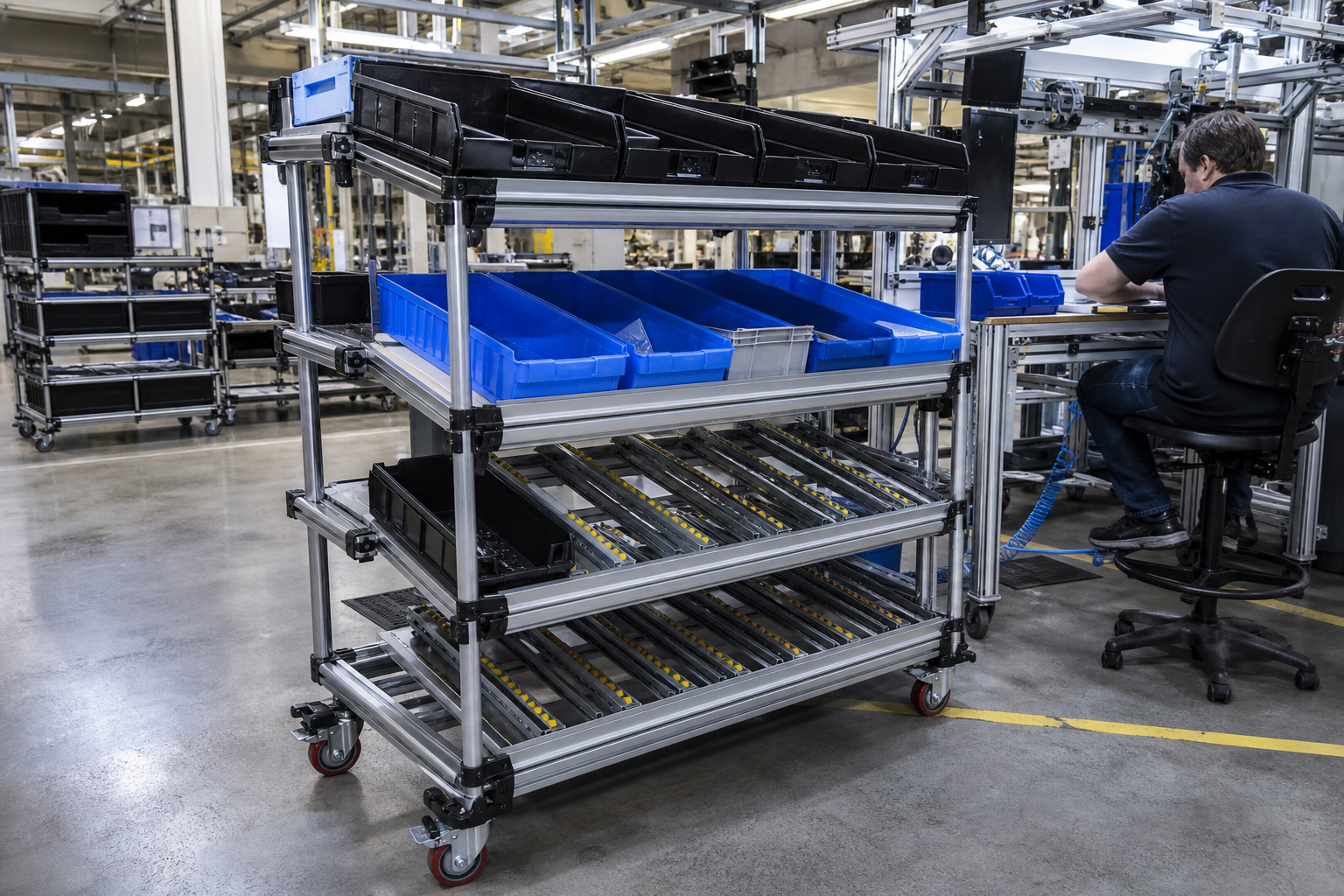 Modular Flow Rack WorkstationsBolt-together posts and beams that carry carton flow lanes, angled pick trays and a work surface in one reconfigurable unit — ideal for kitting, sub-assembly and lineside picking.
 High-Density Piece Pick CellsFabric cell systems that convert a single rack bay into dozens of individually addressable pick locations, adding SKU capacity in the same footprint without adding aisles.
 Multi-Level Pick ModulesRack-supported pick levels with walkways, gates and take-away conveyor that stack two or three pick faces in the same square footage — the standard answer when the floor is full but the building is tall.
 Take-Away and Sortation ConveyorBelt, roller and gravity conveyor that moves picked totes and cartons to pack and shipping so pickers never carry work out of their zone.
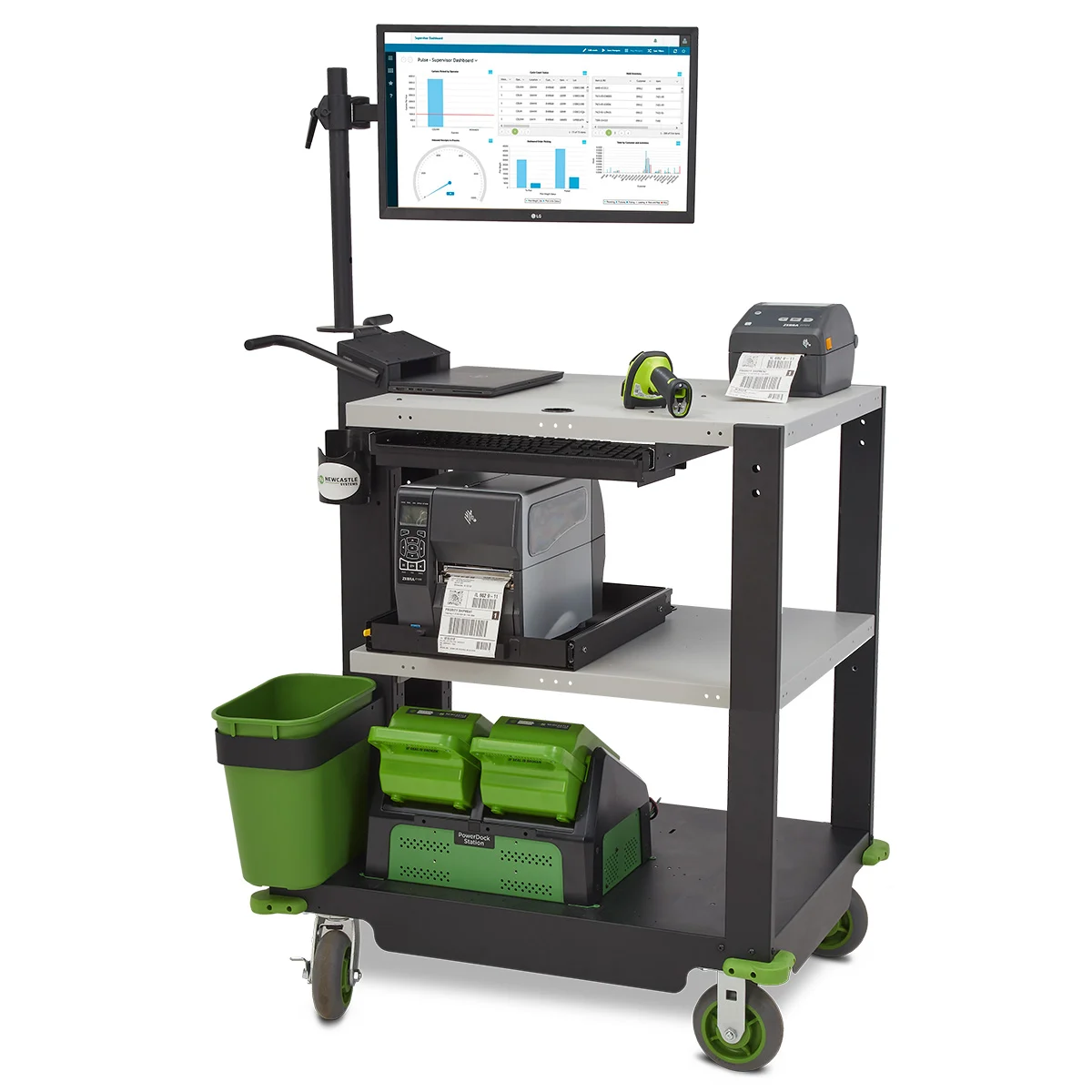 Mobile Powered WorkstationsBattery-powered carts that bring the terminal, scanner and label printer to the pick face, removing the round trip to a fixed station on every order.
Carton Flow: The Backbone of Case Picking
Carton flow converts a static shelf into a self-feeding pick face. Cases are loaded at the high end of an inclined bed, gravity walks them forward, and the picker always takes from a presented front carton. Because replenishment happens behind or above the pick face, restocking stops competing with picking for aisle time.
We specify UNEX SpanTrack beds because they mount inside standard pallet rack beams, are available in to-the-inch widths, and come in wheel-bed or dedicated-lane formats. Wheel beds give you full-width flexibility for re-slotting; lanes give you a fixed, tightly guided path for a carton size that will not change. UNEX documents building a 96″ wide level from four 18″ beds plus two 12″ beds, which is a good illustration of how bed widths are combined to fit real bays.
| Bed type | Construction and rating | Choose it when |
|---|---|---|
| SpanTrack Wheel Bed | Full-width plastic hex hub wheels, 1.6″ diameter, rated from 50 lb per sq ft | Cartons of many sizes; frequent re-slotting left to right |
| SpanTrack Wheel Bed 100 Series | Steel skate wheels, 1.9″ diameter, each wheel on a bearing — the heaviest-duty wheel bed | Heavy cases, high replenishment volume, cold and abusive environments |
| SpanTrack Lane | Dedicated roller or wheel lanes sized to a specific carton footprint | Fixed, predictable SKU locations where the carton size does not change |
Details that matter on a flow level
Interior notching saves vertical space so you can fit more pick levels per bay; shark fin infeed guides keep replenishment cartons from catching at the load end; and the hex hub wheel design keeps cartons tracking straight instead of drifting into the next lane. Ask for these when comparing quotes — they are the difference between a flow level that runs itself and one that jams.
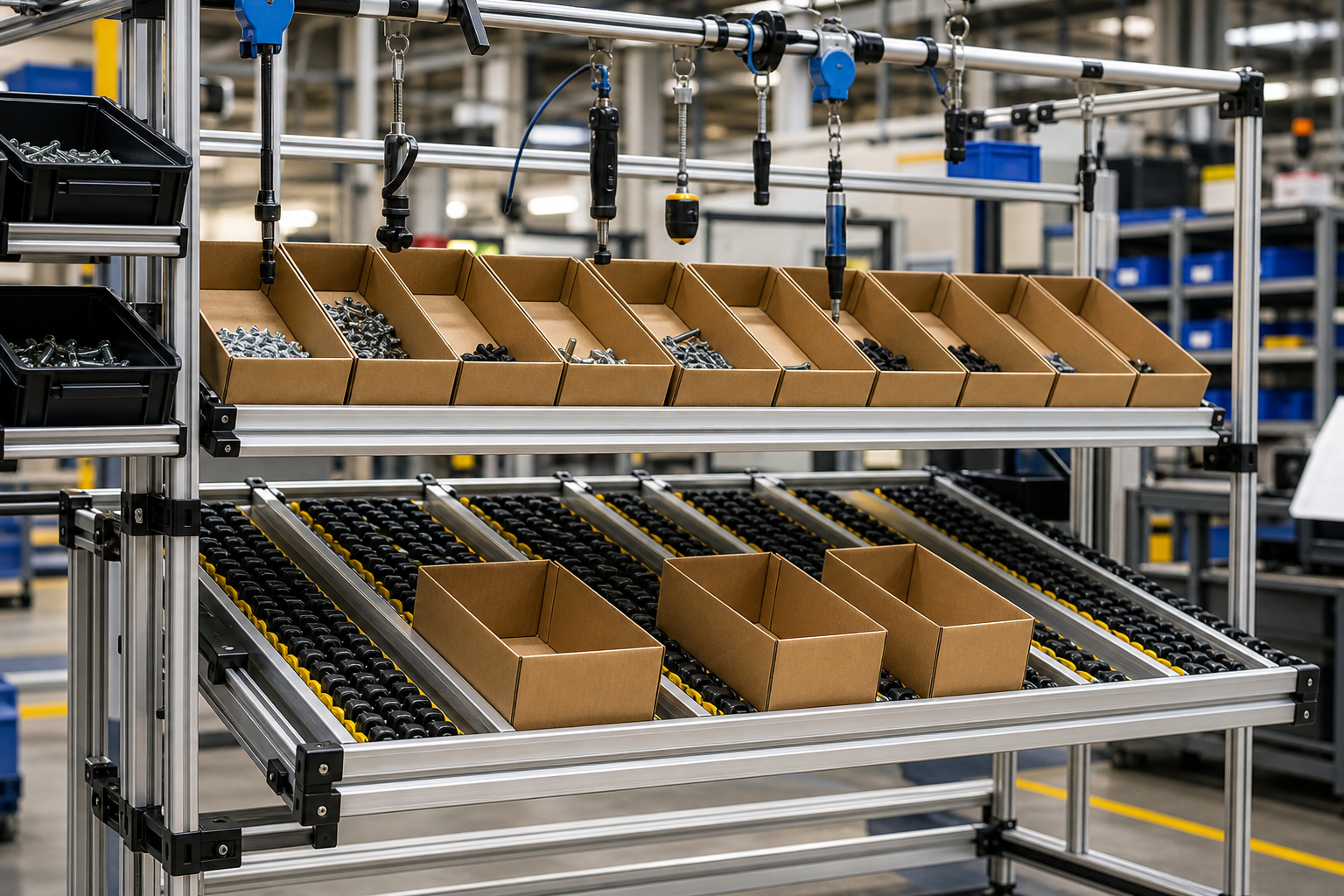
Modular flow workstations
Where the pick face is a workstation rather than a rack bay, a modular flow rack is the better tool. UNEX FlowCell is built from 1.75″ square-tube posts punched on 1″ centers with matching beams, bolted together with 3/8″-16 hardware — one 9/16″ wrench builds the whole unit. Posts are stocked in 6″ increments and beams from 12″ to 96″, so a station can be built to the operator rather than to a catalog size.
Levels adjust on 1″ centers, and accessories include galvanized-steel workbench surfaces in 12″ and 18″ depths and 30° add-on pick trays. Units are powder coated and carry a seven-year warranty. In practice that means a kitting or pack-support station can be re-pitched in an afternoon when the product changes.
Retrofit carton flow into the rack you already own
Send us bay dimensions, beam type and your carton sizes. We will lay out bed widths, lane counts and pick levels, and quote the retrofit without replacing your rack.
Request a Quote Pallet Rack Configurator Call (800) 326-4403
Pick Modules: More Pick Face Without More Building
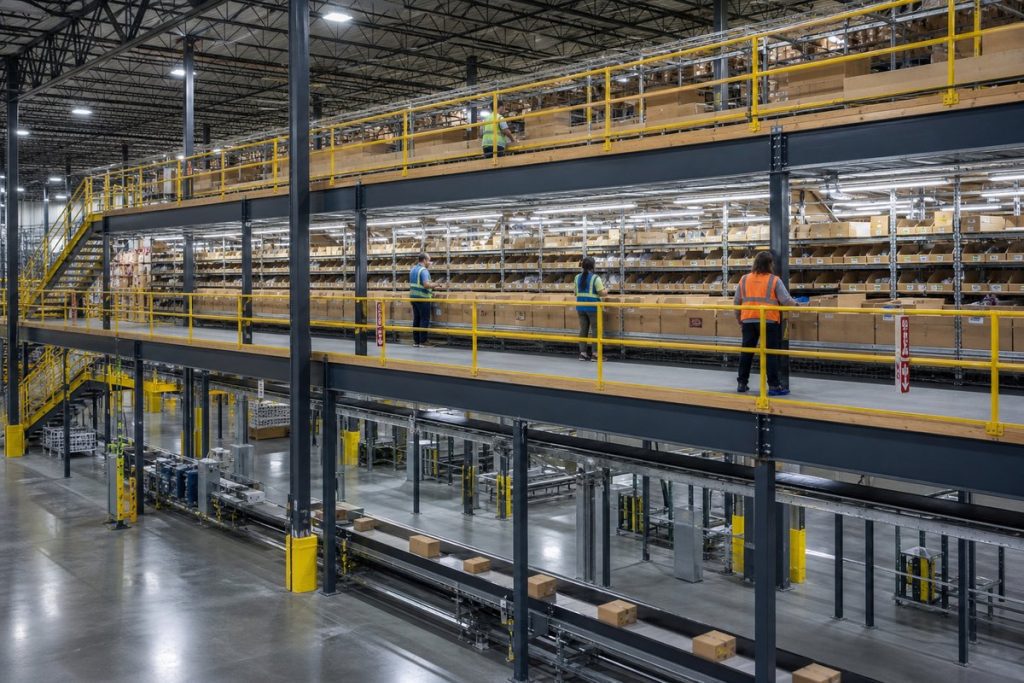
When the forward pick face runs out of linear feet before the building runs out of height, the answer is usually a pick module — a rack-supported structure that stacks two or three levels of pick face over the same footprint, tied together with stairs, walkways and take-away conveyor.
A pick module is a construction project as much as a storage purchase. The design has to resolve egress and stair placement, guarding and gates at every drop point, fire-protection clearances, lighting over each pick level, and how full cases or totes leave each level without a picker carrying them down. We design the structure and the flow together so the conveyor take-away is not an afterthought bolted on after permitting.
Pick modules also make zone picking practical: each level becomes a natural zone, and consolidation happens on the conveyor instead of on the floor.
Permits and engineering
Elevated pick platforms, stairs and guarding are reviewed by your local building department, and rack installations in Utah require permitting and sealed drawings. We provide stamped drawings and coordinate the review — no page on this site should be read as a substitute for an engineer’s seal on your specific structure.
Mobile Powered Workstations at the Point of Pick
Walking to a fixed printer or terminal is the most common hidden cost in a pick operation. A mobile powered workstation carries the monitor, PC or tablet, scanner and label printer with the picker, so labels print where the work happens. Newcastle Systems is the line we specify, and the power system is the reason: PowerSwap Nucleus Classic uses a lithium iron phosphate pack rated at 460 Wh (36 Ah) that drops out and swaps in seconds, so a cart is never taken out of service to charge.
| Series | Deck size | Power system | Typical powered components |
|---|---|---|---|
| NB104NU / NB104NU-S | 24″ standard or 18″ slim deck | PowerSwap Nucleus Classic solo dock | Scanner, tablet or laptop plus a thermal label printer |
| PC490NU4 / PC495NU4 | 30″ or 48″ heavy-duty deck | PowerSwap Nucleus Classic with four 460 Wh batteries and a charging station | Monitor, PC, wide-format label or invoice printer, scanner |
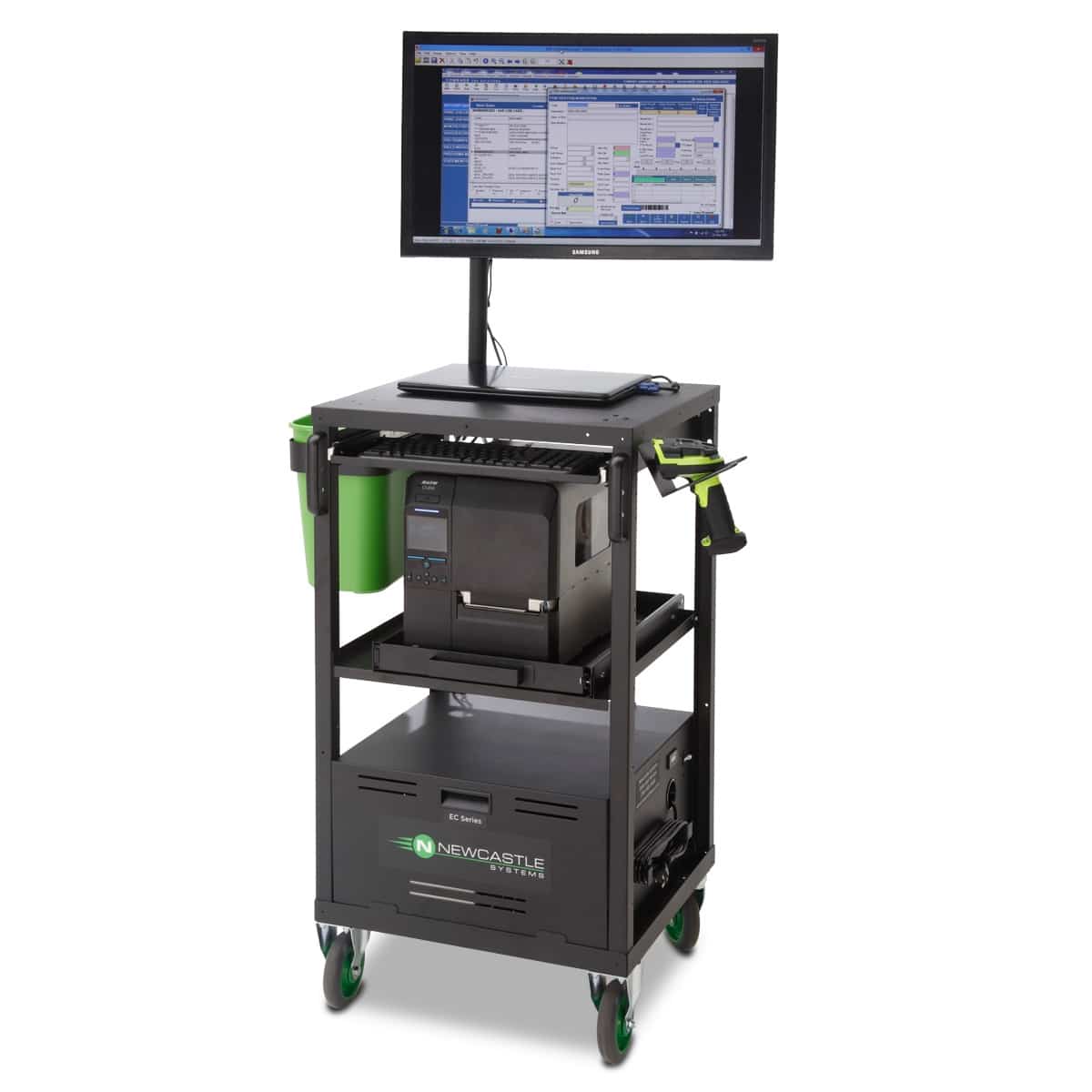
Sizing the power, not just the cart
Published Newcastle specifications for the PowerSwap Nucleus Classic system are 120 W continuous with one battery and 240 W with two, with 550 W and 825 W of surge respectively, a four- to five-hour recharge and an operating range of 50–104°F. Runtime is quoted at 8–12+ hours per charge in typical use.
That surge rating is the number people forget. Thermal and wide-format label printers draw far more current at the moment of printing than they do at idle, so the pack has to be sized for the print spike, not the average. Tell us what you intend to mount — monitor, PC, scanner, scale, printer model — and we will size the battery bank and confirm the cart deck will carry it.
Put a powered workstation on your floor
We will match the deck size, shelf layout and battery bank to the printer and terminal you actually use, and cover both picking and pack-out in the same quote.
Request a Quote Powered Cart Applications Call (800) 326-4403
Packing Stations and Pack-Out Benches
A pack station is a small assembly line. Every second an operator spends reaching for a carton, hunting for tape or waiting on a label is repeated on every order of the shift. The fix is boring and effective: put the right carton sizes within arm’s reach, mount the printer and scale at working height, keep void fill overhead or under the bench, and give the finished parcel one obvious exit path.
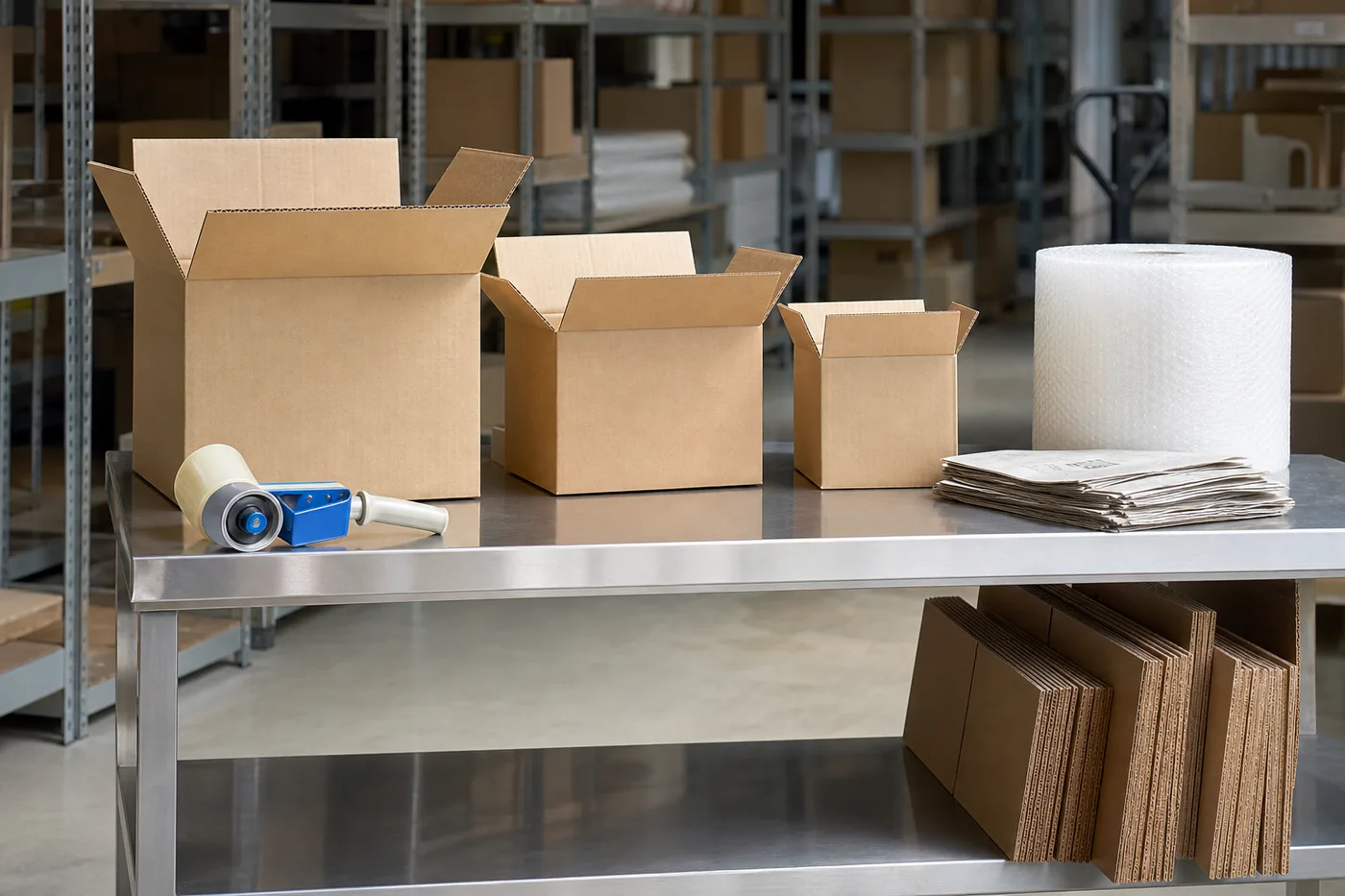 Carton and Void-Fill PresentationStore only the carton sizes your cartonization logic actually uses, staged flat within reach of the bench, with bubble, paper or foam on an overhead roll holder instead of on the floor.
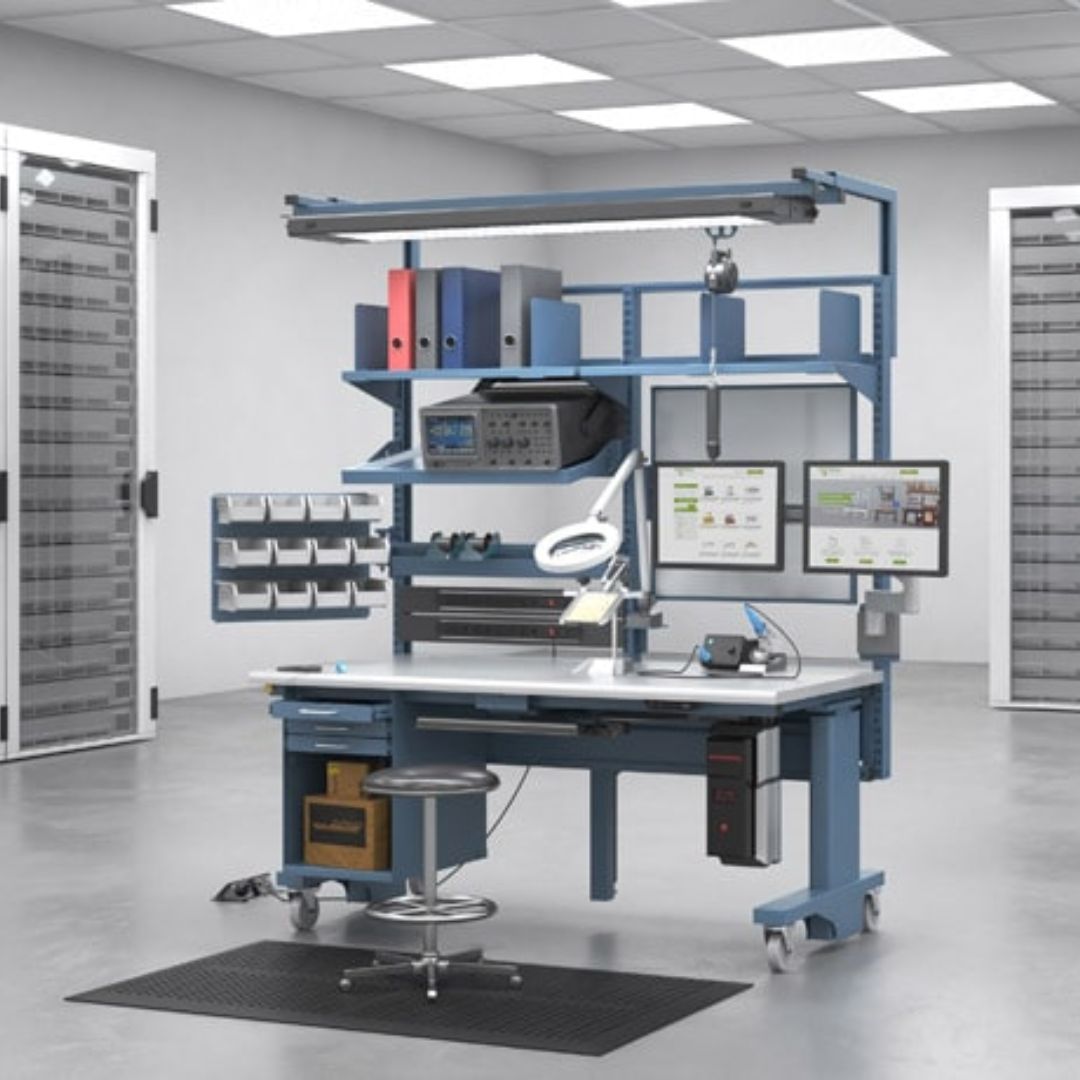 Bench, Bin Rail and LightingA rigid work surface with a bin rail for consumables, task lighting over the pack area, and monitor and scanner arms that keep the deck clear for the parcel.
 Labeling and VerificationLabel and document printers mounted at the station, scan verification before the carton is sealed, and shelf or bin label holders that read the same as the pick list.
Packing table specifications
Tennsco APT packing tables are the workhorse bench in most of the operations we build. All three models below are 83-7/16″ overall height with legs adjustable from 27-7/8″ to 35-3/8″ and a 14-gauge lower shelf rated at 350 lb, so the deck can be set to the operator instead of the operator adapting to the bench.
| Model | Work surface size | Top | Lower shelf | Typical use |
|---|---|---|---|---|
| Tennsco APT-3672W | 72″ W × 36″ D | Hardwood / butcher block | 350 lb 14-gauge lower shelf | General pack-out, kitting, returns |
| Tennsco APT-3072W | 72″ W × 30″ D | Hardwood / butcher block | 350 lb 14-gauge lower shelf | Narrow pack lines and single-parcel stations |
| Tennsco APT-3672S | 72″ W × 36″ D | Steel | 350 lb 14-gauge lower shelf | Wet, oily or heavy-abuse pack areas |
Design the station around the parcel, not the bench
Measure your five most common shipped cartons first. The bench depth has to let an operator work on the largest of them with both hands, and the exit path — conveyor, gravity chute or cart — has to clear the same carton without a lift over the shoulder.
Shipping and Packing Supplies That Keep the Line Running
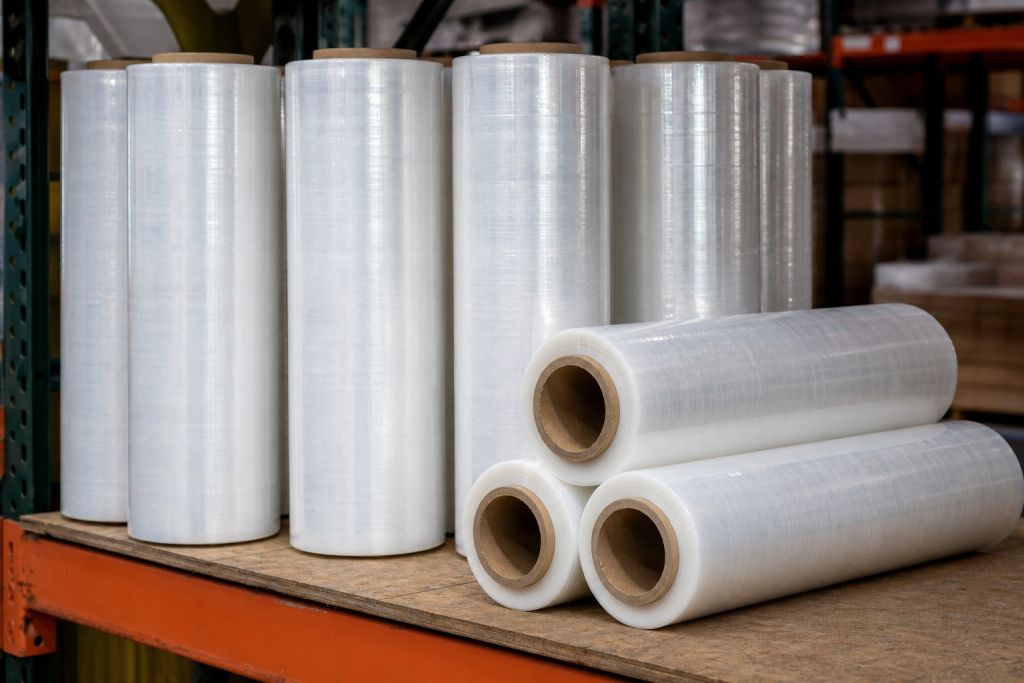
Equipment does not ship orders on its own. The consumables at the pack bench — corrugated cartons, mailers, tape, stretch film, void fill, edge protection, labels — are what actually leave the building, and running out of one size is enough to stall a pack line. We supply them wholesale alongside the equipment, so the same team that designed your bench keeps it stocked.
Standardizing the carton range is usually the single fastest win: fewer sizes means less hunting, better cube utilization, lower dimensional-weight charges and simpler reordering. Pair that with a consistent tape and film spec and pack-out variability largely disappears.
Shop Online at MaterialHandling-USA.com
Packing tables, cartons, tape, film, mailers and labels ship from our online store, so pack-line consumables can be reordered without waiting on a quote:
Goods-to-Person Automation Where It Pays
Automation is not the goal — removing travel is. Goods-to-person systems earn their keep when a large share of your SKUs move slowly, when floor space is capped, or when picking accuracy has to be enforced by the machine rather than by training. They are a poor fit for a small number of very fast movers, which almost always belong in carton flow at floor level.
| System | Capacity | Presentation | Best fit |
|---|---|---|---|
| Vidir Vertical Lift Module | Up to 132,000 lb per unit; 600 lb or 1,000 lb per tray | Trays 96″, 120″ or 144″ wide, 25.5″ or 32.5″ deep; 2.5″, 4.5″ or 6″ pitch | Slow and medium movers, tooling, spare parts, secured SKUs |
| EffiMat 4 box mover | Up to 25 kg (about 55 lb) per box | Boxes up to 600 × 400 × 320 mm; up to 320 boxes per hour and up to five boxes presented at once | High-order-line piece picking that must keep pace with a pack line |

Vertical lift modules
A Vidir vertical lift module stores trays in a sealed tower and delivers the requested tray to an operator window at a comfortable working height. Published capacity is up to 132,000 lb per unit with 600 lb or 1,000 lb per tray, trays 96″, 120″ or 144″ wide and 25.5″ or 32.5″ deep, and tray pitch options of 2.5″, 4.5″ and 6″. Light curtains and variable height sensors are included, and Vidir cites recovering up to 85% of the floor space consumed by equivalent manual shelving.
Box-mover goods-to-person
Where order lines rather than tray weight are the constraint, EffiMat’s box mover approach moves standard boxes both vertically and horizontally instead of lifting a full tray. EffiMat publishes up to 320 boxes per hour for the EffiMat 4, up to five boxes presented per cycle, boxes up to 600 × 400 × 320 mm at up to 25 kg, automatic infeed and outfeed for conveyor or mobile robots, and a floor-space reduction of up to 75% compared with manual shelving.
Model automated storage before you commit
Use the automated vertical storage configurator to test tray sizes and footprints against your SKU list, then have an MH-USA engineer validate the throughput assumptions with you.
Request a Quote Automated Vertical Storage Configurator Call (800) 326-4403
Slotting, Labeling and the Data Behind Them
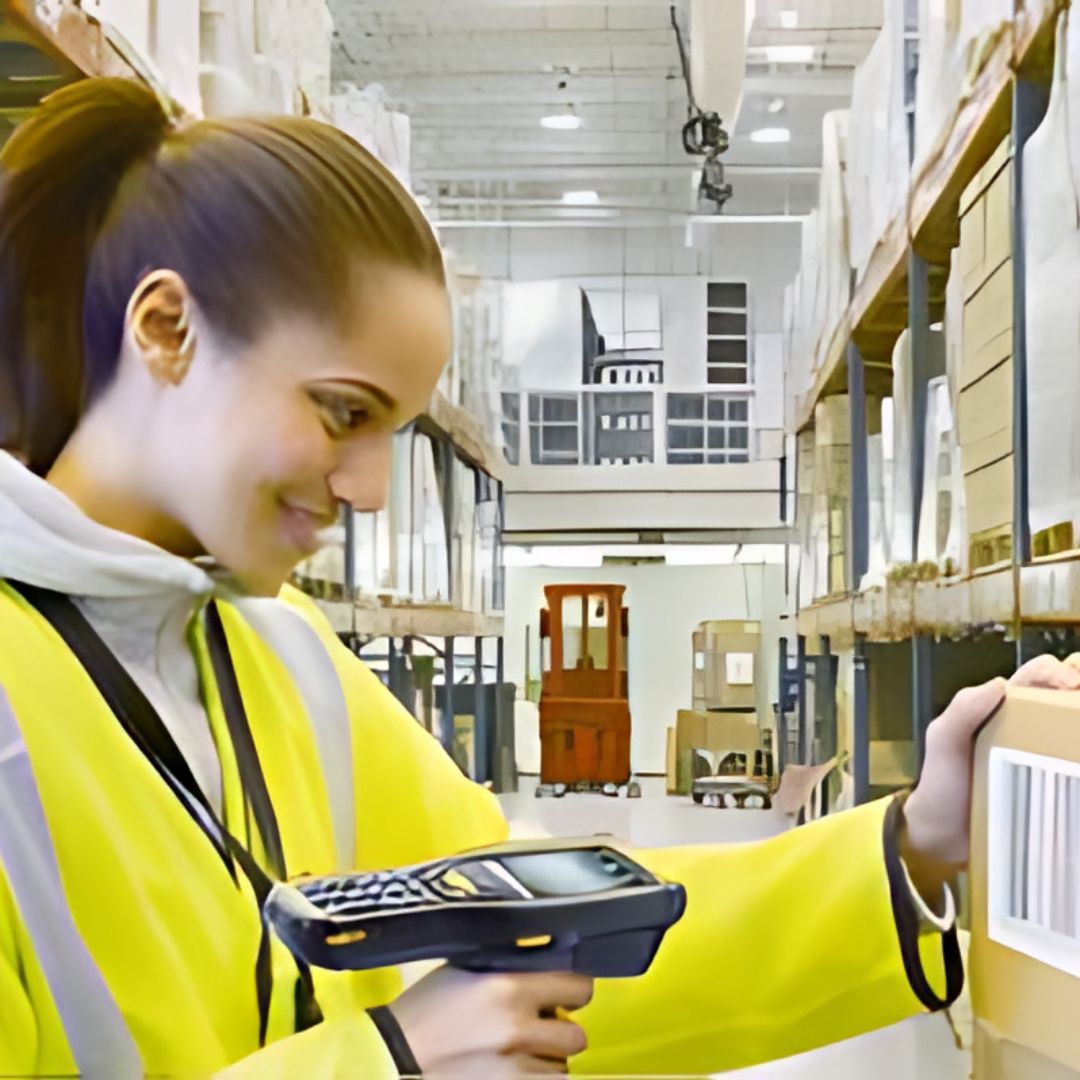
Slotting is the cheapest productivity project in any warehouse: it moves inventory, not steel. Rank SKUs by picks per period, put the top movers in the golden zone closest to the pack path, and push slow movers up, back or into automation. Re-slot on a schedule, because demand moves even when your racking does not.
Labeling makes slotting stick. Every location needs a durable, human-readable and scannable label that matches the WMS exactly, mounted where a picker looks rather than where the label holder happened to fit. Shelf-beam label holders, bin fronts and aisle or bay signage should all follow one numbering convention: aisle, bay, level, position.
Scan verification at the pick and again at pack is what converts a good layout into measurable accuracy. It also gives you the pick-density data you need for the next re-slot.
- One numbering convention across shelf labels, bin fronts, aisle signs, pick lists and the WMS.
- Fast movers in the golden zone; slow movers high, deep or in a vertical lift module.
- Label holders on the beam or bin front, not adhesive labels on painted steel that peel in a season.
- Scan verification at pick and at pack, with exceptions routed to a supervisor rather than to a guess.
- A scheduled re-slot — quarterly for stable operations, monthly for seasonal ones.
How We Design a Picking and Packing Operation
Profile the orders
We start with data: lines per order, units per line, SKU velocity, seasonality and carrier cutoffs. The order profile decides the pick method.
Lay out the flow
Receiving, reserve, forward pick, pack and staging are drawn as one path, with travel distance and touch count as the scoring criteria.
Specify the equipment
Rack, shelving, carton flow, pick cells, modules, conveyor, carts, benches and supplies — matched to velocity band and to the building.
Install and tune
Our crews install, then we walk the first live shifts with you, adjust slotting and bench layout, and hand over labeling and location data that matches your WMS.
Utah and the Mountain West, plus national projects
Material Handling USA has designed and installed storage and fulfillment systems for more than 30 years from Salt Lake City, serving distribution, e-commerce, manufacturing, healthcare and government operations. Call (800) 326-4403 to talk through a project with a designer, not a call center.
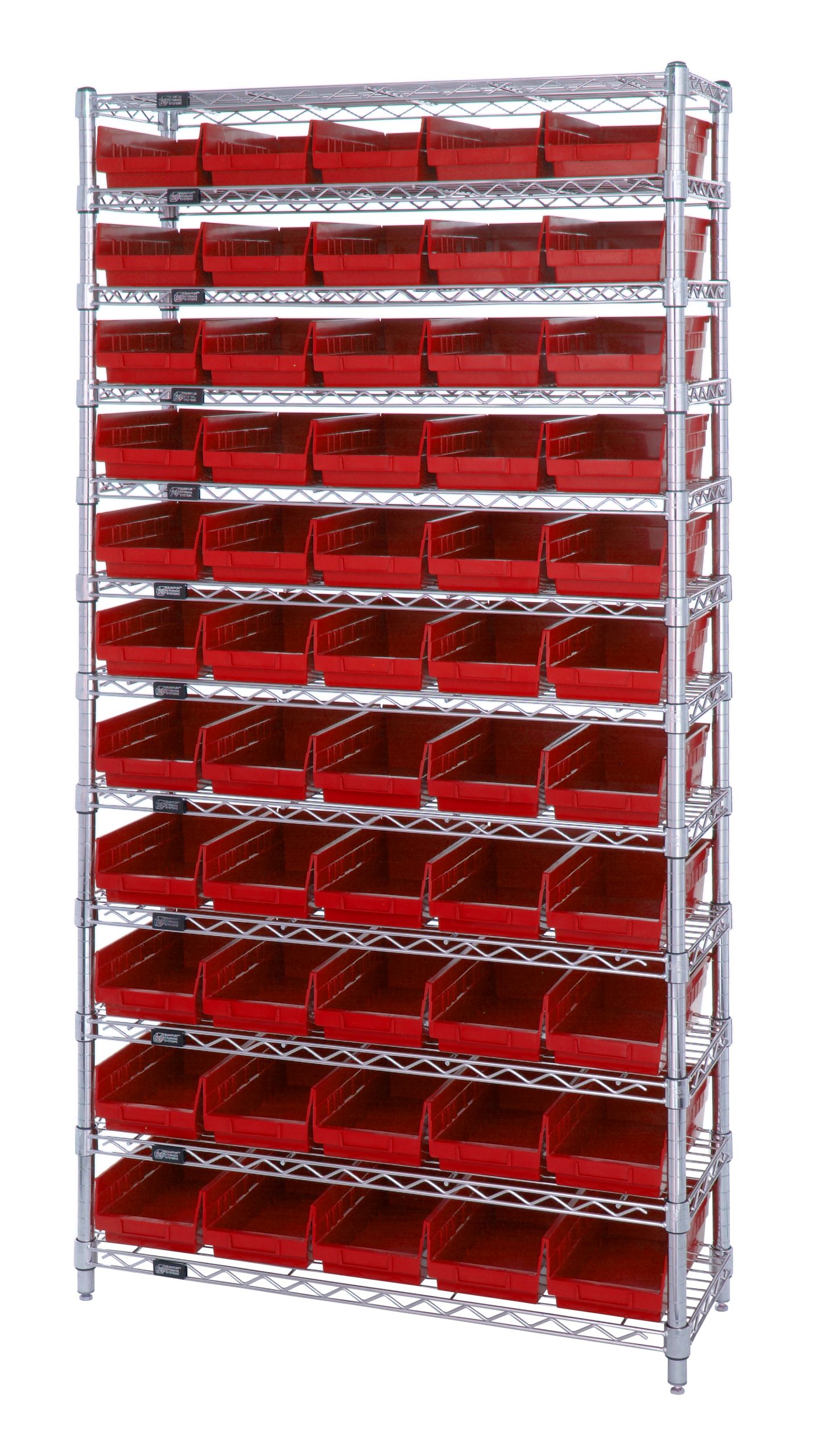
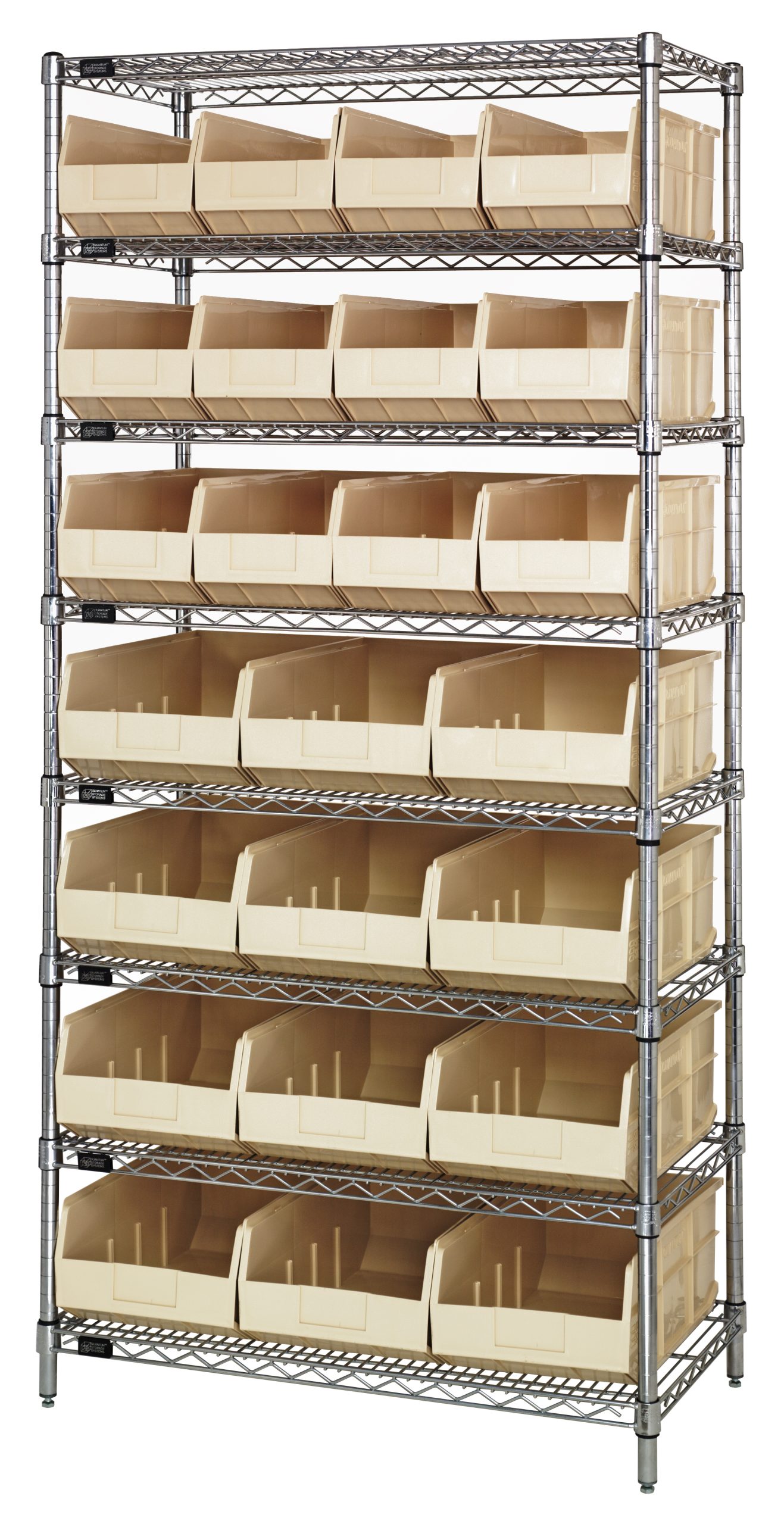
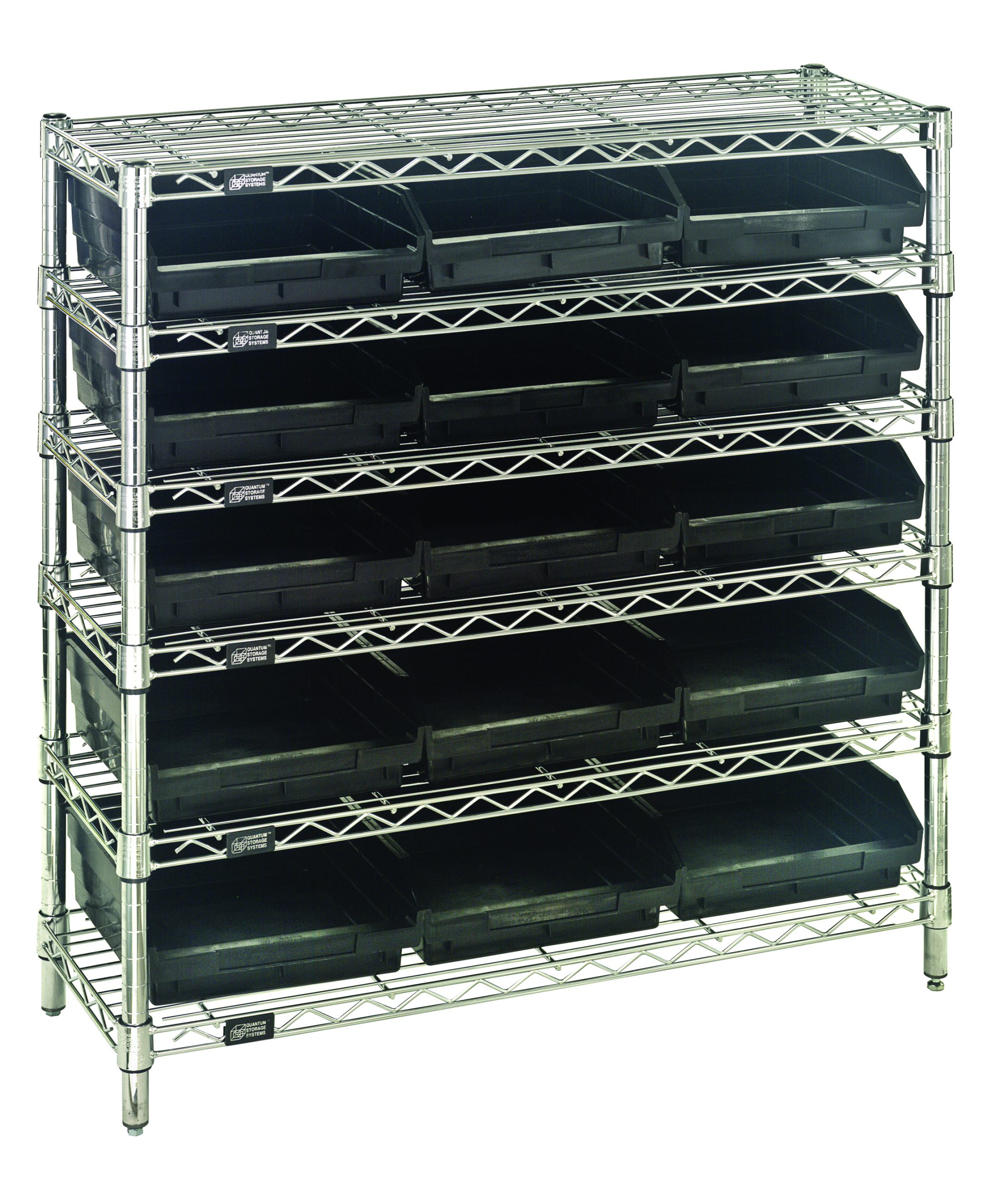
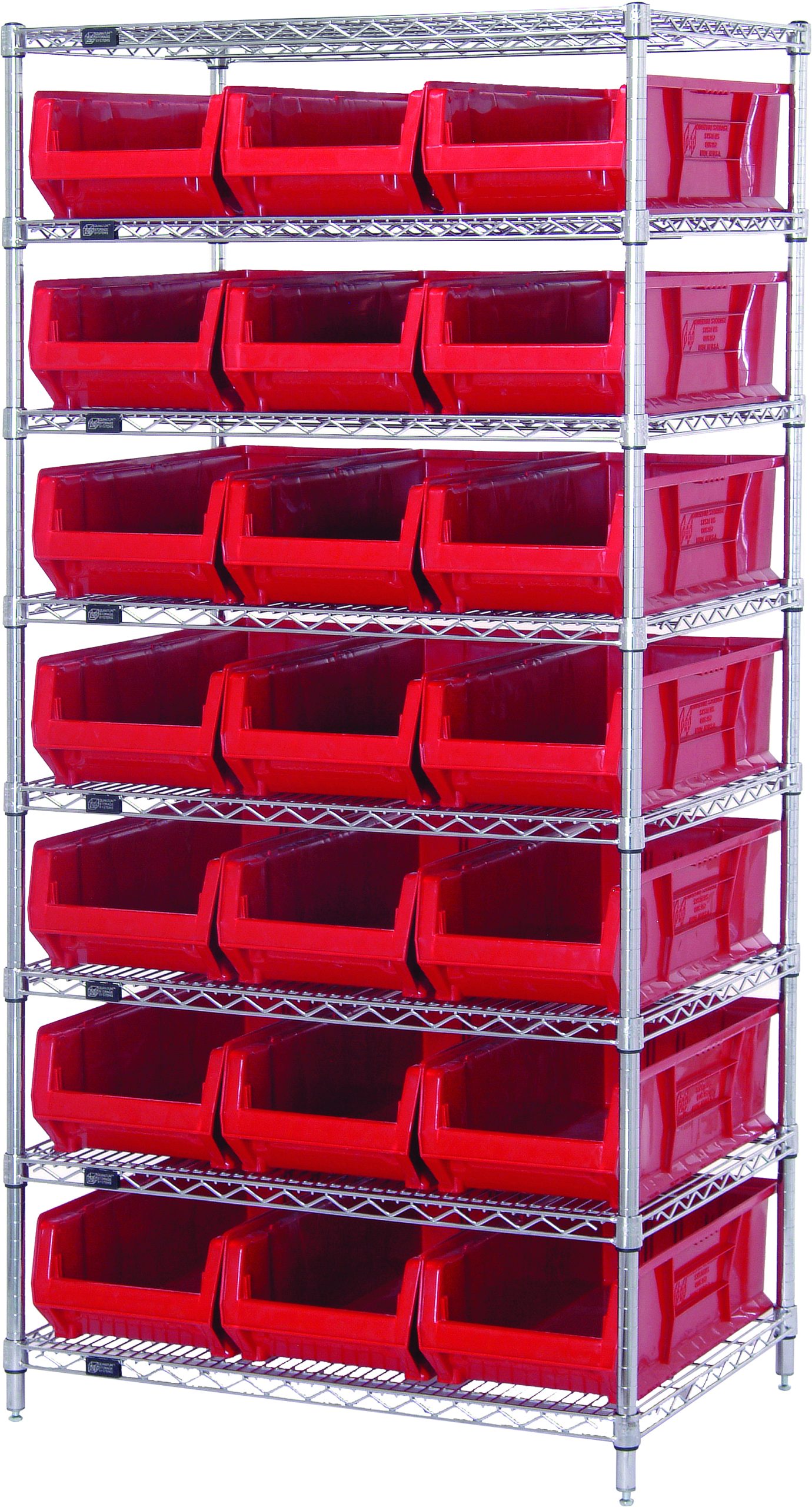
Shop Bin Storage Systems Online
Buy select items directly from our online store, or request a quote for volume, custom sizes and freight-rated orders.
Picking and Packing FAQs
What is the difference between picking and packing?
Which picking method should we use?
When does carton flow rack pay for itself?
How many pick faces fit in a bay?
Do mobile powered workstations really save labor?
How much space does a packing station need?
Can automated storage feed a pick line?
Do you design the layout or only sell the equipment?
Related Products and Resources
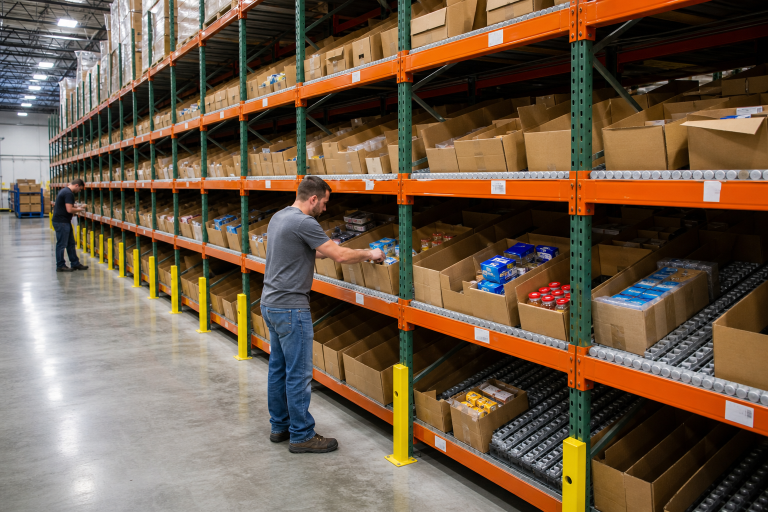 SpanTrack Wheel Bed Carton FlowBed types, ratings and how gravity flow beds retrofit into pallet rack you already own.
 FlowCell Modular Flow RacksPost, beam and accessory specifications for reconfigurable flow rack workstations.
 Conveyor SystemsBelt, roller, gravity and sortation conveyor for moving picked work to pack and shipping.
 Wholesale Shipping SuppliesCartons, mailers, tape, film, void fill and labels for the pack bench, bought in bulk.
 E-Commerce Fulfillment Center DesignHow high-velocity parcel operations are laid out for speed and order accuracy.
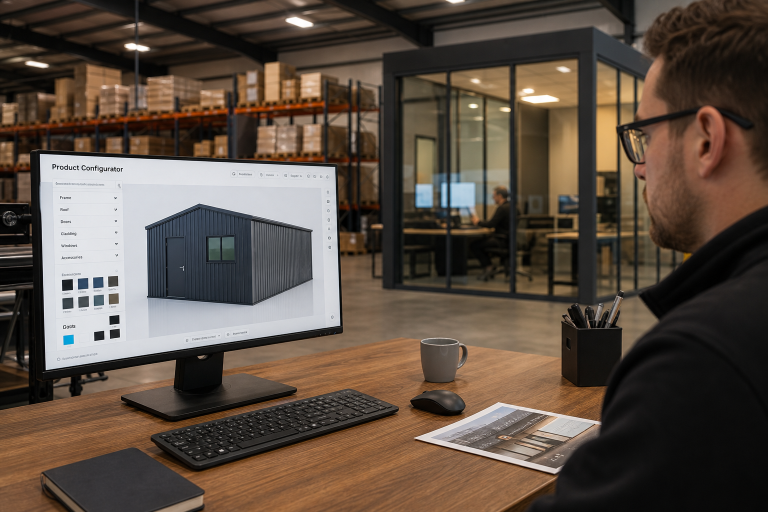 Online Design ToolsConfigure racking, shelving and automated storage layouts yourself, then send the design to our team.
Design Your Picking and Packing Operation
Send us a floor plan, a SKU velocity export or just your order counts. Our designers will map the pick path, size the pick face and pack stations, and quote the equipment that fits. Call (800) 326-4403.