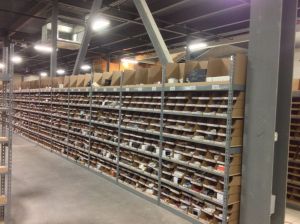
A city clerk is getting ready for budget season when an auditor asks for an old contract. The boxes sit on rolling carts. Active files share shelves with records that are ready for disposal. Nobody can quickly say which schedule covers each section. This happens when a records room grows one box at a time instead of following a plan.
Records room shelving for Utah municipal offices is more than a furniture purchase. It is a decision about retention, access, security, safety and future space. Start with your record series and approved retention schedules. Then measure the room. Only then choose between stationary shelving, mobile shelving, file cabinets or archive storage.
Quick answer
- Plan by record series and retention period, not by today’s box count.
- Use stationary shelving for boxed records, rotary or lateral cabinets for active files, and mobile shelving when a large inactive inventory has to fit a small room.
- Separate permanent records from records scheduled for destruction, and lock up records classified as private, controlled or protected.
- Get floor load, anchoring, sprinkler clearance and access routes checked before you buy.
- Map your room in the free Mobile Shelving Layout Planner or ask us for a free layout review.
Let Retention Schedules Drive the Records Room Layout
A records room serves several jobs at once. Staff pull active files, answer records requests, set aside records on litigation hold and review boxes that are due for disposal. If shelving is sized only for today’s boxes, those jobs start to crowd each other within a few years.
Utah organizes government records into record series. Each series has a retention schedule that says how long the records are kept and what happens at the end: destruction or transfer for permanent keeping. Cities use their own approved schedules, the state general schedules, or both. The State Archives explains how this works in its guidance on Utah retention schedules.
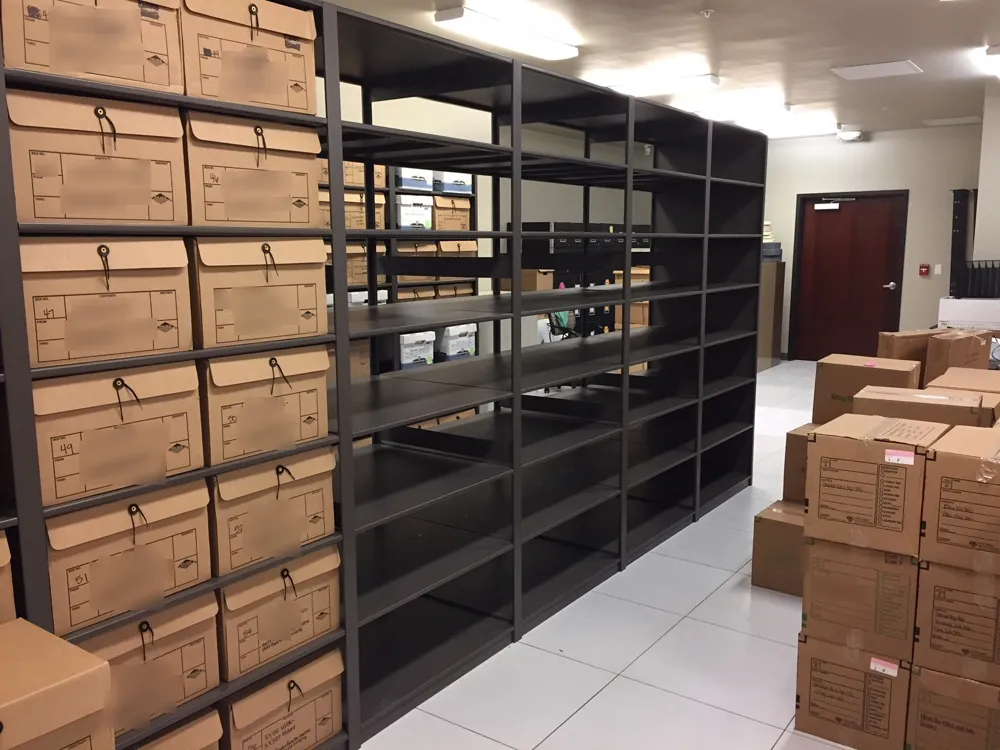
Plan capacity for the full retention period. A series kept for seven years will hold about seven years of boxes at its peak. A permanent series never shrinks. Short-term files can sit near the door for quick review. Multi-year financial and project records belong in deeper inactive storage. Permanent records need their own zone and a clear path to archival storage.
Label zones by department, series, retention period, access level and final disposition. When every bay says what belongs there and where it goes next, staff can answer requests, holds, audits and disposal reviews without opening every box. For a deeper look at the equipment side, see our guide to records room mobile shelving for Utah city and county offices.
What a Utah Records Room Actually Has to Store
City records rooms rarely hold one kind of file. Most mix administrative files, finance and payroll records, utility records, building and project files, court or police records, council minutes, ordinances and historical material. Each group can have a different retention period, access rule and final disposition.
Utah’s Government Records Access and Management Act (GRAMA) also sorts records into four classifications: public, private, controlled and protected. Your records policy has to set standards for that classification under Utah Code 63G-2-701. That matters for shelving. Private, controlled and protected records need a lockable cabinet, a lockable mobile range or a secured area, not an open bay by the front counter.

Match shelving zones to record life cycles
- Short-term administrative files: Keep them near the main entry if staff review them often. Label by department and series so routine disposal never reaches permanent material.
- Finance, payroll, utility and project records: These usually stay for several years and move from active to inactive storage. Plan for the peak volume across the whole retention period.
- Court and police records: Give them their own controlled space when access rules, privacy or chain of custody require it. Do not mix them into open administrative bays.
- Council minutes, ordinances and resolutions: Many are permanent and are often bound volumes. Plan deeper shelves for oversized books and a clear transfer path to archives.
- Historical material: Keep it away from records scheduled for destruction, with a documented path for transfer.
The common failure is easy to spot. A permanent council record sits in the same bay as a short-term file because both fit the same box. The room looks tidy, but the disposal process is not safe. Physical separation is a simple control against accidental destruction.
Shelving and Cabinet Options for Municipal Records
Most city records rooms need more than one type of storage. Stationary shelving handles predictable box storage. Mobile shelving helps when floor space is short. Rotary and lateral cabinets serve active files at the counter. A secured zone protects restricted and permanent material.
| Option | Best fit | Main strength | Main tradeoff |
|---|---|---|---|
| Stationary 4-post or boltless shelving | Boxed administrative, finance and project records | Simple access, easy to expand, simple install | Every row needs its own aisle |
| High-density mobile shelving | Large inactive or long-retention series | Much more storage on the same floor | Heavier floor load, moving parts, one aisle open at a time |
| Rotary file cabinets | Active files used every day | Small footprint, front access, rotates closed when not in use | Not built for large box inventories |
| Lateral file cabinets | Active department files | Familiar drawer access at working height | Low capacity per square foot |
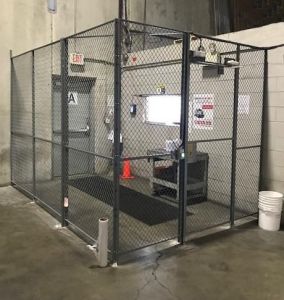
| Lockable cabinets or a secured shelving zone | Private, controlled or protected records | Limits who can reach the records | Needs a key or access control plan |
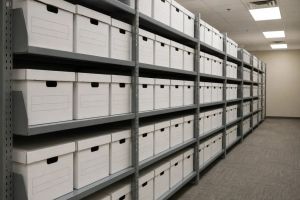
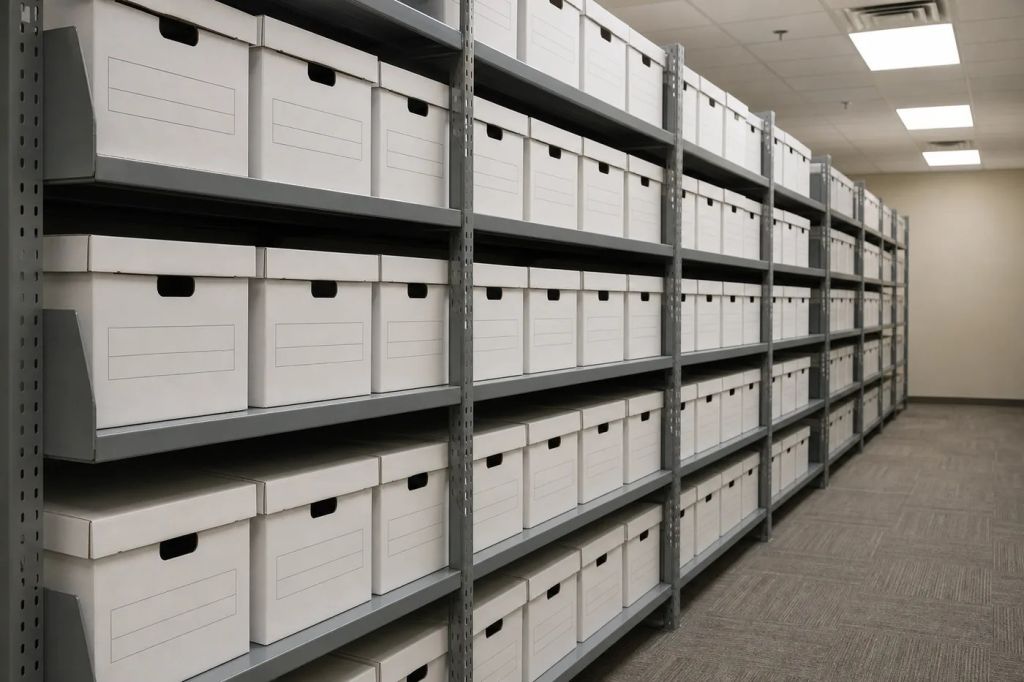
Stationary shelving is the forgiving choice. Staff reach any bay without moving another unit, and a department can grow into the next section. Our records storage shelving lines are a common starting point, and you can price a run in the shelving designer. For a local example, see the boltless shelving we supplied for Draper City Hall and Public Works.
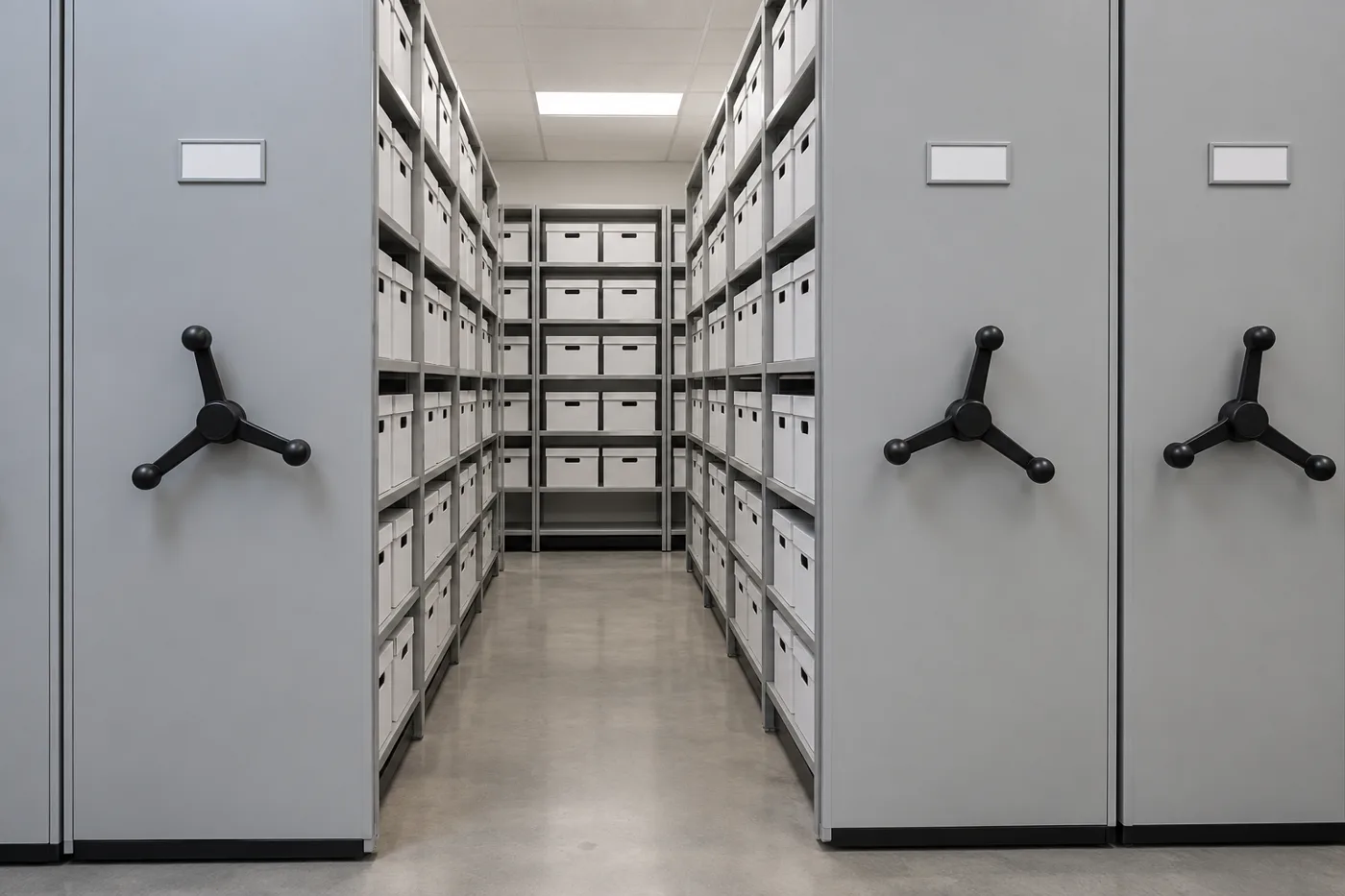
Mobile shelving earns its place when the room is small and the inactive inventory is large. Carriages ride on rails and close together, so you open one aisle at a time. That puts more paper weight on less floor and adds pinch points. Plan for aisle locks or other safety controls, clear operating rules, a floor load check, and coordination with sprinklers and air flow. Our high density mobile shelving page covers the options.
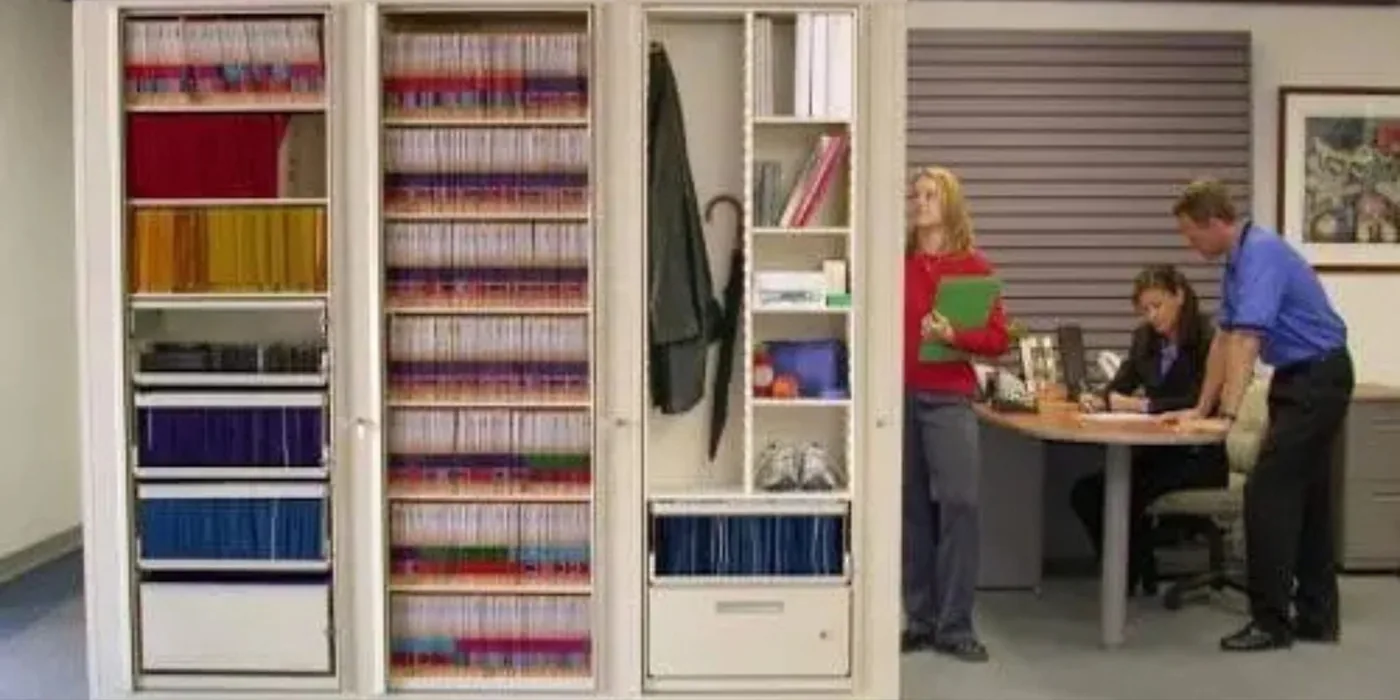
Rotary and lateral cabinets suit the active files that staff pull all week. They keep files at a comfortable height and close up at the end of the day. Ask about lock options for restricted files. Rotary cabinets like Times-2 Speed Files in Utah fit a lot of filing into a small footprint behind a counter. They are not the answer for hundreds of sealed boxes or for permanent records that need a separate access process.
Not sure which mix fits your room?
Sketch it in the free Mobile Shelving Layout Planner, or send us your room size and box counts for a free floor plan review. You can also call (800) 326-4403.
How to Size and Lay Out a Municipal Records Room
A records room can look roomy and still run out of space once every series reaches its peak. Work from the series outward. These steps turn a schedule and a box count into a shelf layout.
- List every record series. Include active, inactive, permanent, on-hold and waiting-for-review records. Note the owning department for each.
- Match each series to its schedule. Use your approved local schedule or the state general schedule. Mark what is destroyed, what transfers to archives and what is permanent.
- Measure the containers. Record outside sizes for standard boxes and flag oversized items like bound books, maps and plans.
- Estimate growth. Count how many boxes each series adds per year and how long it stays. That gives you a peak box count for each series.
- Convert boxes to bays. Use shelf width, depth, usable height and box orientation to turn box counts into shelf sections.
- Lay out zones and aisles. Group bays by series and access level. Keep clear routes, room for a cart and a review or scanning table.
- Label every bay. Give each bay a location code tied to its series, retention period and next action.

Aisles and access
Aisle width is a site decision, not a fixed number. The 2010 ADA Standards set a 36 inch minimum clear width for an accessible route, and many records rooms plan wider main aisles so a staff member can turn a loaded cart. Confirm the final widths with your building official and facility team. Keep posts, braces and carts out of the way of each retrieval face.
Keep permanent, inactive and short-term records apart even when their boxes fit together. Leave space for a review or scanning table and for boxes waiting on a decision. The Utah records management essentials guide is a good refresher on series, access and disposition before you finalize the plan.
A clean room is not always a controlled room. Control comes from the link between the schedule, the label and the disposition record.
Code, Safety and Site Considerations in Utah
A records room can hit its capacity target and still create a safety problem. Loaded paper shelving is a structural system. The federal records storage standard in 36 CFR 1234, summarized in the National Archives facility checklist, requires industrial-style shelving rated for at least 50 pounds per cubic foot supported by the shelf. It also requires shelving to be braced to prevent collapse under full load, with seismic bracing that meets the most stringent applicable state, regional or local code. City rooms are not bound by that federal rule, but it is a sound benchmark.
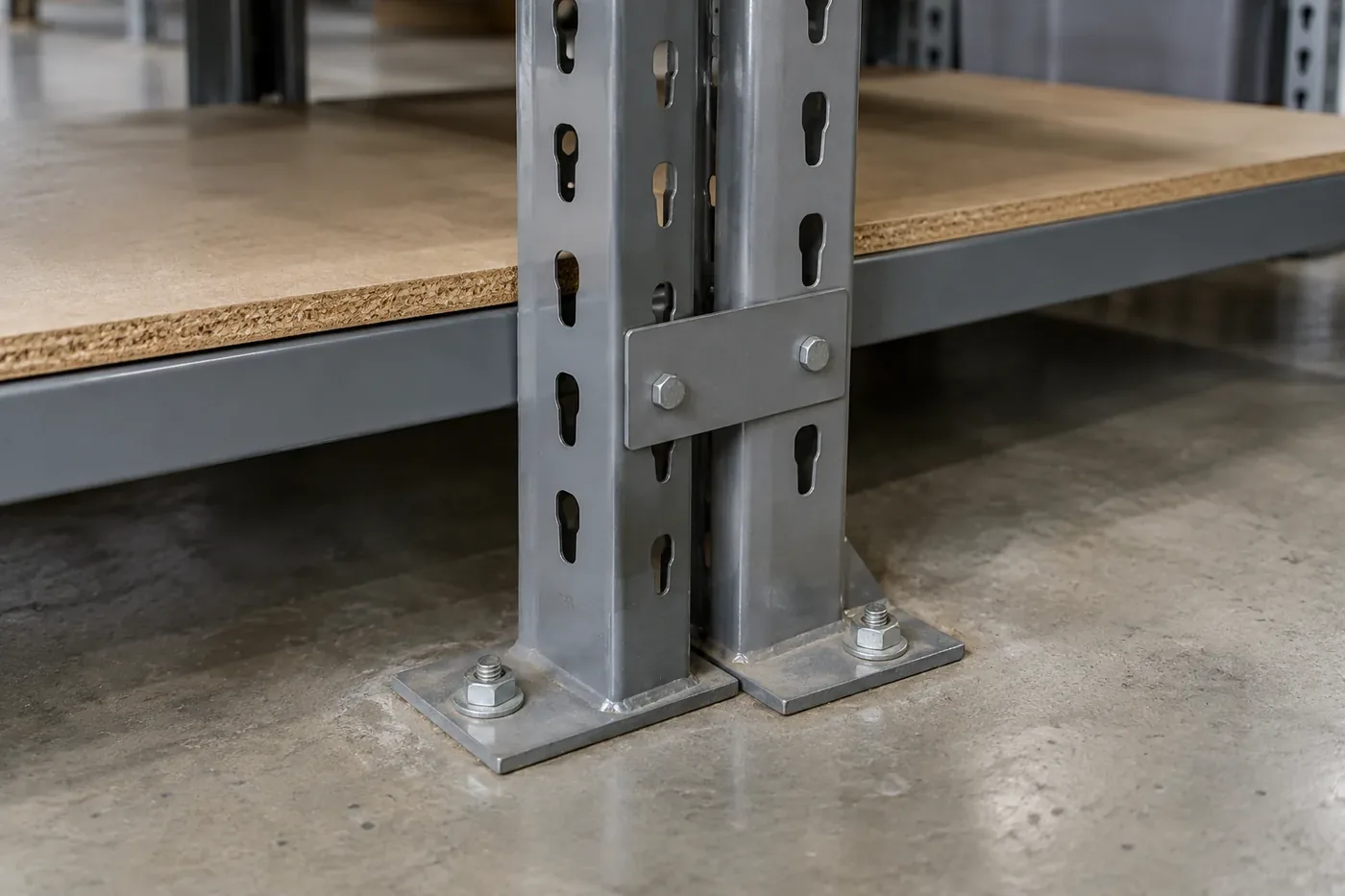
- Seismic restraint: Much of the Wasatch Front sits in a high seismic area. Anchor or brace every unit to the code your building official enforces. For mobile systems, review Utah seismic planning for mobile shelving with your design team.
- Floor capacity: Have a qualified engineer check the floor before you replace stationary shelving with mobile shelving, especially on an upper floor.
- Fire protection: Keep storage below the clearance your fire marshal requires under sprinkler heads. NFPA 13 commonly calls for at least 18 inches below standard sprinkler deflectors. Keep air flow paths open.
- Accessible routes: Keep routes and front access clear for staff and visitors, and set rules for how mobile aisles are opened and locked.
- Water risks: Keep boxes off the floor and away from pipes, mechanical rooms and roof drains.
- Chain of custody: Track who removes a box, where it goes and when it comes back.
Utah law also shapes the paperwork behind the room. Under Utah Code 63G-2-701, a city that adopts a records ordinance or policy must file it, and any amendment, with the State Archives no later than 30 days after its effective date. The city must also report its retention schedules and the classifications it applies to each record series. Review those documents before installation so shelf zones, labels and access rules match what is on file.
Installation and Quote Planning
A records room can be approved on paper and still miss its install window. Field measurements, floor checks, anchoring, freight and installer scheduling all take time. Custom colors, odd widths and special accessories add more. Confirm availability, freight timing and the install date before you tie the purchase to a budget deadline or a building shutdown.
Ask the quote to list these items
- Field measurement and layout drawings
- Freight, inside delivery and installation
- Floor anchors, wall anchors, tie plates and bracing
- Floor load review for mobile systems
- Removal of old shelving and packaging
- Labels, dividers and end panels
A lower product price can disappear once anchoring and site work are added later. Our guide to shelving installation cost explains what drives those line items.
If the room has to be cleared first, move records in stages and keep custody controls in place while files move between departments or vendors. Start early. It helps you avoid election season, budget season and building maintenance closures, and gives staff time to label and migrate files.
Three Common Municipal Scenarios
The small-town clerk with one multipurpose room
Use stationary shelving for boxed records, a rotary or lateral cabinet for active files and a locked section for permanent and restricted material. Keep the layout simple. Put the busiest files near the door, keep a small review table and use series labels any trained staff member can read. Start with our Utah shelving options and send us the room size, box count and schedule.
The mid-size city with active and inactive zones
Separate daily-use files from inactive finance, project and administrative records. Stationary shelving or cabinets can serve active work, while mobile shelving may fit the larger inactive inventory if the floor and seismic review support it. Keep the review station outside the moving aisle so staff can check boxes without blocking access.
Procurement teams that manage many public projects sometimes track them with software for government contractors, but the shelving quote still depends on your physical inventory and approved schedule. For more on dense layouts, read mobile storage systems for records and high density file storage systems.
The archive-heavy city or county
Give permanent historical records their own controlled zone and a documented transfer path. Use archive shelving or lockable mobile ranges where access, protection and clear identification matter more than maximum density. Keep records scheduled for destruction physically apart. The layout should leave room for transfers, scanning and boxes on hold. Nonprofits and churches face a similar mix, covered in our guide to church and nonprofit records mobile shelving in Utah.
Paper and Digital Records Side by Side
Digital preservation is growing fast. In its 2025 year in review, the Utah State Archives reported transferring 3,136 gigabytes of digital government information for permanent preservation, up from 405 gigabytes the year before. That does not remove the need to protect paper records that still have a retention requirement.
Plan a transition zone instead of treating files as either done or forgotten. Use controlled shelving for boxes waiting to be processed, a hold area for records under review and staging space for scanning or transfer. Label each location so staff can connect the box to its digital record and custody history.
Frequently Asked Questions
Where do we confirm our retention schedule?
Start with your records officer or city recorder. Check your local records ordinance or policy and any local schedules. If you have not adopted a local schedule for a record type, the Utah State Archives general schedule applies. Agency-specific schedules are listed on the State Archives website.
Does Utah law require a city to file its records policy with the State Archives?
Yes. Under Utah Code 63G-2-701, a political subdivision that adopts a records ordinance or policy must file it, and any amendment, with the State Archives no later than 30 days after it takes effect. The city must also report its retention schedules and record classifications. This is about paperwork, not shelving, but your shelf zones and labels should match what you filed.
Can we get rid of paper once it is scanned?
Not automatically. A scan does not make the paper original disposable. Follow your approved schedule and disposition process. Until then, keep the paper series identifiable and give boxes waiting for scanning or review their own staging shelves.
How much weight does records shelving need to hold?
Paper is heavy. The federal records storage standard (36 CFR 1234) calls for industrial-style shelving rated for at least 50 pounds per cubic foot of shelf space. It is a federal rule, but it is a useful benchmark for a city room. Ask for the rated capacity of each shelf and compare it with your fullest boxes.
Is mobile shelving a good fit for a city records room?
It often is for large inactive inventories in a small room. It removes most fixed aisles, so the same floor holds more records. It also puts more weight on the floor and adds moving parts. Plan for a floor load review, anchoring, aisle locks and clear operating rules before you choose it.
What should we ask about seismic bracing?
Ask how each unit is anchored or braced, which building code the design follows, and who signs off. For mobile systems, ask about anti-tip features and rail anchoring. Make sure anchors, braces and labor are listed in the quote.
What do we need to send for a free layout review?
Send the room size and ceiling height, door, window and column locations, photos, box sizes, rough box counts by department or series, and which records are active, inactive or permanent. Note any locked or restricted records and your target install window.
Can we phase the project over two budget years?
Yes. Common phases are inventory and site survey, active-file storage, inactive storage, then permanent records or a later mobile expansion. Keep one record-series map for every phase so the first install does not block the second.
Plan Your Records Room With Material Handling USA
Start with the record series and approved schedule. Choose storage that fits each life cycle. Then plan the install around safety and access. That gives your clerk more than extra shelf space. It gives you a room that supports retrieval, review, transfer and lawful disposition.
Get a free records room layout
Map your room in the Mobile Shelving Layout Planner, price stationary shelving in the shelving designer, or request a free quote. We help Utah cities and counties compare stationary shelving, mobile shelving, rotary files and archive storage.
Call (800) 326-4403 or email Sales@MH-USA.com.