
Planning a Records Room for a Utah City or County Office
How Utah governmental entities size and lay out on-site records storage around approved retention schedules, GRAMA and State Archives box standards, and where high-density mobile shelving fits.
Who it is for
City recorders, county clerks, recorders and assessors, records officers and facility managers
Rule that drives the room
Records you keep must follow an approved retention schedule
Off-site option
State Records Center, Clearfield (not climate controlled)
On-site answer
Records-box shelving, often high-density mobile
Records storage that follows the retention schedule, not the other way around
Almost every Utah city hall, county building and special district office has a room that started as spare storage and slowly became the records room. Boxes arrive from the clerk, the treasurer, building permits and human resources; nothing leaves because nobody is sure what can. When that room is finally full, the question put to a shelving supplier is usually “how many more boxes can you fit in here?” The better question is “which records actually need to live here, for how long, and how often will someone pull them?”
This guide walks through that planning sequence for Utah governmental entities. It supports our Utah mobile shelving page, which covers the systems themselves, and focuses on the records side: the retention and custody rules that decide what stays on site, how Utah State Archives box standards shape the shelving, and when a high-density mobile shelving system is the right answer instead of more static shelving or an off-site transfer.
It is general planning guidance, not legal advice. Your appointed records officer and the Utah Division of Archives and Records Service (DARS) are the authorities on your record series; our job is to turn the answer into a room that works.
Why Utah government records rooms fill up
Three things combine to push paper into local-government storage rooms:
- Retention schedules run long. DARS describes a retention schedule as a roadmap for how long to keep a group of records (a record series) and what to do with them once they no longer have value. Some series are short; others are permanent.
- Custody stays with the office. Utah’s records rule for the State Records Center (R17-6) says that when an agency has not transferred records, it remains the agency’s responsibility to manage, maintain and destroy them according to the approved schedule.
- Someone is accountable. Under Utah Code 63A-12-103, each governmental entity’s chief administrative officer appoints records officers responsible for the care, maintenance, scheduling, disposal, classification and preservation of records.
The practical result is a steady inflow and a slow, approval-driven outflow. A records room has to be planned for the balance between the two, not just for today’s box count.
Decide custody first: on site, State Records Center or State Archives
Before sizing any shelving, sort each record series by where it should physically live. DARS publishes a straightforward comparison of its two facilities, summarized below. Check the “format management” section of each series in your retention schedule to see where it is meant to go.
| Keep on site (your records room) | Utah State Records Center | Utah State Archives | |
|---|---|---|---|
| Location | Your building | Clearfield | Salt Lake City |
| What goes there | Active and frequently pulled series, plus anything not yet scheduled | Semi-active records that have not met retention (permanent or not) | Permanent records that have already met retention |
| Custody | Your office | Stays with the creating agency; recall any time | State Archives assumes custody |
| Environment | Whatever your room provides | Not temperature or humidity controlled | Temperature and humidity controlled |
| Capacity (per DARS) | Your floor area | 164,000 cubic feet total | 75,000 cubic feet total |
| Requirements | Your own filing and inventory system | Approved schedule, series number, State Archives boxes | Transfer per schedule |
Two planning consequences follow. First, anything that needs quick, frequent retrieval (current case files, recent minutes, active permits) belongs on site regardless of what the Records Center could hold. Second, series that have not yet been scheduled cannot go to the Records Center at all, so a room full of unscheduled boxes is often a scheduling problem before it is a shelving problem. For a broader cost and access comparison, see our guide to off-site versus on-site records storage.
Inventory what will stay before you buy shelving
A good records-room design starts with a spreadsheet, not a floor plan. For each record series you expect to keep on site, capture:
Once the inventory is in cubic feet, it maps directly to shelf openings. Our mobile shelving capacity sizing guide shows the arithmetic for turning that number into sections and carriages, including growth allowance.
Plan the shelving around the box
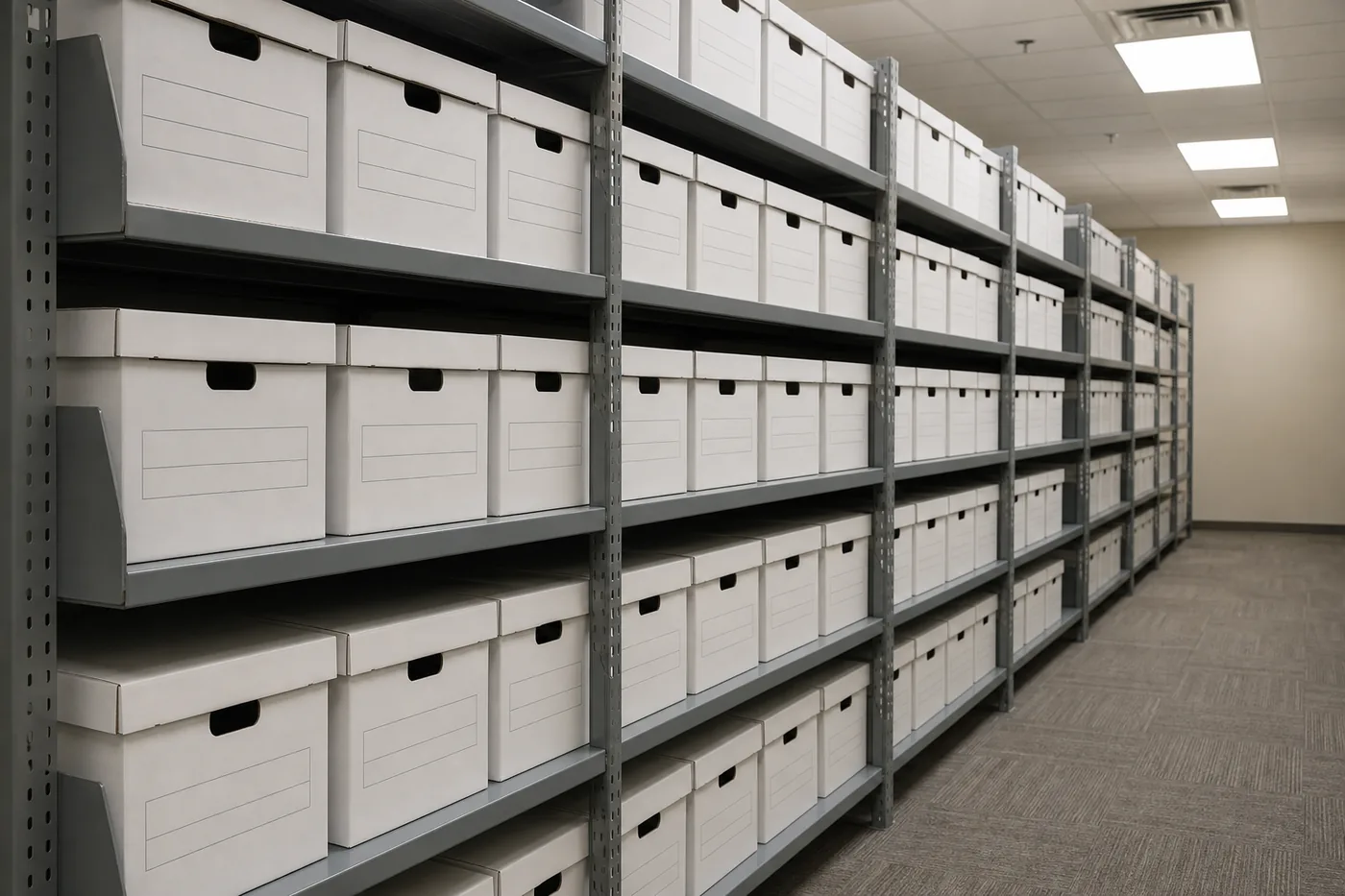
Utah State Archives publishes specific box standards for records going to the State Records Center and State Archives. Even if a series will stay in your building, planning around those boxes keeps it ready to transfer later without re-boxing:
- Records Center boxes are specially contracted to State Archives specifications, including a 35 pound maximum box weight.
- DARS asks offices to replace hanging folders and three-ring binders with labeled manila folders so lids fit snugly, to keep one record series per box, and to leave about three fingers of space between folders.
- Each box gets a printed inventory inside, with a copy kept in the office.
For shelving, that means planning shelf depth and opening height around a standard records box rather than around the folders in today’s cabinets. Records-center style shelving is usually laid out one or two boxes deep, with openings set just above box height so no space is wasted between levels.
State archives elsewhere publish useful shelving rules of thumb that apply equally in Utah. Washington State Archives, for example, notes that a standard archives box is about 10.75 inches tall and needs at least 11.25 inches of vertical opening, and that the lowest shelf should sit at least six inches off the floor to protect records from water. New York State Archives’ guidance on inactive records recommends leaving a few inches between shelving and walls for air circulation. Those details belong in the drawing, not in a note after installation. Our shelf depth and level spacing guide goes deeper on openings for boxes, binders and files.
Where high-density mobile shelving fits in a government records room
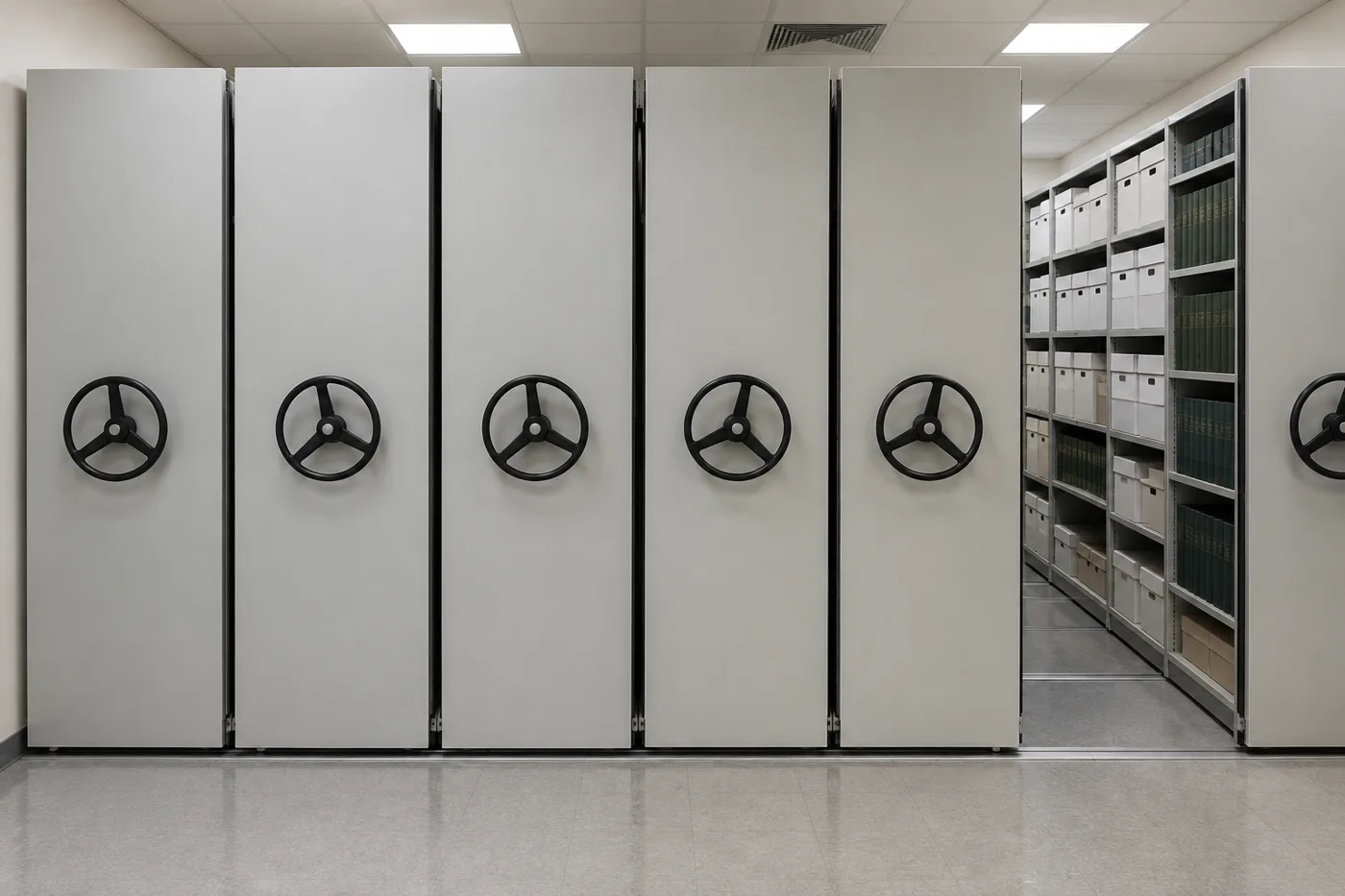
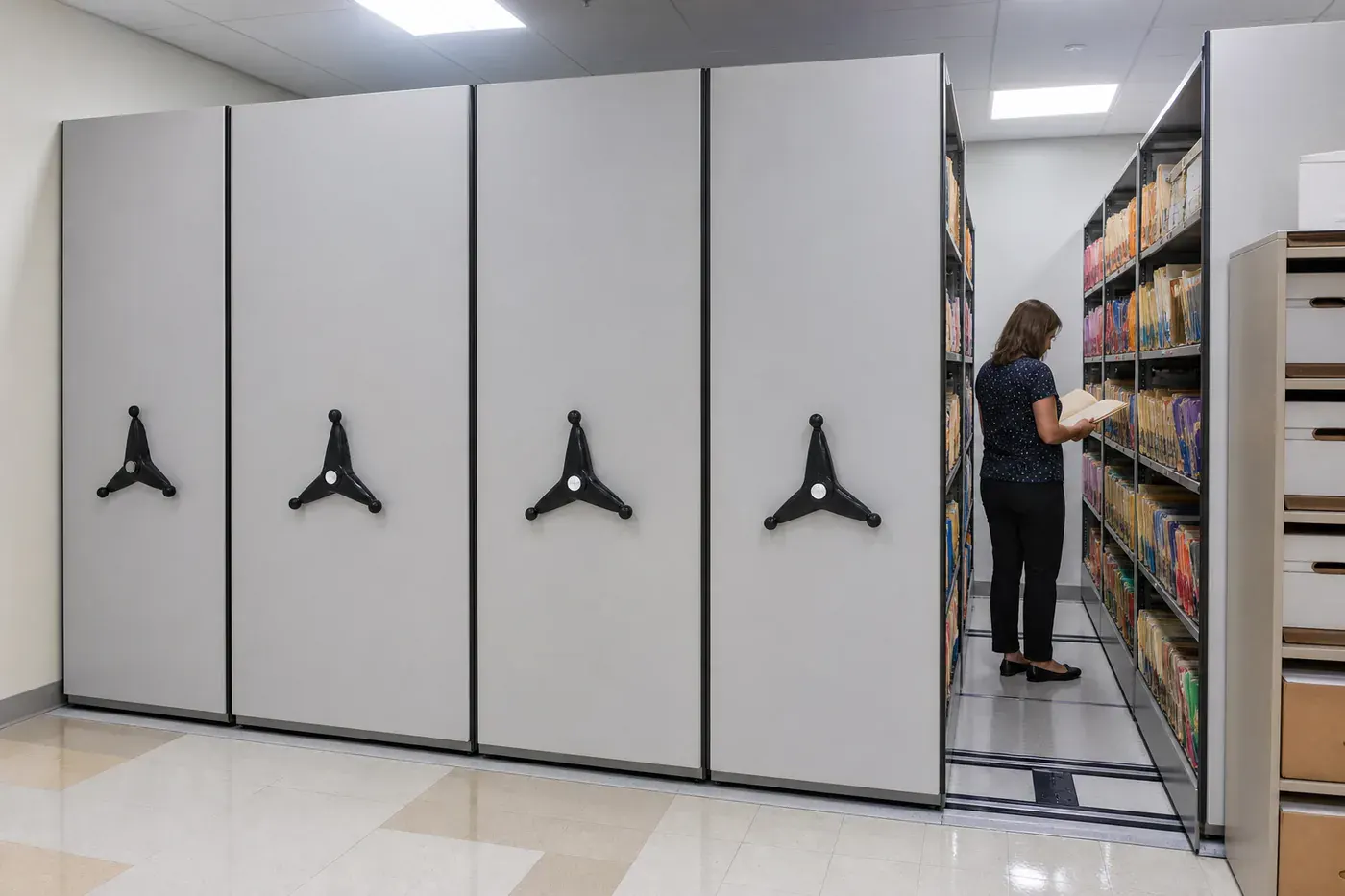
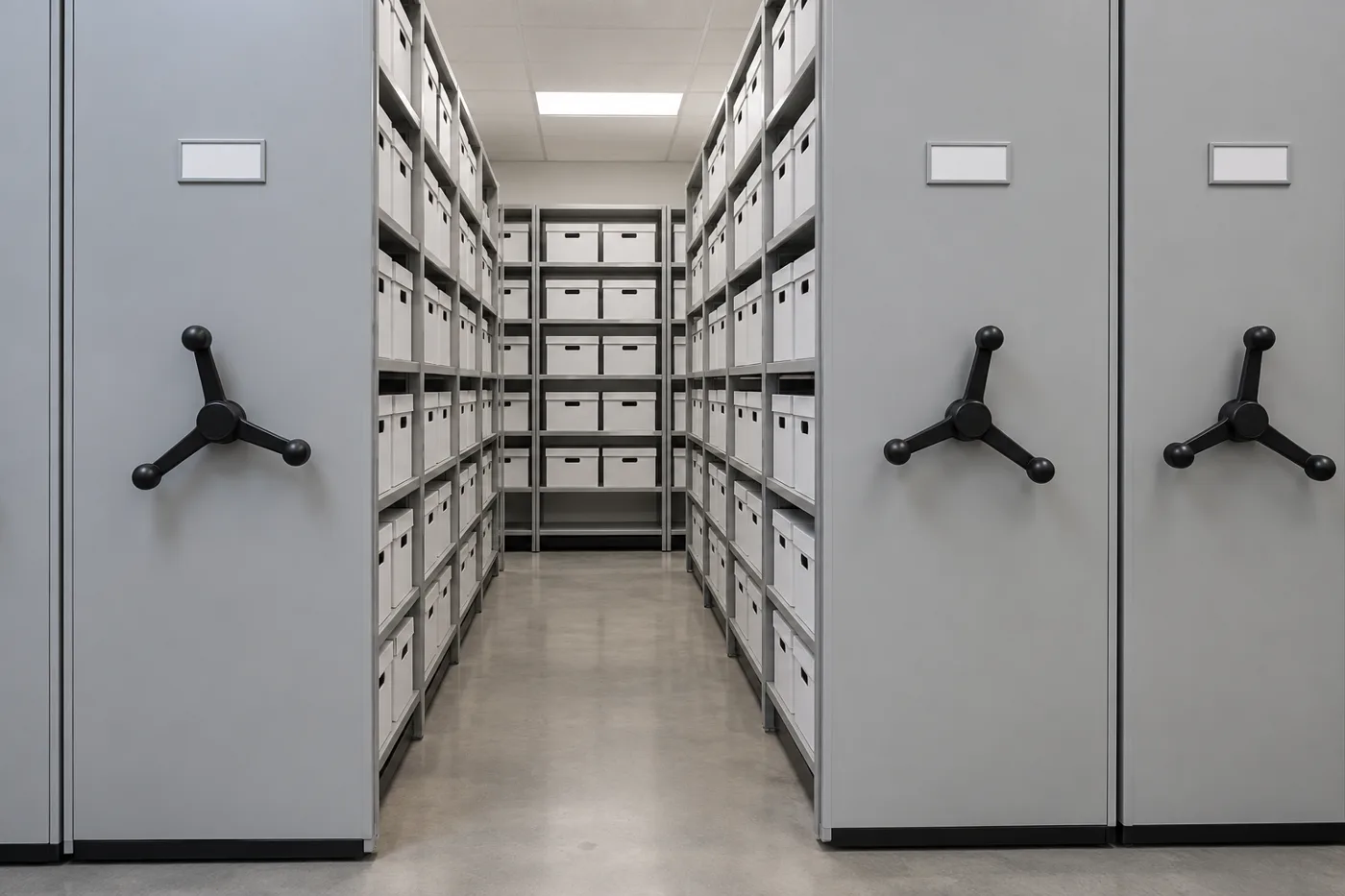
Mobile shelving puts shelving ranges on carriages that roll along floor rails, so a room needs one moving aisle instead of an aisle for every range. In a records room that is mostly boxes and files, that typically lets the same floor area hold considerably more than static shelving, which is why it is the common answer when a city or county cannot add square footage.
It suits government records particularly well when:
- most of the series are retrieved occasionally rather than all day by several people at once;
- private, controlled or protected series need to be kept together behind lockable carriages; and
- the room will absorb years of growth before disposal and transfers catch up.
Static shelving still makes sense for a busy counter-side file wall, and a mix is common: static shelving along one wall for active files, mobile carriages for the retention backlog.
| Question | Static shelving | Mechanical mobile shelving | Transfer off site |
|---|---|---|---|
| Floor area per box stored | Highest | Lower; ranges share one aisle | None in your building |
| Speed of retrieval | Immediate | Seconds to open an aisle | Recall request and delivery |
| Best for | Active files pulled constantly | Semi-active and long-retention series kept on site | Scheduled semi-active series |
| Restricting access | Room-level only | Lockable carriages keep a range closed | Handled by the facility |
| Growth | Needs more floor | Plan rail length and add carriages | Limited by schedule approval |
For the drive choice, see manual, mechanical-assist and powered mobile shelving; for keyed and controlled-access options in general terms, see mobile shelving security and access control.
What each office typically stores
The departments inside a Utah city or county generate very different records, and they rarely all fit on the same shelf. Plan zones by format rather than by department name:
| Office | Typical formats | Shelving implication |
|---|---|---|
| City recorder / county clerk | Minutes, ordinances, resolutions, agreements, election material | Box shelving plus a secure zone for election supplies between cycles |
| County recorder | Recorded documents, plats, oversized bound books | Deeper shelves or flat storage for oversized volumes and plans |
| Assessor / treasurer | Parcel files, appraisal records, tax records | Letter or legal file shelving with dividers, often high retrieval |
| Building and planning | Permits, plan sets, maps | Rolled or flat plan storage alongside files |
| Human resources / finance | Personnel, payroll, purchasing records | Lockable ranges for private series |
| Justice court / police records | Case files, reports | Separate rooms with their own access rules |
Utah’s public colleges and universities work from a separate Colleges and Universities retention schedule, with permanent student academic records and FERPA-protected files. Our guide to mobile shelving for Utah college and university records rooms covers how that changes the layout.

Oversized items are the ones that most often get forgotten. Bound record books, plats and plan sets do not fit a records box, so give them their own shelf depth or a dedicated flat or rolled storage zone. Our plan, map and drawing storage guide covers that format.
Election material is another special case: ballots, precinct supplies and equipment need a secure home between elections without taking over the whole room. We supplied mobile shelving for exactly that purpose to a city election office in North Ogden.
Other Utah public-sector records rooms we have fitted out include a county assessor’s office in Parowan, a county administration building in Heber City that expanded an existing system, and a state agency records room in Salt Lake City.
Building checks that matter in Utah
How a Utah records-room project gets specified
Records inventory
Your records officer lists the series staying on site, their volume, retrieval pattern, growth and classification.
Clean up the backlog
Destroy eligible records and transfer scheduled series first, with DARS approval, so you do not buy shelving for boxes that should leave.
Room survey
We measure the room, note columns, doors, lights, sprinklers and floor condition, and confirm the load and anchorage approach.
Layout drawing
A plan and elevation showing carriages, fixed ranges, aisle, shelf openings sized to your boxes and files, and capacity in cubic feet.
Purchasing
Your purchasing office confirms the procurement route, such as a current cooperative contract or its own quote process.
Install and move-in
Rail and carriage installation, then records reshelved in the order your inventory defines, with locations recorded.
On purchasing: public entities often ask whether a cooperative contract applies. Contract numbers and terms change, so confirm the current contract and its scope with the Utah Division of Purchasing or your own purchasing officer before relying on it. For federal and cooperative routes in general, see GSA and cooperative contract purchasing. For the documents an architect or facilities team usually needs, see the specification and submittal checklist.
A records-room drawing is also a planning tool on its own. Many offices use it to show their council or commission how much the existing room will hold after a backlog clean-up, and how much longer that buys before another expansion is needed.
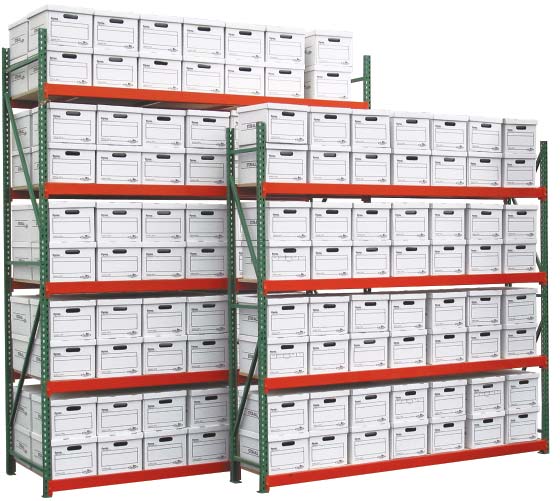
Shop Records Boxes and File Shelving Online
Buy select items directly from our online store, or request a quote for volume, custom sizes and freight-rated orders.


Frequently asked questions
Do Utah cities and counties have to keep records in a particular kind of room?
Can we just send our overflow boxes to the State Records Center?
How much more will mobile shelving hold than our current shelving?
Can private or protected records be kept in the same room as public records?
What about bound record books and plats?
Does Material Handling USA work with Utah government offices?
Planning a records room for a Utah city, county or district office?
Send us your records inventory or just the room dimensions and what you store, and we will prepare a layout drawing showing capacity in cubic feet, shelf openings sized to your boxes and files, and room for growth. Utah surveys and installs from our Salt Lake City base.