
Mobile Shelving for Utah College and University Records Rooms
A planning guide for Utah registrars, records officers, archivists and campus facilities teams: how the state’s higher-education retention rules shape a high-density records room, and what to settle before you buy.

Open-records law
GRAMA covers state-funded Utah colleges and universities (Utah Code 63G-2-103)
Retention rules
Utah’s general schedule has a dedicated Colleges and Universities category
Longest keepers
Student academic records are permanent; transcripts never leave the building
Who it is for
Registrars, records officers, university archivists, HR, financial aid and facilities
Why Utah campuses run short of records space
Every Utah college and university keeps two collections that never stop growing. One is the institution’s own business record: transcripts and grade records, admissions and financial aid files, personnel files, grant and sponsored-research records, contracts and board minutes. The other is its history: the university archives, faculty papers, theses and dissertations, photographs and special collections. Some of that material can be destroyed after a few years. Much of it has to be kept for decades, and a surprising share of it is permanent.
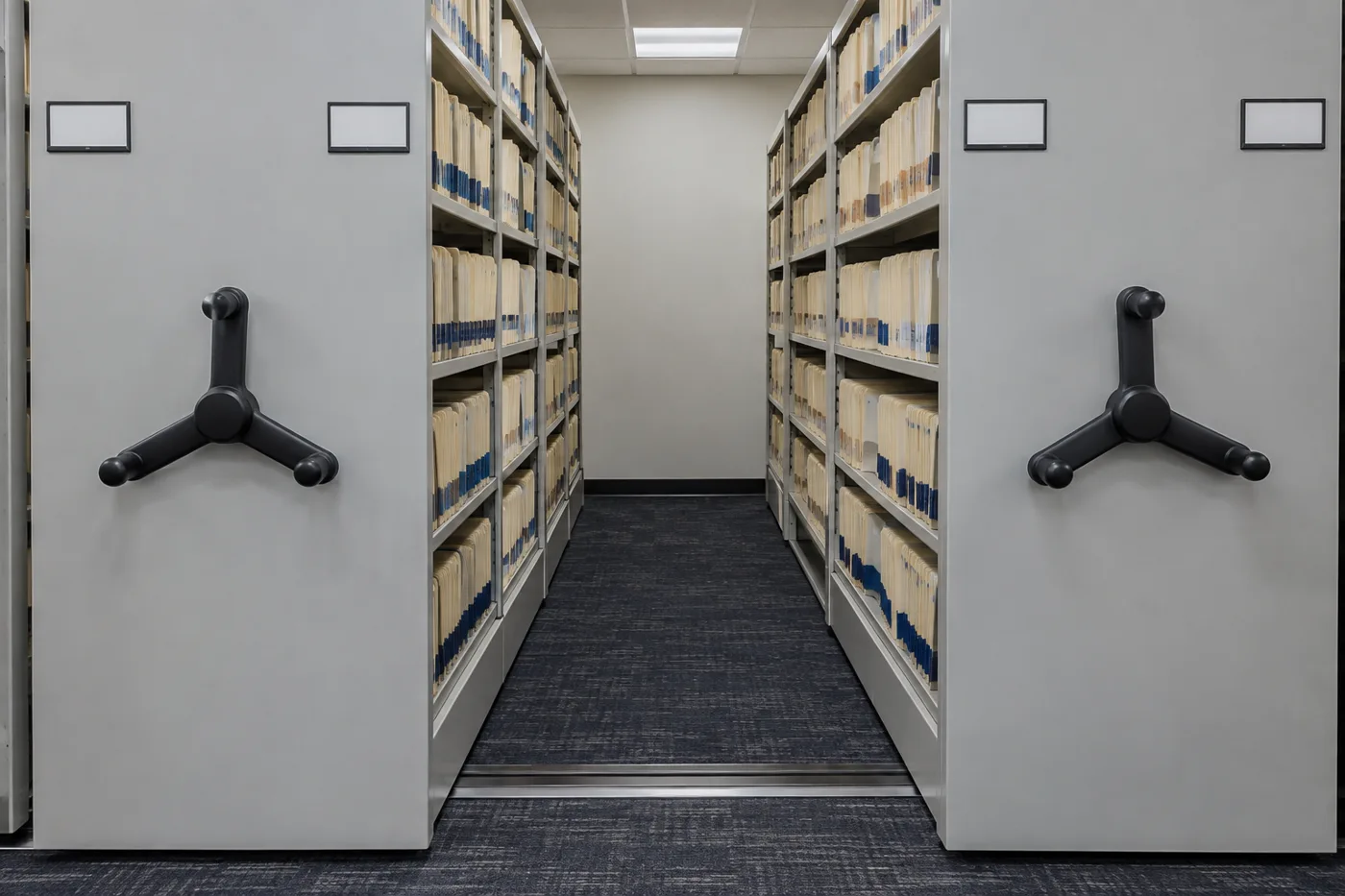
High-density mobile shelving in Utah is how many campus offices keep up. Shelving units ride on carriages that roll along floor rails, so instead of a fixed aisle between every pair of shelving rows you open only the aisle you need. The same room holds far more files, and the closed system can be locked. This guide focuses on what is specific to Utah higher education: which state rules apply, what the state’s Colleges and Universities retention schedule says, how that translates into zones on the shelving, how to handle student records and special collections, and how a campus project gets specified.
This is general planning guidance, not legal advice. Your institution’s records officer, general counsel and approved retention schedules have the final word on how long any record is kept. For city, county and state-agency offices, see our companion guide to Utah government records rooms.
Which rules apply to a Utah campus records room
Utah’s public colleges and universities are governmental entities for records purposes. The Government Records Access and Management Act (GRAMA) defines governmental entities to include any state-funded institution of higher education, and the Utah Board of Higher Education has its own board rule on records access and management that requires a records officer to follow GRAMA.
Campus policies build on that. The University of Utah’s archives policy states that all university records are state records and cannot be destroyed except as state law allows, and that originating offices are responsible for their records until they are officially transferred to the University Archives. Southern Utah University’s records retention policy points offices to the Utah Division of Archives and Records Service schedules and describes two outcomes once a retention period ends: transfer to the University Archives or State Archives, or destruction. Weber State directs offices to its approved schedule and to the Utah State General Retention Schedule for anything not listed.
For shelving, the practical point is simple: a campus records room is not just overflow storage. It holds records the institution is legally obliged to keep, find and eventually dispose of on schedule, so the layout should make those three jobs easy.
What Utah’s Colleges and Universities retention schedule says
The Utah Division of Archives and Records Service publishes general retention schedules, and one category is dedicated to colleges and universities (most items effective September 2017). A few common series show why a single campus often needs both short-term and permanent storage. Periods below are summarized from the state’s published schedule items; always confirm the current wording and any institution-specific schedule in the state general retention schedule search.
| Record series (state schedule item) | Retention summarized from the schedule | Storage implication |
|---|---|---|
| Student academic records (GRS-2048): final grades, grade changes, theses and dissertations, graduation | Permanent; retained 20 years after graduation, then may be transferred to the archives | Long-life, high-security storage near the registrar |
| Higher education admitted student application records (GRS-2041) | 5 years after graduation or separation | Active-to-inactive rotation by class year |
| Educational advising records (GRS-2042) | 5 years after separation | Rotating inactive zone |
| Financial aid records (GRS-2043) | 5 years after separation | Locked, audit-ready inactive zone |
| Student athletic records (GRS-2044) | 5 years after separation | Restricted zone (medical history) |
| Military and veteran students (GRS-2046) | 5 years after separation | Restricted zone |
| Student housing records (GRS-2045) | 3 years after the contract expires | Short-term rotation |
| College student registration records (GRS-2047) | 3 years | Short-term rotation |
| Higher education sponsored research records (GRS-2040) | 6 years after final action | Project-based inactive zone |
Outside the student series, the State Archives’ common-retention summary lists open meeting minutes and audited financial statements as permanent, grant records at 7 years, and employment history records at 65 years after date of hire or 3 years after separation. Some institutions also publish their own schedules; Snow College, for example, lists student transcript records as permanent and includes a legal, audit and compliance hold category that preserves records until the hold is released.
Put together, a typical campus records room holds a small amount of material that turns over every few years, a large block that sits untouched for five years or more, and a permanent collection that only grows. That mix is exactly where mobile shelving pays off: the long-retention material does not need open aisles all day. See the Utah Division of Archives record series and retention schedules for the source schedules.
Zoning the shelving around retention, not just department
Most campus rooms are laid out by department, which is how the files arrive. It works better to zone the ranges by how records move. A department can still own its ranges, but within them the shelving is arranged by retention stage:
Label ranges by series and destruction year, not only by office name. When the annual disposal review comes around, staff can open one aisle, confirm the boxes against the schedule and the box list, and clear a whole block of shelving at once.
Student records, FERPA and access control
Registrar, admissions, advising and financial aid files are education records under the federal Family Educational Rights and Privacy Act (FERPA). FERPA regulations require institutions to use reasonable methods to make sure school officials obtain access only to the education records in which they have a legitimate educational interest, and many universities meet that for paper files by keeping them in locked rooms with limited access. Private and GRAMA-classified records such as personnel files raise the same need to keep the right people in and everyone else out.
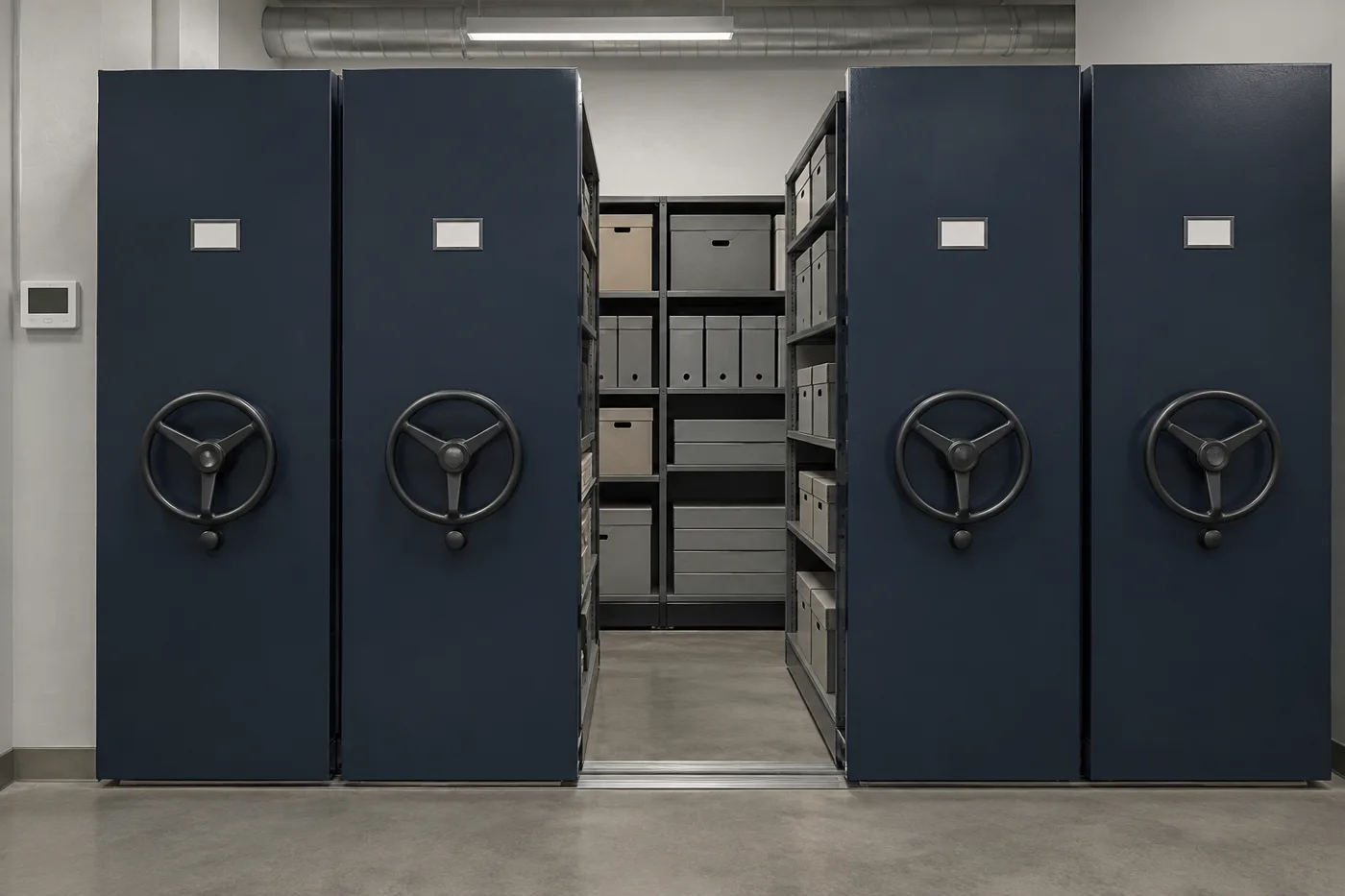
Mobile shelving helps because the closed system is itself a barrier. Common options include a system lock that secures all carriages when closed, locking end-panel doors, lockable doors within a range, and keypad or card control on powered systems. Treat these as one layer inside the room’s own access control and your institution’s records policy, not a replacement for them. Offices of record for student and personnel files are usually named in campus policy, so plan which offices share a room and which ranges each can open.
For the options in detail, see mobile shelving security and access control.
University archives, special collections and theses
University archives and special collections are the permanent end of the records life cycle. At the University of Utah, the University Archives is defined in policy as the official depository for non-current university records of permanent or historic value. Utah State University’s Special Collections and Archives, on the lower level of the Merrill-Cazier Library, holds rare books, manuscripts, photographs, government documents and the university archives. Collections like these grow every year and rarely give anything back.
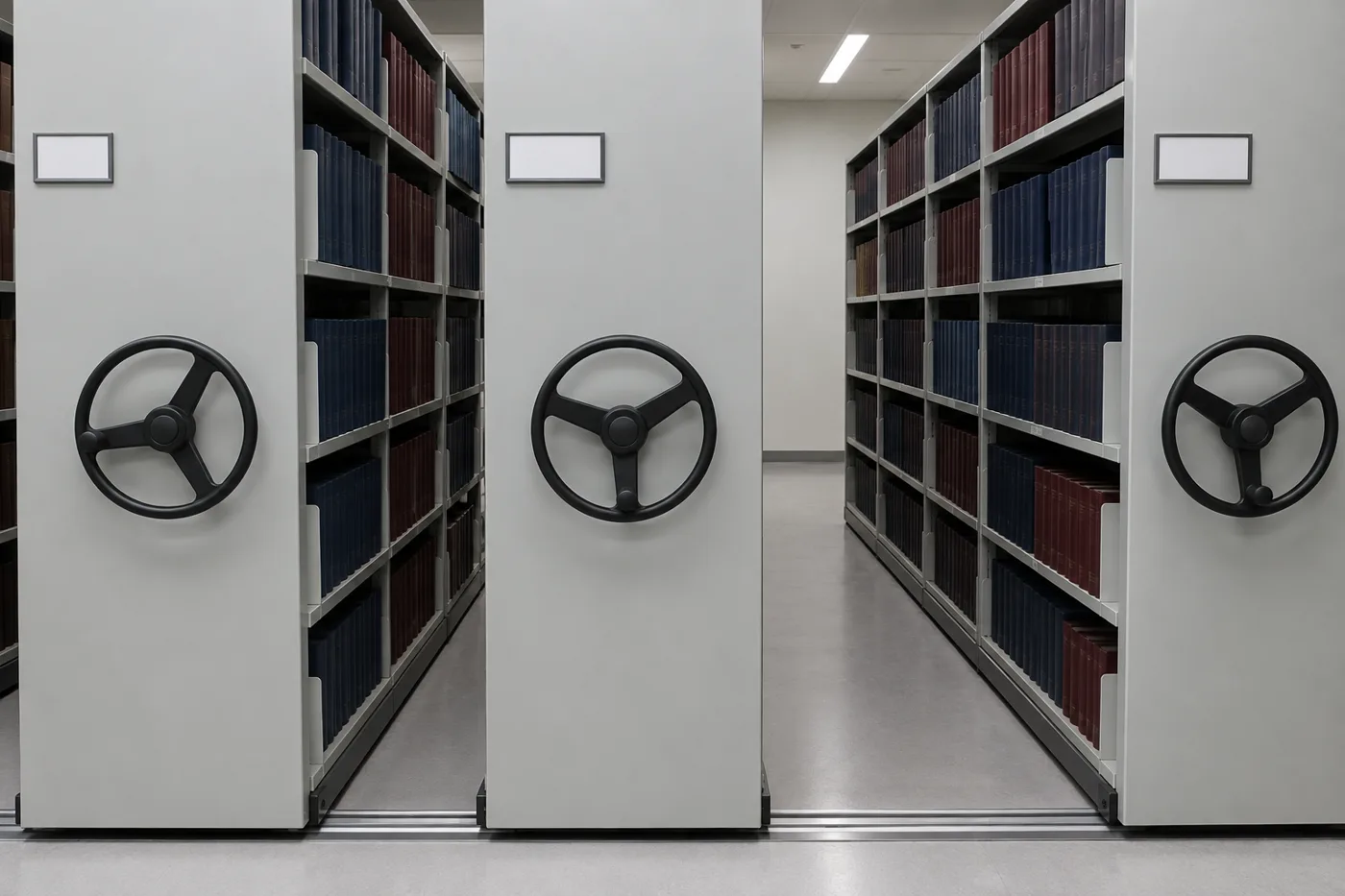
Theses and dissertations are a good example. They are named in the state’s student academic records series, they are bound to a uniform size, and most are consulted rarely once they are cataloged. Bound volumes and archival boxes suit mobile shelving well: shelves can be set to the volume height, bookends keep rows upright as carriages move, and flat boxes for oversize items go on deeper or lower shelves.
Archives stacks have extra planning points: stable temperature and humidity, no water lines above the ranges, shelf finishes suitable for collections, and restraints so contents stay put when carriages move or the ground shakes. Our museum and archival collections guide and library book stacks guide cover those details.
Plan the room for transfer and disposal, not just storage
Records do not stay in a campus records room forever. Each year some boxes reach the end of their retention period and are destroyed, and others move to the University Archives or the State Archives. A room that is designed only to hold boxes, with no space to work, turns every disposal cycle into a hallway project.
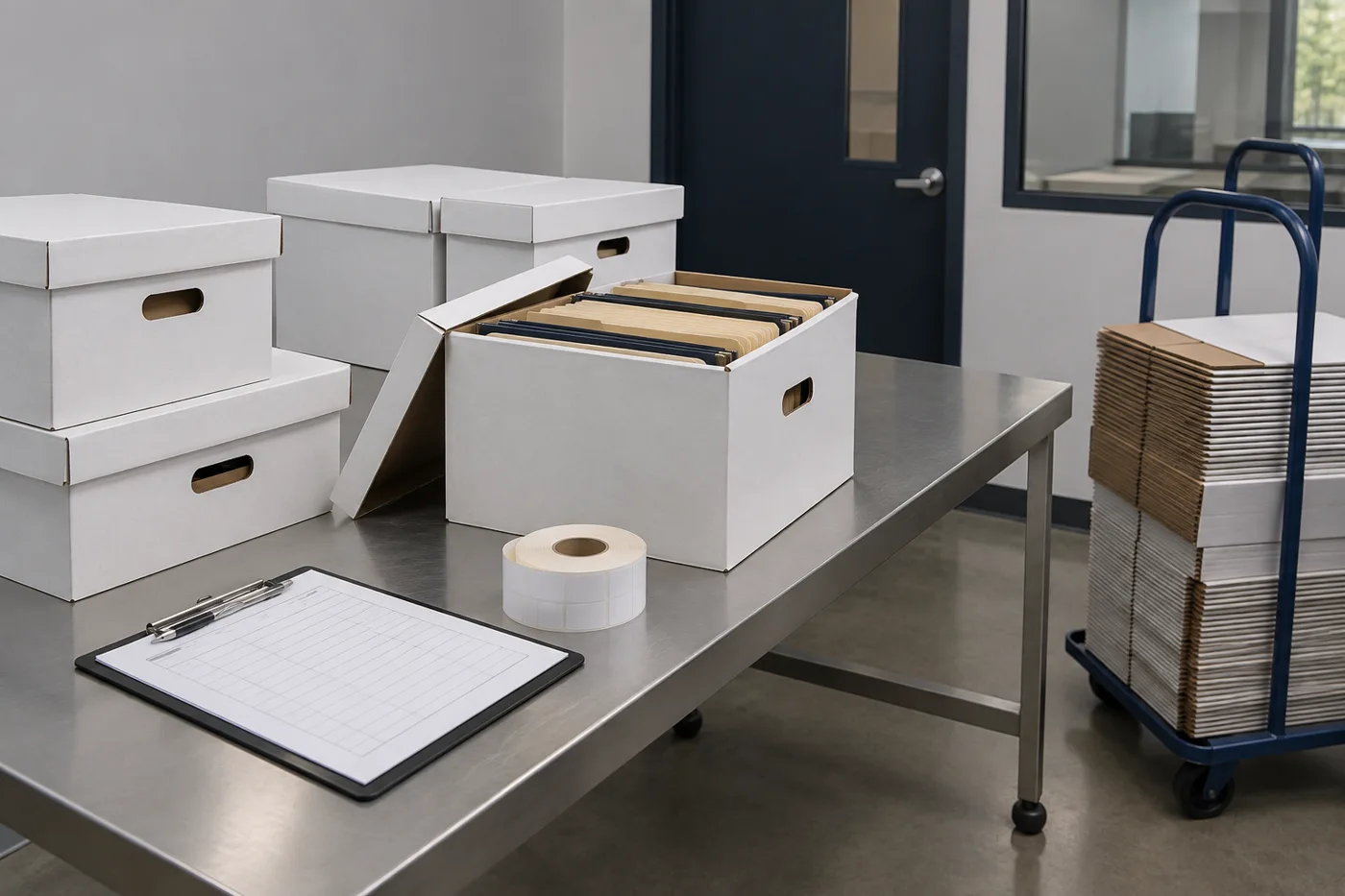
Plan a staging table near the door, space for a hand truck, and a short run of static shelving for boxes being processed. Standardize on one box size where you can: uniform records center boxes make shelf spacing simple and make it easy to count capacity. Utah government offices that send records to the State Records Center in Clearfield must use records center boxes made to State Archives specifications and follow its transfer and box-list procedures, so if your institution uses that service it makes sense to set shelves for those boxes from the start.
Keep box lists with the shelving plan. When each range and shelf has a location code that matches the box list, a record requested under GRAMA or needed for an audit can be found in minutes.
Campus building issues to settle early
Campus records rooms are often in older buildings, basements or converted offices, and that affects what can be installed:
- Floor capacity. Loaded paper storage is heavy, and mobile shelving concentrates it. Upper floors of older campus buildings may need a structural review before a system is ordered. See mobile shelving floor load requirements.
- Earthquakes. Most of Utah’s campuses sit along the Wasatch Front or other active fault zones, and tall loaded ranges need anchorage and shelf restraints designed for the site. Our guide to earthquake-ready mobile shelving in Utah covers the code path and state-building review.
- Sprinklers, lighting and HVAC. Ranges must be coordinated with sprinkler heads, light fixtures and air supply. See sprinkler, lighting and HVAC coordination.
- Accessibility. Aisle widths, carriage operating force and control height matter where staff with disabilities use the room. See ADA and accessible aisle planning.
- Timing. Registrar and financial aid offices are busiest at the start of each term. Schedule moves and installation for semester breaks or summer, and plan where files will live while the room is being worked on.
- Existing systems. Many campus rooms already have an older mobile system. It may be possible to expand or rework it rather than replace it; see relocating and reusing existing mobile shelving.
Manual, mechanical-assist or powered?
Most campus records rooms work well with mechanical-assist carriages moved by a handwheel, which need no power and little maintenance. Powered systems make sense for long or heavily loaded ranges, or where keypad or card access at the carriage is wanted, but they need power and a service plan. Whatever the drive, aisle safety devices keep carriages from closing on someone in an aisle.
| Drive type | Fits when | Watch for |
|---|---|---|
| Manual (push) | Short, lightly loaded ranges | Effort rises quickly with paper loads |
| Mechanical-assist (handwheel) | Most registrar, HR and archives rooms | Handwheel clearance at each end |
| Powered | Long or heavy ranges; keypad or card access | Power, controls and service plan |
Compare them in manual vs mechanical-assist vs powered mobile shelving.
How a Utah campus records room gets specified
Campus projects involve several offices, and the records room is easy to leave until the end. Settling these points early keeps it on track:
Helpful references: capacity sizing, shelf depth and level spacing, and the specification and submittal checklist. Public institutions often buy through cooperative contracts; see GSA and cooperative contract purchasing.
Common mistakes in campus records rooms
- Sizing the room for the files on hand today, with no allowance for permanent series that only grow.
- Mixing records from different retention periods in the same boxes, so nothing can be destroyed on time.
- Leaving student and personnel files on open shelving in a shared room.
- Forgetting a work and staging area for annual disposal and archives transfers.
- Ordering a system for an upper floor before anyone checks the structure.
Related Utah records pages
See how similar rooms were planned elsewhere in Utah: a school records file room in Cottonwood Heights, a museum records and file storage room in Salt Lake City, and a federal agency records room in Salt Lake City.
Shop Records Boxes, End-Tab Files and Archive Shelving Online
Records center boxes, end-tab file jackets for shelf filing, and static archive storage racks for active files and transfer staging. Engineered mobile shelving systems are designed and quoted per project.


Frequently asked questions
Do Utah public colleges and universities have to follow state records law?
How long do Utah colleges keep student records?
Is mobile shelving secure enough for FERPA-protected files?
Can we store archives and active office files in the same system?
Does a campus records room need seismic anchoring?
Manual or powered mobile shelving for a registrar or archives room?
Planning a campus records or archives room in Utah?
Send us the room dimensions, door locations and a rough list of the records series you plan to store. We will prepare a layout drawing, size it for growth and flag the floor, seismic and fire-protection questions to settle with campus facilities. Call (801) 328-8788 to start.