
Buying Mobile Shelving on GSA and Cooperative Contracts
Public buyers rarely lose a storage project on price. They lose it on the contract path, an under-described requirement, or installation scope that ended up on nobody’s order.
FAR 8.405
Ordering procedures for schedule buys
Furniture
Where storage and shelving sits, not IT
One order
Product, freight, installation and commissioning together
Site first
Slab, seismic and access drive the real price
The contract path is a project decision, not paperwork
Agencies buy high-density mobile shelving systems for the same reasons private organisations do: a records room is full, a building is being consolidated, or a collection has outgrown static shelving. What is different in the public sector is that how you buy shapes what you are allowed to ask for, how the price is justified, and whether the installation that makes the equipment work is inside the award at all.
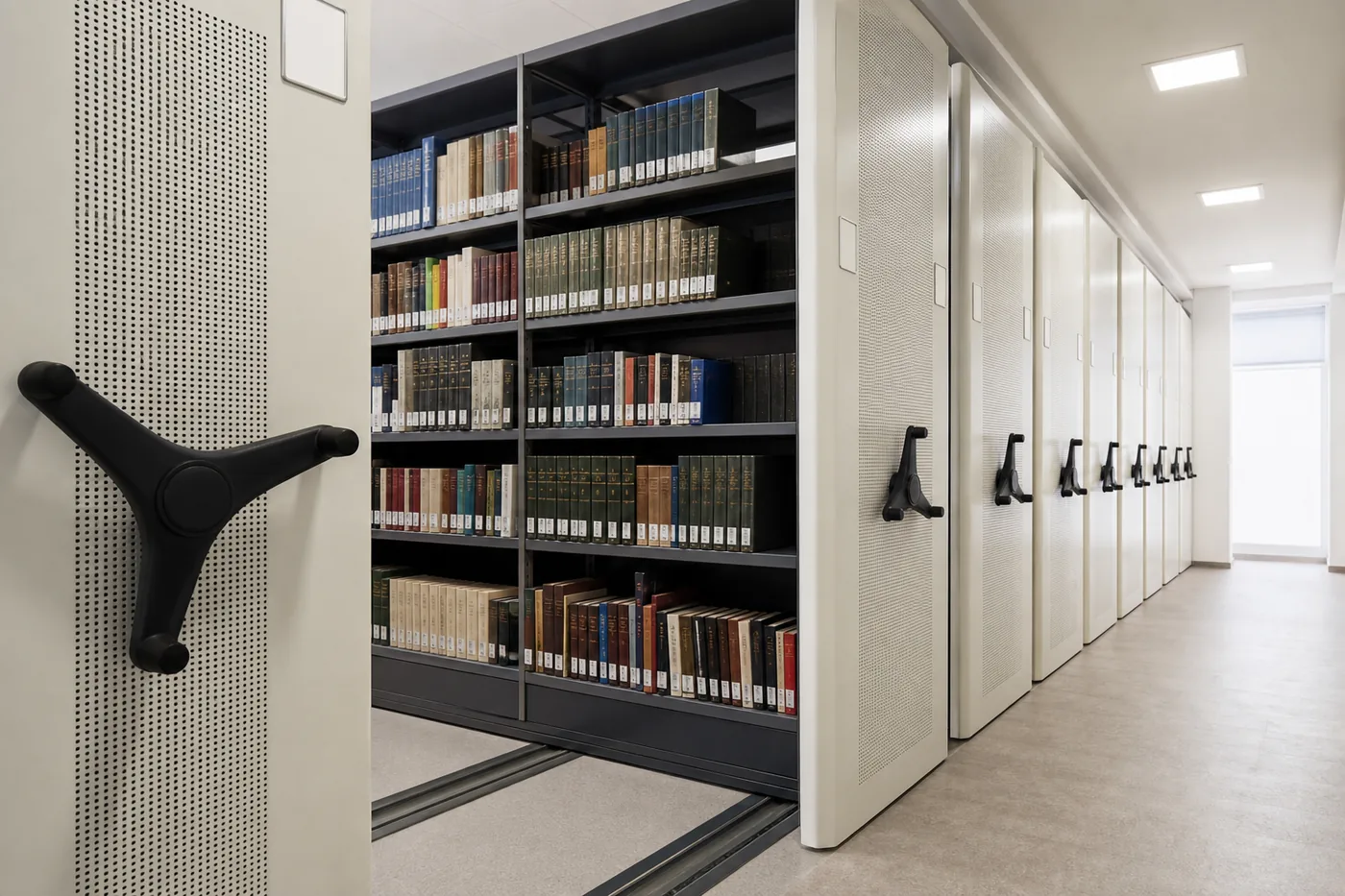
That is why so many public storage projects stall in the middle. The equipment is straightforward. The difficulty is that a mobile shelving room is simultaneously a product buy, a construction-adjacent installation, and a building interface — rail anchored to a slab, a floor whose capacity has to be verified, and seismic requirements that vary by jurisdiction. Contract vehicles that handle catalogue furniture cleanly can handle that badly if the requirement is written as if you were buying desks.
This page sets out the paths available to public buyers, what belongs in the requirement, and how to evaluate quotes so the award you make is the project you actually need.
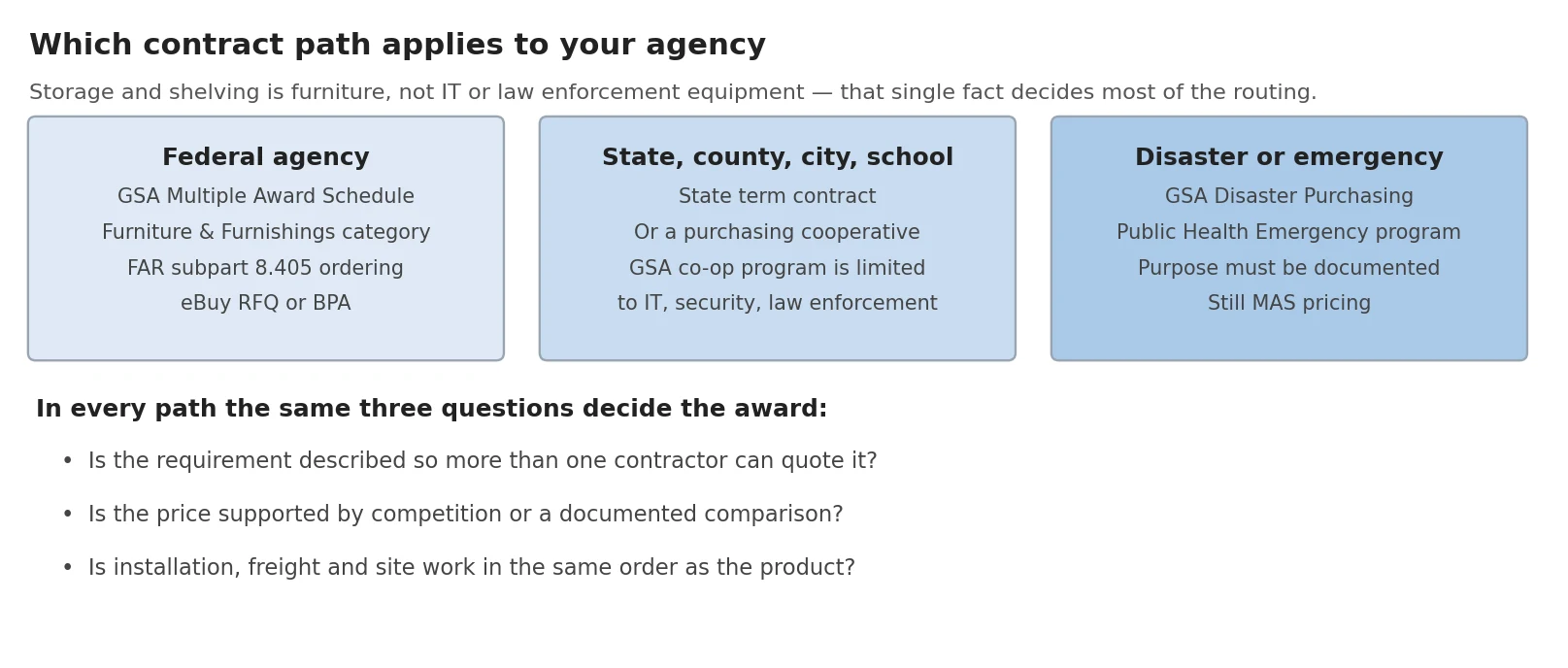
Which path applies to your agency
Three families cover nearly every public purchase of storage equipment.
| Buyer | Usual path | What governs it |
|---|---|---|
| Federal agency | GSA Multiple Award Schedule order or a blanket purchase agreement against a schedule contract | Schedule ordering procedures in FAR subpart 8.405, applied by your contracting officer |
| State agency | State term contract, or a cooperative contract the state has adopted | State procurement code; for NASPO ValuePoint portfolios, the participating addendum the state executed |
| County, city, district | Local solicitation, state contract if permitted, or a purchasing cooperative | Local procurement policy plus whatever the cooperative’s participation rules require |
| K-12 and higher education | Cooperative contracts are common, alongside institutional solicitations | Institutional policy; cooperative eligibility varies by cooperative and by state |
| Disaster or public health response | GSA’s Disaster Purchasing or Public Health Emergency programs for eligible non-federal buyers | Statutory authorities with a documented purpose for the purchase |
The point that surprises most local buyers
GSA’s Cooperative Purchasing program — the one that lets eligible state and local governments buy from the Multiple Award Schedule — is limited by GSA’s published guidance to information technology and to security and law enforcement categories. Shelving and storage furniture is not in those categories. If someone tells you your city can simply ‘buy it off GSA’, check that assumption with your own procurement office before it becomes a protest.
Federal buyers: running a schedule order for a storage room
For a federal agency, the mechanics are familiar; the content is what needs care. The order needs to describe a working room, not a list of shelving units.
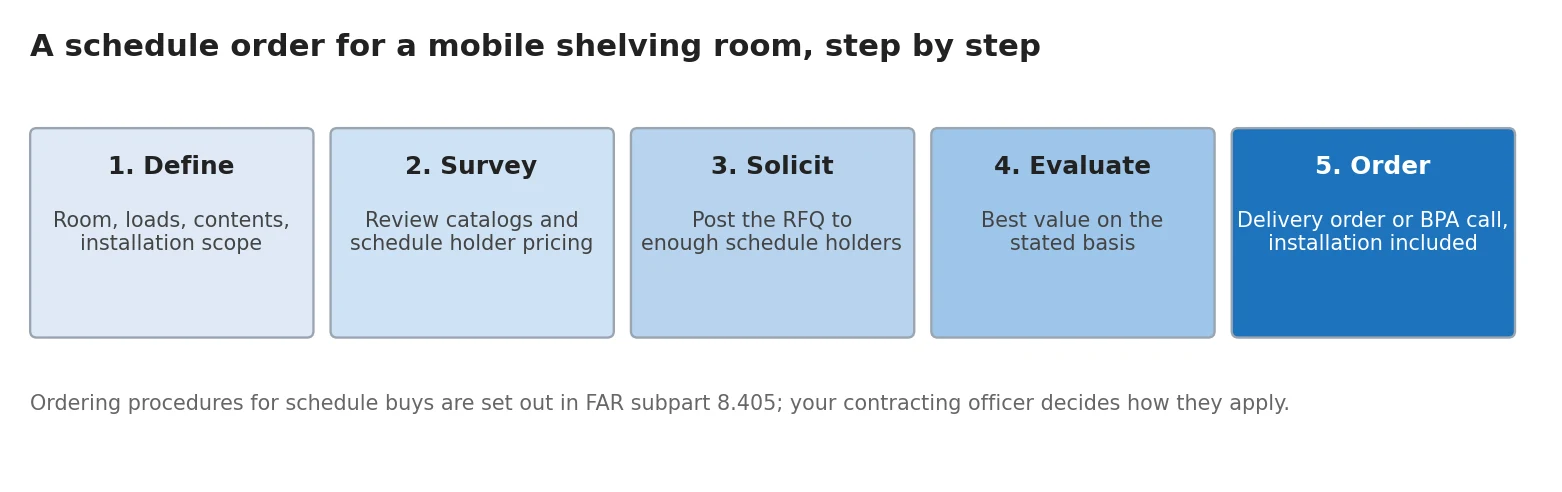
Competition on a schedule buy comes from the ordering procedures themselves: reviewing catalogs or price lists from schedule contractors, requesting quotations from enough contractors that capable sources can respond, or posting a request for quotation so all schedule holders offering the required supplies get an opportunity. Blanket purchase agreements exist for repetitive needs and have their own establishment procedures, with a stated preference for multiple-award BPAs where practicable. Which of those applies to your order is a decision for your contracting officer, not for a vendor.
MH-USA holds and works under federal contract vehicles for this product family, including the Aurora mobile shelving GSA contract and the TAB mobile shelving GSA contract. Our military and government storage page covers the broader product range available to agencies.
State, local and education buyers
Outside the federal government the routing is more varied, and the single most useful habit is to confirm eligibility in writing before you plan around a vehicle.
Whichever vehicle you use, the site-specific work does not go away. A public records room still needs its floor capacity verified and its seismic requirements met to the governing code, and those obligations belong in the requirement rather than in a change order.
Ask the eligibility question early and in writing
Cooperative participation rules differ by cooperative, by state and sometimes by entity type. The cost of asking your procurement office at the start is one email. The cost of discovering the answer after award is a re-solicitation and a delayed project. If your entity has used a cooperative before for furniture, ask specifically whether the same authority extends to installed storage systems, because installed work is where the answers most often diverge.
Writing a requirement that produces comparable quotes
The most common cause of unusable quotes is a requirement that describes the equipment but not the room. Two vendors can both be responsive and quote wildly different systems if the requirement leaves the important variables open. A defensible requirement for a mobile shelving room states:
- What is stored, in the units you actually count it in — cartons, linear inches of files, binders, uniforms, specimens — and the growth you expect over the retention period.
- The room — dimensions, clear height, obstructions, door and elevator access, floor construction and the structural capacity if it is known.
- The performance you need — accessible aisle provision, drive type, security and locking, and any environmental conditions the shelving must live in.
- The scope boundary — who removes the existing shelving, who moves the contents, who patches and finishes the floor, and who provides power if the system is powered.
- Submittals and closeout — shop drawings, structural documentation, commissioning, operator training and warranty documentation, as set out in the specification and submittal checklist.
Describe outcomes, keep it competitive
A requirement can be demanding and still be open. Specify capacity, aisle behaviour, load ratings, finishes and the installation standard rather than one manufacturer’s part numbers. That is what lets several qualified contractors quote the same room and lets you evaluate them on something other than the price of a shelf.
Installation is not a line item, it is the project
Most of the risk in a public storage award sits in the work between delivery and use. Rail has to be set out and levelled to the manufacturer’s tolerance on your slab, anchored, and the system commissioned so carriages move properly under load. Contents have to leave the room before the work starts and come back afterwards in a controlled order. In an occupied building there is dust, noise, egress and access to manage, and often a phased plan so the room stays partly usable.
When that scope is split from the equipment award, the seams become disputes: the shelving arrives before the floor is ready, or the floor contractor finishes to a tolerance the shelving manufacturer will not accept. The installation process guide sets out the sequence and the site-readiness gates that a well-written order should require.
Freight is worth naming too. High-density shelving is heavy, palletised, and often needs a lift gate, inside delivery and staging space. Whether that is included, and who receives and stores it if the room is not ready, belongs in the order rather than in a later conversation.
Evaluating quotes without buying the cheapest gap
Price differences between quotes for the same room usually come from scope differences, not from margin. Before comparing totals, normalise the quotes against a short list of questions.
| Question | Why it moves the price | What to ask for |
|---|---|---|
| Is installation included and to what standard? | Levelling, anchoring and commissioning are a significant share of installed cost | A stated installation scope and the levelling tolerance the manufacturer requires |
| Is rail recessed or surface-mounted? | Recessed rail brings floor work; surface rail brings ramps and accessible route implications | The rail type quoted and any floor work included or excluded |
| Whose scope is the existing shelving and contents? | Removal, disposal and content handling are real labour | Explicit inclusion or exclusion, with disposal responsibility named |
| What is the seismic and structural documentation? | Engineering and anchorage vary by jurisdiction and can be a separate cost | What documentation is provided and who seals it |
| What are the shelf capacities, at what size? | A cheaper shelf is often a lighter shelf | Published capacity for the exact shelf size and gauge quoted |
| What is the freight and delivery arrangement? | Lift gate, inside delivery and storage are frequently excluded | Delivery terms in writing, including who receives it |
The cost and budget drivers guide goes into what actually moves the number on a project of this type, which is useful when you are defending an estimate before the solicitation is issued.
Need budget pricing or specification help for a solicitation?
We routinely provide public agencies with budgetary pricing, layout options and specification language they can issue competitively. Tell us the room and what it has to hold.
Five mistakes that cost public projects the most
Assuming the vehicle before checking eligibility
Confirm in writing that your entity may use the contract you are planning around, for installed storage systems specifically — not just for furniture in general.
Buying shelving and installation separately
The seam between them is where levelling tolerance and commissioning stop being anyone’s responsibility.
Describing the equipment instead of the room
Quotes are only comparable when every bidder is pricing the same contents, the same clear height and the same access constraints.
Leaving the floor out of the requirement
Slab capacity, flatness and finish are the difference between a system that rolls smoothly and a warranty argument.
Treating growth as optional
A records room sized for today’s volume is full on the day it opens. Retention schedules give you the number; use it.
Public work we have delivered
Agency projects in this cluster include a state agency records storage system and a corrections inmate records room. Both were ordinary rooms with unusual constraints — which is the normal condition of public storage work rather than the exception.
Related Boxes & Packaging Supplies
These are boxes and packaging supplies, not shelving, mobile carriages, or storage-system equipment. See each product page for current price and ordering details.




Get a free quote
Tell us what you are storing, the room size and your timeline. A project specialist will follow up with layout options and pricing. Prefer to talk? Call (800) 326-4403.
Frequently asked questions
Can I buy mobile shelving on a GSA schedule?
Can a city, county or school district buy shelving through GSA?
What is a purchasing cooperative and why do agencies use one?
Do we need three quotes?
Should installation be on the same order as the shelving?
Is a sole source justification ever appropriate?
Working on a public storage project?
We can provide budgetary pricing, layouts and specification language for your solicitation, and quote installed systems under the contract vehicle your agency uses.