
Manual vs. Mechanical-Assist vs. Powered Mobile Shelving
How to choose a carriage drive type for a high-density shelving system — matching the mechanism to the load, the access pattern, the users and the building services you actually have.

3
Drive classes: manual, mechanical-assist and powered
10 56 26.13
MasterFormat section for manual mobile storage shelving
10 56 26.23
MasterFormat section for motorized mobile storage shelving
15–48 in.
Reach range that push-button controls can be placed within
The drive type is the decision users live with every day
Two high-density mobile shelving systems can hold identical shelving, sit on identical rail and store identical material, and still feel completely different to the people who work in them. The difference is the drive: how a carriage is moved and how an aisle is opened. Drive type also decides the safety package, because it changes who supplies the force that closes the aisle — see our guide to mobile shelving safety devices, aisle sensors and carriage locks.
There are three classes. A manual system is moved directly by the operator, usually with a pull handle or by pushing the end panel. A mechanical-assist system puts a geared handwheel or three-spoke handle between the operator and the carriage, so a modest hand effort turns into the force needed to move a heavy range. A powered system moves the carriage with an electric drive, opened at the press of a button. The construction specification world recognizes the split explicitly: mobile storage shelving is specified under MasterFormat section 10 56 26, subdivided into 10 56 26.13 for manual and 10 56 26.23 for motorized systems.
The choice is not a ranking. It is a match between the mechanism and four facts about the project: how much weight each carriage carries, how often and how hard the system is accessed, who the users are, and what building services are available. This page works through those four facts and the practical consequences of each option, so the decision is made deliberately instead of defaulting to whatever the first quote used.
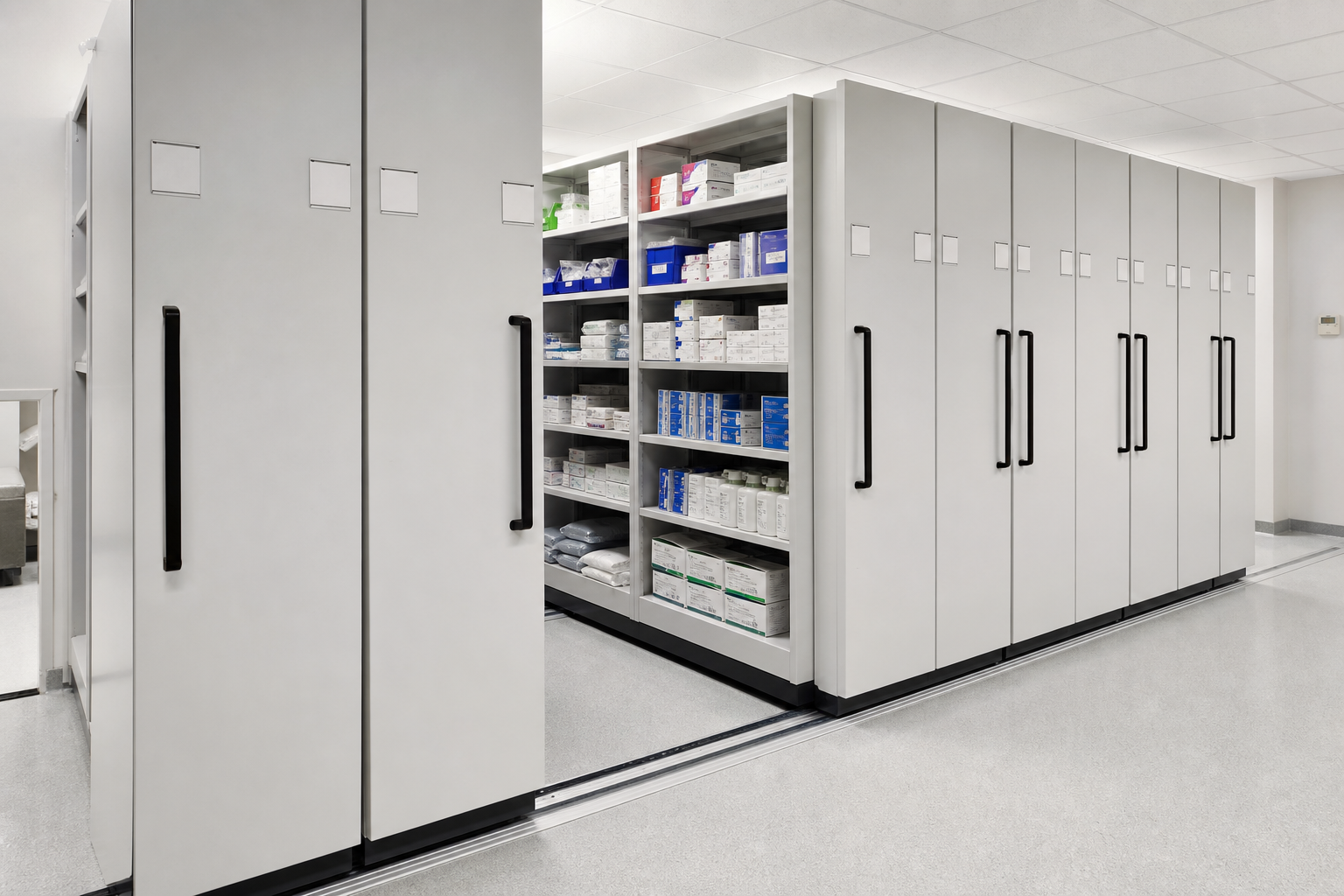
Manual: simple, quiet and easy to underestimate
A manual system has the fewest parts of anything in the category. There is no gearbox, no motor, no controls and no power. The operator grips a handle or the end panel and moves the carriage directly. Fewer components means less to maintain, less to fail and the lowest installed complexity of the three. For a plain-language walkthrough of every part named on this page — carriage, rail, end panel, gear reducer, drive shaft — see our anatomy of a mobile shelving system: parts, components and how they work.
It also means the operator feels the entire load. That is comfortable on a short range of light material — a supply closet, a small file room, a lab consumables system — and steadily less comfortable as range length, shelf depth and material density grow. Weight is not the only variable: rail cleanliness, floor levelness and how evenly a range is loaded all change how a manual carriage feels months after handover.
Manual is the right answer when ranges are short, loads are light, access is occasional, and no user has a functional reason to need reduced operating effort. Where any one of those is uncertain, it is usually cheaper to move up a class at purchase than to retrofit a drive later.
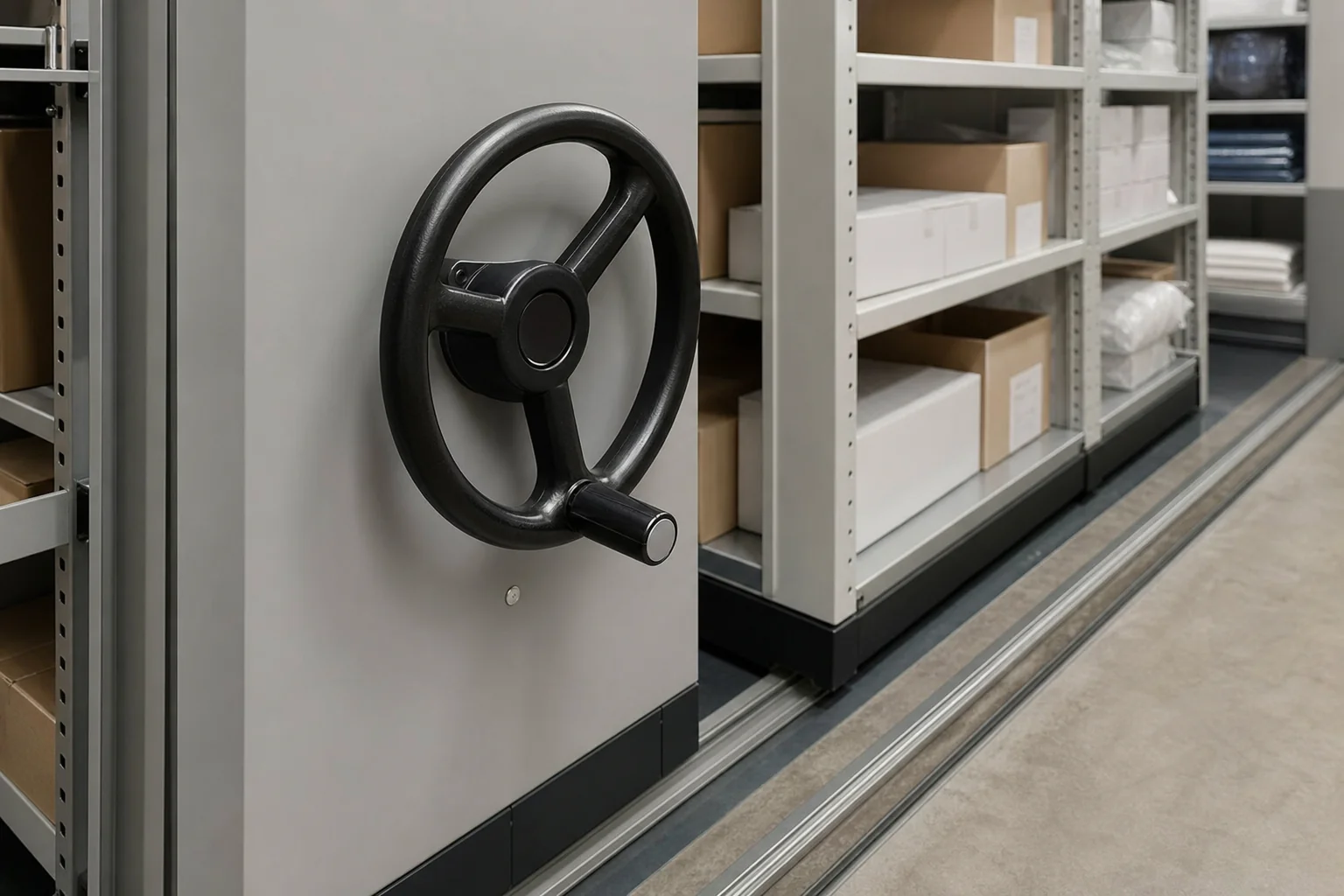
Mechanical-assist: the default for working records and library systems
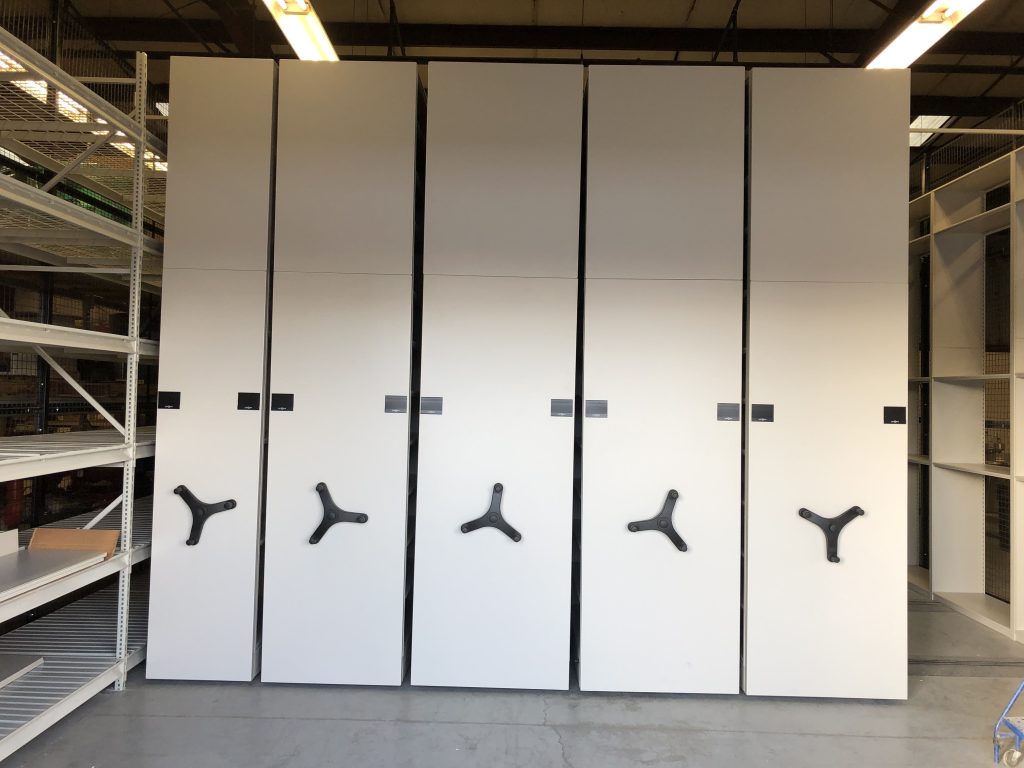
Mechanical-assist is what most people picture when they picture compact shelving: a three-spoke handle or a handwheel on the end of each carriage, geared so the operator turns a wheel rather than shoving a loaded range. The gearing is the entire point. It converts a manageable, sustained hand motion into carriage movement, which is why mechanical-assist stays comfortable at range lengths and loads where manual has long since stopped being pleasant.
That makes it the workhorse class for records rooms, library and archival stacks, evidence storage, museum collections and parts rooms — anywhere staff open aisles many times a day and the ranges are long. It adds no building services: no circuit, no conduit, no electrical rough-in, no coordination with Division 26. For a retrofit into an occupied building, that alone often decides it.
Two things still have to be checked rather than assumed. First, operating effort under full load, on the actual floor, with the actual material — not on a showroom sample. Second, handle position: a handle mounted for a standing user may sit outside the reach range for a seated one, which matters wherever accessible aisle planning is part of the project.
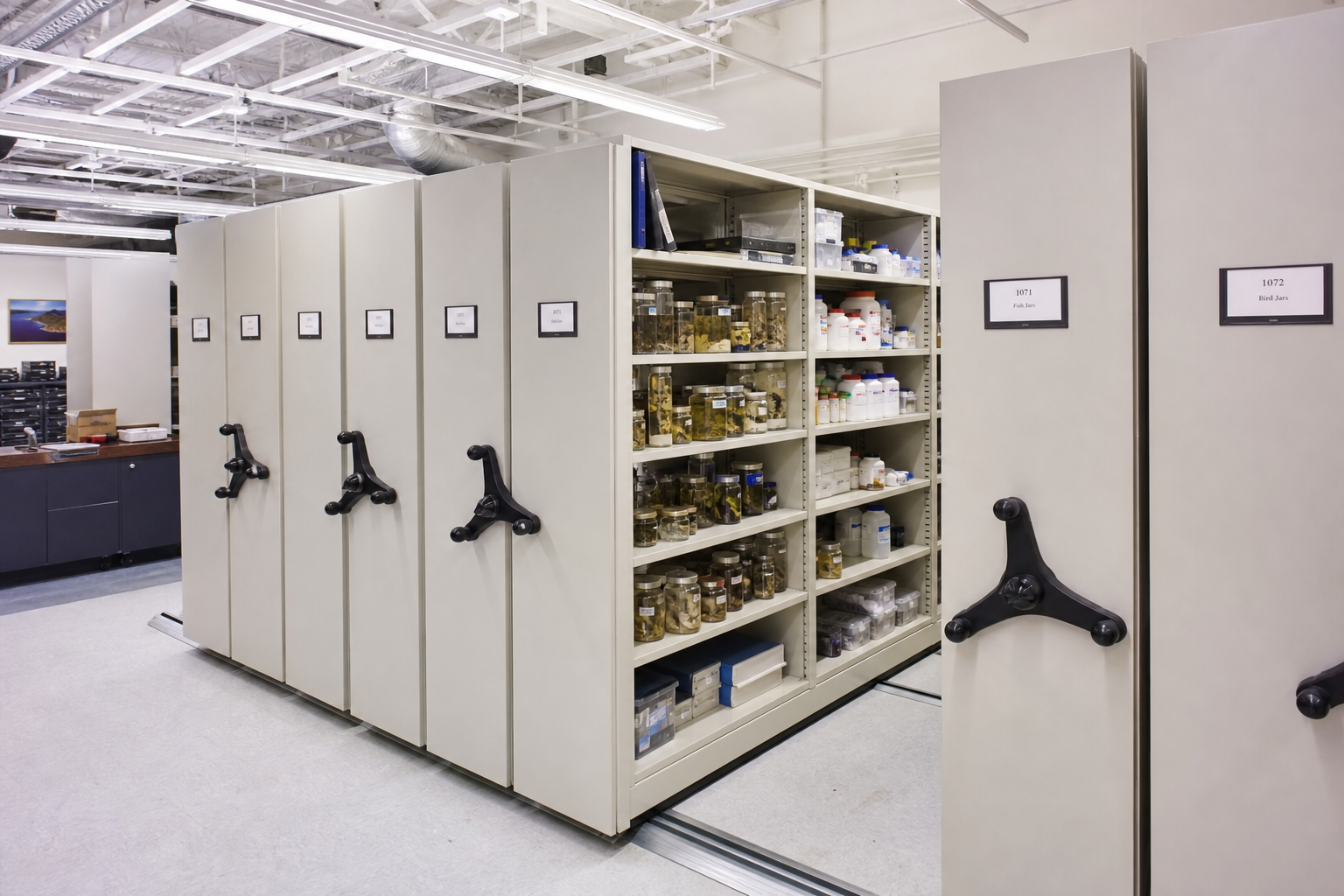
Powered: when access frequency, load or users make effort the constraint
A powered system replaces operator effort with an electric drive and a control — usually a push-button or touch pad on each carriage face. Where mechanical-assist reduces effort, powered removes it, which changes what the system can be asked to do.
Powered drives earn their place in three situations. The first is heavy or very long ranges, where even geared effort becomes a repetitive-motion issue for staff who open aisles all day. The second is high access frequency, particularly in shared rooms where many people use the system and consistency of operation matters more than mechanical simplicity. The third is accessibility: a push-button can be mounted inside the ADA reach range and operated with one hand and light force, which is difficult to guarantee with a handle whose effort varies with load.
The cost is coordination. A powered system needs power. In a typical specification, the shelving package provides the drives and controls while the power wiring and final connections are a separate electrical scope, which means Division 26 coordination, a circuit in the right place, and a conversation with the electrical engineer before the room is finished. Powered systems also introduce control and safety hardware that has to be maintained, and staff who need to know what to do when a safety device trips.
Comparing the three side by side
The comparison below is a planning tool, not a specification. Exact capacities, control types and safety features vary by manufacturer and model, and should be confirmed against the product data for the system being priced.

| Project condition | Points toward |
|---|---|
| Short ranges, light material, occasional access | Manual |
| Long ranges, heavy or dense material, daily staff access | Mechanical-assist |
| Very heavy loads or continuous, all-day aisle opening | Powered |
| No power available and no practical route for a new circuit | Manual or mechanical-assist |
| Independent operation by users who cannot apply sustained hand force | Powered |
| Retrofit into an occupied building with minimal trade coordination | Mechanical-assist |
| Shared public or multi-department room with mixed user population | Powered, or mechanical-assist with verified operating effort |
| Lowest long-term maintenance surface | Manual |
Match the drive to the loaded system, not the empty one
Every drive feels effortless on an empty range in a showroom. The decision that matters is how the mechanism performs on a full range, on your floor, at the frequency your staff will actually use it.
What each choice pulls in behind it
Each of these knock-on scopes also has a price, which is why the drive decision has to be settled before pricing is collected; see what drives the cost of a mobile shelving system for how it interacts with the rest of the budget.
Choosing a drive is also choosing a set of downstream obligations — electrical scope, service routine, training and future flexibility. These are the ones that most often show up after the purchase order.
Not sure which drive class your room justifies?
Send us the range lengths, the material and how often the system will be opened. We will tell you which drive class fits, what it needs from the building, and what it does not.

What stays the same regardless of drive type
The drive changes how an aisle opens. It does not change the engineering underneath the system. Every class rides on rail that has to be set true on a floor with adequate capacity, so floor load verification and rail preparation come first regardless of what moves the carriages. In areas where seismic design applies, the same anchorage and bracing questions apply to a manual system and a powered one alike.
Clearance to fire sprinklers, egress paths, aisle width and shelf reach are also drive-independent. They are decided by the layout and the room, and a powered drive will not rescue a plan that never had room for a compliant aisle.
To compare the individual system types in more depth, see our pages on manual mobile shelving, mechanical-assist mobile shelving and electric mobile shelving.
Get a free quote
Tell us what you are storing, the room size and your timeline. A project specialist will follow up with layout options and pricing. Prefer to talk? Call (800) 326-4403.
What is the difference between mechanical-assist and powered mobile shelving?
Is manual mobile shelving a bad choice?
Does powered mobile shelving need special electrical work?
Can a manual or mechanical-assist system be converted to powered later?
Which drive type is best for accessibility?
How is the drive type reflected in a construction specification?
Get the Right Drive Class the First Time
Tell us what you are storing, how long the ranges are and how often the system gets opened. We will match the drive to the work and show you what each option requires from the building.