
Mobile Shelving Safety: Aisle Sensors, Carriage Locks and Anti-Tip Devices
High-density storage puts staff inside a moving machine. Here is how aisle locks, sensing devices, anti-tip provisions and a short inspection routine keep a mobile shelving room safe to work in.

The aisle
is where staff work — treat it as the point of operation
1 per aisle
Minimum photoelectric safety sweep in common published mobile shelving specifications
Lock first
Positive carriage locking with visible locked/unlocked indication
Seismic
In-track anti-tip provisions are commonly recommended in seismic zones
A compact storage room is a machine that people stand inside
Static shelving is inert. A track-mounted mobile shelving system is not: ranges weighing thousands of pounds each travel along rails, and the only place to retrieve anything is the open aisle between them. Almost every genuine safety question about high-density storage comes back to that one fact. Someone is standing in the gap, and something heavy can close it.
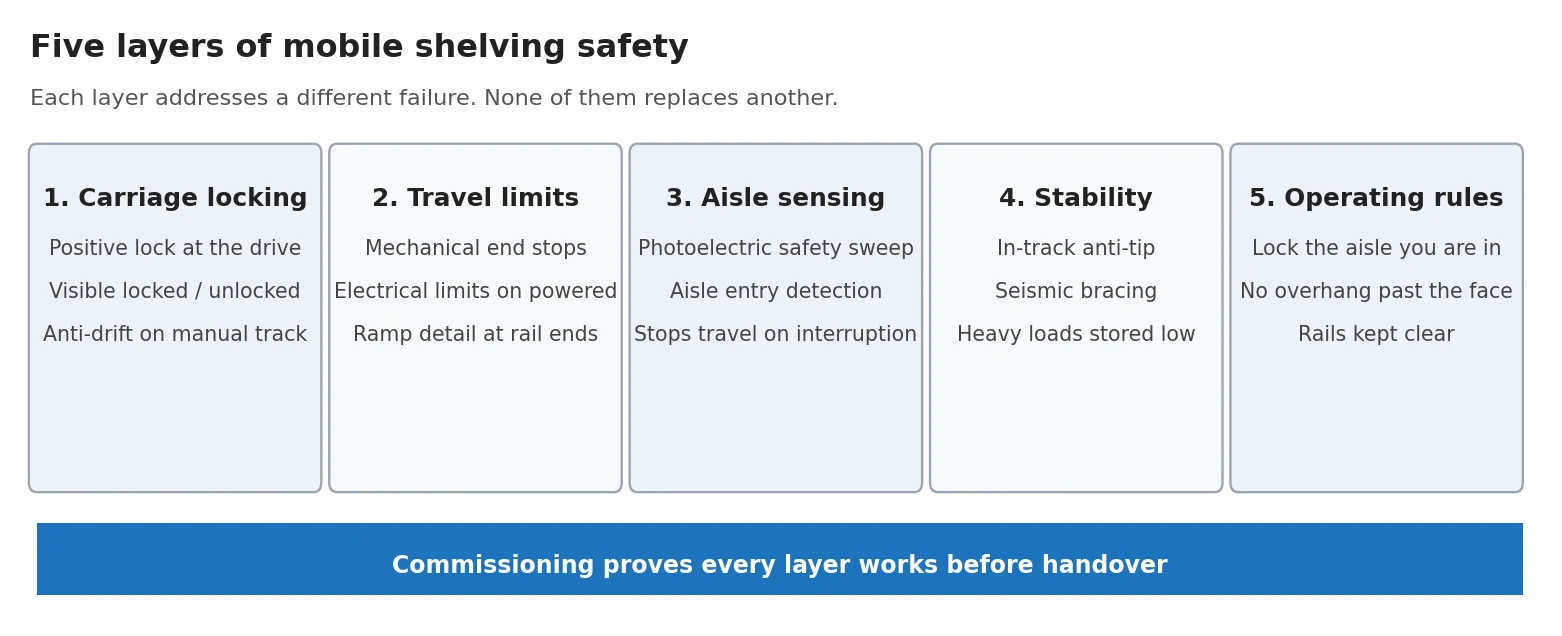
The risks are specific and well understood, which is what makes them manageable:
- Aisle closure while occupied. A carriage moves — driven, drifting or pushed — while a person is inside the aisle. This is the hazard every safety device on a mobile system exists to address.
- Drift on an out-of-level floor. An unlocked carriage on a slightly sloping slab creeps. It is slow, silent and the reason positive locking matters more than it sounds.
- Tipping or collapse. Tall, heavily loaded, top-weighted or seismically shaken ranges. Addressed by anti-tip provisions, bracing and load discipline rather than by sensors.
- Trip, pinch and crush points. Surface-mounted rail edges, the gap between end panels, fingers on a closing face, and material overhanging a shelf front.
- Housekeeping failures. Debris on the rail, cartons stored in the aisle, and stock stacked on top of ranges near sprinklers — all of which turn a safe system into an unsafe one without anything mechanical changing.
Which rules actually apply
There is no single American standard titled “mobile shelving safety”, which is why buyers often receive vague answers. In practice four bodies of requirement do the work.
| Source | What it says that matters here | How it lands on a project |
|---|---|---|
| OSHA general machine guarding (general industry) | Where the operation of a machine exposes an employee to injury, the point of operation must be guarded; barrier guards, two-hand tripping devices and electronic safety devices are named as guarding methods | On a powered system the open aisle is the point of operation, so detection devices are the guarding — not an upsell |
| OSHA materials handling and storage | Aisles and passageways kept clear, in good repair and appropriately marked; stored material must not create a hazard; guarding of openings | Housekeeping and marking obligations continue for the life of the room, and they are the owner’s |
| Structural shelving standard for industrial steel bin shelving | Its current edition explicitly covers bin shelving placed on mobile carriages, and capacities are stated on a uniformly distributed load basis | Shelf and carriage ratings must be read as tested; concentrated or dropped loads are outside them |
| Federal records-storage regulations for records facilities | Shelving must be braced against collapse to the most stringent applicable seismic code, and compact mobile shelving must be arranged to permit air circulation and fire protection | Government and records-centre projects inherit these as contract requirements |
| European machinery standard for power-operated mobile racking and shelving | A dedicated safety standard for power-operated mobile shelving, racking, carousels and storage lifts, covering hazards during installation, start-up, operation, maintenance and dismantling | Not a U.S. requirement, but the reference many manufacturers design powered products against; useful vocabulary when comparing offers |
What this page is not
This page is planning vocabulary, not a safety certification, a guarding assessment or an engineering approval. Guarding decisions for a specific installation belong to the manufacturer’s product design and to your own competent safety review; structural and seismic decisions belong to a licensed engineer.
The devices, in plain language
Manufacturers use trade names for these, and the names differ. The functions do not.
Carriage locking
The primary protection on any manually driven system. Published mobile-shelving specifications describe a single safety lock button mounted on each operating wheel hub, which locks the carriage when pushed in and lets it move in either direction when pulled out, together with colour-coded visual indicators that confirm whether a carriage is locked or unlocked. Flat-track manual systems commonly use a foot-engaged anti-drift mechanism that secures the carriage in place and prevents it from creeping. In both cases the point is the same: the person in the aisle can positively immobilise the range beside them and can see that it is immobilised.
Aisle safety locks and dual-end control
Longer carriages are often driven from either end. That creates a scenario where a colleague opens the aisle you locked from the other end, so specifications offer interconnected dual-aisle locking that secures the open aisle at both ends at once. If your carriages have controls at both ends, ask specifically how the lock behaves from the far end.
Photoelectric safety sweeps
An infrared beam or beam array watching the aisle. Published specifications call for a sweep at a minimum of one per aisle, with options for sweeps on both sides of every movable carriage and additional sweeps at waist height. Interruption of the beam stops carriage travel. Sweeps are the standard guarding on powered systems and an available option on some mechanical-assist systems.
Aisle entry detection
A distinct function from a face-mounted sweep: cross-aisle sensing detects a person entering an aisle that is in the process of closing, and stops the movement. Face sweeps protect against contact; entry detection protects against someone walking into a closing gap.
End stops and travel limits
Mechanical stops prevent a carriage from running off the end of the rail, and powered systems add electrical travel limits. On surface-mounted rail these interact with the ramp detail at the ends of the run, discussed in the comparison of recessed and surface-mounted rail.
Controls placed for the people who use them
Control position is a safety feature. Published powered-system specifications place aisle controls around 44 inches above the floor on the right side of the face panel and require them to be within accessible reach guidelines; manual specifications require at least one operating knob per carriage within reach guidelines at all times. The accessible aisle planning guide covers reach and clear-width planning in detail.
Guards you can see, and habits you cannot
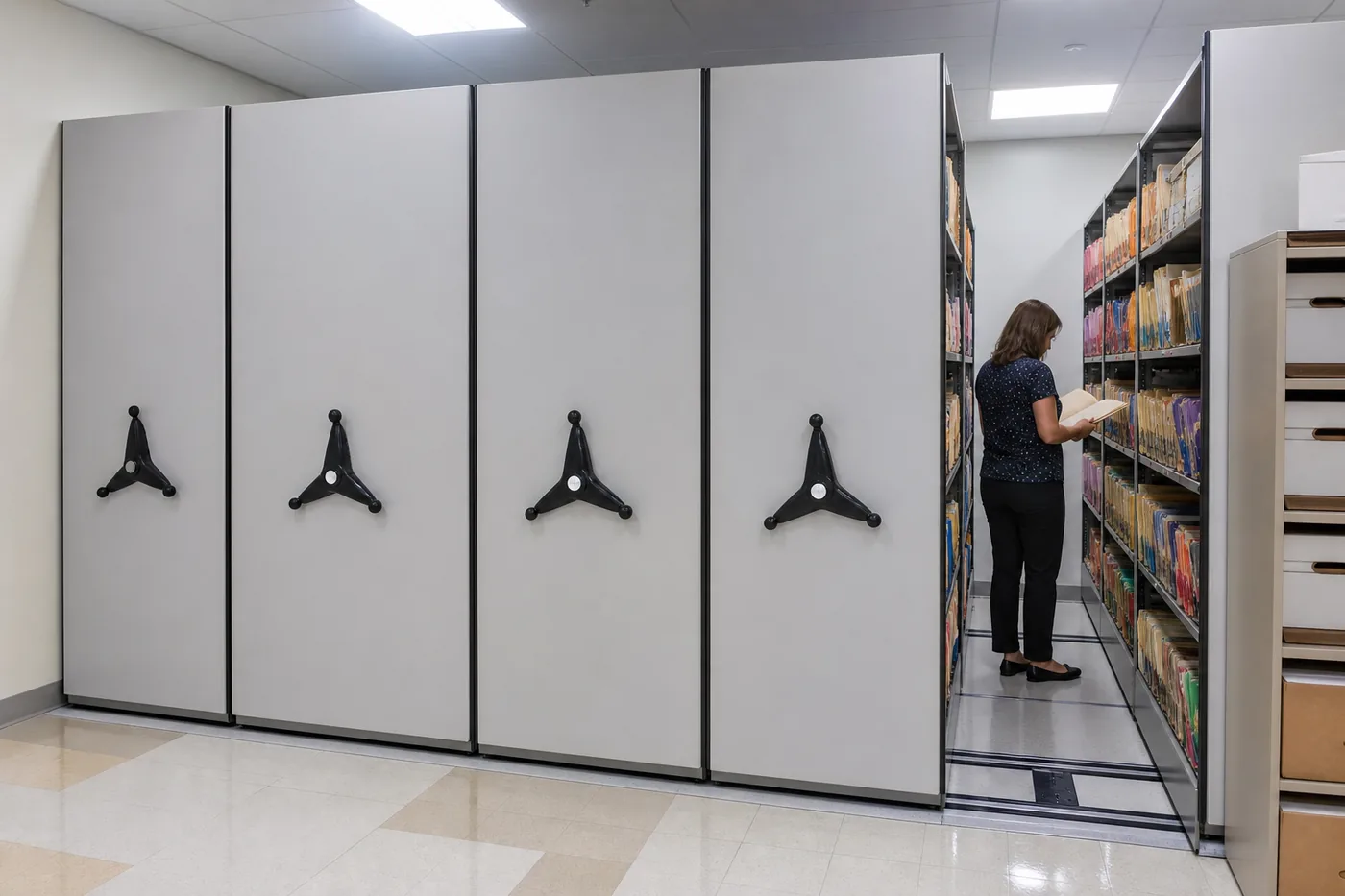
Every device above fails in the same way: it gets bypassed. Sweeps get taped over because a carton overhangs the shelf front and keeps tripping them. Locks stop being used because staff are moving fast. Indicators are ignored because nobody explained what the colours mean.
That is why the specification, the handover training and the inspection routine matter as much as the hardware. A well-guarded system operated carelessly is less safe than a simple manual system operated by people who lock the aisle they are standing in.
What changes between manual, mechanical-assist and powered systems
Drive type is the single biggest determinant of the safety package, because it changes who supplies the force that closes the aisle. The drive-type selection guide compares the three families on ergonomics, cost and throughput; this section covers only the safety consequences.
| Manual push | Mechanical assist (handwheel / chain drive) | Powered | |
|---|---|---|---|
| Who closes the aisle | A person pushing directly | A person turning a handwheel through a geared drive | A motor, on a command |
| Primary protection | Positive carriage lock, end stops, load discipline | Carriage lock with visible indication, controlled stopping without drift, end stops | Machine-guarding devices: safety sweeps, aisle entry detection, controlled stop |
| Force considerations | Force rises with load; heavy ranges become hard to start and hard to stop | Published specifications require geared drives that stop without drifting and hold under unbalanced loads | Force is constant regardless of load, which is exactly why detection is mandatory |
| Typical failure to design out | Staff shoulder-charging a stuck carriage | Aisle unlocked from the opposite end while occupied | Sweep obstructed by overhanging stock and taped over |
| Where it fits | Light loads, low use, small rooms | Most records, library and stockroom systems | Heavy loads, high use, long runs, accessibility-driven projects |
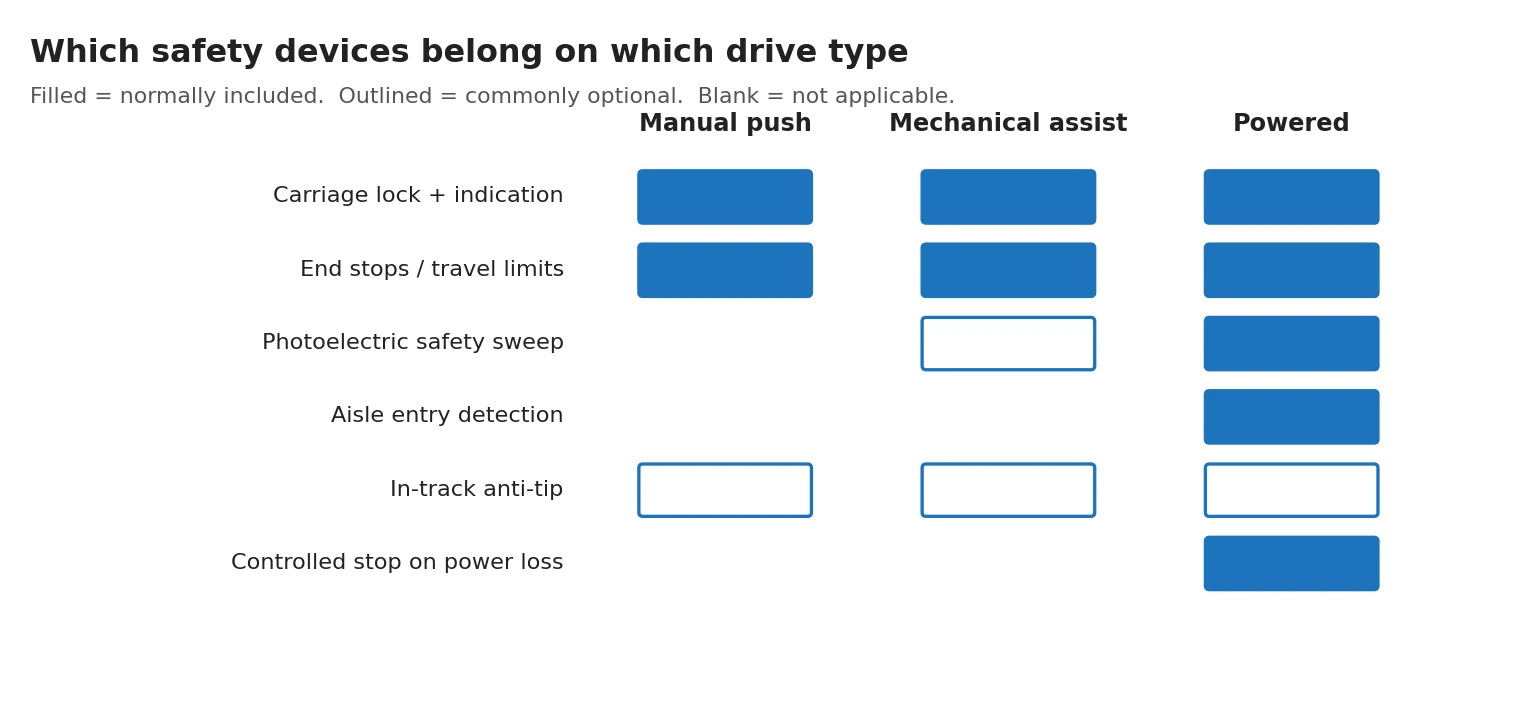
One consequence is worth stating plainly: a decision to save money by dropping detection from a powered system is not a value-engineering decision, it is a guarding decision. If the budget cannot carry the powered package, the honest alternative is a mechanical-assist system, not a powered system with less guarding. Powered options are compared on the electric mobile shelving page.
Anti-tip, bracing and stability
Sensing devices do nothing for stability. That is a structural question, and it gets answered in three places.
In-track anti-tip provisions
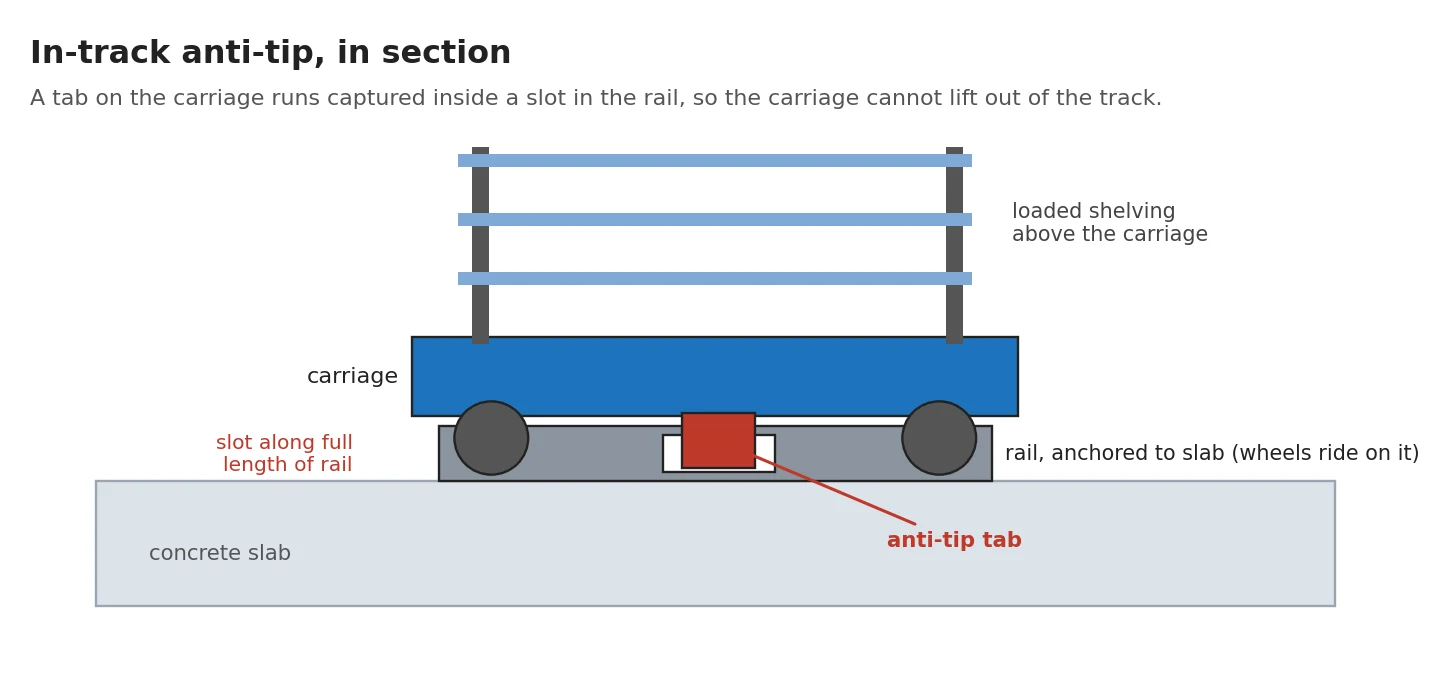
Manufacturers offer arrangements in which a tab on the carriage engages a slot running the full length of the track, so the carriage cannot lift or tip out of the rail. Published product specifications describe this as an optional feature that stabilises the system and is highly recommended in seismic zones. Because it is built into the carriage and the track, it is far cheaper to specify at order stage than to retrofit.
Bracing of the shelving itself
Federal regulations for records storage facilities require storage equipment to be braced so that shelving does not collapse, with bracing designed to the most stringent applicable code, and set a shelf loading basis for records storage. Outside federal work the same logic applies through the building code and the manufacturer’s engineering. Our guide to seismic anchoring requirements covers how rail, carriage and shelving are tied into the structure.
Load discipline
Published shelf ratings assume a uniformly distributed load. Heavy items placed high, or concentrated on one bay, change the behaviour of the whole range — how hard it is to move, how it stops, and how it responds to a shake. Two rules cover most of it: heavy low, and never exceed the posted floor and shelf limits. Slab capacity is the ultimate limit, covered in the floor load requirements guide.
Designing a safe room, not just a safe product
Most incidents in high-density rooms trace back to the layout and the housekeeping rather than to the equipment. Six room-level decisions do the heavy lifting.
Want the safety package reviewed before you order?
Send us your room dimensions, what you store, how often it is accessed and who accesses it. We will lay the system out and specify the locking, detection and anti-tip provisions that match how the room will actually be used.
The operating rules worth writing down
A mobile shelving room needs one page of house rules, posted and covered at induction. These are the rules that appear in every well-run installation we service.
- Lock the aisle you are in. Every time, including for a five-second retrieval. On dual-end carriages, know how the lock behaves from the other end.
- Look before you close. Walk the aisle visually before moving a carriage, and call out on long runs where the far end is not visible.
- One aisle at a time. Two people working two aisles in the same run is where accidents happen; sequence the work instead.
- Nothing overhangs the face. If material projects past the shelf front, it belongs on a deeper shelf, not in the aisle envelope.
- Rails stay clear. Anything on the rail gets removed, not driven over. Debris on the rail is the leading cause of rough travel and of forced pushing.
- Never defeat a device. A sweep that keeps tripping is reporting a real problem — usually overhang or misalignment. Fix the cause and log it.
- Report rough travel. A carriage that has become hard to move is a maintenance item, not a strength test.
Where movement itself should be restricted — evidence, weapons, controlled substances, student records — the same controls double as security measures. The security and access control guide covers key-locked and credentialed movement.
Keeping the safety devices real
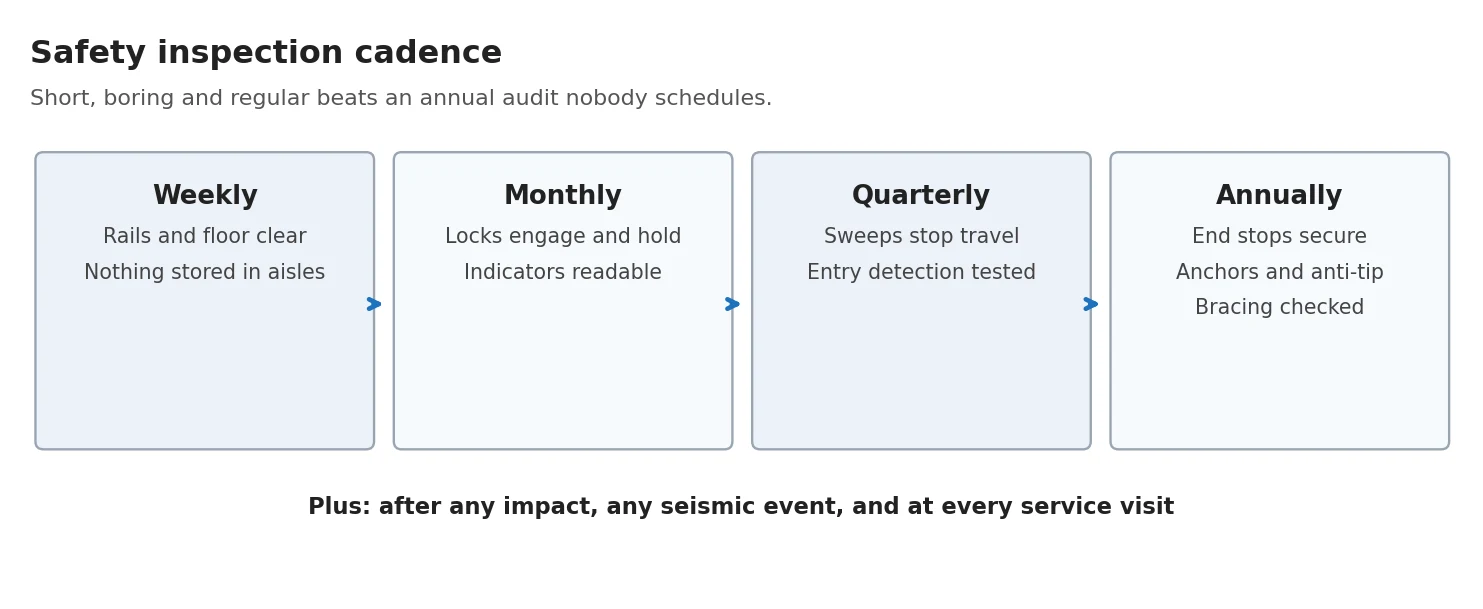
Safety devices are consumables in a way buyers rarely expect. Sweeps drift out of alignment, lock buttons wear, indicator decals fade, end stops loosen and rails collect grit. A short, boring routine keeps all of it working, and it fits inside the visits already described in the maintenance and service intervals guide.
| Check | Frequency | What a failure looks like |
|---|---|---|
| Carriage locks engage and hold, indicators readable | Monthly, by the room’s own staff | Lock feels loose, carriage creeps when locked, decal unreadable |
| Rail and floor clear of debris | Weekly | Grit on the rail, rough or noisy travel, wheel flat spots |
| Safety sweeps and entry detection stop travel on interruption | Quarterly and after any impact | Beam misaligned, lens dirty, carriage continues after interruption |
| End stops and travel limits secure | Annually or with the service visit | Loose fasteners, carriage reaching the end of rail without a positive stop |
| Anchors, bracing and anti-tip engagement | Annually and after any seismic event | Loose anchor, visible rail movement, tab not seated in the slot |
| Load and housekeeping discipline | Ongoing supervision | Overhang, heavy items stored high, stock stacked above ranges into sprinkler clearance |
Getting the safety package into the specification
The most common way a system arrives less safe than the buyer expected is not a supplier acting badly. It is a specification that named the shelving and the drive and left the safety devices as unpriced options. Write them in explicitly, using the specification and submittal checklist as the frame:
- Carriage locking type, whether indication is visual and colour-coded, and behaviour on dual-end carriages.
- Detection devices by type, quantity and mounting height — for example a photoelectric sweep per aisle versus sweeps on both faces of every movable carriage.
- Anti-tip provision, stated as a requirement rather than an option where shelving is tall, heavily loaded or in a seismic region.
- End stops, travel limits and, on powered systems, stopping behaviour on power loss and on a detection event.
- Control positions and reach compliance, plus how movement is restricted where access control is needed.
- Operator familiarisation at handover, the operation and maintenance documentation to be supplied, and what the service visit covers.
- Submittals: the manufacturer’s safety-device data sheets, the seismic and anchoring calculations where applicable, and the layout showing open aisle width and egress.
Installation is the other half. A device installed on a rail that is out of tolerance will misbehave, so the site-readiness and commissioning steps in the installation process guide are part of the safety story, and so is the commissioning test that proves each lock and sweep actually stops the carriage before the room is handed over. For systems being moved or re-used, the same devices need re-commissioning on the new floor; simply reinstalling them is not enough. Static alternatives, where compaction is not worth the operational discipline, are covered on the track shelving page.
If your system is going into a Utah building, our mobile shelving in Utah page explains how our local team reviews floors, anchoring and safety features before installation.
Get a free quote
Tell us what you are storing, the room size and your timeline. A project specialist will follow up with layout options and pricing. Prefer to talk? Call (800) 326-4403.
Frequently asked questions
What safety features should a mobile shelving system have?
Does OSHA regulate mobile shelving?
What is a safety sweep and do we need one?
How does a carriage stay locked while someone is in the aisle?
Are anti-tip devices required?
Who is responsible for safe operation after handover?
Can a mobile shelving system be made safe for public or student access?
Have your mobile shelving safety package specified properly
Tell us how your room is used and who works in it. We will specify the locking, detection and anti-tip provisions with the system, lay out safe aisles and egress, and commission every device before handover.